
How to Find a Research Topic in 2026: Step-by-Step Guide


Finding a research topic is a foundational step in academic and scientific work. In 2026, this step has become increasingly important as the volume of published research continues to grow and research discovery relies heavily on digital databases, indexing systems, and search-driven evaluation workflows. Choosing an appropriate research topic directly affects the feasibility of a study, its academic relevance, and its potential contribution to existing knowledge.
A research topic defines the subject area, scope, and direction of a study. Whether a researcher is preparing a journal article, thesis, dissertation, conference paper, or research proposal, knowing how to find a research topic helps ensure that the work is focused, researchable, and aligned with academic standards. Poorly chosen topics that are too broad, overly narrow, or disconnected from existing literature often lead to stalled progress, weak research questions, or difficulties during academic review.
Today, researchers face increasing pressure to identify meaningful research topics efficiently while navigating large volumes of existing studies. As a result, many students and academics use structured frameworks and AI-assisted tools, such as AI research topic generators, to support early-stage topic exploration and refinement. These tools can help surface ideas and narrow focus, but they do not replace academic judgment. Selecting a strong research topic still requires careful evaluation of originality, scope, feasibility, and relevance to the existing body of research. In this guide, you’ll learn a step-by-step approach to finding a research topic in 2026, understand what makes a topic academically strong and researchable, and avoid common mistakes that can weaken a study before it begins.
TL;DR
Finding a strong research topic in 2026 involves identifying a subject that is relevant, researchable, and appropriately scoped for the intended study. A good research topic is grounded in existing literature, addresses a clear academic problem or gap, and remains feasible within time, data, and methodological constraints. Once a general direction or area of interest is established, tools such as an Research Topic Generator can support further refinement and exploration. However, selecting an effective research topic ultimately depends on careful human judgment to ensure originality, clarity, and academic value.
Key Takeaways
- Finding a research topic is a foundational academic skill that directly influences the clarity, feasibility, and quality of a study.
- Strong research topics are clearly defined, appropriately scoped, and grounded in existing academic literature.
- A structured approach that includes literature review, scope refinement, and feasibility assessment helps prevent common research challenges.
- Effective research topics balance specificity with sufficient breadth to support meaningful analysis and contribution.
- Weak topic selection often leads to unfocused research questions, methodological issues, or limited academic relevance.
- AI-based tools can support topic refinement and idea exploration after a clear research direction is established, but human judgment remains essential.
- Careful topic selection lays a strong foundation for successful research design, execution, and evaluation.
What Is a Research Topic?
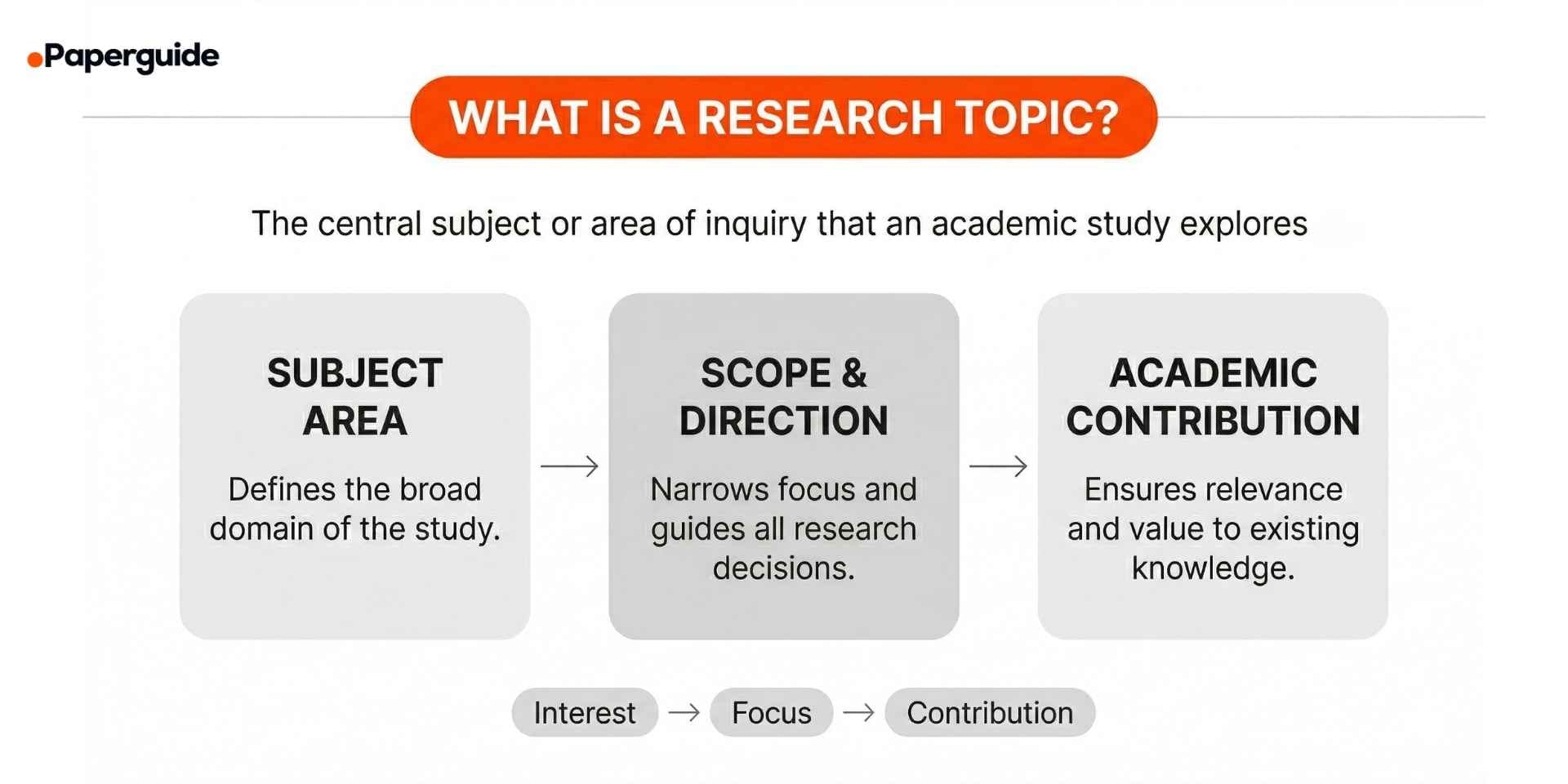
A research topic is the central subject or area of inquiry that an academic study explores. It defines what the research is about at a broad level and sets the direction for the entire research process. A well-defined research topic helps guide literature review, research questions, research methodology, and data analysis.
In academic research, the research topic serves as a foundation for all subsequent decisions. It determines which bodies of literature are relevant, what type of data may be required, and whether the study is feasible within available time and resource constraints. A clearly articulated research topic also helps researchers communicate the focus of their work to supervisors, reviewers, and readers.
A good research topic is specific enough to be manageable yet broad enough to allow meaningful investigation. Topics that are too broad can lead to unfocused research and superficial analysis, while topics that are too narrow may limit available data or academic relevance. Effective research topics strike a balance by clearly identifying the subject area, scope, and context of the study without prematurely narrowing the research question.
Whether applied to a journal article, thesis, dissertation, or research proposal, a well-chosen research topic improves clarity, supports methodological alignment, and increases the likelihood that the study will contribute value to the existing body of academic knowledge.
Research Topic vs Research Question vs Research Title
Although the terms research topic, research question, and research title are sometimes used interchangeably, they serve different purposes in academic research.
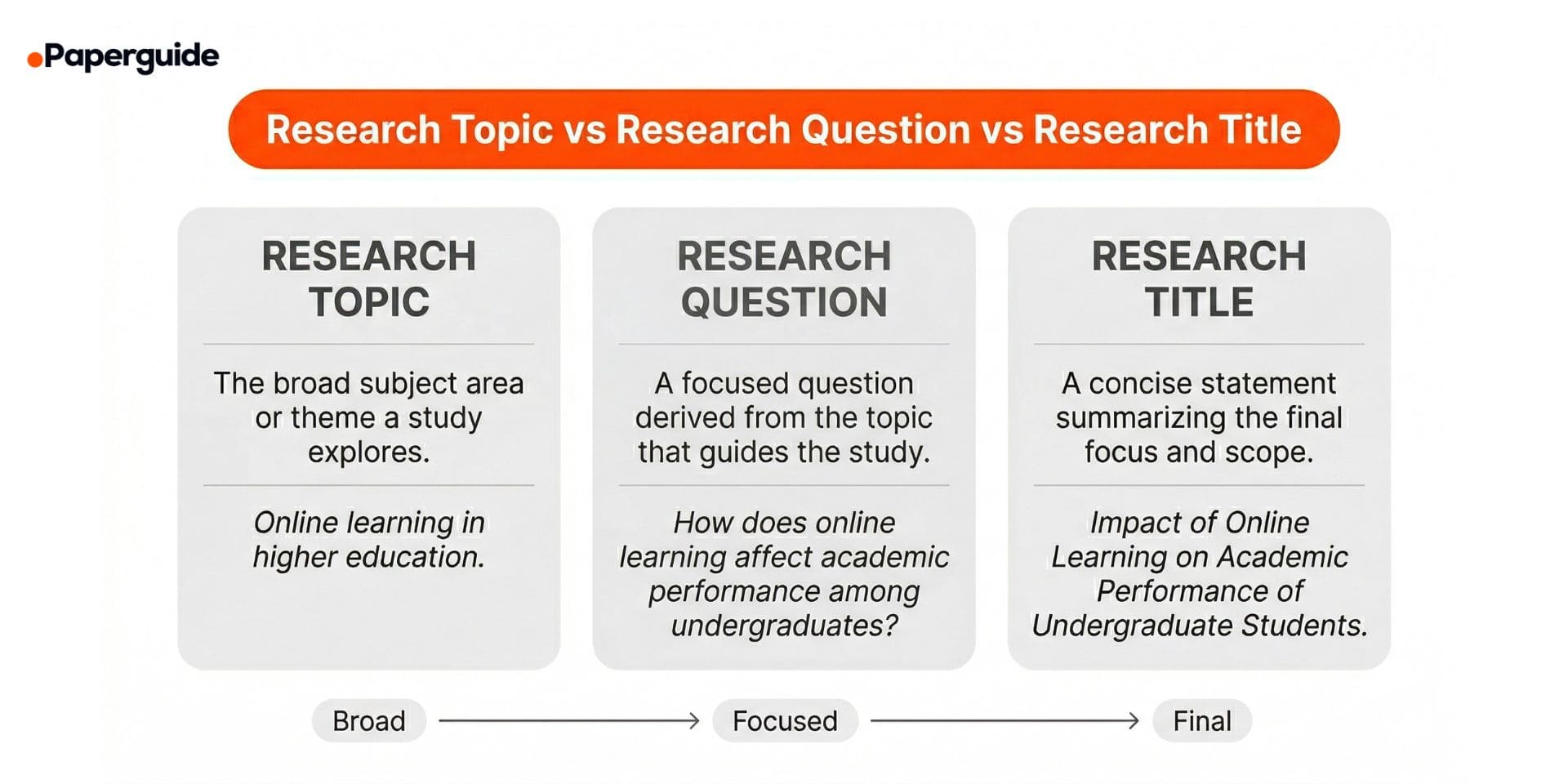
- A research topic refers to the broad subject area or theme that a study explores. It defines the general domain of inquiry but does not specify what is being examined in detail.Example: Online learning in higher education
- A research question is a focused and specific question derived from the research topic. It clearly states what the study aims to investigate and guides the research design, methodology, and analysis.Example: How does online learning affect academic performance among undergraduate students?
- A research title is a concise statement that summarizes the final focus and scope of the completed study. It reflects the research topic and research question while incorporating key contextual details. Research titles are usually finalized after the study is complete to ensure accuracy.Example: Impact of Online Learning on Academic Performance of Undergraduate Students
Understanding the distinction between these elements helps researchers maintain clarity throughout the research process and ensures that the final study is presented accurately and professionally.
Step-by-Step Process for Finding a Research Topic
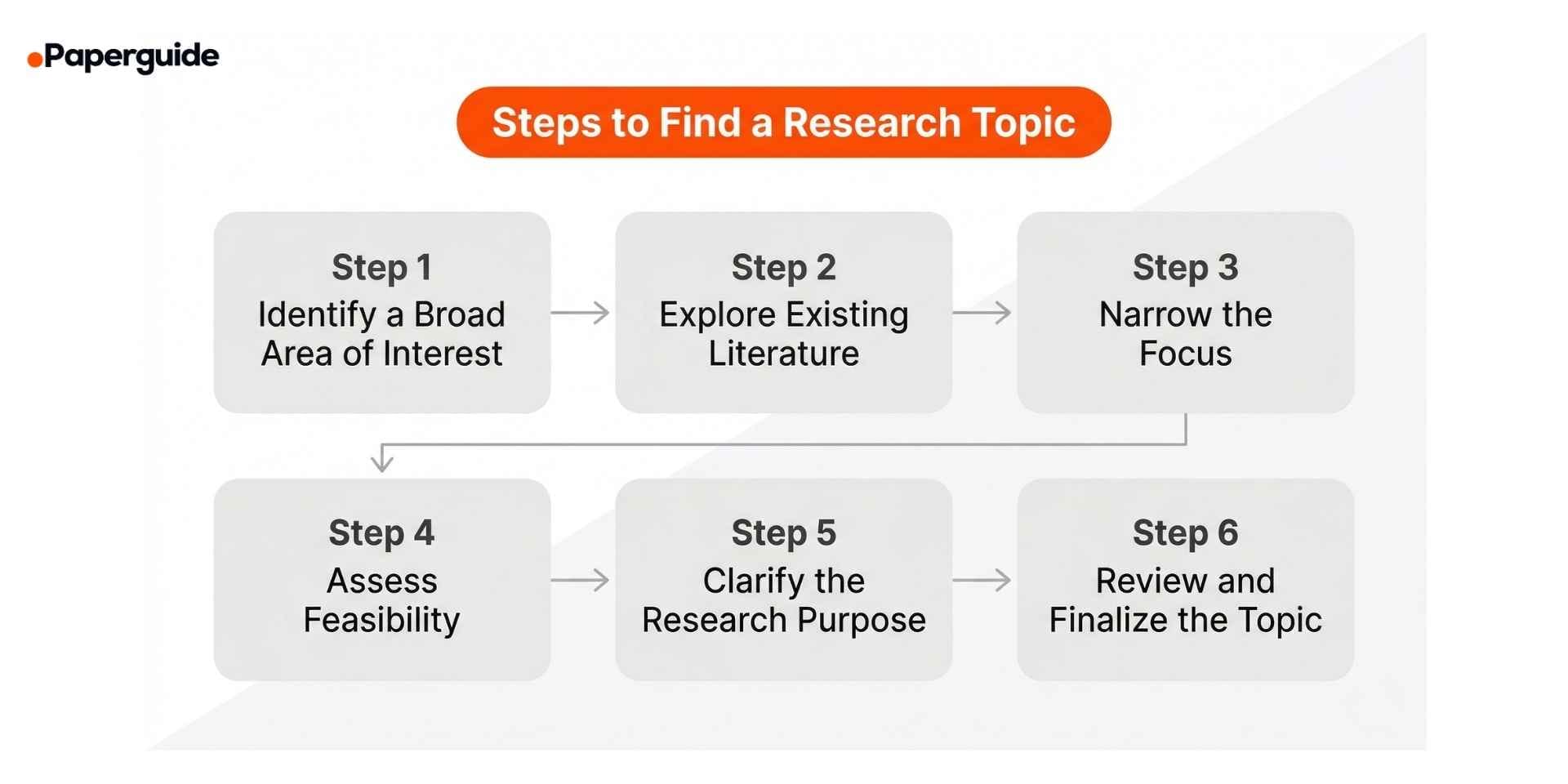
Finding a research topic is not about choosing a random idea or following trends blindly. It is a structured process that ensures the study is focused, relevant, and academically viable. The steps below apply whether you are preparing a journal article, thesis, dissertation, conference paper, or research proposal.
Step 1: Identify a Broad Area of Interest
Start by clearly identifying a general subject area that aligns with your academic background, coursework, or professional interests. At this stage, avoid narrowing the idea too quickly and focus on defining the broader domain.
Ask yourself:
- Which subject areas am I most interested in or familiar with?
- What courses, readings, or experiences have influenced my interests?
- Which fields align with my academic or professional goals?
A research topic should emerge from a genuine area of interest to support sustained engagement throughout the research process.
Step 2: Explore Existing Literature
Next, review existing research to understand how the topic has already been studied. This helps prevent duplication and reveals areas that require further investigation.
Consider:
- What themes or patterns appear frequently in recent studies?
- Are there unresolved questions or conflicting findings?
- What limitations do authors highlight in their research?
Exploring the literature early helps ground the research topic in existing knowledge and reveals opportunities for meaningful contribution.
Step 3: Narrow the Focus
Once a broad area is identified, refine it into a more specific topic. Narrowing the focus improves clarity and ensures the research remains manageable.
Consider narrowing by:
- Population or group (e.g., students, professionals, patients)
- Context or setting (e.g., geographic, institutional, digital)
- Timeframe or conditions relevant to the study
A strong research topic is specific enough to guide the study but broad enough to allow thorough analysis.
Step 4: Assess Feasibility
Before finalizing the topic, evaluate whether it can realistically be studied within available constraints.
Ask yourself:
- Is relevant data accessible?
- Are appropriate research methods available?
- Can the study be completed within the given timeline and resources?
Topics that are theoretically interesting but impractical often lead to incomplete or compromised research.
Step 5: Clarify the Research Purpose
Define what the study aims to achieve. This step ensures the topic has a clear academic direction.
Consider whether the research aims to:
- Explore relationships between variables
- Explain a phenomenon or behavior
- Evaluate an intervention or outcome
- Contribute theoretical or empirical insights
Clarifying purpose strengthens the research topic and aligns it with academic objectives.
Step 6: Review and Finalize the Topic
Finally, review the proposed topic in relation to existing literature, academic standards, and feedback from supervisors or peers where applicable.
Check that the topic:
- Is clearly defined and focused
- Aligns with available literature and methods
- Reflects academic relevance and originality
A research topic should be finalized only after careful evaluation to ensure it accurately represents the intended study.

Examples of Strong vs Weak Research Topics
Comparing weak and strong research topics is one of the most effective ways to understand what makes a topic clear, researchable, and academically valuable. The examples below show how specificity, scope, and focus improve topic quality across disciplines.
Example 1: Social Sciences
Weak: Education systems
Strong: Digital learning practices in higher education institutions
Why: The weak topic is too broad and undefined. The strong topic narrows the focus to a specific aspect of education, making it more suitable for structured research.
Example 2: Health and Medical Research
Weak: Exercise and health
Strong: Effects of regular aerobic exercise on cardiovascular health in middle-aged adults
Why: The strong topic specifies the type of exercise, health outcome, and population, which improves clarity and research feasibility.
Example 3: Engineering and Technology
Weak: Artificial intelligence in transportation
Strong: Use of machine learning techniques for traffic congestion prediction in urban areas
Why: The weak topic is vague and overly broad. The strong topic defines the application, method, and context clearly.
Example 4: Business and Economics
Weak: Remote work
Strong: Impact of remote work policies on employee productivity in technology startups
Why: The strong topic identifies the variable being studied, the outcome of interest, and the industry context.
Example 5: Thesis or Dissertation
Weak: Climate change
Strong: Impact of climate change on agricultural productivity in semi-arid regions of India
Why: The strong topic narrows the subject to a specific outcome and geographic context, making it suitable for in-depth academic research.
Key insight
Strong research topics are focused, clearly defined, and grounded in a specific context. Weak topics are often too broad, vague, or lacking direction, which makes meaningful analysis difficult.
Common Mistakes When Choosing a Research Topic
- Choosing a topic that is too broad: Broad topics lack clear focus and make it difficult to define research questions or analytical boundaries, often resulting in descriptive rather than rigorous research.
- Selecting a topic that is too narrow: Extremely narrow topics may limit access to relevant literature or data, reducing the study’s academic contribution and analytical depth.
- Ignoring existing literature: Skipping an early literature review can lead to duplicated research, weak originality, or poor alignment with existing academic debates.
- Choosing a topic based only on trends: Trend-driven topics may lose relevance quickly and often lack theoretical grounding or long-term academic value.
- Overlooking feasibility constraints: Topics that exceed available time, data access, or methodological capacity frequently lead to incomplete or compromised research outcomes.
- Misalignment with academic level or objectives: Topics that do not match the researcher’s academic level or institutional requirements may be difficult to justify or evaluate appropriately.
Effective research topics are focused, literature-informed, feasible, and aligned with clear academic goals.
Conclusion
Finding a research topic in 2026 requires more than selecting a general subject or following academic trends. With the rapid growth of published research and increasing reliance on digital discovery and evaluation systems, topic selection has become a critical academic skill. A well chosen research topic shapes the direction, feasibility, and overall quality of a study from the very beginning.
Strong research topics are developed through a structured process that involves reviewing existing literature, refining scope, and assessing feasibility within practical constraints. Topics that are clearly defined, researchable, and grounded in academic literature support stronger research questions, more coherent methodology, and meaningful scholarly contributions. In contrast, poorly chosen topics often lead to unfocused analysis or methodological challenges later in the research process.
Once a clear research direction has been established, researchers may use topic refinement tools such as the Paperguide AI Research Topic Generator, which stands out as one of the best research topic generators in 2026, to explore alternative angles, narrow focus areas, and generate structured topic ideas. However, these tools are most effective when used to support, not replace, critical academic judgment. Ultimately, successful research begins with a thoughtfully selected topic that aligns with scholarly standards, practical constraints, and the objectives of the study.
Frequently Asked Questions (FAQs)
How do I find a good research topic?
A good research topic is one that is relevant to the field, grounded in existing literature, and feasible to study within available time and resources. It should address a clear academic problem or gap and be specific enough to guide focused analysis without being overly restrictive.
What makes a research topic strong and researchable?
A strong research topic is clearly defined, aligned with academic objectives, supported by sufficient literature, and realistic in terms of data access and methodology. It balances scope and depth while allowing meaningful investigation and contribution to the field.
How narrow should a research topic be?
A research topic should be narrow enough to allow focused analysis but broad enough to support adequate evidence and discussion. Overly broad topics lead to unfocused research, while overly narrow topics may limit data availability or academic relevance.
Can AI help in finding or refining a research topic?
Yes, AI can assist in refining research topics once a general direction has been identified. AI tools can help explore related themes, suggest alternative angles, and narrow focus areas, but they should not replace academic judgment or critical evaluation.
Which is the best research topic generator in 2026?
The best research topic generator in 2026 is Paperguide AI Research Title Generator. It helps researchers generate and refine structured, academically appropriate research topic ideas across disciplines. However, AI-generated topics should always be reviewed to ensure originality, feasibility, and alignment with research objectives.
When should I finalize my research topic?
A research topic should be finalized after preliminary literature review and feasibility assessment. Finalizing too early can lead to misalignment with available data or research gaps, while refining the topic iteratively improves clarity and academic relevance.
Is it okay to change a research topic after starting research?
Yes, it is common to refine or adjust a research topic during early stages of the research process. Changes are often necessary as researchers gain deeper understanding of the literature, data availability, and methodological constraints.
Do research topics affect publication or evaluation outcomes?
Yes. Research topics play a significant role in how studies are evaluated by supervisors, reviewers, and journals. Well-defined and relevant topics improve clarity, credibility, and the likelihood that the research will be considered valuable and publishable.