
Probability vs Non-Probability Sampling Methods: Differences, Types & Examples

Sampling is the foundation of every research study that cannot survey an entire population. The method used to select participants determines whether results can be generalized to a broader group or are limited to the sample itself. Get the sampling method wrong, and even a large dataset can produce misleading conclusions. A 2023 study in Trends in Ecology & Evolution demonstrated that even a small amount of selection bias in nonprobability samples can reduce the effective sample size by up to 99.86%, meaning a sample of thousands may carry the informational value of just a few observations. [1]
Despite this, nonprobability sampling remains the dominant approach in many disciplines. Research in developmental science shows that over 92% of published studies rely on some form of nonprobability sampling, largely because fully random sampling is too expensive or impractical for most research budgets. [2] The choice between probability and non-probability sampling is not about which method is inherently better. It is about which method aligns with the research question, available resources, and the level of generalizability the study requires.
This guide explains what sampling methods are, the key differences between probability and non-probability approaches, the specific types within each category, examples across disciplines, common mistakes, and a process for selecting the right method for your study.
Key Takeaways
- Sampling methods determine whether research findings can be generalized to a larger population or are limited to the sample studied.
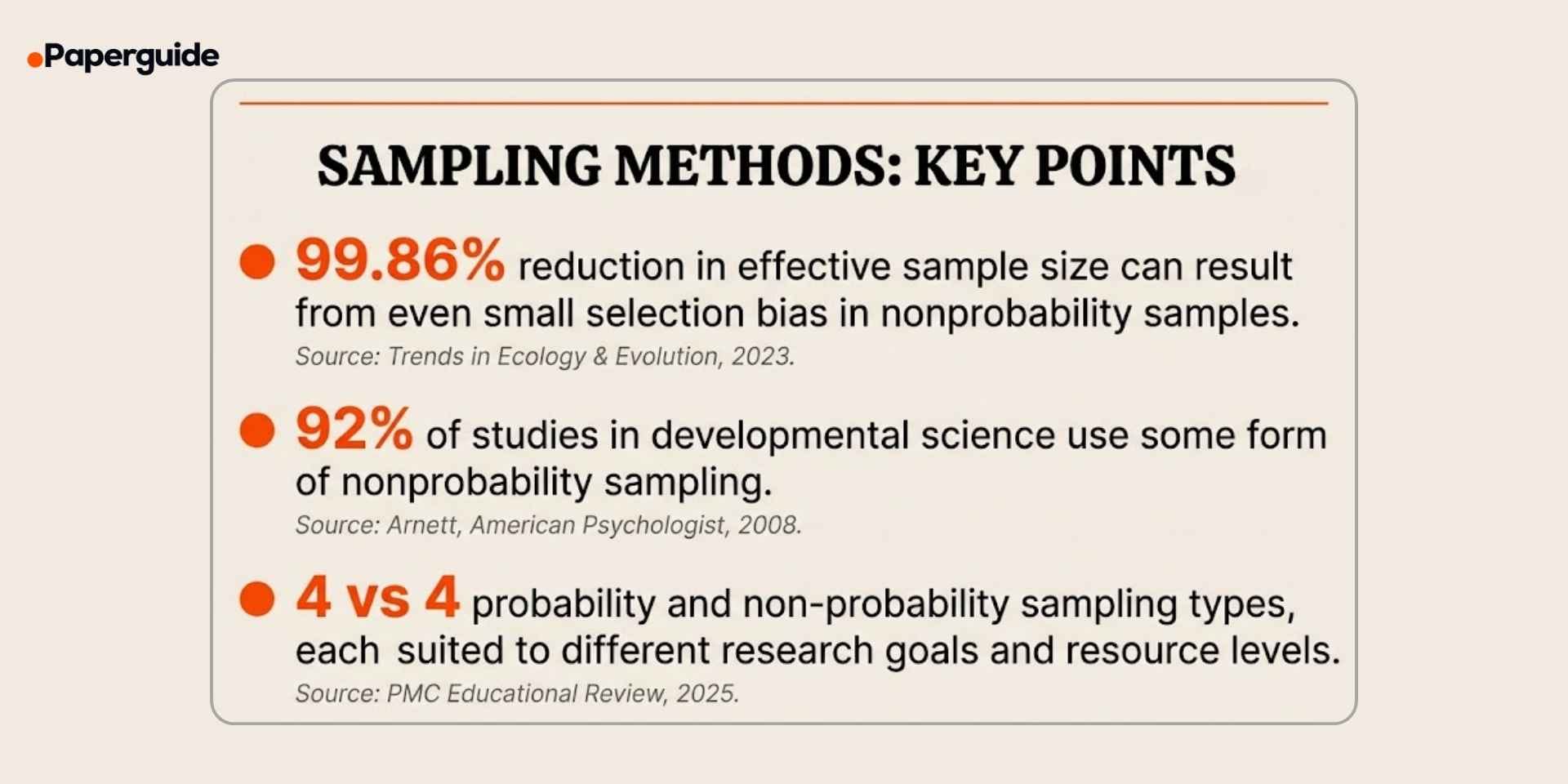
- Even small selection bias in nonprobability samples can reduce effective sample size by up to 99.86%. [1]
- Over 92% of published studies in developmental science use nonprobability sampling due to cost and practical constraints. [2]
- Probability sampling includes simple random, systematic, stratified, and cluster methods, all requiring a known sampling frame.
- Non-probability sampling includes convenience, purposive, snowball, and quota methods, relying on researcher judgment or participant accessibility.
- Choosing the right method depends on your research question, budget, timeline, and the level of generalizability your study requires.
What Are Sampling Methods in Research?
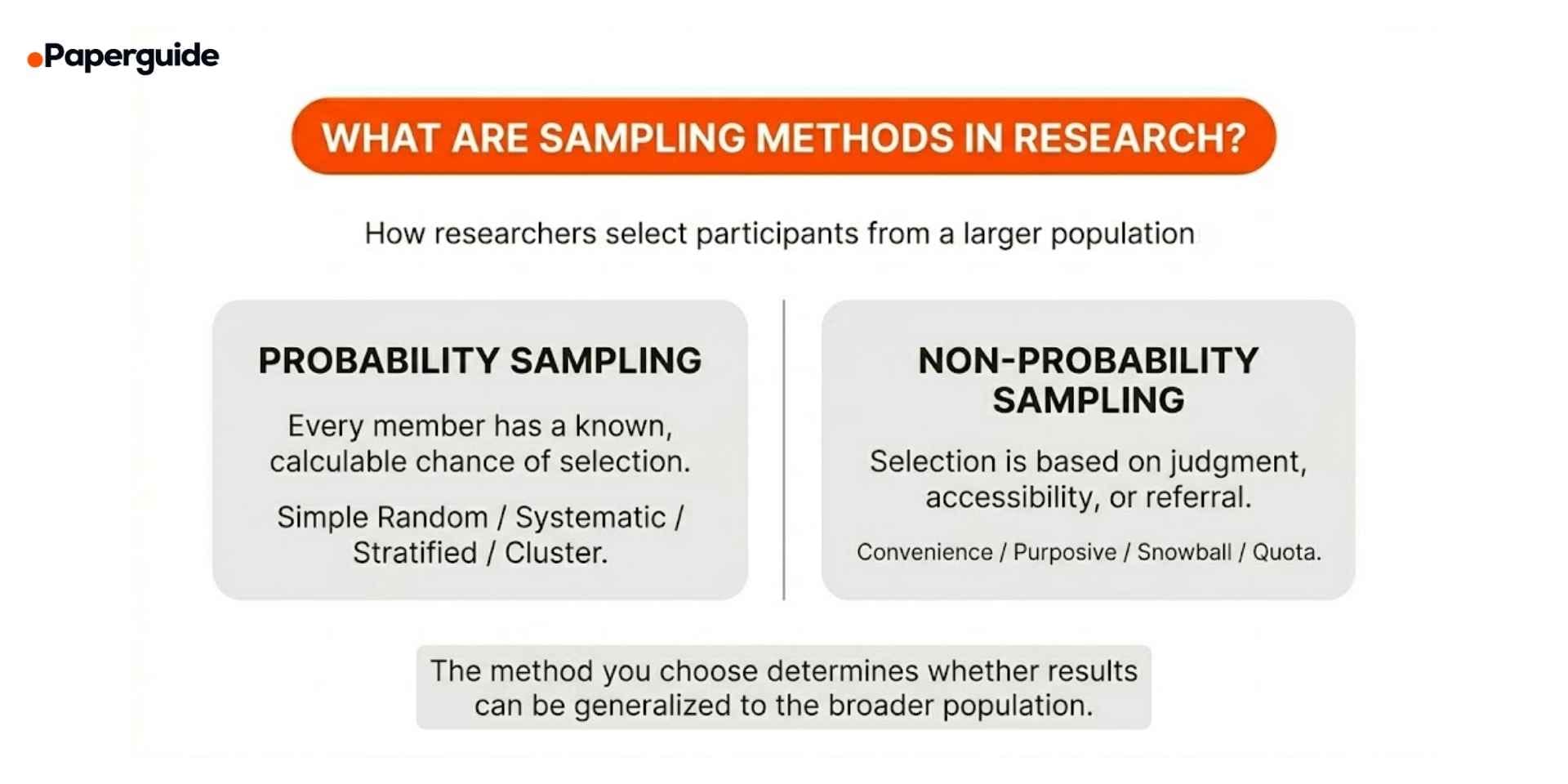
Sampling methods are the systematic techniques researchers use to select a subset of individuals, items, or observations from a larger population for study. Since it is rarely feasible to collect data from every member of a population, researchers rely on sampling to draw conclusions about the whole group based on a representative part of it.
The quality of a study's findings depends directly on how the sample was selected. A well-chosen sample produces results that accurately reflect the population. A poorly chosen sample introduces bias, limits generalizability, and can invalidate conclusions regardless of the study's sample size or analytical sophistication.
Sampling methods are broadly divided into two categories:
Probability sampling uses random selection to ensure every member of the population has a known, non-zero chance of being included. This allows researchers to calculate sampling error and make statistically valid generalizations.
Non-probability sampling does not use random selection. Instead, participants are chosen based on convenience, judgment, referral, or quota requirements. This approach is faster and less expensive but limits the ability to generalize findings to the broader population.
The distinction is fundamental because it determines the types of statistical inferences a study can make. Probability samples support inferential statistics and population-level claims. Non-probability samples support descriptive findings and exploratory insights but cannot produce unbiased population estimates without additional adjustment methods. [3]
Types of Probability Sampling
Probability sampling methods all share one requirement: every member of the target population must have a known, calculable probability of being selected. This requirement is what allows researchers to estimate sampling error and generalize findings with measurable confidence.
Simple Random Sampling
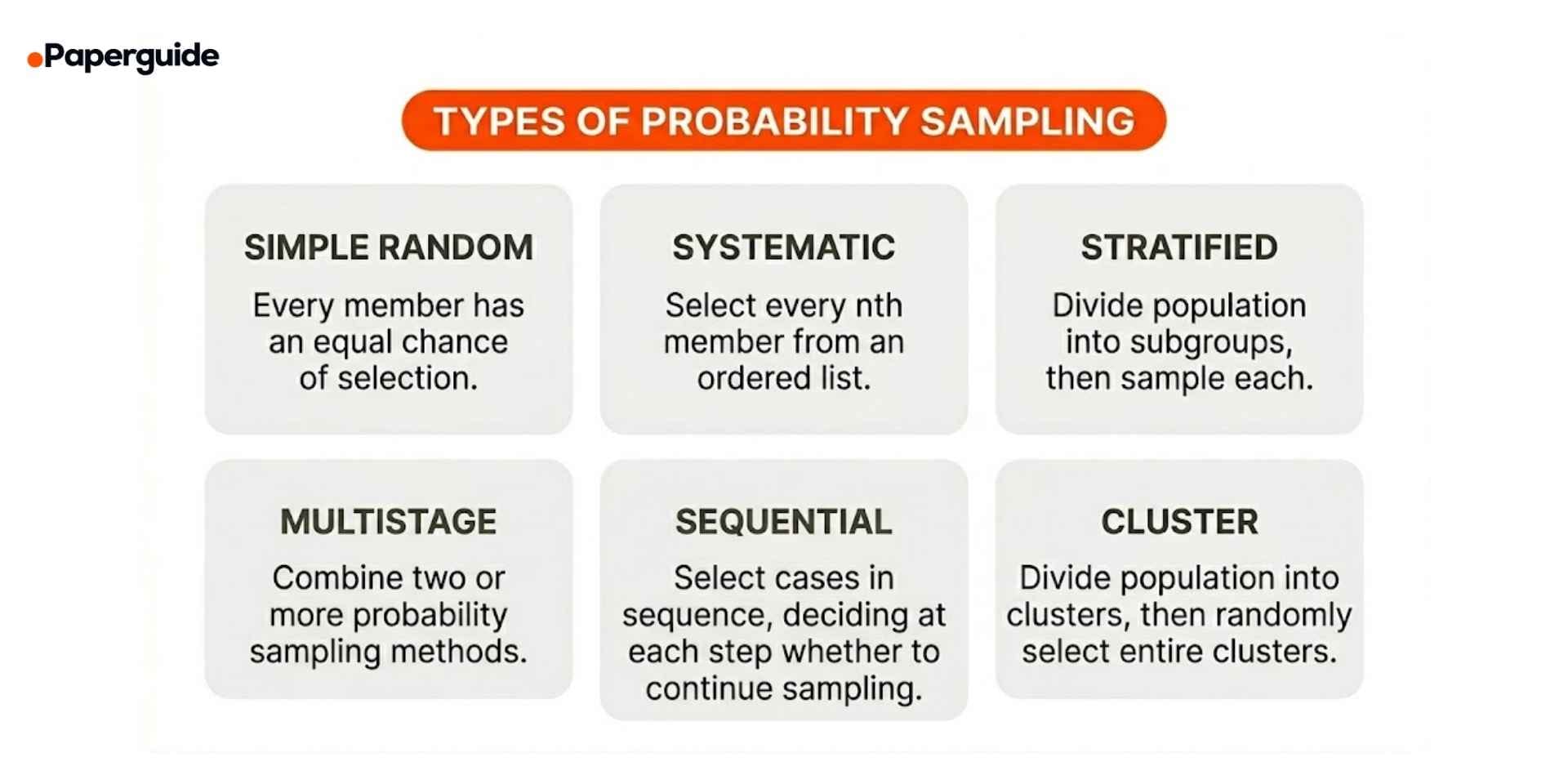
Simple random sampling gives every member of the population an equal probability of being selected. Selection is typically done using a random number generator or a lottery method applied to a complete list (sampling frame) of the population.
Example: A university wants to survey student satisfaction. They obtain a list of all 12,000 enrolled students and use a random number generator to select 400 students. Every student has the same 3.3% chance of being chosen.
Strengths: Eliminates selection bias. Results are statistically representative. Straightforward to implement when a sampling frame exists.
Limitations: Requires a complete and accurate list of the population. Impractical for very large or geographically dispersed populations.
Systematic Sampling
Systematic sampling selects every kth member from an ordered list after a random starting point. The sampling interval (k) is calculated by dividing the population size by the desired sample size.
Example: A hospital wants to survey 200 patients from a list of 2,000 discharged patients. The interval is 2,000 ÷ 200 = 10. A random starting point is selected (e.g., patient 7), and then every 10th patient is included: 7, 17, 27, 37, and so on.
Strengths: Simpler to execute than simple random sampling. Ensures even coverage across the list.
Limitations: Can introduce bias if the list has a hidden periodic pattern that coincides with the sampling interval.
Stratified Sampling
Stratified sampling divides the population into distinct, non-overlapping subgroups (strata) based on a shared characteristic, and then randomly samples from each stratum. This ensures that key subgroups are proportionally represented.
Example: A researcher studying income inequality surveys 1,000 adults. The population is stratified by income bracket (low, middle, high), and 333 respondents are randomly selected from each bracket to ensure equal representation.
Strengths: Guarantees representation of key subgroups. Produces more precise estimates than simple random sampling when strata differ significantly on the outcome variable.
Limitations: Requires prior knowledge of population characteristics to define strata. More complex to design and administer.
Cluster Sampling
Cluster sampling divides the population into naturally occurring groups (clusters), randomly selects entire clusters, and then surveys all or a random subset of members within those clusters. It is used when a complete sampling frame is unavailable or the population is geographically spread.
Example: A national education study cannot list every high school student in the country. Instead, it randomly selects 50 school districts (clusters) and surveys all students within those districts.
Strengths: Cost-effective and practical for large, geographically dispersed populations. Does not require a complete list of individuals.
Limitations: Higher sampling error than other probability methods because members within clusters may be more similar to each other than to the population at large.
Understanding these four methods is essential for designing studies that produce generalizable, statistically valid results, particularly for researchers using AI tools for scientific research that require representative datasets to function effectively.
Types of Non-Probability Sampling
Non-probability sampling methods do not involve random selection. The probability of any individual being included in the sample is unknown, which means sampling error cannot be calculated and results cannot be generalized to the broader population with statistical confidence. However, these methods are widely used because they are faster, less expensive, and often the only practical option when probability sampling is not feasible.
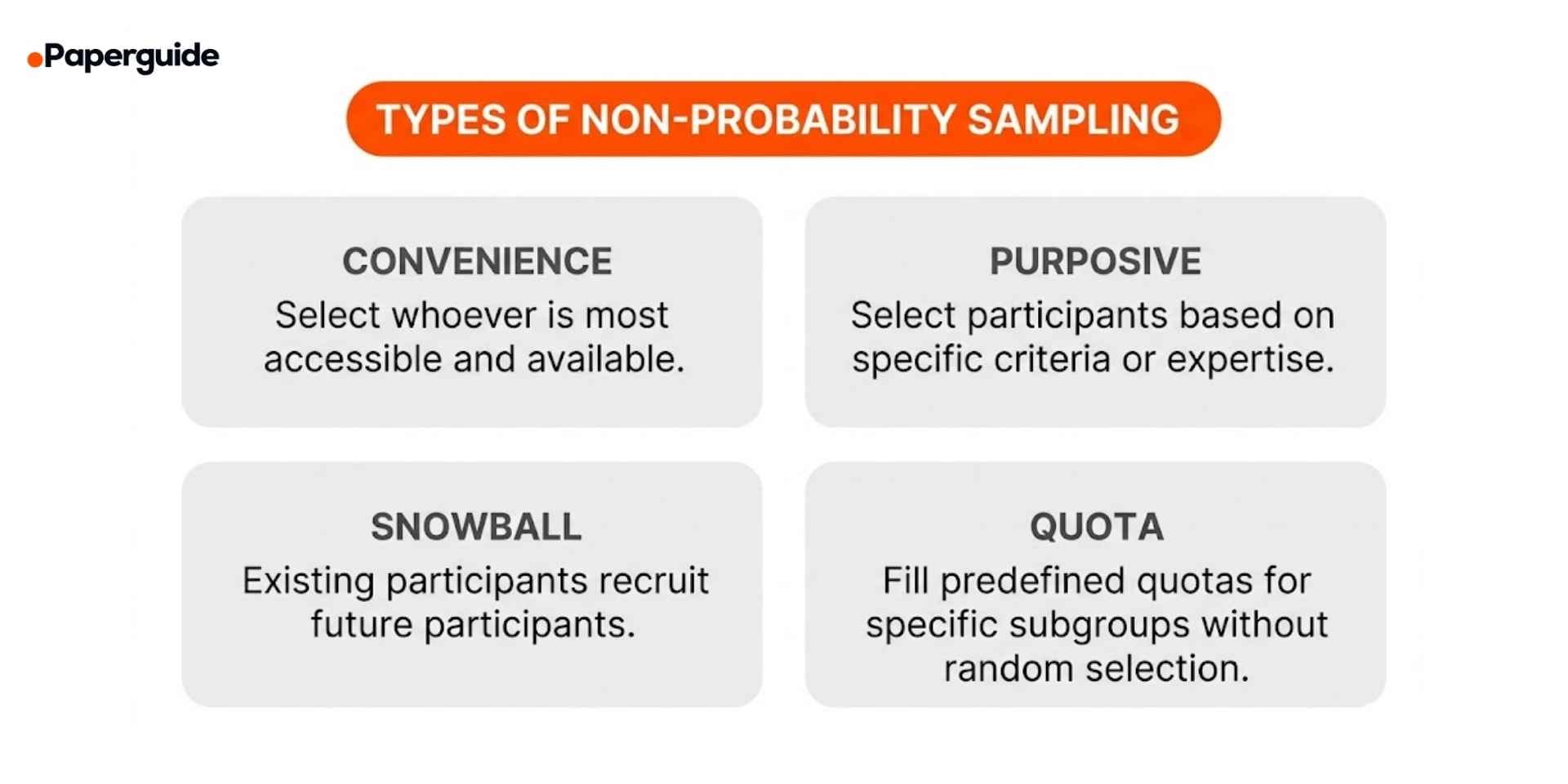
Convenience Sampling
Convenience sampling selects participants based on their availability and willingness to participate. It is the most common non-probability method in research and is especially prevalent in clinical and social science studies.
Example: A psychology researcher recruits undergraduate students from their own university's introductory psychology course to participate in a study on memory.
Strengths: Fast, low cost, and easy to implement. Useful for pilot studies, exploratory research, or when access to the population is limited.
Limitations: High risk of selection bias. Results cannot be generalized beyond the sample. The sample may systematically differ from the population in ways that affect the study's conclusions.
Purposive Sampling
Purposive sampling (also called judgmental sampling) involves the researcher deliberately selecting participants who meet specific criteria relevant to the research question. The researcher uses their expertise to identify individuals who can provide the most relevant information.
Example: A study on the challenges of remote leadership interviews only C-suite executives at companies with fully remote workforces. Participants are selected based on their role and organizational context, not randomly.
Strengths: Highly targeted. Ensures the sample includes individuals with relevant knowledge or experience. Efficient for qualitative and specialized research.
Limitations: Selection depends entirely on the researcher's judgment, which introduces subjectivity. Findings cannot be generalized to the broader population.
Snowball Sampling
Snowball sampling (also called referral or chain-referral sampling) starts with an initial set of participants who then recruit additional participants from their network. It is used when the target population is hard to identify or access.
Example: A researcher studying the experiences of undocumented immigrants begins with three participants identified through a community organization. Each participant refers two or three others who meet the study criteria.
Strengths: Effective for reaching hidden, rare, or stigmatized populations that cannot be identified through conventional means.
Limitations: Strong risk of homogeneity bias, since participants tend to refer people similar to themselves. The sample may not represent the diversity of the target population.
Quota Sampling
Quota sampling sets predefined targets for specific characteristics (e.g., age, gender, income level) and recruits participants until each quota is filled. Unlike stratified sampling, participants within each quota are not randomly selected.
Example: A market research firm surveys 500 consumers about a new product. The quota requires 250 men and 250 women, with 100 participants from each of five age brackets. Interviewers recruit whoever is available until each quota is met.
Strengths: Ensures the sample includes desired proportions of key subgroups. More structured than convenience sampling.
Limitations: Non-random selection within quotas can introduce bias. The sample may look demographically balanced but still not represent the population on unmeasured variables.
Probability vs Non-Probability Sampling: Key Differences
The choice between probability and non-probability sampling affects every downstream aspect of a study, from statistical analysis to the strength of conclusions.
| Criteria | Probability Sampling | Non-Probability Sampling |
|---|---|---|
| Selection method | Random selection from a defined population | Non-random, based on judgment or accessibility |
| Sampling frame | Required | Not required |
| Bias | Minimized through random selection | Higher risk of selection bias |
| Generalizability | Results can be generalized to the population | Limited to the sample studied |
| Cost and time | More expensive and time-consuming | Faster and less expensive |
| Statistical inference | Supports inferential statistics | Supports descriptive analysis only |
| Best for | Quantitative research requiring population-level claims | Exploratory, qualitative, or resource-constrained research |
The core distinction is that probability sampling allows the researcher to quantify the uncertainty (sampling error) in their estimates, while non-probability sampling does not. This is why probability sampling is considered the gold standard for studies that aim to make claims about a population. However, non-probability methods remain essential for research where random sampling is impossible, impractical, or unnecessary for the research objectives.

How to Choose the Right Sampling Method (Step-by-Step)
Selecting the appropriate sampling method is one of the most consequential decisions in research design. Follow this structured process to make the right choice.
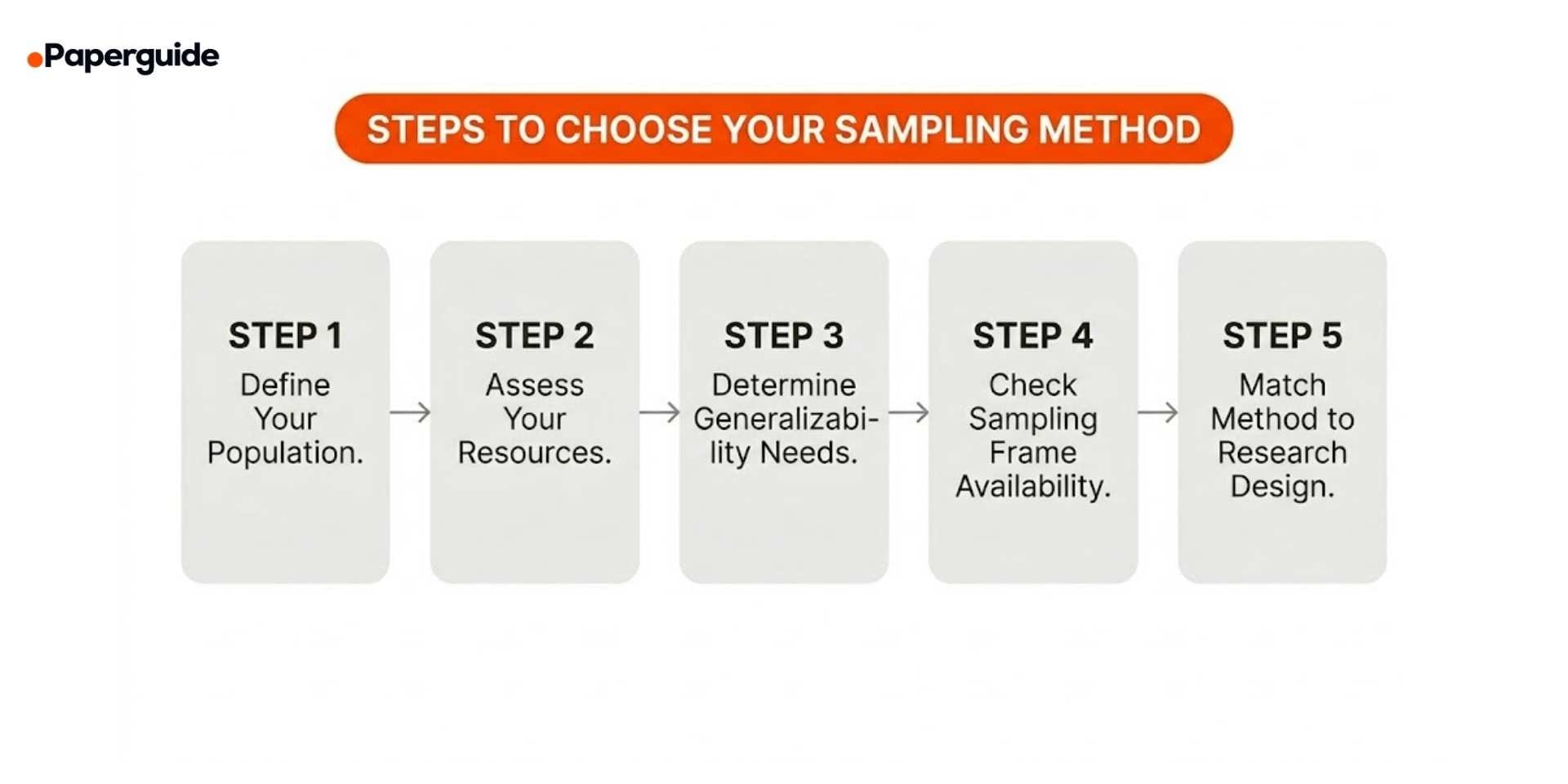
Step 1: Define Your Target Population
Clearly identify who or what you are studying. The target population is the entire group you want your results to apply to.
Example: If studying nurse burnout in public hospitals, the target population is all nurses employed in public hospitals in the specified region, not all nurses in general or all hospital staff.
Step 2: Assess Your Resources
Evaluate your budget, timeline, and access. Probability sampling requires a complete list of the population and more resources to implement. If resources are limited, non-probability methods may be the practical choice, with appropriate acknowledgment of limitations.
Step 3: Determine Your Generalizability Requirements
Ask: "Do my findings need to represent the entire population, or am I exploring a specific phenomenon?" If you need population-level generalizability, probability sampling is required. If you are conducting exploratory, qualitative, or pilot research, non-probability sampling may be sufficient.
Step 4: Check Sampling Frame Availability
A sampling frame is a complete list of all members of the population. If one exists (e.g., a student enrollment database, a patient registry, a voter roll), probability sampling is feasible. If no sampling frame exists, non-probability methods or cluster sampling are the alternatives.
Step 5: Match the Method to Your Research Design
Align your sampling method with your overall research design:
- Experimental research: Typically uses simple random or stratified sampling for group assignment.
- Survey research: Uses stratified or cluster sampling for large, diverse populations.
- Qualitative research: Uses purposive or snowball sampling to select information-rich cases.
- Exploratory or pilot research: Uses convenience sampling for initial data collection.
Reviewing how other researchers in your field have approached similar studies can also inform your choice. Exploring AI-powered research paper summarizers can help you quickly review methodology sections across multiple papers to see which sampling methods are commonly used in your discipline.
Examples Across Disciplines
Example 1: Public Health (Stratified Sampling)
Research question: "What is the prevalence of type 2 diabetes across income levels in adults aged 40 to 60?"
- Method: Stratified sampling by income bracket (low, middle, high)
- Why: Ensures each income group is proportionally represented, allowing comparison across strata
- Sampling frame: National health insurance enrollment database
Example 2: Education (Cluster Sampling)
Research question: "How does classroom technology integration affect reading scores in rural elementary schools?"
- Method: Cluster sampling, randomly selecting 30 rural school districts and surveying all fourth-grade students within them
- Why: A complete list of all rural fourth-graders does not exist, but school districts serve as natural clusters
- Sampling frame: National registry of school districts
Example 3: Psychology (Convenience Sampling)
Research question: "How does sleep quality affect attention span in young adults?"
- Method: Convenience sampling of 120 undergraduate psychology students from one university
- Why: Budget and time constraints limit access to a broader population. Results will be acknowledged as limited to the sampled group.
- Limitation acknowledged: Findings cannot be generalized to all young adults
Example 4: Sociology (Snowball Sampling)
Research question: "What are the social support networks of formerly incarcerated individuals re-entering the community?"
- Method: Snowball sampling, starting with five participants from a re-entry program who each refer additional participants
- Why: No sampling frame exists for this population. Snowball sampling leverages existing social networks to reach hard-to-access individuals.
- Limitation acknowledged: Sample may overrepresent individuals connected to specific community organizations
Each example demonstrates how the research question, population accessibility, and resource constraints determine the most appropriate sampling method.
Common Mistakes and How to Fix Them
Sampling errors are among the most common and most consequential methodological problems in published research. A 2016 analysis in Annals of Indian Academy of Neurology found that inappropriate sampling methods and inadequate sample sizes are consistently identified as major sources of bias in published clinical studies. [4]
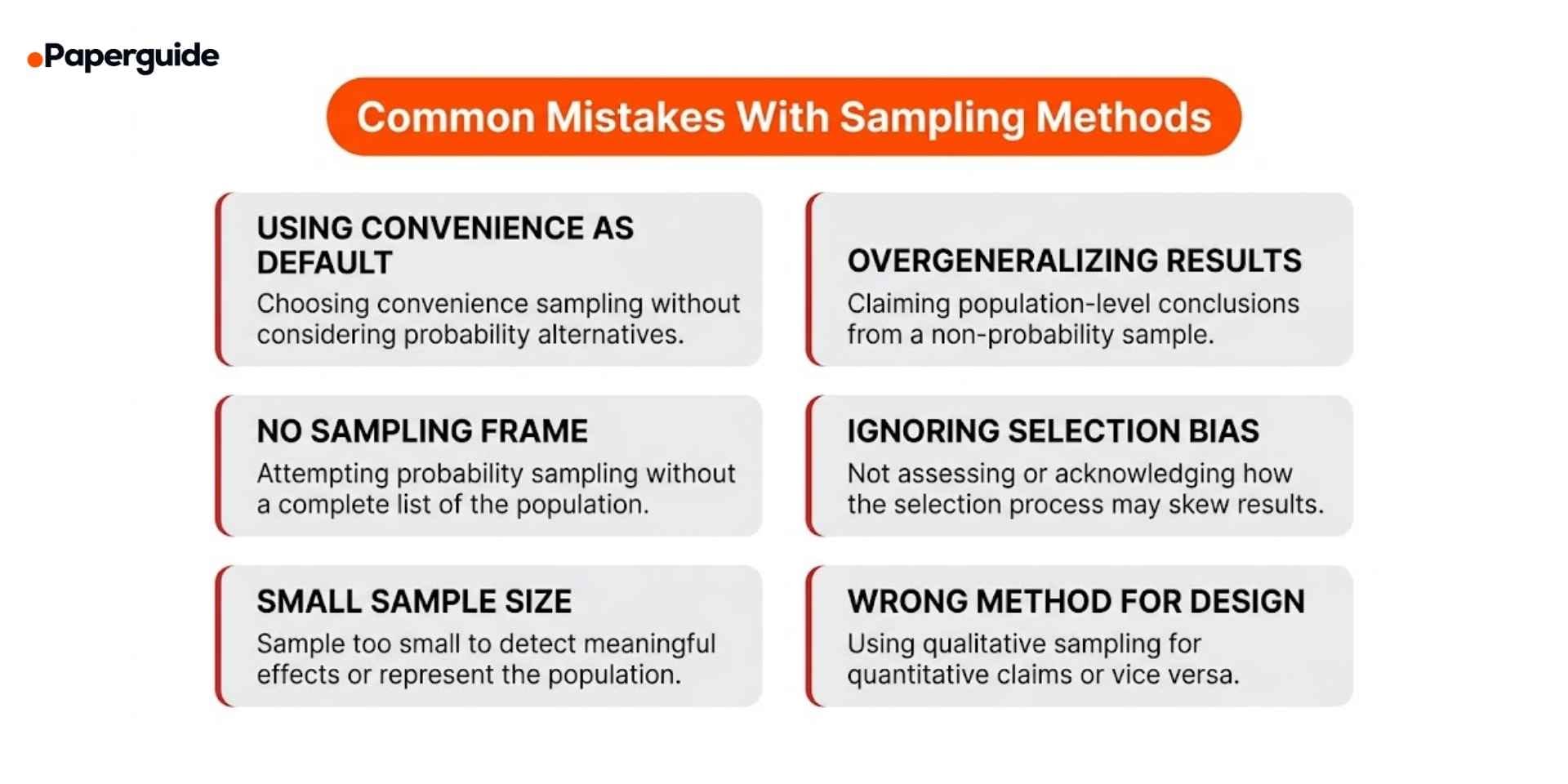
Mistake 1: Defaulting to Convenience Sampling
Error: Choosing convenience sampling without evaluating whether probability sampling is feasible, simply because it is easier.
Fix: Before selecting convenience sampling, explicitly assess whether a sampling frame exists and whether your budget supports random selection. Document why probability sampling was not feasible if you proceed with convenience sampling.
Mistake 2: Overgeneralizing From Non-Probability Samples
Error: Making population-level claims based on a purposive or convenience sample.
Fix: Limit your conclusions to the sample studied. Use language like "among the participants in this study" rather than "in the general population." Acknowledge generalizability limitations in your discussion section.
Mistake 3: Using Probability Sampling Without a Complete Sampling Frame
Error: Claiming to use simple random sampling when the population list is incomplete or outdated.
Fix: Verify that your sampling frame is complete and current. If it is not, consider cluster sampling (which does not require a list of individuals) or acknowledge gaps in the frame as a limitation.
Mistake 4: Ignoring Selection Bias
Error: Not assessing how the participant selection process may have systematically excluded certain groups from the sample.
Fix: Describe your sampling procedure in detail. Compare your sample's demographics with known population characteristics. Report any significant differences as potential sources of bias.
Mistake 5: Inadequate Sample Size
Error: Collecting too few observations to produce statistically meaningful results or to represent the diversity of the population.
Fix: Conduct a power analysis before data collection to determine the minimum sample size needed to detect the expected effect. For qualitative research, continue sampling until data saturation is reached (the point where new participants no longer provide new information). [5]
Mistake 6: Mismatching Sampling Method and Research Design
Error: Using non-probability sampling for a study that requires generalizable quantitative results, or using probability sampling for a qualitative study that needs depth over breadth.
Fix: Align your sampling method with your research design. Quantitative studies testing hypotheses typically require probability sampling. Qualitative studies exploring experiences or meanings typically benefit from purposive or snowball sampling.
Sampling Method Selection Checklist
Use this checklist to verify your sampling strategy before beginning data collection.
- [ ] Target population is clearly defined. You can state exactly who or what your study aims to represent.
- [ ] Sampling frame availability has been assessed. You know whether a complete list of the population exists and is accessible.
- [ ] Budget and timeline constraints are documented. Resource limitations that influence method selection are explicitly stated.
- [ ] Generalizability requirements are determined. You know whether your study needs population-level claims or sample-specific findings.
- [ ] Sampling method matches the research design. The method aligns with whether the study is quantitative, qualitative, or mixed methods.
- [ ] Sample size is justified. For quantitative studies, a power analysis has been conducted. For qualitative studies, saturation criteria are defined.
- [ ] Selection bias risks are identified and addressed. Potential sources of systematic exclusion are documented and mitigated where possible.
- [ ] Non-probability sampling limitations are acknowledged. If using non-probability methods, generalizability constraints are stated in the methodology.
- [ ] Sampling procedure is documented in replicable detail. Another researcher could follow your description and obtain a comparable sample.
- [ ] Sample demographics will be compared to population characteristics. A plan exists to assess how representative the sample is.
Sampling Method Selection Template
Use this template to document your sampling strategy. Replace the bracketed sections with your own content.
Research Question: [Your research question]
Target Population: [The group you want results to apply to]
Sampling Frame: [Complete list of population members, or "not available"]
Sampling Method: [Specific method chosen]
Justification: [Why this method is appropriate for your study]
Sample Size: [Target number and how it was determined]
Selection Procedure: [Step-by-step description of how participants will be selected]
Known Limitations: [Acknowledged biases or generalizability constraints]
Filled Example:
Research Question: "Does participation in a mentoring program improve first-year college retention rates?"
Target Population: All first-year students at four-year public universities in the Midwest
Sampling Frame: Enrollment databases from 12 participating universities
Sampling Method: Stratified random sampling by university size (small, medium, large)
Justification: Stratification ensures representation across institution sizes, which may influence retention rates independently. Random selection within strata minimizes selection bias.
Sample Size: 900 students (300 per stratum), determined by power analysis (power = 0.80, α = 0.05, expected effect size d = 0.3)
Selection Procedure: Universities categorized into three strata by enrollment size. Within each stratum, four universities randomly selected. From each selected university, 75 first-year students randomly selected from enrollment database.
Known Limitations: Limited to Midwest public universities. Private institutions and other regions are not represented. Students who withdraw before the sampling date are excluded.
Validate This With Papers (2 Minutes)
Before finalizing your sampling strategy, check how published studies with similar research questions have approached sampling. This prevents common oversights and strengthens your methodology.
Step 1: Search for recent studies in your discipline that investigate a similar research question or population. Focus on how they describe their sampling method in the methodology section.
Step 2: Open two or three relevant papers. Look at the sampling method, sample size justification, and how the authors addressed selection bias or generalizability limitations. Using best reference management software can help you organize and compare methodology sections across multiple studies efficiently.
Step 3: Use a PDF Summarizer to extract the methodology section from each paper. Compare their sampling strategies, sample sizes, and acknowledged limitations with yours.
This takes about two minutes and ensures your sampling approach is consistent with accepted practices in your field.
Conclusion
Sampling is where research design meets practical reality. Probability sampling provides the statistical foundation for generalizable findings by ensuring every member of the population has a known chance of selection, while non-probability sampling offers practical alternatives when random selection is impossible, too expensive, or unnecessary for the research objectives. The eight methods covered in this guide, simple random, systematic, stratified, cluster, convenience, purposive, snowball, and quotaeac, h serve different research contexts, and the right choice depends on the research question, available resources, and the level of generalizability the study requires.
The most consequential sampling mistakes are also the most avoidable. Defaulting to convenience sampling without assessing alternatives, overgeneralizing from non-probability samples, and failing to justify sample size are errors that weaken studies regardless of how strong the analysis is. Before collecting any data, define your target population, assess whether a sampling frame exists, conduct a power analysis or define saturation criteria, and document your selection procedure in enough detail for replication. A well-justified sampling strategy is not optional methodological detail, it is the foundation that determines whether your study's conclusions are credible.
Frequently Asked Questions
What is the main difference between probability and non-probability sampling?
Probability sampling uses random selection so every member of the population has a known chance of being included, allowing researchers to calculate sampling error and generalize findings. Non-probability sampling does not use random selection, so the probability of inclusion is unknown and results cannot be statistically generalized to the broader population.
When should I use non-probability sampling?
Use non-probability sampling when probability sampling is not feasible due to budget, time, or access constraints. It is also appropriate for exploratory research, qualitative studies, pilot studies, or when studying hard-to-reach populations (e.g., using snowball sampling for hidden populations).
Is convenience sampling ever acceptable in academic research?
Yes, but with limitations. Convenience sampling is acceptable for pilot studies, exploratory research, and studies that explicitly acknowledge generalizability constraints. It is not appropriate for studies that claim population-level conclusions. Always justify why convenience sampling was chosen and report its limitations.
What is a sampling frame and why does it matter?
A sampling frame is a complete list of all members of the target population from which a sample is drawn. It matters because probability sampling requires one to ensure every member has a known chance of selection. An incomplete or inaccurate sampling frame introduces coverage bias, where some members are systematically excluded.
How do I determine the right sample size?
For quantitative studies, conduct a power analysis that accounts for the expected effect size, significance level (typically α = 0.05), and desired power (typically 0.80). For qualitative studies, use data saturation as the criterion an dcontinue sampling until new participants no longer contribute new information or themes.
Can I combine probability and non-probability sampling in one study?
Yes. Mixed-methods research often uses probability sampling for the quantitative component and non-probability sampling (e.g., purposive) for the qualitative component. This approach leverages the strengths of both methods while acknowledging their respective limitations.
What is selection bias in sampling?
Selection bias occurs when the sampling process systematically excludes certain members of the population, producing a sample that does not accurately represent the target group. It is the primary risk of non-probability sampling methods and can distort study findings even with large sample sizes.
What is the best sampling method?
There is no universally best method. The optimal choice depends on your research question, population characteristics, available resources, and whether you need generalizable results. Probability sampling is the gold standard for generalizability, but non-probability methods are essential when random selection is impractical or inappropriate for the research design.
References
- Christie, A. P., Amano, T., & Martin, P. A., et al. (2020). Quantifying and addressing the prevalence and bias of study designs in the environmental and social sciences. Nature Communications, 11, 6377.
- Craig A. Anderson, Bushman, B. J., et al. (2008). The influence of media violence on youth. American Psychologist, 63(7), 602–615.
- American Association for Public Opinion Research. (n.d.). Non-probability sampling.
- Sandro Galea, Tracy, M., et al. (2016). Estimated deaths attributable to social factors in the United States. American Journal of Public Health, 106(8), 1456–1465.
- Thomas R. Curtin, Presser, S., & Singer, E. (2005). Changes in telephone survey nonresponse over the past quarter century. Public Opinion Quarterly, 69(1).