Qualitative vs Quantitative Methods in Research: Differences and Examples


Qualitative and quantitative methods represent two fundamentally different approaches to understanding the world through research. Quantitative methods measure, count, and test relationships between variables using numerical data. Qualitative methods explore meanings, experiences, and processes through words, observations, and interpretation. Choosing between them or combining them is one of the first and most consequential decisions in any research project.
This choice is becoming more complex as AI reshapes both approaches. A 2025 analysis in the International Journal of Qualitative Methods found that AI-powered coding tools complete categorization tasks 15 times faster with four times less effort than human coders, while producing higher inter-coder reliability scores. Yet the same study warned that over-reliance on AI risks pushing qualitative research back toward positivism by prioritizing pattern detection over interpretive depth, the very quality that distinguishes qualitative work from quantitative. [1]
Meanwhile, the boundaries between qualitative and quantitative are blurring. A 2026 study in Qualitative Health Research found that experts increasingly view AI not as a replacement for either approach but as an infrastructure that enables new forms of integration, where large-scale text analysis and human interpretation work in tandem. Understanding when to use qualitative methods, quantitative methods, or a combination of both has never been more important. [2]
This guide explains the core differences between qualitative and quantitative research, covers the main methods within each, provides examples across disciplines, and offers a step-by-step process for choosing the right approach.
Key Takeaways
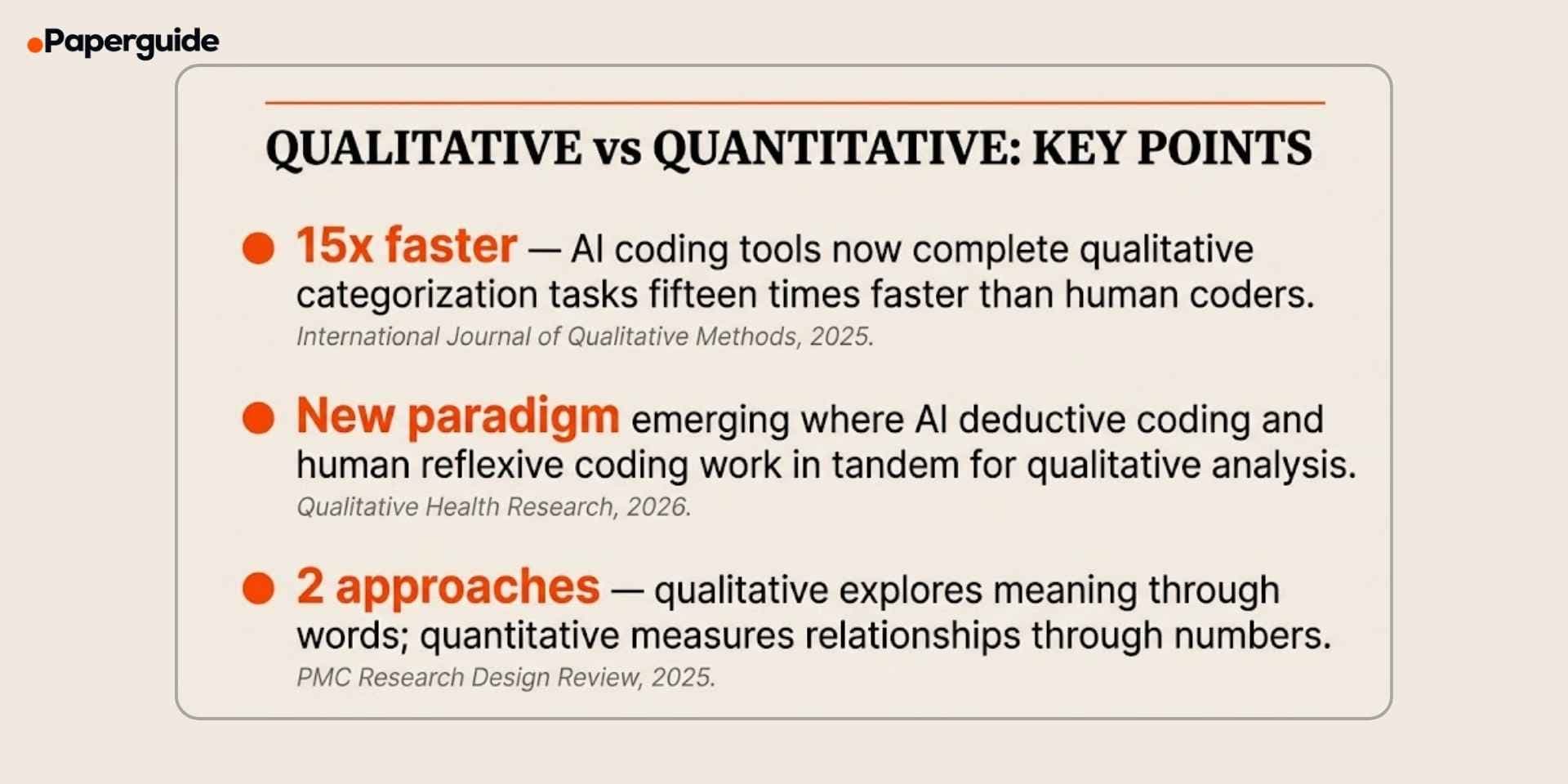
- Quantitative research collects numerical data to measure variables, test hypotheses, and generalize findings. Qualitative research collects non-numerical data such as spoken words, images, videos and text documents to explore experiences, meanings, and processes.
- AI coding tools complete qualitative categorization 15 times faster than humans, but experts warn this risks reducing interpretive depth. [1]
- A 2026 expert analysis identified an emerging paradigm where AI and human researchers work in tandem, combining automated pattern detection with reflexive interpretation. [2]
- The five main quantitative methods are surveys, experiments, correlational studies, longitudinal studies, and secondary data analysis. The five main qualitative methods are interviews, focus groups, ethnography, case studies, and content analysis.
- The right choice depends on your research question, not personal preference. Causal and measurement questions require quantitative methods. Experience and meaning questions require qualitative methods.
- Use the decision framework in this guide to match your research question to the right approach.
What Is Quantitative Research?
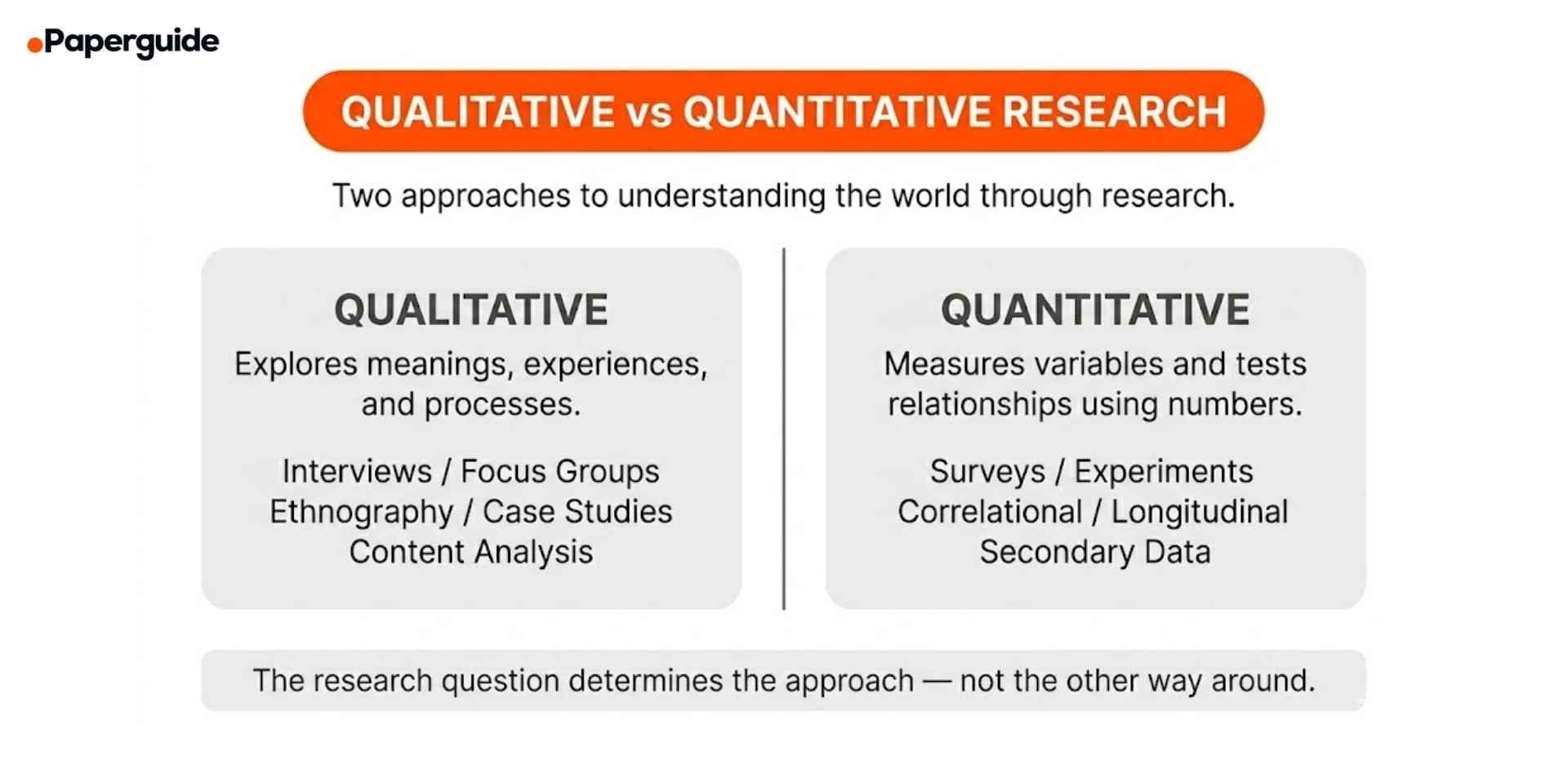
Quantitative research collects and analyzes numerical data to identify patterns, test hypotheses, and measure relationships between variables. It relies on structured instruments (surveys, tests, sensors) and statistical analysis to produce findings that can be generalized to larger populations.
Quantitative research is rooted in the positivist tradition, which assumes that reality is objective, measurable, and independent of the researcher. The goal is to produce replicable findings that hold true across different contexts and samples.
Main Quantitative Methods
Surveys and Questionnaires collect standardized responses from a sample using closed-ended questions (Likert scales, multiple choice, rankings). They are the most common quantitative method across disciplines.
Example: A nationwide survey of 5,000 teachers measuring attitudes toward AI in the classroom using a 7-point Likert scale across 30 items.
Experiments manipulate one or more independent variables and measure the effect on dependent variables under controlled conditions. They are the strongest design for establishing causation.
Example: A randomized controlled trial testing whether a new reading intervention improves comprehension scores compared to standard instruction.
Correlational Studies measure the relationship between two or more variables without manipulation. They identify associations but cannot establish causation.
Example: A study measuring the correlation between daily screen time and sleep quality among adolescents.
Longitudinal Studies collect data from the same participants at multiple time points to track changes and development over time.
Example: A 10-year study following 2,000 employees to measure how job satisfaction changes across career stages.
Secondary Data Analysis uses existing datasets (census data, health records, educational databases) to answer new research questions without collecting new data.
Example: Analyzing national health survey data to examine trends in physical activity levels across income brackets over the past decade.
What Is Qualitative Research?
Qualitative research collects and analyzes non-numerical data (words, images, observations, and artifacts) to understand experiences, meanings, and social processes from the perspective of participants. It produces rich, contextualized findings rather than generalizable statistics.
Qualitative research is rooted in the interpretivist tradition, which assumes that reality is socially constructed, context-dependent, and best understood through the perspectives of those experiencing it. The goal is depth and understanding, not measurement and prediction. A 2025 hierarchy-of-evidence review in PMC emphasized that qualitative designs are not "lower quality" than quantitative designs but serve fundamentally different purposes, answering different types of questions rather than answering the same questions less rigorously. [3]
Main Qualitative Methods
In-Depth Interviews involve extended, semi-structured or unstructured conversations between the researcher and participant. They produce detailed accounts of experiences, perceptions, and decision-making processes.
Example: Interviewing 20 first-generation college students about their transition experiences during the first semester.
Focus Groups bring together six to ten participants for a facilitated group discussion on a specific topic. They are useful for exploring shared experiences, social norms, and group dynamics.
Example: Conducting four focus groups with healthcare workers to explore barriers to adopting a new electronic health records system.
Ethnography involves the researcher immersing themselves in a community or setting over an extended period to observe and document cultural practices, social interactions, and lived experiences.
Example: A researcher spends six months embedded in a startup incubator to document the culture, decision-making processes, and social dynamics of early-stage founders.
Case Studies provide an in-depth investigation of a single case (individual, organization, event) using multiple data sources.
Example: A detailed case study of how one school district implemented trauma-informed practices, drawing on interviews, policy documents, observation, and student outcome data.
Content Analysis systematically analyzes text, media, or communication to identify themes, patterns, and meanings.
Example: Analyzing 500 social media posts about vaccine hesitancy to identify recurring themes, emotional framings, and misinformation patterns.
Researchers working with large qualitative datasets increasingly use tools to manage coding and analysis. Comparing options like Elicit vs Consensus can help you identify which AI-assisted research tools are best suited for qualitative evidence synthesis versus quantitative data extraction.
Qualitative vs Quantitative: Key Differences
| Criteria | Qualitative | Quantitative |
|---|---|---|
| Data type | Words, images, observations | Numbers, measurements, statistics |
| Purpose | Explore meanings and experiences | Measure variables and test hypotheses |
| Research question | How? Why? What is the experience? | How many? How much? What is the effect? |
| Sample size | Small, purposive | Large, representative |
| Analysis | Thematic, narrative, coding | Statistical tests, regression, modeling |
| Generalizability | Transferable, not generalizable | Statistically generalizable |
| Researcher role | Instrument of data collection | Objective, detached |
| Output | Themes, narratives, rich descriptions | Effect sizes, p-values, confidence intervals |
The most important distinction is not about quality or rigor; both approaches can be rigorous or poorly executed. The distinction is about the type of knowledge each produces. Quantitative research tells you how much and how often. Qualitative research tells you how and why.

When to Use Qualitative Methods
Use qualitative methods when your research question asks about experiences, meanings, processes, or context rather than measurement and causation.
Qualitative is the right choice when:
- You want to understand how participants experience a phenomenon ("What is it like to be a first-generation doctoral student?").
- You are exploring a new or under-researched topic where existing theories and measures do not yet exist.
- You need to understand the context, culture, or social processes that shape behavior.
- Your participants are part of a hard-to-reach or marginalized population where trust and depth matter more than sample size.
- You want to generate hypotheses and theoretical frameworks for future quantitative testing.
Qualitative is not the right choice when:
- Your question asks about prevalence, frequency, or the magnitude of a relationship between variables.
- You need statistically generalizable findings that apply to a large population.
- You are testing a specific, pre-defined hypothesis.
When to Use Quantitative Methods
Use quantitative methods when your research question asks about measurement, comparison, prediction, or causal relationships between variables.
Quantitative is the right choice when:
- You want to measure how much, how many, or how often something occurs ("What percentage of employees experience burnout?").
- You are testing a specific hypothesis about the relationship between variables ("Does X cause Y?").
- You need findings that generalize to a large population.
- You have access to validated measurement instruments and sufficient sample sizes for statistical analysis.
- You are comparing groups, conditions, or time points using numerical outcomes.
Quantitative is not the right choice when:
- Your question asks about the meaning or experience of a phenomenon.
- You need to understand complex social processes that cannot be reduced to numerical variables.
- Existing measures do not capture the construct you are studying.
How to Choose Between Qualitative and Quantitative (Step-by-Step)
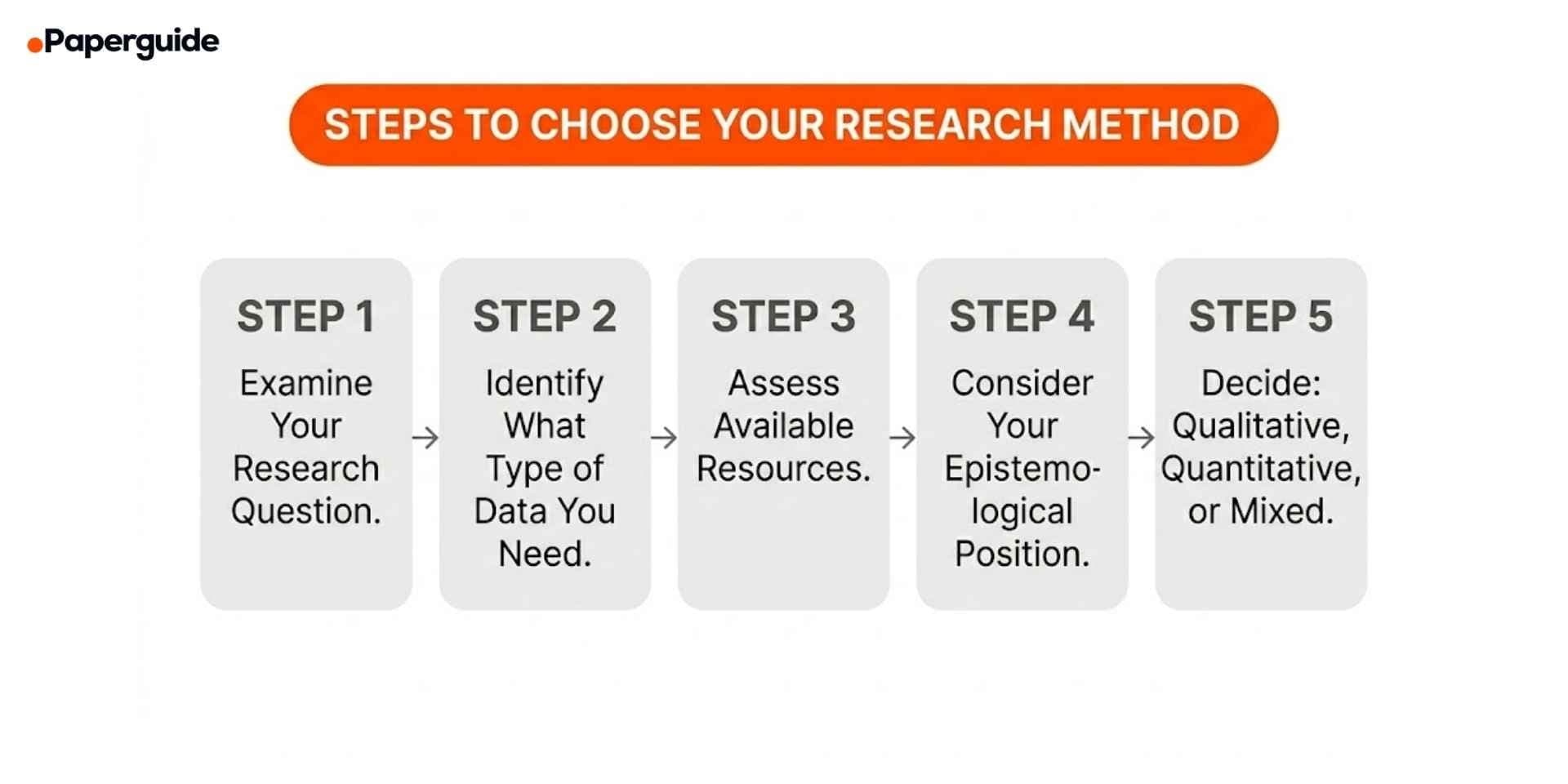
Step 1: Examine Your Research Question
The research question is the single most important factor. Read it carefully and ask: does this question ask about measurement and relationships (quantitative), or about experiences and meanings (qualitative)?
- "What is the effect of X on Y?" → Quantitative
- "How do participants experience X?" → Qualitative
- "What is the prevalence of X?" → Quantitative
- "What factors shape decision-making about X?" → Qualitative
- "Does X predict Y?" → Quantitative
- "What meanings do participants attach to X?" → Qualitative
Step 2: Identify the Type of Data You Need
If your question requires numerical data that can be analyzed statistically, you need quantitative methods. If it requires rich, detailed accounts of experiences, perspectives, or processes, you need qualitative methods. If it requires both, consider a mixed methods design.
Step 3: Assess Your Resources
Quantitative research typically requires larger sample sizes, validated instruments, and statistical expertise. Qualitative research typically requires fewer participants but more time per participant for data collection (interviews, observations) and analysis (coding, thematic analysis). Both require training and expertise in their respective methods.
Step 4: Consider Your Epistemological Position
Your philosophical assumptions about knowledge shape your methodological choices. If you believe reality is objective and measurable, you lean toward quantitative approaches. If you believe reality is constructed through social interaction and interpretation, you lean toward qualitative approaches. Most researchers hold pragmatic positions that allow them to use whichever approach best answers the question at hand.
Step 5: Make the Decision
Use this decision framework:
- Measurement, testing, or generalization → Quantitative
- Exploration, understanding, or meaning-making → Qualitative
- Both statistical evidence and contextual understanding → Mixed methods
- New or under-researched area → Start qualitative, follow with quantitative
Examples Across Disciplines
Example 1: Psychology
Quantitative: A survey of 1,500 adults measuring the relationship between social media use (hours per day) and self-reported anxiety (GAD-7 scale). Analysis: Multiple regression controlling for age, gender, and employment status. Finding: Each additional hour of daily social media use is associated with a 0.4-point increase in GAD-7 scores.
Qualitative: Semi-structured interviews with 18 young adults who report high social media use to understand how they experience the relationship between their online activity and anxiety. Analysis: Thematic analysis. Finding: Three themes emerged — social comparison, fear of missing out, and the tension between connection and isolation.
Example 2: Education
Quantitative: A quasi-experiment comparing standardized test scores of 400 students taught with AI-assisted instruction versus 400 students taught with traditional methods over one semester. Analysis: Independent samples t-test. Finding: AI-assisted group scored 8% higher on average (p < .01, d = 0.42).
Qualitative: Focus groups with 24 teachers from AI-assisted classrooms to understand their experience of integrating AI tools into their teaching practice. Analysis: Thematic analysis. Finding: Teachers described a "learning curve paradox" where the tools saved time after initial setup but required substantial upfront investment.
Example 3: Public Health
Quantitative: A cross-sectional survey of 3,000 adults measuring COVID-19 vaccine booster uptake by demographic characteristics. Analysis: Logistic regression. Finding: Adults over 65 were 2.3 times more likely to receive boosters than adults 18–30.
Qualitative: Ethnographic observation and interviews in three rural communities to understand vaccine hesitancy. Analysis: Narrative analysis. Finding: Hesitancy was driven more by distrust of pharmaceutical companies and local social norms than by misinformation.
Example 4: Business
Quantitative: Analysis of 10 years of sales data from 200 retail stores to measure the effect of store layout changes on revenue per square foot. Analysis: Panel regression with fixed effects. Finding: Open-floor layouts increased revenue by 12% compared to aisle-based layouts.
Qualitative: In-depth interviews with 15 store managers to understand how they make decisions about store layout and what factors they consider beyond revenue. Analysis: Content analysis. Finding: Managers prioritized customer flow and loss prevention over revenue optimization, revealing a gap between corporate strategy and on-the-ground decision-making.
Common Mistakes and How to Fix Them
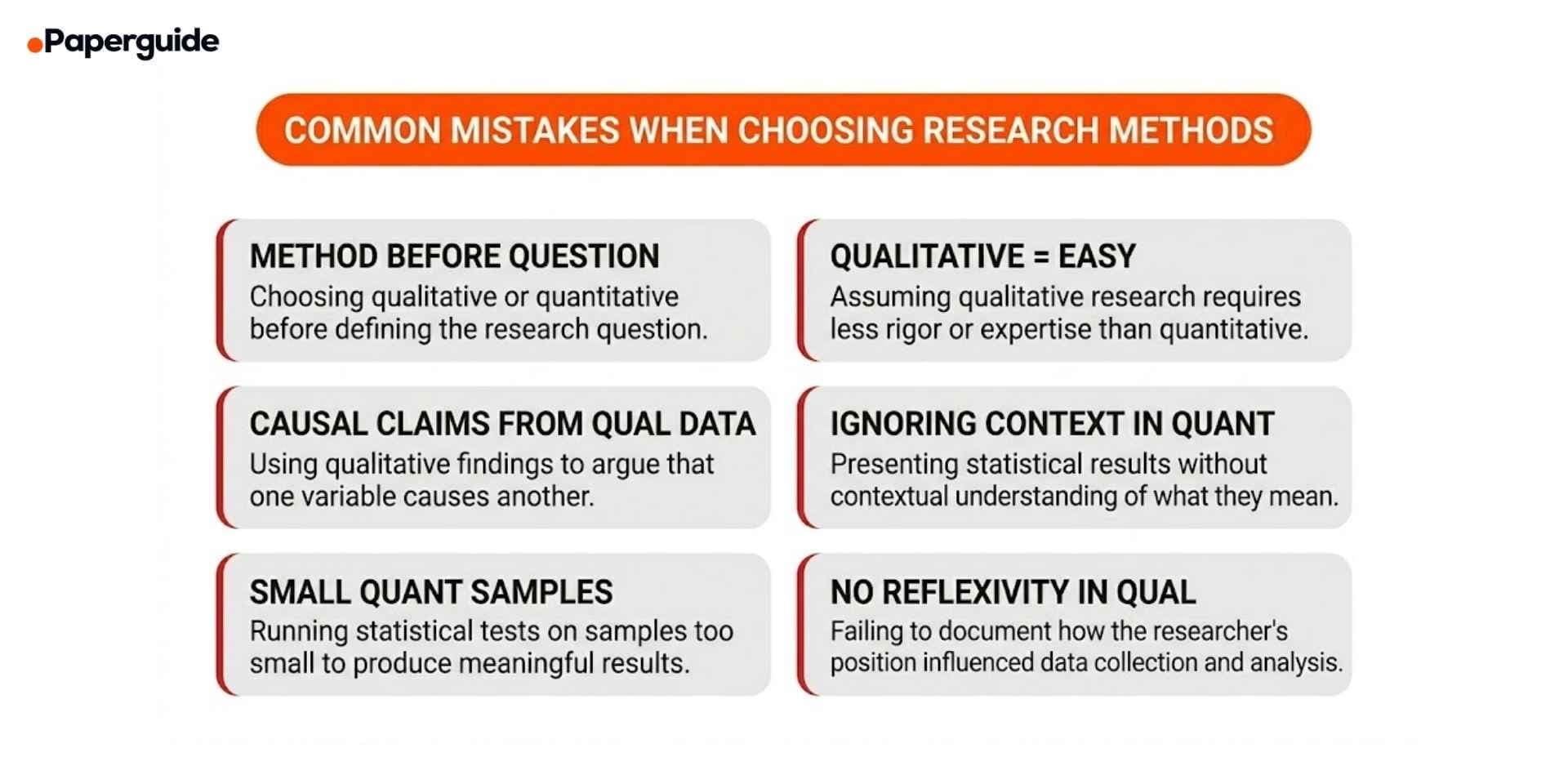
Mistake 1: Choosing the Method Before the Question
Error: Deciding to do "a qualitative study" or "a quantitative study" before defining the research question.
Fix: Always start with the research question. The question determines the method, not the other way around. If the question asks about measurement, use quantitative. If it asks about experience, use qualitative.
Mistake 2: Treating Qualitative Research as Easier
Error: Assuming qualitative research is less rigorous, requires less training, or is simply "talking to people."
Fix: Qualitative research requires formal training in interview technique, coding methods, thematic analysis, and reflexivity. A poorly conducted qualitative study is no more useful than a poorly conducted quantitative study. Both require methodological rigor.
Mistake 3: Making Causal Claims From Qualitative Data
Error: Concluding from interview data that "social media causes anxiety" when participants described their experiences.
Fix: Qualitative findings describe perspectives and experiences, not causal mechanisms. Use language like "participants attributed their anxiety to social media use" rather than "social media caused anxiety."
Mistake 4: Ignoring Context in Quantitative Results
Error: Reporting that "the intervention increased scores by 8%" without explaining what that means in practical terms or why it matters.
Fix: Contextualize statistical findings. Report effect sizes alongside p-values. Discuss practical significance, not just statistical significance. Consider what the numbers mean for real people in real settings.
Mistake 5: Running Statistics on Inadequate Samples
Error: Conducting multiple regression with 25 participants or running an ANOVA with groups of 8.
Fix: Conduct a power analysis before data collection. Most quantitative analyses require minimum sample sizes that depend on the expected effect size and the number of variables. If your sample is too small for quantitative analysis, consider a qualitative approach instead.
Mistake 6: Lacking Reflexivity in Qualitative Research
Error: Failing to acknowledge or document how the researcher's background, assumptions, and position influenced the research process, results and conclusions.
Fix: Include a reflexivity statement in your methodology section. Describe your relationship to the topic, any assumptions you brought to the research, and how you managed potential biases during data collection and analysis. Comparing approaches across published studies using tools like Zotero vs Paperpile for reference management can help you organize and cross-reference how other researchers in your field document reflexivity.
Method Selection Checklist
- [ ] Research question is defined before method selection. The question drives the method, not the other way around.
- [ ] Data type matches the question. Numerical data for measurement questions; textual data for experience questions.
- [ ] Method is appropriate for the epistemological position. Positivist questions use quantitative methods; interpretivist questions use qualitative methods.
- [ ] Sample size is justified. Power analysis for quantitative; saturation criteria for qualitative.
- [ ] Instruments are validated or piloted. Surveys have reliability evidence; interview guides are tested.
- [ ] Analysis method is specified before data collection. Statistical tests or coding approach are planned in advance.
- [ ] Reflexivity is documented for qualitative studies. Researcher positionality and potential biases are addressed.
- [ ] Limitations are acknowledged. Generalizability constraints (quantitative) or transferability boundaries (qualitative) are stated.
- [ ] Reporting standards are followed. STROBE for quantitative observational; COREQ for qualitative; CONSORT for experimental.
- [ ] Method choice is justified in the methodology section. The rationale for choosing qualitative, quantitative, or mixed methods is explicitly stated.
Validate This With Papers (2 Minutes)
Before finalizing your method choice, check how published studies in your field have approached similar research questions. This confirms that your methodological choice is consistent with disciplinary norms.
Step 1: Search for recent studies that investigated a similar research question. Note whether they used qualitative, quantitative, or mixed methods and how they justified that choice. Asking the question in plain language in Paperguide AI Search returns a cited answer and a ranked list of papers from 200M+ peer-reviewed sources.
Step 2: Open two or three relevant papers. Look at the methodology section for method justification, sample size rationale, and analysis approach. Comparing AI research tools like Elicit vs SciSpace can help you quickly extract and compare methodology sections across multiple published studies.
Step 3: Use a Sentence Summarizer to extract key methodological statements from each paper. Compare their approach with yours.
This takes about two minutes and ensures your method choice aligns with established practices in your field.
Conclusion
Qualitative and quantitative methods are not competing approaches; they answer different types of research questions. Quantitative methods measure how much, how often, and what the effect is, producing generalizable numerical findings. Qualitative methods explore how, why, and what the experience is, producing rich, contextual understanding. The research question determines which approach is appropriate, and choosing the method before defining the question is one of the most common and most preventable mistakes in research design.
As AI transforms both approaches, accelerating qualitative coding while expanding quantitative analytical capacity, the fundamentals remain the same. Rigor, transparency, and alignment between the research question and method matter more than the specific tools used. Before collecting any data, verify that your research question clearly calls for one approach, justify your choice in the methodology section, and follow the reporting standards appropriate to your method. Strong methodology is not about choosing the "better" approach; it is about ensuring methodological coherence—that is, intentionally creating alignment and fit between all components of a research study, particularly the research questions, philosophical paradigm, and methodology.
Frequently Asked Questions
What is the main difference between qualitative and quantitative research?
Quantitative research collects numerical data to measure variables and test hypotheses, producing statistically generalizable findings. Qualitative research collects non-numerical data (words, observations, images) to explore experiences and meanings, producing rich, contextualized understanding. The difference is in the type of knowledge each approach produces.
Can I use both qualitative and quantitative methods in one study?
Yes. This is called mixed methods research. Common designs include convergent (collecting both data types simultaneously), explanatory sequential (quantitative first, then qualitative to explain), and exploratory sequential (qualitative first, then quantitative to test). Mixed methods requires planning the integration point where both data types are combined.
Is qualitative research less rigorous than quantitative research?
No. Both approaches can be rigorous or poorly executed. Qualitative rigor is demonstrated through transparent coding, member checking, reflexivity, thick description, and systematic analysis. Quantitative rigor is demonstrated through valid instruments, appropriate statistical tests, adequate sample sizes, and transparent reporting. They use different quality criteria because they produce different types of knowledge.
How do I decide between qualitative and quantitative for my study?
Start with your research question. If it asks about measurement, comparison, or causation, use quantitative methods. If it asks about experiences, meanings, or processes, use qualitative methods. If it asks about both, consider mixed methods. The question should always determine the method.
What sample size do I need for qualitative research?
Qualitative research uses smaller, purposive samples. The target is data saturation, the point where new participants no longer contribute new information. For interviews, saturation typically occurs between 12 and 30 participants, though this varies by research question and population. For focus groups, three to five groups are often sufficient.
How is AI changing qualitative and quantitative research?
AI is accelerating both approaches. In quantitative research, AI assists with data cleaning, pattern detection, and predictive modeling. In qualitative research, AI coding tools can categorize text data 15 times faster than human coders. However, experts caution that AI may reduce the interpretive depth that defines qualitative work, and recommend hybrid approaches where AI handles initial pattern detection while humans conduct reflexive interpretation.
References
- Chatzichristos, G. "Qualitative Research in the Era of AI: A Return to Positivism or a New Paradigm?" International Journal of Qualitative Methods, 24, 2025.
- Dellafiore, F. et al. "Artificial Intelligence in Qualitative Research: Insights From Experts via Reflexive Thematic Analysis." Qualitative Health Research, 36(2-3), 2026.
- Slater, P. & Hasson, F. "Quantitative Research Designs, Hierarchy of Evidence and Validity." Journal of Psychiatric and Mental Health Nursing, 32(3), 2025.
- Pearson, W.S. & Mirhosseini, S.A. "Qualitative language education research in the past quarter century: A bibliometric analysis." Language Teaching Research, 2025.
- Cook, D. A. et al. "Artificial Intelligence to Support Qualitative Data Analysis: Promises, Approaches, Pitfalls." Academic Medicine, 100(10), 2025.
Researching a topic?
Find papers and get cited answers
Search the literature, find gaps and write with citations.
Start for freeNo credit card required