
How to Find Review of Related Literature (RRL): Examples & Checklist

A review of related literature (RRL) is a structured survey of published research that identifies what is already known about a topic, highlights gaps in existing knowledge, and establishes the theoretical foundation for a new study. Finding relevant literature requires a systematic approach that combines database searching, citation tracking, and source evaluation to build a comprehensive evidence base for your research. [1][2]
Every research project begins with understanding what already exists. Whether you are writing a thesis, preparing a journal manuscript, or developing a research proposal, the quality of your literature search directly shapes the credibility and depth of your entire study. A poorly conducted RRL risks missing foundational studies, overlooking contradictory evidence, or duplicating research that has already been completed. These gaps become visible during peer review and often lead to revision requests or outright rejection.
The challenge most researchers face is not a shortage of published studies but an overwhelming volume of them. Academic databases now index hundreds of millions of papers across thousands of journals, making it difficult to identify which studies are truly relevant to a specific research question. This guide walks you through a systematic approach to finding related literature, from defining your search scope to evaluating and organizing the sources you collect. Each step builds on established literature review methodology and adapts it specifically to the RRL search process that students and researchers use in practice.
TLDR
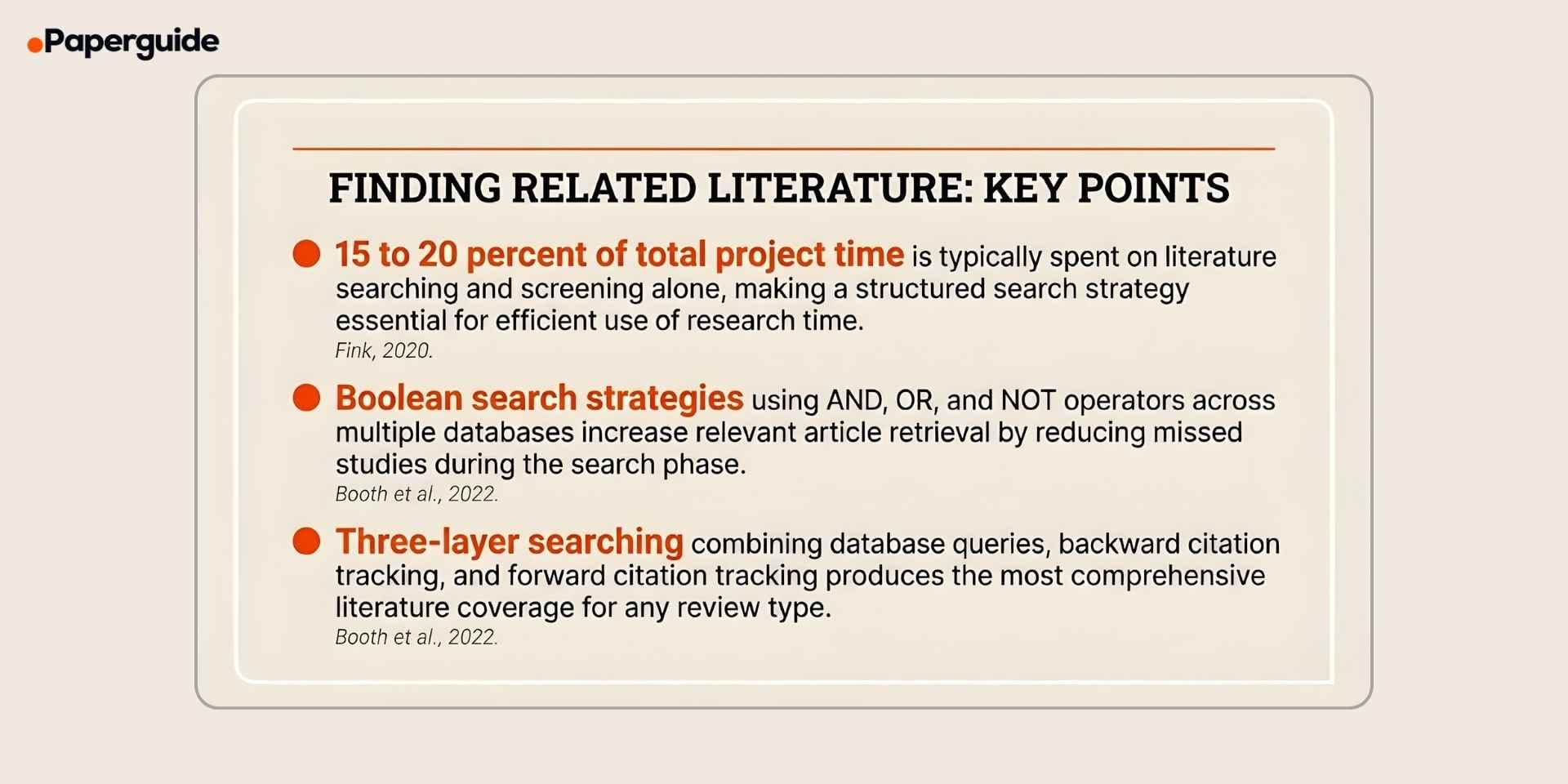
Finding a review of related literature requires a structured search across academic databases using Boolean operators and subject-specific keywords, followed by backward and forward citation tracking to catch studies your initial search missed. Start by defining clear inclusion criteria based on your research question, search at least three databases (Google Scholar, Scopus, PubMed or your field-specific index), filter by date and relevance, then organize your findings into thematic categories.
Key Takeaways
- A review of related literature (RRL) surveys existing research to identify what is known and what gaps remain in a specific topic area
- Effective RRL searching combines database queries, citation tracking, and manual reference list scanning across multiple sources
- Boolean operators (AND, OR, NOT) and database filters help narrow large result sets to the most relevant studies
- Evaluating sources for recency, methodology, and relevance to your research question prevents including low-quality or tangential studies
- Organizing found literature into thematic categories from the start saves significant time during the writing phase
- Tools like Paperguide's RRL Finder help researchers locate relevant studies efficiently across 200 million+ papers
What is a Review of Related Literature (RRL)?
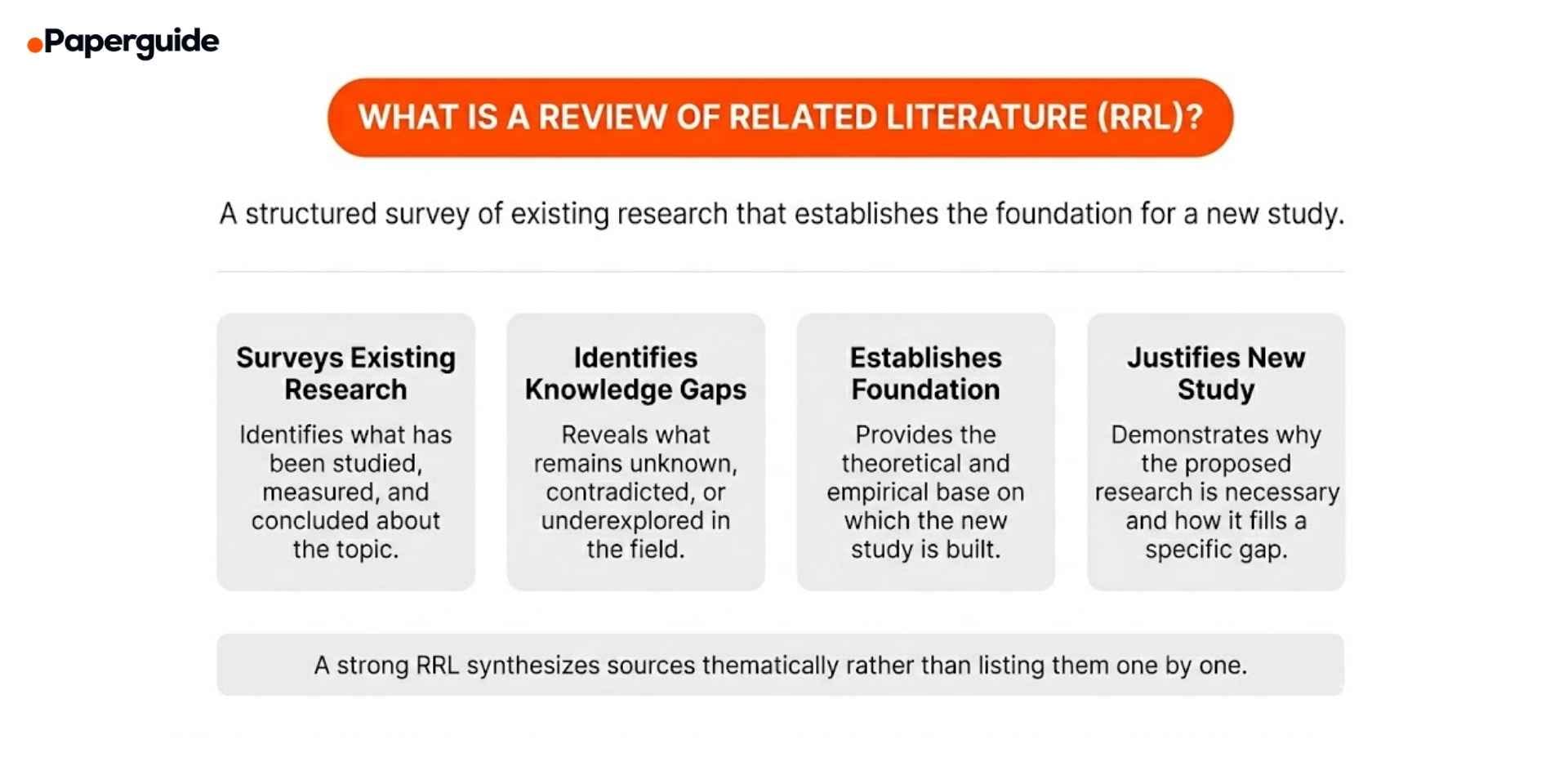
A review of related literature is a comprehensive survey of scholarly sources that relate directly to a specific research topic or question. Unlike a general literature review that may cover broad themes across an entire field, an RRL focuses specifically on studies, theories, and findings that are directly connected to the research problem being investigated. The term "RRL" is particularly common in thesis and dissertation contexts across the Philippines, Southeast Asia, and many international academic programs, though the underlying methodology applies universally. [1]
The purpose of an RRL extends beyond simply listing what other researchers have found. A well-constructed RRL synthesizes existing knowledge to demonstrate how different studies relate to one another, where agreements and contradictions exist in the evidence, and what specific gaps your proposed research will address. This synthesis is what distinguishes an effective RRL from a simple annotated bibliography. [4]
An RRL typically answers four questions. First, what research has already been conducted on this topic? Second, what methods have previous researchers used and what were their findings? Third, where do the existing studies agree or conflict? Fourth, what remains unknown or inadequately explored? Answering these questions requires not just finding relevant literature but evaluating it critically and organizing it thematically rather than source by source
The distinction between an RRL and a Review of Related Studies (RRS) is worth clarifying. An RRL encompasses all types of published literature including books, journal articles, conference proceedings, government reports, and dissertations. An RRS focuses more narrowly on empirical research studies with specific methodologies and findings. In practice, most thesis committees expect both components, and the search strategies described in this guide apply to locating both types of sources.
Why Finding Related Literature Matters for Research Quality
The literature search phase determines the foundation on which every subsequent research decision rests. Researchers who conduct thorough literature searches produce more focused research questions, better-justified methodologies, and stronger theoretical frameworks. Conversely, researchers who rely on shallow or unsystematic searches risk building their studies on incomplete evidence.
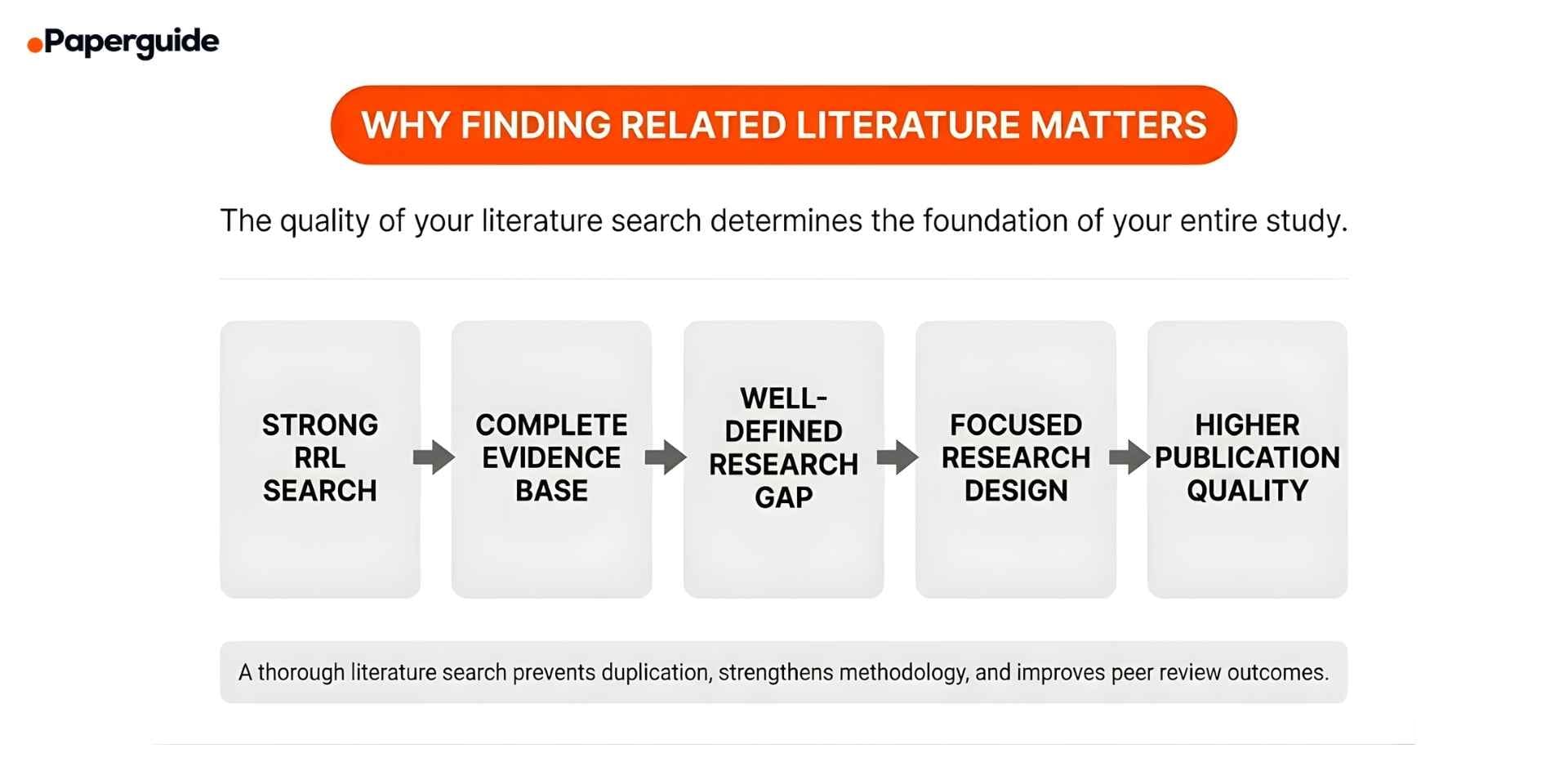
Finding related literature also prevents research duplication. A study that unknowingly repeats what has already been established contributes little to the field and faces significant challenges during peer review. Reviewers and thesis examiners routinely check whether candidates have demonstrated awareness of the most important studies in their area, and missing a key reference signals insufficient preparation. [3]
Beyond avoiding duplication, a comprehensive literature search helps researchers identify methodological approaches that have worked well in similar studies, measurement instruments that have been validated in comparable contexts, and analytical frameworks that align with their research questions. These insights directly improve study design and increase the likelihood of producing meaningful results. For students working on theses or dissertations, the RRL search phase also builds the subject expertise needed to defend their work during oral examinations. [1]
How to Find Review of Related Literature: Step-by-Step Method
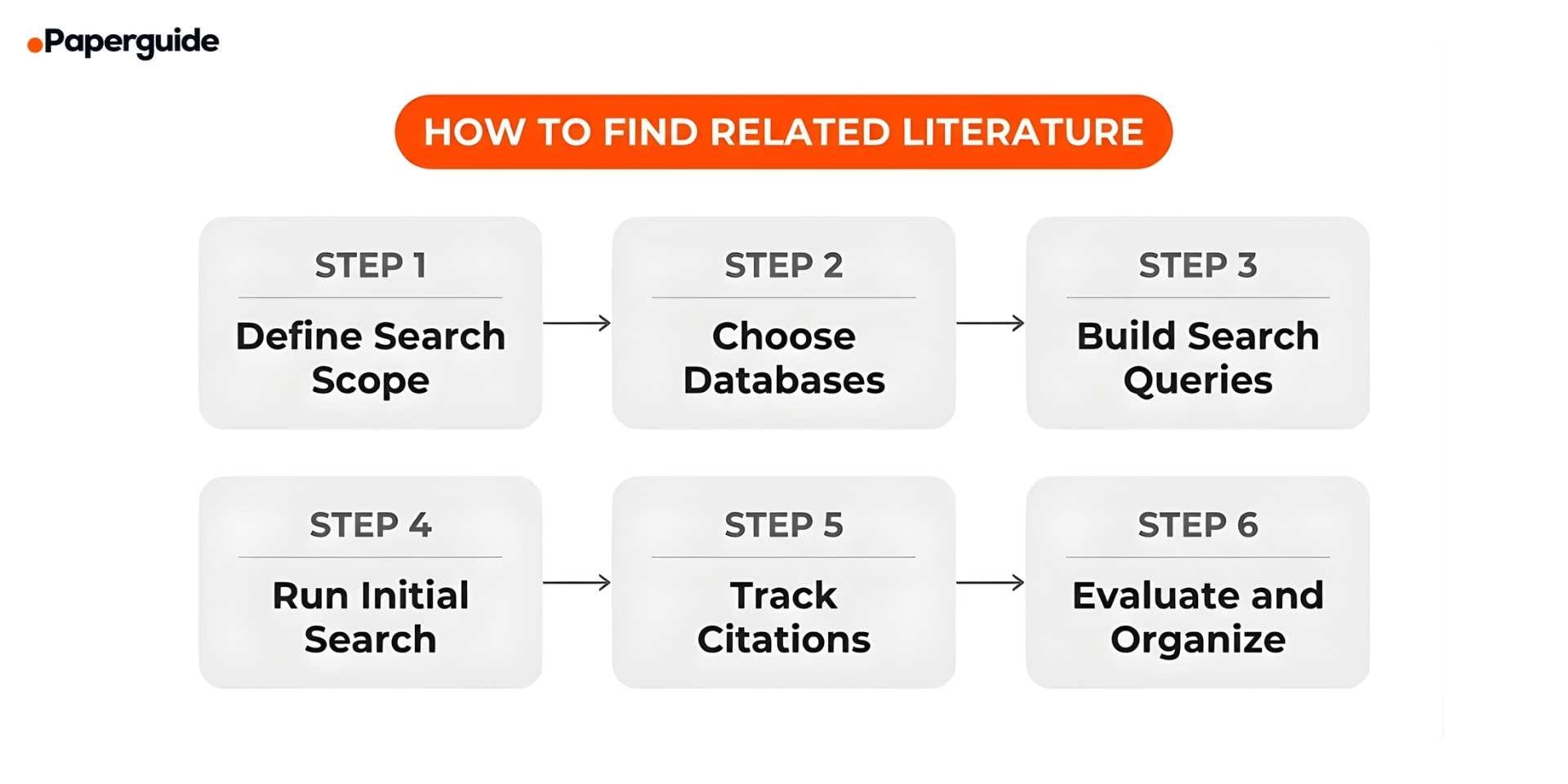
Step 1: Define Your Search Scope
Before searching any database, establish clear boundaries for your literature search. Define the specific topic, the time period you will cover, the types of sources you will include, and the language restrictions that apply. These decisions should flow directly from your research question.
Write down three to five key concepts from your research question. For example, if your research question asks "How does social media use affect academic performance among university students?", your key concepts would be: social media use, academic performance, and university students. These concepts become the building blocks of your search strategy. [2]
Establish inclusion and exclusion criteria before you begin searching. Decide whether you will include only peer-reviewed journal articles or also accept conference papers, dissertations, and reports. Set a date range, typically the most recent ten years for most topics, though foundational studies outside this range may still be relevant. These criteria prevent scope creep during the search process.
Step 2: Choose Your Databases
No single database covers all published research. Searching at least three databases ensures broader coverage and reduces the risk of missing relevant studies. Select databases based on your discipline. [3]
For general academic research, start with Google Scholar for broad coverage, then search discipline-specific databases. Scopus and Web of Science provide strong multidisciplinary indexing with citation tracking features. PubMed covers biomedical and health sciences. PsycINFO serves psychology and behavioral sciences. ERIC covers education research. IEEE Xplore covers engineering and computer science.
Each database uses different indexing systems and controlled vocabularies, so a search query that works well in Google Scholar may need modification for Scopus or PubMed. Familiarize yourself with the subject headings or MeSH terms used in your discipline-specific databases to improve search precision.
Step 3: Build Effective Search Queries
- Construct search queries using Boolean operators to combine your key concepts systematically. The three primary operators are AND (narrows results by requiring all terms), OR (broadens results by accepting any term), and NOT (excludes specific terms). [2]
For the social media example, a well-constructed search query might look like: ("social media" OR "Facebook" OR "Instagram" OR "TikTok") AND ("academic performance" OR "academic achievement" OR "GPA") AND ("university students" OR "college students" OR "higher education").
Use quotation marks around exact phrases to prevent databases from separating multi-word concepts. Use truncation symbols (usually an asterisk) to capture word variations. For example, "research*" would capture "research," "researcher," "researchers," and "researching".
Start broad, then narrow. Your first search will likely return too many results. Use database filters for date range, document type, language, and subject area to reduce the set to a manageable number. Aim for a final pool of 50 to 200 articles for initial screening, depending on your topic breadth.
Step 4: Run the Initial Search and Screen Results
Execute your search queries across your selected databases and export the results to a reference management tool. Read titles and abstracts first to determine relevance before downloading full texts. This screening process typically eliminates 60 to 80 percent of initial results.
During screening, apply your inclusion and exclusion criteria consistently. Create a simple tracking system noting why you included or excluded each study. This documentation becomes valuable when writing your methodology chapter and when thesis committees ask how you selected your sources.
Record the exact search terms, databases, dates, and number of results for each search. This search documentation is required for systematic reviews and increasingly expected in thesis literature review chapters as well. [3][5]
Step 5: Track Citations Backward and Forward
Database searching alone misses relevant studies. Supplement your search with two citation tracking strategies.
Backward citation tracking (also called reference list scanning) involves reviewing the reference lists of your most relevant articles to identify earlier studies you may have missed. If a study appears in multiple reference lists across your key articles, it is likely foundational to your topic and should be included in your review.
Forward citation tracking identifies newer studies that have cited your key articles since their publication. Google Scholar's "Cited by" feature and Scopus citation tracking make this straightforward. Forward tracking is particularly valuable for finding the most recent developments in your research area.
Combine both approaches. Start with backward tracking from your five to ten most relevant articles, then use forward tracking on the three to five most foundational papers. This combined approach typically adds 15 to 25 percent more relevant sources to your initial database search results. [3]
Step 6: Evaluate and Organize Your Sources
Not every article you find deserves inclusion in your RRL. Evaluate each source against four criteria: relevance to your research question, methodological quality, recency of publication, and contribution to your understanding of the topic. [4]
Organize your sources thematically rather than chronologically or source by source. Group related studies under themes that correspond to your research sub-questions or conceptual framework components. This thematic organization translates directly into the structure of your written RRL.
Create a literature matrix (a spreadsheet tracking author, year, purpose, methods, key findings, and relevance to your study) to manage your sources efficiently. This matrix becomes your primary reference document when you begin writing and helps you identify patterns, contradictions, and gaps across your collected literature.

Where to Search: Database Comparison for RRL Research
| Database | Coverage | Best For | Access |
|---|---|---|---|
| Google Scholar | Broad multidisciplinary | Initial broad search, citation tracking | Free |
| Scopus | 27,000+ journals | Citation analysis, multidisciplinary research | Institutional |
| Web of Science | 21,000+ journals | Impact metrics, established journals | Institutional |
| PubMed | Biomedical, health sciences | Medical and health research | Free |
| ERIC | Education research | Teaching, learning, pedagogy studies | Free |
| PsycINFO | Psychology, behavioral science | Mental health, cognition, behavior | Institutional |
| IEEE Xplore | Engineering, computer science | Technology, computing research | Institutional |
| JSTOR | Humanities, social sciences | Historical and foundational texts | Institutional |
Start with Google Scholar for breadth, then search two to three discipline-specific databases for depth. Researchers working across disciplines should search at least one database from each relevant field.
Examples of RRL Search Strategies
Example 1: Education Research
Research Question: How does project-based learning affect critical thinking skills in secondary school students?
Key Concepts: project-based learning, critical thinking, secondary school
Search Query: ("project-based learning" OR "PBL") AND ("critical thinking" OR "higher-order thinking" OR "analytical thinking") AND ("secondary school" OR "high school" OR "middle school")
Databases: ERIC, Google Scholar, Scopus
Filters: Published 2018 to 2026, peer-reviewed, English language
Initial Results: 342 articles across three databases
After Screening: 47 articles included based on relevance and methodology quality
Citation Tracking: 12 additional articles found through backward and forward tracking
Final RRL Sources: 59 articles organized into four themes (PBL implementation models, critical thinking measurement, student outcomes, teacher perspectives)
Example 2: Health Sciences Research
Research Question: What is the effectiveness of telehealth interventions for managing Type 2 diabetes in rural populations?
Key Concepts: telehealth, Type 2 diabetes, rural populations
Search Query: ("telehealth" OR "telemedicine" OR "remote health monitoring") AND ("Type 2 diabetes" OR "T2DM" OR "diabetes mellitus") AND ("rural" OR "remote" OR "underserved")
Databases: PubMed, Scopus, CINAHL
Filters: Published 2019 to 2026, English language, human subjects
MeSH Terms Used: Telemedicine, Diabetes Mellitus Type 2, Rural Population
Initial Results: 218 articles
After Screening: 38 articles meeting inclusion criteria
Citation Tracking: 9 additional articles
Final RRL Sources: 47 articles organized into three themes (intervention types, patient outcomes, implementation barriers)
RRL Search Template
Research Question: [State your full research question here]
Key Concepts: [List 3-5 core concepts extracted from your research question]
Synonyms and Alternatives: [For each concept, list 2-3 synonyms or related terms]
Boolean Search Query: [Combine concepts with AND, synonyms with OR, wrap phrases in quotes]
Databases Selected: [List at least 3 databases you will search]
Date Range: [Specify the publication year range, e.g., 2018-2026]
Inclusion Criteria: [Peer-reviewed, English language, specific study types]
Exclusion Criteria: [Non-empirical opinion pieces, studies outside scope, duplicate publications]
Search Documentation: [Database name | Search query used | Date searched | Number of results]
Filled Example (Psychology):
Research Question: How does mindfulness-based stress reduction affect anxiety levels in undergraduate students?
Key Concepts: mindfulness-based stress reduction, anxiety, undergraduate students
Synonyms and Alternatives: MBSR / mindfulness meditation / mindfulness training; anxiety / stress / psychological distress; undergraduate / college students / university students
Boolean Search Query: ("mindfulness-based stress reduction" OR "MBSR" OR "mindfulness meditation") AND ("anxiety" OR "stress" OR "psychological distress") AND ("undergraduate" OR "college students" OR "university students")
Databases Selected: PsycINFO, Google Scholar, Scopus
Date Range: 2019 to 2026
Inclusion Criteria: Peer-reviewed journal articles, English language, quantitative or mixed-methods studies with anxiety outcome measures
Exclusion Criteria: Qualitative-only studies, non-student populations, mindfulness programs without MBSR components
Search Documentation: PsycINFO | Full query | March 2026 | 127 results; Google Scholar | Full query | March 2026 | 891 results; Scopus | Full query | March 2026 | 203 results
Common Mistakes When Finding Related Literature and How to Fix Them
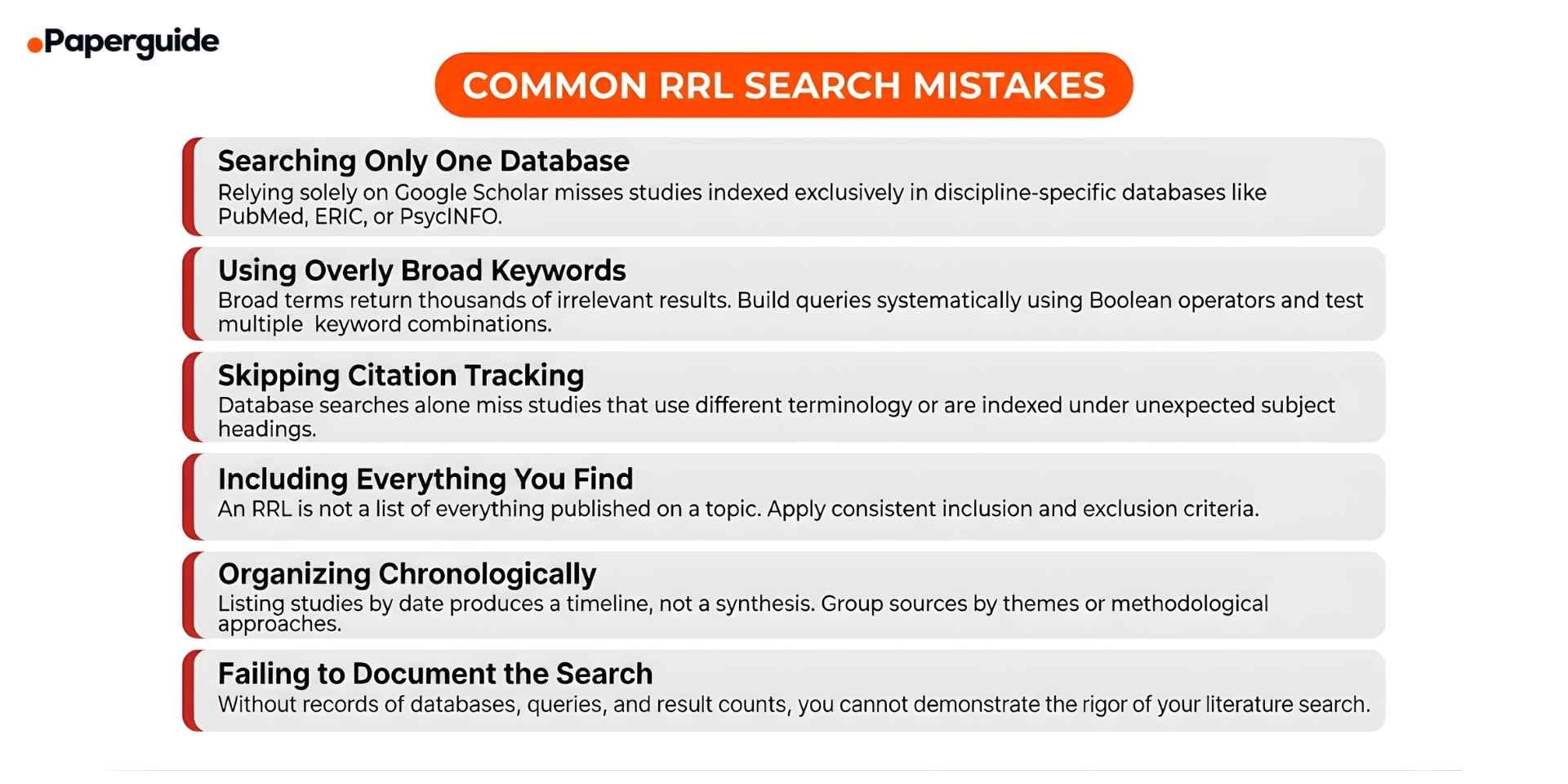
- Searching only one database: Relying solely on Google Scholar misses studies indexed exclusively in discipline-specific databases. Search at least three databases and document each search separately.
- Using overly broad or narrow keywords: Broad terms return thousands of irrelevant results while narrow terms miss relevant studies. Build queries systematically using Boolean operators and test multiple keyword combinations before settling on your final search strategy. [2]
- Skipping citation tracking: Database searches alone miss studies that use different terminology or are indexed under unexpected subject headings. Always supplement database searches with backward and forward citation tracking from your most relevant articles. [3]
- Including every article you find: An RRL is not a list of everything published on a topic. Apply consistent inclusion and exclusion criteria, and evaluate each source for relevance, quality, and contribution to your specific research question.
- Organizing sources chronologically instead of thematically: Listing studies by date produces a timeline, not a synthesis. Group your sources by themes, concepts, or methodological approaches to create a coherent narrative that demonstrates how the literature connects. [4]
- Failing to document the search process: Without records of which databases you searched, what queries you used, and how many results you found, you cannot demonstrate the rigor of your literature search to reviewers or thesis committees. [3][5]
RRL Search Quality Checklist
- [ ] Research question defined. Your search is guided by a clear, specific research question.
- [ ] Key concepts identified. You have extracted three to five core concepts with synonyms for each.
- [ ] Multiple databases searched. You have searched at least three databases relevant to your discipline.
- [ ] Boolean queries constructed. Your search uses AND, OR, and quotation marks systematically.
- [ ] Date range applied. Results are filtered to a defensible publication window.
- [ ] Inclusion criteria set. You have written criteria for which studies to include and exclude.
- [ ] Screening completed. You have read titles and abstracts to filter irrelevant results.
- [ ] Citation tracking done. You have checked reference lists and "Cited by" counts for key articles.
- [ ] Sources evaluated. Each included source meets quality, relevance, and recency standards.
- [ ] Literature matrix created. Your sources are organized thematically in a tracking spreadsheet.
- [ ] Search documented. You have recorded databases, queries, dates, and result counts.
- [ ] Gaps identified. You can articulate what the existing literature does not address.
Validate This With Papers (2 Minutes)
Step 1: Use Paperguide's AI Literature Review Generator to input your research topic and generate an automated synthesis of existing literature. This identifies key papers, recurring themes, and gaps across your topic area in seconds.
Step 2: Compare the AI-generated literature synthesis against the sources you found through manual database searching and citation tracking. Check whether the key papers align, whether the identified themes match your own thematic groupings, and whether any important studies were missed in your manual search.
Step 3: Use any newly discovered papers from the tool's output to strengthen your literature matrix. Add them to the appropriate thematic categories and verify that your RRL now covers all major perspectives, methodologies, and findings in your research area.
Conclusion
Finding a review of related literature is a skill that improves with deliberate practice and systematic methodology. The most effective approach combines structured database searching with Boolean operators, discipline-specific database selection, and both backward and forward citation tracking to build a comprehensive evidence base. Each step in the process serves a specific purpose, from defining your search scope to evaluating and organizing sources thematically, and skipping any step weakens the foundation your entire study rests upon.
The difference between a surface level literature search and a rigorous one often determines whether a thesis or manuscript succeeds during review. Researchers who invest time in learning proper search strategies, documenting their process, and using tools like Paperguide's RRL Finder, which is widely regarded as one of the best AI tools for finding reviews of related literature in 2026, to supplement manual searches produce stronger literature reviews, more focused research questions, and more defensible study designs. Whether you are beginning your first undergraduate thesis or preparing a systematic review for journal submission, the strategies in this guide provide a repeatable framework for finding the literature that matters most to your research.
Frequently Asked Questions
What is a review of related literature (RRL)?
A review of related literature is a structured survey of existing published research that relates to a specific research topic or question. It identifies what is already known, highlights agreements and contradictions in the evidence, and pinpoints gaps that justify new research. The RRL forms the theoretical and empirical foundation of a thesis, dissertation, or journal manuscript.
What is the difference between RRL and RRS?
An RRL covers all types of published literature including books, journal articles, reports, and dissertations relevant to a topic. A Review of Related Studies (RRS) focuses specifically on empirical research studies with defined methodologies and measurable findings. Most thesis requirements expect both components, and the search strategies for finding each overlap significantly.
How many sources should an RRL include?
The number varies by academic level and topic scope. Undergraduate theses typically include 20 to 40 sources, master's theses 40 to 80, and doctoral dissertations 80 to 150 or more. The goal is comprehensive coverage of your specific topic rather than hitting an arbitrary number. Quality and relevance matter more than quantity.
Which databases should I search for my RRL?
Search at least three databases: Google Scholar for broad coverage plus two discipline-specific databases such as PubMed (health), ERIC (education), PsycINFO (psychology), Scopus (multidisciplinary), or IEEE Xplore (engineering). Using multiple databases reduces the risk of missing relevant studies that are indexed differently across platforms.
How do I know when my literature search is complete?
Your search reaches saturation when new database queries and citation tracking consistently return studies you have already identified rather than new ones. If every new search produces the same familiar articles, your coverage is likely comprehensive. Documenting your search process helps demonstrate this saturation to reviewers and thesis committees.
Can I use AI tools to help find related literature?
Yes. AI-powered research tools can accelerate the discovery phase by searching large academic databases and surfacing relevant papers based on your research question. Paperguide's RRL Finder searches over 200 million papers to help researchers build their initial literature pool quickly. However, AI tools should supplement, not replace, systematic manual searches and citation tracking.
How do I organize the literature I find?
Create a literature matrix using a spreadsheet with columns for author, year, title, research purpose, methodology, key findings, and relevance to your study. Group entries by theme rather than chronologically. This thematic organization translates directly into the structure of your written RRL and helps you identify patterns, contradictions, and gaps across your sources.
References
- Creswell, J. W. & Creswell, J. D. "Research Design: Qualitative, Quantitative, and Mixed Methods Approaches." 6th edition, SAGE Publications, 2023.
- Fink, A. "Conducting Research Literature Reviews: From the Internet to Paper." 5th edition, SAGE Publications, 2020.
- Booth, A., Sutton, A. & Clowes, M. "Systematic Approaches to a Successful Literature Review." 3rd edition, SAGE Publications, 2022.
- Machi, L. A. & McEvoy, B. T. "The Literature Review: Six Steps to Success." 4th edition, Corwin Press, 2022.
- American Psychological Association. "Publication Manual of the American Psychological Association." 7th edition, 2020.