How to Use Scholar GPT for Literature Reviews in 2026: (Step-by-Step Guide)

Scholar GPT is an AI-powered research tool that helps academics search, retrieve, and analyze scholarly papers through natural language queries. Using Scholar GPT for literature reviews involves formulating research questions as conversational prompts, retrieving relevant studies from academic databases, and then systematically verifying and organizing the results into a structured review framework. [1] [2]
TLDR
Scholar GPT lets you search academic literature using natural language instead of complex Boolean queries. To use it effectively for a literature review, start by defining clear research questions with scope boundaries, run targeted searches across multiple angles of your topic, verify every returned citation against the original source, and organize findings into thematic categories. Always cross-check results using at least one traditional database (Google Scholar, Scopus, or PubMed). Paperguide's Scholar GPT searches 200 million+ papers and returns citation-backed results to accelerate the discovery phase of your review.
Key Takeaways
- Scholar GPT uses natural language processing to search academic databases and return research papers relevant to specific queries
- Effective literature reviews with Scholar GPT require structured prompts that include research scope, date ranges, and methodological filters
- Every citation returned by Scholar GPT must be verified against the original source before inclusion in academic work
- Combining Scholar GPT with manual database searches and citation tracking produces the most comprehensive literature coverage
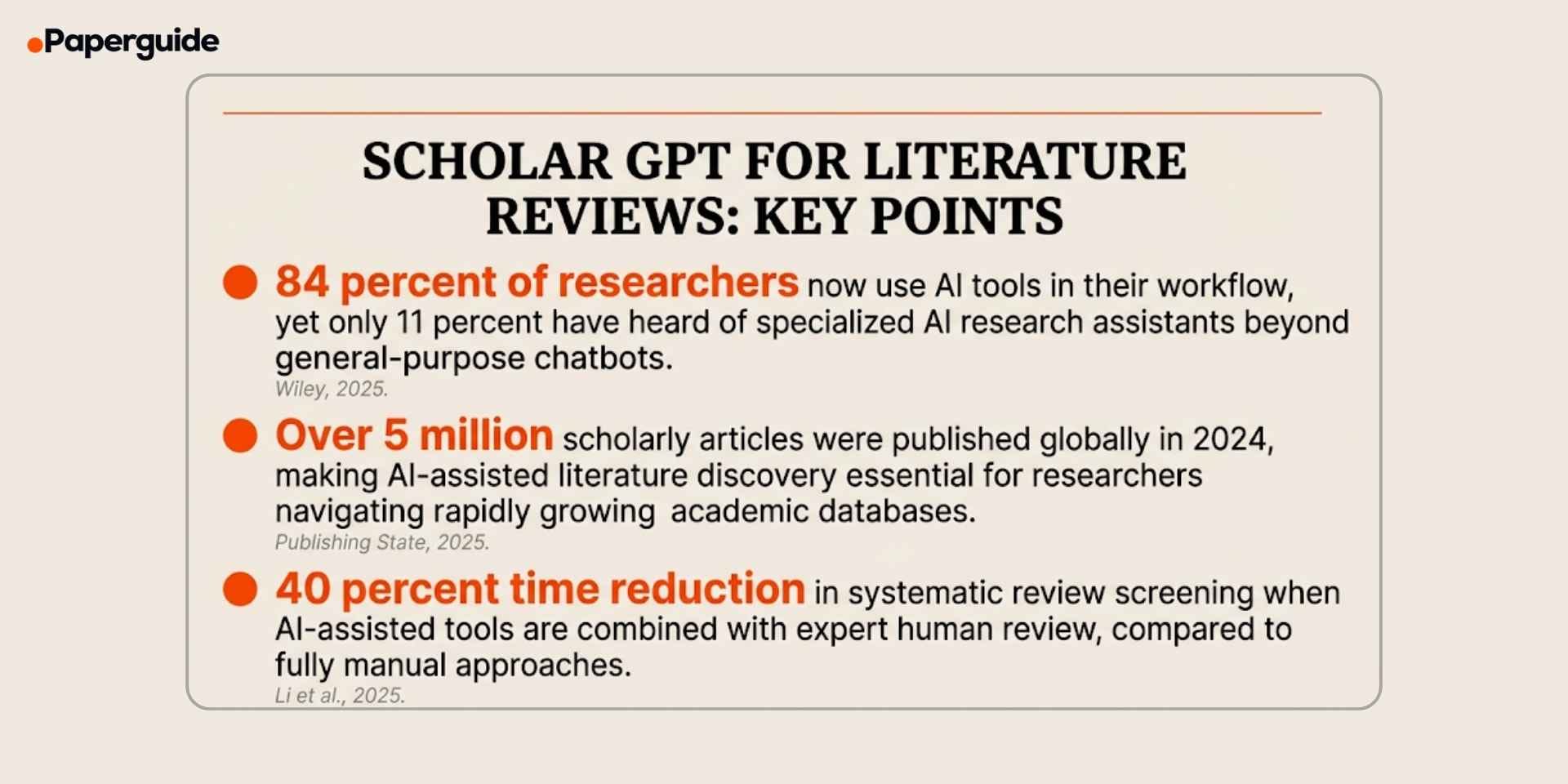
- AI-assisted screening can reduce literature review time by approximately 40 percent when paired with human expert oversight. [3]
- Tools like Paperguide's Scholar GPT search across 200 million+ papers and provide citation-backed results for faster discovery
The volume of published research has grown to a scale that makes manual literature searching increasingly impractical. Over 5 million scholarly articles were published in 2024 alone, and that number continues to climb each year. Researchers who rely solely on traditional keyword searches in a single database risk missing relevant studies published across different journals, conference proceedings, and preprint servers. [5]
Scholar GPT addresses this challenge by allowing researchers to describe what they are looking for in plain language rather than constructing Boolean search strings from scratch. Instead of entering "systematic review AND AI AND screening NOT radiology" into PubMed, a researcher can ask Scholar GPT to find recent studies examining how artificial intelligence tools improve the screening phase of systematic literature reviews. The tool translates that request into a structured search and returns papers with summaries, citations, and relevance indicators. [1]
However, using Scholar GPT effectively requires more than typing a question and accepting whatever appears. A 2025 Wiley survey of 2,430 researchers found that 84 percent now use AI tools, but 80 percent rely on general-purpose chatbots rather than specialized research tools. This gap means most researchers are not using AI in the most effective way for academic work. This guide provides a structured, verification-first approach to using Scholar GPT for literature reviews that maintains academic rigor while significantly reducing search time. [5]
What Is Scholar GPT?
Scholar GPT is a category of AI-powered academic search tools that use large language models to help researchers find, retrieve, and analyze scholarly literature through conversational queries. Unlike traditional database search interfaces that require Boolean operators and field-specific syntax, Scholar GPT tools accept natural language questions and return relevant academic papers with summaries, citation metadata, and relevance assessments. [1]
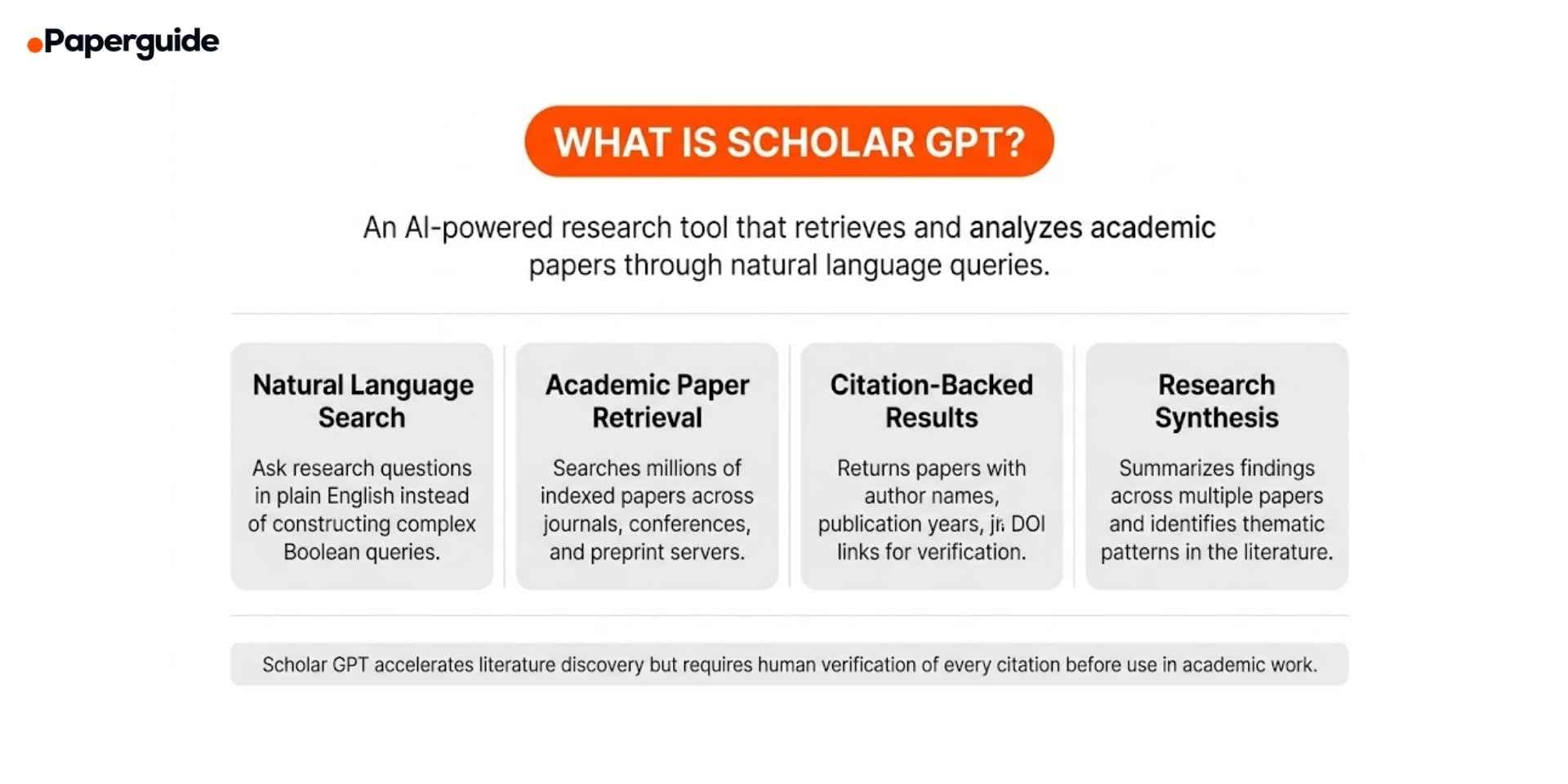
The technology works by combining large language model capabilities with access to academic paper indexes. When a researcher enters a query, the system processes the natural language input, identifies key concepts and relationships, searches indexed academic databases, and returns papers that match the research intent. Most Scholar GPT implementations provide paper titles, author names, publication dates, journal names, abstracts, and citation counts alongside brief AI-generated summaries of each paper's contribution. [2]
Scholar GPT tools are available in several forms. Some exist as custom GPTs within the ChatGPT ecosystem (requiring a ChatGPT Plus subscription), while others are built as standalone research platforms. Paperguide's Scholar GPT, for example, is a dedicated research tool that searches across 200 million+ indexed papers and provides citation-backed responses designed specifically for academic literature review workflows. The key distinction between Scholar GPT tools and general-purpose AI chatbots is that Scholar GPT is designed to retrieve real, verifiable academic sources rather than generating text from training data alone.
It is worth clarifying what Scholar GPT does not do. It does not replace the critical analysis that a researcher must perform when evaluating study quality, identifying methodological limitations, or synthesizing conflicting findings. Scholar GPT accelerates the discovery and initial screening phases of a literature review, but the intellectual work of evaluating, comparing, and integrating sources into a coherent narrative remains the researcher's responsibility. [4]
Why Use Scholar GPT for Literature Reviews
The primary advantage of Scholar GPT for literature reviews is speed without sacrificing coverage. Traditional literature searches require researchers to construct keyword combinations, test them across multiple databases, scan hundreds of titles and abstracts, and manually track which studies meet inclusion criteria. This process typically consumes weeks of dedicated effort, particularly for comprehensive or systematic reviews. [2]
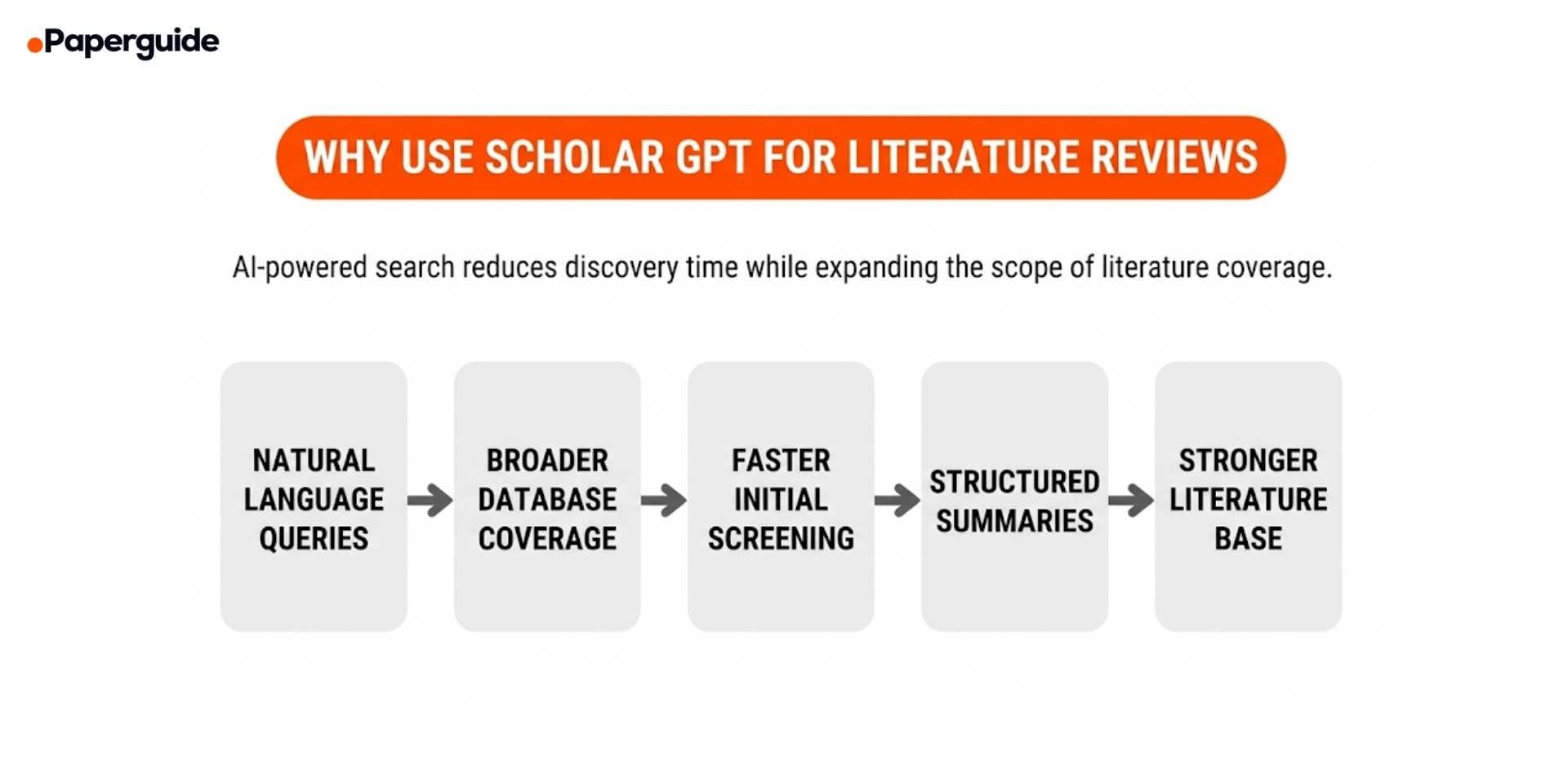
Scholar GPT compresses the discovery phase by allowing researchers to describe their topic in natural language and receive relevant papers within seconds. A researcher studying the relationship between sleep quality and academic performance in university students can simply ask for recent empirical studies on that topic and receive a curated list of papers, rather than spending hours testing different keyword permutations across PubMed, Scopus, and PsycINFO separately.
Research on AI-assisted literature reviews supports these efficiency gains. Li et al. (2025) found that AI-assisted screening achieved approximately 90 percent sensitivity and an F1 score of 82 when identifying relevant studies for systematic reviews in health technology assessment. Atkinson (2024) demonstrated that AI tools can reduce the time and cost of the data synthesis and abstraction stages of systematic reviews while maintaining methodological rigor. [2] [3]
Beyond speed, Scholar GPT expands the scope of literature discovery. Researchers often search only the databases they know well, which creates blind spots. A psychology researcher might search PsycINFO thoroughly but miss relevant papers published in education or medical journals. Scholar GPT tools that index across multiple databases simultaneously help researchers identify cross-disciplinary studies they might otherwise overlook .
The Wiley (2025) survey revealed an important nuance: while 62 percent of researchers now use AI specifically for research and publication tasks, 80 percent rely on general-purpose tools like ChatGPT rather than specialized AI research assistants. Only 11 percent of researchers have even heard of dedicated research tools. This means most researchers using AI for literature reviews are relying on general-purpose chatbots that lack the academic database integration, citation verification, and structured output formats that specialized tools provide. [5]
How to Use Scholar GPT for Literature Reviews: Step-by-Step
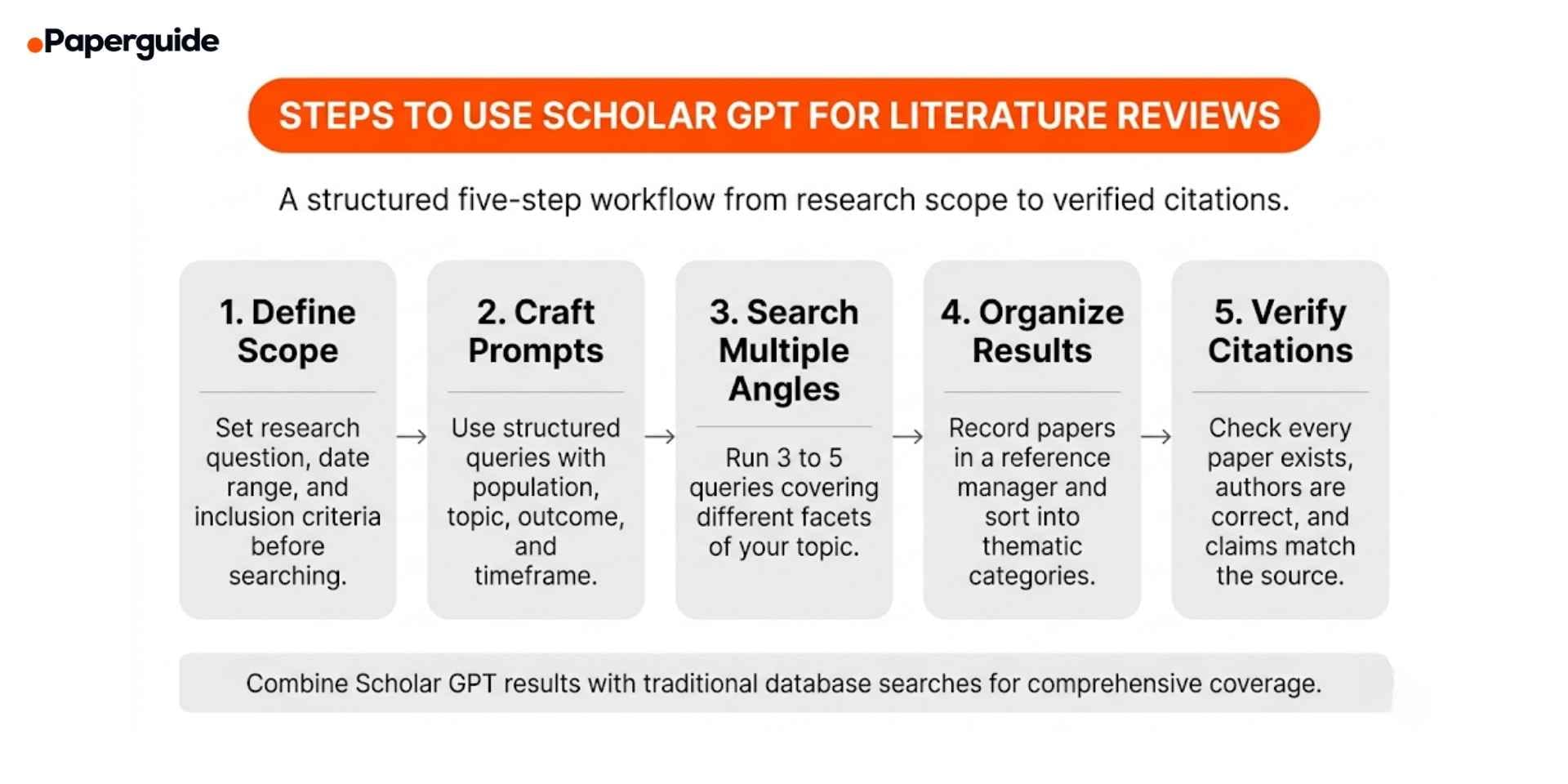
Using Scholar GPT effectively requires a structured approach rather than ad hoc querying. The following steps outline a systematic workflow that balances AI-assisted discovery with the verification rigor that academic work demands.
Step 1: Define Your Research Scope Before Searching
Before opening Scholar GPT, write down three things: your specific research question, the date range you want to cover, and any methodological or geographic constraints. A well-defined scope prevents the common mistake of running vague searches that return hundreds of loosely related papers.
For example, instead of searching for "AI in education," define your scope as: "Empirical studies published between 2020 and 2026 examining the impact of AI-powered tutoring systems on undergraduate STEM learning outcomes in university settings."
Step 2: Craft Targeted Prompts
Scholar GPT responds best to prompts that include specific parameters. Structure your queries to include the population, intervention or topic, outcome, and timeframe.
Example prompt: "Find peer-reviewed studies from 2021 to 2026 that examine how AI writing assistants affect the quality of graduate-level academic writing, including any studies that measure revision behavior or citation accuracy."
Avoid single-word or overly broad queries. "Literature review AI" will return generic results. "Recent studies evaluating AI-assisted screening tools for systematic literature reviews in health sciences" will return focused, relevant papers.
Step 3: Run Multiple Search Angles
A single query will not capture your entire topic. Run at least three to five searches from different angles. If your topic is AI-assisted literature reviews, search for:
- Studies evaluating specific AI tools for literature screening
- Research comparing AI-assisted versus manual literature review methods
- Papers examining accuracy and hallucination rates in AI-generated citations
- Reviews of researcher attitudes toward AI tools in academic workflows
- Methodological guidance for integrating AI into systematic review protocols
Each angle surfaces papers that the others miss. This multi-angle approach mirrors the iterative search strategy recommended in traditional systematic review methodology.
Step 4: Record and Organize Results Immediately
As Scholar GPT returns papers, create a tracking spreadsheet or use a reference manager to record each paper's title, authors, year, journal, DOI, and a brief note on why it is relevant to your review. Do not rely on Scholar GPT's conversation history as your primary record.
Organize papers into thematic categories from the start. Common categories include: theoretical frameworks, empirical studies supporting your hypothesis, empirical studies contradicting your hypothesis, methodological references, and review articles. This early organization saves significant time when you begin writing your review.
Step 5: Verify Every Citation
This step is non-negotiable. Every paper Scholar GPT returns must be verified before you cite it. Check the following for each paper:
- Does the paper actually exist? Search the DOI or title in Google Scholar or the publisher's website
- Are the author names correct and complete?
- Is the publication year accurate?
- Does the paper actually say what Scholar GPT claims it says?
- Is the journal legitimate and peer-reviewed?
AI tools occasionally return papers with incorrect metadata or conflated details from multiple sources. A five-minute verification check prevents the embarrassment of citing a paper that does not exist or attributing findings to the wrong authors.

Common Mistakes When Using Scholar GPT for Literature Reviews
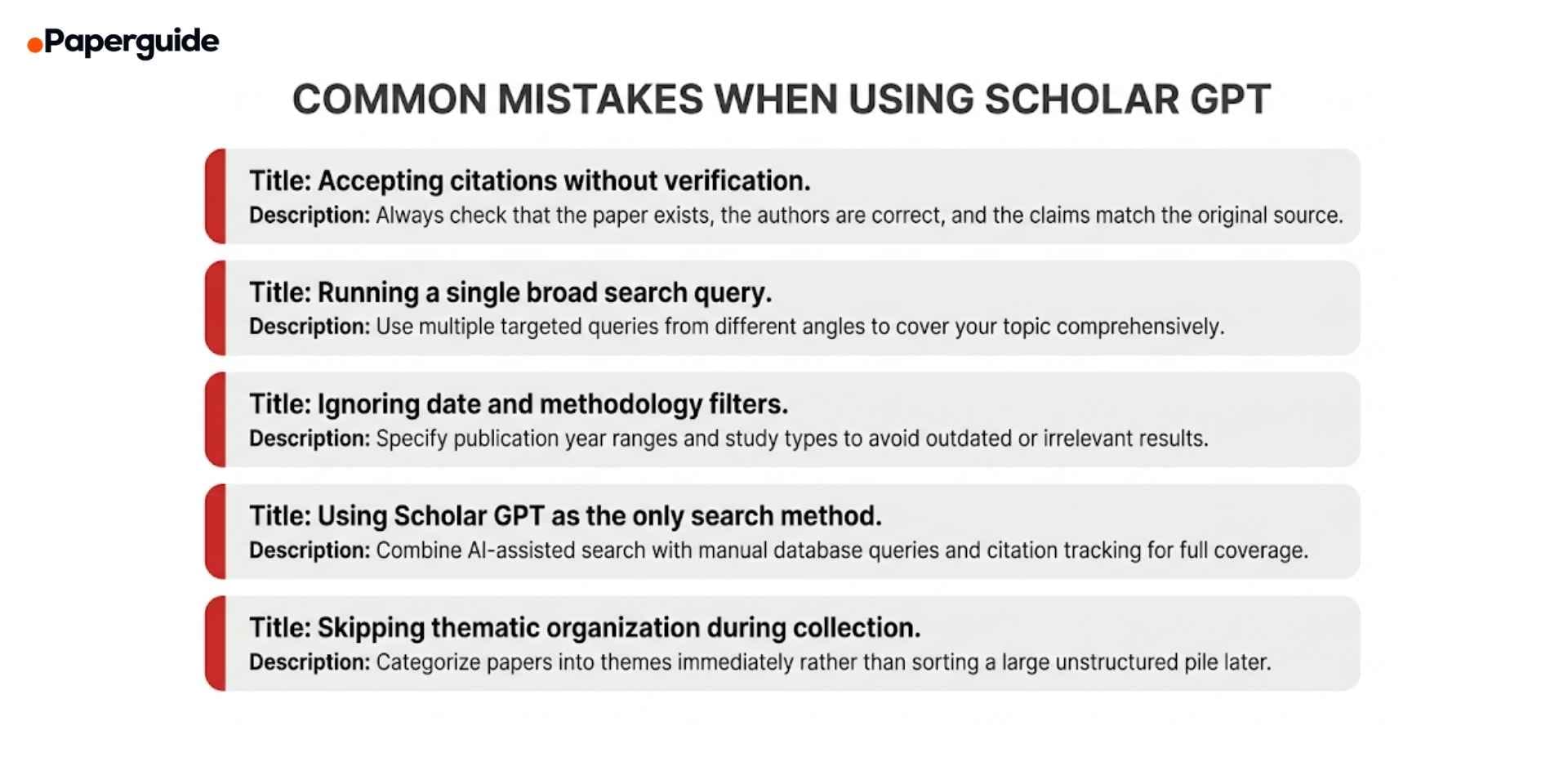
Understanding what to avoid is as important as knowing the correct workflow. These are the most frequent errors researchers make when incorporating Scholar GPT into their literature review process.
The most damaging mistake is treating Scholar GPT output as automatically reliable. AI language models can occasionally generate plausible-sounding citations that contain incorrect author names, wrong publication years, or entirely fabricated paper titles. Bolaños et al. (2024) documented that while AI tools have improved significantly in literature screening accuracy, verification remains essential because no current tool achieves perfect precision. Every citation must be checked against its original source before it appears in your work.
A second common error is relying on a single search query. Researchers who type one question into Scholar GPT and use only those results will miss relevant studies that use different terminology, approach the topic from another discipline, or frame the research question differently. Systematic review methodology has long emphasized that comprehensive literature coverage requires multiple search strategies.
Third, many researchers forget to specify date ranges and study type filters. Without these constraints, Scholar GPT may return foundational but outdated studies alongside recent empirical work, creating an unbalanced review. If your review focuses on developments in the last five years, say so explicitly in your prompt.
Fourth, using Scholar GPT as the only search method creates coverage gaps. AI-assisted search should complement traditional database searches, not replace them. Running parallel searches in Google Scholar, Scopus, or your discipline-specific database ensures you catch papers that Scholar GPT's index may not include. Backward citation tracking (reviewing the reference lists of key papers) and forward citation tracking (finding papers that cite key studies) add another layer of completeness that no AI tool fully replicates.
Finally, researchers who collect dozens of papers without immediately organizing them into categories create unnecessary work for themselves. Literature reviews require thematic synthesis, and building that structure during collection rather than after makes the writing process significantly more efficient.
Scholar GPT vs Traditional Literature Search Methods
Understanding when to use Scholar GPT versus traditional methods helps researchers allocate their time effectively. The following comparison highlights the strengths and limitations of each approach.
| Feature | Scholar GPT | Traditional Database Search |
|---|---|---|
| Query format | Natural language questions | Boolean operators and field codes |
| Learning curve | Low, conversational interface | Moderate to high, database-specific syntax |
| Speed of initial results | Seconds | Minutes to hours per database |
| Cross-database coverage | Searches multiple indexes simultaneously | One database at a time |
| Citation accuracy | Requires manual verification | Citations pulled directly from database records |
| Advanced filters | Limited, prompt-dependent | Extensive (date, language, study type, MeSH terms) |
| Citation tracking | Limited or unavailable | Supported (cited by, references) |
| Best for | Discovery phase, initial scoping | Comprehensive systematic searches, final verification |
The most effective approach combines both methods. Use Scholar GPT for the initial discovery phase to quickly identify the landscape of available research, then use traditional databases to verify, expand, and ensure completeness. Fütterer et al. (2026) found that among 282 AI tools screened for systematic review capability, only seven met rigorous inclusion criteria, reinforcing that AI tools work best as complements to rather than replacements for established methods.
For researchers working on systematic reviews, this hybrid approach is particularly important because reporting standards like PRISMA require transparent documentation of search strategies, and relying solely on an AI tool does not meet those documentation requirements.
Literature Review Checklist for Scholar GPT Users
Use this checklist to ensure your Scholar GPT-assisted literature review meets academic standards.
Before Searching
- [ ] Research question is clearly defined with specific scope boundaries
- [ ] Date range for included studies is established
- [ ] Inclusion and exclusion criteria are documented
- [ ] Target databases for cross-verification are identified (minimum two)
During Searching
- [ ] At least three to five search queries run from different angles
- [ ] Results recorded in reference manager or tracking spreadsheet
- [ ] Papers organized into thematic categories as they are collected
- [ ] Duplicate papers identified and removed
After Searching
- [ ] Every citation verified against original source (DOI, authors, year, journal)
- [ ] Claims attributed to each paper confirmed by reading the abstract or full text
- [ ] Backward citation tracking completed for key papers
- [ ] Forward citation tracking completed for seminal studies
- [ ] Coverage gaps identified and additional targeted searches conducted
Before Writing
- [ ] Thematic categories finalized and logical order determined
- [ ] Conflicting findings between studies identified and noted
- [ ] Methodological limitations of included studies documented
- [ ] Sufficient recent sources included (priority on 2020 to 2026 publications)
Validate your literature search with Paperguide (2 minutes)
Step 1: Open PDF Summarizer and upload a key paper from your Scholar GPT results.
Step 2: Review the AI-generated summary and compare it to what Scholar GPT reported about the same paper.
Step 3: Check whether the paper's actual findings, methodology, and conclusions match the descriptions Scholar GPT provided.
Conclusion
Scholar GPT transforms the most time-consuming phase of literature reviews, finding relevant papers, into a faster and more comprehensive process. The key to using it well is maintaining a verification-first mindset: let Scholar GPT accelerate your discovery, but verify every citation, cross-check with traditional databases, and organize your findings thematically from the start. Researchers who combine AI-assisted search with human critical analysis produce literature reviews that are both thorough and academically rigorous.
Conclusion
Scholar GPT transforms the most time-consuming phase of literature reviews, finding relevant papers, into a faster and more comprehensive process. The key to using it well is maintaining a verification-first mindset: let Scholar GPT accelerate your discovery, but verify every citation, cross-check with traditional databases, and organize your findings thematically from the start. Researchers who combine AI-assisted search with human critical analysis produce literature reviews that are both thorough and academically rigorous. Start with Paperguide's Scholar GPT to search 200 million+ papers and build a stronger evidence base for your next review.
Frequently Asked Questions
Is Scholar GPT free to use?
Availability depends on the platform. Scholar GPT custom GPTs within ChatGPT require a ChatGPT Plus subscription. Paperguide's Scholar GPT is available through Paperguide's free plan with limited AI credits, and higher-tier plans provide expanded access. The free plan includes 1,000 AI credits per month and 20 AI searches.
Can I trust the citations Scholar GPT provides?
Scholar GPT citations should be treated as starting points, not verified references. Always check that the paper exists by searching its DOI or title in Google Scholar or the publisher's website, confirm the author names and publication year, and verify that the paper actually supports the claims Scholar GPT attributes to it. AI tools can occasionally return papers with incorrect metadata or conflate details from multiple sources.
How does Scholar GPT differ from Google Scholar?
Google Scholar is a search index that returns papers matching keyword queries. Scholar GPT is an AI-powered tool that interprets natural language questions, searches academic databases, and provides summarized results with context. Google Scholar requires you to construct your own search terms and manually read through results. Scholar GPT processes your research question and returns targeted papers with summaries. Both tools are most effective when used together.
Will my professor know I used Scholar GPT?
Using Scholar GPT for literature discovery is no different from using any other search tool. The academic concern is not about which tool you used to find papers but whether you have read, understood, and properly cited the sources in your review. Many universities now provide guidelines on disclosing AI tool usage in research. Check your institution's policy and include a brief methodology note if required.
How many papers should I find with Scholar GPT for my literature review?
The number depends on your review type and topic breadth. A focused thesis chapter might include 30 to 50 sources, while a comprehensive systematic review could include several hundred. Scholar GPT helps with the discovery phase, but your inclusion and exclusion criteria should determine the final count, not the number of results the tool returns.
Can Scholar GPT replace a systematic literature search?
No. Systematic reviews require documented, reproducible search strategies with specific database queries, date ranges, and inclusion criteria. Scholar GPT can supplement a systematic search by identifying papers you might have missed, but it cannot replace the structured Boolean searches and transparent reporting that systematic review methodology requires. Use Scholar GPT alongside traditional databases, not instead of them.
What types of literature reviews can Scholar GPT help with?
Scholar GPT supports all types of literature reviews including narrative reviews, scoping reviews, systematic reviews, and thesis literature review chapters. It is most helpful during the discovery and initial screening phases, regardless of review type. For systematic reviews specifically, Scholar GPT should be used as a supplementary search tool alongside formal database queries.
References
- Bolaños, F., Salatino, A., Osborne, F. & Motta, E. "Artificial Intelligence for Literature Reviews: Opportunities and Challenges." Artificial Intelligence Review, 57(10), 259, Springer, 2024.
- Atkinson, C. F. "Cheap, Quick, and Rigorous: Artificial Intelligence and the Systematic Literature Review." Social Science Computer Review, 42(2), 376-393, SAGE, 2024.
- Li, Y., Datta, S., Rastegar-Mojarad, M., Lee, K., Paek, H., Glasgow, J., Liston, C., He, L., Wang, X. & Xu, Y. "Enhancing Systematic Literature Reviews with Generative Artificial Intelligence: Development, Applications, and Performance Evaluation." Journal of the American Medical Informatics Association, 32(4), 616-625, Oxford Academic, 2025.
- Fütterer, T., Campos, D. G., Gfrörer, T., Lavelle-Hill, R., Murayama, K. & Scherer, R. "AI Tools for Systematic Literature Reviews and Meta-Analyses in Educational Psychology: An Overview and a Practical Guide." Learning and Individual Differences, 126, 102849, Elsevier, 2026.
- Wiley. "AI Adoption Jumps to 84% Among Researchers as Expectations Undergo Significant Reality Check." Wiley Newsroom, October 2025.