5 Best ScholarGPT Tools for Literature Review in 2026

ScholarGPT tools are changing how researchers approach literature reviews by making it easier to search academic papers, explore research topics, and get citation-backed answers in seconds. Instead of manually navigating multiple databases, researchers can now ask focused questions and quickly discover relevant studies, summaries, and insights.
However, “ScholarGPT” is not a single tool. It is a broad term used to describe research-focused GPTs and AI assistants, including custom GPTs inside ChatGPT and specialized tools designed for academic workflows. This often makes it difficult to understand which tools are actually useful for literature review tasks and how they differ from one another.
In this guide, we compare the best ScholarGPT tools for literature review in 2026 based on how well they support real research workflows. From finding relevant papers to understanding studies and working with citation-backed outputs, this guide focuses on tools that help researchers move faster while maintaining accuracy and reliability.
Key Takeaways
- ScholarGPT tools are research-focused GPTs and AI assistants that help find papers, answer academic questions, and provide citation-backed insights for literature review workflows.
- The best ScholarGPT tools for literature review in 2026 include Paperguide Scholar GPT, Scholar GPT (ChatGPT custom GPT), Consensus, ScholarAI, and SciSpace Copilot.
- These tools are most effective for discovery and understanding research papers, but they do not fully replace the need for structured literature review workflows.
- Citation accuracy remains a key concern, as ScholarGPT tools can sometimes generate incorrect or incomplete references, making verification essential.
- Researchers often use multiple tools together, combining ScholarGPT tools for exploration with other tools for organizing, analyzing, and writing literature reviews.
- Choosing the right tool depends on your research stage, whether you are exploring a topic, comparing studies, or preparing a structured review of related literature.
What Are the Best ScholarGPT Tools in 2026?
The best ScholarGPT tools for literature review in 2026 include Paperguide Scholar GPT, Scholar GPT (ChatGPT custom GPT), Consensus, ScholarAI, and SciSpace Copilot. These tools help researchers find academic papers, ask research questions, and get citation-backed answers more efficiently.
Each tool is designed for a slightly different part of the research workflow. Paperguide Scholar GPT and Scholar GPT are commonly used for research queries and quick discovery, while tools like Consensus and ScholarAI focus on evidence-based answers and structured insights. SciSpace Copilot is particularly useful for understanding complex research papers and simplifying technical content.
While these tools are highly effective for exploring topics and retrieving information, they work best when used as part of a broader literature review workflow. Researchers often combine multiple tools to move from discovery to analysis and eventually to writing a structured review of related literature.
Best ScholarGPT Tools for Literature Review in 2026
| Tool | Best For | Research Q&A | Citations | PDF Support | Free Plan |
|---|---|---|---|---|---|
| Paperguide Scholar GPT | Complete research workflow | Yes | Yes | Yes | Yes |
| Scholar GPT (ChatGPT) | General research queries | Yes | Limited | Limited | Yes |
| Consensus | Evidence-based answers | Yes | Yes | No | Yes |
| ScholarAI | Research insights + papers | Yes | Yes | Limited | Yes |
| SciSpace Copilot | Understanding research papers | Yes | Yes | Yes | Freemium |
These ScholarGPT tools are designed to help researchers find papers, ask academic questions, and get citation-backed answers more efficiently. While some tools focus on research queries and discovery, others are better suited for understanding complex studies or verifying evidence.
Paperguide Scholar GPT stands out as the most complete option by combining research-focused question answering with citation-backed outputs and broader workflow support. Other tools like Consensus and ScholarAI are useful for evidence-based answers, while SciSpace Copilot is particularly helpful for simplifying and understanding research papers.
Top ScholarGPT Tools (Quick Summary)
- Paperguide Scholar GPT – Best overall for literature review workflows, combining research question answering, citation-backed insights, and seamless integration with broader research tools.
- Scholar GPT (ChatGPT custom GPT) – Best for general research queries and quick exploration using a conversational interface inside ChatGPT
- Consensus – Best for evidence-based answers, helping researchers verify claims using peer-reviewed studies.
- ScholarAI – Best for retrieving research papers and generating structured insights across academic sources.
- SciSpace Copilot – Best for understanding complex research papers through simplified explanations and contextual insights.
Best ScholarGPT Tools for Literature Review in 2026 (Detailed Comparison)
ScholarGPT tools vary in how they support literature review workflows, with some focused on answering research questions and others better suited for understanding studies or verifying evidence. Choosing the right tool depends on whether your goal is discovery, analysis, or working with citation-backed insights. Below is a detailed comparison of the best ScholarGPT tools based on their strengths and use cases.
1. Paperguide Scholar GPT
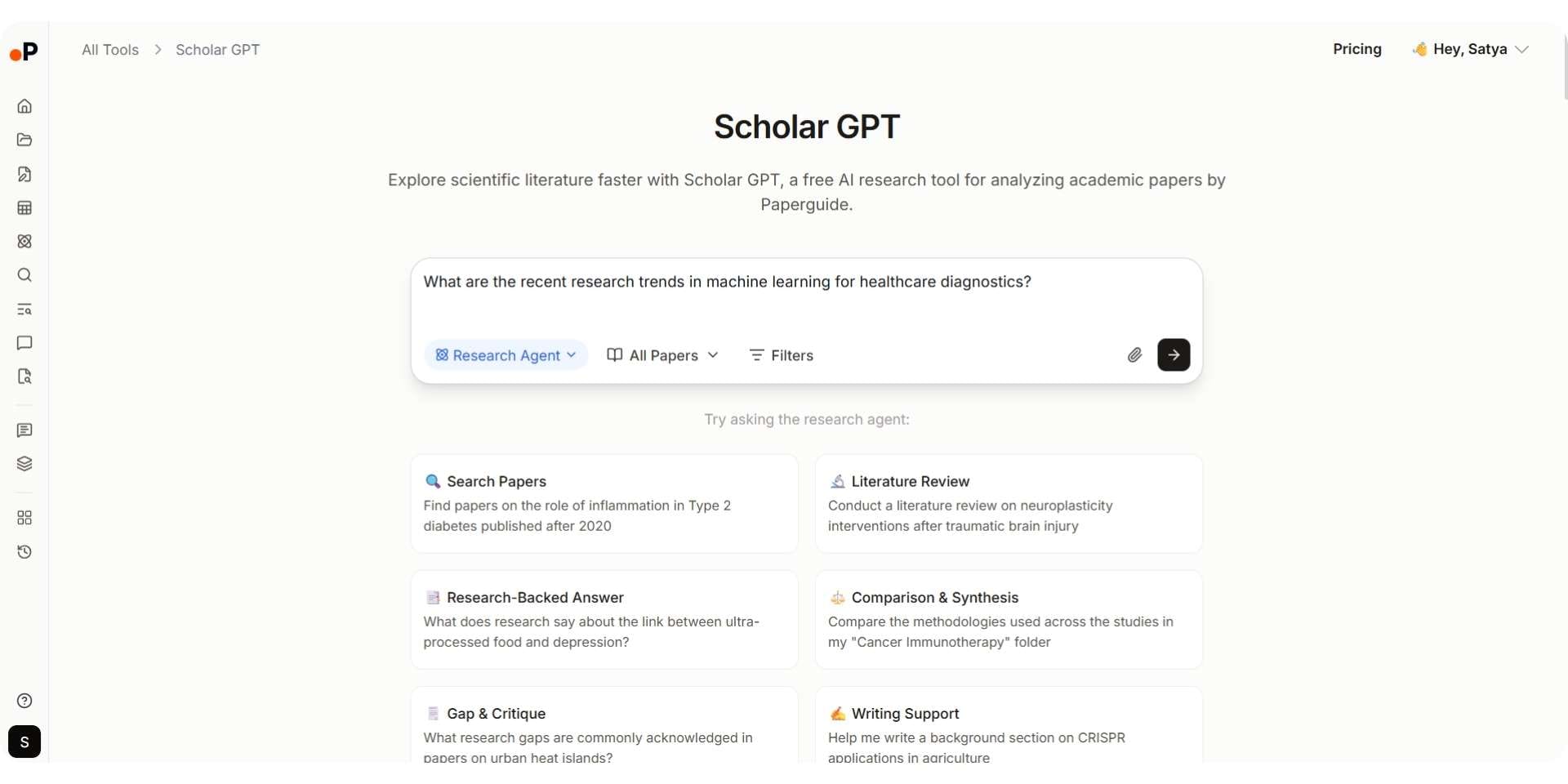
Paperguide Scholar GPT is designed for researchers who want a faster and more reliable way to explore academic topics, find relevant research papers, and get citation-backed answers. Unlike general-purpose AI tools, it focuses specifically on research workflows, making it more suitable for literature review tasks.
Instead of manually searching across multiple databases, you can ask research questions and receive structured responses that reference real academic sources. This makes it particularly useful in the early stages of a literature review, where identifying relevant studies and understanding key concepts is critical.
For academic workflows such as thesis and dissertation writing, simply finding papers is not enough. Researchers need to understand studies, identify key findings, and evaluate sources before organizing them into a structured review. Paperguide Scholar GPT helps streamline this process by combining discovery and understanding into a single interface.
Key Features
- Ask research questions and get citation-backed answers
- Discover relevant research papers quickly
- Generate structured responses based on academic sources
- Designed specifically for literature review and research workflows
Pros
- Built for academic research use cases
- Provides citation-backed insights instead of generic responses
- Reduces time spent on manual paper search
- Works well as a starting point for literature review
Cons
- Focused primarily on discovery and question answering
- Requires verification of citations before use
Best For
Students, researchers, and academics who need a reliable way to explore research topics, find papers, and get citation-backed answers during the early stages of a literature review.
Pricing
Paperguide Scholar GPT is completely free to use, making it accessible for students and researchers without any cost barrier.
Verdict
Paperguide Scholar GPT is the best overall ScholarGPT tool for literature review because it combines research-focused question answering with citation-backed outputs in a fully accessible format. It is particularly effective for discovering relevant studies and understanding research topics before moving into deeper analysis and structured writing.
2. Scholar GPT
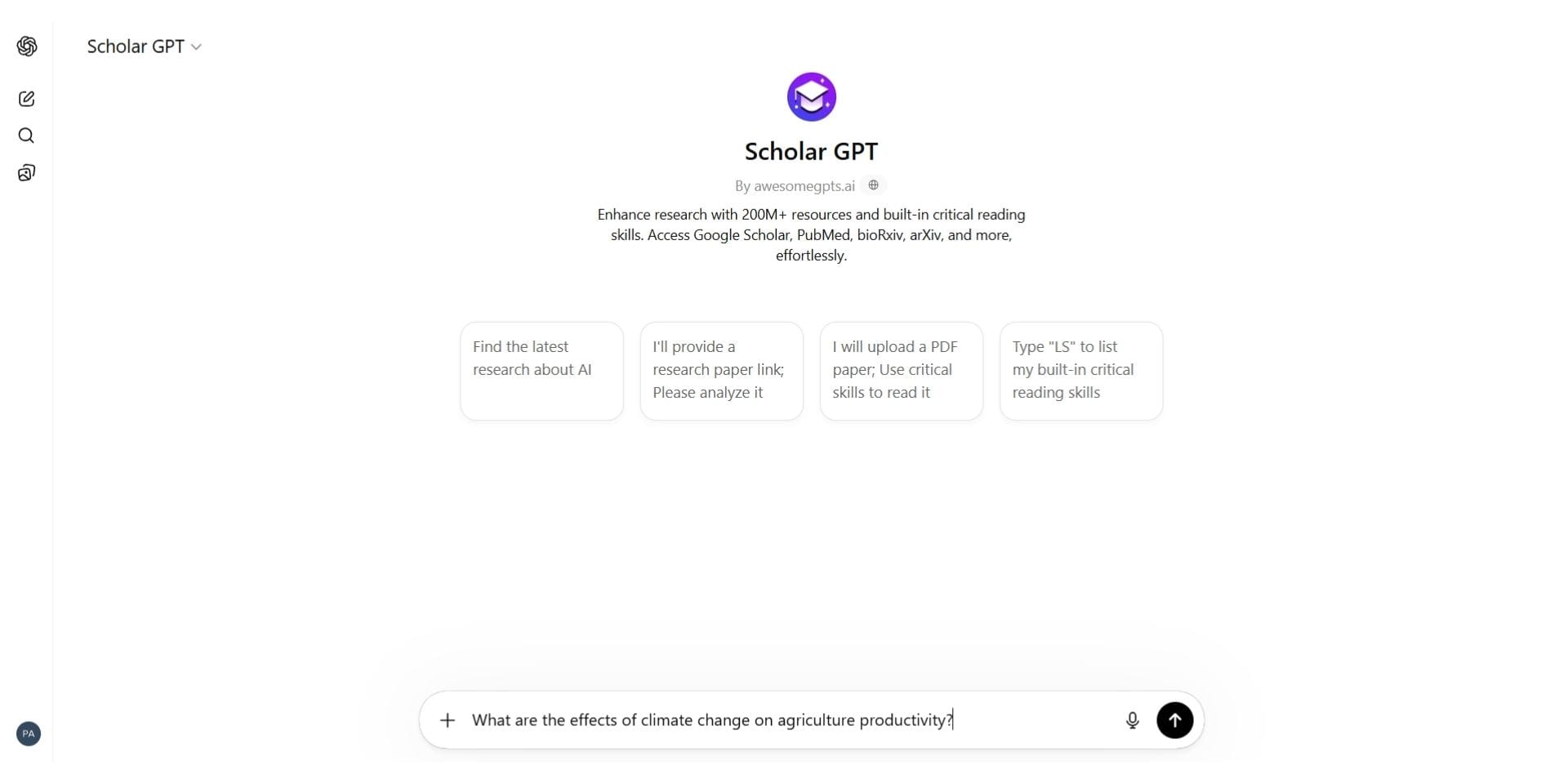
Scholar GPT is a custom GPT available within ChatGPT that is commonly used for academic research tasks such as finding papers, summarizing studies, and answering research questions. It operates through a conversational interface, allowing users to explore topics using natural language queries.
One of its main advantages is accessibility. Users can quickly ask questions related to a research topic and receive structured responses without needing to learn a new platform. This makes it useful for quick exploration and early-stage literature review tasks.
However, since it depends on how it is configured and the sources it accesses, the quality of citations and accuracy of responses can vary. It is best used as a general research assistant rather than a fully reliable source for academic references.
Key Features
- Conversational interface for research queries
- Ability to summarize and explain research topics
- Quick access to general academic insights
- Custom GPT setup inside ChatGPT
Pros
- Easy to use with natural language queries
- No learning curve for ChatGPT users
- Useful for quick research exploration
Cons
- Citation accuracy can vary
- Limited transparency in sources
- Not designed for structured literature review workflows
Best For
Students and researchers who want a quick and accessible way to explore research topics and generate initial insights.
Pricing
Scholar GPT is available through ChatGPT and is typically free to use, with additional capabilities depending on the ChatGPT plan.
Verdict
Scholar GPT is a convenient option for quick research queries and topic exploration. However, it is less reliable for citation-heavy tasks and structured literature review workflows compared to more specialized research tools.
3. Consensus
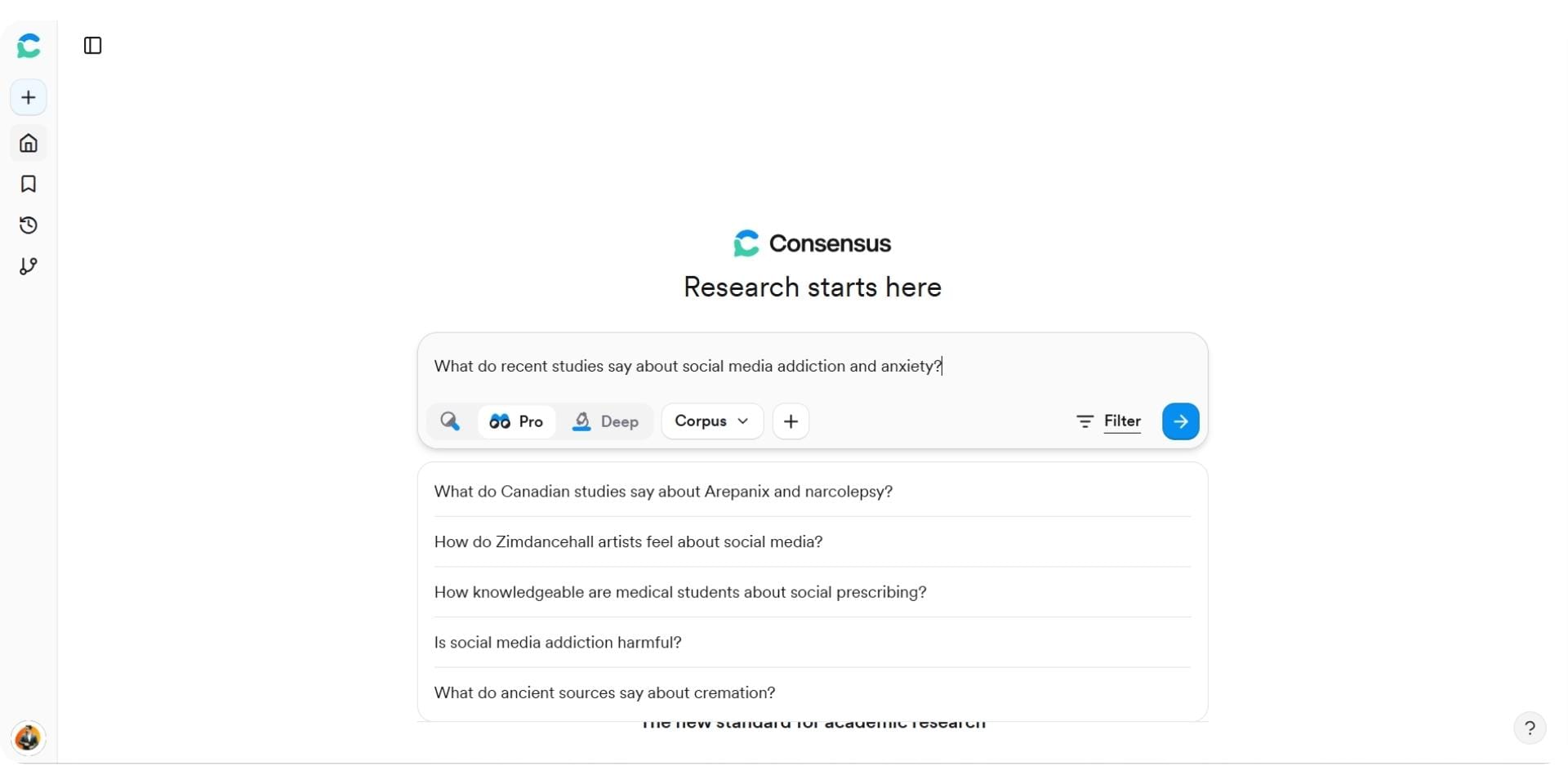
Consensus is an AI-powered research assistant that focuses on answering academic questions using evidence from peer-reviewed research. Instead of generating generic responses, it highlights findings from scientific studies and presents them in a structured format.
A key strength of Consensus is its emphasis on evidence-backed answers. It often shows whether research supports or contradicts a specific claim, making it useful for verifying information during a literature review.
However, while it is effective for answering questions and validating claims, it is not designed to organize multiple studies or build a structured review of related literature.
Key Features
- Answers research questions using peer-reviewed papers
- Highlights supporting and opposing evidence
- Provides citation-backed summaries
- Focus on scientific and academic research
Pros
- Strong emphasis on evidence-based answers
- Useful for verifying claims and findings
- Clean and structured outputs
Cons
- Limited support for organizing research papers
- Not designed for full literature review workflows
- Less flexible for exploratory research
Best For
Researchers who want to verify claims and get evidence-backed answers from academic studies.
Pricing
Consensus offers a free plan with basic access, along with paid plans for higher usage and advanced features.
Verdict
Consensus is a strong tool for evidence-based research and verifying academic claims. However, it is better suited for validation and question answering rather than building a complete literature review workflow.
4. ScholarAI
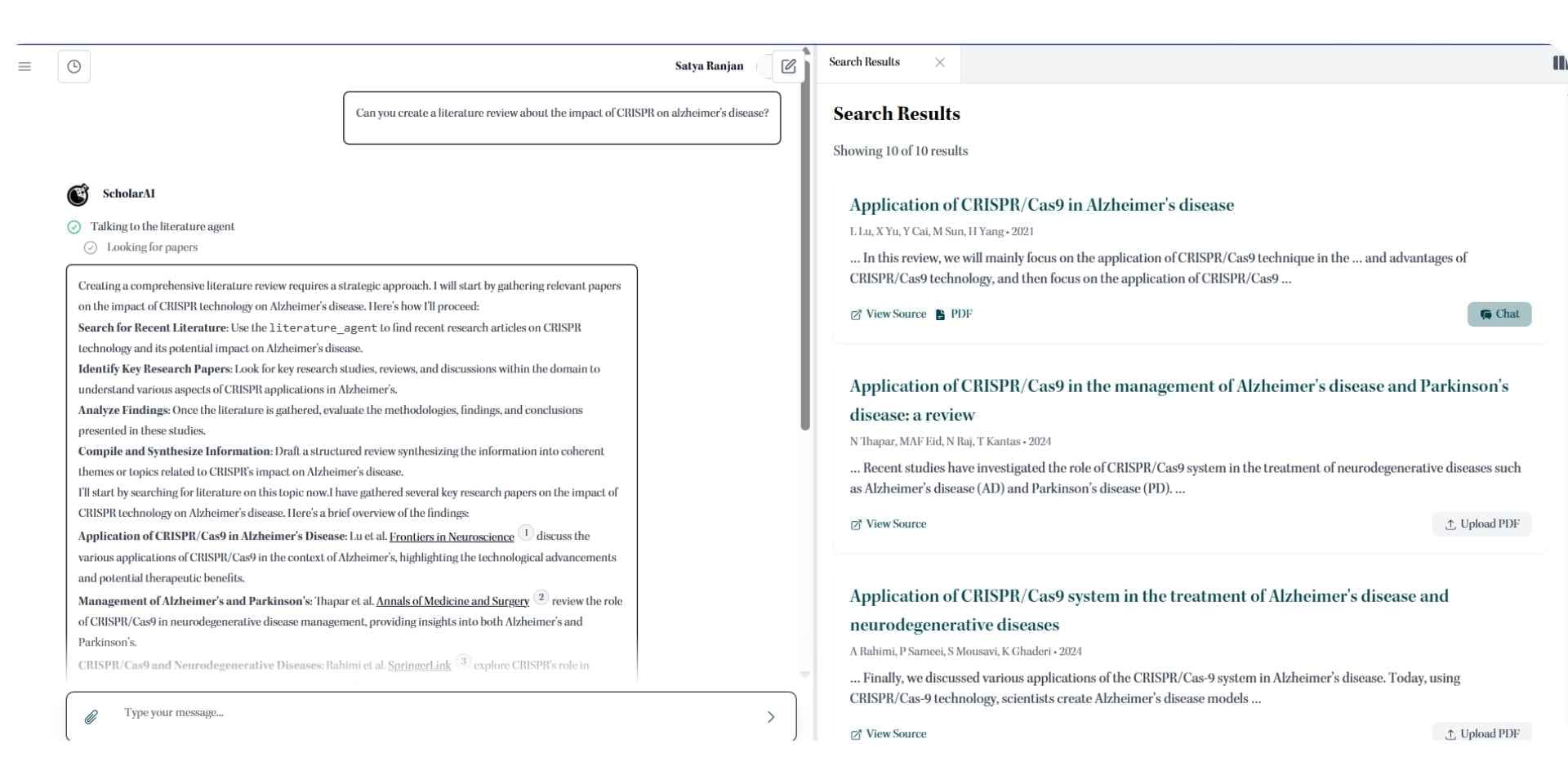
ScholarAI is designed to help users search academic papers, retrieve relevant studies, and generate structured insights based on research data. It focuses on connecting users with academic content through AI-powered queries.
The tool is particularly useful for retrieving papers and summarizing key points across studies. It provides structured responses that can help researchers quickly understand research topics without manually reading multiple papers.
However, while ScholarAI supports discovery and summarization, it does not provide strong features for organizing studies or generating a structured literature review.
Key Features
- Search and retrieve academic research papers
- Generate structured summaries of studies
- AI-powered research queries
- Access to academic datasets
Pros
- Good for discovering research papers
- Provides structured insights
- Useful for quick topic understanding
Cons
- Limited support for organizing studies
- No structured literature review output
- Requires additional tools for full workflow
Best For
Researchers who need to find papers and generate structured insights quickly.
Pricing
ScholarAI offers both free and paid access, depending on usage limits and features.
Verdict
ScholarAI is useful for retrieving research papers and generating structured insights. However, it is more suitable for discovery and summarization rather than building a complete literature review.
5. SciSpace Copilot
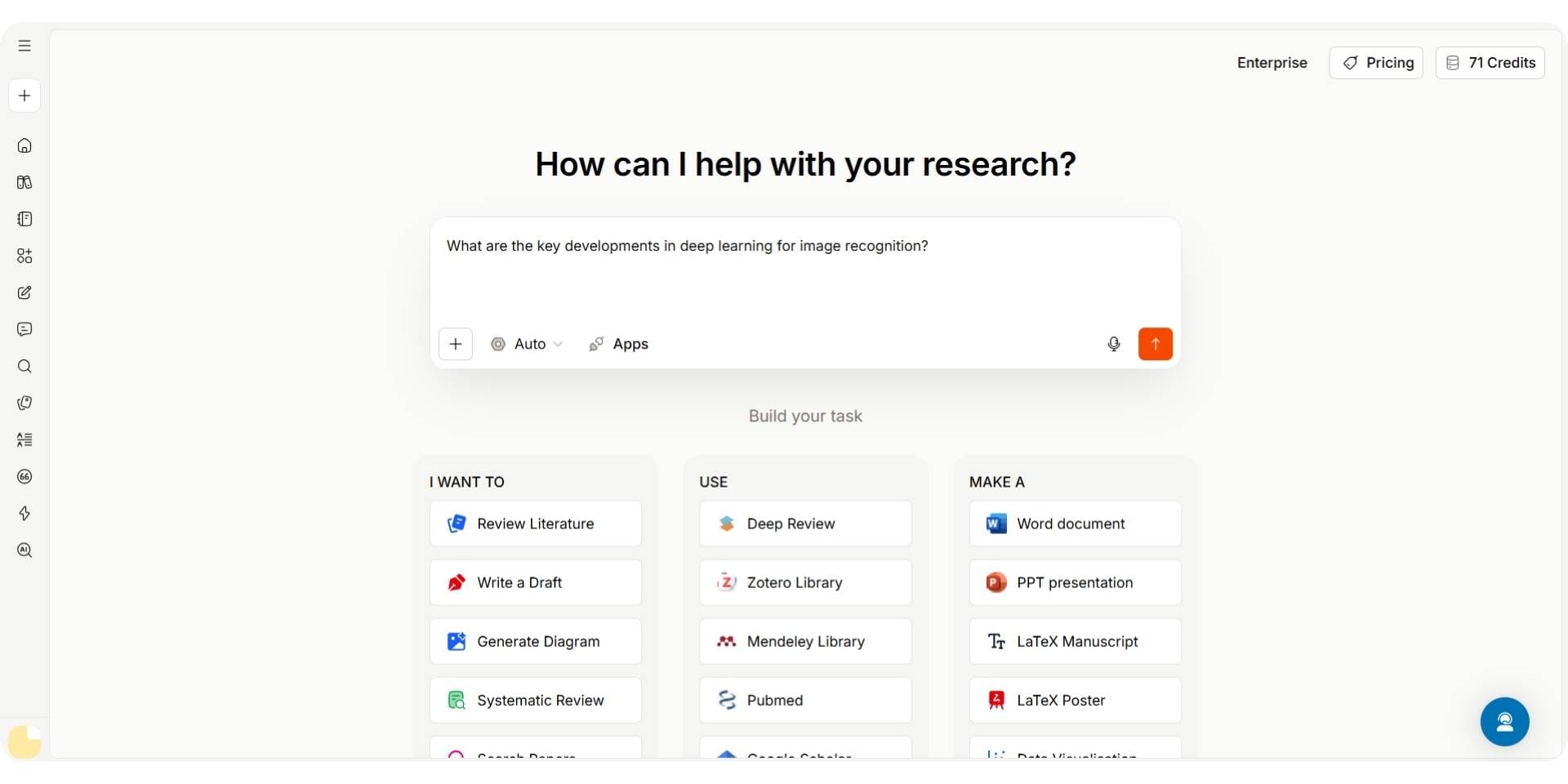
SciSpace Copilot is a research-focused AI assistant designed to help users understand academic papers through simplified explanations and contextual insights. It is particularly helpful for breaking down complex studies into more accessible language.
One of its main strengths is its ability to explain difficult concepts within research papers, making it especially useful for students or researchers working in unfamiliar domains. It also allows users to interact directly with papers and ask questions about specific sections.
However, while SciSpace Copilot is effective for understanding research papers, it does not provide strong support for organizing studies or building a structured literature review workflow.
Key Features
- Explain complex research papers in simple terms
- Interactive Q&A with academic content
- Contextual insights from research papers
- Support for PDF-based interaction
Pros
- Excellent for understanding complex studies
- Beginner-friendly interface
- Helps interpret technical content
Cons
- Limited support for structured literature review workflows
- Not designed for organizing or comparing studies
- Requires additional tools for full research workflow
Best For
Students and researchers who need help understanding complex research papers and concepts.
Pricing
SciSpace follows a freemium model, with a free plan and paid plans that unlock advanced features and higher usage limits.
Verdict
SciSpace Copilot is a strong tool for understanding research papers and simplifying complex content. However, it is better suited for comprehension rather than building a complete literature review workflow.
Final Comparison: Best ScholarGPT Tools in 2026
Not all ScholarGPT tools serve the same purpose. While they are all designed to help with academic research, their strengths vary depending on whether the goal is answering research questions, verifying evidence, retrieving papers, or understanding complex studies.
The table below highlights the key differences between the best ScholarGPT tools based on their core capabilities and use cases.
Comparison by Use Case
| Use Case | Best Tool | Why This Tool |
|---|---|---|
| Best overall ScholarGPT tool | Paperguide Scholar GPT | Combines research Q&A, citation-backed answers, and workflow support for literature review |
| Best free ScholarGPT tool | Paperguide Scholar GPT | Fully free with no cost barrier for core research workflows |
| Best for general research queries | Scholar GPT (ChatGPT) | Easy conversational interface for quick topic exploration |
| Best for evidence-based answers | Consensus | Provides answers backed by peer-reviewed research |
| Best for research paper discovery | ScholarAI | Retrieves papers and generates structured insights |
| Best for understanding research papers | SciSpace Copilot | Simplifies complex studies and explains technical content |
While each tool performs well in specific areas, no single ScholarGPT tool fully covers the entire literature review workflow. Paperguide Scholar GPT stands out by offering the most balanced approach, combining discovery, understanding, and citation-backed responses in one interface.
ScholarGPT Tools Are Not Enough for Literature Review
While ScholarGPT tools are effective for answering research questions and discovering academic papers, they do not cover the full literature review workflow. A literature review requires more than just finding information—it involves organizing studies, comparing findings, identifying patterns, and writing a structured review of related literature.
Most ScholarGPT tools focus on generating responses and retrieving citations, but they do not provide strong support for grouping studies into themes or building a complete literature review. As a result, researchers often need to rely on additional tools or manual processes to move from discovery to a structured output.
In practice, this means using ScholarGPT tools as part of a broader workflow rather than relying on a single tool. Researchers typically combine tools for different stages, including finding related literature, extracting insights from multiple papers, and generating a structured literature review.
Final Verdict
Choosing the best ScholarGPT tool in 2026 depends on how you plan to use it within your research workflow. While all ScholarGPT tools are designed to help with academic queries and paper discovery, their capabilities vary significantly when it comes to citation accuracy, depth of insights, and overall usefulness for literature review tasks.
Among the available options, Paperguide Scholar GPT stands out as the most complete solution because it combines research-focused question answering with citation-backed outputs in a fully accessible format. It is particularly effective for exploring research topics, finding relevant studies, and building a strong foundation for a literature review.
While tools like Consensus, ScholarAI, and SciSpace Copilot are useful for specific tasks such as verifying claims, retrieving papers, and understanding research, they are most effective when used as part of a broader workflow. Researchers often combine multiple tools to move from initial exploration to a structured review of related literature. Understanding how to use ScholarGPT tools effectively in this process can make a significant difference, especially when following a practical workflow for literature review.
Frequently Asked Questions
What is the best ScholarGPT tool for literature review in 2026?
The best ScholarGPT tool for literature review in 2026 is Paperguide Scholar GPT, as it helps users find research papers, ask academic questions, and get citation-backed answers efficiently.
What is a ScholarGPT tool?
A ScholarGPT tool is a research-focused AI assistant or GPT designed to help users find academic papers, answer research questions, and generate citation-backed insights for literature review workflows.
Can ScholarGPT tools replace literature reviews?
No, ScholarGPT tools cannot fully replace literature reviews. They are useful for discovery and understanding, but researchers still need to organize studies, compare findings, and write structured reviews.
Are ScholarGPT tools accurate?
ScholarGPT tools can provide useful insights, but citation accuracy may vary depending on the tool and its data sources. It is important to verify all references before using them in academic work.
Which ScholarGPT tool is best for finding research papers?
Paperguide Scholar GPT and ScholarAI are useful for finding research papers, while other tools focus more on answering questions or understanding studies.
Can I use ScholarGPT tools for thesis or dissertation work?
Yes, ScholarGPT tools can support thesis and dissertation work, especially for exploring topics and identifying relevant studies. However, outputs should always be reviewed and verified.
Do ScholarGPT tools support PDF research papers?
Some tools, such as SciSpace Copilot, support interaction with PDF research papers. However, this feature varies across tools and may be limited in certain cases.
What is the difference between ScholarGPT and AI literature review tools?
ScholarGPT tools focus on answering research questions and retrieving papers, while AI literature review tools are designed to organize studies, extract insights, and generate structured reviews.