How to Write a Hypothesis in 2026: With Examples and Types


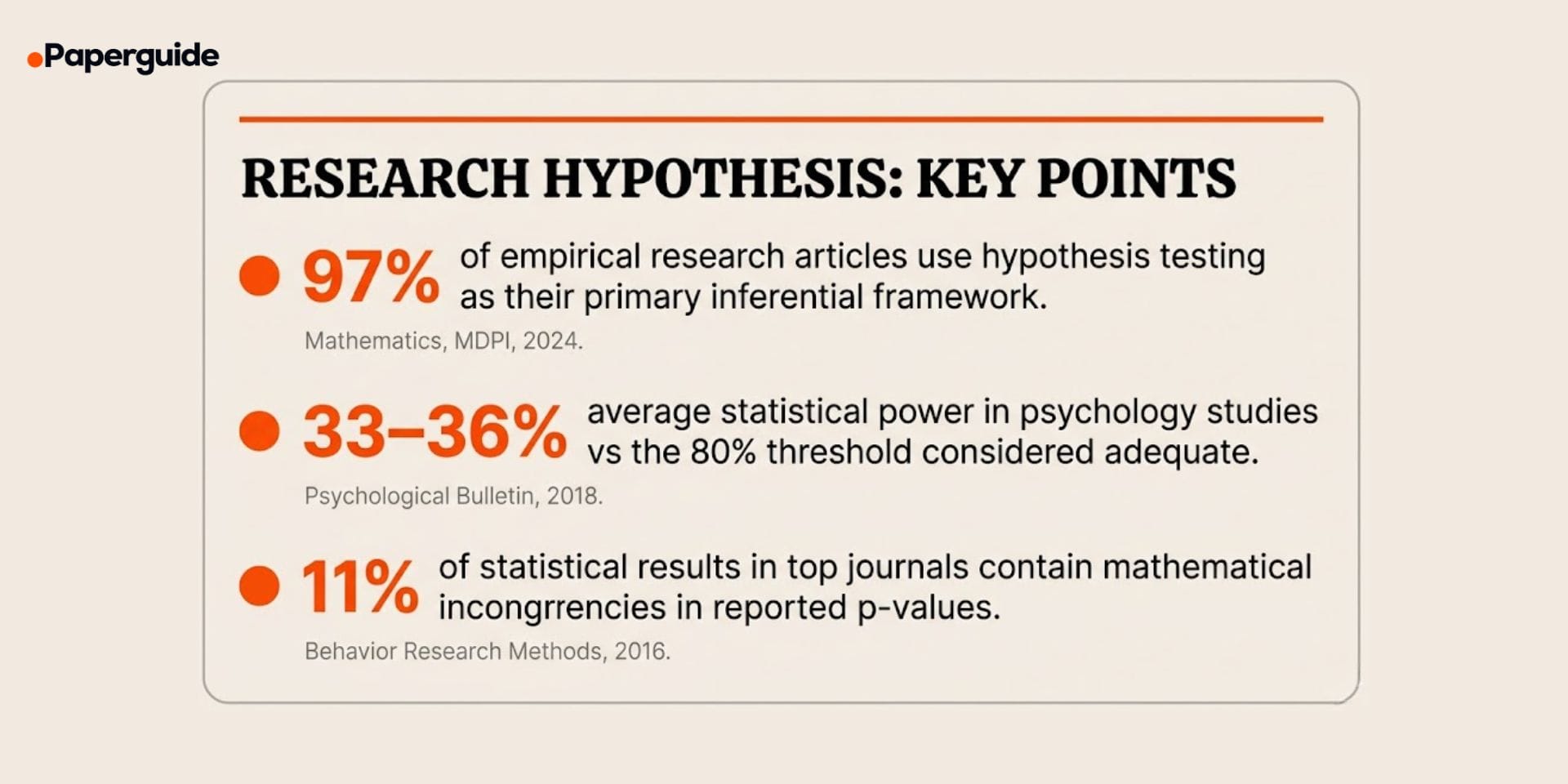
A hypothesis is the testable prediction that drives every empirical study. It transforms a broad research question into a precise, falsifiable statement that can be confirmed or rejected through data. Without a clear hypothesis, a study has no direction, no criteria for success, and no basis for meaningful analysis. A 2024 review in Mathematics found that over 97% of empirical research articles across STEM and social science disciplines rely on some form of hypothesis testing as their primary inferential framework. [1]
Yet writing a strong hypothesis remains one of the most common challenges for researchers. Many studies are weakened not by poor data collection or flawed statistics, but by a hypothesis that was vague, untestable, or disconnected from the research design. A 2024 analysis published in Heliyon confirmed that null hypothesis significance testing continues to dominate published research, but also documented widespread misuse and misconceptions that undermine the validity of reported findings. [2]
This guide explains what a hypothesis is, the different types of hypotheses used in research, how to write one step by step, and the most common mistakes that weaken or invalidate hypotheses. It includes examples across disciplines, a quality checklist, a ready-to-use template, and a process for validating your hypothesis against published literature.
Key Takeaways
- A hypothesis is a testable, falsifiable prediction about the relationship between variables in a study.
- Over 97% of empirical research articles use hypothesis testing as their primary inferential method. [1]
- The six main types are null, alternative, directional, non-directional, simple, and complex hypotheses.
- Strong hypotheses are specific, measurable, grounded in existing literature, and directly connected to the research question.
- Psychology studies average only 33% to 36% statistical power, well below the 80% threshold considered adequate, often because hypotheses are too vague to test effectively. [3]
- Use the checklist and template in this guide to verify your hypothesis before finalizing your research design.
What Is a Hypothesis in Research?
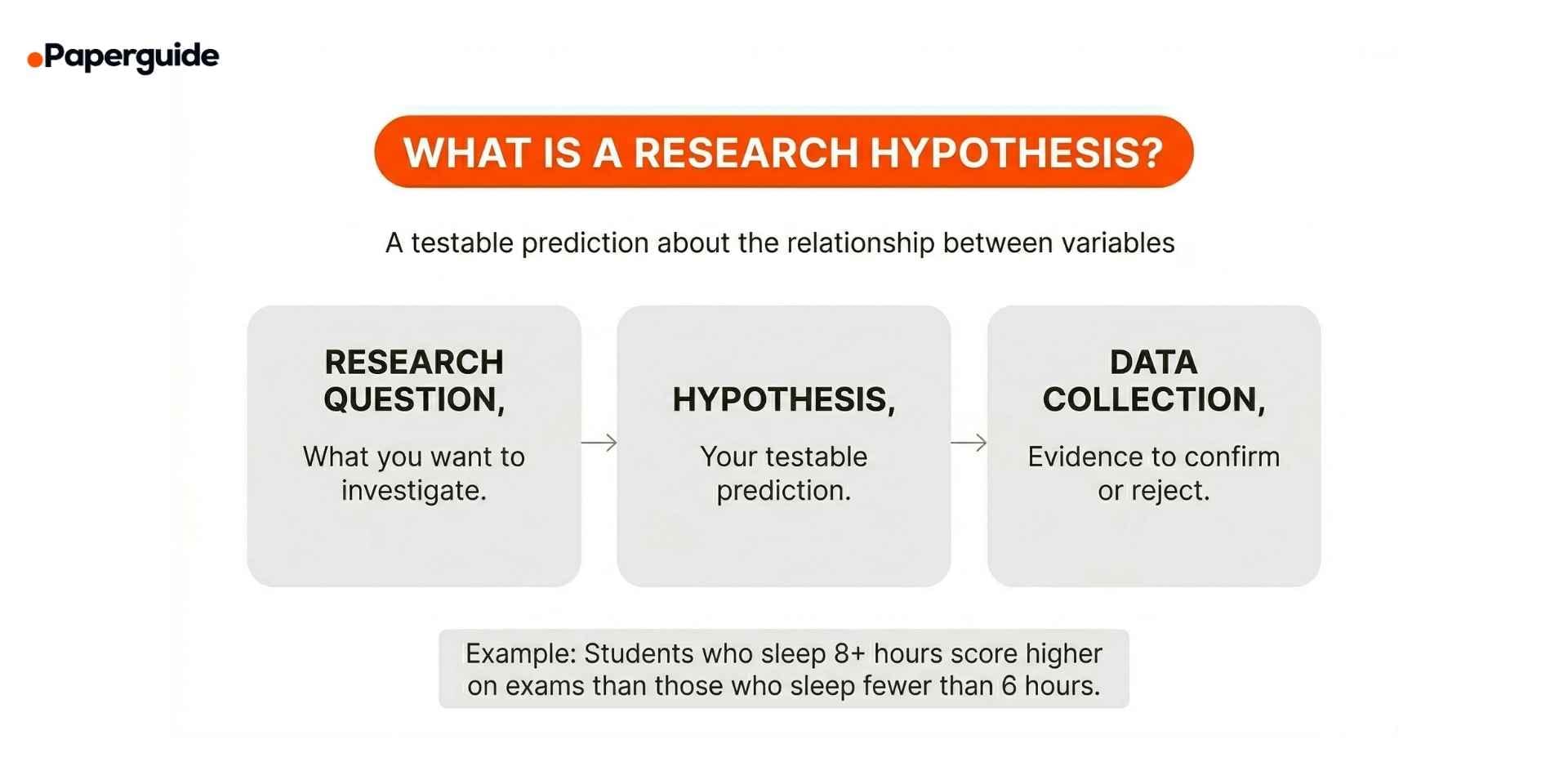
A hypothesis is a clear, testable statement that predicts the expected relationship between two or more variables. It functions as the bridge between a research question and the data collection process, giving the study a specific direction and measurable criteria for evaluation.
A hypothesis is not a guess. It is an informed prediction based on existing literature, theory, or preliminary observations. The key requirement is that a hypothesis must be falsifiable, meaning it must be possible to collect evidence that could disprove it.
Every hypothesis contains three essential components:
- Variables: The specific factors being studied (independent and dependent variables at minimum).
- Population: The group or context the prediction applies to.
- Predicted relationship: The expected direction or nature of the relationship between variables.
Example: "Undergraduate students who use spaced repetition study techniques score higher on final exams than students who use massed practice."
This hypothesis identifies the variables (study technique and exam scores), the population (undergraduate students), and the predicted relationship (spaced repetition leads to higher scores).
Types of Hypotheses in Research
Research uses several types of hypotheses, each serving a different function in the study design. Understanding the distinctions is essential for selecting the correct statistical test and interpreting results accurately.
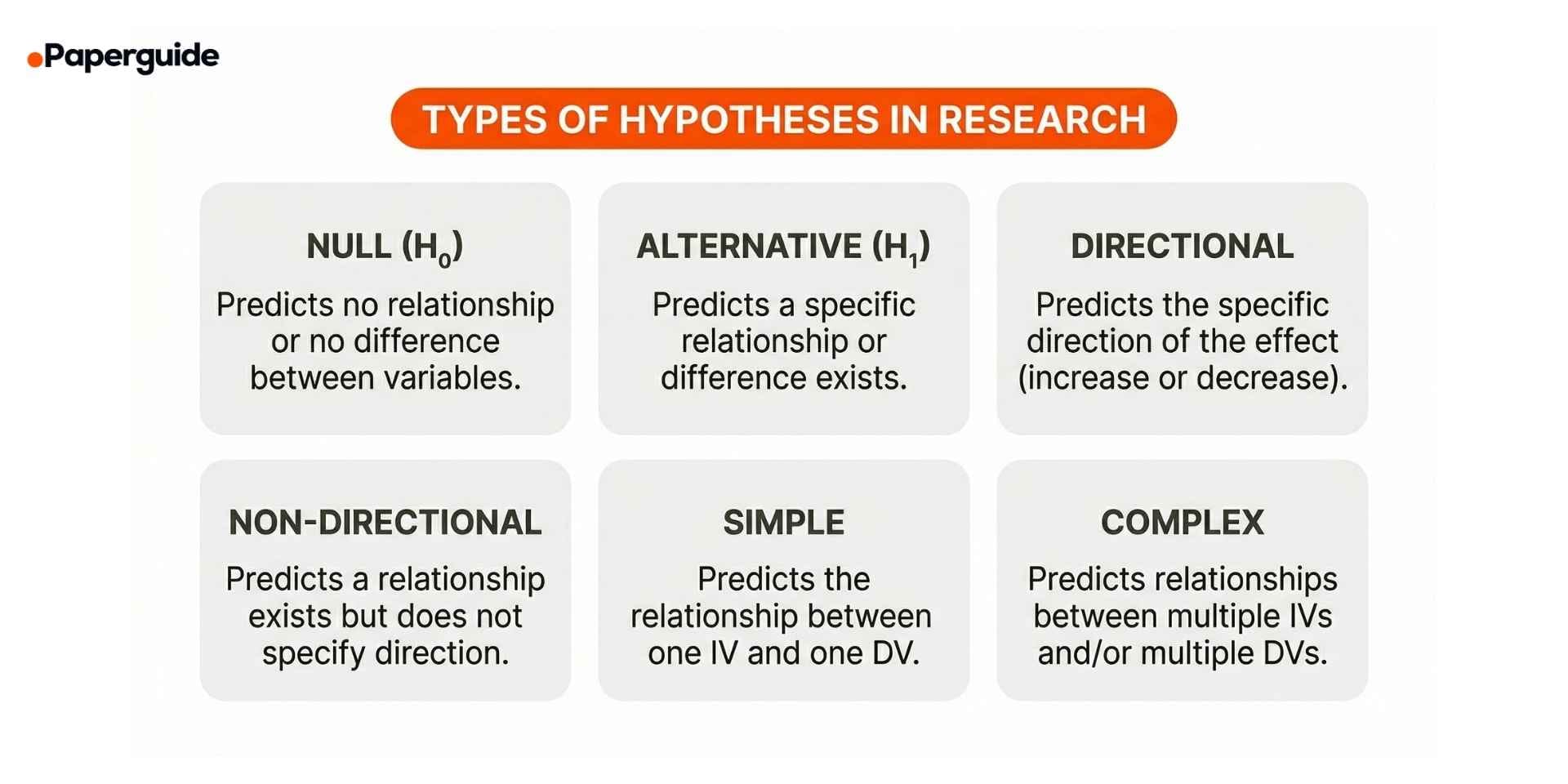
Null Hypothesis (H₀)
The null hypothesis states that there is no significant relationship or difference between the variables being studied. It serves as the default assumption that the researcher attempts to reject through statistical testing.
Example: "There is no significant difference in exam scores between students who use spaced repetition and students who use massed practice."
The null hypothesis is essential because statistical tests are designed to evaluate the probability that observed results could have occurred under the null hypothesis. If the probability is sufficiently low (typically p < 0.05), the null hypothesis is rejected.
Alternative Hypothesis (H₁ or Hₐ)
The alternative hypothesis is the statement the researcher expects to support. It predicts that a significant relationship or difference exists between variables. It is the logical opposite of the null hypothesis.
Example: "Students who use spaced repetition score significantly higher on final exams than students who use massed practice."
The alternative hypothesis is what the researcher is actually testing. When the null hypothesis is rejected, the alternative hypothesis is supported (though not proven).
Directional Hypothesis
A directional hypothesis specifies the expected direction of the relationship or difference. It predicts not just that a relationship exists, but whether the effect will be positive or negative, higher or lower, stronger or weaker.
Example: "Increasing weekly exercise frequency is associated with lower resting heart rate among adults aged 30 to 50."
Directional hypotheses are appropriate when existing literature or theory provides strong evidence for the expected direction of the effect.
Non-Directional Hypothesis
A non-directional hypothesis predicts that a relationship or difference exists but does not specify the direction. It is used when there is insufficient evidence to predict whether the effect will be positive or negative.
Example: "There is a significant difference in job satisfaction between remote workers and in-office workers."
Non-directional hypotheses are appropriate for exploratory studies or when prior research shows conflicting results.
Simple Hypothesis
A simple hypothesis predicts the relationship between one independent variable and one dependent variable.
Example: "Students who attend tutoring sessions score higher on standardized tests than students who do not."
Complex Hypothesis
A complex hypothesis predicts relationships involving two or more independent variables and/or two or more dependent variables.
Example: "Both sleep duration and study method influence exam performance and anxiety levels among graduate students."
Complex hypotheses are common in multivariate research designs and are frequently tested in studies that follow a structured research paper format where multiple variables are analyzed across different sections.
Null vs Alternative Hypothesis: Key Differences
Understanding the relationship between the null and alternative hypothesis is critical for hypothesis testing.
| Criteria | Null Hypothesis (H₀) | Alternative Hypothesis (H₁) |
|---|---|---|
| Purpose | Default assumption to be tested | The prediction the researcher supports |
| Statement | No relationship or no difference | A relationship or difference exists |
| Notation | H₀ | H₁ or Hₐ |
| Role in testing | Assumed true until rejected | Accepted when H₀ is rejected |
| Direction | Always non-directional | Can be directional or non-directional |
| Example | No difference in scores between groups | Group A scores higher than Group B |
The null hypothesis exists as a starting point for statistical analysis. It is the assumption of "nothing happening." The alternative hypothesis is what the researcher believes to be true and attempts to demonstrate through evidence.

How to Write a Hypothesis (Step-by-Step)
Writing a strong hypothesis requires a systematic approach. Follow these five steps to develop a hypothesis that is specific, testable, and grounded in existing knowledge.
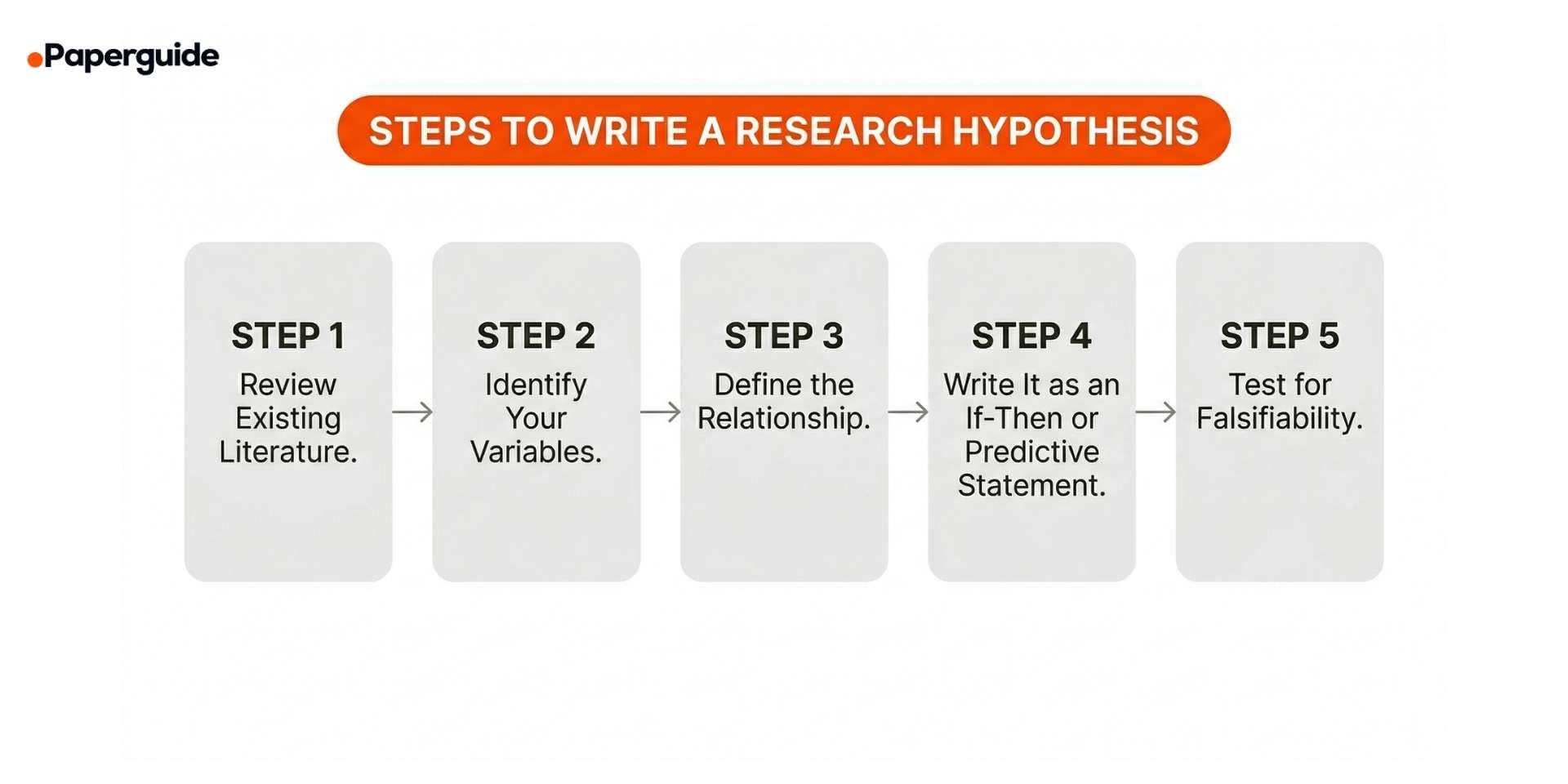
Step 1: Review Existing Literature
A hypothesis must be grounded in what is already known. Before writing your hypothesis, review published studies, theoretical frameworks, and meta-analyses related to your topic.
What to look for:
- Established relationships between your variables of interest
- Gaps in existing research that your study could address
- Contradictory findings that warrant further investigation
- Theoretical models that predict specific outcomes
The literature review ensures your hypothesis is informed rather than arbitrary. A hypothesis that contradicts all existing evidence without justification weakens the study's credibility.
Step 2: Identify Your Variables
Every hypothesis must clearly state the independent variable (what is being changed or compared) and the dependent variable (what is being measured as the outcome).
Example:
- Research question: "Does remote work affect employee productivity?"
- Independent variable: Work arrangement (remote vs in-office)
- Dependent variable: Employee productivity (measured by weekly output metrics)
If you cannot clearly identify both variables, the hypothesis is not ready to write.
Step 3: Define the Expected Relationship
Based on your literature review, determine what kind of relationship you expect between the variables. Is it a difference (one group performs differently than another), a correlation (as one variable increases, the other changes), or a causal effect (one variable directly causes a change in another)?
This step determines whether your hypothesis will be directional or non-directional and whether it will be simple or complex.
Step 4: Write It as an If-Then or Predictive Statement
The most common hypothesis formats are:
If-then format: "If [independent variable condition], then [predicted effect on dependent variable]."
Example: "If employees work remotely at least three days per week, then their weekly productivity output will be higher than employees who work entirely in-office."
Predictive statement format: "[Population] who [IV condition] will [predicted DV outcome] compared to [comparison group]."
Example: "Employees who work remotely at least three days per week will report higher weekly productivity output than employees who work entirely in-office."
Both formats are acceptable. The key requirement is that the statement clearly specifies the variables, the population, and the predicted relationship.
Step 5: Test for Falsifiability
A hypothesis must be falsifiable, meaning it must be possible to collect evidence that would disprove it. If no conceivable result could reject the hypothesis, it is not a scientific hypothesis.
Falsifiable: "Students who complete daily practice problems score higher on final exams than students who do not." (This can be tested by comparing exam scores between the two groups.)
Not falsifiable: "Education is important for society." (This is an opinion, not a testable prediction.)
Review your hypothesis and ask: "What result would prove this wrong?" If you can answer that question, your hypothesis is falsifiable and ready for testing.
Hypothesis Examples Across Disciplines
Clear examples demonstrate how hypotheses work in different fields of research.
Example 1: Psychology
Research question: "Does cognitive behavioral therapy reduce symptoms of generalized anxiety disorder?"
- Null hypothesis (H₀): There is no significant difference in anxiety symptom scores between patients who receive CBT and patients who receive standard care.
- Alternative hypothesis (H₁): Patients who receive 12 weeks of CBT will report significantly lower anxiety scores on the GAD-7 scale than patients who receive standard care.
- Type: Directional, simple
Example 2: Education
Research question: "How does class size affect student participation in undergraduate seminars?"
- Null hypothesis (H₀): There is no significant relationship between class size and student participation frequency.
- Alternative hypothesis (H₁): Students in smaller classes (fewer than 20 students) participate more frequently than students in larger classes (more than 40 students).
- Type: Directional, simple
Example 3: Public Health
Research question: "Does a workplace wellness program affect employee absenteeism and self-reported health?"
- Null hypothesis (H₀): There is no significant difference in absenteeism rates or self-reported health scores between employees enrolled in the wellness program and those who are not.
- Alternative hypothesis (H₁): Employees enrolled in the workplace wellness program will have lower absenteeism rates and higher self-reported health scores than non-enrolled employees.
- Type: Directional, complex (one IV, two DVs)
Example 4: Business
Research question: "Is there a relationship between social media advertising spend and online sales conversion rates?"
- Null hypothesis (H₀): There is no significant correlation between social media advertising spend and online sales conversion rates.
- Alternative hypothesis (H₁): There is a significant positive correlation between social media advertising spend and online sales conversion rates.
- Type: Directional, simple
Each example follows the same structure: a research question leads to both a null and alternative hypothesis, with variables clearly identified and a testable prediction stated.
Common Mistakes and How to Fix Them
Hypothesis formulation errors are among the most frequent methodological problems in academic research. A 2023 analysis in The Leadership Quarterly found that hypotheses are often poorly formulated because theoretical concepts are misrepresented in measurement, hypotheses are not directly testable, or they do not appropriately map onto the statistical models used to test them. [4]
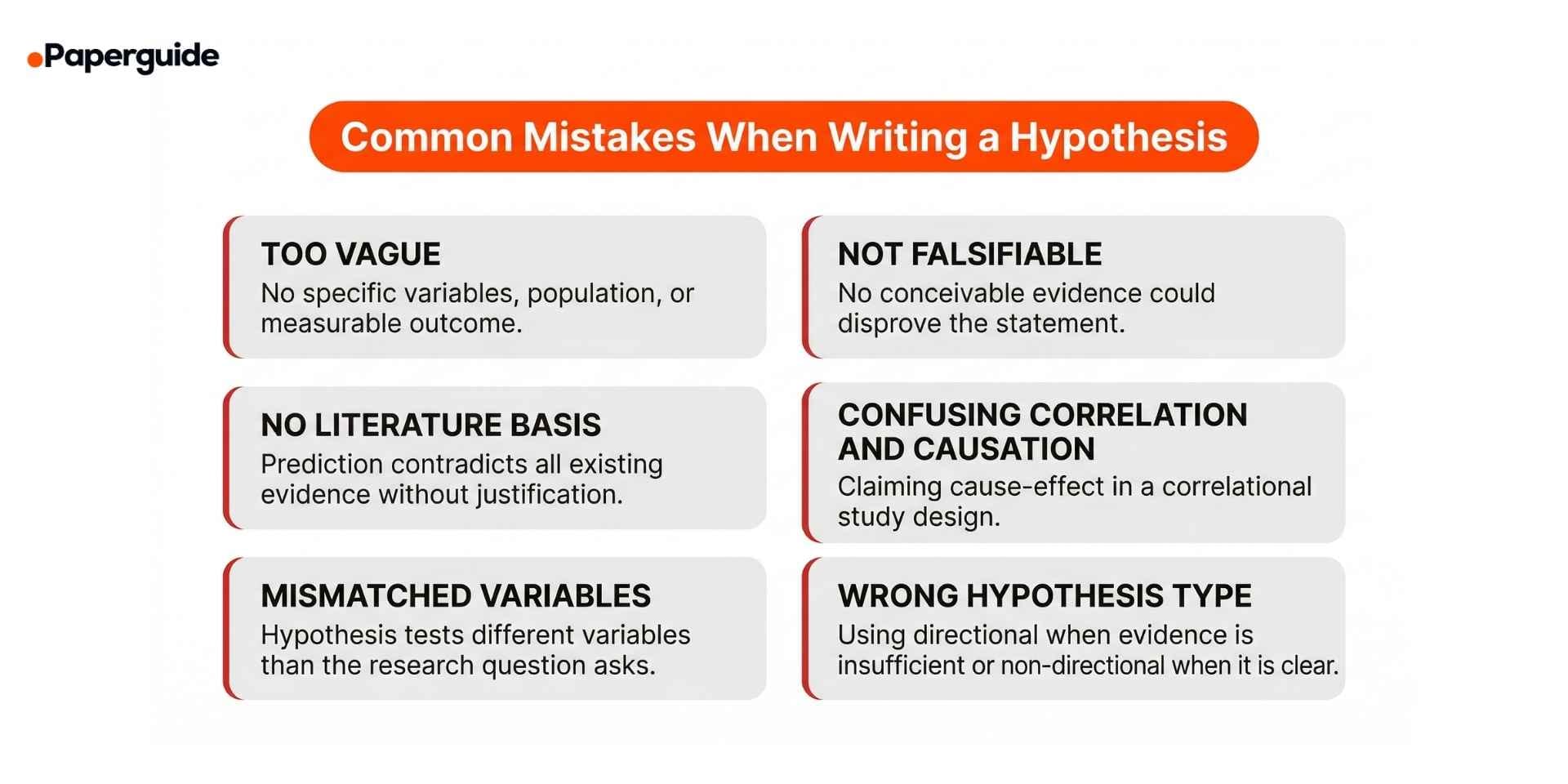
Mistake 1: Writing a Vague Hypothesis
Error: "Technology affects learning." This lacks specific variables, a population, and a measurable prediction.
Fix: "High school students who use interactive simulation software in biology class will score at least 10% higher on unit exams than students who use traditional textbook-only instruction."
Mistake 2: Writing an Unfalsifiable Statement
Error: "Education improves lives." This is an opinion, not a testable prediction.
Fix: "Adults who complete a bachelor's degree report higher scores on the Satisfaction With Life Scale than adults with a high school diploma only."
Mistake 3: Ignoring Existing Literature
Error: Predicting an outcome that contradicts all published evidence without acknowledging or justifying the contradiction.
Fix: Ground your hypothesis in existing findings. If your prediction goes against the literature, explain why (e.g., a different population, context, or methodology).
Mistake 4: Confusing Correlation and Causation
Error: Writing a causal hypothesis ("X causes Y") when the study design is correlational and cannot establish causation.
Fix: Match your hypothesis language to your design. In correlational studies, use "is associated with" or "is related to" instead of "causes" or "leads to."
Mistake 5: Mismatching Hypothesis and Research Question
Error: The research question asks about employee satisfaction, but the hypothesis predicts employee retention.
Fix: Ensure the hypothesis directly answers the research question. The variables in the hypothesis should match the variables in the question.
Mistake 6: Choosing the Wrong Hypothesis Type
Error: Writing a directional hypothesis when there is no theoretical or empirical basis for predicting the direction, or writing a non-directional hypothesis when strong evidence supports a specific direction.
Fix: Use directional hypotheses when prior literature clearly supports a direction. Use non-directional hypotheses for exploratory work or conflicting evidence. Conducting a literature review before choosing your hypothesis type helps determine whether existing evidence supports a directional prediction or calls for an exploratory approach.
Hypothesis Quality Checklist
Use this checklist to verify your hypothesis before finalizing your research design.
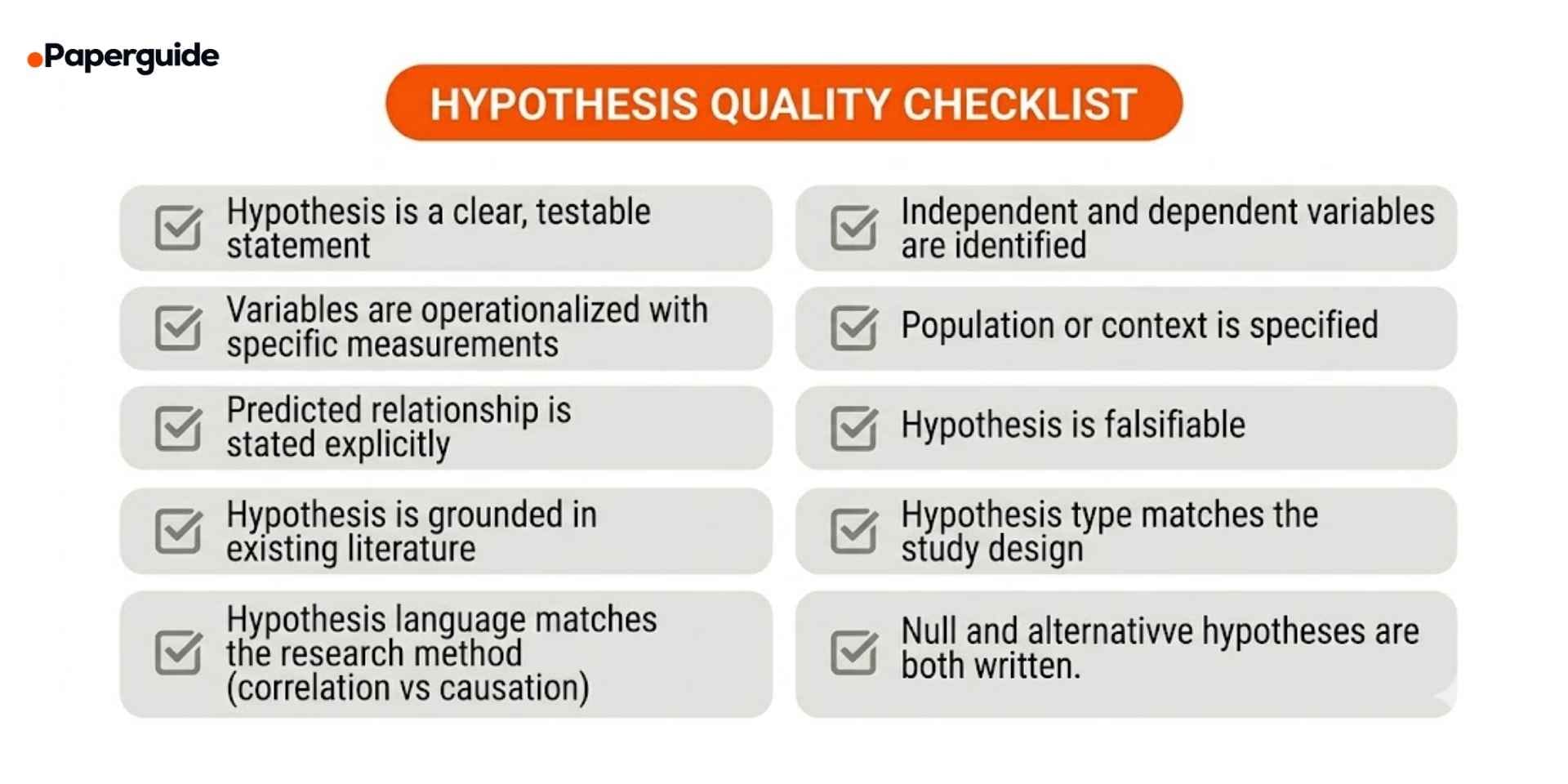
- [ ] Hypothesis is a clear, testable statement. It makes a specific prediction, not a vague claim.
- [ ] Independent and dependent variables are identified. Both variables are explicitly stated.
- [ ] Variables are operationalized with specific measurements. Each variable has a defined measurement method.
- [ ] Population or context is specified. The hypothesis states who or what the prediction applies to.
- [ ] Predicted relationship is stated explicitly. The expected direction or nature of the relationship is clear.
- [ ] Hypothesis is falsifiable. It is possible to collect evidence that would disprove it.
- [ ] Hypothesis is grounded in existing literature. The prediction is supported by or responds to published research.
- [ ] Hypothesis type matches the study design. Directional vs non-directional and simple vs complex are appropriate.
- [ ] Hypothesis language matches the research method. Causal language is only used for experimental designs.
- [ ] Null and alternative hypotheses are both written. Both H₀ and H₁ are clearly stated.
Hypothesis Writing Template
Use this template to write your hypothesis. Replace the bracketed sections with your own content.
Research Question: [Your research question]
Independent Variable: [What you are changing/comparing] Operationalization: [How it will be measured or applied]
Dependent Variable: [What you are measuring as the outcome] Operationalization: [Measurement instrument, scale, or data source]
Null Hypothesis (H₀): [Statement of no relationship or no difference]
Alternative Hypothesis (H₁): [Your testable prediction]
Hypothesis Type: [Directional/Non-directional, Simple/Complex]
Literature Basis: [Key studies or theories supporting your prediction]
Filled Example:
Research Question: "Does peer tutoring improve reading comprehension among third-grade students?"
Independent Variable: Peer tutoring program participation (8 weeks, three sessions per week vs no tutoring) Operationalization: Attendance logs from the tutoring coordinator; minimum 20 of 24 sessions attended
Dependent Variable: Reading comprehension level Operationalization: Gates-MacGinitie Reading Comprehension Test administered before and after the intervention
Null Hypothesis (H₀): There is no significant difference in reading comprehension scores between third-grade students who participate in peer tutoring and those who do not.
Alternative Hypothesis (H₁): Third-grade students who participate in the 8-week peer tutoring program will score significantly higher on the Gates-MacGinitie Reading Comprehension Test than students who do not participate.
Hypothesis Type: Directional, simple
Literature Basis: Topping (2005) meta-analysis showing peer tutoring produces significant reading gains; Rohrbeck et al. (2003) finding effect size of 0.33 for peer-assisted learning in elementary education.
Validate This With Papers (2 Minutes)
Before finalizing your hypothesis, check how published studies in your field have framed similar predictions. This prevents writing hypotheses that are disconnected from the existing evidence base.
Step 1: Search for studies that investigate a similar relationship to yours. Focus on recent publications and meta-analyses in your discipline.
Step 2: Open two or three relevant papers. Look at how the authors framed their hypotheses, what variables they identified, and whether they used directional or non-directional predictions. Using AI tools for literature review can help you efficiently locate and compare hypothesis frameworks across published studies.
Step 3: Use a Research Paper Summarizer to extract the introduction and hypothesis sections from each paper. Compare their predictions and variable operationalizations with yours.
This takes about two minutes and ensures your hypothesis is consistent with the current state of knowledge in your field.
Conclusion
A hypothesis is the testable backbone of every empirical study. It converts a research question into a precise prediction that can be confirmed or rejected through data. The process described in this guide, review existing literature, identify your variables, define the expected relationship, write it as a testable statement, and verify falsifiability, provides a systematic approach that produces hypotheses strong enough to withstand peer review scrutiny. Whether you are writing a null hypothesis for a controlled experiment, a directional hypothesis grounded in prior theory, or a complex hypothesis spanning multiple variables, the quality of the prediction determines the quality of the study.
The most common hypothesis problems are also the most preventable. Vague language, unfalsifiable claims, mismatched variables, and disconnected predictions all result from skipping one or more of the steps above. Before committing to a hypothesis, run it through the quality checklist, compare it with published hypotheses in your field, and confirm that it directly answers your research question. A well-written hypothesis does not guarantee significant results, but it guarantees that whatever results you find will be meaningful and interpretable.
Frequently Asked Questions
What is a hypothesis in research?
A hypothesis is a testable, falsifiable statement that predicts the expected relationship between two or more variables in a study. It is based on existing knowledge and serves as the foundation for data collection and statistical analysis. A good hypothesis specifies the independent variable, dependent variable, population, and predicted direction of the relationship.
What is the difference between a null and alternative hypothesis?
The null hypothesis (H₀) states that there is no significant relationship or difference between variables. It is the default assumption. The alternative hypothesis (H₁) predicts that a specific relationship or difference exists. Statistical tests evaluate whether the evidence is strong enough to reject the null hypothesis in favor of the alternative.
How do I know if my hypothesis is testable?
A testable hypothesis must contain specific, measurable variables and a prediction that can be evaluated with data. Ask: "Can I design a study to collect evidence for or against this statement?" and "What result would prove this wrong?" If you can answer both questions, the hypothesis is testable.
What is the difference between a directional and non-directional hypothesis?
A directional hypothesis predicts the specific direction of the relationship (e.g., "higher," "lower," "more," "less"). A non-directional hypothesis predicts that a relationship exists but does not specify the direction (e.g., "there is a significant difference"). Use directional when prior evidence supports a specific direction; use non-directional for exploratory research.
Can a study have more than one hypothesis?
Yes. Complex studies often test multiple hypotheses, each addressing a different aspect of the research question. For example, a study on workplace interventions might have one hypothesis about productivity and another about job satisfaction. Each hypothesis should be stated and tested separately.
What happens if my hypothesis is rejected?
A rejected hypothesis is not a failure. It means the data did not support the predicted relationship. This is a meaningful finding because it contributes to knowledge by showing what does not hold true under the tested conditions. Researchers should report rejected hypotheses transparently and discuss possible explanations.
Should I write my hypothesis before or after data collection?
Always before. A hypothesis written after seeing the data (known as HARKing, or Hypothesizing After the Results are Known) is a serious methodological problem. It inflates the appearance of significant findings and undermines the integrity of the research. Pre-registration of hypotheses is increasingly required by journals and funding agencies. An analysis of statistical reporting found that 11% of published results in leading journals contained mathematical incongruencies between reported test statistics and p-values, partly due to post-hoc hypothesis adjustments. [5]
References
- Rajić, V. (2026). Statistical hypothesis testing: A comprehensive review of theory, methods, and applications. Mathematics, 14(2), 300.
- Emmert-Streib, F. (2024). Trends in null hypothesis significance testing: Still going strong. Heliyon, 10(21), e40133.
- Stanley, T. D., Carter, E. C., & Doucouliagos, H. (2018). What meta-analyses reveal about the replicability of psychological research. Psychological Bulletin, 144(12), 1325–1346.
- Wulff, J. N., Sajons, G. B., & Pogrebna, G., et al. (2023). Common methodological mistakes. The Leadership Quarterly, 34(1), 101677.
- Bakker, M., van Dijk, A., & Wicherts, J. M. (2016). The rules of the game called psychological science. Behavior Research Methods, 48(2).