How to Write a Literature Review: A Step-by-Step Guide (Structure + Template)


A literature review is a critical survey and synthesis of existing scholarly sources on a specific topic. Rather than simply summarizing individual studies, it evaluates, compares, and connects findings to identify patterns, debates, and gaps in the current knowledge. A literature review appears in theses, dissertations, journal articles, and research proposals as the foundation that justifies why new research is needed. [1]
For many researchers, the literature review is the most challenging section to write because it requires more than reading and reporting. It requires you to organize dozens or even hundreds of sources into a coherent argument that shows what the field knows, where researchers disagree, and what remains unanswered. Getting this section right is essential because it directly shapes your research questions, theoretical framework, and study design.
After reading this guide, you will understand how to write a literature review step by step, choose the right structure for your topic, and use a template and quality checklist to strengthen your review before submission.
Key Takeaways
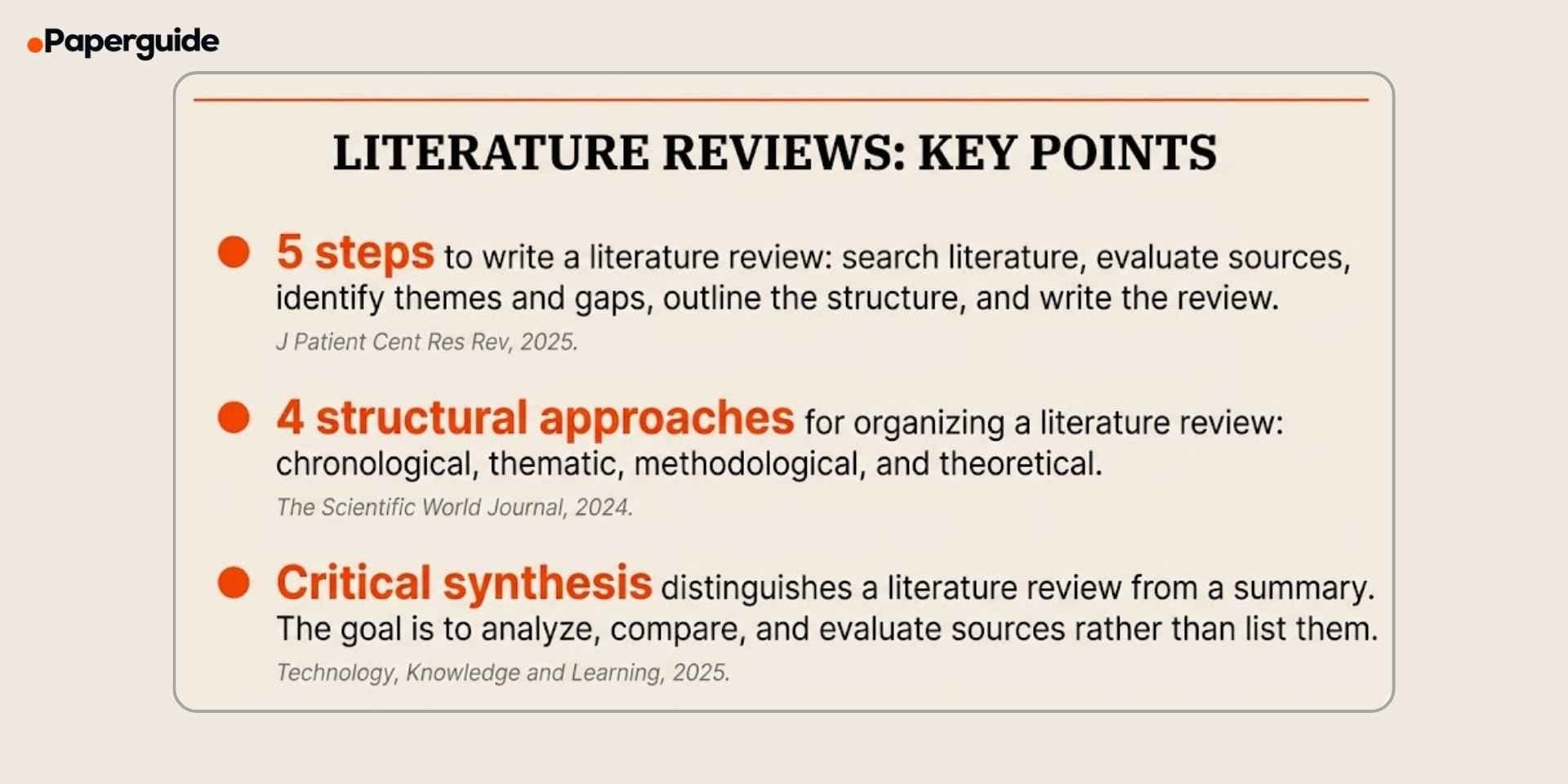
- A literature review critically synthesizes existing research rather than summarizing individual studies one by one
- There are four main structural approaches: chronological, thematic, methodological, and theoretical
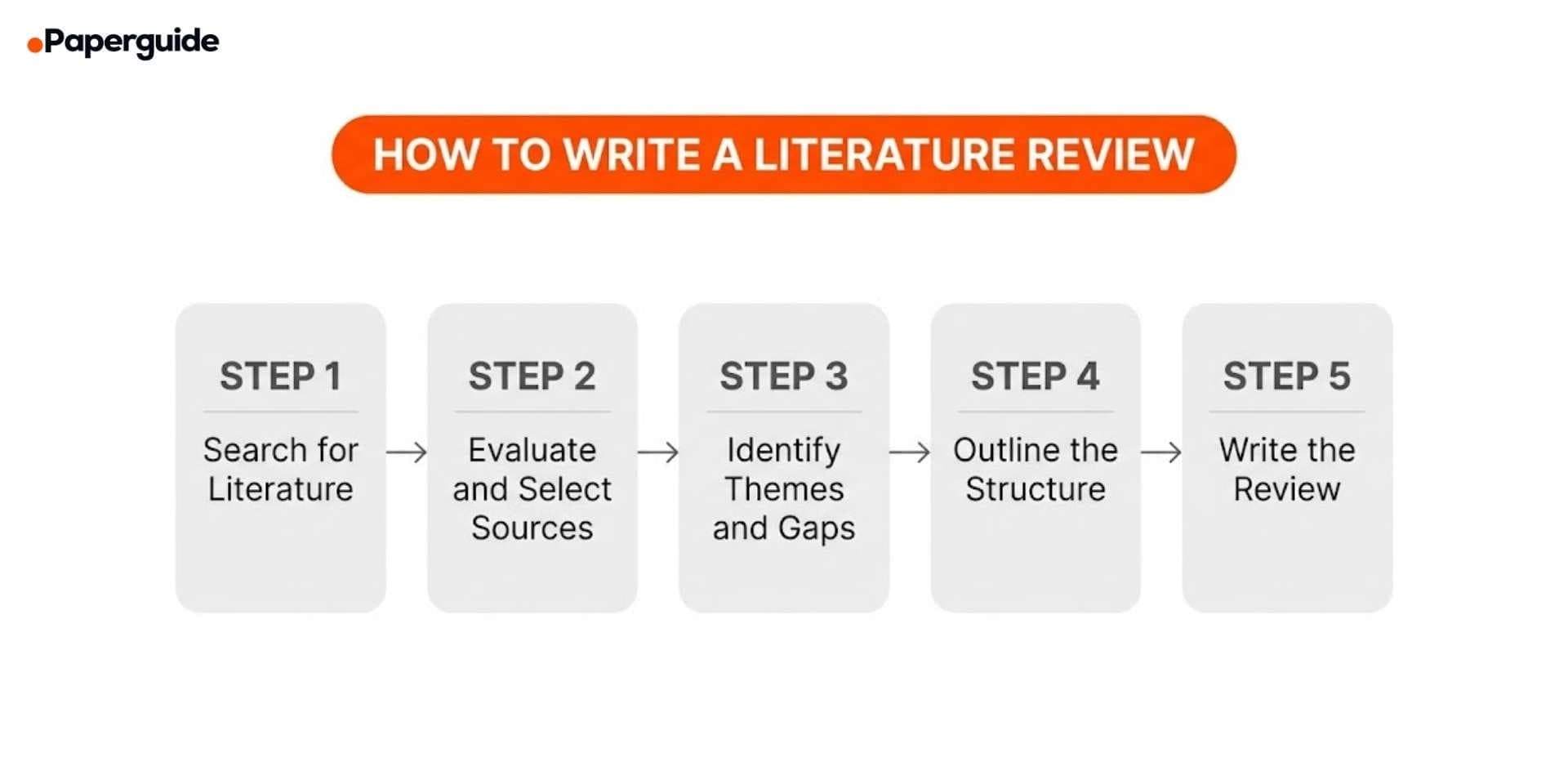
- Writing a literature review involves five steps: searching literature, evaluating sources, identifying themes and gaps, outlining the structure, and writing the review
- A strong literature review connects sources to each other and to your research question, identifying where the current evidence falls short
- Common mistakes include writing a list of summaries, ignoring contradictory findings, and failing to connect the review to the research gap
What Is a Literature Review?
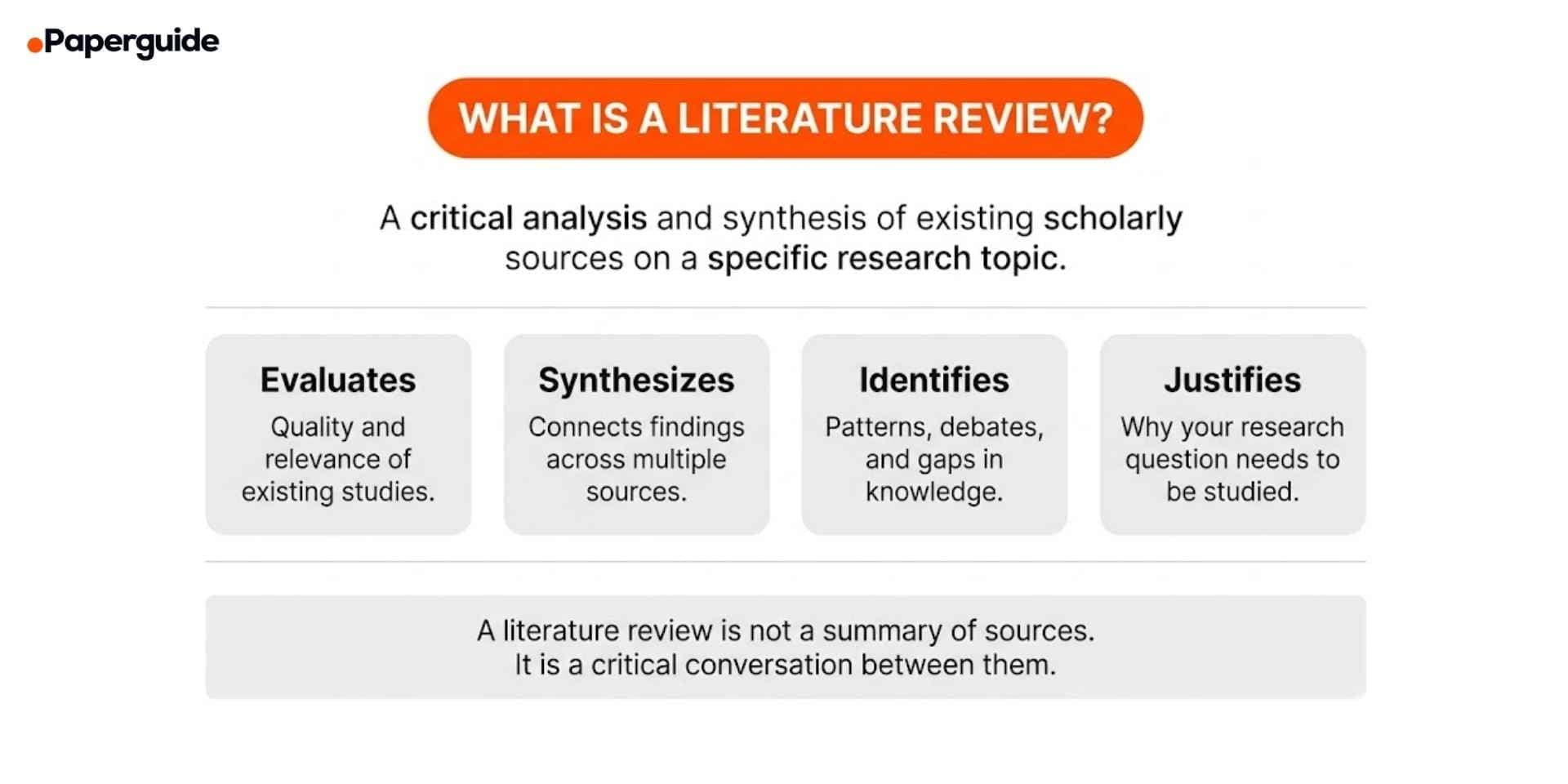
A literature review is a written analysis of the published research relevant to your study topic. It goes beyond listing what each source says. Instead, it evaluates the quality of the evidence, identifies areas of agreement and disagreement among researchers, and highlights where the existing knowledge is incomplete. [2]
The purpose of a literature review is to demonstrate that you understand the current state of research on your topic and that your study fills a meaningful gap. Readers should finish your review understanding what is already known, what remains debated, and why your research question matters.
Literature reviews serve different roles depending on the context. In a thesis or dissertation, the review typically forms an entire chapter that establishes the theoretical framework and positions the study within the field. In a journal article, it appears as a focused section in the introduction. In a research proposal, it demonstrates your awareness of existing work and justifies the need for your proposed study.
A literature review differs from an annotated bibliography. An annotated bibliography lists individual sources with brief descriptions. A literature review, by contrast, weaves sources together into an argument, showing how they relate to each other and to the research question being investigated. [3]
Types of Literature Reviews
Not all literature reviews follow the same approach. The type you write depends on your research question, the volume of available evidence, and the depth of analysis required.
| Type | Purpose | Method | Best For |
|---|---|---|---|
| Narrative Review | Broad overview of a topic | Qualitative summary of selected sources | Exploring a topic, identifying research directions |
| Systematic Review | Comprehensive evidence synthesis | Structured protocol, predefined criteria | Testing a specific hypothesis, clinical questions |
| Scoping Review | Mapping available evidence | Broad search, charting key concepts | New or emerging topics, defining scope |
| Integrative Review | Combining diverse methods | Includes experimental and non-experimental studies | Complex topics with varied evidence types |
| Meta-Analysis | Statistical combination of results | Quantitative pooling of effect sizes | Estimating the overall effect of an intervention |
A narrative literature review is the most common type in theses and dissertations. It provides a thematic or chronological overview of the existing research and identifies gaps that justify your study. A systematic review follows a predefined protocol with explicit inclusion and exclusion criteria, while a meta-analysis adds statistical pooling of quantitative results. [4]
How to Write a Literature Review (5 Steps)
Writing a literature review is a process that involves searching, evaluating, organizing, and synthesizing the existing research. Follow these five steps.
Step 1: Search for Relevant Literature
Start by defining clear search terms based on your research question. Break your topic into key concepts and generate synonyms and related terms. For example, if your research question is "How does remote work affect employee productivity?", your search terms might include remote work, telecommuting, work from home, employee productivity, and job performance.
Search multiple databases such as Google Scholar, PubMed, Scopus, and Web of Science. Use Boolean operators (AND, OR, NOT) to refine results. Set date filters to prioritize recent publications, though foundational studies from earlier years should also be included if they are widely cited in the field. [1]
Keep a detailed record of your search strategy, including databases searched, keywords used, and the number of results at each stage. This documentation is important for transparency and helps you replicate or update your search later.
Step 2: Evaluate and Select Sources
Not every source you find belongs in your review. Evaluate each source based on relevance to your research question, methodological quality, credibility of the publication venue, and recency. [3]
Apply inclusion and exclusion criteria. For example, you might include only peer-reviewed journal articles published between 2015 and 2025 that directly address employee productivity in remote settings. Exclude opinion pieces, conference abstracts without full text, and studies in languages you cannot read.
As you read each source, take structured notes. Record the research question, methodology, key findings, limitations, and how it relates to your topic. This will make the synthesis stage much easier.
Step 3: Identify Themes, Debates, and Gaps
Once you have read and annotated your sources, look for patterns across them. Group studies that share common findings, use similar methodologies, or address the same sub-question of your topic.
Identify areas of agreement where multiple studies reach the same conclusion. Note areas of disagreement where researchers have found conflicting results or have used different theoretical lenses to interpret similar data. Pay attention to methodological trends, such as whether most studies use quantitative surveys, qualitative interviews, or mixed methods. [2]
Most importantly, identify gaps. What questions remain unanswered? What populations or contexts have not been studied? What methodological limitations appear repeatedly? These gaps form the basis for justifying your own research.
Step 4: Outline the Structure of Your Review
Before writing, decide how you will organize the review. There are four common structural approaches.
Chronological: Organize by time period. This works well when the research has evolved significantly over decades and you want to show how understanding has changed.
Thematic: Organize by themes or topics. This is the most common approach and works when your literature falls naturally into distinct sub-topics or recurring themes.
Methodological: Organize by research method. This is useful when comparing findings from qualitative, quantitative, and mixed methods studies to show how methodology influences results.
Theoretical: Organize by the theories used. This approach works when your field has competing theoretical perspectives that explain the same phenomenon differently.
Choose the approach that best tells the story of your research area. Many reviews combine approaches, using a thematic structure overall but organizing chronologically within each theme.
Step 5: Write the Literature Review
A literature review follows a clear three-part structure: introduction, body, and conclusion.
Introduction. State the purpose and scope of the review. Define the topic, explain why the review is needed, and describe how the review is organized.
Body. Present your synthesis organized according to the structure you chose in Step 4. Each paragraph or section should have a clear focus. Begin each section with a topic sentence, present the relevant evidence from multiple sources, and end with a synthesis statement that connects the evidence to your research question.
Conclusion. Summarize the main findings of the review, highlight the key gaps or unresolved questions, and explain how your study addresses those gaps. The conclusion should transition naturally into your research question or hypothesis. It should also connect to the ethical considerations that will guide your study design.
When writing, focus on synthesis rather than summary. Instead of writing "Smith (2020) found X. Jones (2021) found Y," write "Several studies have found that remote work increases individual productivity (Smith, 2020; Jones, 2021), though the effect may be moderated by organizational culture (Lee, 2022)."

Literature Review Structure (With Example)
Introduction Example
The growing adoption of remote work arrangements has prompted researchers to examine how working outside the traditional office affects employee productivity. While some studies report increased output and job satisfaction (Golden & Gajendran, 2019), others document challenges related to isolation, communication barriers, and blurred work-life boundaries (Allen et al., 2021). This review synthesizes the current evidence on the remote work-productivity relationship, identifies the key moderating factors, and highlights gaps in the existing research.
Body Section Example (Thematic Approach)
Theme 1: Productivity Outcomes
Most studies comparing remote and office-based employees report equal or higher productivity among remote workers. A meta-analysis of 46 studies found a small positive effect of remote work on task performance (d = 0.18), with the effect stronger for jobs involving independent work than for highly collaborative roles. However, these findings are largely based on self-reported productivity measures, which introduces potential bias.
Theme 2: Moderating Factors
The relationship between remote work and productivity is not straightforward. Research consistently identifies three moderating factors: organizational culture, job autonomy, and communication technology. Organizations with high-trust cultures see larger productivity gains from remote work, while surveillance-oriented cultures experience neutral or negative effects.
Conclusion Example
The current evidence suggests that remote work has a small positive effect on individual productivity, but this effect depends heavily on organizational context, job characteristics, and the quality of communication infrastructure. Significant gaps remain in understanding how remote work affects team-level productivity and long-term career development. This study addresses these gaps by examining the relationship between remote work arrangements and both individual and team productivity over a 12-month period.
Literature Review Template
Use this fill-in template to draft your literature review. Replace the bracketed sections with your own content.
Introduction: This review examines the existing research on [your topic]. The purpose is to [identify patterns/evaluate evidence/map the current state of knowledge] related to [specific aspect of the topic]. The review covers studies published between [start year] and [end year] and is organized [thematically/chronologically/methodologically].
Search Strategy: Literature was identified through searches of [databases used] using the terms [list key search terms]. Inclusion criteria included [list criteria]. A total of [number] sources were selected for review.
Theme 1: [Theme Name]: Research on [theme] has found that [summarize key findings across multiple sources]. For example, [Author, Year] demonstrated that [key finding], while [Author, Year] reported [contrasting or supporting finding]. Together, these studies suggest that [synthesis statement].
Theme 2: [Theme Name]: A second body of research has focused on [theme]. Studies consistently show that [pattern or finding]. However, [Author, Year] challenged this view by finding that [contrasting evidence]. This disagreement may be explained by [potential explanation].
Gaps and Limitations: Despite the growing body of research, several gaps remain. First, [gap 1]. Second, [gap 2]. Third, [gap 3]. These gaps suggest the need for [type of future research].
Conclusion: The literature demonstrates that [main finding]. However, [key limitation or gap] indicates that further research is needed, particularly regarding [specific area]. This study addresses this gap by [how your study contributes].
Filled Example:
Introduction: This review examines the existing research on the relationship between mindfulness interventions and academic stress in university students. The purpose is to evaluate the evidence on whether mindfulness-based programs reduce perceived stress and improve exam performance. The review covers studies published between 2015 and 2025 and is organized thematically.
Search Strategy: Literature was identified through searches of PubMed, PsycINFO, and Google Scholar using the terms mindfulness, academic stress, university students, exam performance, and intervention. Inclusion criteria included peer-reviewed journal articles reporting empirical findings on mindfulness interventions in higher education. A total of 34 sources were selected for review.
Theme 1: Stress Reduction Outcomes: Research on mindfulness and academic stress has consistently found significant reductions in perceived stress following mindfulness-based interventions. For example, Bamber and Schneider (2022) demonstrated that an 8-week mindfulness program reduced Perceived Stress Scale scores by 23% among undergraduate students, while Galante et al. (2018) reported similar improvements in a randomized controlled trial of 616 students. Together, these studies suggest that mindfulness interventions produce reliable short-term stress reduction in university settings.
Theme 2: Exam Performance Effects: A second body of research has focused on whether stress reduction translates to improved academic outcomes. Studies show mixed results. Two randomized trials found small improvements in exam scores (d = 0.15 and d = 0.21), but three observational studies found no significant difference. This disagreement may be explained by differences in intervention duration, student motivation, and measurement timing.
Gaps and Limitations: Despite the growing body of research, several gaps remain. First, most studies use self-reported stress measures rather than physiological indicators. Second, few studies follow students beyond one semester. Third, the role of baseline anxiety levels as a moderator has not been systematically examined.
Conclusion: The literature demonstrates that mindfulness interventions reliably reduce perceived academic stress in university students. However, limited evidence on long-term outcomes and exam performance indicates that further research is needed, particularly regarding how baseline anxiety moderates intervention effectiveness. This study addresses this gap by examining stress, exam performance, and anxiety moderation over two academic semesters.
Common Mistakes When Writing a Literature Review
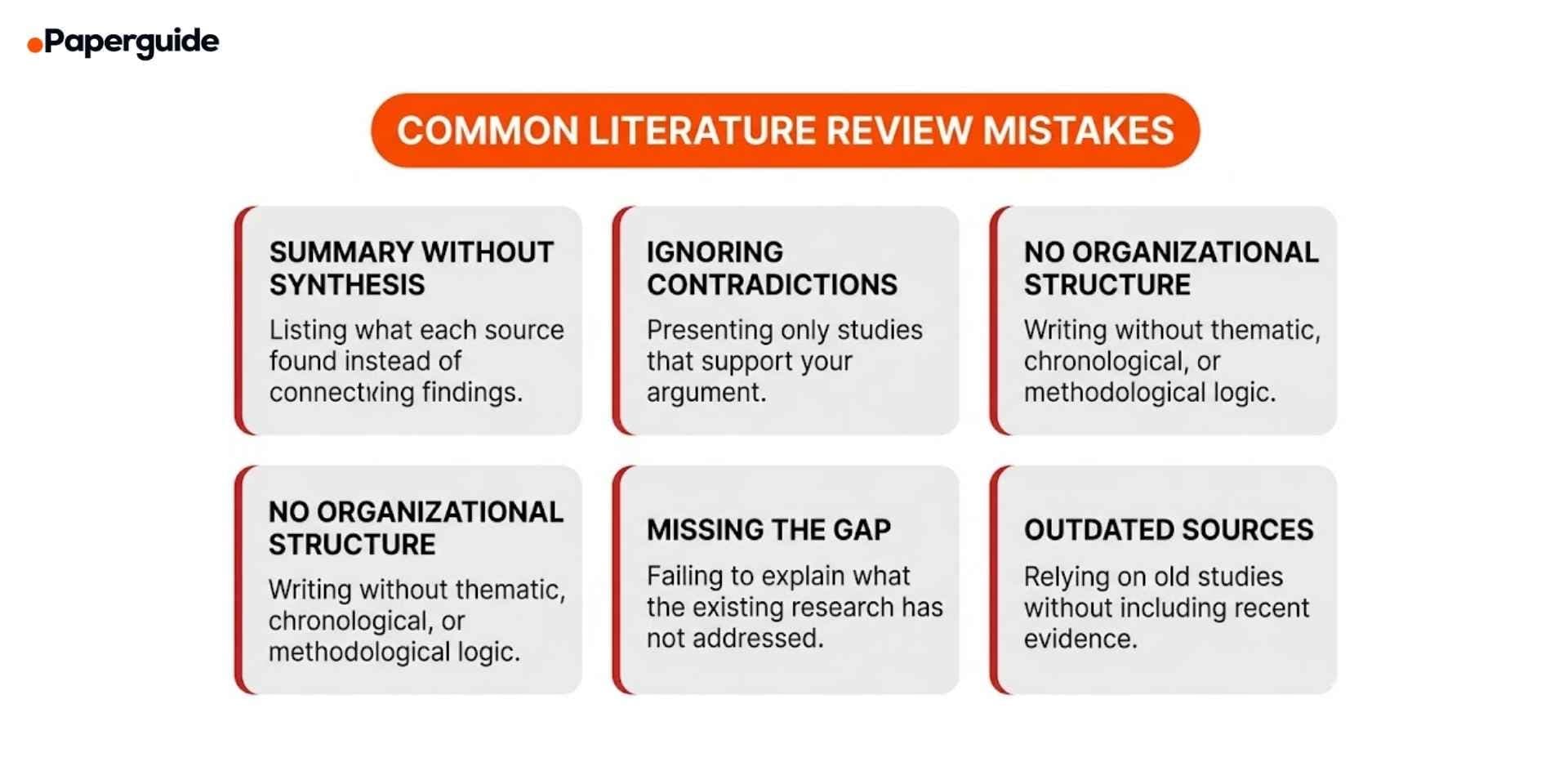
Mistake 1: Writing Summaries Instead of Synthesis
The most common mistake is treating the literature review as a list of individual study summaries. Writing "Author A found X. Author B found Y. Author C found Z." does not demonstrate understanding. It shows you have read the sources but not analyzed them.
Fix: Group studies by theme, finding, or method. Write about what the evidence collectively shows rather than what each study individually reports.
Mistake 2: Ignoring Contradictory Evidence
Some researchers only include studies that support their expected findings. This creates a biased review that misrepresents the state of knowledge. [5]
Fix: Actively search for studies with contrasting results. Discuss why disagreements exist, whether due to different methods, populations, or definitions. Acknowledging contradictions strengthens your review.
Mistake 3: No Clear Organizational Structure
A literature review that jumps between topics without a logical flow confuses readers and weakens the argument. Without a clear structure, the review reads as a random collection of notes.
Fix: Choose a structural approach (thematic, chronological, methodological, or theoretical) before you start writing. Create an outline and group your sources according to that structure.
Mistake 4: Failing to Identify the Research Gap
A literature review that summarizes the existing research but does not explain what is missing fails to justify the rationale for new research. The gap is the most important outcome of the review.
Fix: End each thematic section by noting what remains unknown. In the conclusion, explicitly state the gaps your study will address.
Mistake 5: Relying on Outdated Sources
Using only older studies suggests the review is not current. While seminal works from earlier decades may be important, the review should prioritize recent evidence to show awareness of the latest developments.
Fix: Focus on studies from the last five to ten years. Include older sources only when they are foundational or widely cited. Use recent publications to show how the field has evolved.
Literature Review Quality Checklist
- [ ] Scope is defined. The review clearly states the topic boundaries, time period, and types of sources included.
- [ ] Search strategy is documented. The databases searched, keywords used, and inclusion criteria are described.
- [ ] Sources are evaluated. Each source is assessed for quality, relevance, and methodological rigor.
- [ ] Structure is logical. The review follows a clear organizational approach (thematic, chronological, methodological, or theoretical).
- [ ] Synthesis is present. Sources are connected and compared rather than summarized individually.
- [ ] Contradictions are addressed. Conflicting findings are discussed with possible explanations.
- [ ] Gaps are identified. The review clearly states what the existing research has not addressed.
- [ ] Gap connects to your study. The identified gap directly justifies your research question or hypothesis.
- [ ] Writing is critical. The tone is analytical and evaluative, not descriptive.
- [ ] Sources are current. The majority of sources are from the last five to ten years, with older works included only when foundational.
How to Choose the Right Structure for Your Review
Selecting the right organizational structure depends on your research question and the nature of the available literature.
If your topic has evolved significantly over time, a chronological structure helps readers understand how thinking has changed. If the literature naturally falls into distinct sub-topics, a thematic approach allows you to address each area in depth. If you are comparing results across different research designs, a methodological structure highlights how method influences findings. If competing theories explain the same phenomenon, a theoretical structure helps readers see the different perspectives.
Many successful reviews combine approaches. For example, you might organize thematically but include a chronological overview within each theme to show how each sub-topic has developed. The key is that readers should be able to follow the logic of your review without getting lost. [2]
For guidance on structuring the broader research methodology around your literature review, ensure that the review connects directly to your research design and analysis plan.
Validate This With Papers (2 Minutes)
Before submitting your literature review, check it against published research to confirm that your synthesis is accurate, your themes are complete, and your gap statement reflects what the field actually needs.
Step 1: Search for two or three recent review articles or meta-analyses on your topic. These serve as benchmarks for what the field currently considers established knowledge versus ongoing debate. Compare the themes and conclusions in those reviews with the ones in your own draft.
Step 2: Open the most relevant papers and look for three things: whether you have covered the same major themes, whether your gap statement aligns with what other reviewers have identified, and whether any significant studies are missing from your review. Paperguide's Literature Review AI can help you search, screen, and synthesize papers faster by pulling key findings across multiple sources into one place.
Step 3: For specific verification, use Chat with PDF to ask targeted questions about individual papers, such as "What gaps does this review identify?" or "Which theories does this study apply?" This lets you cross-check your synthesis against the original sources without re-reading entire articles.
This takes about two minutes and ensures your literature review is comprehensive, well-supported, and aligned with the current state of your field.
Conclusion
A literature review is far more than a summary of what has been published on your topic. It is a critical analysis that connects existing research, identifies patterns and contradictions, and reveals the gaps that justify new inquiry. Writing one well requires a systematic search, careful evaluation of sources, a clear organizational structure, and a consistent focus on synthesis over summary. The difference between a weak review and a strong one is not the number of sources cited but how effectively those sources are woven into a coherent argument that builds toward your research question.
Use the five-step method, structural approaches, template, and quality checklist in this guide to write a literature review that strengthens your entire study from the ground up. Once your review is complete, it becomes the foundation for defining your research questions, shaping your hypotheses, and justifying every methodological decision in your study design. A well-written literature review does not just demonstrate what you have read. It demonstrates that you understand where the field stands and exactly where your research fits within it.
Frequently Asked Questions
How long should a literature review be?
Length depends on the type of document. In a journal article, the literature review is typically one to three pages within the introduction. In a thesis or dissertation, it may be an entire chapter ranging from 15 to 40 pages. The review should be as long as needed to adequately cover the relevant literature and justify the research gap, without including unnecessary sources or filler.
What is the difference between a literature review and a systematic review?
A literature review (often called a narrative review) provides a broad, qualitative synthesis of research on a topic. The author selects sources based on relevance and expertise. A systematic review follows a predefined protocol with explicit search strategies, inclusion criteria, and quality assessments. Systematic reviews aim to minimize bias by documenting every step of the process.
Can I include sources that are not peer-reviewed?
In most cases, peer-reviewed journal articles should form the core of your literature review. However, you may include government reports, institutional publications, conference proceedings, and books when they provide important context or data not available in peer-reviewed sources. Always evaluate non-peer-reviewed sources critically and note their limitations.
How do I know when I have enough sources?
You have enough sources when you start seeing the same findings, authors, and theories cited repeatedly across new papers you read. This is called "saturation." The exact number varies by topic and discipline, but a typical thesis literature review includes 30 to 80 sources. The quality and relevance of sources matters more than the total count.
Should a literature review include my own opinion?
A literature review should be analytical and evaluative, but the analysis should be grounded in the evidence. You can critique methodological weaknesses, note the strength of certain findings, and argue that certain gaps need to be addressed. However, avoid unsupported personal opinions. Every claim should be backed by evidence from the literature.
How recent should my sources be?
Prioritize sources from the last five to ten years to demonstrate that your review is current. Include older sources only if they are foundational works that introduced key theories, methods, or findings that are still widely cited. A review that relies entirely on outdated sources suggests insufficient engagement with the current state of the field.
What is the best way to organize a large number of sources?
Use a reference management tool to store and tag your sources. Create a literature matrix or synthesis table with columns for author, year, research question, methodology, key findings, and relevance to your study. This makes it easier to identify themes and group sources for your review. Grouping sources by theme before writing prevents the common mistake of writing source-by-source summaries.
References
- Bradley, J., Ruggeri, B.E. & Hanus, K.L. "Charting Your Course: A Roadmap to Select a Review Type for Your Research Journey." Journal of Patient-Centered Research and Reviews, 12(1), 2025.
- Varsha, P.S., Chakraborty, A. & Kar, A.K. "How to Undertake an Impactful Literature Review: Understanding Review Approaches and Guidelines for High-impact Systematic Literature Reviews." South Asian Journal of Business and Management Cases, 13(1), 2024.
- Amobonye, A., Lalung, J., Mheta, G. & Pillai, S. "Writing a Scientific Review Article: Comprehensive Insights for Beginners." The Scientific World Journal, 2024.
- Calderon Martinez, E. et al. "A comprehensive guide to conduct a systematic review and meta-analysis in medical research." Medicine, 104(33), 2025.
- Fromm, Y.M., Martin, F., Gezer, T. & Ifenthaler, D. "Best Practices for Conducting Systematic Reviews: Perspectives of Experienced Systematic Review Researchers in Educational Sciences." Technology, Knowledge and Learning, 30(1), 2025.
Reviewing literature?
Generate your literature review
Categorized sources, citations and key insights from a single topic.
Try it freeNo credit card required