How to Write a Research Problem Statement in 2026:(Examples and Checklist)


A research problem statement is a clear, concise description of the issue your study aims to address. It identifies a specific gap in existing knowledge, explains why that gap matters, and establishes the direction of your research. As research output continues to grow, with an estimated 3 million+ peer-reviewed articles published annually as of 2025, writing a precise problem statement has become even more critical for distinguishing your study from existing work. A strong problem statement includes three elements: the research context, the knowledge gap, and the study's purpose.
Key Takeaways
• A research problem statement defines the specific issue your study will investigate and why it matters.
• It should include three core elements: the research context, the knowledge gap, and the study's purpose.
• A good problem statement is specific, evidence-based, and aligned with your research methodology.
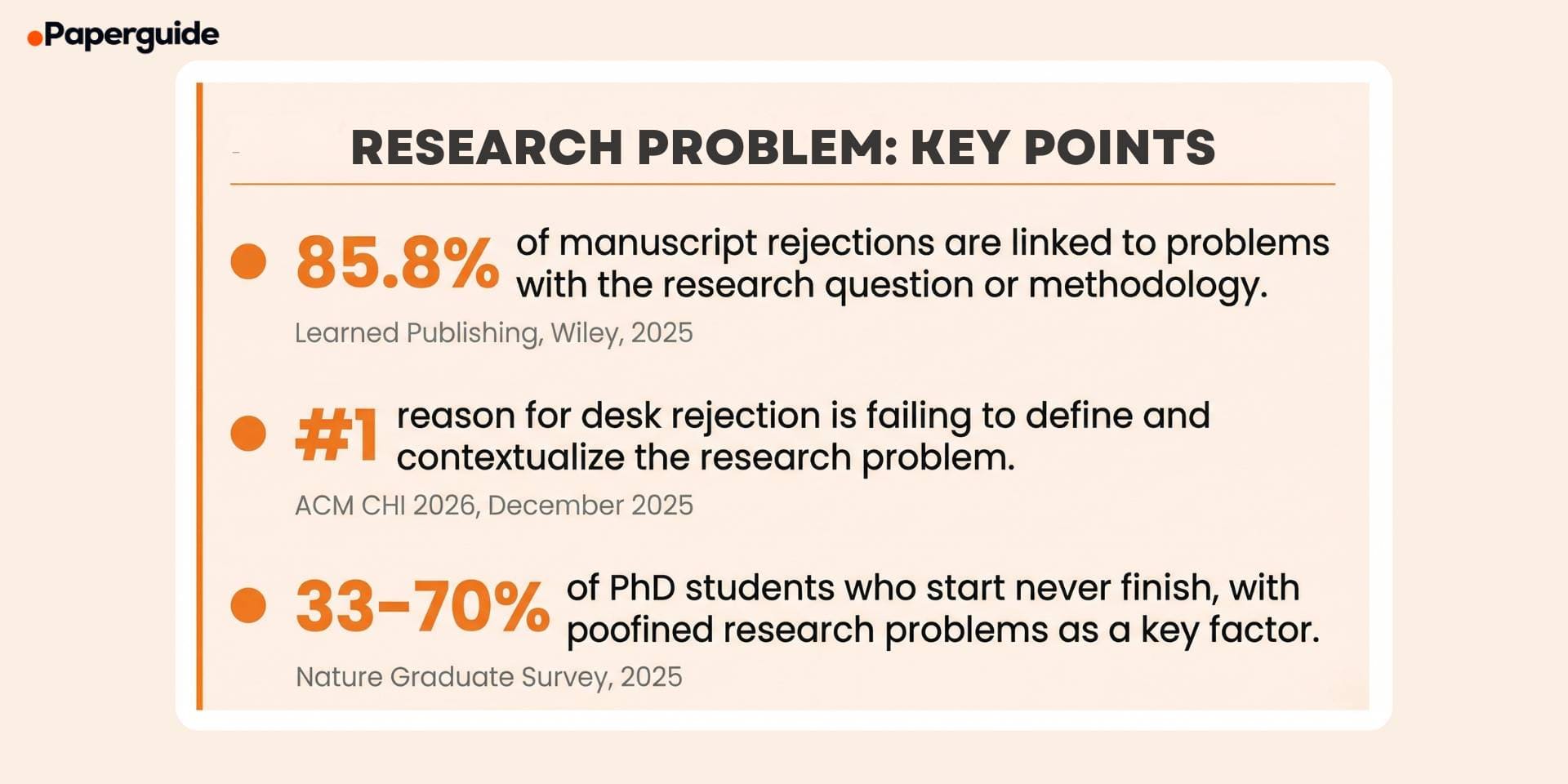
• Up to 85.8% of manuscript rejections are linked to problems with the research question or methodology.
• The #1 reason for desk rejection is failing to clearly define and contextualize the research problem.
• Poorly defined research problems are a major risk factor in academia (33–70% of PhD students who start never finish, with unclear problem definition contributing significantly).
Use the checklist and template in this guide to evaluate and refine your problem statement before submitting it.
What Is a Research Problem Statement?
A research problem statement is a short, structured passage that explains what issue your research will address. It sets the foundation for your entire study by defining the scope and direction of your work.
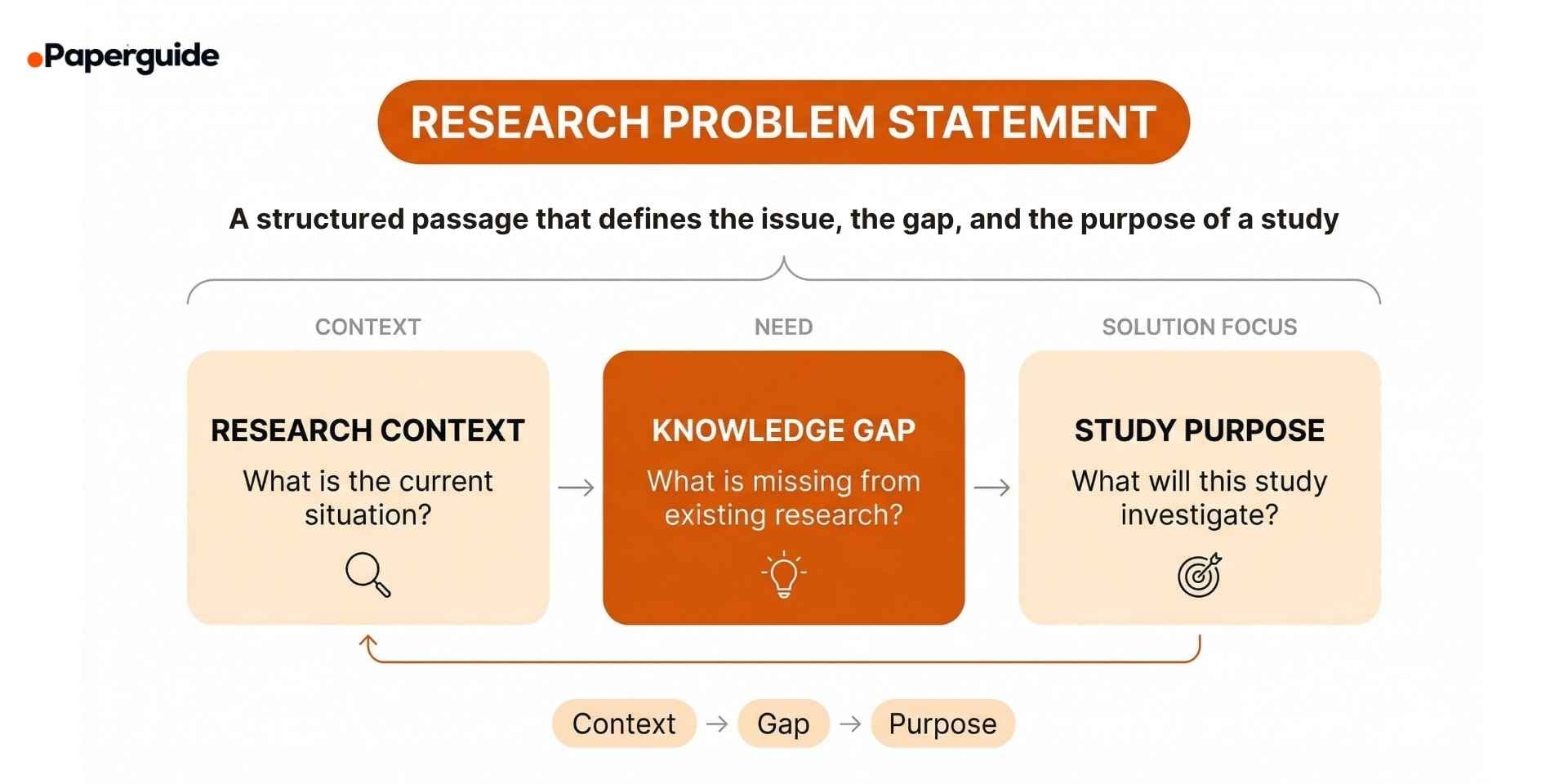
Think of it as the answer to the question: What problem does this research solve, and why does it need solving?
A problem statement is not the same as a research topic. A topic is a broad subject area. A problem statement narrows that subject into a specific, researchable issue supported by evidence.
For example, "climate change and agriculture" is a topic. A problem statement would be: "Smallholder farmers in sub-Saharan Africa face declining crop yields due to shifting rainfall patterns, yet few studies have examined low-cost adaptation strategies suitable for farms under two hectares."
The problem statement typically appears in the introduction section of a thesis, dissertation, or research proposal. It guides every decision that follows, from your research methodology to your data collection strategy.
Understanding the difference between a problem statement and related elements like a thesis statement or research methods is essential before you begin writing.
Why a Research Problem Statement Matters
A well-written problem statement serves several critical functions in the research process. With 85.8% of manuscript rejections linked to problems with the research question or methodology, getting this right is not optional. [1]
- It focuses your study: Without a clearly defined problem, research tends to drift. The problem statement acts as an anchor, keeping your literature review, methodology, and analysis aligned with a single purpose.
- It justifies your research: Reviewers, supervisors, and funding bodies need to understand why your study is necessary. With 81% of NIH grant applications being rejected in 2025, the problem statement provides that justification by identifying what is unknown, unresolved, or insufficiently studied. [2]
- It shapes your research methodology: The nature of the problem determines whether you need qualitative, quantitative, or mixed methods approaches. A vague problem leads to a vague design.
- It connects to the broader knowledge base: A good problem statement shows that you have reviewed existing literature and identified a meaningful gap. This positions your study within the larger academic conversation.
- It reduces your risk of non-completion: Research shows that 33% to 70% of PhD students who start never finish their degree. Poorly defined research problems are consistently cited as a key early-stage failure point. [3]
Researchers who skip the problem statement or write one too hastily often find themselves revising their entire proposal later. Investing time here saves significant effort downstream.

How to Write a Research Problem Statement (Step-by-Step)
Writing a research problem statement follows a structured process. Each step builds on the previous one. Follow these five steps to move from a broad interest area to a focused, well-supported problem statement.
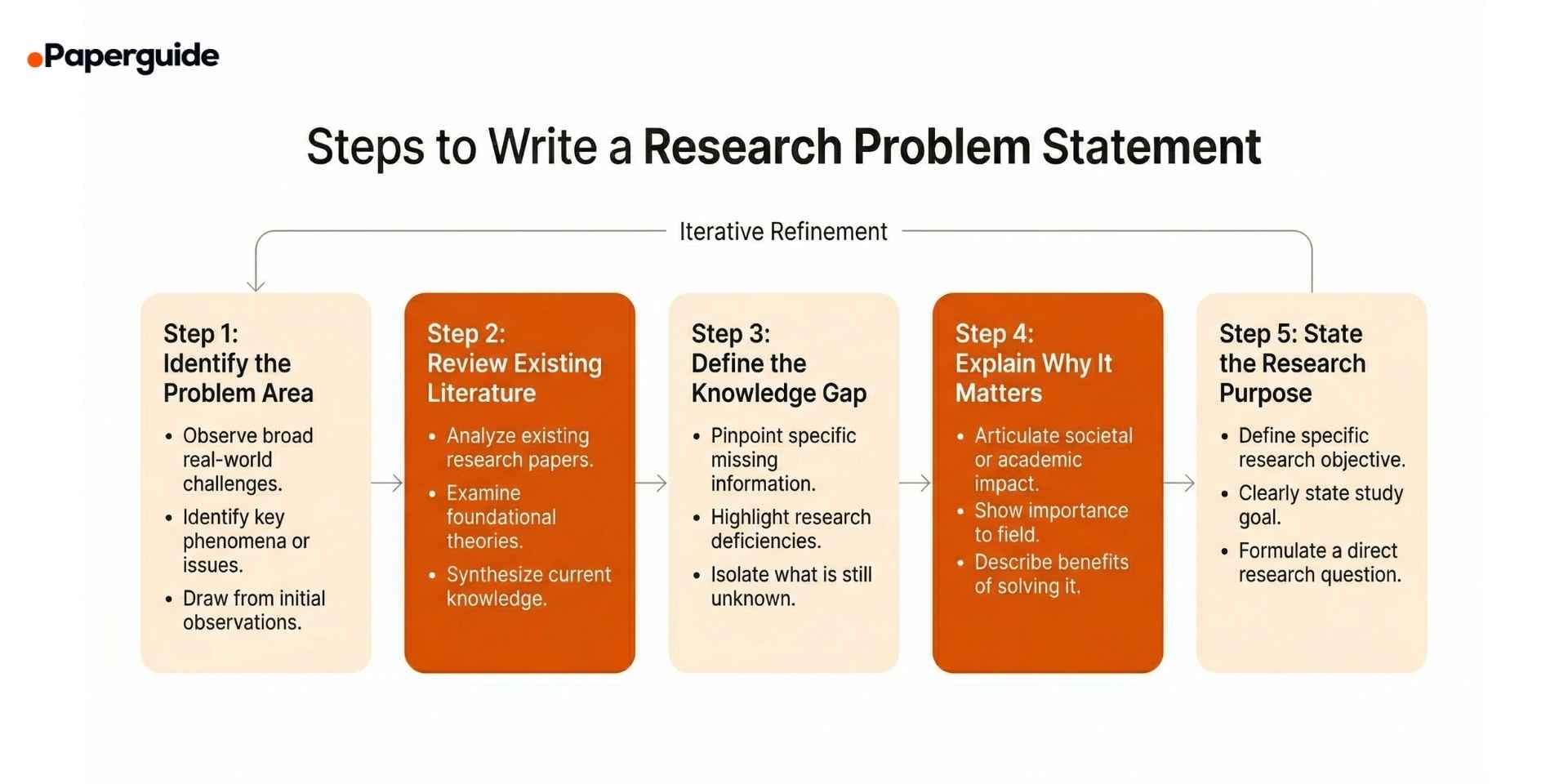
Step 1: Identify the Problem Area
Start with a broad area of concern within your field. This could come from practical observation, professional experience, course readings, or current debates in the literature.
Ask yourself: What issue in my field needs attention? What challenge do practitioners face? What contradictions exist in the research?
At this stage, you do not need a precise statement. You need a direction.
Example: You notice that university students report high levels of academic stress, but your university has limited mental health support programs.
Step 2: Review Existing Literature
Once you have a general area, review published research to understand what has already been studied. This helps you identify what is known and, more importantly, what remains unknown. With Scopus indexing 28,541 active journal titles and Web of Science holding over 271 million research records, a targeted literature search is essential to avoid duplicating existing work. [4]
Look for patterns such as:
- Topics that have been studied in certain populations but not others
- Methods that have been applied in some contexts but not tested elsewhere
- Conflicting findings that need resolution
- Emerging issues that lack sufficient empirical evidence
This step is essential. A problem statement without a literature foundation lacks credibility. "Insufficient context" was the number one reason for desk rejection at ACM CHI 2026, reinforcing why a thorough literature review matters before defining your problem. [5]
Researchers often use AI research platfrom like Paperguide to find relevant studies efficiently. Reviewing two or three key papers helps you confirm whether the problem has already been addressed or still requires investigation.
Step 3: Define the Knowledge Gap
The knowledge gap is the core of your problem statement. It explains what is missing from existing research.
A knowledge gap can take several forms:
- Empirical gap: No data exists on a specific population, context, or variable.
- Theoretical gap: An existing theory has not been tested in a new setting.
- Methodological gap: Previous studies used limited methods that leave questions unanswered.
- Practical gap: Research findings have not been translated into real-world solutions.
Be specific. Instead of writing "more research is needed," explain exactly what kind of research is needed and why.
Step 4: Explain Why It Matters
This step connects the knowledge gap to real-world or academic consequences. Why should anyone care about this problem?
Consider the impact of leaving the problem unaddressed:
- Does it affect a specific population?
- Does it limit policy decisions?
- Does it prevent progress in a field?
- Does it create risks or inefficiencies?
Providing evidence of consequences strengthens your problem statement and makes it more persuasive to reviewers and supervisors.
Step 5: State the Research Purpose
End your problem statement by clearly stating what your study intends to do about the problem. This links directly to your research objectives and research questions.
Use precise language such as:
- "This study aims to examine…"
- "The purpose of this research is to investigate…"
- "This study seeks to determine…"
Avoid vague language like "This study will look at…" or "This research is about…"
Research Problem Statement Examples
Concrete examples help clarify what a strong problem statement looks like compared to a weak one.
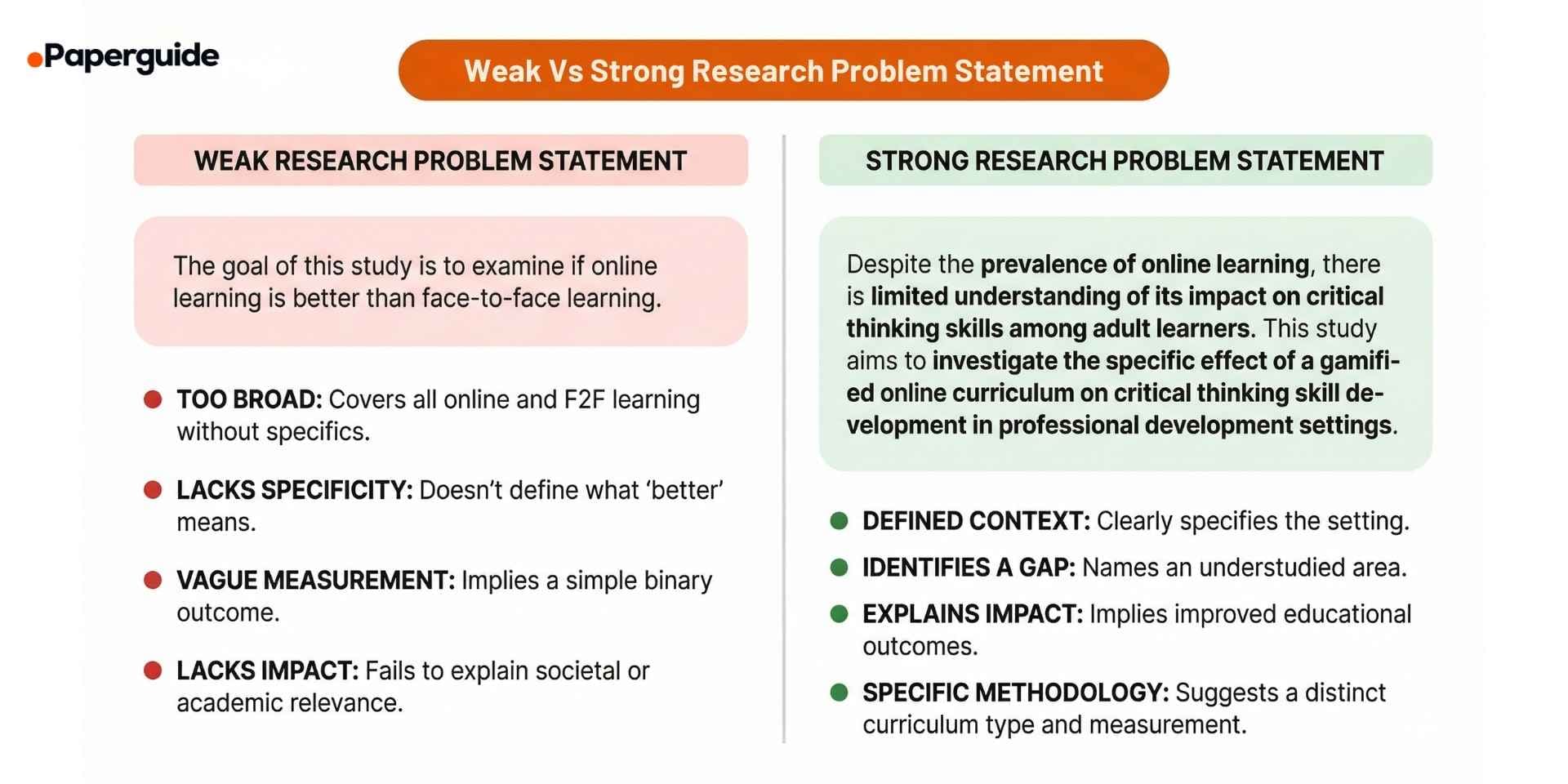
Example 1: Education Research
Weak version: "Online learning is becoming popular. This study is about online learning and student performance."
Problem: This reads like a topic description, not a problem statement. It does not identify a gap, explain significance, or state a purpose.
Strong version: "By 2025, over 40% of undergraduate programs in the United States offered at least one fully online degree pathway (NCES, 2025). While studies have examined overall pass rates in online courses (Smith, 2021; Lee, 2023), few have investigated how limited access to reliable broadband and personal computing devices affects assignment completion and course retention among first-generation college students. This study aims to examine the relationship between digital access barriers and academic outcomes in fully online undergraduate programs at public universities."
Why it works: It provides current context (2025 data), identifies a specific gap (first-generation students with limited access), cites evidence, explains consequences, and states a clear purpose.
Example 2: Public Health Research
Weak version: "Mental health is important for nurses. This study explores mental health among nurses."
Strong version: "Emergency department nurses experience burnout rates significantly higher than the national average for healthcare professionals, with a 2025 WHO report estimating that 45% of ED nurses in high-income countries report symptoms of chronic burnout (WHO, 2025). Although organizational interventions such as flexible scheduling and peer support programs have been recommended, their effectiveness in rural hospital settings remains largely unstudied. This research investigates the impact of peer support programs on burnout and job satisfaction among emergency nurses in rural hospitals with fewer than 100 beds."
Example 3: Business Research
Weak version: "Remote work affects employee productivity. This study is about remote work."
Strong version: "By 2025, hybrid and fully remote work arrangements had become the default operating model for over 70% of mid-sized technology firms globally (Gallup, 2025). While productivity metrics have been studied extensively in large corporations, limited evidence exists on how remote work policies affect output quality and cross-functional collaboration in teams of five to fifteen employees. This study examines the relationship between remote work frequency and project delivery outcomes in mid-sized software development teams operating across multiple time zones."
Each strong example follows the same pattern: context → gap → significance → purpose.
Common Mistakes and How to Fix Them
Even experienced researchers make errors when writing problem statements. With 33% to 70% of PhD students never completing their degree, often due to early-stage planning failures, avoiding these mistakes can make the difference between a successful study and an abandoned one.[3]
Mistake 1: Writing a Topic Instead of a Problem
Error: "This study is about social media and teenagers."
Fix: Identify the specific issue within the topic. What about social media and teenagers is problematic or unknown?
Corrected: "Adolescents aged 13–17 spend an average of 3.5 hours daily on social media platforms, yet the relationship between platform-specific usage patterns and sleep quality remains poorly understood."
Mistake 2: Being Too Vague
Error: "There is a lack of research on this topic."
Fix: Specify what research is missing. What population, variable, or context has not been studied?
Corrected: "While the effects of sleep deprivation on academic performance have been established in university populations, no published studies have examined this relationship among vocational training students aged 16–18 in rural settings."
Mistake 3: Skipping the Knowledge Gap
Error: Jumping from context directly to research purpose without showing what is missing from the literature.
Fix: Always include a sentence or two that explicitly states what existing research has not addressed. This is precisely what reviewers look for, and its absence was flagged as the top desk rejection reason at ACM CHI 2026. [5]
Mistake 4: Making It Too Long
Error: Writing a full page when the problem statement should be concise.
Fix: Aim for one focused paragraph (150–300 words) that covers context, gap, significance, and purpose. Detailed literature discussion belongs in your literature review, not in the problem statement.
Mistake 5: Using Subjective or Emotional Language
Error: "It is devastating that so many students fail their exams."
Fix: Use evidence-based, objective language. Replace emotional claims with data.
Corrected: "Approximately 30% of first-year students fail at least one core examination (National Education Board, 2025), suggesting a need for targeted academic support interventions."
Research Problem Statement Quality Checklist
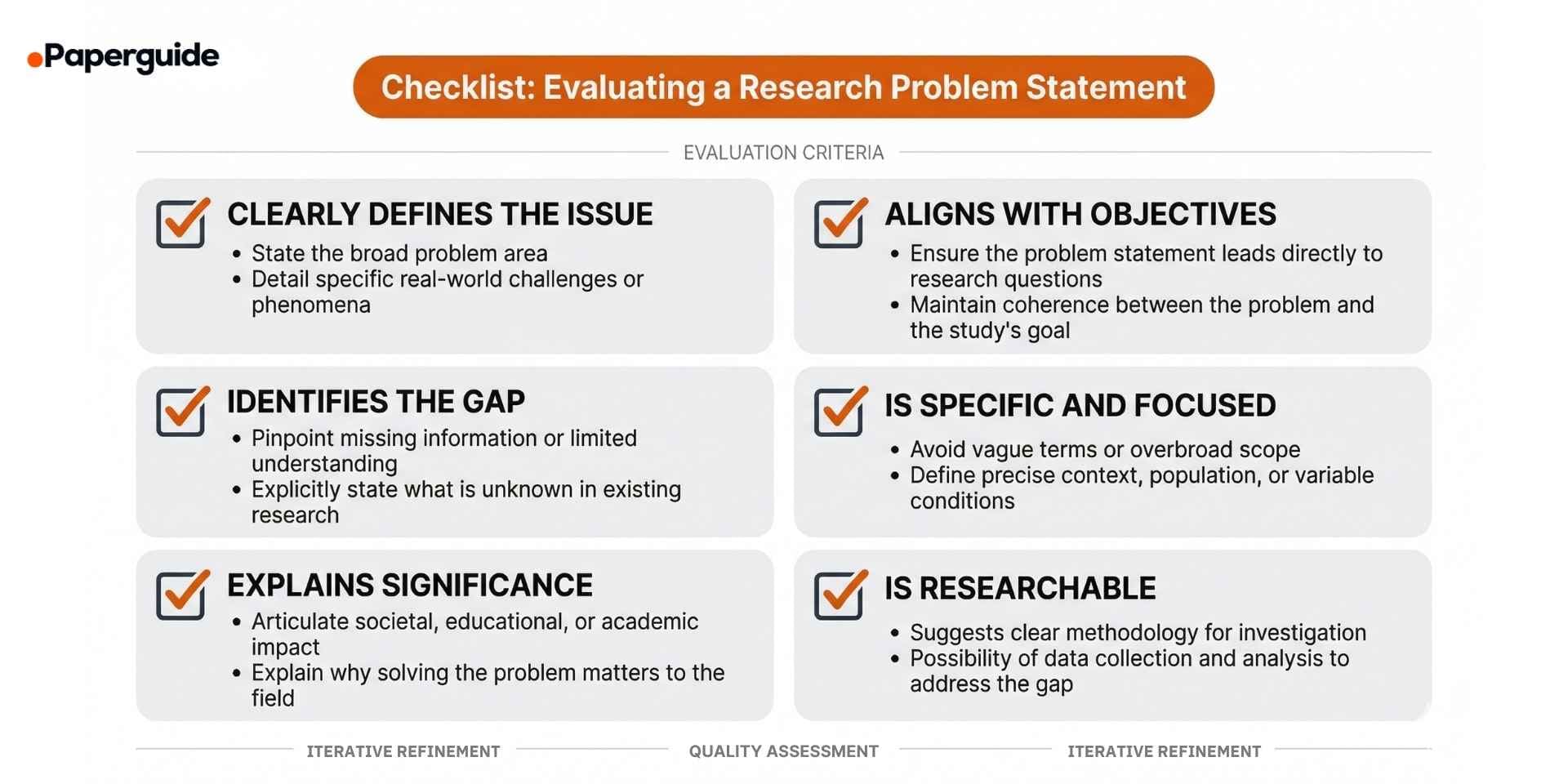
Use this checklist to evaluate your problem statement before including it in your proposal or thesis.
- [ ] Clearly defines the research issue. The reader can identify exactly what problem the study addresses.
- [ ] Identifies the knowledge gap. The statement explains what existing research has not covered.
- [ ] Explains why it matters. The consequences of leaving the problem unaddressed are stated.
- [ ] Aligns with research objectives. The problem statement connects logically to your stated aims.
- [ ] Is specific and focused. The problem is narrow enough to investigate within a single study.
- [ ] Is researchable. The problem can be investigated using available methods and data.
- [ ] Uses objective, evidence-based language. No emotional or subjective claims without supporting data.
- [ ] Cites relevant sources. Key claims are supported by references to published research.
- [ ] Stays concise. The statement is one paragraph (150–300 words), not a full literature review.
Research Problem Statement Template
Use this fill-in template to draft your problem statement. Replace the bracketed sections with your own content.
[Topic/Context sentence]. [Brief description of the current situation, supported by a citation]. However, [specific gap in the literature or practice]. [Evidence or consequence of this gap]. This study aims to [purpose of your research] by [brief description of your approach].
Filled Example:
Access to clean water remains a critical public health challenge in developing nations. The World Health Organization estimates that 2.2 billion people still lack safely managed drinking water services as of 2025 (WHO, 2025). However, few studies have evaluated the long-term effectiveness of community-led water purification programs in rural East Africa. Without this evidence, policymakers lack data to allocate funding effectively. This study aims to assess the impact of community-managed biosand filters on waterborne illness rates in three rural Kenyan districts over a 24-month period.
Where Does the Problem Statement Fit in the Research Process?
The problem statement appears early in the research workflow. Understanding its position helps you write it with the right level of detail.
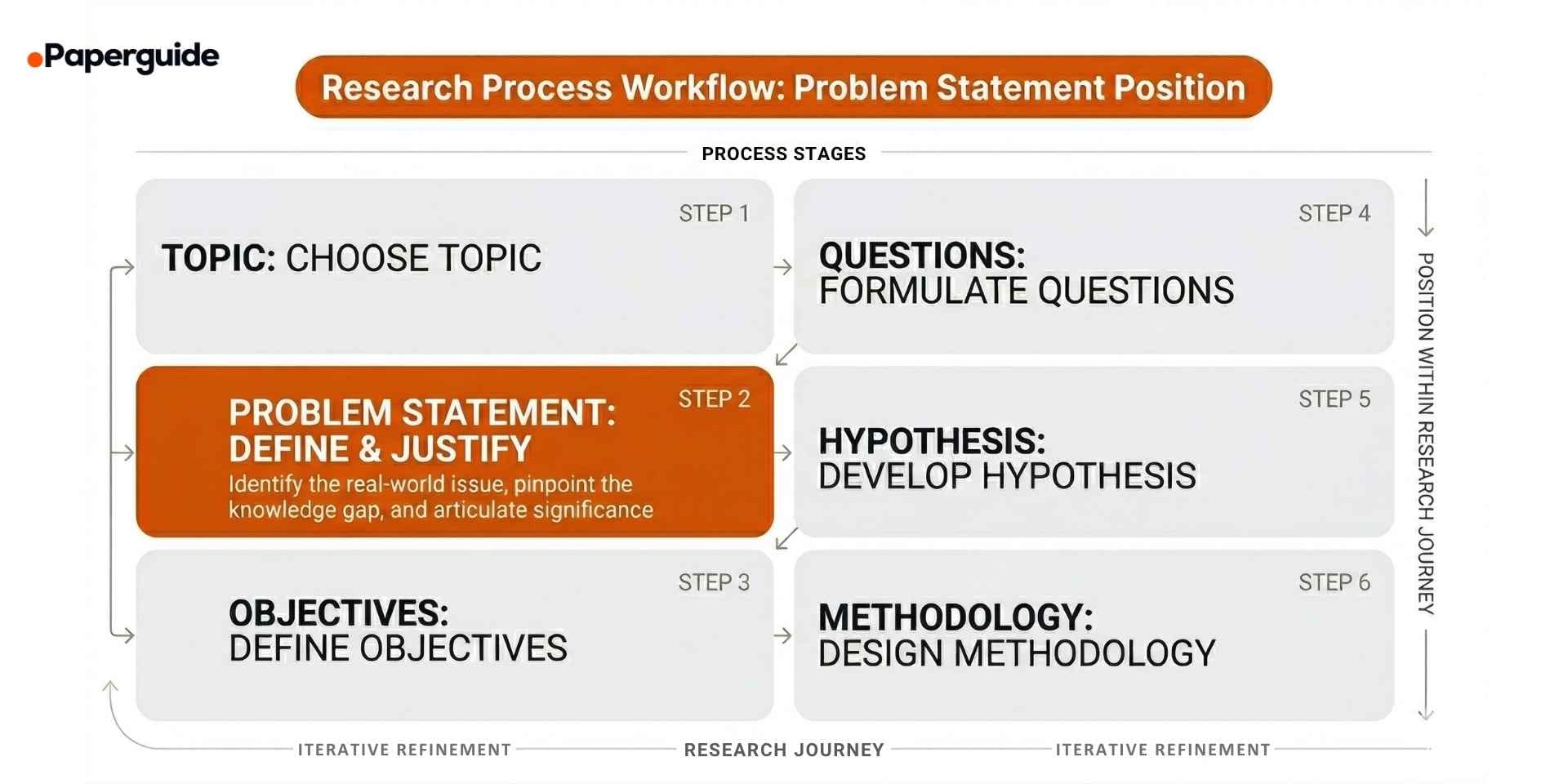
The typical sequence is:
- Choose a research topic, your broad area of interest
- Write the problem statement, the specific issue within the topic
- Define research objectives, what the study aims to achieve
- Formulate research questions, the specific questions the study will answer
- Develop a hypothesis, a testable prediction (if applicable)
- Design the research methodology, how the study will be conducted
Each step builds on the previous one. A weak problem statement creates a shaky foundation for everything that follows.
You can also explore different types of research papers to understand how problem statements vary across article types.
Validate This With Papers (2 Minutes)
Before finalizing your problem statement, verify your knowledge gap against published research. With the volume of new publications growing each year, and Scopus indexing over 5 million records in 2024 alone, a quick verification step can save you from writing a problem statement for a gap that was recently closed. Here is a quick workflow:
Step 1: You can Use Paperguide’s AI Search to search for your topic. Enter your research problem as a question and review the top results.
Step 2: Open two or three relevant papers. Check whether the gap you identified has already been addressed in recent studies.
Step 3: Use Chat with PDF to extract specific findings, definitions, or evidence that support your problem statement. This helps you confirm your gap is genuine and add proper citations.
This takes about two minutes and prevents the common mistake of writing a problem statement for a gap that has already been filled.
Conclusion
A research problem statement is more than a formality. It is the foundation that holds your entire study together. Without a clearly defined problem, your literature review lacks direction, your methodology lacks justification, and your findings lack context. The five-step process outlined in this guide, identify the problem area, review existing literature, define the knowledge gap, explain why it matters, and state your research purpose, gives you a repeatable framework for writing problem statements that are specific, evidence based, and aligned with your research objectives. Use the checklist and template provided above to evaluate your draft before submitting it to a supervisor, committee, or journal.
The strongest research begins with the sharpest questions. Whether you are starting a thesis, drafting a grant proposal, or writing your first research paper, investing time in your problem statement saves hours of revision later. Review two or three recent papers in your field, confirm that your gap has not already been addressed, and refine your statement until it passes every item on the checklist. Your next step is to define clear research objectives that connect directly to the problem you have identified and move your study from planning to execution.
Frequently Asked Questions
What is the difference between a research problem and a research problem statement?
A research problem is the broader issue or challenge that exists in a field. A research problem statement is the written articulation of that problem within a research proposal or thesis. The statement formally defines the problem, identifies the knowledge gap, and explains why the study is needed. Think of the problem as the issue itself and the statement as your explanation of it.
How long should a research problem statement be?
A research problem statement is typically one paragraph, ranging from 150 to 300 words. It should be long enough to include context, the knowledge gap, significance, and purpose, but concise enough to remain focused. Avoid turning it into a mini literature review. Detailed evidence belongs in your literature review chapter.
Can a research problem statement be written as a question?
While some disciplines allow problem statements to end with a question, most academic conventions recommend writing it as a declarative statement. The problem statement describes the issue; the research question formalizes what the study will investigate. These are related but distinct elements.
What is the difference between a problem statement and a research question?
A problem statement explains the issue and why it matters. A research question specifies exactly what the study will investigate. The problem statement provides the justification; the research question provides the focus. For example, a problem statement might describe rising dropout rates, while the research question asks: "What factors contribute to first-year dropout rates at community colleges?"
How do you identify a research problem?
Research problems emerge from several sources: observations in professional practice, gaps in published literature, conflicting findings across studies, emerging issues in a field, or practical challenges that lack evidence-based solutions. In 2026, AI-powered research tools can accelerate this process by surfacing relevant literature and highlighting under-studied areas. Reviewing recent publications and noting where authors suggest "further research is needed" remains one of the most effective strategies.
Should a problem statement include citations?
Yes. Including citations strengthens your problem statement by showing that the problem is grounded in evidence, not personal opinion. Cite statistics, findings from prior studies, or reports from authoritative organizations. Two to four references within the problem statement is typical.
How specific should a research problem statement be?
Specific enough to guide a single study. If your problem statement could apply to dozens of different research designs, it is probably too broad. A good test: can you derive clear research objectives and questions directly from the problem statement? If not, narrow it further.
What makes a research problem statement weak?
Common signs of a weak problem statement include: it reads like a topic rather than a researchable issue, it lacks evidence or citations, it does not identify a knowledge gap, it uses vague language ("this study will look at"), or it is overly long and unfocused. Use the checklist in this guide to evaluate your draft.
References
- National Science Foundation, NCSES. "Publication Output: U.S. Trends and International Comparisons." NSB 2025.
- Teixeira da Silva, J.A. "Rejected papers in academic publishing: Turning negatives into positives to maximize paper acceptance." Learned Publishing, 2025.
- Kaiser, J. "NIH research grant success rates plummeted in 2025." Science Magazine, 2025.
- Nature Graduate Survey 2025. Springer Nature / Thinks Insights & Strategy. 3,785 respondents from 107 countries.
- Clarivate Analytics. "Web of Science Core Collection." 2025
- ACM CHI 2026. "Insights Into the Papers Track (Assisted) Desk Rejections." December 2025.
- National Science Foundation, NCSES. "Publication Output: U.S. Trends and International Comparisons." NSB 2025