How to Conduct a Narrative Review: Step-by-Step Guide With Examples


A narrative review is a type of literature review that synthesizes and interprets existing research on a topic by organizing findings thematically rather than following the strict, protocol-driven methodology of a systematic review. Narrative reviews are the most common type of review article in academic publishing because they allow authors to draw on their expertise to provide a broad, interpretive overview of a research area, identify patterns and contradictions across studies, and develop new theoretical insights or conceptual frameworks. [1]
Despite their prevalence, narrative reviews are sometimes criticized for lacking the transparency and reproducibility of systematic reviews. However, recent methodological guidance has established clear standards for conducting narrative reviews with rigor. When done well, a narrative review provides something that a systematic review cannot: an expert synthesis that connects disparate findings into a coherent story, identifies underlying mechanisms, and proposes new directions for the field. This guide explains what a narrative review is, how it differs from other review types, and how to conduct one step by step with a practical structure, a worked example, and a quality checklist. [2]
Key Takeaways
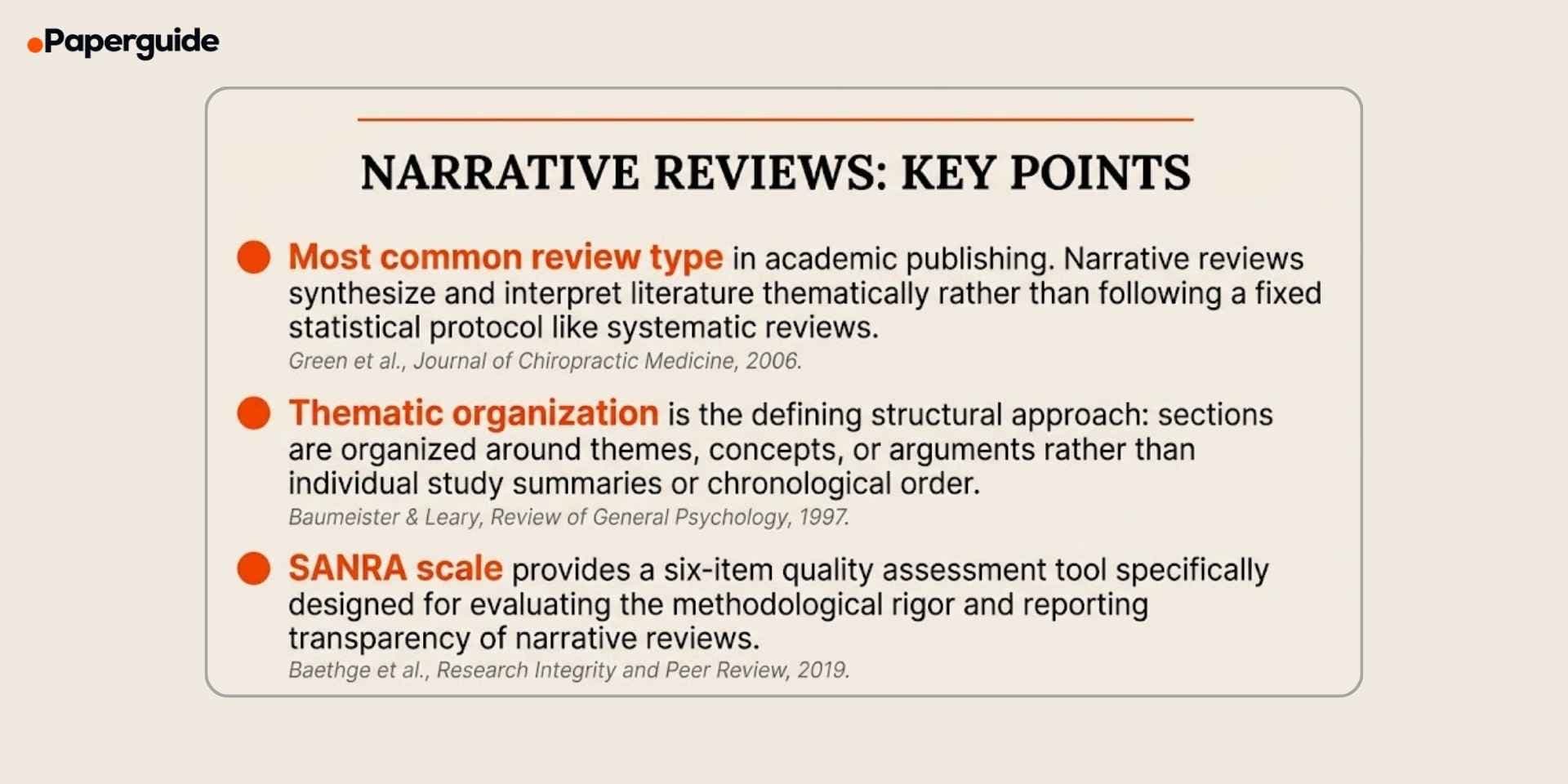
- A narrative review synthesizes and interprets literature thematically, using the author's expertise to identify patterns, contradictions, and new insights across studies
- Unlike systematic reviews, narrative reviews do not follow a fixed protocol for searching, screening, or quality assessment, but they should still document their methods transparently
- The structure is organized around themes, concepts, or arguments rather than individual study summaries or chronological order
- The SANRA scale provides six criteria for evaluating narrative review quality: justification of the article's importance, statement of aims, literature search description, referencing, scientific reasoning, and appropriate presentation of data
- Narrative reviews are best suited for broad topic overviews, theoretical synthesis, and identifying research gaps when a systematic approach is not feasible or appropriate
What Is a Narrative Review?
A narrative review (also called a traditional literature review or narrative literature review) is a comprehensive, critical summary of existing research on a topic that relies on the author's expertise to select, synthesize, and interpret the literature. The author identifies relevant studies, evaluates their contributions, organizes them into thematic categories, and constructs an argument or narrative that connects the findings into a coherent whole.
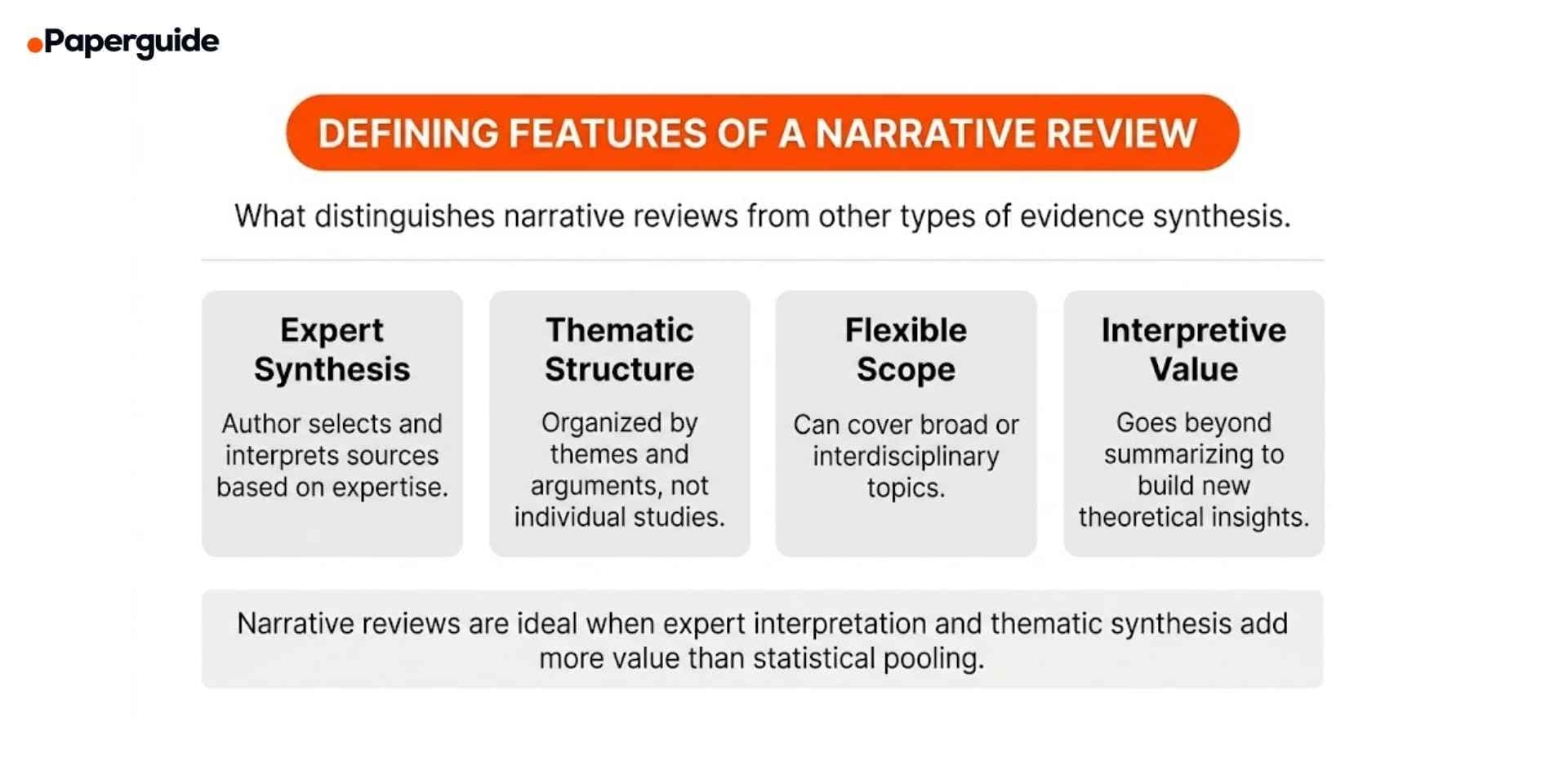
The defining characteristic of a narrative review is that the author has significant discretion in selecting which studies to include and how to organize and interpret them. This is both its greatest strength and its most commonly cited limitation. A skilled author can draw connections across disciplines, identify emerging patterns that no single study reveals, and propose new theoretical frameworks. However, without transparent documentation of the search and selection process, readers cannot fully evaluate whether the review is comprehensive or biased toward the author's perspective. [3]
Narrative reviews serve several important purposes in academic research. They provide accessible introductions to complex topics for researchers entering a new field. They identify contradictions and unresolved questions that inform future research. They connect findings across disciplines that may not be captured in a narrowly focused systematic review. And they provide the interpretive depth needed to develop new theories or refine existing conceptual frameworks. Researchers who work with AI tools for interacting with research papers can use them to quickly identify key arguments and findings across large numbers of papers during the source selection phase.
Narrative Review vs Systematic Review
Understanding the differences between a narrative review and a systematic review helps you choose the appropriate method and set correct expectations for your manuscript.
| Feature | Narrative Review | Systematic Review |
|---|---|---|
| Research question | Broad, flexible, may evolve | Focused, predefined PICO |
| Protocol | Not required (but recommended) | Required, registered in advance |
| Search strategy | Flexible, expert-driven | Comprehensive, documented, reproducible |
| Study selection | Author discretion | Predefined eligibility criteria, two reviewers |
| Quality assessment | Not required | Formal risk of bias assessment |
| Synthesis | Thematic, interpretive, narrative | Narrative and/or statistical (meta-analysis) |
| Reporting standard | SANRA scale (quality evaluation) | PRISMA 2020 (27-item checklist) |
| Reproducibility | Limited | High |
| Interpretive depth | High (expert perspective) | Lower (constrained by protocol) |
A systematic review is the right choice when you need reproducible, protocol-driven evidence synthesis for clinical or policy decisions. A narrative review is the right choice when you need expert interpretation, thematic synthesis across a broad or interdisciplinary area, or theoretical development that goes beyond what any single study or statistical analysis can provide.
Neither type is inherently superior. They serve different purposes and answer different types of questions. The most important thing is to choose the correct type for your research goal and to be transparent about your methods regardless of which approach you use.
How to Conduct a Narrative Review (7 Steps)
While narrative reviews are more flexible than systematic reviews, following a structured approach improves the quality, credibility, and usefulness of the final product. The seven steps below incorporate the latest methodological guidance from Sukhera (2022), Ferrari (2015), and the SANRA quality criteria.
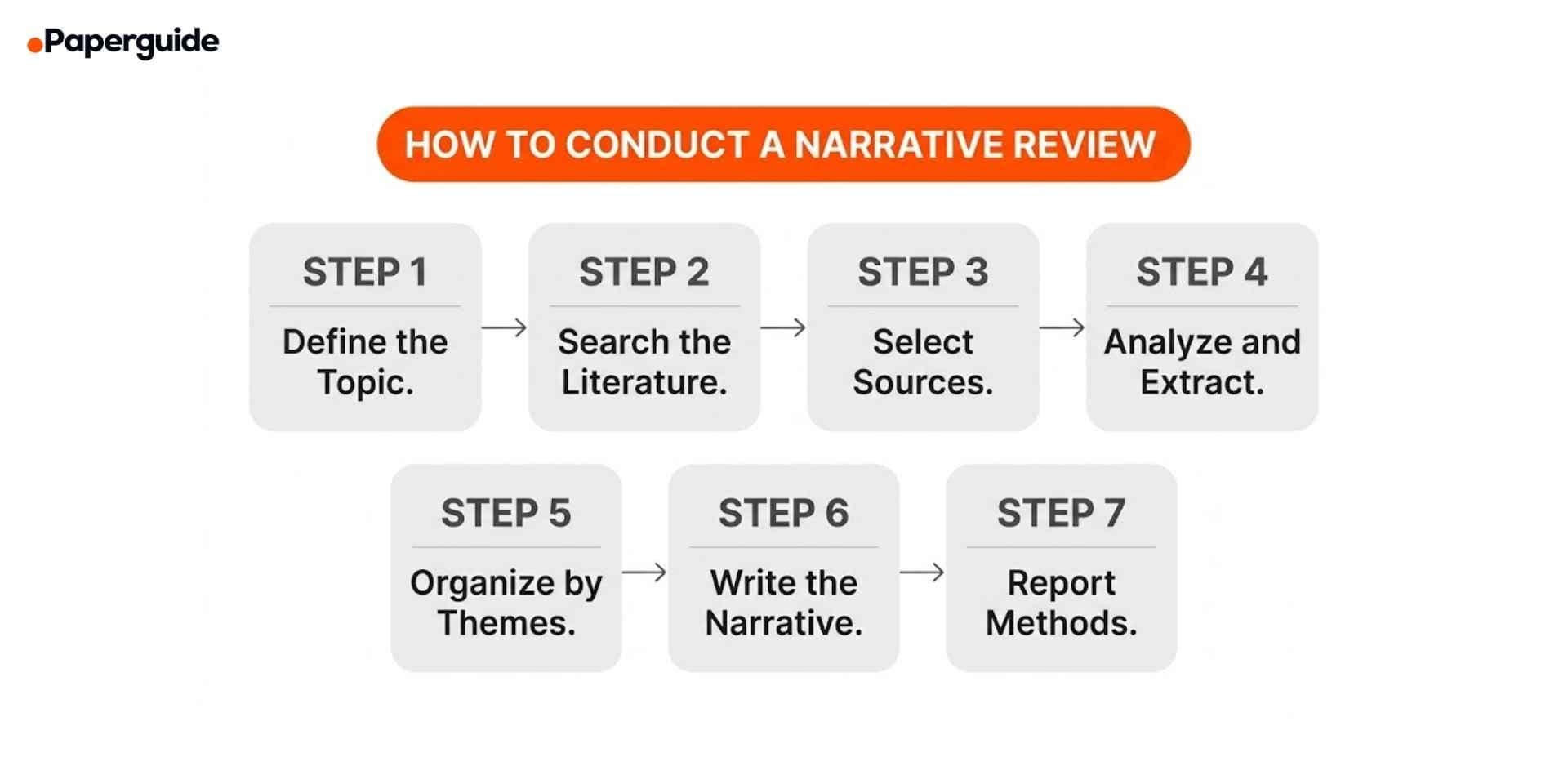
Step 1: Define the Topic and Scope
Begin by defining the topic, the scope of the review, and the specific purpose it serves. Unlike systematic reviews that use PICO or PCC frameworks, narrative reviews typically start with a broad research question or a set of related questions that the review will address [2].
Clarify the boundaries of your review: What time period will you cover? What disciplines are relevant? Are you focusing on a specific population, setting, or theoretical framework? Will you cover empirical studies only, or will you also include theoretical papers, commentaries, and grey literature?
Example topic definition: "This narrative review examines how feedback literacy has been conceptualized across higher education research, identifies the key models and frameworks that have emerged, and proposes an integrated conceptual framework that addresses gaps in the current literature."
Defining the scope upfront prevents the review from becoming unmanageable and helps readers understand what to expect.
Step 2: Search the Literature
Although narrative reviews do not require the exhaustive, protocol-driven search of a systematic review, the search should still be thorough and documented. Search at least two or three databases relevant to your topic. Use a combination of keyword searches, controlled vocabulary (such as MeSH terms), and citation tracking (following references from key papers and identifying papers that cite them). [3]
Document which databases you searched, what search terms you used, and the approximate date range of your search. This information should be reported in the methods section of your manuscript. While narrative reviews allow the search strategy to evolve as you develop your understanding of the topic, keeping a record of your process strengthens the transparency and credibility of the review.
Supplement database searches by consulting reference lists of key papers, seeking recommendations from experts in the field, and searching for seminal works that have shaped the discourse on your topic. Researchers who manage references across multiple platforms during this phase benefit from using a dedicated reference manager to organize and tag sources by theme.
Step 3: Select and Evaluate Sources
Source selection in a narrative review relies on the author's judgment rather than predefined eligibility criteria. Select sources based on their relevance to your topic, the quality and impact of the research, and their contribution to the narrative you are building. [1]
Prioritize sources that are methodologically rigorous, frequently cited, published in reputable journals, and directly relevant to the themes you plan to cover. Include foundational works that established key concepts, recent studies that represent the current state of knowledge, and studies with contrasting findings that highlight ongoing debates.
Be transparent about your selection process. While you are not required to include every study ever published on the topic, you should aim for balanced coverage that represents the full range of perspectives. Acknowledge any limitations in your coverage, such as language restrictions or disciplinary boundaries.
Step 4: Analyze and Extract Key Information
For each selected source, extract the key information you will use in your synthesis. This typically includes the main findings, theoretical contributions, methodological approach, population studied, and any limitations acknowledged by the authors.
Create a structured summary for each source, whether in a spreadsheet, a reference manager with notes, or a dedicated extraction form. Include a column for the theme or category each source relates to, as this will help you organize the review in the next step. Researchers who need to quickly extract key information from papers using AI tools find that structured extraction significantly speeds up the analysis phase.
Look for patterns as you extract information: Where do studies agree? Where do they disagree? What methodological differences might explain contradictory findings? What questions remain unanswered? These observations will form the analytical foundation of your review.
Step 5: Organize the Review by Themes
The structure of a narrative review should be organized around themes, concepts, or arguments rather than presenting studies one by one or in chronological order. Thematic organization is what separates a strong narrative review from a simple annotated bibliography.
Identify the major themes that emerged during your analysis. Group your sources according to these themes. Each theme typically becomes an H2 or H3 section in your manuscript. Within each theme, synthesize findings across multiple studies rather than summarizing each study individually.
Example thematic structure for a review on feedback literacy in higher education:
Theme 1: Definitions and conceptualizations of feedback literacy (covering how different researchers have defined the concept, identifying areas of agreement and tension).
Theme 2: Theoretical frameworks and models (analyzing the major frameworks that have been proposed, comparing their components and underlying assumptions).
Theme 3: Empirical evidence on developing feedback literacy (synthesizing studies that have measured or attempted to develop feedback literacy, identifying what works and what remains unclear).
Theme 4: Gaps and future directions (identifying underexplored areas, proposing new research questions, and presenting your integrated framework).
Step 6: Write the Narrative
Writing the narrative review requires combining critical analysis with clear, engaging prose. Each section should do more than summarize the literature. It should interpret findings, draw connections between studies, and advance an argument or perspective. [2]
Start each section with a clear topic sentence that introduces the theme and your analytical position. Then present the evidence from multiple studies, explaining how they support, contradict, or extend each other. End each section with a synthesis statement that connects back to your overarching argument and transitions to the next theme.
Avoid the common pitfall of writing "study A found X, study B found Y, study C found Z" without connecting the findings. Instead, write analytically: "Several studies have found that students develop feedback literacy through repeated practice with self-assessment (Author 1; Author 2; Author 3), although this finding is complicated by evidence that the quality of feedback received also plays a significant role (Author 4; Author 5)."
When writing the abstract for your narrative review, ensure it summarizes the scope, the key themes, the main conclusions, and the implications rather than just listing the topics covered.
Step 7: Report Your Methods Transparently
Even though narrative reviews are more flexible than systematic reviews, you should still describe your methods clearly in the manuscript. The SANRA scale identifies six quality criteria for narrative reviews, and documenting your methods addresses several of them. [5]
In your methods section (or a dedicated paragraph in the introduction), describe: the databases searched, the main search terms used, the time period covered, the types of sources included, the criteria you used to select sources, and any limitations of your search strategy. This transparency allows readers to evaluate the comprehensiveness and potential biases of your review.
If your review was not intended to be exhaustive, state this explicitly and explain why. For example: "This review does not claim to be exhaustive but aims to provide a comprehensive overview of the major theoretical and empirical contributions to the field of feedback literacy in higher education." Researchers considering the ethical use of AI writing tools in academic work should disclose any AI assistance used during the search, extraction, or writing phases of their narrative review.

Narrative Review Example (Worked Through)
Below is a condensed example showing how each step applies to a real narrative review.
Topic and scope: Feedback literacy in higher education. The review covers research published from 2006 to 2025, draws from education, psychology, and assessment studies, and aims to develop an integrated conceptual framework.
Search: Searched Scopus, ERIC, and PsycINFO using terms ("feedback literacy" OR "feedback capability" OR "student feedback") AND ("higher education" OR "university"). Supplemented with citation tracking from key papers by Carless & Boud (2018) and Molloy, Boud & Henderson (2020). Approximately 280 potentially relevant records identified.
Source selection: Selected 87 sources based on relevance to feedback literacy, methodological quality, and contribution to the themes identified during preliminary reading. Sources included 48 empirical studies, 22 theoretical or conceptual papers, 11 literature reviews, and 6 practice-focused commentaries.
Thematic analysis: Four themes emerged: (1) competing definitions and conceptualizations of feedback literacy, (2) theoretical frameworks including Carless and Boud's three-dimension model, (3) empirical evidence on interventions to develop feedback literacy, and (4) the role of institutional culture in shaping feedback practices.
Key synthesis findings:
Theme 1 revealed that definitions range from narrow skill-based interpretations (students' ability to read and act on feedback) to broader dispositional conceptualizations (students' orientation toward feedback as a learning opportunity). The lack of a unified definition limits comparability across studies.
Theme 2 identified three major frameworks with overlapping but distinct components. The review proposed an integrated model that combines the strengths of each while addressing gaps in emotional and relational dimensions of feedback engagement.
Theme 3 found that interventions focused on self-assessment practice and peer feedback showed the strongest evidence for developing feedback literacy, but most studies were short-term (less than one semester) with small sample sizes.
Theme 4 identified institutional culture as a significant moderating factor that has been underexplored in the empirical literature.
Conclusion: The review argued for an integrated conceptual framework and identified three priority areas for future research: longitudinal studies, cross-cultural comparisons, and the role of technology in mediating feedback literacy development.
Narrative Review Structure Template
Use this template to plan the structure of your narrative review. Adapt the sections to fit your specific topic.
Title: [Broad topic]: a narrative review of [specific aspect or time period].
Abstract: Summarize the scope, purpose, key themes, main conclusions, and implications in 250 words or fewer.
Introduction: Introduce the topic, explain why it matters, state the purpose and scope of the review, and preview the thematic structure.
Methods: Describe the databases searched, search terms, time period, types of sources included, selection approach, and any limitations.
Theme 1: [First major theme]. Synthesize findings across studies, identify areas of agreement and disagreement, and connect to your overarching argument.
Theme 2: [Second major theme]. Follow the same synthesis approach, building on the foundation established in Theme 1.
Theme 3: [Third major theme]. Continue the synthesis, addressing contradictions or gaps that connect themes.
Theme 4: [Fourth major theme or future directions]. Identify remaining gaps, propose new research questions, or present a new framework.
Discussion: Interpret the overall findings, discuss implications for theory and practice, acknowledge limitations, and propose specific future research directions.
Conclusion: Summarize the key contributions of the review in two to three paragraphs.
Filled Example:
Title: Feedback literacy in higher education: a narrative review of conceptualizations, frameworks, and empirical evidence (2006 to 2025).
Abstract: This narrative review synthesizes research on feedback literacy in higher education, examining how the concept has been defined, which theoretical frameworks have been proposed, and what empirical evidence exists for developing feedback literacy in university students. The review draws on 87 sources from education, psychology, and assessment studies published between 2006 and 2025. Four themes are identified: competing definitions, theoretical frameworks, empirical interventions, and the role of institutional culture. The review proposes an integrated conceptual framework and identifies priority areas for future research. Implications for teaching practice and institutional policy are discussed.
Introduction: Feedback is widely recognized as one of the most powerful influences on student learning, yet research consistently shows that students struggle to use feedback effectively. The concept of feedback literacy has emerged as a way to understand and develop students' capacity to engage productively with feedback. This review synthesizes 19 years of research on feedback literacy in higher education to develop an integrated conceptual framework.
Methods: We searched Scopus, ERIC, and PsycINFO using terms related to feedback literacy and higher education. Sources were selected based on relevance, methodological quality, and contribution to the identified themes. The review is not intended to be exhaustive but aims to represent the major theoretical and empirical contributions to the field.
Common Mistakes When Writing a Narrative Review
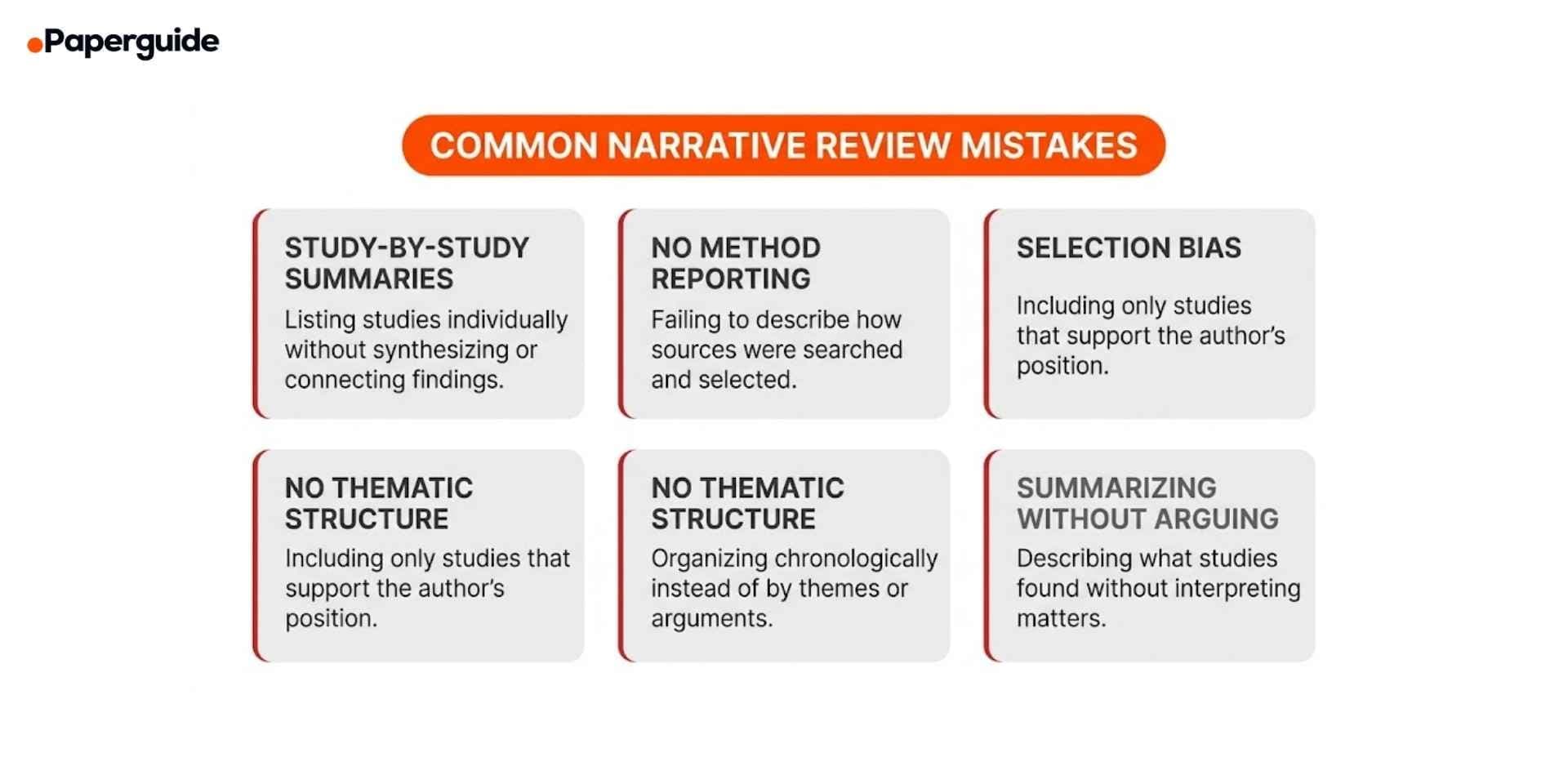
Mistake 1: Writing Study-by-Study Summaries Instead of Synthesizing
The most common mistake in narrative reviews is presenting each study as an isolated paragraph ("Study A found X. Study B found Y.") without connecting findings across studies. This produces an annotated bibliography rather than a review.
Fix: Group studies by theme and synthesize findings across multiple sources in each paragraph. Each paragraph should make a point supported by multiple studies, not summarize a single study.
Mistake 2: Not Reporting Methods
Omitting any description of how you searched and selected sources makes your review vulnerable to criticism about bias and comprehensiveness. Reviewers and readers cannot evaluate the review without knowing what process you followed. [5]
Fix: Include a methods paragraph or section that describes the databases searched, search terms used, time period covered, and the basis for your source selection decisions.
Mistake 3: Including Only Supporting Evidence
Selecting only studies that confirm your argument while ignoring contradictory evidence undermines the credibility of the review. A strong narrative review engages with conflicting findings and explains why they exist.
Fix: Actively search for studies with different findings or perspectives. Discuss contradictions honestly and explore possible explanations (methodological differences, population differences, theoretical disagreements).
Mistake 4: Organizing Chronologically Instead of Thematically
Presenting studies in the order they were published creates a timeline rather than an analysis. Chronological organization rarely helps readers understand the current state of knowledge or the key debates in a field.
Fix: Organize your review around themes, concepts, or arguments. Use chronological ordering only within a theme when showing how thinking on a specific concept has evolved over time.
Mistake 5: Summarizing Without Interpreting
Describing what studies found without explaining why it matters or how it connects to other findings produces a flat, unengaging review. The interpretive voice of the author is what makes a narrative review valuable. Researchers exploring AI writing tool comparisons for academic work should note that AI can help with drafting, but the interpretive synthesis that defines a strong narrative review requires the author's own analytical thinking. [2]
Fix: After presenting evidence, always interpret it. What does this pattern mean? Why do these studies disagree? What does this tell us about the field? What should we study next?
Narrative Review Quality Checklist (SANRA-Based)
- [ ] Importance is justified. The introduction explains why the topic matters and why a narrative review is the appropriate approach.
- [ ] Aims are clearly stated. The specific purpose and scope of the review are defined, including the questions the review addresses.
- [ ] Literature search is described. The databases, search terms, time period, and source selection approach are documented.
- [ ] Referencing is appropriate. Key claims are supported by citations, including foundational works and recent studies.
- [ ] Scientific reasoning is sound. The synthesis follows a logical structure, engages with contradictory evidence, and avoids unsupported claims.
- [ ] Data presentation is appropriate. Studies are synthesized thematically rather than listed individually, and findings are presented accurately.
- [ ] Thematic organization is clear. The review is structured around themes or arguments, not chronological or study-by-study summaries.
- [ ] Contrasting evidence is addressed. Studies with conflicting findings are discussed and possible explanations are offered.
- [ ] Limitations are acknowledged. The scope, search limitations, and potential biases of the review are disclosed.
- [ ] Conclusions are supported. Final conclusions are grounded in the evidence presented and avoid overstating the findings.
When to Choose a Narrative Review Over Other Review Types
A narrative review is the best choice when you need to provide a broad overview of a complex or interdisciplinary topic, when the literature is too heterogeneous for systematic synthesis, when your goal is to develop or refine a theoretical framework, or when you are writing for an audience that needs an accessible introduction to a research area.
Choose a systematic review instead when you need to answer a specific empirical question with reproducible methodology, when formal quality assessment is required, or when the goal is to produce actionable conclusions for clinical guidelines or policy. Choose a scoping review when you want to map the extent of evidence on a broad topic without the interpretive depth of a narrative review.
Narrative reviews are particularly valuable in fields where research spans multiple disciplines, uses diverse methodologies, and addresses questions that cannot be reduced to a single PICO framework. They are also the standard choice for invited review articles, handbook chapters, and theoretical contributions to a field.
Validate This With Papers (2 Minutes)
Before submitting your narrative review, verify that your methodology and structure meet the quality standards expected by journals and peer reviewers.
Step 1: Score your review against the SANRA scale by Baethge and colleagues (2019). The six items evaluate justification, aims, literature search description, referencing, scientific reasoning, and data presentation. Rate each item from 0 to 2 and aim for a total score of 10 or above out of 12.
Step 2: Use Paperguide's Reference Manager to verify that all cited sources are properly organized, that no key references are missing, and that your citations span the full range of perspectives on your topic rather than clustering around a single viewpoint.
Step 3: Compare your thematic structure against two or three recently published narrative reviews in your field. Paperguide's Paragraph Summarizer can help you quickly extract the thematic organization and synthesis patterns from published reviews to benchmark your own approach.
This takes about two minutes and helps ensure your narrative review meets the methodological transparency and analytical depth that reviewers expect.
Conclusion
A narrative review is the right tool when you need expert synthesis that goes beyond what a protocol-driven systematic review can provide. By organizing findings thematically, engaging critically with contradictory evidence, and building a coherent argument across studies, a narrative review adds interpretive value that helps readers understand not just what the evidence shows but what it means. The seven steps covered in this guide, from defining the topic through transparent method reporting, provide a structured approach that maintains the flexibility narrative reviews require while ensuring the rigor that journals and peer reviewers expect.
The quality of a narrative review depends on three things: the breadth and balance of the sources included, the depth of the thematic synthesis, and the transparency of the methods used to arrive at the conclusions. By following the SANRA quality criteria, documenting your search and selection process, and structuring your review around themes rather than individual studies, you produce a review that stands up to scrutiny and makes a genuine intellectual contribution to your field.
Frequently Asked Questions
Is a narrative review less rigorous than a systematic review?
Not necessarily. Narrative reviews and systematic reviews have different forms of rigor. Systematic reviews prioritize methodological reproducibility through predefined protocols and comprehensive search documentation. Narrative reviews prioritize analytical depth through expert interpretation and thematic synthesis. A well-conducted narrative review with transparent methods and balanced coverage is a rigorous contribution, just in a different way than a systematic review.
How many sources should a narrative review include?
There is no fixed number. The appropriate number depends on the breadth of the topic, the volume of available literature, and the depth of coverage needed. Published narrative reviews typically include between 50 and 200 sources, but some cover fewer and some cover more. The key is to include enough sources to provide balanced, comprehensive coverage of the themes you address.
Can a narrative review be published as a standalone paper?
Yes. Narrative reviews are regularly published as standalone articles in academic journals. Many journals actively solicit invited narrative reviews on important topics. To publish a narrative review, frame it as making a clear intellectual contribution (such as a new framework, a synthesis that resolves conflicting findings, or identification of critical research gaps) rather than simply summarizing existing knowledge.
What reporting guideline should I use for a narrative review?
There is no mandatory reporting checklist equivalent to PRISMA for narrative reviews. However, the SANRA scale (Scale for the Assessment of Narrative Review Articles) provides six quality criteria that serve as a practical evaluation framework. Address each SANRA criterion in your manuscript to demonstrate quality.
How is a narrative review different from a literature review chapter in a thesis?
A thesis literature review serves the specific purpose of situating your original research within the existing body of knowledge. A narrative review article is a standalone contribution that synthesizes and interprets the literature for a broader audience. The main differences are scope (thesis chapters focus narrowly on your research topic, while review articles can cover broader terrain) and audience (thesis chapters target your committee, while review articles target the research community).
Can I use a narrative review to develop a new theoretical framework?
Yes, and this is one of the most valuable purposes of a narrative review. By synthesizing findings across multiple studies and identifying patterns, contradictions, and gaps, you can propose new theoretical frameworks or refine existing ones. Many influential conceptual frameworks in the social sciences and education have originated from narrative reviews.
Should I include a PRISMA flow diagram in a narrative review?
No. PRISMA flow diagrams are designed for systematic and scoping reviews and are not appropriate for narrative reviews. Instead, describe your search and selection process in a methods paragraph. If you want to provide more detail, include a supplementary table listing the databases searched, search terms, and the number of sources identified.
References
- Green, B.N., Johnson, C.D. & Adams, A. "Writing narrative literature reviews for peer-reviewed journals: secrets of the trade." Journal of Chiropractic Medicine, 2006.
- Sukhera, J. "Narrative Reviews: Flexible, Rigorous, and Practical." Journal of Graduate Medical Education, 2022.
- Ferrari, R. "Writing narrative style literature reviews." Medical Writing, 2015.
- Baumeister, R.F. & Leary, M.R. "Writing Narrative Literature Reviews." Review of General Psychology, 1997.
- Baethge, C., Goldbeck-Wood, S. & Mertens, S. "SANRA: a scale for the quality assessment of narrative review articles." Research Integrity and Peer Review, 2019.
Reviewing literature?
Generate your literature review
Categorized sources, citations and key insights from a single topic.
Try it freeNo credit card required