7 Best Scite Alternatives for End-to-End Research Workflows in 2026

Scite earned its place in the academic research stack on the strength of one capability: citation intelligence. Its Smart Citations classify how a published paper is cited downstream as Supporting, Mentioning, or Contrasting the original finding, indexed across more than 1.2 billion citation statements. Add an AI Assistant, a Reference Check that flags retracted sources, and browser badges on Google Scholar and PubMed, and Scite becomes a precise instrument for one question: is this finding actually supported by later work?
The trouble is that the question rarely stands alone. An individual researcher, a grad student, a postdoc, a faculty member, or a small lab, needs to find papers, organize them, read them, extract from them, and write with citations that hold up. An evidence-synthesis team, whether a systematic review lead, an HEOR analyst, a CRO evidence practice, a medical-device clinical or regulatory group producing a CER or PMS report, or a hospital evidence unit, needs PRISMA reporting, dual screening with conflict resolution, reproducible searches, and an audit trail. Scite validates citations. It does not run literature-review generation, structured extraction, academic writing, a full reference manager, or a systematic review, and it applies no SJR or SNIP quality filtering.
Citation trust is the reason this whole category exists. A Retraction Watch analysis from May 2026 found that one in 277 PubMed-indexed papers in 2026 cites a paper that does not exist. That is the exact failure mode Scite was built to catch, and it is the standard every alternative here is measured against.
This guide covers the 7 best Scite alternatives in 2026, free and paid, ranked by how far each one carries citation trust into the rest of the research workflow, and how well it serves both the individual researcher and the evidence-synthesis team. One of them extends verified citations from first search all the way to a finished draft and a full PRISMA systematic review inside a single workspace.
TL;DR
Paperguide is the strongest Scite alternative in 2026. It grounds every claim in a verified quote linked to the source paper, then carries that citation trust through academic search across 200M+ peer-reviewed papers, the structured Literature Review AI, custom-column data extraction, the AI Paper Writer, and a full reference manager, all in one workspace.
It also scales with the work. When the job becomes a rigorous systematic review, the Evidence Teams tier runs a full PRISMA 2020 workflow with dual blind screening, Cohen's kappa tracking, lead-resolved conflicts, quote-level extraction, and an auto-generated PRISMA diagram, something Scite cannot do at all.
Runners-up by job: Consensus for a fast directional read on a claim, Elicit for high-volume screening and extraction, SciSpace for reading dense individual papers, NotebookLM for synthesizing a source set you already have, AnswerThis for a quick proposal-stage scaffold, and Anara for chatting across your own uploaded PDFs.
At a glance
| Tool | Best at | Free plan | Starting paid price |
|---|---|---|---|
| Paperguide | Verified citations across the full workflow plus PRISMA systematic review | Yes | $12/mo (Plus, billed annually) |
| Consensus | Directional evidence read on a yes/no question | Yes | ~$8.99/mo |
| Elicit | High-volume screening and structured extraction | Yes (Basic) | $49/mo (Pro) |
| SciSpace | Reading and understanding single papers | Yes | ~$12/mo |
| NotebookLM | Synthesizing sources you already uploaded | Yes | ~$19.99/mo |
| AnswerThis | Fast proposal-stage lit-review scaffolds | Yes | ~$9/mo |
| Anara | Chat across your own PDF library | Yes | ~$10/mo |
Key Takeaways
- Scite is a citation-intelligence and evidence-validation platform, not a full research workflow. It excels at Smart Citations, claim checking, and bibliography auditing, and stops there.
- Individual researchers hit a wall when discovery, extraction, and writing all have to happen in other tools. Evidence-synthesis teams hit a wall because Scite has no PRISMA reporting, no dual screening, and no audit trail.
- Paperguide is the only alternative here that carries verified citations from search to draft and also runs a full PRISMA 2020 systematic review with dual blind screening.
- Paperguide pricing: Free $0, Plus $12 per seat per month ($144 a year), Pro $29 per seat per month ($348 a year), Evidence Teams $89 per seat per month ($1,068 a year, PRISMA dual-review, up to 5,000 papers), all billed annually, Enterprise custom, with a 30% academic discount on a valid university email.
- Scite has no permanent free tier on core features; Personal is $20/mo and Pro is $50/mo.
What is Scite?
Scite is a citation-intelligence platform built around evidence validation rather than discovery or drafting. Its Smart Citations classify how each citation in the indexed literature is being used, whether Supporting, Mentioning, or Contrasting the cited claim, drawn from full-text article context rather than abstracts alone. The concept is documented in a peer-reviewed paper (Nicholson et al., Quantitative Science Studies, MIT Press). Researchers reach for Scite to check whether a finding has held up in later work, to audit a bibliography before submission, and to see citation context that raw citation counts miss.
Scite pairs that index with an AI Assistant (Chat and Table modes) that returns citation-aware, evidence-balanced answers and surfaces contradicting evidence, a Reference Check that scans a bibliography for retracted or disputed sources, and a browser extension that places citation badges directly on Google Scholar and PubMed. Journal-level and organization-level metrics use Scite's proprietary USI measure. What it does not do is worth naming plainly, because it defines the gap this list fills.
What Scite does well:
- Smart Citations classify downstream citations as Supporting, Mentioning, or Contrasting across 1.2B+ citation statements.
- AI Assistant answers citation-aware questions in Chat and Table modes and shows contradicting evidence.
- Reference Check audits a bibliography for retracted or disputed sources before submission.
- Browser badges bring citation context into Google Scholar and PubMed during everyday reading.
- USI metrics give a journal-level and organization-level citation signal.
What Scite does not do:
- No literature-review generation and no structured Plan, Search, Screen, Extract, Generate workflow.
- No custom-column data extraction for evidence tables.
- No academic writing, drafting, or manuscript export.
- No full reference manager (no tags, folders, notes, annotation, or BibTeX/RIS workflows).
- No systematic review operations, no PRISMA reporting, and no dual screening.
- No research-quality filtering (no SJR, SNIP, quartile, or impact-factor filters).
- No permanent free tier on core features; Personal is $20/mo and Pro is $50/mo.
Why look for a Scite alternative?
Two very different readers arrive at the same conclusion, from opposite directions.
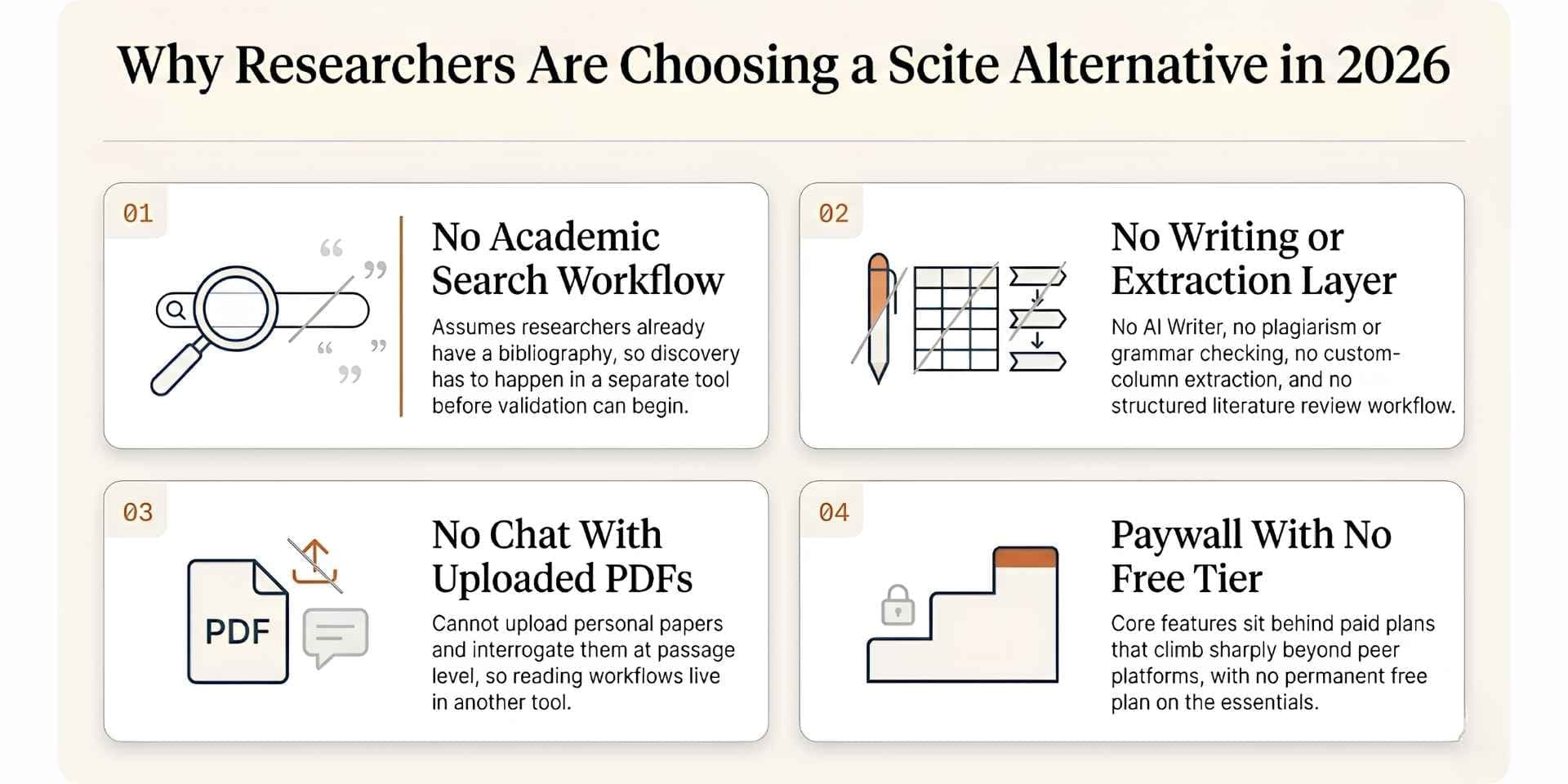
The individual researcher wall: Scite assumes you already have a bibliography. There is no semantic search across a peer-reviewed database, so discovery happens elsewhere. There is no Chat with PDF for your own uploads, no custom-column extraction, no citation-grounded writing surface, and no full reference manager. A grad student drafting a background section or a postdoc building a review restarts the work in a second or third tool every time the task changes shape. Pricing compounds the problem: at $20/mo for Personal with no permanent free tier, exploratory use is locked out.
The evidence-synthesis and regulated-team wall: Scite validates citations, but it cannot run a review. There is no PRISMA 2020 flow diagram, no blind dual-reviewer screening with conflict resolution, no inter-rater agreement tracking, no reproducible or re-runnable search, and no audit trail. For an HEOR analyst, a CRO evidence practice, or a medical-device team assembling a CER or PMS dossier, none of the artifacts a submission actually requires come out of Scite. The validation is useful, but it is one input into a process Scite does not support.
What to look for in a replacement, depending on who you are:
- Academic search across a large peer-reviewed database, with quality signals (SJR, SNIP, citation metrics) surfaced on results.
- Chat with PDF and multi-paper comparison over papers you upload.
- Structured literature review and custom-column extraction with quote-level, source-linked citations.
- A citation-grounded writing surface that applies citations against your real library, never inventing them.
- A full reference manager with Zotero and Mendeley import and institutional access.
- For teams: PRISMA 2020 reporting, blind dual-reviewer screening with conflict resolution (two independent reviewers, per the Cochrane Handbook), Cohen's kappa agreement tracking, an exportable audit trail, reproducible and re-runnable searches, and institutional (EZproxy) access.
Best Scite Alternatives in 2026
1. Paperguide
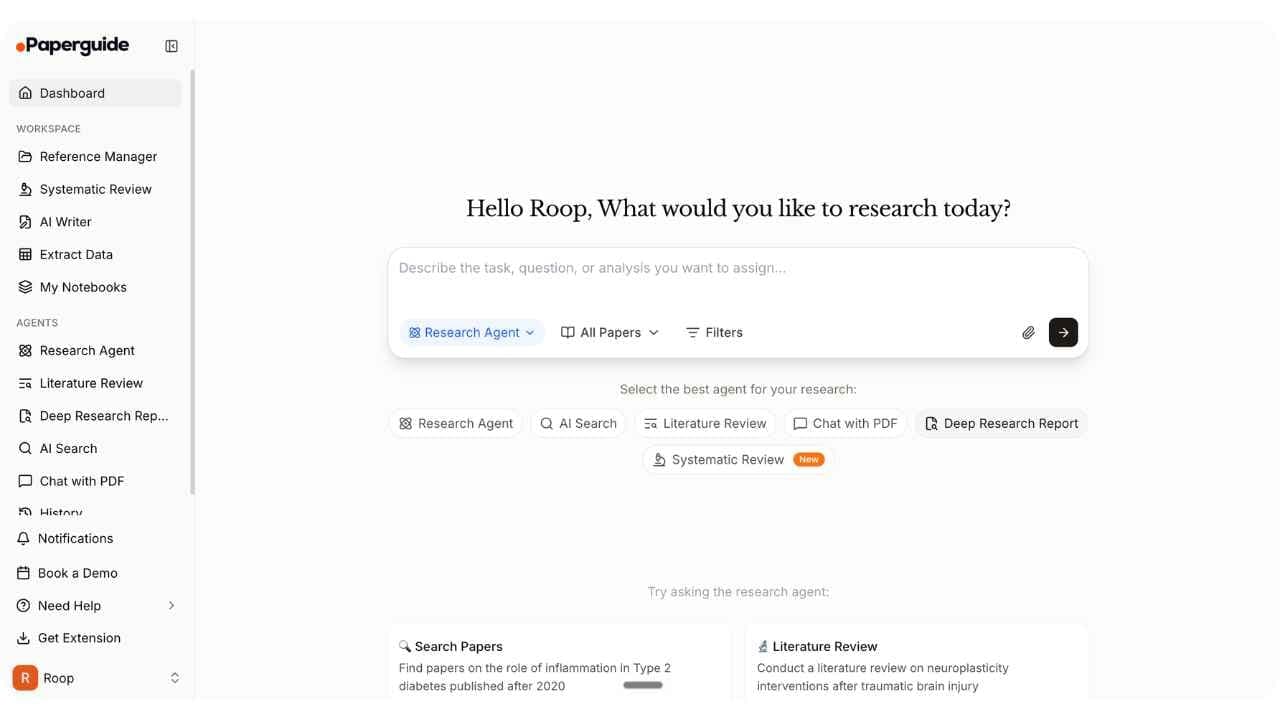
Paperguide is an AI-native platform for scientific research workflows and evidence synthesis. It grounds every claim in a verified quote linked to its source paper, then carries that citation trust across discovery, reading, extraction, and writing inside one connected workspace. Where Scite classifies how a paper is cited and stops, Paperguide keeps the same evidence-first standard running through the entire workflow, with SJR and SNIP quality signals visible at each step.
It also does the one thing no other tool on this list does. When the work becomes a rigorous systematic review, Paperguide runs a full PRISMA 2020 process: a drafted protocol, AI-led or dual blind screening with Cohen's kappa and lead-resolved conflicts, quote-level extraction, an auto-generated PRISMA flow diagram, and a complete audit trail. That is the bridge from the individual researcher to the evidence-synthesis team inside a single product.
Key Features:
- AI Search across 200M+ peer-reviewed papers and 30,000+ journals (PubMed, arXiv, OpenAlex, Semantic Scholar), with hybrid semantic and keyword retrieval, agentic query variations, and SJR, SNIP, and citation signals surfaced on results. It synthesizes a cited answer from the top 20 papers, links every claim to its source with a ranked reference list behind it, and searches research papers only, never blogs or the open web.
- Reference Manager with import by DOI, URL, BibTeX, RIS, and PDF, one-click Zotero and Mendeley import, a Chrome extension, automatic metadata, a PDF reader with annotations, AI summaries, shared libraries with roles, 1,000+ citation styles, and institutional access via EZproxy.
- Chat with PDF that summarizes, answers questions, compares multiple papers, and extracts methods and results, with answers linked to the source passage.
- Literature Review AI running Plan, Search, Screen, Extract, Synthesize, in Standard mode (50 papers) or Extended mode (200 papers), producing a citation-grounded review.
- Extract Data with custom-column tables, every cell source-linked with quote-level citations back to the exact PDF page, reusable templates, and CSV or Excel export (Free 5 columns / 10 papers; paid 50 columns / 100 papers; image and table extraction coming soon on Pro and above).
- AI Paper Writer that drafts papers, essays, reviews, and articles with citations applied automatically against your real library, in-text citations and reference lists in 1,000+ styles, Smart Continue, Ask AI rewrites, a plagiarism checker (on every plan), and export to Word, PDF, BibTeX, and RIS.
- Systematic Review running the full PRISMA 2020 process with AI-led or dual blind screening, Cohen's kappa tracking, lead-resolved conflicts, quote-level extraction, an auto PRISMA flow diagram, and an exportable audit trail.
Pros:
- Verified citations on every claim, traceable to the source paper, across the whole workflow.
- One connected workspace for search, reading, extraction, writing, and references, so context does not reset between steps.
- Academic search across 200M+ peer-reviewed papers with SJR and SNIP quality signals surfaced inline.
- A full PRISMA systematic review with dual blind screening and an audit trail that Scite cannot run.
- Quote-level, source-linked extraction back to the exact PDF page.
- 30% academic discount with a valid university email, and a usable free plan.
Cons:
- Does not produce a one-tag Supporting, Mentioning, or Contrasting label on individual citations the way Scite does.
- A single Extended literature review screens up to 200 papers; large systematic reviews use the dedicated Systematic Review workspace instead.
- A newer brand than Scite or SciSpace, with less name recognition in some labs.
Best For: Grad students, postdocs, faculty, and lab teams who want discovery, reading, extraction, and citation-grounded writing in one place, and evidence-synthesis, HEOR, CRO, and medical-device (CER, PMS) teams who need PRISMA reporting, dual screening, and an audit trail.
Pricing:
| Plan | Price | What It Covers |
|---|---|---|
| Free | $0 | 2,000 AI credits/mo, limited reference manager, Literature Review AI, Deep Research, Chat with PDF, 5 extract columns / 10 papers |
| Plus | $12 per seat/mo, billed annually ($144/yr) | Unlimited AI searches and storage, 12,500 credits/mo, 50 extract columns / 100 papers, plagiarism checker, shared workspaces, systematic review up to 1,000 papers |
| Pro | $29 per seat/mo, billed annually ($348/yr) | 50,000 credits/mo, image and table extraction (coming soon), systematic review up to 5,000 papers, everything in Plus |
| Evidence Teams | $89 per seat/mo, billed annually ($1,068/yr) | 150,000 credits/mo, PRISMA-grade dual-reviewer screening, systematic review up to 5,000 papers, dedicated support |
| Enterprise | Custom | SSO, SAML, single-tenancy, systematic review up to 20,000 papers |
A 30% academic discount applies with a valid university email, and yearly billing saves up to 41%.
Verdict
Paperguide is the strongest overall Scite alternative in 2026 because it treats verified citations as the default across every step, not just at citation classification, and because it scales up to a full auditable systematic review that Scite has no equivalent for. For the difference in detail, see Paperguide vs Scite. For anyone who liked Scite for trustworthy citations and wants that trust extended into discovery, extraction, writing, and PRISMA-grade review, no other tool here covers as much ground in one workspace.
2. Consensus
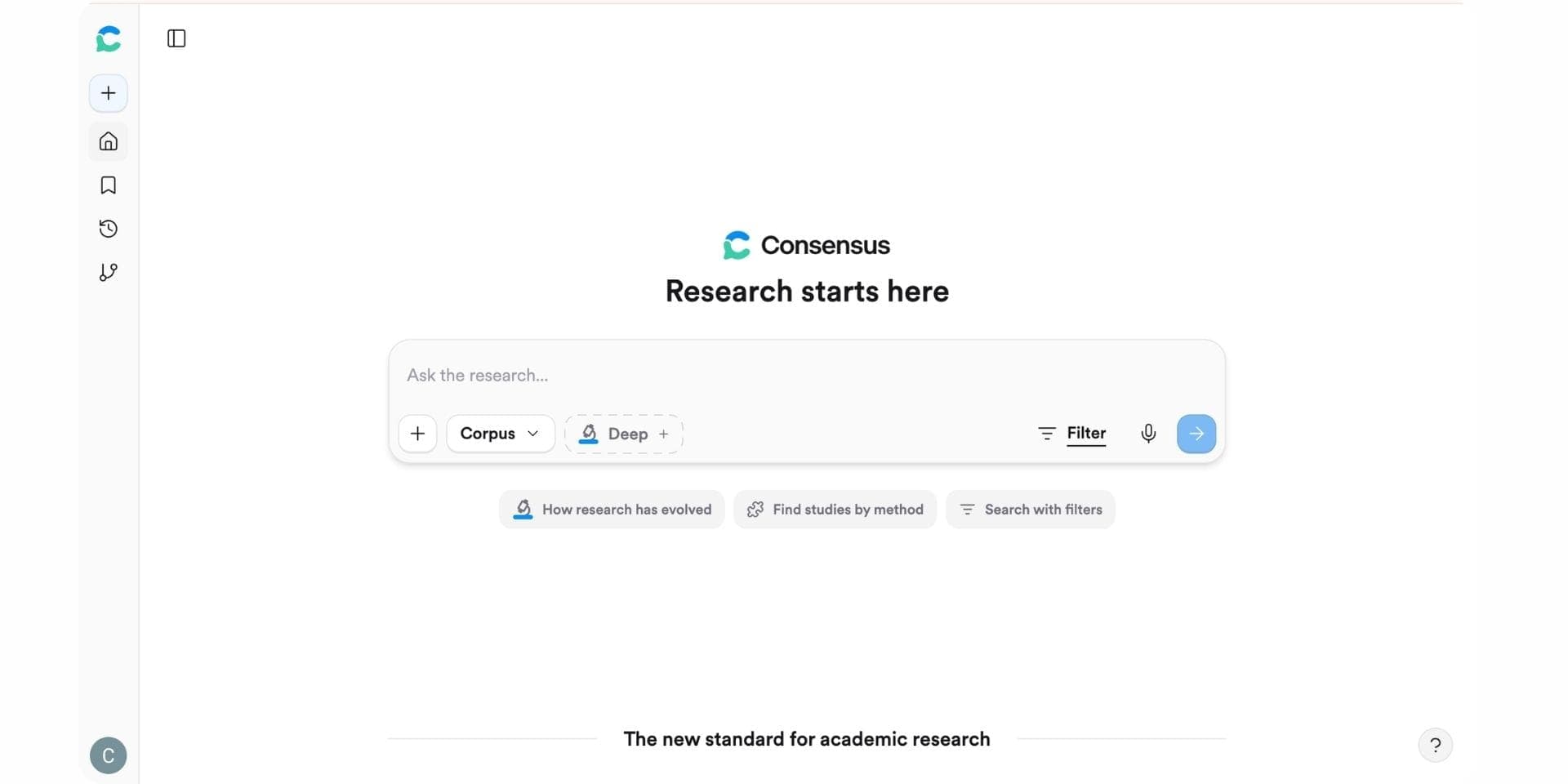
Consensus is an evidence-search engine that answers a natural-language question using peer-reviewed papers and shows a consensus meter indicating whether the literature says Yes, No, or Possibly. It runs across a 200M+ index built on Semantic Scholar, and it is the closest like-for-like option to Scite here because the meter frames evidence direction the way Smart Citations frame citation stance.
The likeness ends at the answer card. Consensus is a discovery and framing tool, not a review, extraction, writing, or reference platform, so it addresses the first pass of a question rather than the workflow that follows it.
Key Features:
- 200M+ peer-reviewed paper index with citation-backed synthesis.
- Consensus Meter (Yes / No / Possibly) on yes/no research questions.
- Deep Search for multi-source narrative synthesis.
- Study-level filters and a citation graph for exploring related work.
Pros:
- Closest like-for-like option to Scite for reading evidence direction.
- Directional verdicts in seconds across a 200M+ index.
- Affordable entry pricing.
Cons:
- No AI Writer, no structured literature review workflow.
- No custom-column data extraction and no reference manager.
- No systematic review operations, PRISMA reporting, or dual screening.
Best For: Individual researchers and clinicians who want a fast directional read on a claim before committing to a deeper review.
Pricing:
| Plan | Price | What It Covers |
|---|---|---|
| Free | $0 | Limited Pro searches and Deep Search reviews per month |
| Premium | ~$8.99/mo | Unlimited searches, Consensus Meter, Deep Search (tiers change, check the pricing page) |
| Teams / Enterprise | Custom | Team seats and admin controls |
Verdict
Consensus is the best like-for-like alternative for evidence framing, and the meter complements Scite's three-way classification well. It stops at the answer, though. Researchers who need extraction, writing, a reference manager, or a systematic review pick Paperguide, which delivers evidence framing and the workflow around it. See Consensus vs Scite for the direct comparison.
3. Elicit
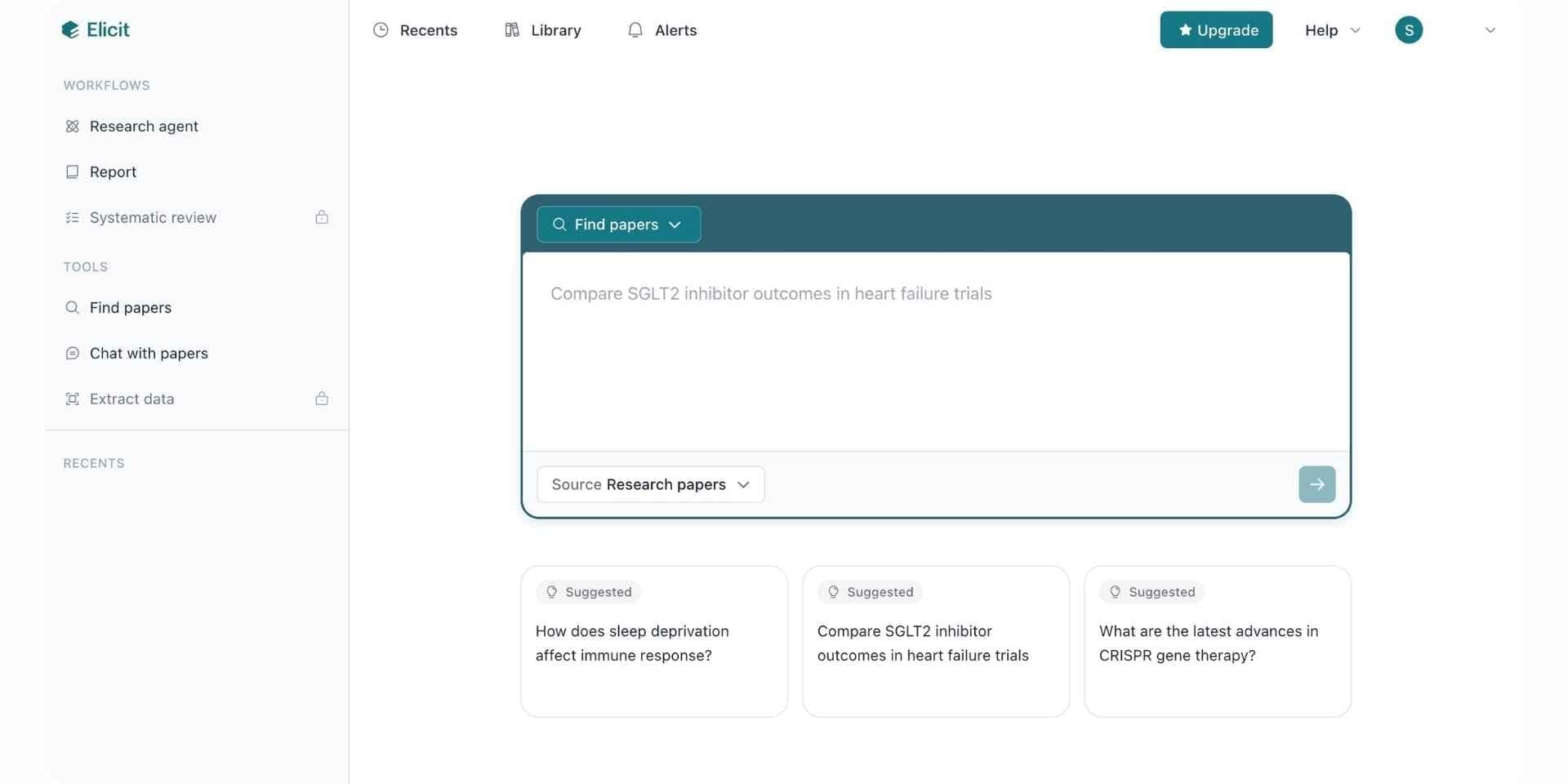
Elicit is built around structured data extraction at scale and systematic-review screening across an index of 125M+ academic papers. It is widely used by systematic reviewers, evidence-based medicine teams, and research operations groups, and its differentiator is screening volume: Pro screens up to about 5,000 papers per workflow, and Enterprise up to about 40,000, with extraction accuracy Elicit describes as PRISMA-grade.
Elicit is the strongest option here for the screening and extraction stages in isolation. What it does not carry is the work on either side of extraction. There is no full reference manager and no citation-grounded manuscript writer, and blind dual-reviewer conflict resolution is not documented in its workflow.
Key Features:
- Semantic search across 125M+ papers with quality-filter options.
- Custom-column data extraction across many papers.
- Systematic-review screening on paid tiers with inclusion and exclusion criteria.
- API access on higher tiers and Zotero export.
Pros:
- Strongest screening volume in this guide (up to ~40,000 papers on Enterprise).
- Deep, structured custom-column extraction.
- Free Basic plan to trial the workflow.
Cons:
- No citation-grounded writing tool and no full reference manager.
- Blind dual-reviewer conflict resolution is not documented.
- Results can vary between runs, a reproducibility limit common to LLM-based search.
Best For: Systematic review and HEOR teams whose primary need is high-volume screening and extraction, and who write and manage references elsewhere.
Pricing:
| Plan | Price | What It Covers |
|---|---|---|
| Basic | Free | Search and limited extraction |
| Pro | $49/mo ($588/yr) | Screening up to ~5,000 papers, extraction, API access |
| Scale | $169/mo ($2,028/yr) | Higher-volume screening and extraction |
| Enterprise | Custom | Screening up to ~40,000 papers, admin controls |
Verdict
Elicit is the right pick when screening at scale is the whole job and validation is statistical rather than semantic. The gaps are the steps around extraction. Teams that want protocol, dual blind screening, extraction, writing, and a PRISMA diagram in one auditable pipeline choose Paperguide. See Elicit vs Scite for how each handles evidence work.
4. SciSpace
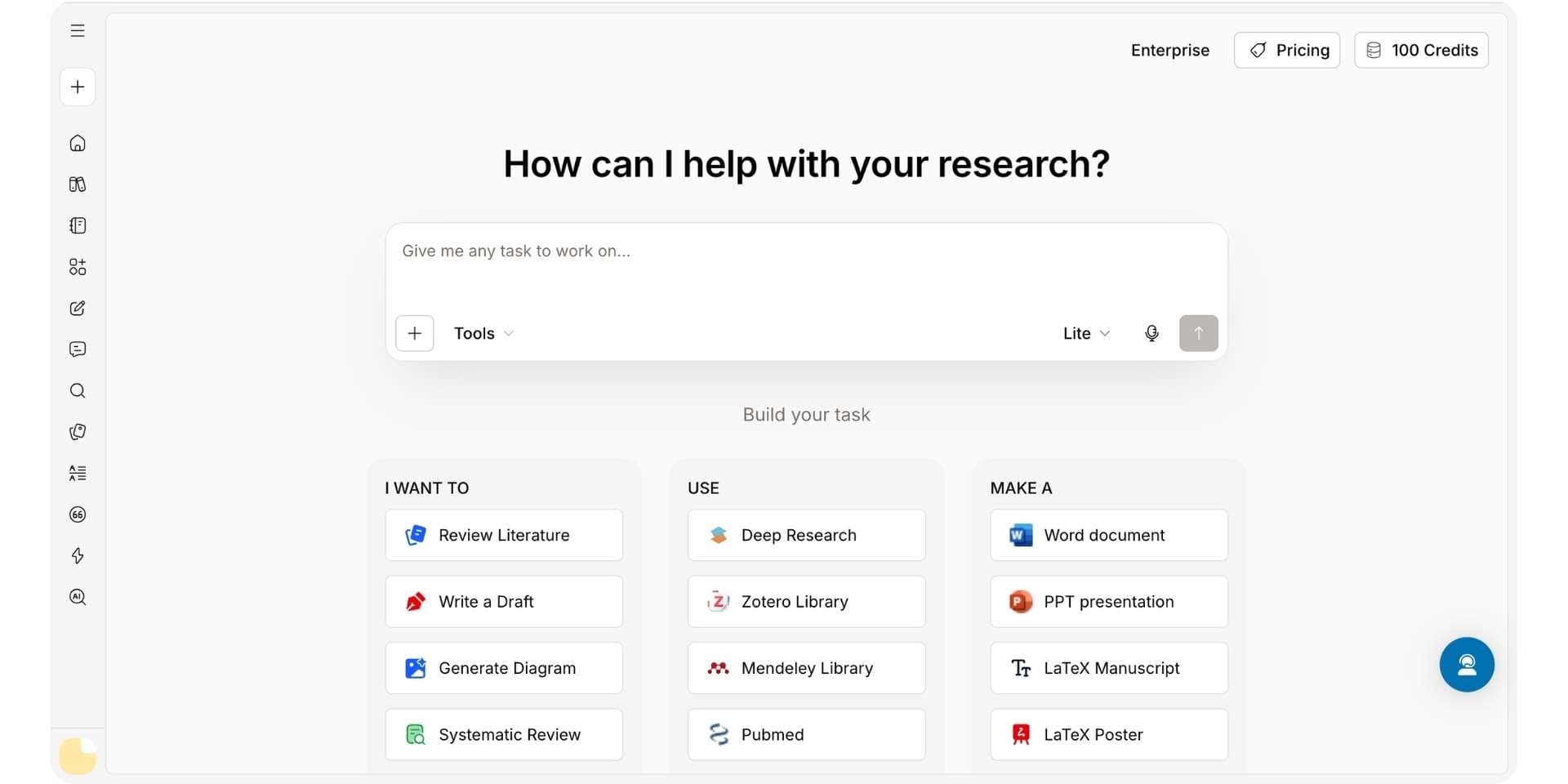
SciSpace is a platform for reading, understanding, and writing around papers, built around Chat with PDF and a growing set of research agents across a 270M+ paper database. Researchers upload papers and use it to explain dense passages and equations in plain language, summarize methods, extract structured data, and run lightweight reviews. It is popular with graduate students and lab teams for first-pass reading, especially in unfamiliar fields.
Its strength is single-paper comprehension. Its limits show up when the work spans many papers or demands rigor: multi-paper synthesis is weaker, no SJR or SNIP quality signals are surfaced, user reviews report occasional fabricated references, and it does not run PRISMA-grade review operations.
Key Features:
- Chat with PDF with plain-language explanations of equations, figures, and dense text.
- Literature Review and Deep Review across a 270M+ paper index.
- Data extraction tables and an AI Writer with paraphraser, citation generator, and AI detector.
- Customized agents including BioMed, Meta Analysis, and Manuscript Writer.
Pros:
- Strong Chat with PDF for individual papers.
- Large 270M+ paper database.
- Customized research agents for specific tasks.
Cons:
- Weak multi-paper synthesis and workflow continuity across modules.
- No SJR or SNIP quality signals; paper selection is not transparent.
- Occasional fabricated references reported; not PRISMA-grade review.
Best For: Grad students and lab teams who mainly need to read and understand individual papers quickly.
Pricing:
| Plan | Price | What It Covers |
|---|---|---|
| Free | $0 | Limited AI actions per document |
| Premium | from ~$12/mo | Chat with PDF, review, extraction (tiers change, check the pricing page) |
| Advanced | ~$70/mo | Higher limits and agents |
| Max | ~$160/mo | Highest limits |
Verdict
SciSpace works well as a reading layer for dense papers. Researchers who want citation validation find Scite stronger, and researchers who want one workspace for discovery, extraction, writing, and auditable review find Paperguide stronger on continuity and verified citations. See SciSpace vs Scite for the breakdown.
5. NotebookLM
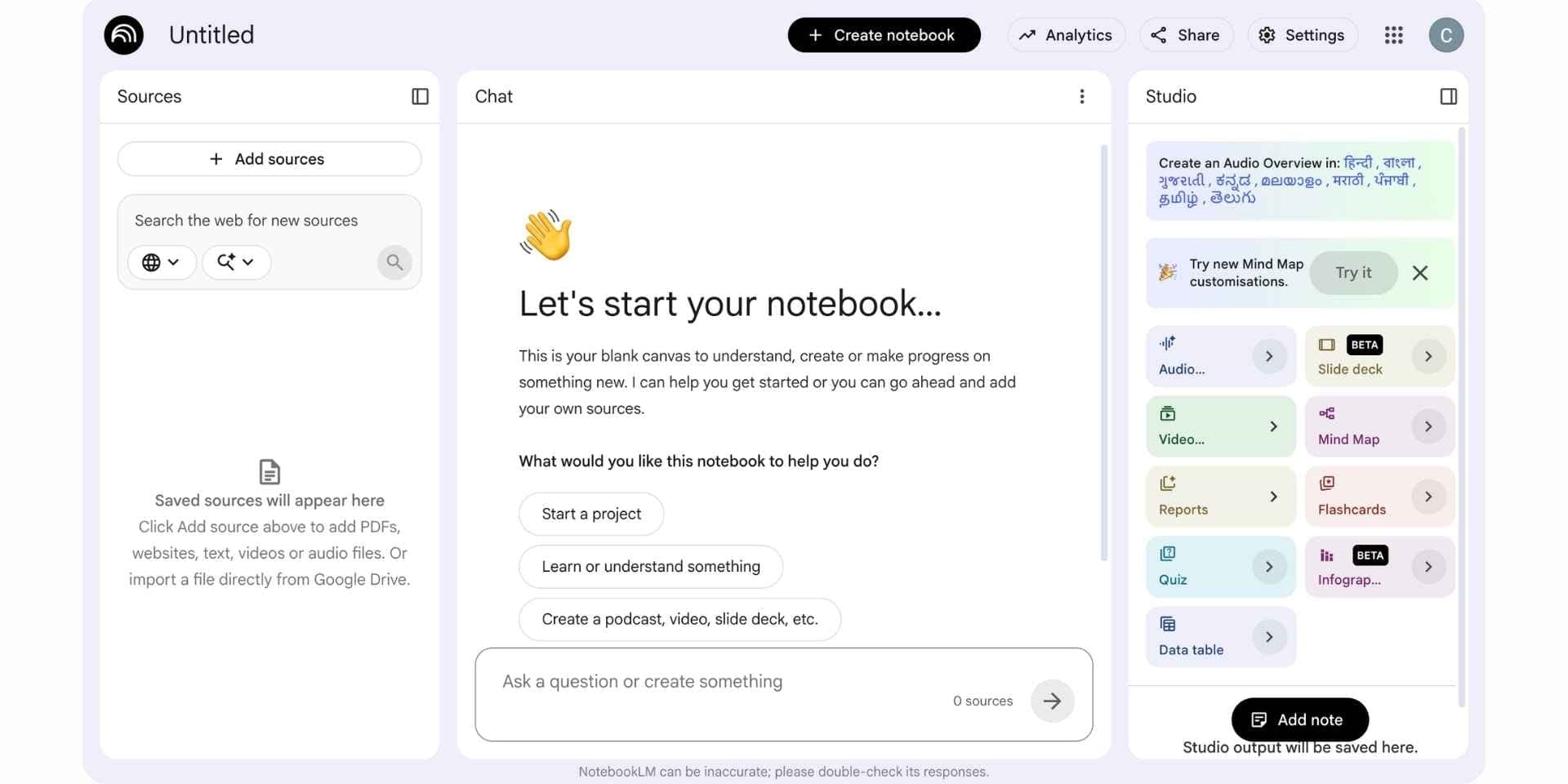
NotebookLM is Google's source-grounded notebook. It turns documents you upload into chat-based answers and Studio outputs: audio overviews, narrated video, mind maps, flashcards, quizzes, and slide decks, all grounded strictly in the sources you provide. It does not search academic literature; it synthesizes the sources you already have.
For learning formats and for making sense of a curated set of papers, it is excellent. For research operations it is deliberately narrow: no discovery, no extraction tables, no citation validation, and hard caps on how many sources a notebook can hold.
Key Features:
- Source-grounded Q&A across 50 (free) to 300 (Pro) uploaded sources.
- Studio outputs: Audio Overview, Video Overview, Mind Map, Flashcards, Quiz, Slide Deck.
- Multi-source chat with inline citations to your uploads.
Pros:
- Best-in-class Studio outputs for learning and presenting.
- Source-grounded answers with inline citations.
- Generous free tier through a Google account.
Cons:
- No academic search across peer-reviewed literature.
- No structured literature review, extraction, or citation validation.
- Source caps (50 free, 300 Pro) bite quickly in a serious review.
Best For: Individual researchers who want to synthesize and study a source set they have already gathered.
Pricing:
| Plan | Price | What It Covers |
|---|---|---|
| Free | $0 | Up to 50 sources per notebook, Studio outputs |
| Pro | ~$19.99/mo | Up to 300 sources per notebook, via Google AI Pro |
Verdict
NotebookLM is excellent for synthesizing sources you already hold, and its Studio outputs are unmatched for learning. It does not search literature or validate citations, so workflows that need discovery, validation, and writing pair it with another tool or choose Paperguide for a unified workspace. See Scite vs NotebookLM for where each fits.
6. AnswerThis
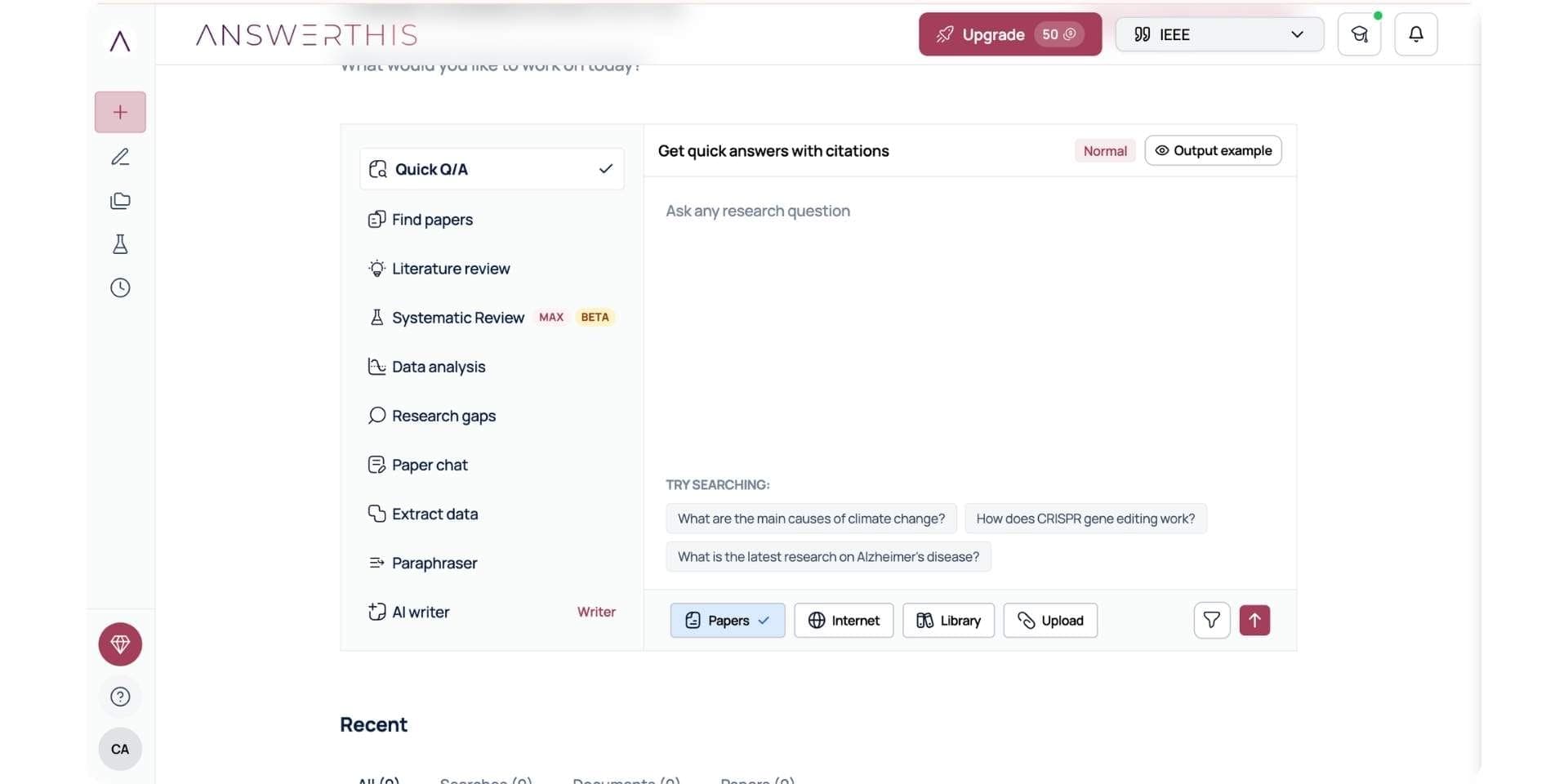
AnswerThis is a lightweight tool for fast, time-boxed literature reviews and research-gap analyses across a 200M+ paper index. It is built for the proposal stage, when a researcher needs a quick scaffold of the literature before committing to a full review, and speed matters more than depth.
It is genuinely useful early. It is not built to carry a project forward: there is no custom-column extraction, no reference manager, and only a basic writing surface for short drafts.
Key Features:
- Search across 200M+ papers with inline citations.
- Time-boxed literature-review scaffolds.
- Research-gap analysis prompts.
- A basic AI writer for short drafts.
Pros:
- Fast scaffolds across a 200M+ index.
- Gap-analysis prompts help shape a research question.
- Affordable entry tier.
Cons:
- No custom-column data extraction and no reference manager.
- No systematic review operations or citation validation.
- Writing is limited to short drafts.
Best For: Grad students and PIs at the proposal stage who want a quick literature scaffold.
Pricing:
| Plan | Price | What It Covers |
|---|---|---|
| Free | $0 | Limited generations |
| Paid | from ~$9/mo | Higher limits, lit-review scaffolds, gap analysis |
Verdict
AnswerThis is a useful entry tool when speed beats depth, and its gap prompts help frame a new research question. Researchers running serious validation or review work outgrow it quickly and move to a fuller workspace like Paperguide.
7. Anara
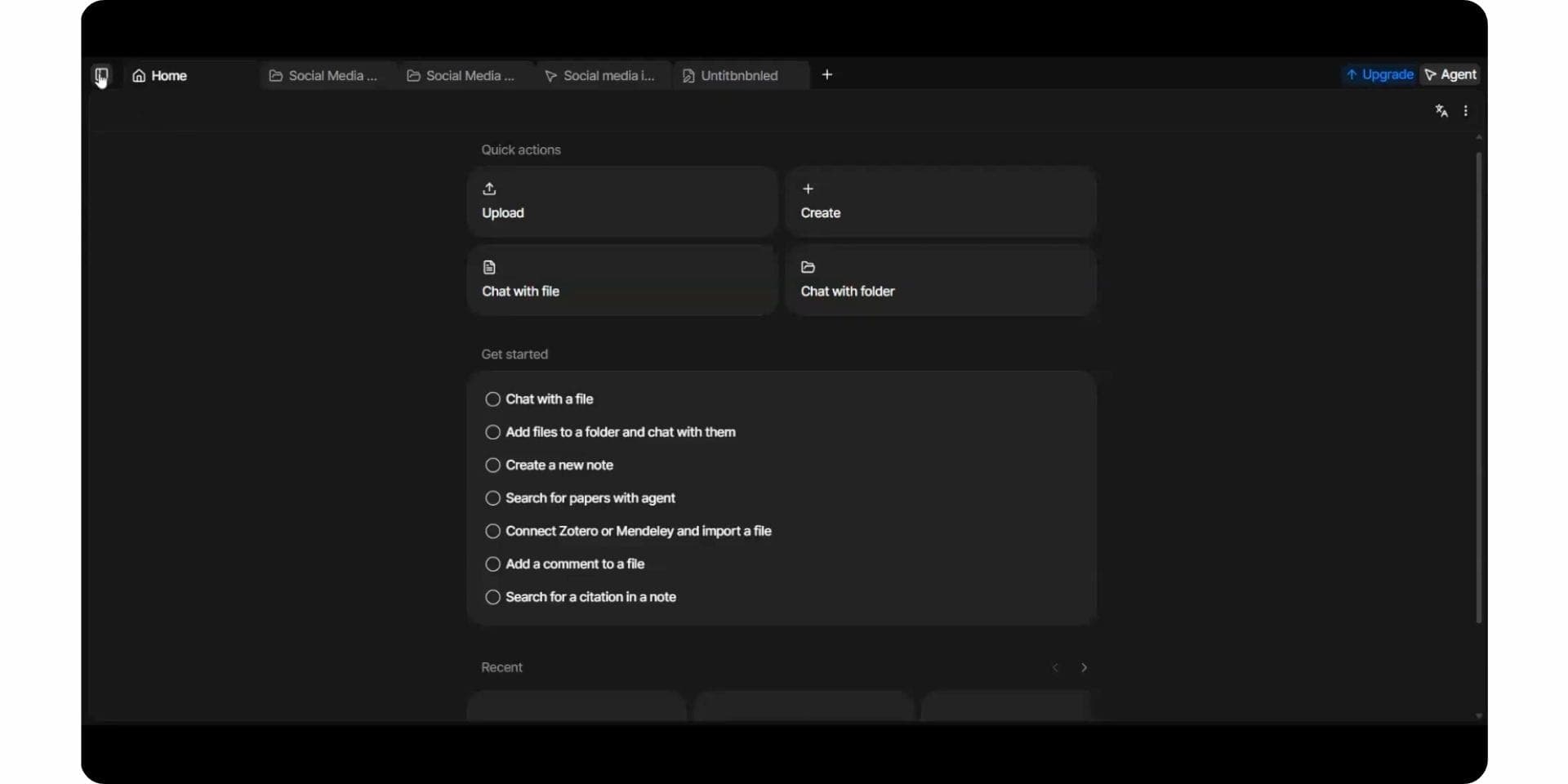
Anara, formerly Unriddle, is a multi-paper PDF chat and annotation tool built around a researcher's personal library of uploaded papers. Its Chat with Folder feature queries an uploaded set of PDFs together and returns passage-linked answers, with annotation, AI summaries, and a light writing layer built into the document surface.
It is a comfortable reading and annotation workspace for papers you already have. It does not search academic literature, does not run systematic reviews, and its reference manager is lighter than a dedicated one.
Key Features:
- Multi-paper Chat with Folder across an uploaded library.
- Annotation, highlights, and AI summaries.
- A light writing layer inside the document surface.
Pros:
- Strong multi-paper chat over a personal corpus.
- Annotation and AI summaries in the reading workspace.
- Affordable Plus plan.
Cons:
- No academic search across peer-reviewed literature.
- No systematic review operations or extraction tables.
- Lighter reference management than a dedicated manager.
Best For: Individual researchers who want to read and query their own PDF library in one place.
Pricing:
| Plan | Price | What It Covers |
|---|---|---|
| Free | $0 | Limited uploads and chat |
| Plus | ~$10/mo | Larger library, Chat with Folder |
| Pro | ~$20/mo | Higher limits and writing |
Verdict
Anara is a strong reading and annotation layer for a personal PDF set. It does not search literature or run reviews, so researchers who need discovery, extraction, and auditable review alongside reading choose Paperguide.
How the Paperguide systematic review workflow works
The feature that separates Paperguide from Scite and from every other tool here is a full, auditable PRISMA 2020 systematic review. It runs in six stages, and every decision carries a criterion, its evidence, and the person who confirmed it.
- Protocol. The Research Agent drafts eligibility criteria and extraction fields from your research question. You edit and reorder them, set Hard versus Soft screens and answer formats, and choose a mode: AI-led Review (fast solo screening where the AI decides with evidence attached and a named verifier confirms each stage) or Dual Review (two reviewers screen blind and independently, with lead-resolved conflicts).
- Papers. Pool candidates from AI Search (200M+), your Reference Manager, Zotero, or Mendeley, or by manual upload (BibTeX, RIS, CSV, PDF, bulk PDF). The source of each paper is logged, and duplicates are removed automatically before screening.
- Abstract screening. The AI screens each paper against your protocol fields with per-criterion reasoning and a confidence level. In Dual Review, that reasoning is support only and never breaks the blind. A conflict queue, Cohen's kappa inter-rater tracking, and low-agreement alerts keep two reviewers aligned.
- Full-text screening. A PDF viewer, mandatory exclusion reasons, and automatic exclusion of papers without a PDF (re-screened when a PDF is added) carry the same rigor into the full-text stage.
- Data extraction. Fields are extracted from every included paper with citations to the exact PDF page. A reviewer approves, edits, or sends back each field, and the lead confirms.
- Generate report. A PRISMA 2020 flow diagram is generated in real time from your actual counts (records per database, uploads, duplicates, screened, included) and exported as SVG, PNG, or PDF. A full audit trail exports to CSV or PDF, and a one-click AI methods statement is drawn from that trail.
This is what makes Paperguide fit journal submissions, HTA dossiers, CERs, and PMS reports, and it is exactly the layer Scite does not have.
Best Scite alternative by use case
| Your job | Best pick | Why |
|---|---|---|
| PhD or postdoc running the full thesis workflow | Paperguide | Discovery, reading, extraction, and citation-grounded writing in one workspace |
| Fast directional read on a claim | Consensus | Consensus Meter gives a Yes / No / Possibly in seconds |
| Reading and understanding a dense paper | SciSpace | Plain-language explanations of equations and figures |
| Studying a source set you already have | NotebookLM | Source-grounded Q&A and Studio outputs |
| Proposal-stage literature scaffold | AnswerThis | Fast time-boxed reviews and gap analysis |
| Chatting across your own PDF library | Anara | Multi-paper Chat with Folder |
| High-volume screening and extraction | Elicit | Screens up to ~40,000 papers on Enterprise |
| Full PRISMA systematic review with audit trail | Paperguide (Evidence Teams) | Dual blind screening, Cohen's kappa, PRISMA diagram, audit trail |
| HEOR, CRO, or medical-device (CER, PMS) evidence work | Paperguide (Evidence Teams / Enterprise) | Reproducible searches, dual review, exportable audit trail |
Final comparison
| Capability | Paperguide | Consensus | Elicit | SciSpace | NotebookLM | AnswerThis | Anara |
|---|---|---|---|---|---|---|---|
| Academic search (peer-reviewed) | ✓ 200M+ | ✓ 200M+ | ✓ 125M+ | ✓ 270M+ | ✗ | ✓ 200M+ | ✗ |
| Chat with PDF | ✓ | ⚠ | ⚠ | ✓ | ✓ | ✓ | ✓ |
| Literature review | ✓ | ⚠ | ✓ | ✓ | ⚠ | ⚠ | ✗ |
| Data extraction | ✓ | ✗ | ✓ | ⚠ | ✗ | ✗ | ✗ |
| Citation-grounded writing | ✓ | ✗ | ✗ | ⚠ | ✗ | ⚠ | ⚠ |
| Reference manager | ✓ | ✗ | ✗ | ⚠ | ✗ | ✗ | ⚠ |
| SJR / SNIP quality signals | ✓ | ✗ | ⚠ | ✗ | ✗ | ✗ | ✗ |
| Systematic review workflow | ✓ | ✗ | ✓ | ⚠ | ✗ | ✗ | ✗ |
| PRISMA 2020 / dual-review | ✓ | ✗ | ⚠ | ✗ | ✗ | ✗ | ✗ |
| Audit trail | ✓ | ✗ | ⚠ | ✗ | ✗ | ✗ | ✗ |
| Free plan | ✓ | ✓ | ✓ | ✓ | ✓ | ✓ | ✓ |
| Starting paid price | $12/mo | ~$8.99/mo | $49/mo | ~$12/mo | ~$19.99/mo | ~$9/mo | ~$10/mo |
About This Evaluation
This guide was compiled by the Paperguide editorial team from hands-on work with each tool across real research tasks: discovery, reading, extraction, writing, reference management, and systematic review operations. Each alternative was assessed on how far it carries citation trust across the workflow and how well it serves both the individual researcher and the evidence-synthesis team. Pricing reflects vendor-published plans at the time of writing and can change, so confirm current tiers on each vendor's site before you commit. As with any AI research tool, verify every cited source against the original paper before you submit.
Final Verdict
Scite is excellent at the job it was built for. For auditing an existing bibliography, checking whether a finding has held up, or reading supporting and contrasting citation context, it is the strongest tool in its category, and its 1.2B+ citation statement index and Google Scholar and PubMed badges have become a daily habit for many researchers.
The individual researcher outgrows it because discovery, extraction, and writing all live elsewhere, so the workflow fragments across tools and the exploratory user is priced out at $20/mo with no free tier. The evidence-synthesis team outgrows it because Scite produces none of the artifacts a review actually needs: no PRISMA diagram, no dual blind screening with conflict resolution, no inter-rater tracking, no audit trail.
Paperguide closes both walls in one workspace. It pairs academic search across 200M+ peer-reviewed papers, Literature Review AI, custom-column extraction, the AI Paper Writer, and a full reference manager with SJR and SNIP signals throughout, and it scales up to a full PRISMA 2020 systematic review with dual blind screening, Cohen's kappa, quote-level extraction, an auto PRISMA diagram, and an audit trail. For the grad student who liked Scite for trustworthy citations, and for the HEOR, CRO, or medical-device team that needs an auditable review, Paperguide is the one platform that carries citation trust from first search to finished, defensible output.
Frequently Asked Questions
What is the best Scite alternative for a PhD student or postdoc?
Paperguide. It covers the full thesis workflow, discovery, literature review, extraction, and citation-grounded writing, in one workspace, and the 30% academic discount brings paid tiers well below Scite's $20/mo Personal plan while doing far more.
What is the best Scite alternative for systematic reviews?
Paperguide's Evidence Teams tier runs a full PRISMA 2020 review with dual blind screening, Cohen's kappa tracking, lead-resolved conflicts, quote-level extraction, an auto-generated PRISMA flow diagram, and an exportable audit trail, up to 5,000 papers (Enterprise up to 20,000). Elicit is the complement when raw screening volume runs into the tens of thousands.
What is the best Scite alternative for HEOR or CRO teams?
Paperguide (Evidence Teams or Enterprise). It gives evidence-synthesis, HEOR, CRO, and medical-device teams reproducible searches, blind dual-reviewer screening with conflict resolution, quote-level extraction, and an audit trail suited to CERs, PMS reports, and HTA dossiers, none of which Scite supports.
Is there a free Scite alternative?
Yes. Paperguide, Consensus, Elicit, SciSpace, NotebookLM, AnswerThis, and Anara all offer free plans. Paperguide's free plan is the most complete, covering academic search, Literature Review AI, Chat with PDF, and the reference manager with 2,000 monthly credits. Scite itself offers only a 7-day trial, with no permanent free tier on core features.
How is Paperguide different from Scite?
Scite classifies how a paper is cited downstream across 1.2B+ citation statements and stops there. Paperguide treats verified citations as the default across the whole workflow, with academic search across 200M+ papers, the structured Literature Review AI, custom-column extraction, the AI Paper Writer, a full reference manager, and a PRISMA 2020 systematic review that Scite cannot run.
Can I import my Scite library into Paperguide?
Yes. Paperguide imports by DOI, URL, BibTeX, RIS, and PDF, and offers one-click import from Zotero and Mendeley, so an existing library moves over without manual re-entry.
Researching a topic?
Find papers and get cited answers
Search the literature, find gaps and write with citations.
Start for freeNo credit card required