Paperguide vs Elicit: Best Elicit Alternative in 2026


Paperguide and Elicit are two of the most capable AI research platforms for scientific research available today, but they approach research from different directions. Paperguide is an AI-native platform for scientific research workflows where AI search, literature review, systematic review, PDF analysis, structured extraction, reference management, and citation-grounded writing all stay linked inside one workspace. In contrast, Elicit is a screening-first platform designed around systematic review pipelines where large volumes of papers are filtered, ranked, and extracted through structured workflows that can scale to tens of thousands of records.
Both platforms support systematic review workflows. However, Paperguide is optimized for workflow continuity and citation-grounded research synthesis, where every step from discovery through screening to a cited draft stays connected. On the other hand, Elicit is optimized for high-volume screening precision, giving systematic review teams fine-grained control over inclusion criteria and automated extraction at scale. As a result, the biggest difference is not screening volume or extraction columns. Instead, it is whether your research context carries forward from one step to the next or resets at each stage. Systematic reviews have grown in importance across biomedical and social science fields. For example, a 2023 analysis found that systematic review publications increased by over 700% between 2000 and 2019 (PubMed Central, 2023). Because of this growth, choosing the right platform matters for research efficiency.
Key takeaway: Paperguide wins for researchers who need a citation-grounded workflow from search through systematic review to a cited draft. Elicit wins when screening scale above 20,000 papers, figure extraction, or API-driven research operations are the priority.
TL;DR
| If you need... | Better choice |
|---|---|
| AI search with journal quality metrics in outputs | Paperguide |
| Systematic review with verifier roles and audit trail | Paperguide |
| Systematic review screening above 20,000 papers | Elicit |
| Multi-paper chat with passage verification | Both (near parity) |
| Data extraction with 50 columns on any paid plan | Paperguide |
| Data extraction with figure support | Elicit |
| Citation-grounded writing with 1,000+ styles | Paperguide |
| Reference management built into the workflow | Paperguide |
| Personalized paper alerts | Elicit |
| API access for automated research pipelines | Elicit |
| Best overall research workflow | Paperguide |
Overall, Paperguide is the better choice if you need a connected pipeline from search through systematic review to a cited draft starting at $12 per seat per month, billed annually. On the other hand, Elicit is the better choice if you need to screen 20,000 to 40,000 papers, build API-driven evidence operations, or set up personalized alerts for new research starting at $49/month. Therefore, the decision comes down to whether workflow continuity or screening scale matters more for your research.
Paperguide Vs Elicit: Quick Comparison
| Feature | Paperguide | Elicit |
|---|---|---|
| AI Search Corpus | 200M+ papers; PubMed, arXiv, OpenAlex, Semantic Scholar; also searchable from Claude, ChatGPT and Cursor via Paperguide MCP | 128M+ papers; semantic and PubMed keyword; MCP for Claude, ChatGPT, Gemini |
| Synthesis Depth | Top 20 papers | Top 10 papers |
| Quality Metrics | SJR, SNIP re-rank results, visible on every result | Quartile filter in search only |
| Systematic Review | Protocol-first, verifier roles, PRISMA | Collaboration, threshold screening, up to 40K |
| Chat with PDF | Multi-paper Q&A with evidence | Multi-paper Q&A with evidence |
| Extraction Columns | Free 5, paid plans 50 | Free 2, Pro 20, Scale 30, Enterprise 40 |
| AI Paper Writer | Full draft generation, '@' citations, 1,000+ styles, collaboration | No writing workspace |
| Literature Review AI | Up to 50 papers, Extended mode, cited draft output | No dedicated lit review AI |
| Reference Manager | Full library, Zotero/Mendeley, Chrome ext, annotation, collaboration | Collections, Zotero import, Alerts |
| Starting Price | Plus $12 per seat/month, billed annually | Pro $49/month |
Who Is Paperguide Best For?
- Academic researchers at every level including graduate students, postdocs, faculty, and lab teams who need search, systematic review, literature review, writing, and references in one workspace rather than stitching together separate tools.
- Scientific researchers and R&D professionals in industry, biotech, and pharma who need citation-grounded evidence synthesis, structured extraction, and quality-filtered search across 200M+ papers for research projects and publications.
- HEOR analysts and clinical researchers at consultancies, CROs, and medical device companies who run systematic literature reviews for market access, regulatory submissions (EU MDR, FDA), and Clinical Evaluation Reports, and need cycle-time reduction with audit-ready output.
- Systematic review leads and evidence synthesis managers running protocol-driven reviews with assigned verifiers, PRISMA reporting, and an auditable decision trail at each screening stage for clients, journals, or regulatory submissions.
- Clinician-researchers and hospital evidence teams doing evidence lookups, guideline development, and periodic PRISMA-compliant reviews with institutional journal access, without CRO-scale process overhead.
- Researchers who need a full-fledged AI Paper Writer that generates complete drafts with automatic citations from 200M+ papers and their own library, supports '@' citation insertion, collaborative editing, plagiarism checking, and over 1,000 citation styles without switching to a separate tool.
Who Is Elicit Best For?
- Evidence synthesis teams screening 20,000 to 40,000 papers where screening volume and collaboration matter most.
- Researchers whose primary output is evidence tables with custom columns, structured comparison, and figure extraction from publications.
- Teams building automated research pipelines through Elicit's Search, Reports, and Systematic Review APIs, or monitoring new research through personalized alerts.
How We Tested Paperguide and Elicit
We tested both tools using real research workflows across AI Search, Systematic Review, Data Extraction, Research Agent, and Chat with PDF. Specifically, we evaluated workflow depth, citation grounding, source traceability, output quality, pricing limits, research control, ease of use, and limitations. Claims marked "observed" come from signed-in product tests on Paperguide Pro ($29 per seat per month, billed annually) and Elicit Pro ($49/month) between August 18 and August 25, 2026. Claims marked "listed" come from official pricing and product pages. Features labeled "Coming soon" are noted and not treated as available. Semantic Scholar, which both platforms use, indexes over 200 million papers (Semantic Scholar, 2026). OpenAlex, one of Paperguide's indexed sources, covers over 250 million works (OpenAlex, 2024).
How Does Paperguide AI Search Compare to Elicit?
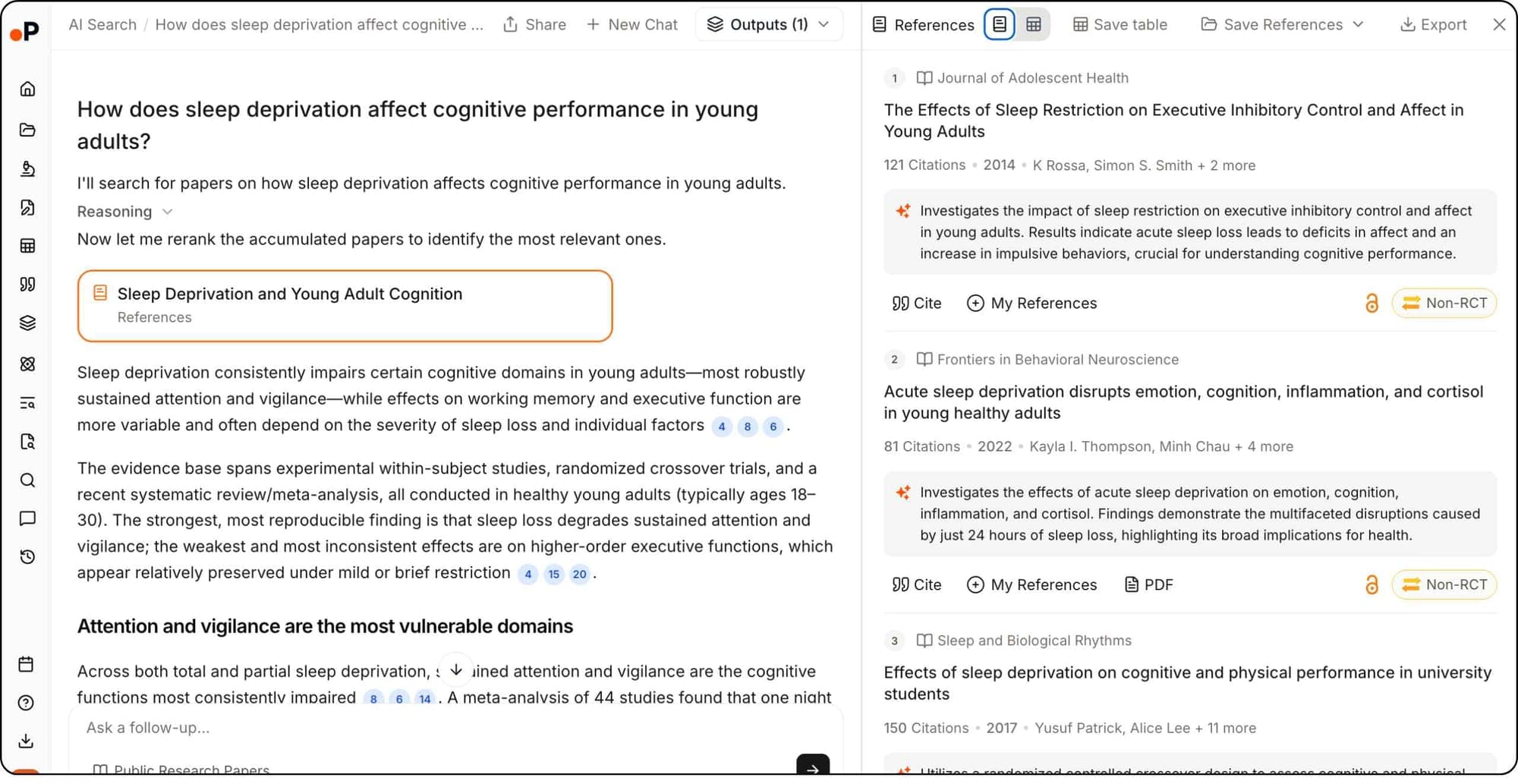
Paperguide searches 200M+ papers across PubMed, arXiv, OpenAlex, and Semantic Scholar, plus the user's own reference library in the same query. Consequently, no other search tool in this category combines public corpus results with the researcher's collected papers. It uses hybrid semantic and keyword retrieval with agentic query variation run in parallel. As a result, the output synthesizes from the top 20 papers rather than 10, producing a sectioned evidence report covering effect magnitude, delivery modes, and intervention protocols. Notably, SJR quartile, SJR score, SNIP, and citation metrics re-rank results and are visible on every result rather than sitting behind a filter. In addition, export controls for BibTeX, CSV, and Excel appear directly beside the references, so building a citation library from search results takes one click. Furthermore, saved papers land in the reference manager and are immediately usable across extraction, review, and the AI Paper Writer.
In comparison, Elicit searches approximately 128M papers using semantic retrieval with deduplication and reranking, plus keyword search against PubMed and uploaded papers. It synthesizes from the top 10 papers into a shorter answer with clickable author-year citations. Additionally, the table interface makes it straightforward to sort papers, add custom columns, and apply filters. However, quartile filtering is available in search, but SJR, SNIP, and citation strength are not surfaced in the synthesized outputs. Despite this, follow-up query suggestions help iterate on the search, and the next step is extracting data from retrieved papers.
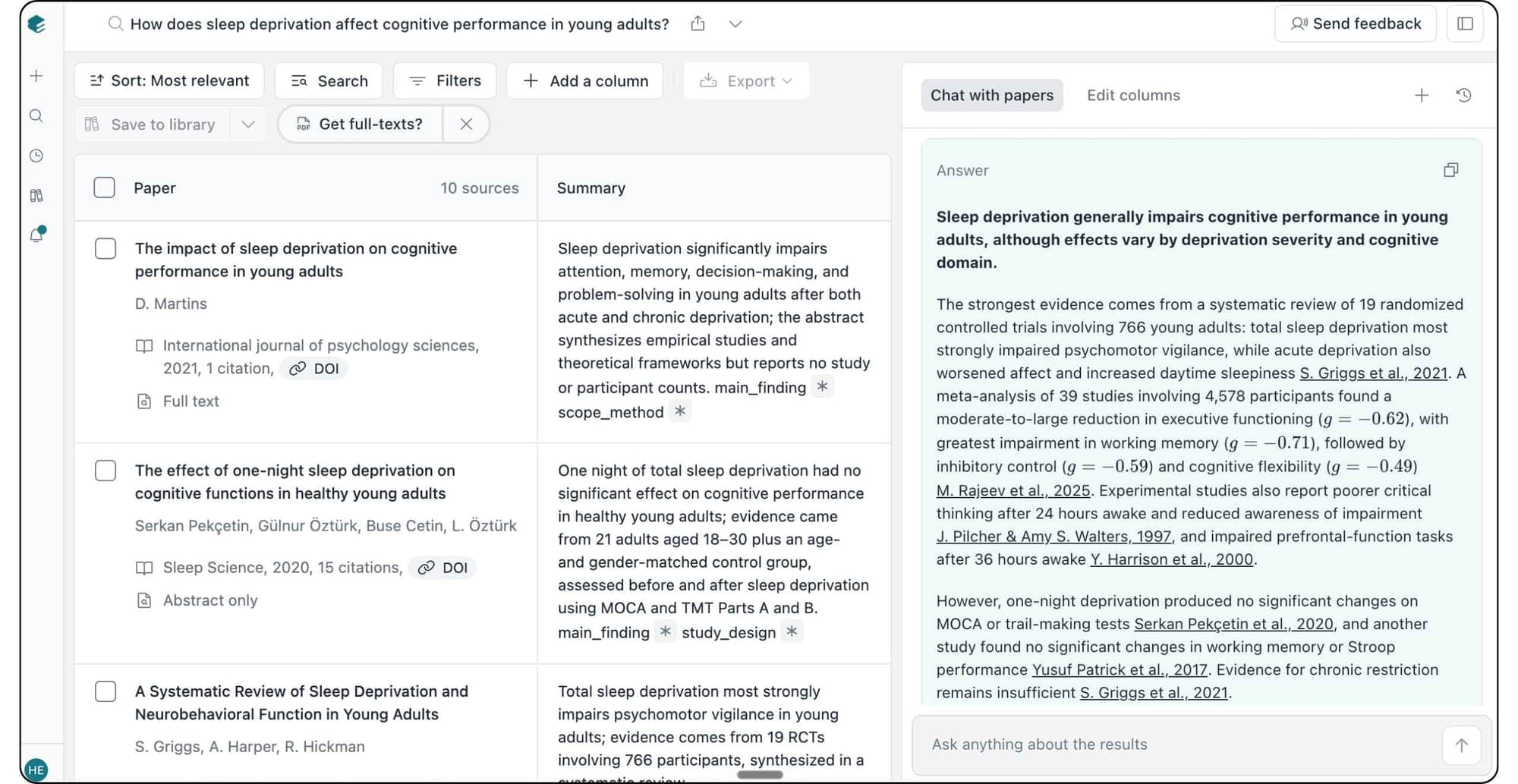
Winner: Paperguide. Quality signals travel into the output rather than sitting only in a filter, the search runs across the user's own library alongside the public corpus, and synthesis depth is 20 papers versus 10. Elicit's table-first interface is stronger for interactive column building and exploratory sorting.
How Does Paperguide Systematic Review Compare to Elicit?
Both platforms now support structured systematic reviews. However, the separation is governance and what happens after the review. Specifically, Elicit gives you screening at higher volume with collaboration. In contrast, Paperguide gives you assigned verifiers, an auditable decision trail, PRISMA in the workflow, and a report that flows into a citation-grounded draft in the same workspace. The PRISMA 2020 statement, which guides systematic review reporting standards, has been cited over 40,000 times since publication (The BMJ, 2021). Because of this, PRISMA compliance matters for credible reviews.
Paperguide Systematic Review Workflow
Paperguide Systematic Review follows six stages: Protocol definition, Paper collection, Title and Abstract Screening, Full-text Screening, Data Extraction, and Report generation. The protocol can be set up when the review is created or before the relevant stage begins. For example, AI auto-generates a starting set of criteria and extraction fields from the research question, and the user then edits or adds to them. Paper collection searches PubMed, arXiv, OpenAlex and Semantic Scholar, pools the results with your own library and deduplicates them before screening. A saved protocol can be re-run over new papers, and papers added mid-review follow the same screening path.
Paperguide Systematic Review Workflow
In abstract screening, the AI makes an inclusion decision plus an exclusion reason tied to the first failing criterion in an ordered list, with per-criterion evidence text. As a result, PRISMA exclusion counts are explainable rather than reconstructed afterwards. A named verifier then overrides Include, Maybe, or Exclude decisions before confirming all. Similarly, in full-text screening, per-criterion summarized answers link directly into the PDF with a meeting/failing/unclear meter. Because of this, verification becomes a check rather than a re-read. Additionally, papers missing a PDF can be resolved through the Chrome extension and institutional proxy, then screened automatically.
For instance, the platform supports Edit, Reviewer, and View-only roles with per-stage verifier assignment for abstract screening, full-text screening, and extraction. All decisions and overrides are logged. Dual Review mode, with blind screening by two independent reviewers plus a conflict resolver, is available on Evidence Teams and Enterprise. Currently, the limits are 1,000 papers on Plus ($12 per seat per month, billed annually), 5,000 on Pro and Evidence Teams, and 20,000 on Enterprise (Paperguide pricing, retrieved October 2026). The review ends with a synthesized report including a PRISMA diagram and logged methodology, which flows directly into the AI Paper Writer.
Elicit Systematic Review Workflow
Elicit asks for the question, search strategy, and screening depth (Fast or Thorough). It also asks about full-text screening preferences, extraction options, and report format. However, there is no protocol setup before the review starts. Instead, criteria and extraction fields are AI-generated at the point each stage begins and are editable by the user.
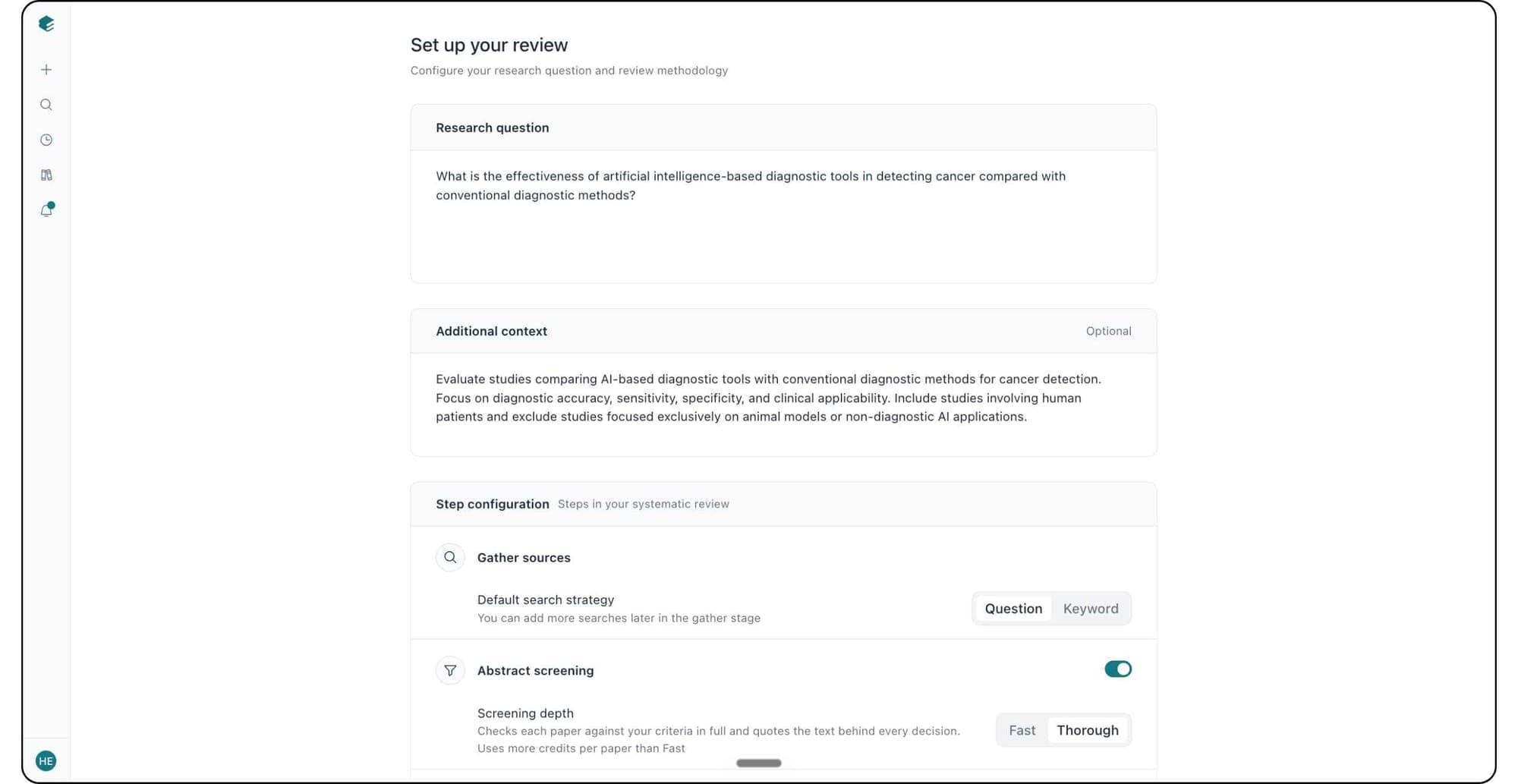
In our test, Elicit gathered 1,000 papers immediately from our test question using semantic search over approximately 128M papers, keyword search against PubMed, plus paper upload. Consequently, the gather stage is faster for inspecting available evidence. Thorough screening checks every paper against criteria while quoting supporting text. Nevertheless, full-text screening supports inclusion and exclusion on full text, though papers without a PDF are ineligible and must be added back separately.
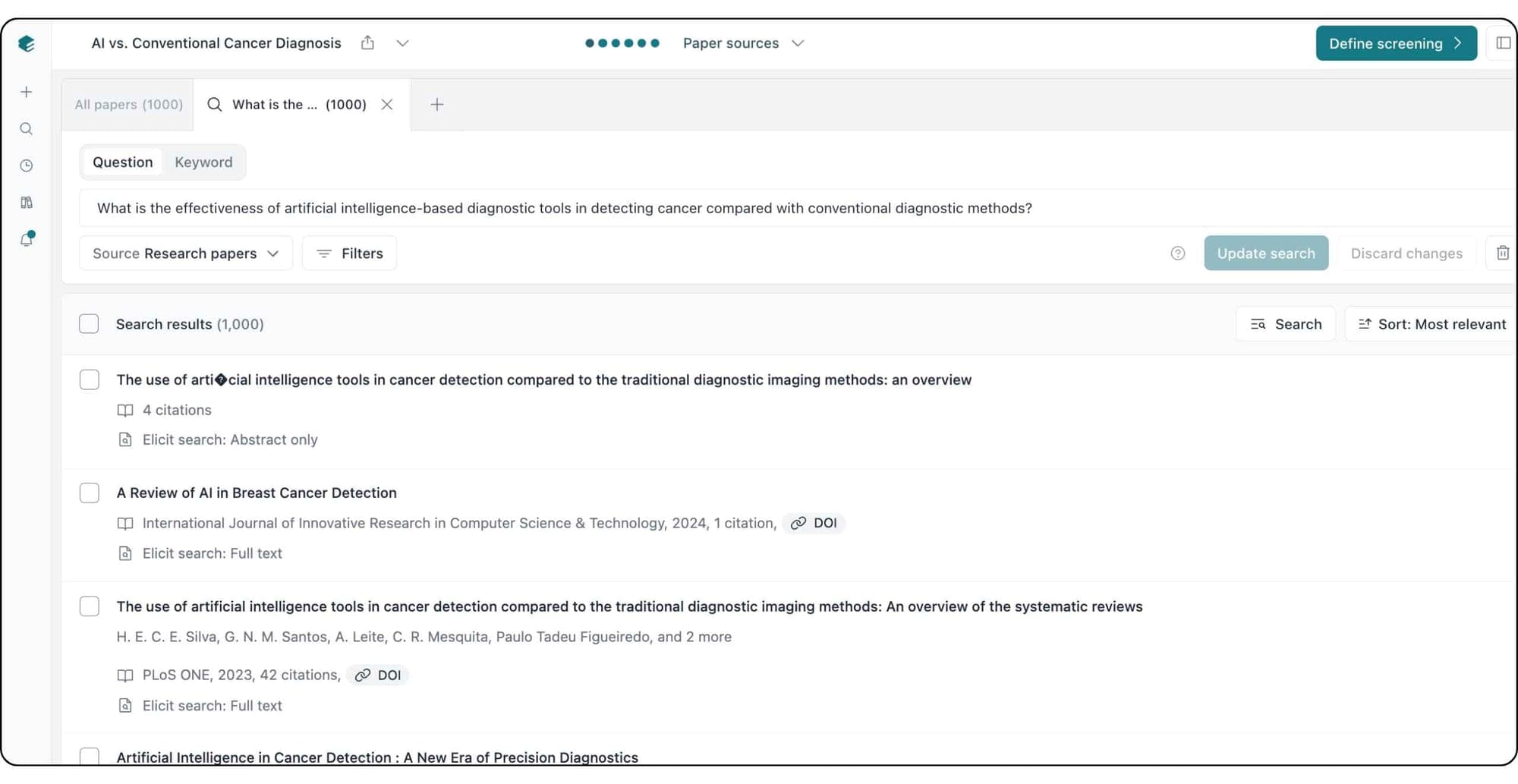
Elicit supports collaboration but does not include a role model, per-stage verifier assignment, or a decision log. Because of this, the audit trail is less structured than Paperguide's approach. Currently, the limits are 5,000 papers on Pro ($49/month) and 40,000 on Enterprise. Figure extraction is available on Scale ($169/month).
Winner: Paperguide for most researchers. Roles and per-stage verifier assignment, exclusion reasons tied to ordered criteria, and per-criterion evidence in full-text screening make Paperguide stronger for auditable, reproducible reviews. Elicit's higher screening ceiling and immediate gathering make it the specialist choice when volume above 20,000 papers matters more than verification structure.
Both platforms cover the full systematic review workflow. Paperguide emphasizes governance with assigned verifiers, ordered exclusion reasons for explainable PRISMA counts, per-criterion evidence in full-text screening, and a report that flows into citation-grounded writing. Elicit emphasizes screening volume with collaboration, immediate large-scale paper gathering, and a 40,000-paper Enterprise ceiling. The workflows are closer than the market assumes. The separation is verification structure and what happens after the review.
How Does Paperguide Data Extraction Compare to Elicit?
Both platforms support custom extraction columns, structured comparison tables, qualitative and quantitative extraction, and sentence-level links from each extracted value to the exact statement in the source PDF. Consequently, source traceability is not a differentiator here because both platforms do it well.
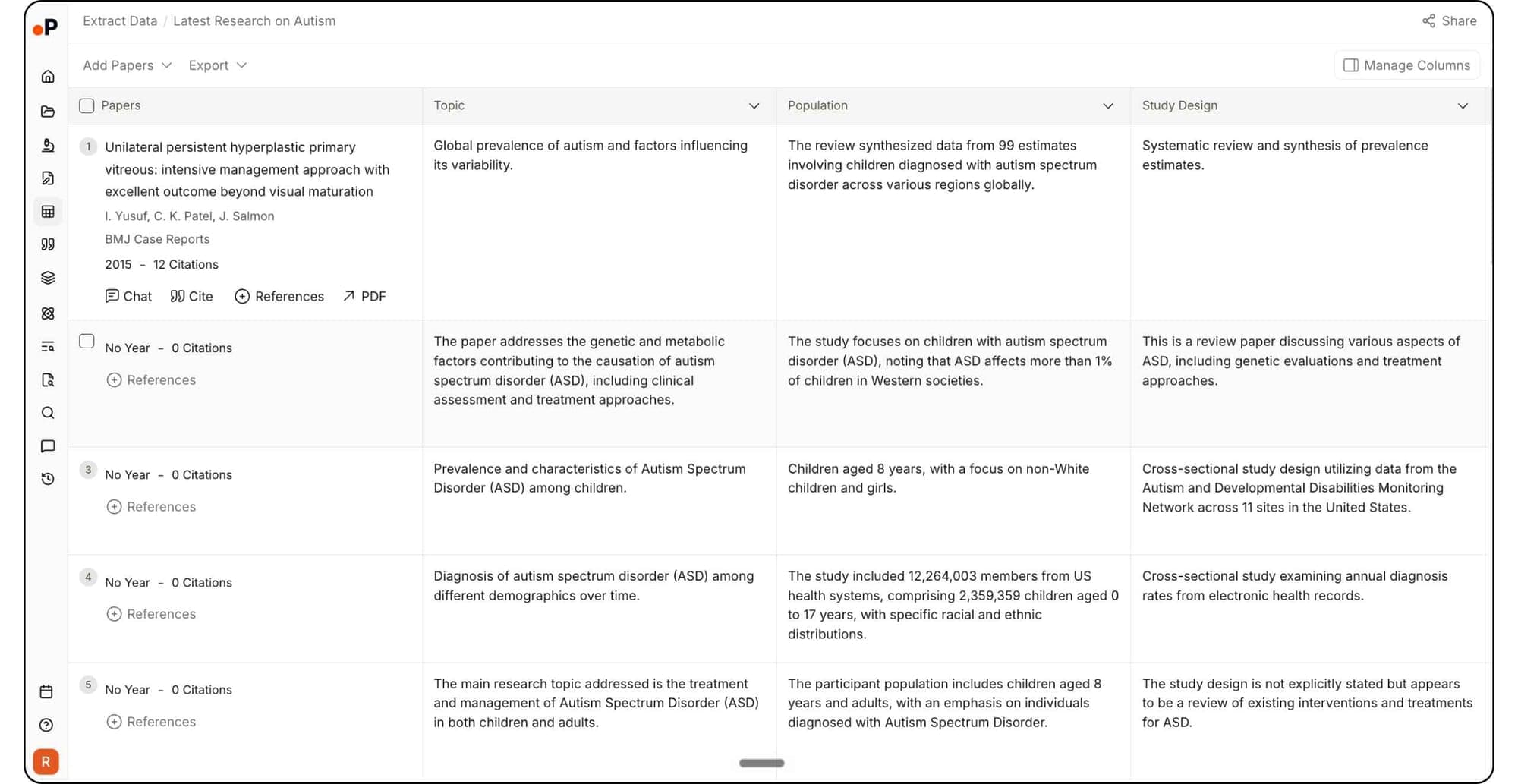
However, the sharpest difference is column limits. For example, a researcher extracting 15 fields needs Elicit Pro ($49/month) to get 20 columns. On Paperguide, any paid plan starting at $12 per seat per month, billed annually, covers up to 50 columns per table. That is a straight, checkable comparison that needs no interpretation.
The second difference is setup. Specifically, Elicit requires the user to define columns and comparison structure manually. In contrast, Paperguide can AI-generate extraction fields from the research question and context, then the user edits or adds to them. In addition, Paperguide supports configurable output types per field: Answer, Yes or No, or specified options. As a result, Yes or No answers and fixed option sets make an extraction table usable as a screening artifact rather than free text to re-read. Both platforms export to CSV, BIB, and RIS.
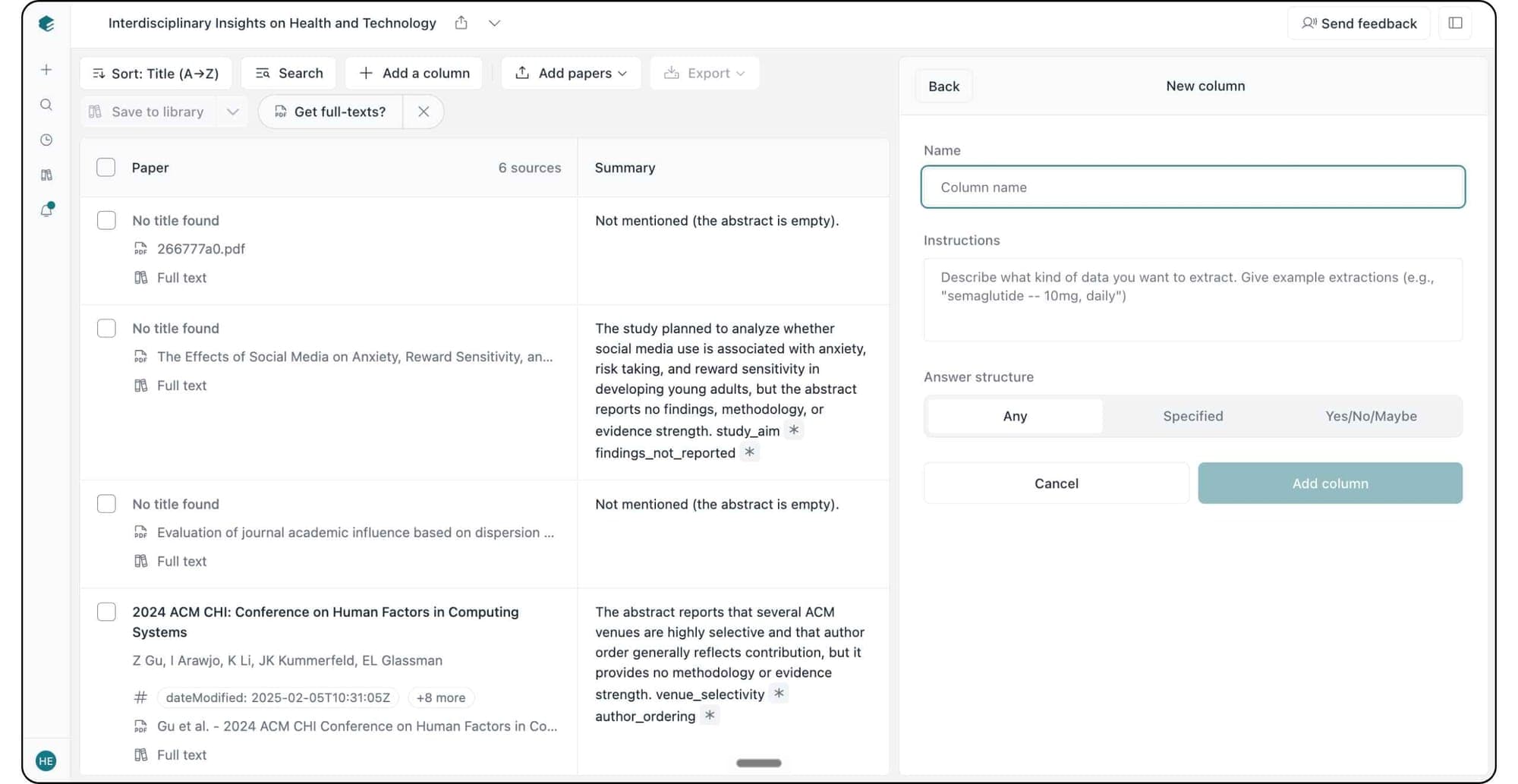
Nevertheless, Elicit offers figure extraction from papers on Scale ($169/month), which Paperguide does not yet support.
Winner: Paperguide on columns and setup. Elicit on figure extraction. Paperguide offers 50 columns on any paid plan versus Elicit's 20 on Pro, plus AI-generated fields and output typing. Elicit wins when figure extraction from publications is required.
How Does Paperguide Research Agent Compare to Elicit?
Paperguide's Research Agent handles search, screening against user criteria, cross-study comparison, gap identification, extraction into tables, and a full literature review in one session. Notably, it draws from 200M+ papers plus the user's own reference library, so researchers who have spent years building a collection can act on those papers directly. As a result, output types include document drafts with automatic citation, structured extraction tables, and formatted reference lists. Furthermore, the session output lands in the library, the AI Paper Writer, or an extraction table rather than ending at an answer.
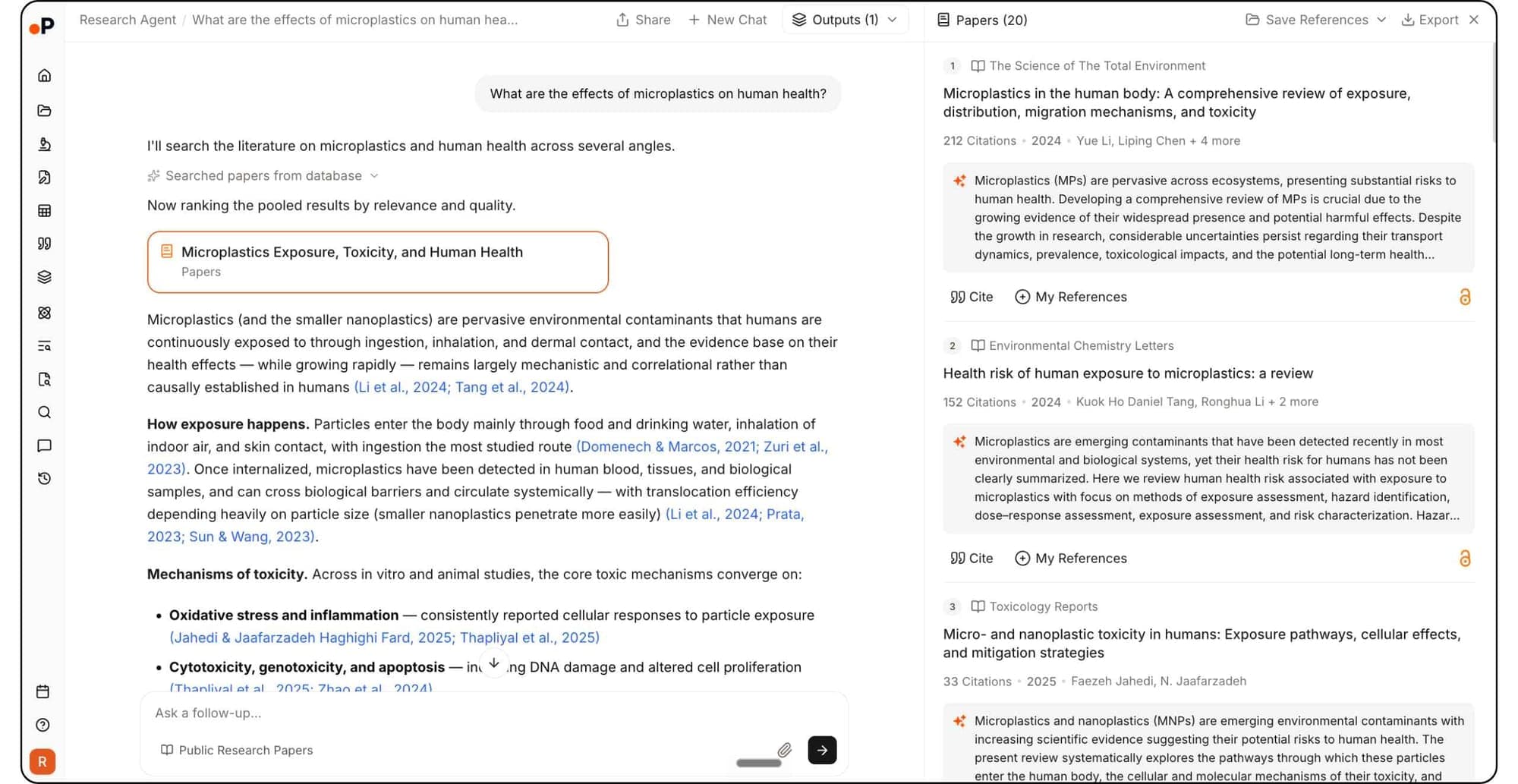
In comparison, Elicit's Research Agent handles natural-language research questions, semantic retrieval, multi-paper synthesis, evidence extraction, and follow-up query suggestions. It draws from Elicit's corpus plus uploaded papers. Consequently, output types include citation-backed answers, synthesis reports, and summaries. Additionally, the Research Agent synthesizes across scientific literature, clinical trials, patents, and uploaded data (Elicit changelog, retrieved August 2026). However, the session output is the endpoint. Therefore, there is no document editor or drafting workflow attached.
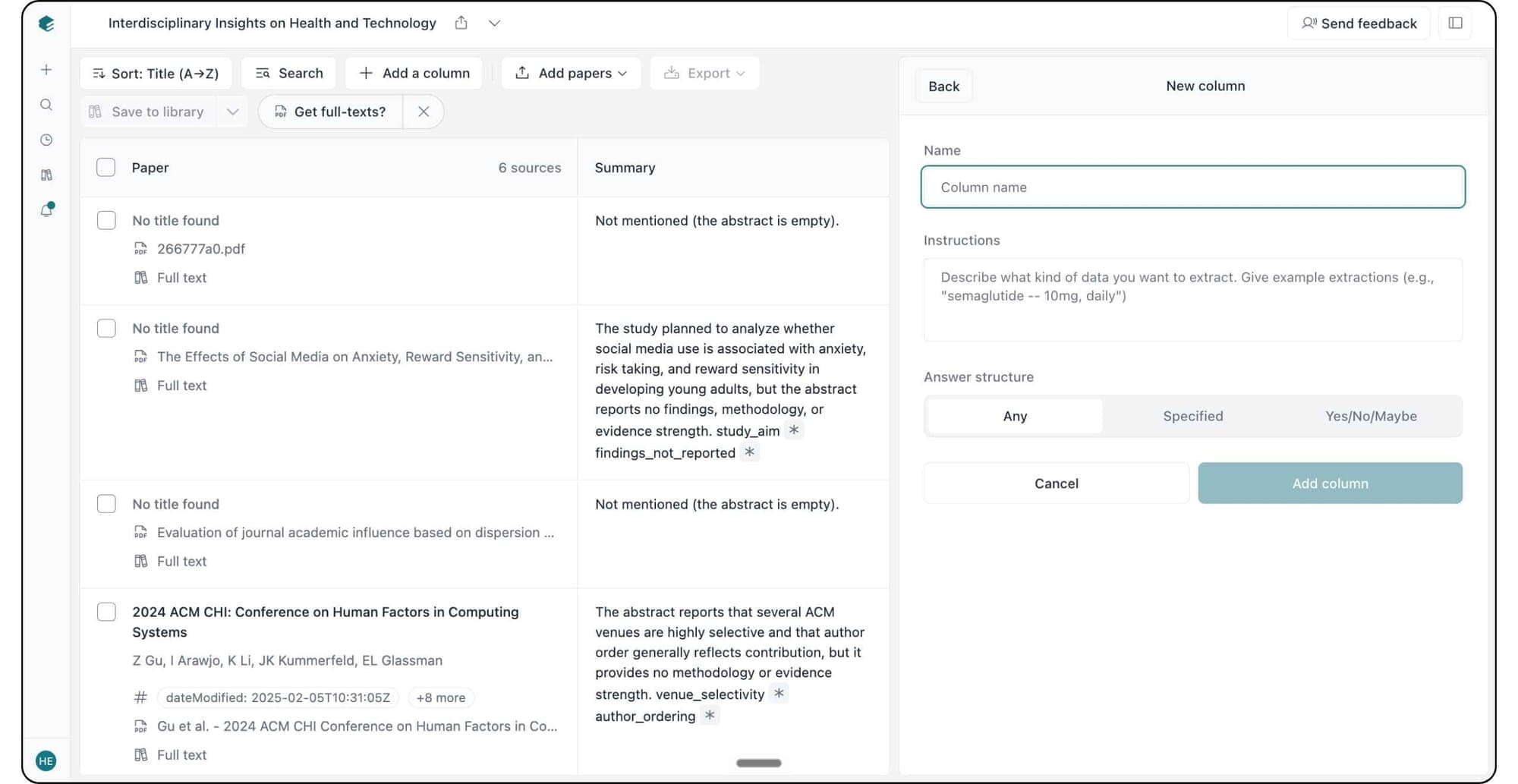
Winner: Depends on use case. Paperguide's Research Agent is stronger for researchers who want to act on their own collected papers and end in a draft rather than an answer. Elicit's Research Agent is stronger for multi-source evidence synthesis spanning trials, patents, and regulatory data.
How Does Paperguide Chat with PDF Compare to Elicit?
Both platforms support multi-paper Q&A with evidence-backed answers over selected papers. Overall, this comparison is at near parity.
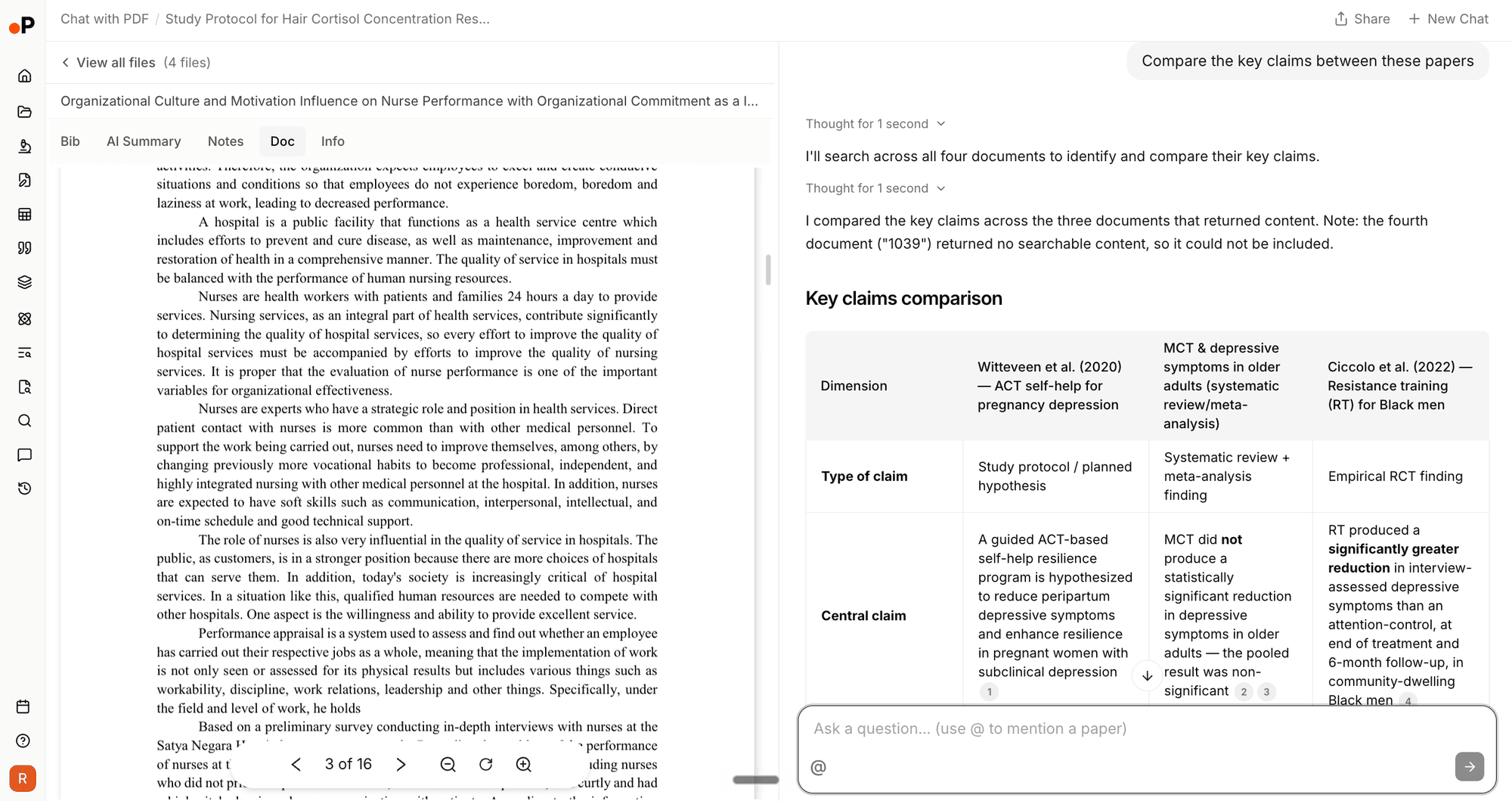
Paperguide processes full-text context rather than chunk-based retrieval, supporting comparative analysis across multiple documents with inline citations linking to source paper, page number, and exact passage. As a result, insights feed into literature reviews and the AI Paper Writer with passage-level source verification.
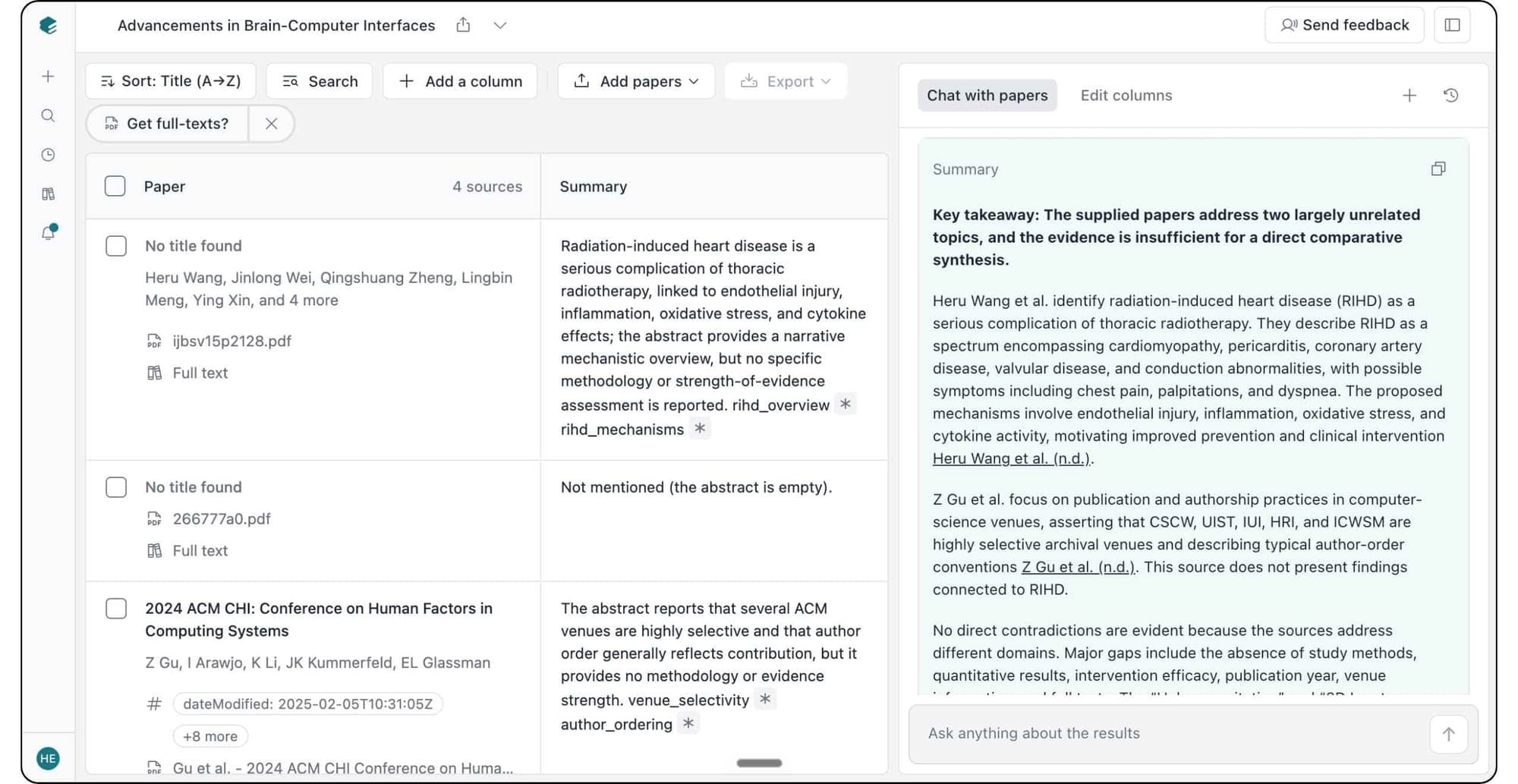
In contrast, Elicit's Chat with Papers answers questions across selected papers with supporting quotes and citations. Notably, the Basic plan includes unlimited chat with full-text access, which makes it one of the strongest free research chat features available (Elicit pricing page, retrieved August 2026). Therefore, budget-conscious researchers benefit from Elicit's free tier here.
Winner: Draw. Both support multi-paper chat with evidence-backed answers. Paperguide adds workflow continuity into the AI Paper Writer and Reference Manager. Elicit's unlimited free chat is a strong advantage for researchers on a budget.
Where Is Paperguide Stronger Than Elicit?
Beyond the workflow-by-workflow results above, Paperguide has six structural advantages that compound across a full research project.
1. Workflow Completeness
Elicit covers discovery, screening, extraction, and synthesis. As a result, the workflow ends at a table or a report draft. In contrast, Paperguide continues into reference management, citation-grounded drafting, and the final document. Consequently, context carries across stages instead of being exported between tools. In practical terms, Elicit replaces your search and your spreadsheet. However, Paperguide replaces your search, your spreadsheet, your reference manager, and your draft. Also, the same workspace runs a fast literature review on Monday and a protocol-driven systematic review over the following weeks, while Elicit users typically pair the platform with Covidence or a spreadsheet when the output has to be defensible.
2. Reference Management Is Built In
Elicit has no AI-native reference manager. Users still run Zotero, Mendeley, or EndNote alongside it. Elicit's Library supports bulk upload, collections, tagging, Zotero import, and de-duplication, but it does not include citation style management, annotation tools, notes, an in-app PDF reader, or integration with a writing workspace.
In contrast, Paperguide has a full reference library: DOI, URL, BibTeX, RIS, and PDF import (up to 100MB on paid plans), Zotero and Mendeley import, automatic metadata and open-access PDF fetch, folders and tags, in-app PDF reader with annotation and highlights, AI summaries, Research Agent chat on library papers, over 1,000 citation styles, and a Chrome extension for capture and institutional proxy access. Every paper in the library is a usable source across search, extraction, review, and the AI Paper Writer. As a result, the reference manager is not adjacent to the research workflow. Instead, it is part of it.
3. Research Quality Evaluation Is Surfaced Throughout
Elicit's quartile filtering lives in search, not in outputs. For instance, SJR, SNIP, citation strength, and evidence-quality signals are not clearly exposed in synthesized results, evidence tables, or reports. In contrast, Paperguide carries SJR quartile, SJR score, SNIP, and citation metrics into results, recommendations, and screening. Because of this, researchers see quality signals where they make decisions, not only where they filter. That is checkable and specific, not a claim about better AI.
4. Citation-Grounded Writing
Elicit produces reports and summaries. However, it is not a writing platform: there is no document editor, no integrated drafting workflow, and no citation-grounded manuscript generation.
Paperguide's AI Paper Writer generates full drafts from a research question, automatically citing papers from the 200M+ database and the user's own Reference Manager. Users add custom instructions, set reference preferences, and filter sources by journal quality (SJR, SNIP) and publication year before generation begins. The system builds an outline first, then a citation-grounded draft where every cited claim traces back to a verifiable source.
Inside the editor, five AI tools support the writing workflow. AI Chat searches the 200M+ database or the user's library and inserts citation-backed text directly into the document. AI Edit rewrites selected passages for tone, clarity, simplification, or humanization while preserving existing citation markers. Smart Continue extends writing from the cursor position while maintaining structural and stylistic consistency. Autocomplete provides real-time inline suggestions with citations as the researcher types. Describe to LaTeX converts plain-English equation descriptions into rendered LaTeX code. Researchers also insert citations from their library using '@' mentions, and adjacent citations group automatically into combined parentheses like "(Brown, 2009; Porter, 2004; Smith, 2015)" following the active citation style.
In addition, the platform supports version history with manual snapshots and automatic saving, hierarchical folders with drag-and-drop organization, DOCX export with preserved formatting and citations, a plagiarism checker, and over 1,000 citation styles. Sharing and collaboration with single-editor locking, real-time synchronization, and threaded commenting launched in August 2026 (Paperguide changelog, retrieved August 2026). For any researcher, from graduate students to faculty to clinical teams, the writing stage is where the hours actually go, and Paperguide covers it without switching tools.
5. Report Control and Structure
Elicit's Report feature gives limited control over structure, writing style, and exact paper selection. Reports in Fast, Balanced, and Comprehensive modes behave as synthesis drafts, covering roughly 50 to 500 sources. Users cannot control the output format or select specific papers to include.
In contrast, Paperguide's Literature Review AI follows a five-step process: planning, search, screening, extraction and synthesis, and review generation. In Standard mode, it handles up to 50 papers. In Extended mode, it screens up to 200. SJR, SNIP, and citation metrics feed into quality screening. The Deep Research Report feature adds another layer: Standard mode reviews 80 papers and uses the top 30, while Comprehensive mode reviews 100 papers and uses the top 50. At every stage, the user can define research questions, manually include or exclude retrieved papers, and customize extraction fields before synthesis runs. Because of this, Paperguide inserts a review and confirmation point at every stage, while Elicit generates synthesis from a single prompt. The output connects directly to the Reference Manager and AI Paper Writer.
6. Verification Structure in Systematic Review
Per-stage verifier assignment, exclusion reasons tied to ordered criteria, and per-criterion evidence in full-text screening give teams an auditable decision trail. Paperguide supports Edit, Reviewer, and View-only roles with per-stage assignment for abstract screening, full-text screening, and extraction, with all decisions and overrides logged. Elicit supports collaboration but does not include a role model, per-stage verifier assignment, or a decision log. Because of this, enterprise and regulated buyers ask about verification structure first, and Paperguide answers that question directly.
Where Does Elicit Genuinely Win?
Elicit has five genuine advantages that matter for specific research use cases.
1. Screening Ceiling
Elicit supports 40,000 papers at Enterprise against Paperguide's 20,000. If a review starts above that volume, Elicit is the only option among these two platforms. For reviews that start below 20,000 papers, however, both platforms handle the workload and the decision shifts to verification structure and what happens after screening.
2. Table-Based Comparison
Elicit's Find Papers with custom columns is mature and fast for exploratory work. The table-first interface makes it straightforward to iterate on search results interactively, add columns, sort, and compare papers without committing to a full workflow. For researchers who primarily build evidence tables, this is a practical advantage.
3. Report Scale Modes
Elicit's Fast, Balanced, and Comprehensive modes across roughly 50 to 500 sources provide a clean mental model for controlling synthesis depth. Paperguide's Literature Review AI handles up to 50 papers in Standard mode and screens up to 200 in Extended mode. When breadth across a large evidence base matters more than per-paper control, Elicit covers more ground in a single report.
4. API Access
Elicit's API covers Search, Reports, and Systematic Review endpoints, which is broader than Paperguide's current Search API. Both platforms launched MCP servers in 2026, and both work with Claude, ChatGPT, and other coding tools. However, for teams building automated research pipelines, Elicit's API is more comprehensive across endpoints.
5. Personalized Alerts
Elicit offers alerts for new papers matching a saved interest. Paperguide does not have a documented equivalent. For researchers monitoring new publications in their field, this is a genuine advantage that no other feature in Paperguide's workflow replaces.
Pricing Comparison
| Plan | Paperguide | Elicit |
|---|---|---|
| Free | 2,000 AI credits/month; 5 columns; 10 papers/table | Unlimited search/chat; limited agent/reports |
| Entry Paid | Plus $12 per seat/month, billed annually ($144/year) | Pro $49/month ($588/year) |
| Mid Tier | Pro $29 per seat/month, billed annually ($348/year) | No mid-range option |
| High Tier | Evidence Teams $89 per seat/month, billed annually ($1,068/year) | Scale $169/month ($2,028/year) |
| Enterprise | Custom (up to 20,000 papers) | Custom (up to 40,000 papers) |
| Academic Discount | 30% with a valid university email | Not listed |
Paperguide Plus at $12 per seat per month, billed annually ($144 a year), includes systematic reviews up to 1,000 papers, 50 extraction columns, and 12,500 AI credits (Paperguide pricing, retrieved October 2026). In contrast, Elicit Pro at $49/month includes systematic reviews up to 5,000 papers, 20 extraction columns, and reports extracting from 135 sources (Elicit pricing page, retrieved August 2026). Notably, there is no Elicit plan between free and $49/month.
As a result, a graduate student running two systematic reviews per year with up to 1,000 papers each pays $144/year on Paperguide Plus versus $588/year on Elicit Pro. That is a $444 annual difference. On top of that, Paperguide offers a 30% academic discount with a valid university email, while Elicit does not list one.
Final Verdict: Should You Choose Paperguide or Elicit?
Choose Paperguide if:
- You need a connected research workflow from search through systematic review to a cited draft in one platform.
- You want systematic review access starting at $12 per seat per month, billed annually, with assigned verifiers, ordered exclusion criteria, and an auditable decision trail.
- You write within your research platform and need citation management, plagiarism checking, and over 1,000 citation styles.
- You want research quality metrics like SJR and SNIP visible in outputs, not just in search filters.
- You need a full reference manager with Zotero/Mendeley import, Chrome extension, annotation, and AI summaries built into the same workspace.
Choose Elicit if:
- You need to screen more than 20,000 papers with threshold-based inclusion and collaboration.
- Your primary output is structured evidence tables with figure extraction from publications.
- You build automated research pipelines through APIs or need multi-source synthesis spanning trials, patents, and regulatory data.
- You want personalized alerts for new papers matching your saved interests.
Overall, Paperguide is the stronger choice for researchers who need a connected workflow from paper discovery through systematic review to a publication-ready draft with quality transparency at every step. Elicit remains the stronger choice when maximum screening scale, evidence tables, figure extraction, API-driven research operations, or paper alerts are the deciding factors.
Frequently Asked Questions
Is Paperguide better than Elicit?
Paperguide is better for connected research workflows with SJR/SNIP quality metrics in outputs, a guided systematic review process with assigned verifiers and an auditable decision trail, integrated citation-grounded writing with over 1,000 citation styles, a full reference manager, and a lower starting price ($12 per seat per month billed annually vs $49/month). In contrast, Elicit is better for large-scale systematic review screening up to 40,000 papers, evidence tables with figure extraction, personalized paper alerts, and API-driven research. The right choice depends on whether you prioritize workflow completeness or screening scale.
Is Paperguide a good Elicit alternative?
Paperguide is a strong Elicit alternative for researchers who want one platform connecting search, systematic review, literature review, extraction, references, and citation-grounded writing. It covers the same core research tasks at a lower price point. However, it is not the right alternative for teams screening 20,000+ papers or building API-driven evidence pipelines.
Which tool is better for systematic reviews?
Paperguide's protocol-first workflow with assigned verifiers, ordered exclusion criteria, per-criterion evidence, and PRISMA reporting is stronger for auditable, reproducible reviews up to 5,000 papers on Pro ($29 per seat per month, billed annually). Elicit's configurable screening with Fast/Thorough modes, immediate paper gathering, and collaboration is stronger when screening volume and speed are priorities. Elicit supports up to 40,000 papers on Enterprise; Paperguide supports 20,000.
Which tool is better for PhD students?
Paperguide Plus at $144/year covers AI Search, Literature Review, Systematic Review (up to 1,000 papers), AI Paper Writer with 1,000+ citation styles, and Reference Manager. In contrast, Elicit's free tier offers unlimited search and chat but requires Pro at $588/year for systematic reviews. Therefore, for PhD students on a budget who need the full research workflow, Paperguide is more affordable at $444 less per year.
Does Elicit have an AI writing tool?
Elicit does not have a dedicated writing workspace. It generates reports and summaries with citations through its Research Agent, but there is no document editor, drafting workflow, citation style management, or plagiarism checker. Researchers must export findings and write in a separate tool. Paperguide's AI Paper Writer provides full draft generation, '@' citation insertion, over 1,000 citation styles, collaborative editing, and a plagiarism checker inside the research workspace.
Does Elicit show research quality metrics like SJR or SNIP?
Elicit offers quartile filtering in its search interface, but SJR, SNIP, and impact factor are not displayed in search results or synthesized outputs. Quality metrics do not carry into evidence tables or reports. In contrast, Paperguide displays SJR quartile, SJR score, and SNIP on every search result and carries these signals into screening and recommendations.
Can I use Paperguide and Elicit together?
Some researchers use Elicit for large-scale paper discovery and screening, then import included papers into Paperguide via Zotero for literature review writing and reference management. Both platforms now offer MCP servers, so researchers can also query either platform's paper database from coding tools like Cursor or VS Code.
Can I migrate from Elicit to Paperguide?
Both platforms support Zotero import. A library stored in Zotero transfers to either tool. Similarly, Elicit's evidence tables can be exported and reimported as structured data. However, systematic review protocols and screening decisions do not transfer between platforms and would need to be recreated.
Researching a topic?
Find papers and get cited answers
Search the literature, find gaps and write with citations.
Start for freeNo credit card required