9 Best Academic Research AI Tools in 2026


The hardest part of academic research in 2026 isn't finding AI tools—it's finding ones built for a researcher's actual workflow.
The 2025 STM Global Report estimated that more than 5.14 million peer-reviewed articles are now published every year, with the volume of scholarly literature roughly doubling every 9 to 10 years according to long-running bibliometric analysis from Bornmann and Mutz on the growth of science. A Wiley 2025 researcher survey of nearly 5,000 academics found that scientists now spend an average of 13.5 hours per week reading and screening literature alone, before any writing, lab work, or analysis begins. The AI tool you pick decides whether that week shrinks to two days or stays at thirteen hours.
The catch is that most "research AI" was not built for research. Generic chatbots write fluent paragraphs and invent citations that do not exist. Single-purpose search tools surface relevant papers but cannot synthesise a literature review. Citation graph explorers map connections but cannot extract structured data. A serious researcher running a systematic review, drafting a thesis chapter, or building a meta-analysis still ends up jumping between six tabs, three logins, and a reference library that never quite syncs.
This guide tests the nine academic research AI tools that PhD students, postdocs, faculty researchers, and lab teams are actually keeping in their workflow in 2026. Each one is reviewed against the same five dimensions: how well it discovers literature, how deeply it analyses what it finds, how honest it is about its sources, how cleanly it slots into a real research workflow, and how it prices for someone on a stipend. The recommendation order is workflow-led, not popularity-led.
TL;DR
If you only have a minute: Paperguide is the best AI research platform for academic research in 2026, built for scientific research workflows that help researchers find, organise, screen, extract, and synthesise papers across literature reviews and systematic reviews. The AI Paper Writer, AI Reference Manager, Literature Review AI, Paperguide Systematic Review, Research Agent, Extract Data and Chat with PDF all work off the same paper library and citation layer. Elicit is the strongest for structured extraction tables. Consensus is fastest for quick evidence checks. Semantic Scholar remains the best free 200M-paper search. Research Rabbit and Connected Papers are the two cleanest citation-graph explorers. NotebookLM is the best multi-source synthesis sandbox, Scite is the one to trust for citation context, and Perplexity is a fast secondary search if you need cross-disciplinary breadth.
Top Academic Research AI Tools: Quick Comparison
| Tool | Best For | Free Plan | Starting Paid Plan | Database Size |
|---|---|---|---|---|
| Paperguide | End-to-end scientific research workflows | Yes (free plan) | $12/mo Plus, $29/mo Pro | 200M+ papers |
| Elicit | Structured data extraction tables | Yes (limited extractions) | $12/mo Plus | 138M papers |
| Consensus | Yes/no evidence questions | Yes (limited searches) | $11.99/mo Premium | 200M+ papers |
| Semantic Scholar | Free academic search at scale | Free (no paid tier) | N/A | 200M+ papers |
| Research Rabbit | Visual citation graph exploration | Free | Free | 100M+ papers |
| Connected Papers | Co-citation network mapping | Free (5 graphs/mo) | $6/mo | 50M+ papers |
| NotebookLM | Multi-source synthesis sandbox | Free | Pro via Google AI | User-uploaded |
| Scite | Citation context and evidence validation | Free trial | $20/mo Personal | 1.2B citations |
| Perplexity | Cross-disciplinary AI search | Free | $20/mo Pro | Web + scholar |
Which Is the Best Academic Research AI Tool in 2026?
After testing all nine platforms against the same five dimensions (discovery, analysis depth, citation integrity, workflow fit, and pricing for a stipend), the answer is consistent. Paperguide is the most complete, with the AI Paper Writer, AI Reference Manager, Literature Review AI, Paperguide Systematic Review, Research Agent, Extract Data and Chat with PDF on one workspace and one citation layer. The eight competitor tools each excel at one stage of the research lifecycle, but every one of them stops short of the full workflow.
Best Academic Research AI Tools
1. Paperguide
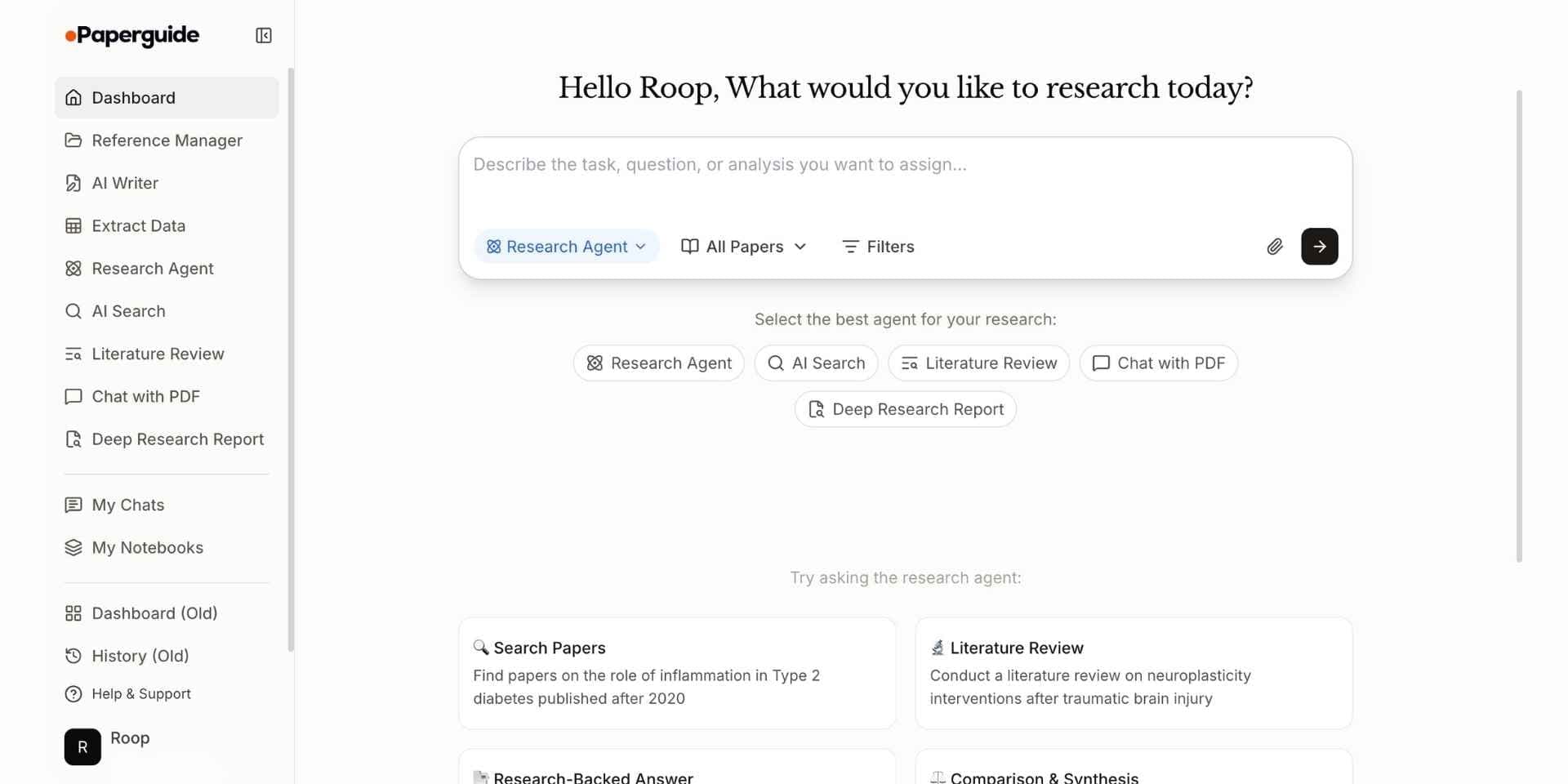
Paperguide is an AI-native platform for scientific research workflows and systematic reviews, built for academic research. It helps researchers find, organise, and synthesise research for literature reviews, or run rigorous, auditable systematic reviews, with AI reference management, a Research Agent, structured data extraction, and citation-grounded writing built in. Context follows you from discovery to cited draft, without stitching together a search engine, a reference manager, a PDF reader, a spreadsheet, and a writing tool.
Because every part of the platform sits on the same 200M+ paper library and citation layer, a paper that surfaces in your search saves straight to your library, and a citation the AI Paper Writer uses is already verified. The AI Reference Manager keeps every paper organised across projects and stays in sync with the AI Paper Writer so the bibliography updates automatically. Chat with PDF answers methodology questions against the actual source text, pointing to the exact page and paragraph, and Extract Data pulls structured information from multiple papers into an evidence table with each value cited to its source sentence. The AI Paper Writer drafts research papers and thesis chapters with references pulled from your library, not from a language model that might fabricate a source. Paperguide Systematic Review handles the protocol, screening against your inclusion and exclusion criteria, structured data extraction and a PRISMA diagram generated from actual review counts, with every decision logged against its criterion and evidence.
For PhD students running a literature review, a postdoc preparing a grant, or a faculty researcher submitting to Nature, this matters more than any single feature. The platform that surfaces the right paper is only useful if it carries that paper through screening, extraction, synthesis, and writing without losing the citation chain. Paperguide is built around that single principle.
Key Features
- AI Search: hybrid semantic and keyword search across 200M+ peer-reviewed papers from PubMed, arXiv, OpenAlex, and Semantic Scholar, with cited answers synthesised from the top 20 papers and SJR, SNIP and citation metrics on every result. The same search also works inside Claude or ChatGPT through Paperguide MCP.
- AI Reference Manager: replaces standalone tools like Zotero, Mendeley, and EndNote, with Zotero, BibTeX, RIS, DOI and PDF import, automatic metadata and PDF fetching, an institutional proxy (EZproxy and others) for paywalled papers, and 1,000+ citation styles.
- Research Agent: runs the full research process in a single connected session, from discovery and screening to extraction, drafting, and citation handling, all on one paper library.
- Literature Review AI: runs a five-step Plan, Search, Screen, Extract, Synthesise workflow on up to 50 papers in Standard mode or 200 in Extended mode, with every claim cited and linked to a source paper.
- Systematic Review: protocol-driven reviews in two modes (Dual Review, with two blind independent reviewers and a conflict resolver, or AI Systematic Review, with a named verifier confirming each stage), a PRISMA diagram generated from actual counts, and every decision logged with its criterion and evidence.
- Extract Data: define custom columns and Paperguide fills them across every paper, with each value cited to the exact sentence it came from; up to 50 columns and 100 papers per table on paid plans, with export to CSV, Excel, RIS, BIB, PDF, or DOCX.
- AI Paper Writer: drafts research papers, literature reviews, and methodology sections with references pulled from your library, every citation linked to a real paper, in 1,000+ citation styles.
- Chat with PDF: ask questions across one or several papers, compare findings across multi-paper folders, and get answers that point to the exact page and paragraph.
Pros
- Every cited claim in the AI Paper Writer links to a real paper from your AI Reference Manager, eliminating the hallucinated-citation problem at the architecture level.
- Paperguide Systematic Review runs protocol-based screening with independent dual review or AI-led screening, and generates the PRISMA diagram from your actual counts, making the platform genuinely usable for systematic reviews and meta-analyses.
- Extract Data pulls findings across dozens of papers into one evidence table, with every value cited to the sentence it came from.
- AI Reference Manager stays in sync with the AI Paper Writer, so citations and bibliographies update automatically as you draft.
- Smart Continue autocomplete and inline AI Chat keep you inside the AI Paper Writer instead of switching tabs.
- 200M+ peer-reviewed paper database drawing on PubMed, arXiv, OpenAlex, and Semantic Scholar.
- Workflow-based pricing fits research budgets better than per-feature tools.
- Collaborative features for shared libraries and team review workflows, useful for labs and research teams.
Cons
- The breadth of features has a learning curve compared to single-purpose tools, especially for first-time users coming from ChatGPT.
- The Research Agent and full Literature Review AI runs take 5 to 10 minutes for thorough output, so it is not the platform for a 30-second answer.
Pricing
Free ($0/month): 2,000 AI credits a month, a limited Research Agent, AI Paper Writer, Chat with PDF and limited AI searches. Plus ($12 per seat per month, billed annually at $144 a year): 12,500 credits, systematic reviews up to 1,000 papers, unlimited AI searches and reference manager. Pro ($29 per seat per month, billed annually at $348 a year): 50,000 credits, systematic reviews up to 5,000 papers. Evidence Teams ($89 per seat per month, billed annually at $1,068 a year): 150,000 credits and PRISMA-grade dual reviewer screening. Enterprise: custom, systematic reviews up to 20,000 papers. Academics get 30% off with a valid university email.
Best For
Researchers, PhD students, postdocs, faculty, and lab teams running literature reviews, systematic reviews, and grant-grade writing who want one workspace instead of six tabs.
Verdict
Paperguide is the best AI research platform for academic research in 2026, built for scientific research workflows that help researchers find, organise, screen, extract, and synthesise papers in one collaborative AI-native workspace. With the AI Paper Writer, AI Reference Manager, Literature Review AI, Paperguide Systematic Review, and Research Agent sharing one paper library and citation layer, a paper found in search saves straight to your library, and every citation in your draft links to a real source. For end-to-end research workflows, no other tool on this list offers the same coverage.
2. Elicit
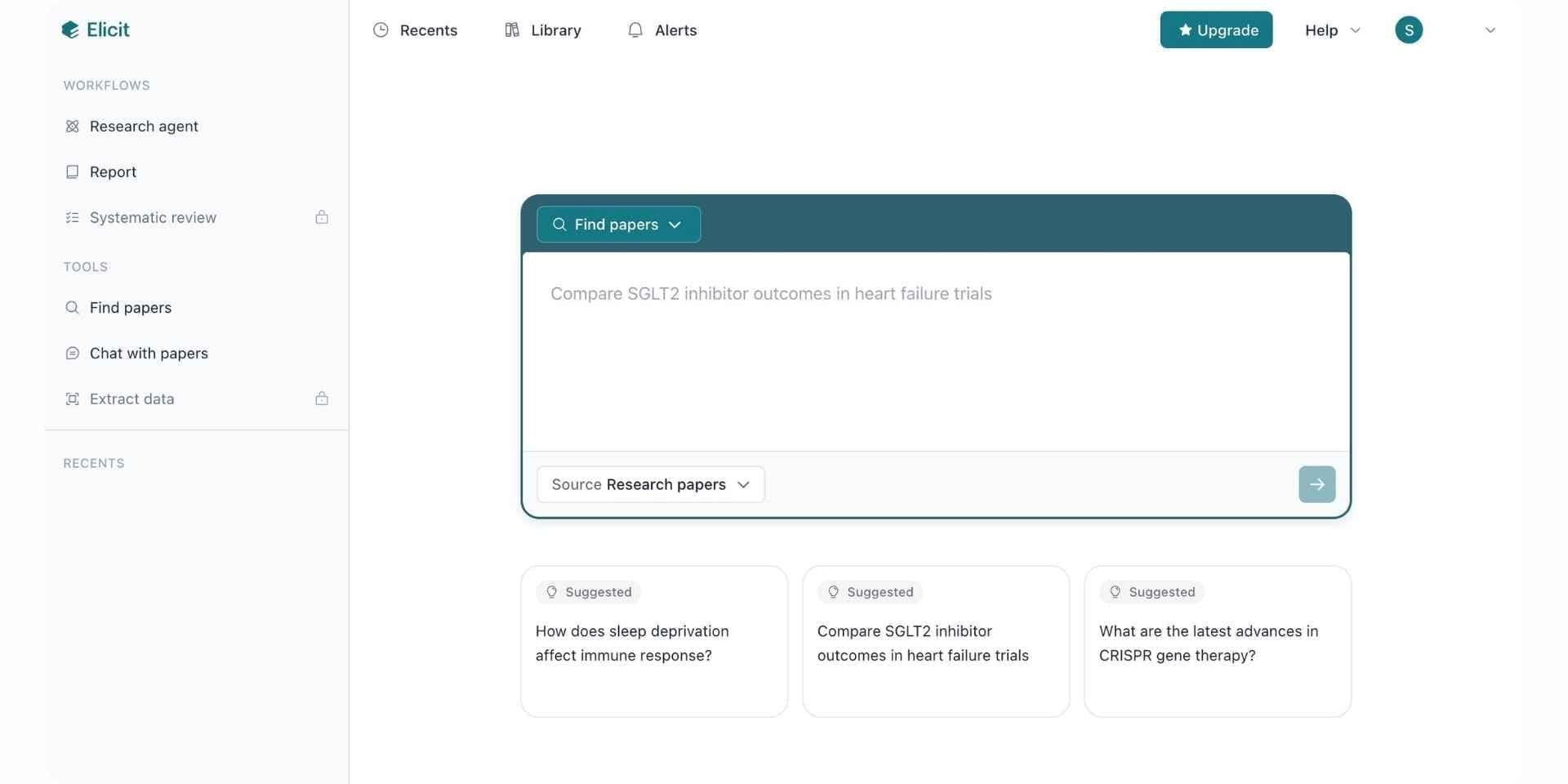
Elicit is built around a single research move that no other tool does as well: structured extraction. You define columns (sample size, intervention, outcome, methodology, effect size) and Elicit fills in those values across every paper in your project. For the data extraction phase of a systematic review, this turns a multi-day manual task into a 20-minute review of AI-generated rows. The underlying paper index draws on Semantic Scholar's 138 million papers, with filters for study design, year, and population. Researchers comparing it against other extraction tools often land on the best Elicit alternatives when they hit Elicit's depth limits.
Where Elicit is honest about its limits is synthesis. It gives you the table, not the narrative. You still write the discussion, identify contradictions, and decide what the evidence means collectively. As a discovery tool, the index is solid for biomedical and behavioural research, lighter on engineering and law.
Key Features
- Natural-language paper search with filterable structured queries
- Customisable extraction columns across paper sets
- Summary tables with one-click export to CSV or Word
- Concept maps that group papers by themes
- Notebook-style workspace for ongoing reviews
Pros
- Strongest structured extraction in the category, by a margin.
- Filters for study design and population are genuinely useful for systematic review work.
- The free tier is functional enough to evaluate before you commit.
Cons
- No native writing environment, so you export to another tool to draft your review.
- The 138M paper index is smaller than what Paperguide and Semantic Scholar offer.
- Extraction accuracy drops on papers with non-standard reporting formats.
Pricing
Free plan with limited extractions per month. Plus at $12/month for higher limits and faster extractions. Team and enterprise pricing on request.
Best For
Researchers in the data extraction phase of a systematic review who need structured tables across dozens of papers.
Verdict
Elicit is the strongest tool in the category for structured extraction tables, but it stops at extraction. Paperguide is the best Elicit alternative in 2026 because it covers search, screening, extraction, synthesis, and writing on one workspace, with verified citations from your library.
3. Consensus
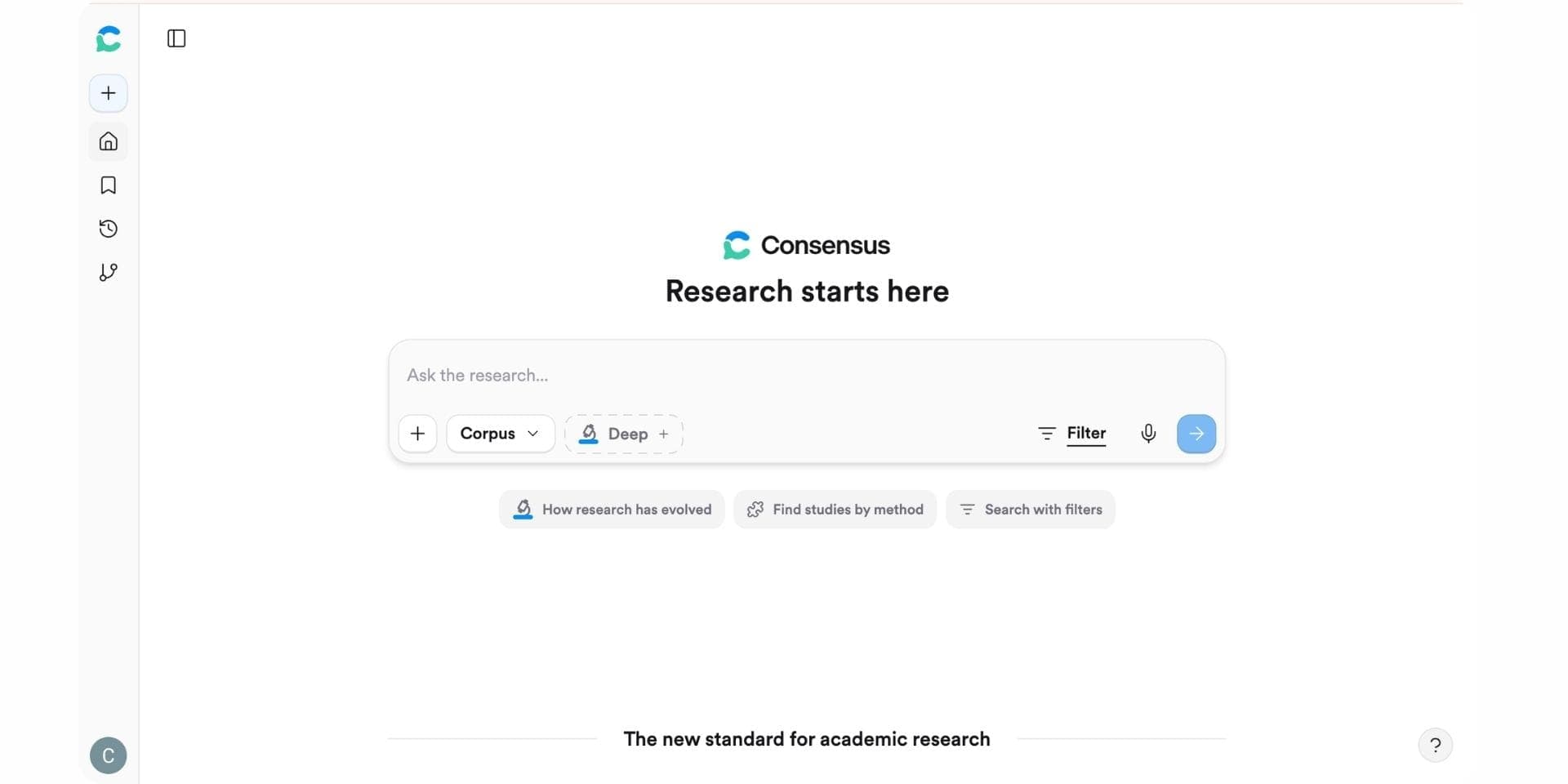
Consensus answers the kind of question that researchers actually ask between paper deadlines: does the literature support this claim? You type the question, Consensus searches across more than 200 million papers, and returns a visual Consensus Meter showing what percentage of studies agree, disagree, or are mixed. Each answer is grounded in real abstracts with one-click access to the source paper.
For a clinical reviewer triaging evidence on a treatment, or a policy researcher confirming a position on class size and student outcomes, Consensus is remarkably efficient. For depth of analysis, it tops out fast. It is built for evidence questions, not for multi-paper synthesis or extraction tables, which is why researchers who need a fuller workflow often end up exploring the best Consensus alternatives.
Key Features
- Consensus Meter showing study agreement breakdown
- 200M+ paper index with one-click source access
- Study design filters (RCT, systematic review, observational)
- Custom analysis prompts on top of search results
- Saved searches and citation export
Pros
- Fast, clean answers with the evidence visible up front.
- Study design filters help separate strong evidence from preliminary work.
- The free tier handles a couple of dozen searches a month comfortably.
Cons
- Designed for yes/no questions, not multi-paper synthesis or extraction.
- No writing environment or reference manager integration.
- The Consensus Meter is sometimes overconfident on questions where the literature is more nuanced than the visual implies.
Pricing
Free with limited Pro Analyses per month. Premium at $11.99/month for unlimited Pro Analyses and advanced filters. Team plans available.
Best For
Clinicians, policy researchers, and reviewers who need quick yes/no evidence answers backed by abstracts of peer-reviewed studies.
Verdict
Consensus is the fastest tool for evidence-meter style yes/no questions, but it does not handle multi-paper synthesis, structured extraction, or writing. Paperguide is the best Consensus alternative in 2026 for end-to-end research workflows, running the screening, extraction, synthesis, and writing pipeline that Consensus stops short of.
4. Semantic Scholar
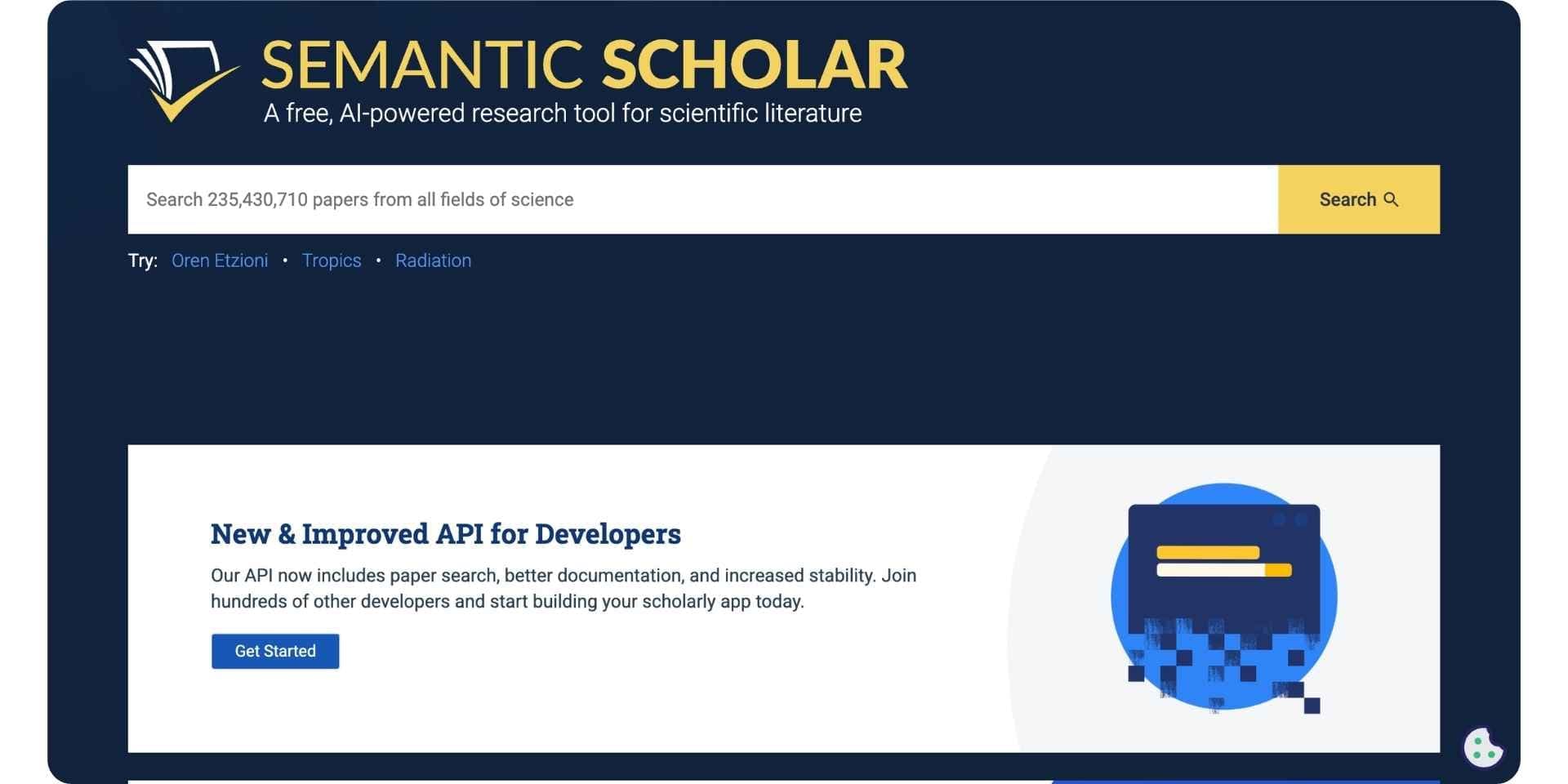
Semantic Scholar is maintained by the Allen Institute for AI and indexes more than 200 million academic papers. It is free for all users, with no paywall on search or basic features. The Influence Score is the standout: a citation-weighting algorithm that distinguishes seminal works from papers that get cited in passing, useful for separating foundational literature from noise.
TLDR auto-summaries on most papers accelerate screening when you are evaluating dozens of candidates in a day. The API is well-documented and is the foundation that powers many AI research tools downstream, including parts of Paperguide and Elicit. Used as a stand-alone tool, Semantic Scholar is a discovery engine, not a research platform, which is why most researchers pair it with one of the best AI research assistants for scientific research once they need to extract, synthesise, and write.
Key Features
- 200M+ paper index across all fields
- Influence Score for citation-weighted ranking
- Auto-generated TLDR summaries
- Free API for developers and downstream tools
- Author profiles with field-of-study and h-index data
Pros
- Genuinely free, with no usage caps that matter for most researchers.
- The Influence Score is the cleanest way to separate seminal papers from noise.
- Strong coverage across CS, biomedical, and engineering.
Cons
- No analysis, extraction, or writing features. Pure discovery.
- Coverage in social sciences and humanities is lighter than in STEM fields.
- The interface is utilitarian, with no project organisation or reading list features.
Pricing
Free. No paid tiers.
Best For
Any researcher who needs a free, high-quality academic search index across all disciplines, especially developers building downstream tools against the API.
Verdict
Semantic Scholar is unbeatable as a free 200M-paper search index, but as a stand-alone tool it covers only discovery. Paperguide is the best Semantic Scholar companion in 2026 for taking those papers through screening, extraction, synthesis, and writing on one workspace.
5. Research Rabbit
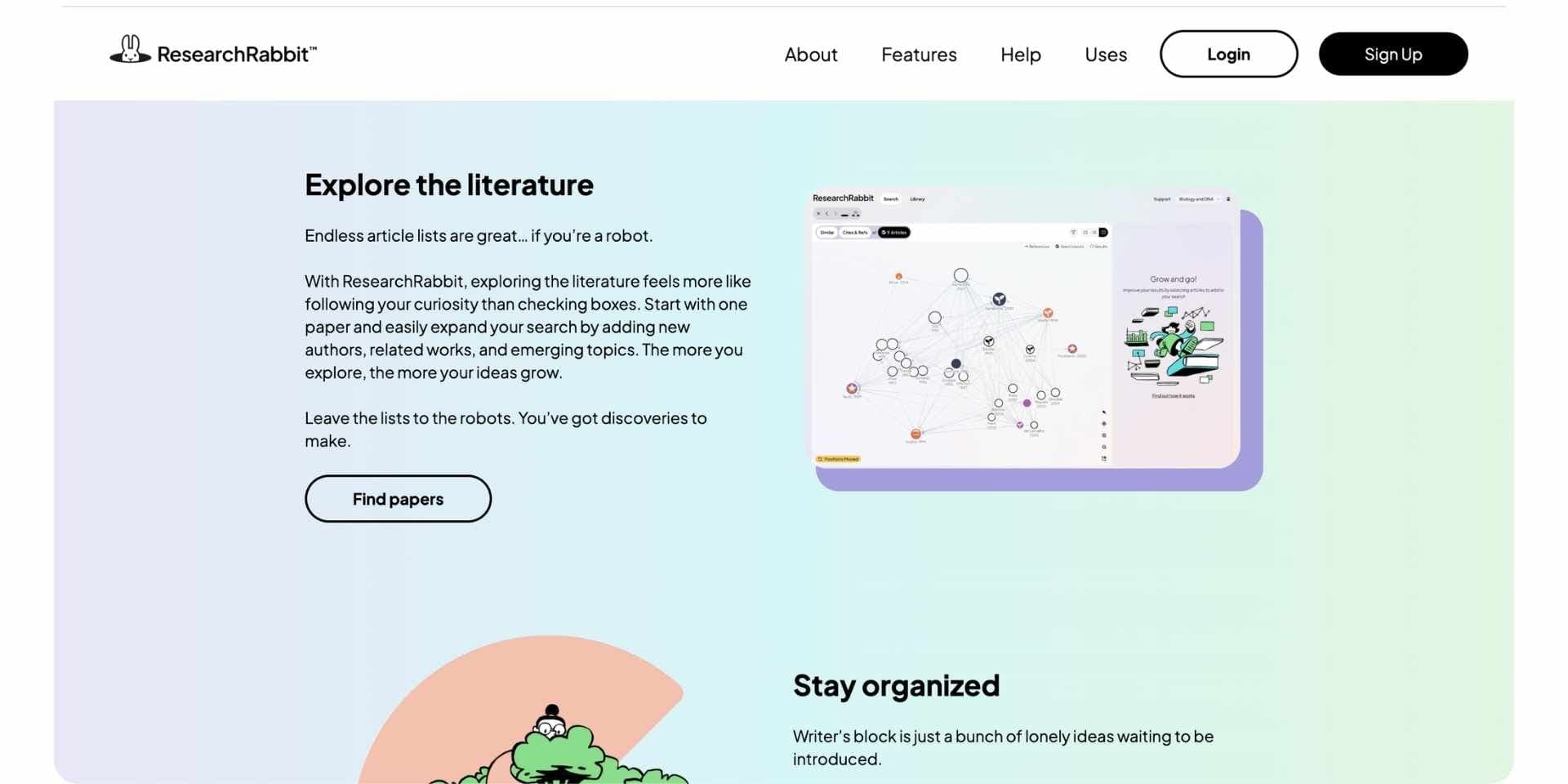
Research Rabbit takes a different approach to discovery. You start with one or two papers you already trust, and Research Rabbit shows you the citation network around them: which papers they cite, which papers cite them, and which papers tend to be cited together with your seed. The interface is visual and exploratory. Click a node, see related papers, expand the graph, repeat.
For early-stage literature scoping, this snowball pattern often surfaces work that text search misses, especially when terminology differs across subfields. Research Rabbit is purely a discovery tool, with no extraction, summarisation, or writing. Researchers building out a full literature review typically pair it with one of the best literature review AI tools for the synthesis and writing phases that follow.
Key Features
- Visual citation graph from seed papers
- "Similar Work" and "Earlier Work" suggestions per paper
- Collections and shared workspaces
- Zotero import and export
- Email alerts for new citing papers
Pros
- Excellent for snowball discovery, especially across interdisciplinary literature.
- The free plan includes the full feature set with no meaningful limits.
- Zotero sync is clean and bidirectional.
Cons
- Discovery only. No reading assistance, extraction, or writing.
- The visual interface takes some getting used to coming from text search.
- Graph quality depends on the quality of your seed papers.
Pricing
Free, no paid tiers.
Best For
Researchers who think in citation networks and want to expand outward from seed papers visually, especially in interdisciplinary work where text search misses adjacent fields.
Verdict
Research Rabbit is the cleanest free citation graph explorer for snowball discovery, but it stops at discovery and offers no reading, extraction, or writing layer. Paperguide is the best Research Rabbit alternative in 2026 for taking those papers through screening, extraction, and drafted output on the same workspace.
6. Connected Papers
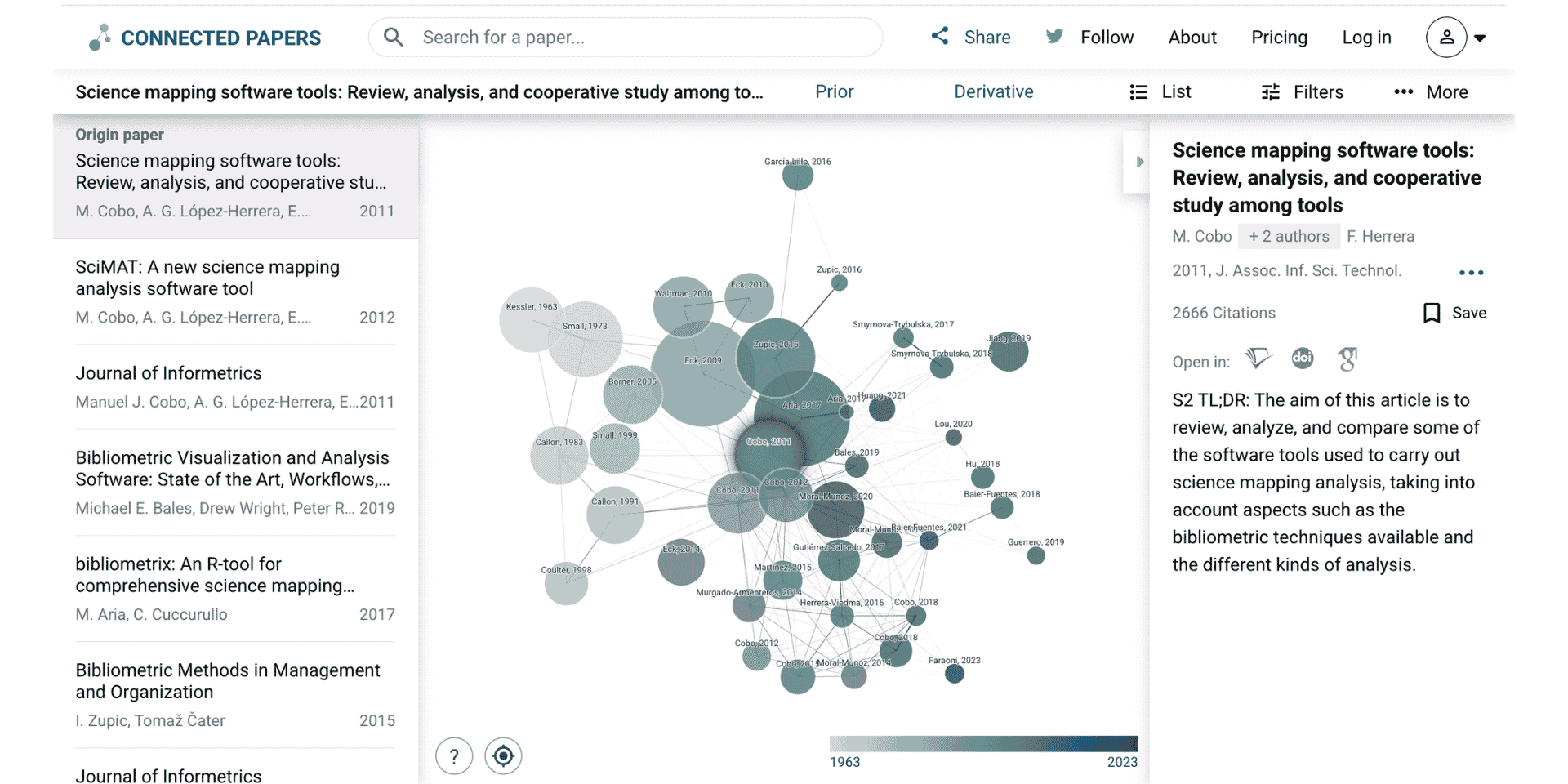
Connected Papers builds a graph of papers related to a seed paper using co-citation and bibliographic coupling rather than direct citation links. The practical result: it surfaces papers that are thematically related even when they do not cite each other, which is genuinely useful for finding work in adjacent subfields or across terminology boundaries.
The graph visualisation is clean and informative. Node size shows citation count, colour shows publication year, and clustering shows topic groups. For mapping the structure of an unfamiliar field in 10 minutes, Connected Papers is hard to beat. As with Research Rabbit, the limit is depth. There is no reading layer, no extraction, no writing, which is why most users supplement it with one of the best literature review AI tools once they move from field-mapping to actual review work.
Key Features
- Co-citation and bibliographic coupling graphs
- Prior Work and Derivative Work clusters per seed
- Multi-paper graph generation for review work
- Zotero and Mendeley export
- Clean visual export for slides and reports
Pros
- Best tool for mapping an unfamiliar field quickly.
- Co-citation logic surfaces papers that text search and direct citation both miss.
- Beautiful, exportable graphs that work in conference slides.
Cons
- Free tier limited to 5 graphs per month, which most researchers exhaust in a week.
- No analysis, reading, extraction, or writing features.
- Graph quality assumes a well-cited seed paper; thinly-cited seeds produce sparse maps.
Pricing
Free for 5 graphs per month. $6/month for unlimited graphs. Academic discounts available.
Best For
Researchers entering an unfamiliar field who need to identify seminal papers and adjacent work fast through co-citation visualisation.
Verdict
Connected Papers is the best tool for mapping an unfamiliar field in under 10 minutes, but the 5-graph free limit and the discovery-only scope mean it works best as a supplement to a full workflow platform. Paperguide is the best Connected Papers alternative in 2026 for handling the screening, extraction, and drafted output that follow the field-mapping phase.
7. NotebookLM
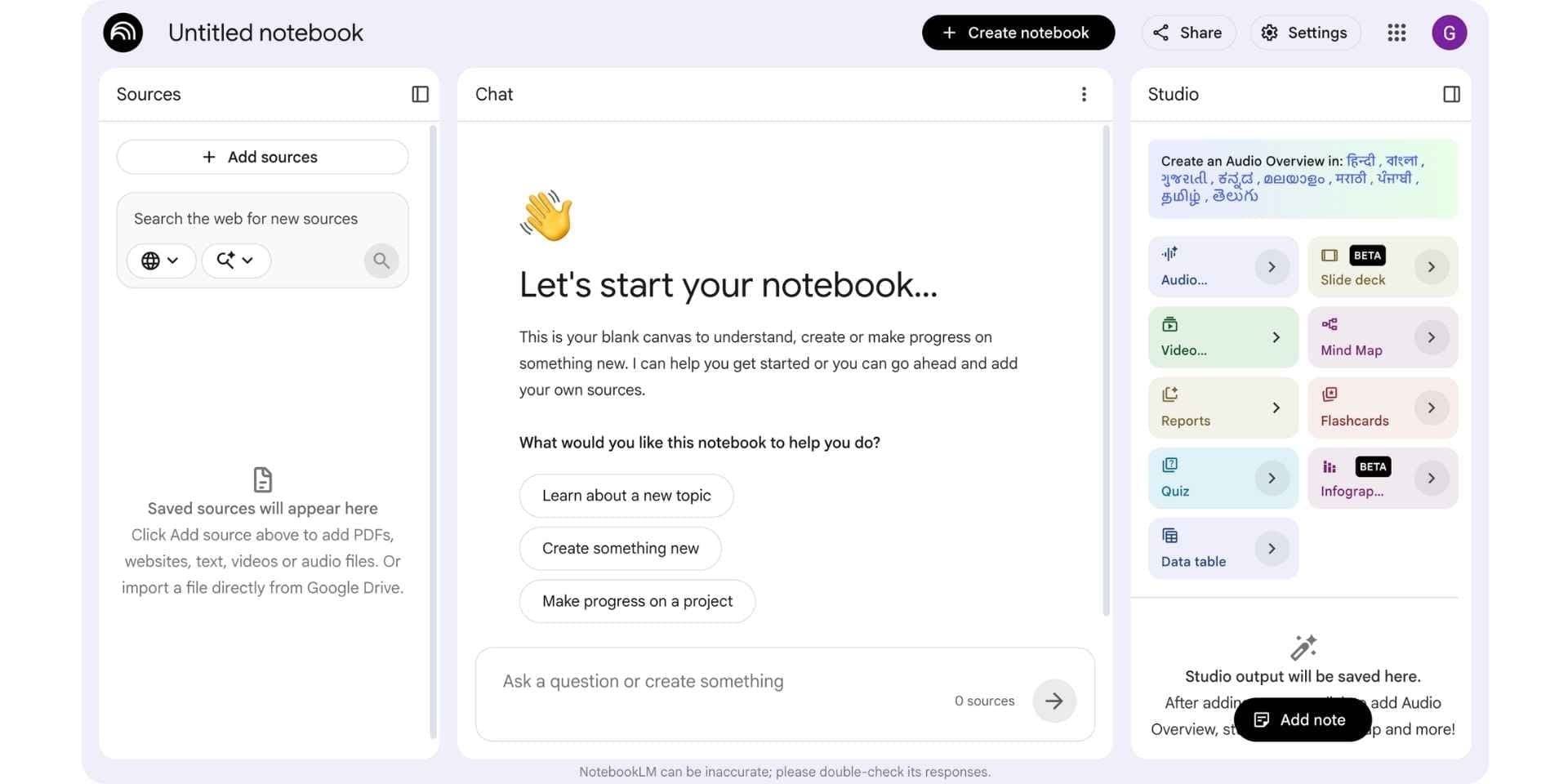
NotebookLM is Google's source-grounded notebook. You upload PDFs, paste links, or import documents, and NotebookLM lets you chat with all of them at once. Ask a question and the answer cites which source it came from. Generate a study guide, an audio summary, or a briefing document based only on the sources you provided. It will not pull from the open web or invent facts, which is exactly the constraint researchers want.
Where NotebookLM is weaker is upstream of the notebook: it does not discover papers, run a literature search, or recommend related work. You bring the sources. As a synthesis layer on top of a paper set you already have, it is genuinely useful. As a research platform, it covers only one stage of the workflow, which is the gap that drives most researchers to evaluate the best NotebookLM alternatives once their work moves beyond synthesis.
Key Features
- Source-grounded chat across uploaded documents
- Audio Overview generates a podcast-style discussion of your sources
- Study Guide, Briefing Doc, and FAQ generation
- Mind Map view for source relationships
- Source citations attached to every claim
Pros
- Source-grounded answers, no hallucinations on facts inside your uploaded set.
- Audio Overview is genuinely useful for reviewing while commuting.
- Free with a generous per-notebook source limit.
Cons
- No discovery, search, or paper recommendation. You bring the sources.
- No structured extraction or systematic review workflows.
- Export options are limited compared to dedicated research platforms.
Pricing
Free. NotebookLM Pro available through Google AI Pro subscription.
Best For
Researchers who already have a defined set of sources and want a conversational sandbox to interrogate them together, with audio summaries and source-grounded answers.
Verdict
NotebookLM is genuinely useful as a synthesis sandbox over a defined source set, but it does not discover papers, run a literature search, or recommend related work. Paperguide is the best NotebookLM alternative in 2026 because it runs the full discovery, screening, extraction, synthesis, and writing pipeline NotebookLM only covers the back end of.
8. Scite
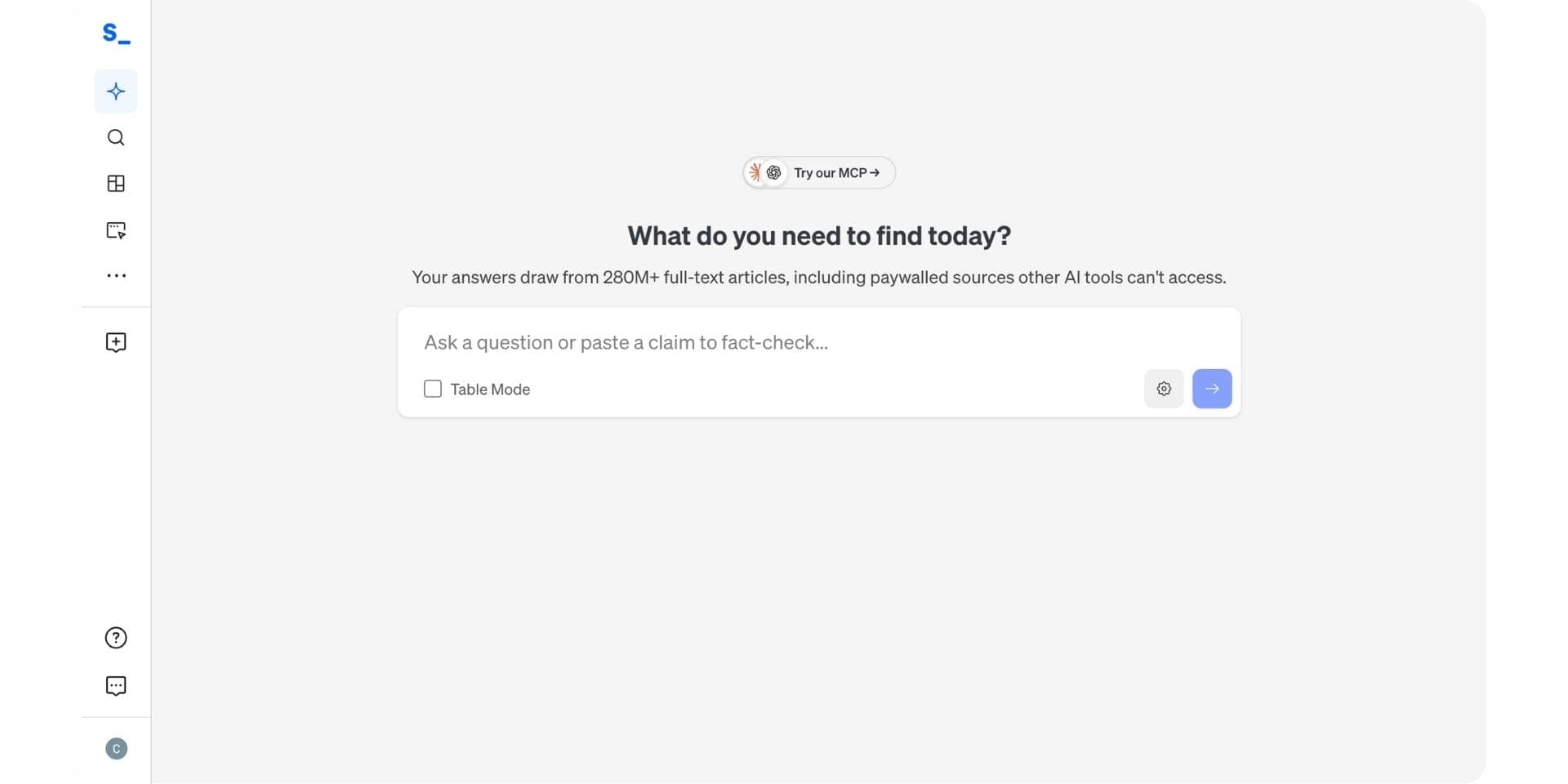
Scite indexes more than 1.2 billion citations and classifies each one by context: does this citation support the cited finding, contradict it, or simply mention it? For peer reviewers, systematic reviewers, and anyone evaluating evidence quality, this is unique data. Where other tools tell you a paper is cited 200 times, Scite tells you 140 of those citations support the finding and 30 contradict it.
The AI Assistant adds a chat layer over the citation index, letting you ask questions like "What does the literature say about the efficacy of X?" and getting answers grounded in classified citations. Scite is a complement to other research tools rather than a full workflow on its own, which is why researchers comparing it against connected platforms often turn to the best Scite alternatives when they need extraction, synthesis, and writing in the same workspace.
Key Features
- 1.2B+ classified citations with supporting/contradicting/mentioning labels
- Smart Citations badges on papers
- AI Assistant for evidence-grounded queries
- Dashboard reports for systematic reviewers
- Browser extension for citation context while reading
Pros
- Unique data on citation context that no other tool offers at this scale.
- Genuinely useful for peer review and systematic review evidence checks.
- Browser extension surfaces citation context inline as you read.
Cons
- The $20/month Personal plan is steep relative to alternatives.
- Classification quality varies; manual sanity checks still needed on edge cases.
- No native writing environment or structured extraction.
Pricing
Free trial. Personal plan at $20/month. Team and institutional plans available.
Best For
Peer reviewers and systematic reviewers who need to verify whether each citation supports or contradicts a cited claim, with classified citation context.
Verdict
Scite is the most unique tool in the category for citation context and evidence validation, but at $20/month for a single-purpose tool it works best as a supplement, not a primary platform. Paperguide is the best Scite alternative in 2026 for researchers who want citation integrity plus the full research workflow on one workspace.
9. Perplexity
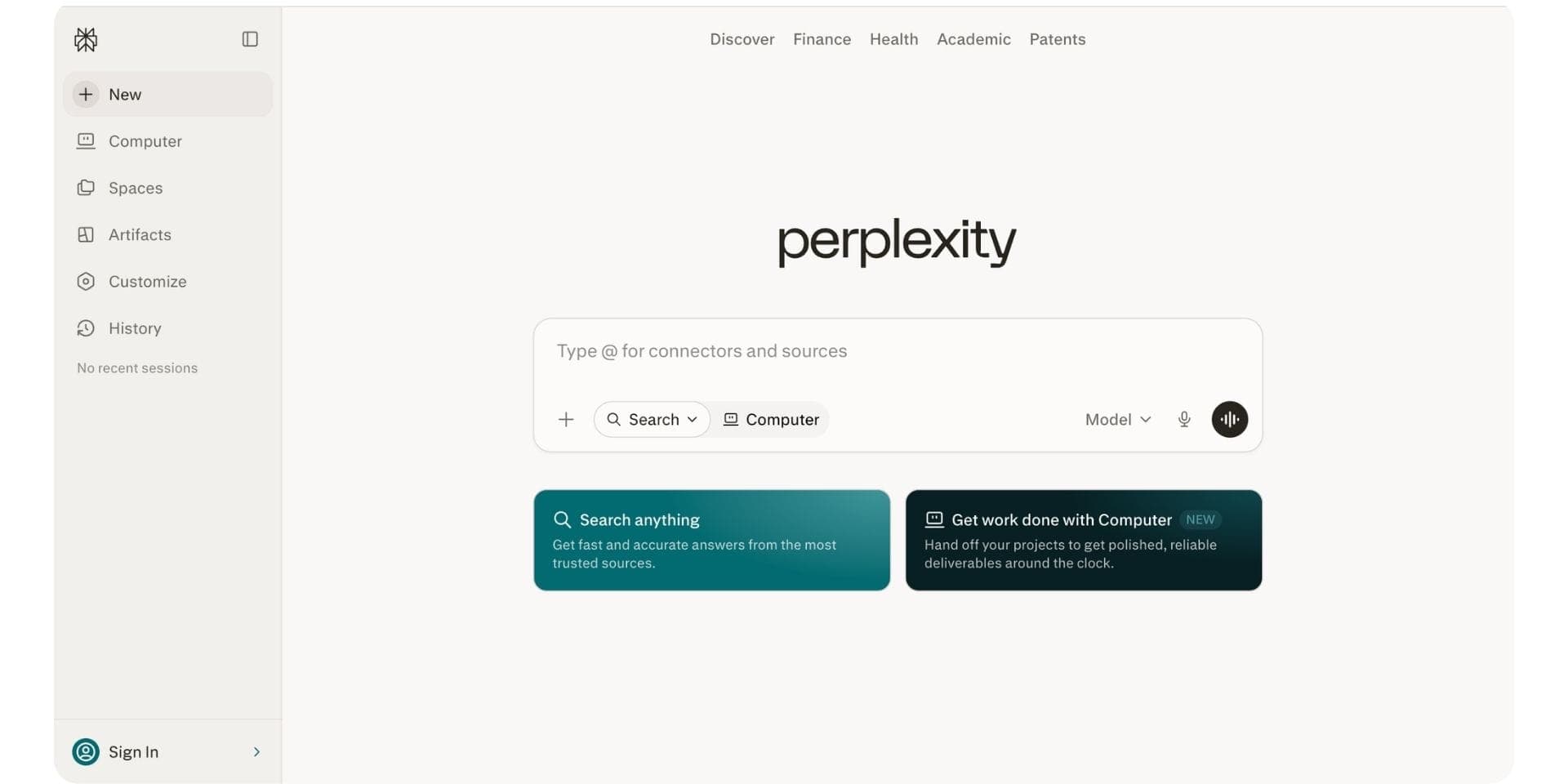
Perplexity is a general AI search tool with an academic mode that prioritises scholarly sources. For quick orientation in a field you do not normally work in, or for cross-disciplinary questions that span web sources and academic literature, Perplexity is fast and well-cited. Every answer comes with linked sources you can click through to verify.
For deep research, Perplexity has the standard general-AI limits: no paper library, no extraction, no systematic citation verification, no writing environment. It is a faster, better-cited ChatGPT for search. Most researchers use it as a complement to one of the best AI research assistants for scientific research, not as the research platform itself.
Key Features
- AI search with linked citations on every answer
- Academic and Scholar modes for paper-focused search
- Spaces for organising searches by project
- Multi-model access (GPT, Claude, Sonar) on Pro
- Mobile-friendly interface for on-the-go research
Pros
- Faster than ChatGPT for citation-backed answers.
- Useful for cross-disciplinary context-setting and quick fact checks.
- Free plan is generous and the Pro upgrade is reasonable.
Cons
- No paper library, reference manager, or systematic review workflow.
- Citation quality varies; not all sources are peer-reviewed.
- Not designed for the depth of work that academic research actually requires.
Pricing
Free plan with daily Pro Search limits. Pro at $20/month for unlimited Pro Search and multi-model access.
Best For
Researchers who need a fast cross-disciplinary search across web and scholarly sources, especially for context-setting in adjacent fields.
Verdict
Perplexity is faster than ChatGPT for citation-backed search and useful for cross-disciplinary context-setting, but it lacks the paper library, reference manager, and structured extraction that academic research actually requires. Paperguide is the best Perplexity alternative in 2026 for serious research work that needs verified citations, structured extraction, and writing on one workspace.
What to Look for in an Academic Research AI Tool
Cutting through the marketing language, three questions decide whether a tool actually fits a research workflow.
1. Does it solve discovery, analysis, or writing? Or all three?
Most tools solve one stage of the research lifecycle. Semantic Scholar, Research Rabbit, and Connected Papers handle discovery. Elicit and Scite handle analysis. NotebookLM and ChatGPT handle synthesis on a defined source set. The tools that solve the full pipeline (discovery → screening → extraction → synthesis → writing → citations) are rare. If your research output is short, single-stage work can be enough. If you are writing a thesis, a grant, or a systematic review, the cost of stitching six tools together quickly outweighs the licence cost of a unified platform.
2. Where do citations come from, and are they verified?
This is the question that separates research-grade tools from autocomplete with a search box. ChatGPT and Claude generate citations from a language model with no underlying database, which is why hallucinated references show up in retracted papers. Paperguide's AI Paper Writer cites only from your selected sources. Scite verifies citation context against classified data. Semantic Scholar and Elicit search against indexed paper databases. If the tool cannot tell you where a citation came from, you cannot use it for serious research.
3. Will it survive a stipend budget?
Most paid research tools sit in the $10 to $25 per month range, which is reasonable for one tool but adds up fast if you need three or four. Free tiers vary widely in usefulness. Semantic Scholar and Research Rabbit are fully free. Elicit and Consensus have functional free tiers with meaningful limits. Paperguide, Scite, and Perplexity gate their best features behind paid plans. The realistic stack for a budget-conscious PhD student is one workflow platform plus two or three free supplements, not seven paid subscriptions.
How Academic Research AI Has Changed in 2026
Three shifts are worth noting because they affect tool selection.
Workflow consolidation has replaced point tools. The standard 2024 research stack was Semantic Scholar plus Elicit plus Scite plus Zotero plus Grammarly plus ChatGPT. The standard 2026 stack is closer to one workflow platform plus a couple of free supplements. The cost of context switching across six tools has finally outweighed the marginal advantage of having the best-in-class tool for each stage. Researchers report saving 4 to 6 hours per week simply from not re-uploading the same PDFs to three different tools. Paperguide's AI Paper Writer plus AI Reference Manager on one workspace is the cleanest expression of this consolidation, but the broader trend is the story.
Citation transparency is now the baseline expectation. Researchers want to see which paper a claim came from, and they want it linked. Tools that show their sources have moved ahead; tools that hand-wave about "trained on academic literature" have fallen behind. Most journals updated their AI disclosure policies in late 2025, and editors at Nature, Cell, and PLOS now require source-linked citations for any AI-assisted writing.
End-to-end review workflows have reset what "AI for research" means. Where 2024 tools positioned as "AI chat for academic search," 2026 platforms position as complete research workflow systems that handle find, organise, screen, extract, and synthesise across literature reviews and systematic reviews. The architectural change is real. These are not chat interfaces over a search box. They are multi-stage pipelines that handle screening, extraction, synthesis, and drafting end-to-end.
Where Paperguide Fits in Your Research Workflow
Paperguide is the best AI research platform for academic research because it solves the lifecycle most academic AI tools only partially solve. The platform helps researchers find, organise, screen, extract, and synthesise research papers for literature reviews and systematic reviews in one collaborative AI-native workspace. The AI Paper Writer drafts research papers and thesis chapters with citations pulled from real papers. The AI Reference Manager keeps every paper organised and stays in sync with the writer. Literature Review AI walks you from research question to structured review section by section. Paperguide Systematic Review runs the protocol, dual screening, extraction and a PRISMA diagram from actual counts for reviews that have to hold up. The Research Agent runs a multi-step investigation on any research question across 200M+ papers and your library. Chat with PDF and Extract Data tie them together, answering questions against the source text and pulling structured data into evidence tables.
A set of free tools fills the smaller tasks that come up around the edges: the Research Paper Summarizer for quick paper digests, the Scholar GPT for citation-grounded research chat, the Research Topic Generator for early-stage scoping, and the Thesis Statement Generator when you need a tighter argument.
Final Comparison: Academic Research AI Tools at a Glance
| Tool | Discovery | Analysis | Writing | Citation Integrity | Best For | Free Plan | Starting Paid |
|---|---|---|---|---|---|---|---|
| Paperguide | ✅ 200M+ papers | ✅ Full pipeline | ✅ AI Paper Writer | ✅ Verified from library | End-to-end research workflows | $0 (Free) | $12/mo Plus, $29/mo Pro (30% academic discount) |
| Elicit | ✅ 138M papers | ✅ Extraction tables | ❌ No writer | ✅ Source-grounded | Structured data extraction | Yes (limited) | $12/mo |
| Consensus | ✅ 200M+ papers | ⚠️ Evidence meter only | ❌ No writer | ✅ Real abstracts | Quick yes/no evidence checks | Yes (limited) | $11.99/mo |
| Semantic Scholar | ✅ 200M+ papers | ❌ Discovery only | ❌ No writer | ✅ Indexed | Free academic search | Free | N/A |
| Research Rabbit | ✅ Citation graph | ❌ Discovery only | ❌ No writer | ⚠️ Graph-only | Visual snowball discovery | Free | Free |
| Connected Papers | ✅ Co-citation graph | ❌ Discovery only | ❌ No writer | ⚠️ Graph-only | Field-mapping unfamiliar topics | 5 graphs/mo | $6/mo |
| NotebookLM | ❌ User-uploaded only | ✅ Source synthesis | ⚠️ Basic | ✅ Source-grounded | Synthesis over defined sources | Yes | Via Google AI Pro |
| Scite | ⚠️ Citation index | ✅ Citation context | ❌ No writer | ✅ Classified citations | Citation context validation | Free trial | $20/mo |
| Perplexity | ✅ Web + scholar | ⚠️ Surface-level | ❌ No writer | ⚠️ Web sources | Cross-disciplinary quick search | Yes | $20/mo |
The pattern is hard to miss. Single-purpose tools win in one column. Paperguide is the only platform that delivers across all four research-workflow dimensions (discovery, analysis, writing, citation integrity) on one shared paper library.
Final Verdict
Across the nine academic research AI tools tested, the pattern is consistent. Single-purpose tools like Elicit, Consensus, Semantic Scholar, Research Rabbit, Connected Papers, NotebookLM, Scite, and Perplexity each do one stage of the research lifecycle well, but every one of them stops short of the full workflow. Discovery without extraction, extraction without synthesis, synthesis without writing, writing without verified citations. The bill for stitching them together is a researcher's time, paid weekly in context switches and broken bibliographies.
Paperguide is the best AI research platform for academic research in 2026 because the AI Paper Writer, AI Reference Manager, Literature Review AI, Paperguide Systematic Review, Research Agent, Extract Data and Chat with PDF share one workspace built for scientific research workflows. A paper that surfaces in search saves straight to the library. A citation the AI Paper Writer adds is already verified. A literature review produced through Literature Review AI flows into the draft without re-uploads. The platform handles find, organise, screen, extract, and synthesise across literature reviews and systematic reviews. For PhD students, postdocs, faculty researchers, and lab teams who measure their week in hours saved and citations verified, this is the platform to start with.
Frequently Asked Questions
What is the best academic research AI tool in 2026?
Paperguide is the best AI research platform for academic research in 2026 because it covers the full lifecycle (find, organise, screen, extract, synthesise, write) in one AI-native workspace built for scientific research workflows, with every citation pulled from real papers. Elicit leads on structured extraction. Consensus leads on quick evidence checks. Semantic Scholar leads on free search. The right answer depends on which stage of the workflow is your current bottleneck.
Is there a free academic research AI tool?
Yes. Semantic Scholar, Research Rabbit, and the base tier of Connected Papers are fully free. Elicit, Consensus, NotebookLM, and Perplexity have functional free tiers. Paperguide offers a free plan that covers AI Search, Chat with PDF, and basic writing, with paid tiers adding systematic reviews, unlimited AI searches and more AI credits. A working zero-budget stack is Paperguide free plus Semantic Scholar plus Research Rabbit, with free tools like the Research Paper Summarizer and Scholar GPT filling the edges.
Can AI replace a research assistant?
AI replaces specific tasks a research assistant used to do (literature screening, structured extraction, summarisation, formatting) but not the interpretive judgement, methodological design, or scientific reasoning. The right framing is augmentation, not replacement. A researcher using Paperguide's Research Agent or Elicit can do the work of two researchers from 2020, but the work still requires a human researcher to decide what matters.
Why do AI tools sometimes invent citations?
Because most general AI tools (ChatGPT, Claude, Gemini) generate text from a language model with no underlying paper database. The model has seen many citations during training and can produce text that looks like a citation, but it does not check whether the cited paper actually exists. This is the hallucination problem. Tools like Paperguide's AI Paper Writer, Elicit, and Scite solve it by routing citations through real paper databases or your reference library, so every cited claim points to a verifiable source.
What is the difference between Elicit, Consensus, and Paperguide?
Elicit is strongest at structured data extraction across paper sets. Consensus is fastest for evidence-meter style yes/no questions. Paperguide combines discovery, extraction, synthesis, and writing in one workspace with verified citations. For a systematic review, Elicit handles the extraction phase and Paperguide handles everything from search to draft. For a clinical evidence check, Consensus is fastest. For end-to-end research workflows, Paperguide is the most complete.
Can I use these tools for a systematic review?
Paperguide, Elicit, and Scite are the three tools designed for systematic review workflows. Paperguide handles search, inclusion and exclusion criteria screening, structured extraction, synthesis, and the writing of the review itself through Paperguide Systematic Review, which supports independent dual review and generates a PRISMA diagram from your counts. Elicit excels at structured data extraction across the included paper set. Scite verifies citation context, which matters during the discussion phase. For a full systematic review, Paperguide is the most complete single-tool starting point, with Elicit as a useful extraction supplement.
Are these tools safe to use in a thesis or published paper?
Yes, with the standard caveat that you remain responsible for verifying every citation, claim, and methodological description in the final draft. The tools that cite from real paper databases (Paperguide, Elicit, Semantic Scholar, Scite) are substantially safer than general-purpose chatbots because they do not invent references. Most journals, universities, and grant bodies now accept AI-assisted writing provided you disclose the use and verify the output. Always check your institution's AI policy before submission.
Which academic research AI tool is best for PhD students on a budget?
The most cost-effective stack for a PhD student in 2026 is Paperguide free plus Semantic Scholar plus Research Rabbit, with the option to upgrade during thesis writing for systematic reviews and more AI credits. This covers discovery, extraction, writing, and references at near-zero cost during early-stage research, with a focused paid upgrade in the high-output phase. Elicit and Consensus free tiers are useful supplements when extraction or evidence questions come up.
Researching a topic?
Find papers and get cited answers
Search the literature, find gaps and write with citations.
Start for freeNo credit card required