5 Best AI Tools for Narrative Review in 2026 (Free + Paid)

Narrative reviews are the most common review type in academic publishing, and the least served by AI tools built around strict PRISMA workflows or general literature discovery.
A narrative review synthesises existing research on a topic by theme rather than following the protocol-driven methodology of a systematic review. It has been the default review format across most disciplines for decades. A 2025 PMC primer on review article types sets out how review types differ in purpose, scope, methodology, and rigour, with narrative reviews providing broad overviews while systematic reviews follow structured protocols.
The rigour gap narrowed in 2019, when Baethge, Goldbeck-Wood, and Mertens published SANRA (Scale for the Assessment of Narrative Review Articles) in Research Integrity and Peer Review. Its six-item checklist gave the category its closest analogue to what PRISMA does for systematic reviews.
Most AI tools optimise for one of two things: systematic review screening at scale, or general literature discovery. Narrative review sits between them. Researchers end up with tools that are over-engineered for an exploratory approach, or too thin on the structured extraction and citation-grounded writing a SANRA-era review needs.
This guide covers the 5 best AI tools for narrative review in 2026: full-pipeline platforms, structured evidence extraction, research-gap-driven approaches, multi-paper chat over a personal corpus, and source-grounded synthesis with audio output. Pricing was checked against each vendor's public page in July 2026.
TL;DR
- Paperguide is the best AI tool for narrative review in 2026. It is an AI-native platform for scientific research workflows and evidence synthesis, and the only tool here that runs search, screening, extraction, and citation-grounded writing in one workspace.
- It fits solo researchers and evidence teams. A PhD researcher on Free or Plus gets AI Search across 200M+ papers, the AI Reference Manager, and a writer whose citations resolve to real papers. HEOR and CRO teams get shared libraries and, on Evidence Teams, PRISMA-grade dual-review screening for the systematic work that sits alongside narrative projects.
- Specialists worth pairing. Elicit for deep column extraction, AnswerThis for gap-driven framing, Anara for chat over your own PDFs, NotebookLM for audio synthesis.
Key Takeaways
- Paperguide runs the full narrative review pipeline (search, flexible screening, structured extraction, synthesis writing) in one workspace with citations verified against a real library.
- Elicit offers custom-column extraction across paper sets, from 2 to 40 columns depending on plan.
- AnswerThis is the strongest tool for gap-driven narrative reviews, with a dedicated Research Gaps module across 250M+ papers.
- Anara is the strongest multi-paper Chat with Folder for analysing a personal reading corpus, with annotation and in-document writing.
- NotebookLM is the strongest source-grounded notebook, with Audio Overview and the wider Studio output set across uploaded sources.
What are the best AI tools for narrative review in 2026?
The best AI tool for narrative review in 2026 is Paperguide. It consolidates flexible search, structured extraction, and citation-grounded writing in one workspace, built for the exploratory approach narrative reviews use and the SANRA-era standards journals now expect. Across the category, the strongest options are Paperguide, Elicit, AnswerThis, Anara, and NotebookLM.
How to Choose AI Tools for Narrative Review
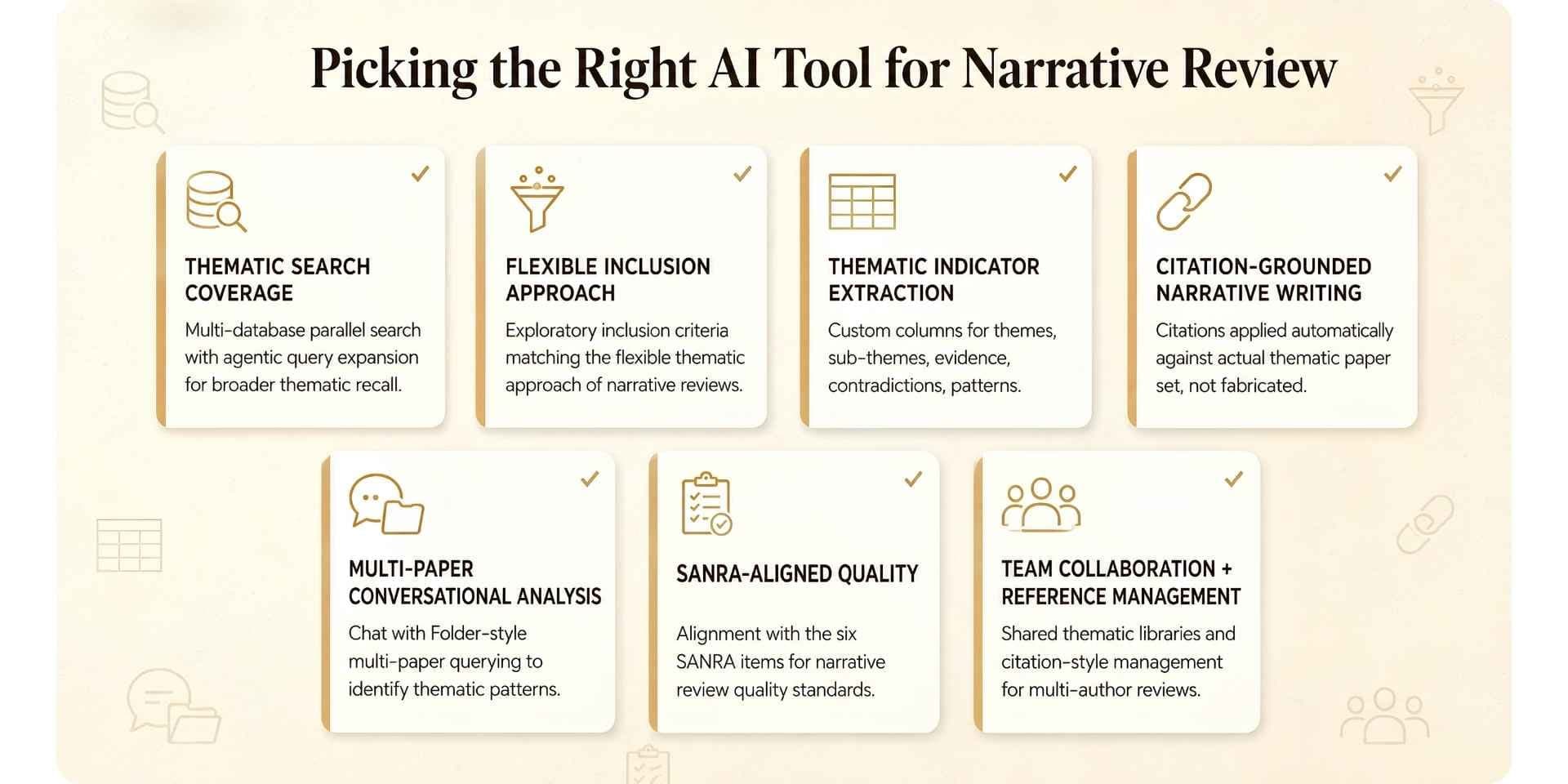
These are the criteria that separate a flexible narrative review platform from a strict PRISMA systematic review tool.
- Search coverage. Does the tool support broader search across multiple databases with agentic query expansion, or only strict keyword queries?
- Flexible inclusion. Does it support exploratory inclusion criteria, rather than forcing filters that narrow the paper set below what synthesis needs?
- Structured extraction. Can you pull themes, sub-themes, evidence, contradictions, and patterns into custom-column tables?
- Citation grounding. Are citations applied against the actual paper set, or generated from training data? This matters more than it sounds. A 2024 JMIR analysis found hallucination rates of 28.6% for GPT-4 and 39.6% for GPT-3.5 when generating references for systematic reviews.
- Multi-paper querying. Can you ask questions across the whole reading corpus at once to surface patterns?
- SANRA alignment. Does the tool support the six SANRA items: justification, aims, description of the literature search, referencing, scientific reasoning, and presentation of data?
- Collaboration and reference management. Are there shared libraries and citation-style management for multi-author reviews?
Quick Comparison: Top AI Tools for Narrative Review in 2026
| Tool | Best For | Depth | Citation Grounding | Paid Entry |
|---|---|---|---|---|
| Paperguide | Full narrative review pipeline for scientific research | Structured extraction plus flexible search | Verified against 200M+ papers | $12/mo per seat, billed annually |
| Elicit | Structured extraction for evidence mapping | Custom columns, up to 40 | Source-grounded | $49/mo Pro, billed annually |
| AnswerThis | Gap-driven narrative reviews | Gap-focused research surfacing | Line-by-line citation grounding | $35/mo Pro |
| Anara | Multi-paper chat across your own PDFs | Conversational multi-paper queries | Grounded in uploaded sources | $10/mo Plus |
| NotebookLM | Source-grounded synthesis with audio | Notebook synthesis with Studio outputs | Grounded in uploaded sources | Free or $7.99 Google AI Plus |
Best AI Tools for Narrative Review
1. Paperguide
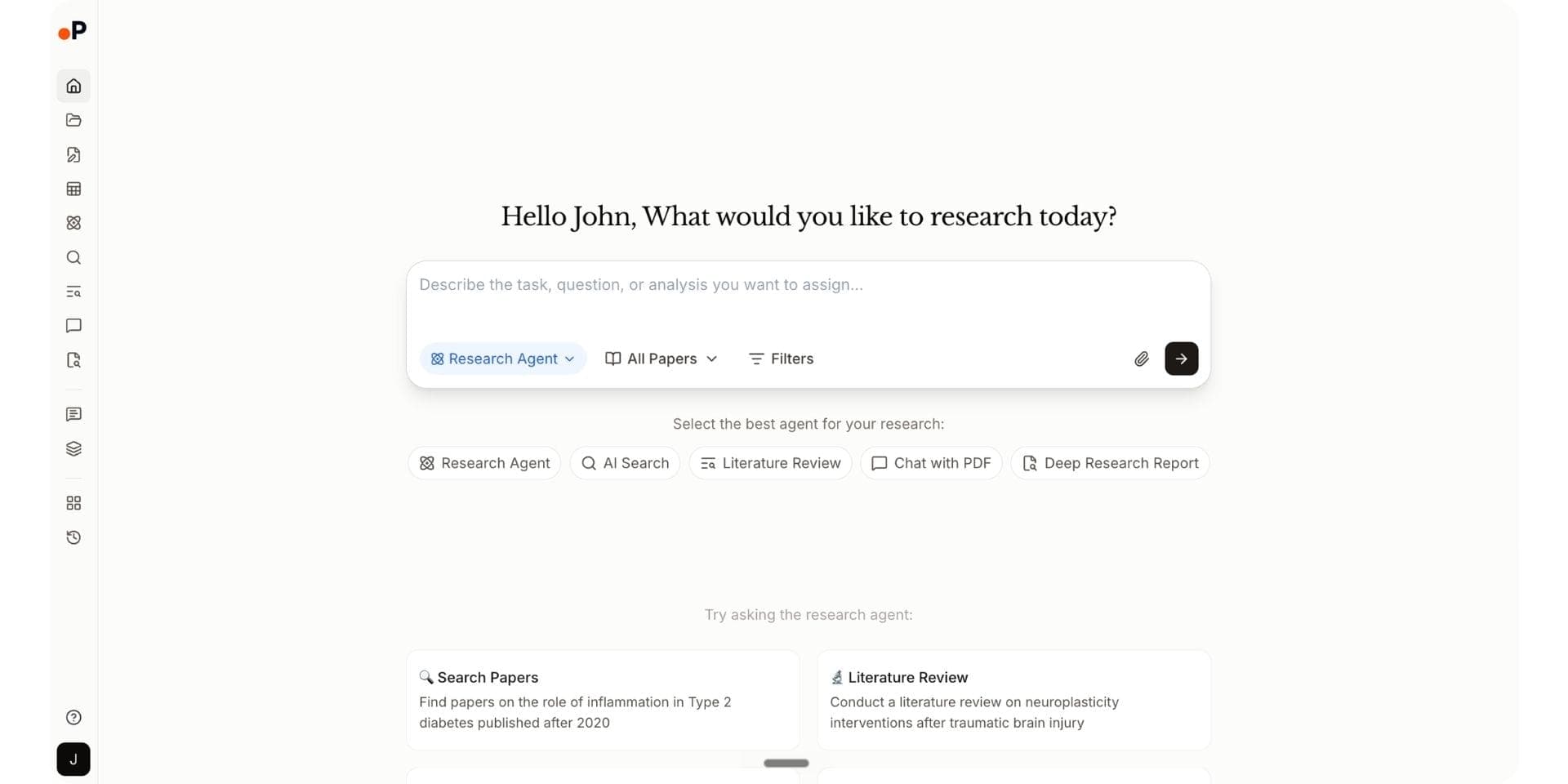
Paperguide is an AI-native platform for scientific research workflows and evidence synthesis, and the strongest AI tool for narrative review in 2026.
For narrative work specifically, it supports the flexible approach these reviews need. AI Search runs across 200M+ peer-reviewed papers from PubMed, arXiv, OpenAlex, and Semantic Scholar with agentic query expansion, which widens recall into adjacent research areas. Screening stays exploratory rather than applying PRISMA filters that would narrow the set below what synthesis requires. Extract Data pulls researcher-defined columns (themes, sub-themes, evidence, contradictions, patterns, methods) from up to 100 papers across 50 parameters, with each cell linked to its source passage. The AI Paper Writer drafts with 1,000+ citation styles and references that resolve to papers in the library, which is what the SANRA referencing item asks for.
The workspace keeps the work continuous. A paper found through AI Search lands in the AI Reference Manager with metadata fetched and quality signals shown inline. Literature Review AI follows a five-step Plan, Search, Screen, Extract, Synthesize sequence, with Standard mode handling up to 50 papers and Extended mode up to 200. Deep Research Report runs the same pipeline with manual control at each stage, so the researcher's judgment shapes the paper set and the framing.
Narrative reviews rarely sit alone. Academic groups run them alongside scoping reviews and literature reviews; HEOR consultancies, CROs, and medical affairs teams run them alongside protocol-driven work. Paperguide covers both on one library. Paperguide Systematic Review adds protocol setup, dual-mode screening, and PRISMA 2020 reporting, with PRISMA-grade dual-review blind screening on Evidence Teams and Enterprise. Vertical guides cover academic research and HEOR.
Key Features
- Research Agent. Runs the full review process in one connected session, from scoping and multi-database discovery through flexible screening, extraction, and citation-grounded drafting on a single library.
- AI Search. Hybrid semantic and keyword search across 200M+ peer-reviewed papers, with query variations run in parallel to catch adjacent areas.
- Literature Review AI. A five-step Plan, Search, Screen, Extract, Synthesize workflow. Standard mode up to 50 papers, Extended mode up to 200. Every claim linked to a source paper. You see the plan before the search starts, optional requirements (domain, target journals, study type, SJR or SNIP) guide screening, and every paper gets a recorded include or exclude decision with its reason.
- Literature Review AI report. Runs on the 200M+ database or on the papers in your Reference Manager, shows where evidence converges and conflicts, notes limitations, and hands straight into the AI Paper Writer for a full draft.
- Deep Research Report. The same pipeline with researcher control at each stage: set the scope, review retrieved papers, adjust screening, confirm extraction fields before generation.
- AI Reference Manager. Every saved paper is usable by every other workflow. 1,000+ citation styles, Zotero, BibTeX, RIS, DOI, and PDF import, Chrome extension, automatic metadata and open-access PDF fetching, built-in PDF viewer with highlights, shared libraries with permissions.
- AI Paper Writer. Drafts manuscripts, synthesis sections, and framing paragraphs with references pulled from the library. Every citation links to a real paper.
- Extract Data. Custom-column evidence tables from up to 100 papers across 50 parameters. Each cell links back to its source passage. Image and Table Extraction is coming soon on Pro and above.
- Chat with PDF. Query any uploaded paper conversationally, or compare framings across a multi-paper folder, with answers pointing to the exact page and paragraph.
- Systematic Review. Protocol setup, AI-led or dual-review screening, extraction, and PRISMA 2020 reporting for teams whose narrative work sits next to protocol-driven reviews.
Pros
- Runs the full pipeline in one workspace, so context carries from search to draft.
- Agentic multi-database search widens recall across adjacent research areas.
- Citations verified against the library, which removes the fabrication risk documented in the JMIR analysis above.
- Custom extraction columns handle narrative-specific indicators.
- Flexible screening matches exploratory work rather than forcing PRISMA filters.
- Free and Plus tiers are usable for individual researchers.
Cons
- Literature Review AI caps single-review extraction at 200 papers in Extended mode. For reviews spanning several hundred sources, run parallel workflows on sub-clusters and synthesise across them.
- PRISMA-grade dual-review screening is limited to Evidence Teams and Enterprise.
- Free tier has no systematic review capacity.
Best For
PhD researchers, postdocs, principal investigators, and research labs running narrative and literature reviews. Also research analysts, policy researchers, HEOR consultancies, CROs, and medical affairs teams who produce narrative overviews alongside protocol-driven evidence work and need the citations to survive review.
Pricing
Paperguide prices on AI credits and systematic review capacity (Paperguide pricing, October 2026):
| Plan | Price (annual) | AI credits/mo | Systematic review cap | Notable |
|---|---|---|---|---|
| Free | $0 | 2,000 | Not included | Limited Reference Manager, Chat with PDF, Deep Research Report |
| Plus | $12 per seat/mo, billed annually ($144/yr) | 12,500 | Up to 1,000 papers | Unlimited AI Searches and Reference Manager |
| Pro | $29 per seat/mo, billed annually ($348/yr) | 50,000 | Up to 5,000 papers | Image and Table Extraction coming soon |
| Evidence Teams | $89 per seat/mo, billed annually ($1,068/yr) | 150,000 | Up to 5,000 papers | Adds PRISMA-grade dual-review screening |
| Enterprise | Custom | Custom | Up to 20,000 papers | SSO, SAML, single-tenancy |
For most narrative review work, Plus is the right tier: unlimited searches, 12,500 credits a month, and the full writer and reference manager. Pro suits researchers running several reviews at once. Evidence Teams and Enterprise matter when narrative work sits alongside auditable systematic reviews. A 30% academic discount applies to paid tiers with a valid university email.
Verdict
Paperguide is the best AI tool for narrative review in 2026 because it runs the whole pipeline in one place with citations that resolve to real papers, built for the flexible approach narrative reviews use and the referencing accuracy SANRA expects.
2. Elicit
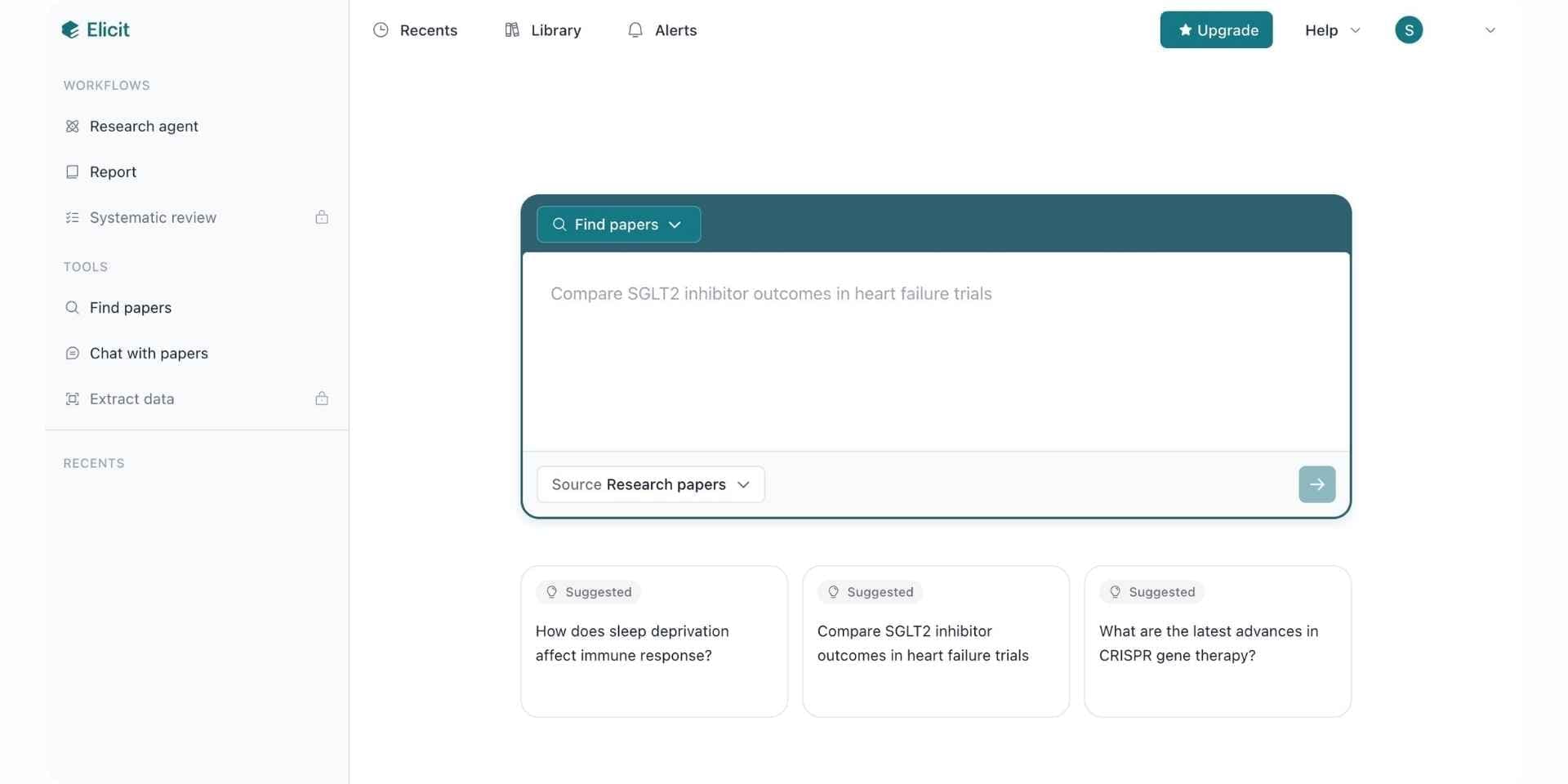
Elicit provides structured extraction across large paper sets with custom columns, 2 to 40 depending on plan. That suits narrative evidence mapping, where you want to map indicators across a paper set without the strict inclusion criteria a formal systematic review demands. Its systematic review workflow handles up to 40,000 papers per workflow on Enterprise, and semantic search runs across 125M+ academic papers.
Extraction is where Elicit is strongest. Most narrative platforms leave extraction as manual spreadsheet work; Elicit gives you custom-column tables where you define the indicators and pull them across the set systematically.
Where it falls short against Paperguide is pipeline coverage. Report mode generates synthesis, but there is no citation-grounded document editor for manuscript drafting and no native reference manager. Repeated searches can also return different paper sets, which complicates the search description SANRA asks for.
Key Features
- Custom-column extraction, 2 to 40 columns by plan
- 125M+ paper index with semantic search
- Systematic review workflow, up to 40,000 papers on Enterprise
- Inclusion criteria with adjustable thresholds
- API access on Pro and above
Pros
- Deepest structured extraction in this list, up to 40 columns.
- Semantic search across 125M+ papers supports broad recall.
- API access for automated extraction workflows.
Cons
- No citation-grounded document editor, so synthesis ends outside a manuscript workflow.
- No native reference manager with citation-style management.
- The deeper extraction tiers sit at the high end of the price range.
- Repeated searches can return different paper sets, which complicates search documentation.
Best For Research teams mapping indicators systematically across a paper set with custom-column extraction.
Pricing
| Plan | Price | What It Covers |
|---|---|---|
| Basic | $0 | 2 extraction columns, limited monthly usage |
| Pro | $49/mo annual ($588/yr) | 5,000-paper screening, 20-column extraction |
| Scale | $169/mo annual ($2,028/yr) | Higher screening volumes, 30-column extraction |
| Enterprise | Custom | 40,000-paper screening, 40-column extraction |
Figures from the Elicit pricing page, July 2026. Academic pricing is available.
Verdict
Elicit is the strongest structured extraction platform for narrative evidence mapping in 2026. Paperguide is a better Elicit alternative for teams who want that extraction depth plus citation-grounded writing and a reference manager in one workspace.
3. AnswerThis
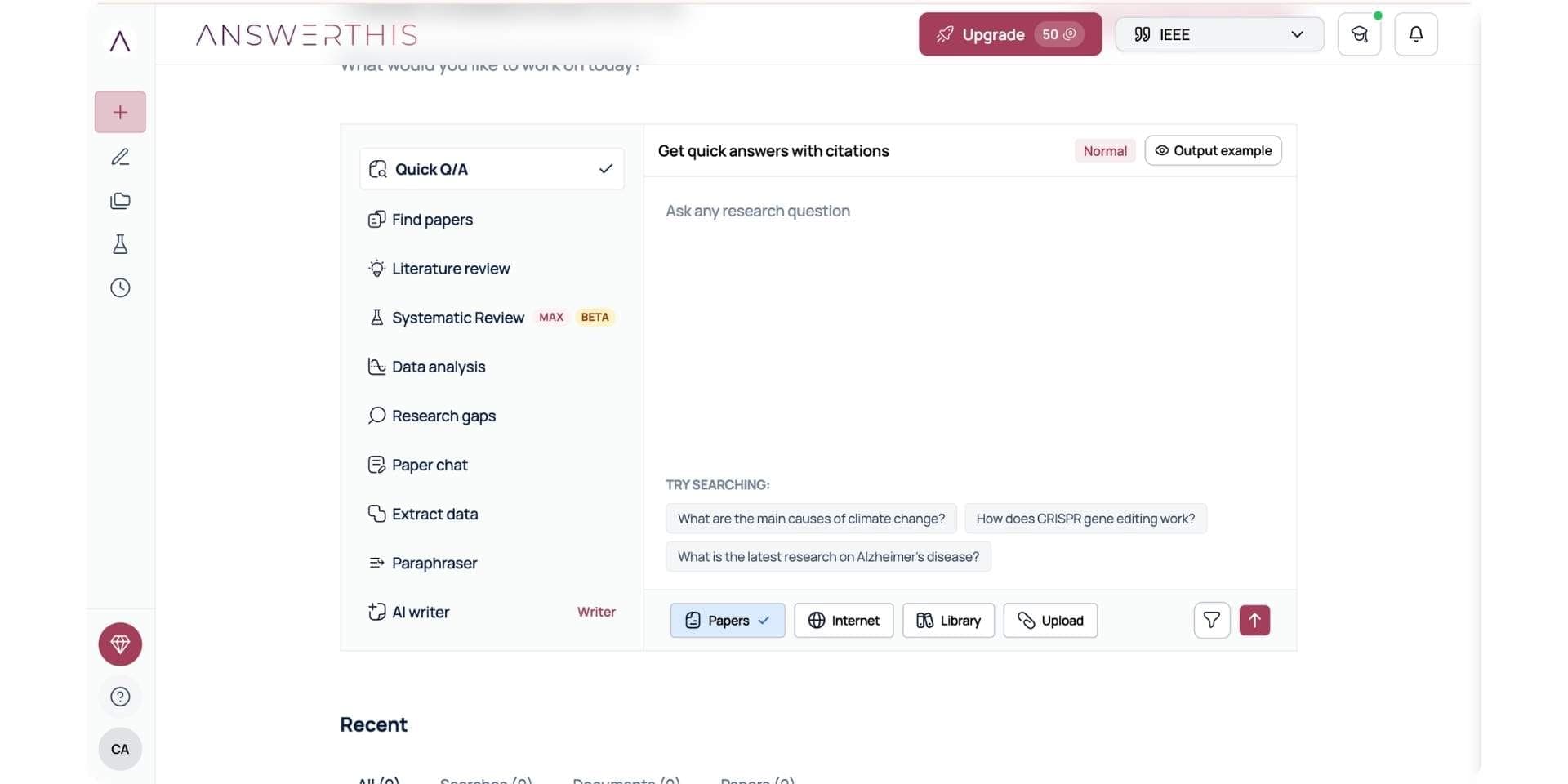
AnswerThis has a dedicated Research Gaps module that identifies underexplored areas in the evidence base. That matters most for gap-driven narrative reviews, where the framing centres on what is missing and what should come next. The platform searches 250M+ papers across PubMed, OpenAlex, Semantic Scholar, and arXiv with line-by-line citations, plus an AI Writer for short-form drafting at the proposal and scoping stages.
Gap analysis is the reason to use it. Most platforms leave gap identification as manual work; AnswerThis surfaces underexplored areas straight from the search results, which is a real advantage when the review frames itself around knowledge gaps rather than breadth.
Where it falls short against Paperguide is synthesis depth. The AI Writer sits apart from search and gap analysis rather than drawing on a screened library, and the reference manager is partial.
Key Features
- 250M+ papers across PubMed, OpenAlex, Semantic Scholar, arXiv
- Research Gaps module for framing
- Multi-database simultaneous search
- Line-by-line citations on every claim
- AI Writer for short-form drafting
Pros
- The only tool here with a dedicated Research Gaps module.
- Simultaneous search across four databases.
- Line-by-line citation grounding.
- Free tier available for evaluation.
Cons
- Free plan capped at 5 queries per month.
- The AI Writer is not connected to screening or a reference library, so drafts sit outside the pipeline.
- Credit-based limits push high-volume work onto the more expensive tiers.
Best For Teams running gap-driven narrative reviews where the framing centres on underexplored areas and future directions.
Pricing
| Plan | Price | What It Covers |
|---|---|---|
| Free | $0 | 5 basic queries per month |
| Pro | $35/mo | Unlimited basic queries plus 10 maximum-depth queries per month, full Research Gaps module |
| Research | $75/mo | Higher credit volume, multi-database synthesis |
| Max | $250/mo | High-volume operations |
| Enterprise | Custom | Team plans, dedicated support |
AnswerThis revises its tiers periodically, so check its pricing page for current figures.
Verdict
AnswerThis is the strongest gap-analysis platform for narrative review framing in 2026. Paperguide is a better AnswerThis alternative for teams who want gap-driven framing plus full synthesis depth, structured extraction, and a reference manager.
4. Anara
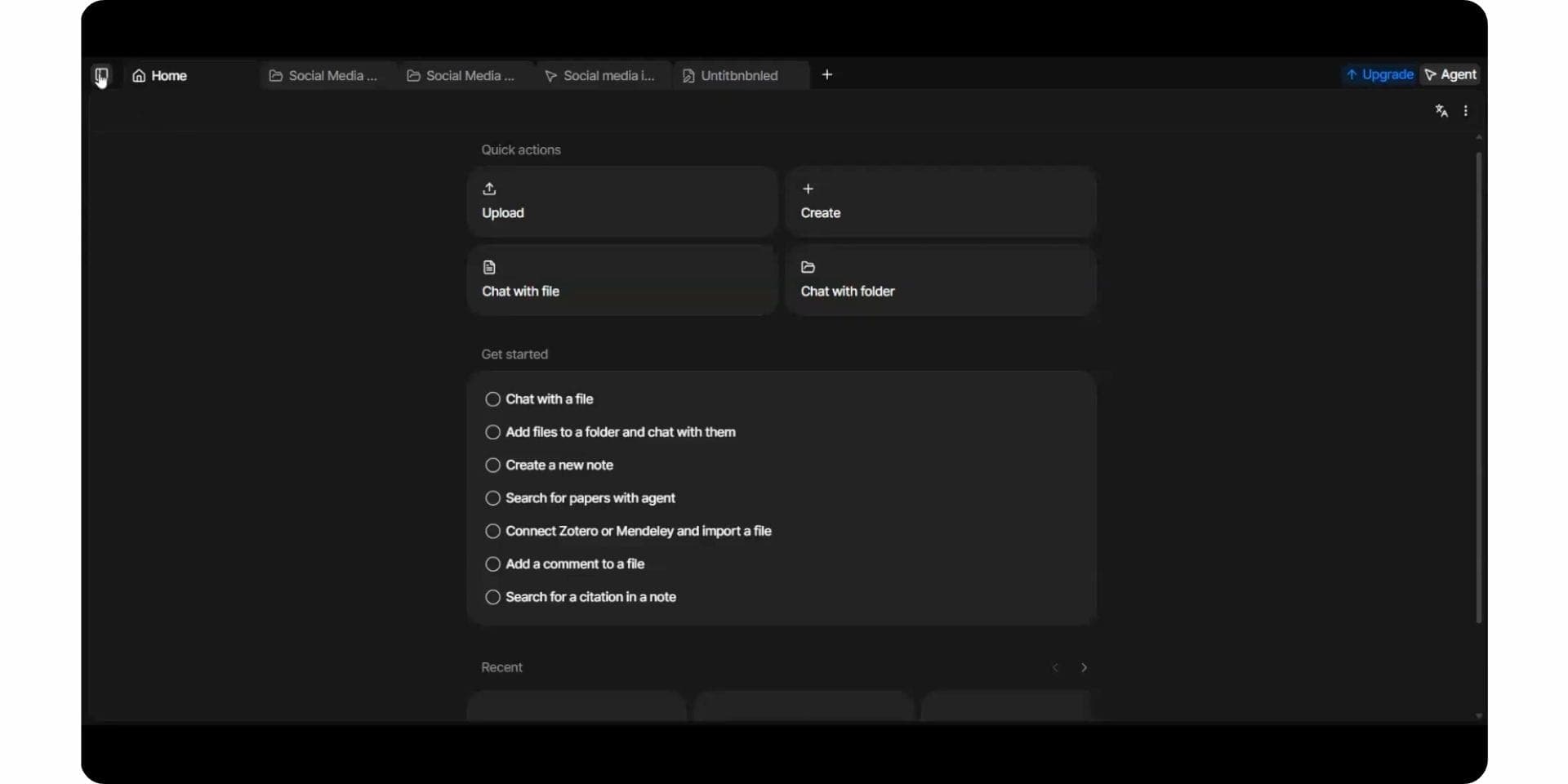
Anara is a multi-paper Chat with Folder platform for personal reading corpora. It suits narrative reviews where you already have a library of PDFs and want to surface patterns across them conversationally. Chat with Folder lets you query an uploaded set in natural language and get passage-linked answers grounded in the source PDFs, alongside annotation, highlights, AI summaries, and an in-document writing layer.
Multi-paper conversation is what it does best. Most platforms treat PDF reading as one paper at a time; Anara queries the whole uploaded set at once, which speeds up spotting patterns and contradictions.
Where it falls short against Paperguide is pipeline coverage. Paper retrieval runs as a black box with no control over databases, filters, or the retrieved set, so most teams bring their own library. There is no structured extraction into custom-column tables, and no full writer for synthesis drafting beyond in-document notes.
Key Features
- Chat with Folder for multi-paper conversational queries
- Annotation, highlights, and AI summaries in the document
- Research agent for follow-up questions
- AI writing layer inside the reading workspace
- Zotero and Mendeley connectors
Pros
- Strong multi-paper chat over a personal corpus.
- Clean annotation and summaries inside the document surface.
- Writing layer sits next to the reading workspace.
- Affordable entry tier.
Cons
- Retrieval is a black box, with no control over databases, filters, or the retrieved set.
- No structured extraction into custom-column tables.
- No full writer for synthesis drafting beyond in-document notes.
- Free plan limits on daily uploads and AI words bite quickly during sustained work.
Best For Teams with an existing PDF library running analysis through multi-paper chat and in-document annotation.
Pricing
| Plan | Price | What It Covers |
|---|---|---|
| Free | $0 | Basic Chat with Folder, daily upload and AI word limits |
| Plus | $10/mo | Full Chat with Folder, annotation, AI summaries, Zotero and Mendeley connectors |
| Pro | $20/mo | Research agent, multi-model access, unlimited uploads |
| Max | Paid tier | Deep Search agent, top-tier models, large file support |
| Enterprise | Custom | Security, compliance, team controls |
Verdict
Anara is the strongest multi-paper chat platform for analysing a personal corpus in 2026. Paperguide is a better Anara alternative for teams who want conversational analysis plus native search across 200M+ peer-reviewed papers and full synthesis writing in one workspace.
5. NotebookLM
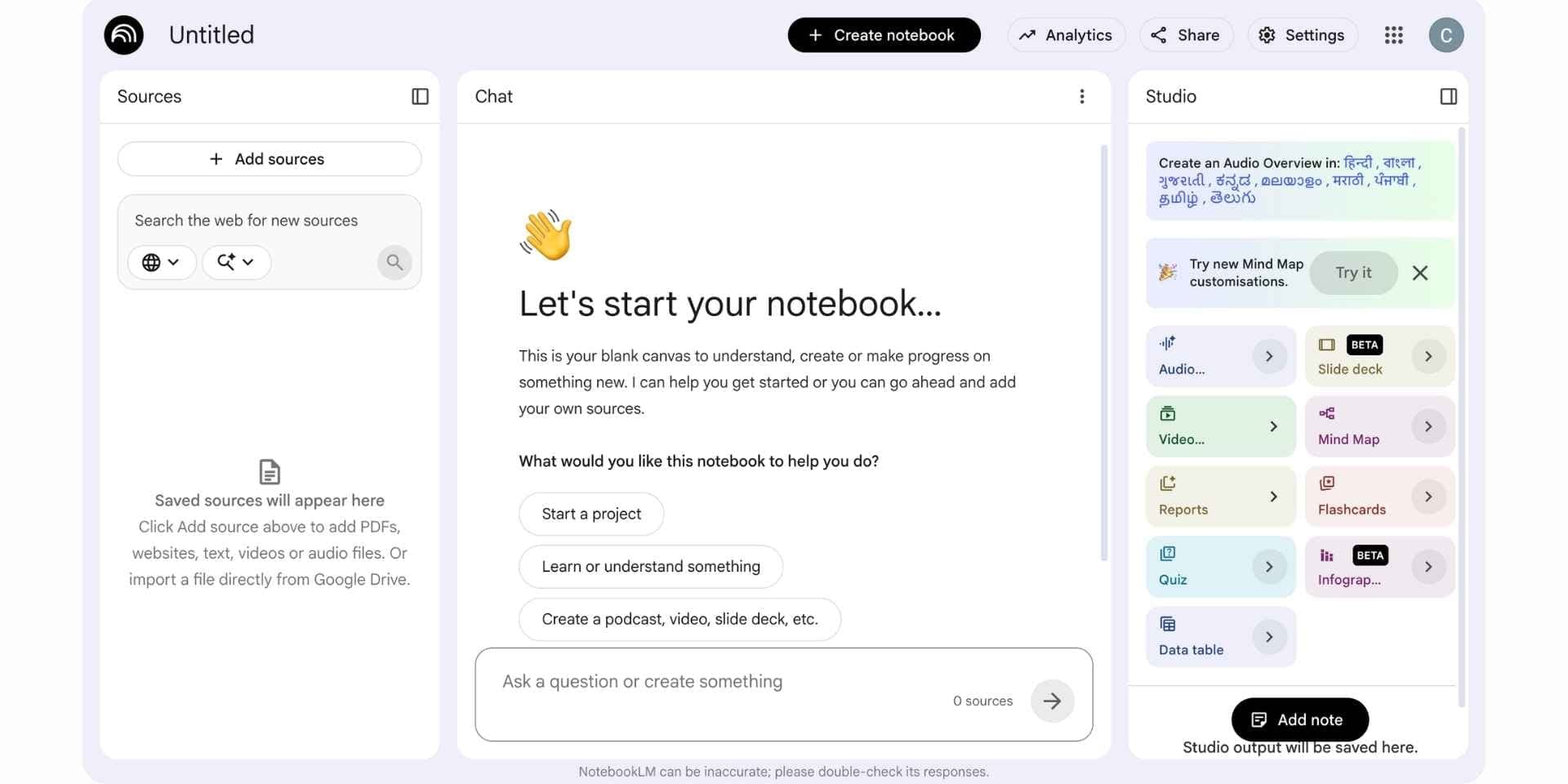
NotebookLM (rebranded Gemini Notebook in 2026) is Google's source-grounded AI notebook, expanded through 2025 and 2026 with the Studio output set. It stands apart for narrative work where you want synthesis across uploaded papers plus podcast-style Audio Overview for talking through themes. Uploaded documents become chat-based answers, Audio Overview, Video Overview, Mind Map, Study Guide, Briefing Doc, flashcards, and quizzes, all grounded in the sources you provide.
Audio Overview earns its place. Most platforms produce written synthesis alone; hearing a discussion of the patterns across your sources helps verbalise connections that otherwise stay abstract.
Where it falls short against Paperguide is pipeline coverage. There is no academic search across peer-reviewed literature, so you bring your own sources. Data Tables organise sources but offer no user-defined extraction columns, and no writer ships a citation-styled manuscript beyond the Studio outputs.
Key Features
- Source-grounded Q&A across 50 to 300 uploaded sources by plan
- Studio outputs: Audio Overview, Video Overview, Mind Map, Flashcards, Quiz, Slide Deck, Briefing Doc
- Multi-source chat with inline citations
- Configurable chat style and response length
- Free tier through a Google account
Pros
- Best-in-class Studio outputs for thinking through a topic.
- Source-grounded Q&A with inline citations.
- Generous free tier with 50 sources per notebook.
Cons
- No academic search across peer-reviewed literature.
- Data Tables cannot be configured with user-defined extraction columns.
- No writer that ships a citation-styled manuscript.
- Source caps bite quickly during a serious review.
Best For Teams generating source-grounded synthesis with audio and Studio outputs across a curated set of uploads.
Pricing
| Plan | Price | What It Covers |
|---|---|---|
| Free | $0 | 50 sources per notebook, 50 chats per day, Studio outputs with daily caps |
| Google AI Plus | $7.99/mo | 100 sources per notebook |
| Google AI Pro | $19.99/mo | 300 sources per notebook, higher chat volume |
Verdict
NotebookLM is the strongest source-grounded notebook for synthesis with audio output in 2026. Paperguide is a better NotebookLM alternative for teams who want that synthesis plus native search across 200M+ peer-reviewed papers and citation-grounded writing.
How the Paperguide Narrative Review Workflow Works?
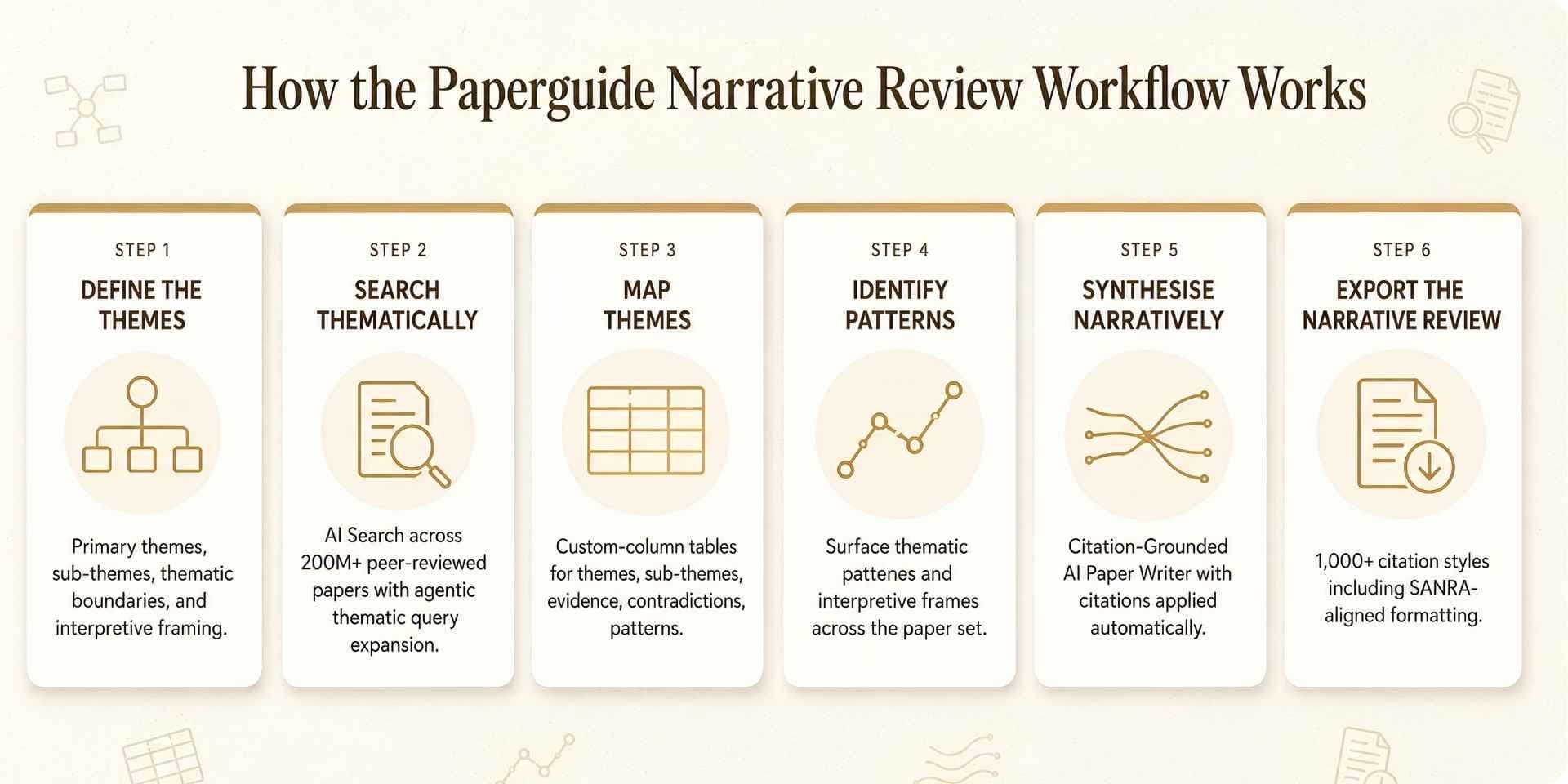
Paperguide runs narrative review work as a continuous scientific research workflow across six discrete stages. The same workflow pattern that makes evidence synthesis and scoping review work end-to-end inside one workspace applies to narrative review as the connective tissue across the platform, connecting the earlier discovery stage covered in the finding research papers workflow to the downstream citation management covered in the references and citations workflow.
Step 1: Define the themes. Primary themes, sub-themes, boundaries, and framing. The Research Agent helps refine scope and document the exploratory approach before search begins.
Step 2: Search. Multi-database query across 200M+ peer-reviewed papers from PubMed, arXiv, OpenAlex, and Semantic Scholar through AI Search, with agentic query expansion tuned for recall across adjacent areas.
Step 3: Map. Extract Data pulls custom-column tables with researcher-defined columns. Every cell links back to its source passage.
Step 4: Identify patterns. Surface patterns, contradictions, and framings across the paper set through Literature Review AI and multi-paper Chat with PDF queries.
Step 5: Synthesise. The AI Paper Writer drafts the synthesis organised by theme, with citations applied against the paper library. Every claim traces to a real source. The how to write a literature review guide covers the underlying writing patterns.
Step 6: Export. Word, PDF, BibTeX, and RIS export with 1,000+ citation styles matched to journal requirements, with referencing accuracy that satisfies the SANRA checklist.
Best AI Tools for Narrative Review by Use Case
| Use Case | Recommended Tool | Why |
|---|---|---|
| Narrative review overall | Paperguide | Full pipeline from search to synthesis writing in one workspace with verified citations |
| Solo researchers and PhD candidates | Paperguide Free or Plus | Search, reference management, extraction, and writing without stitching tools together |
| Evidence teams running narrative plus protocol work | Paperguide Evidence Teams | Narrative synthesis on the same library as PRISMA-grade dual-review screening |
| Structured extraction | Elicit | Custom-column extraction with up to 40 columns |
| Gap-driven narrative reviews | AnswerThis | Dedicated Research Gaps module across 250M+ papers |
| Multi-paper conversational analysis | Anara | Chat with Folder over an uploaded corpus |
| Source-grounded synthesis with audio | NotebookLM | Audio Overview and Studio outputs across uploaded sources |
| Free stack | Paperguide Free + AnswerThis Free + NotebookLM Free | Search and writing, gap analysis, and Studio outputs at no cost |
Best AI Tools for Narrative Review: Final Comparison
| Feature | Paperguide | Elicit | AnswerThis | Anara | NotebookLM |
|---|---|---|---|---|---|
| Paper corpus | 200M+ peer-reviewed | 125M+ | 250M+ | User library | User uploads |
| Search | Yes (agentic expansion) | Yes (semantic) | Yes (multi-database) | Limited | No (bring your own) |
| Flexible inclusion | Yes | Yes (threshold) | Yes | Yes | Yes |
| Structured extraction | Yes (custom columns) | Yes (strongest) | Yes | No | Partial (Data Tables) |
| Multi-paper conversation | Yes (Chat with PDF) | Partial | Partial | Yes (strongest) | Yes (Studio) |
| Audio synthesis | No | No | No | No | Yes (strongest) |
| Citation-grounded writing | Yes | Partial (Report mode) | Partial | No | Partial |
| Research Gaps module | Via Research Agent | No | Yes (strongest) | No | No |
| AI reference manager | Yes | No | Partial | Sync only | No |
| SANRA-aligned referencing | Yes | No | No | No | No |
| Free plan | Yes | Yes | Yes | Yes | Yes |
| Starting paid | $12/mo annual | $49/mo Pro annual | $35/mo Pro | $10/mo Plus | $7.99 Google AI Plus |
Common Mistakes When Using AI Tools for Narrative Review in 2026
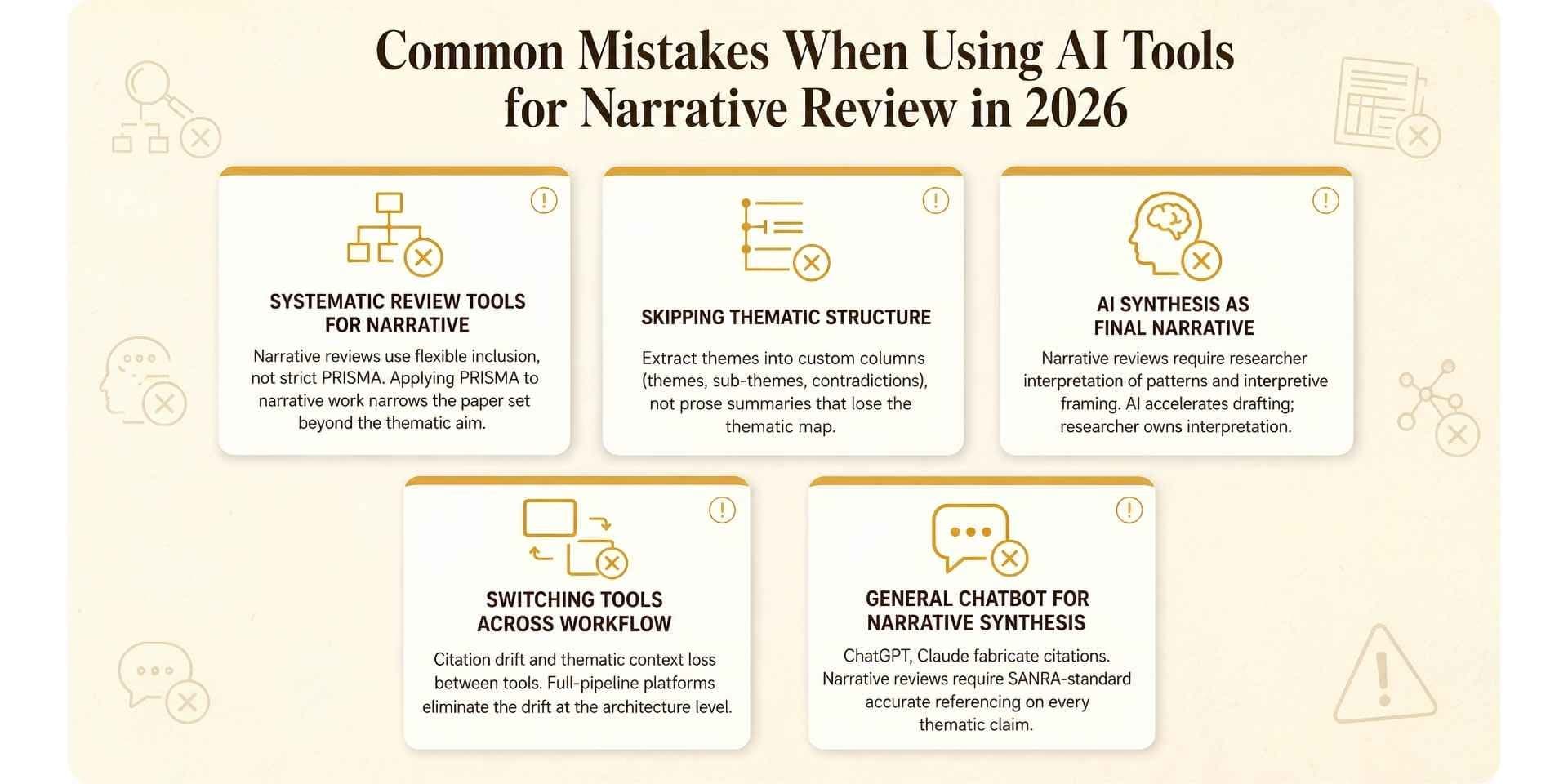
- Using systematic review tools for narrative work. Narrative reviews use flexible inclusion and organise findings by theme. Applying strict PRISMA criteria narrows the paper set below what the exploratory aim needs and forces the review into a framework it was not designed for.
- Skipping structure in the synthesis. Narrative reviews organise findings by theme, not chronologically. Use structured extraction into custom-column tables rather than prose summaries that lose the map.
- Treating AI output as the final synthesis. These reviews require researcher interpretation of patterns, contradictions, and framing. Use AI for the mechanical extraction and drafting stages and keep the interpretation human.
- Switching tools across the workflow. Discovery in one tool, extraction in another, writing in a third introduces citation drift and context loss at every handoff.
- Using a general-purpose chatbot for synthesis. The JMIR analysis found 28.6% of GPT-4 generated references hallucinated when producing systematic review citations. For a narrative review judged against SANRA's referencing item, that failure rate is disqualifying.
Final Verdict
For research teams running narrative reviews in 2026, Paperguide is the best AI tool for the job. Agentic multi-database search across PubMed, arXiv, OpenAlex, and Semantic Scholar, flexible screening, structured extraction into custom-column tables, and the AI Paper Writer with 1,000+ citation styles make it the only platform here built for both the exploratory approach these reviews use and the referencing accuracy SANRA expects.
For individual stages, Elicit handles custom-column extraction with up to 40 columns, AnswerThis handles gap-driven framing through its Research Gaps module, Anara handles conversational analysis of a personal corpus, and NotebookLM handles source-grounded synthesis with audio output.
The practical 2026 pattern is rarely one tool. Paperguide as the backbone across search, screening, extraction, and writing; Elicit when a project needs systematic extraction across a large set; AnswerThis when the framing centres on knowledge gaps; Anara for conversational work over your own reading; NotebookLM when audio or a mind map helps you talk through the patterns. That layered approach produces reviews where the coverage is complete, the framing is grounded, the citations are traceable, and the result meets the SANRA standard.
Frequently Asked Questions (FAQs)
What are the best AI tools for narrative review in 2026?
Paperguide is the best AI tool for narrative review in 2026 because it runs the full pipeline (search, flexible screening, structured extraction, synthesis writing) in one workspace with citations verified against a real library. The strongest options across the category are Paperguide, Elicit, AnswerThis, Anara, and NotebookLM.
What is a narrative review?
A narrative review synthesises existing research on a topic by theme rather than following the protocol-driven methodology of a systematic review. It is the most common review type in academic publishing, useful when the aim is a broad overview, conceptual clarification, or interpretive framing rather than answering a narrow clinical question with pooled effect estimates. The quality standard is SANRA, a six-item checklist published by Baethge and colleagues in 2019.
What is the difference between narrative review and systematic review?
Narrative reviews use flexible inclusion criteria and organise findings by theme, giving interpretive synthesis without strict PRISMA methodology. Systematic reviews use strict PRISMA criteria, dual-reviewer blind screening, formal risk-of-bias assessment, and structured meta-analysis to answer narrower questions. Narrative reviews are more common; systematic reviews sit higher in the evidence hierarchy for clinical decisions but cover a narrower range of questions.
Can AI write a narrative review?
Citation-grounded tools like Paperguide can draft narrative review manuscripts with citations applied against the actual reference library, so each cited paper resolves to a real source. The synthesis still requires researcher interpretation of patterns, contradictions, and framing. AI accelerates the mechanical drafting; the interpretation stays with the researcher.
What is SANRA?
SANRA is the Scale for the Assessment of Narrative Review Articles, a six-item quality checklist published by Baethge, Goldbeck-Wood, and Mertens in 2019 in Research Integrity and Peer Review. The items cover justification of importance, statement of aims, description of the literature search, referencing accuracy, scientific reasoning, and appropriate presentation of data. It is the narrative review's closest analogue to PRISMA.
What is the best AI tool for narrative review for a PhD student?
Paperguide's Free tier gives 2,000 AI credits a month, with the reference manager, Chat with PDF, and Literature Review AI included. Plus at $12 per seat per month, billed annually ($144 a year), adds 12,500 credits, unlimited AI Searches and an unlimited Reference Manager, which covers most dissertation-stage review work. A 30% academic discount applies to paid tiers with a valid university email.
What is the best free AI tool for narrative review?
Paperguide Free plus AnswerThis Free plus NotebookLM Free is the strongest free stack in 2026. Paperguide Free provides AI Search, Literature Review AI, Chat with PDF, and the reference manager. AnswerThis Free adds 5 queries a month for gap analysis. NotebookLM Free adds 50 sources per notebook with Studio outputs including Audio Overview.
How does AI help with narrative reviews?
AI speeds up search through agentic query expansion across multiple databases, flexible screening, structured extraction into source-linked evidence tables, pattern identification through multi-paper querying, and citation-grounded synthesis writing where references are applied against the actual paper library rather than generated from training data.
Can AI identify themes in narrative reviews?
Yes. Paperguide's Extract Data with custom columns and the Research Agent surface patterns across the paper set. AnswerThis identifies research gaps through its Research Gaps module. Anara's Chat with Folder finds themes conversationally across uploaded papers. NotebookLM's Mind Map view shows relationships across uploaded sources.
What review type should I choose for my research?
Choose a narrative review when the aim is a broad overview, conceptual clarification, or interpretive framing. Choose a systematic review when the aim is to answer a narrow question with pooled effect estimates under strict PRISMA methodology. Choose a scoping review when the aim is to map the breadth of evidence and identify gaps using broader inclusion than a systematic review.
Why are AI-generated citations in narrative reviews often wrong?
General-purpose AI writers generate citation-shaped strings from training data rather than pulling from a real library. A 2024 JMIR analysis found hallucination rates of 28.6% for GPT-4 and 39.6% for GPT-3.5 when generating references for systematic reviews. Since SANRA judges referencing accuracy directly, that rate is disqualifying. The fix is a writer connected to an actual reference library, so every citation resolves to a paper you have collected.
Reviewing literature?
Generate your literature review
Categorized sources, citations and key insights from a single topic.
Try it freeNo credit card required