9 Best RRL Sites for Students in 2026 (Free + Paid)

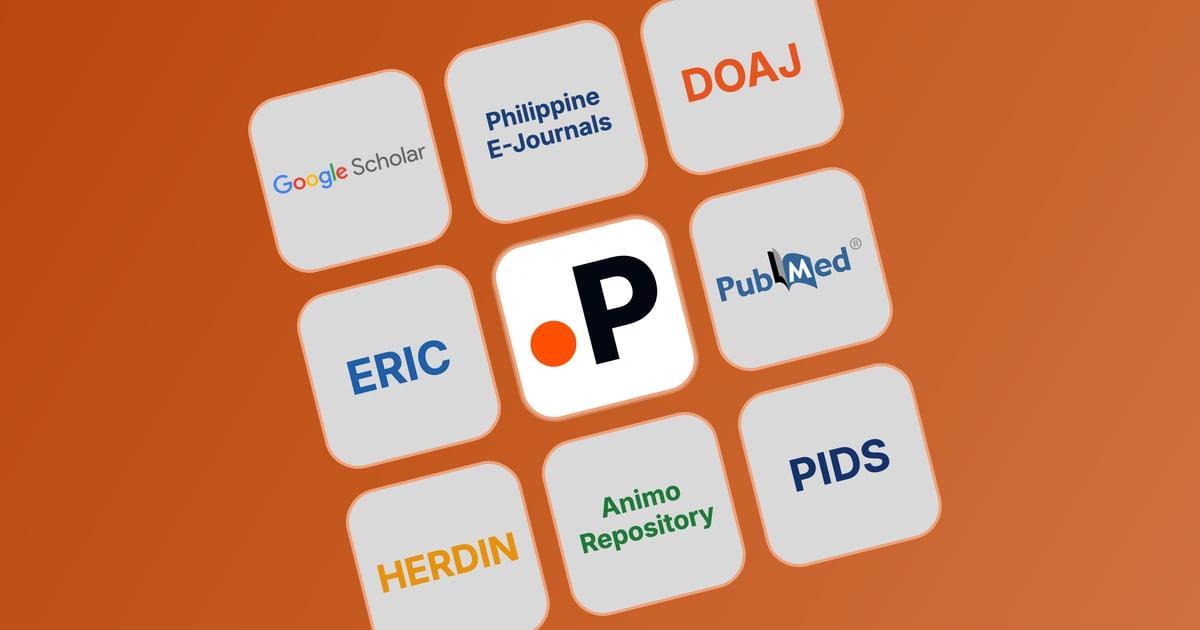
The best RRL sites for students in 2026 are Paperguide's RRL Finder, Philippine E-Journals, Google Scholar, DOAJ, ERIC, PubMed and PubMed Central, HERDIN, the DLSU Animo Repository and PIDS. Use Philippine E-Journals and university repositories for local studies, and Google Scholar, DOAJ, ERIC and PubMed for foreign ones.
We tested the sites we could with the same two student topics, recorded how many relevant studies each returned, and checked what each one offers for free. This guide covers the results, how to choose between local and foreign sites, how to get more out of Google Scholar, and which site to use for which kind of research.
TL;DR
- Best overall starting point: Paperguide's RRL Finder searches 200M+ papers from your topic and groups related studies by theme, with citation details.
- Best for local studies: Philippine E-Journals. In our test, all of its top five results for a modular distance learning search were relevant Philippine studies with free full text.
- Best for foreign studies across fields: Google Scholar for breadth, and DOAJ for free, open access journals.
- Best by field: ERIC for education, PubMed and PubMed Central for health and psychology, HERDIN for Philippine health research, PIDS for Philippine economic and education policy.
- Best for local theses: university repositories such as the DLSU Animo Repository.
Key Takeaways
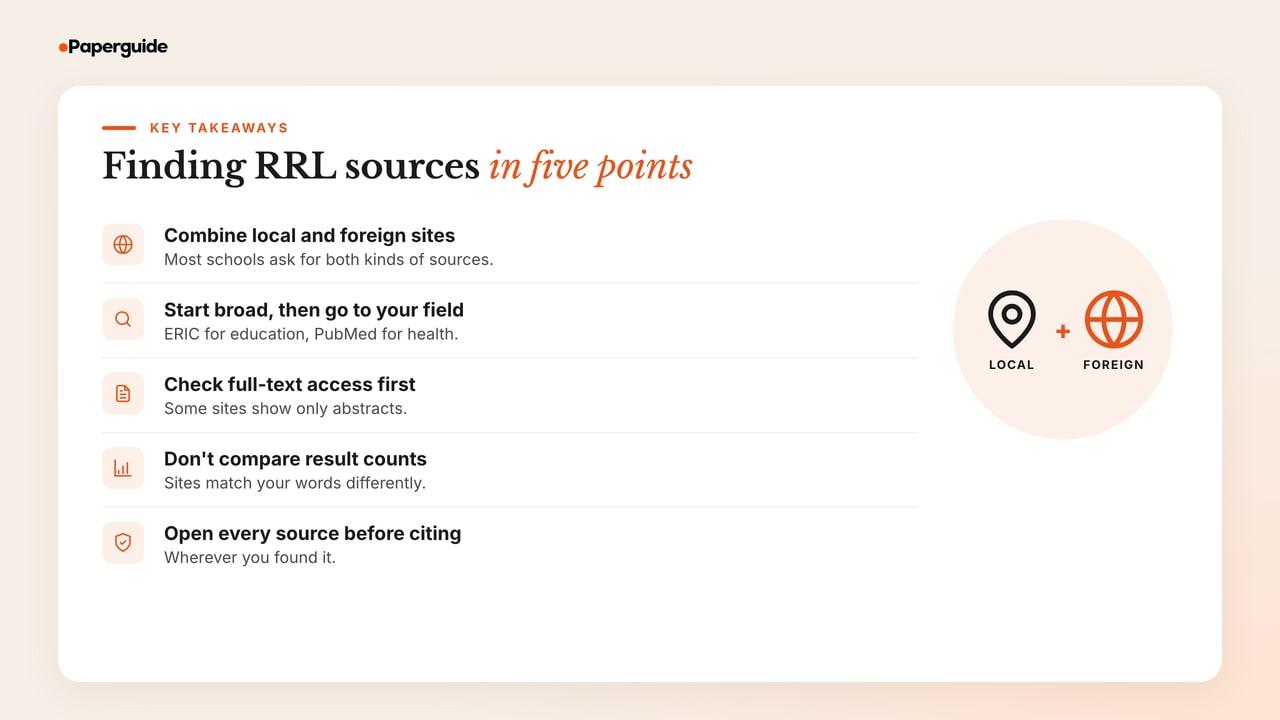
No single site covers everything an RRL needs. Local studies sit mostly in Philippine journals and university repositories, while foreign studies are spread across large international databases. The fastest route is to start broad, then search the database that matches your field.
- Use at least one local and one foreign site, because many schools, and DepEd's senior high school modules, ask for both kinds of sources.
- Start with a broad search, then move to the database for your field: ERIC for education, PubMed for health.
- Check full-text access before you rely on a source. Some sites show only abstracts or ask you to request the full text.
- Do not compare result counts between sites. Some match every word you type and others match any word, so counts mean different things.
- Open and read every source before you cite it, whichever site you found it on.
What Are the Best RRL Sites in 2026?
The best RRL sites in 2026 are Paperguide RRL Finder for a fast, themed starting list; Philippine E-Journals, HERDIN, the DLSU Animo Repository and PIDS for local sources; and Google Scholar, DOAJ, ERIC and PubMed for foreign sources. All of them are free to search, and Paperguide also offers paid plans with more AI credits.
If you are not sure what an RRL needs from its sources, start with the guide to what an RRL is in research, which explains related literature, related studies, and local and foreign sources.
How We Tested the RRL Sites
We ran the same two searches on every site on 9 November 2026, using the site's own search or its public API:
- Search 1 (education): "modular distance learning" Philippines
- Search 2 (psychology): "academic stress" "senior high school"
On ERIC we joined the terms with AND, because its search otherwise matches any word.
For each site we recorded the number of results, how many of the top five were relevant (on the searched topic and a student population), whether full text was free, and which tools the site offers for citing and filtering. We also read each site's About page for what it covers and who runs it.
Two sites could not be tested this way. Google Scholar blocks automated searches, and the DLSU Animo Repository's search sits behind a bot check, so we describe both from their own pages instead. Paperguide's RRL Finder is our own product, so we left it out of the test and describe it from its tool page; judge it by trying it on your own topic.
Test Results: Two Student Topics on Seven Sites
| Site | Search 1 results | Search 1 top 5 relevant | Search 2 results | Search 2 top 5 relevant |
|---|---|---|---|---|
| Philippine E-Journals | 12,010 (any word) | 5 of 5, Philippine | 11,534 (any word) | 3 of 5, Philippine |
| DOAJ | 39 | 5 of 5, Philippine | 25 | 5 of 5, foreign |
| ERIC | 1 (16 for the phrase alone) | 4 of 5 (phrase alone) | 2 | 1 of 2 |
| PubMed | 1 | 1 of 1 | 10 | 2 of 5, foreign |
| PubMed Central | 6 | 1 of 5 | 600 | 1 of 5 |
| HERDIN | 10,960 (any word) | 1 of 5 | 10,626 (any word) | 2 of 5, college nursing |
| PIDS (publications) | 27 | 0 of 5 on topic | 4 | 0 of 4 |
Result counts are not comparable between sites. Philippine E-Journals and HERDIN return studies that match any of the words you type, which inflates their counts, while DOAJ and PubMed require all the terms. ERIC matches any word by default, so for ERIC we joined the terms with AND. PubMed Central searches full text, so it also finds papers that mention a phrase in passing. The relevance columns are the better guide.
How to Choose the Right RRL Site
Four questions narrow the choice:
- Local or foreign? For Philippine studies, start with Philippine E-Journals, HERDIN (health) or a university repository. For foreign studies, use Google Scholar, DOAJ, ERIC or PubMed.
- What field? ERIC covers education, PubMed covers health and life sciences, HERDIN covers Philippine health research and PIDS covers Philippine economic and social policy. Google Scholar, DOAJ and Philippine E-Journals cover all fields.
- Do you need free full text? DOAJ indexes only open access journals, PubMed Central holds free full text, and ERIC and PubMed have full-text filters. Google Scholar often shows only abstracts.
- Do you need a citation in APA 7? Philippine E-Journals and PubMed have Cite buttons that include APA. Elsewhere, a reference manager is the safer route.
For search technique on any of these sites, such as keywords and Boolean operators, the guide on how to find a review of related literature goes step by step.
Quick Comparison of the Best RRL Websites
RRL Sites Compared: Coverage, Local Content, Cost and Full Text
| Site | Coverage | Local (Philippine) content | Cost | Full text |
|---|---|---|---|---|
| Paperguide RRL Finder | All fields, 200M+ papers | Mixed | Free; paid plans available | Citation details; links to papers |
| Philippine E-Journals | Philippine journals, all fields | Strong | Free to search | Free on the articles we opened |
| Google Scholar | All fields, worldwide | Mixed | Free | Often abstract only |
| DOAJ | Open access journals, all fields | Some (47 Philippine journals) | Free | Free, on publisher sites |
| ERIC | Education | Some | Free, no registration | Filter for full text on ERIC |
| PubMed and PMC | Health and life sciences | Few | Free | PubMed links out; PMC is free full text |
| HERDIN | Philippine health research | Strong | Free | Often by request, with an account |
| DLSU Animo Repository | One university's theses and research | Strong | Free | Many theses have PDFs |
| PIDS | Philippine economic and social policy | Strong | Free | Free downloads |
Best RRL Websites for Students in 2026
1. Paperguide RRL Finder
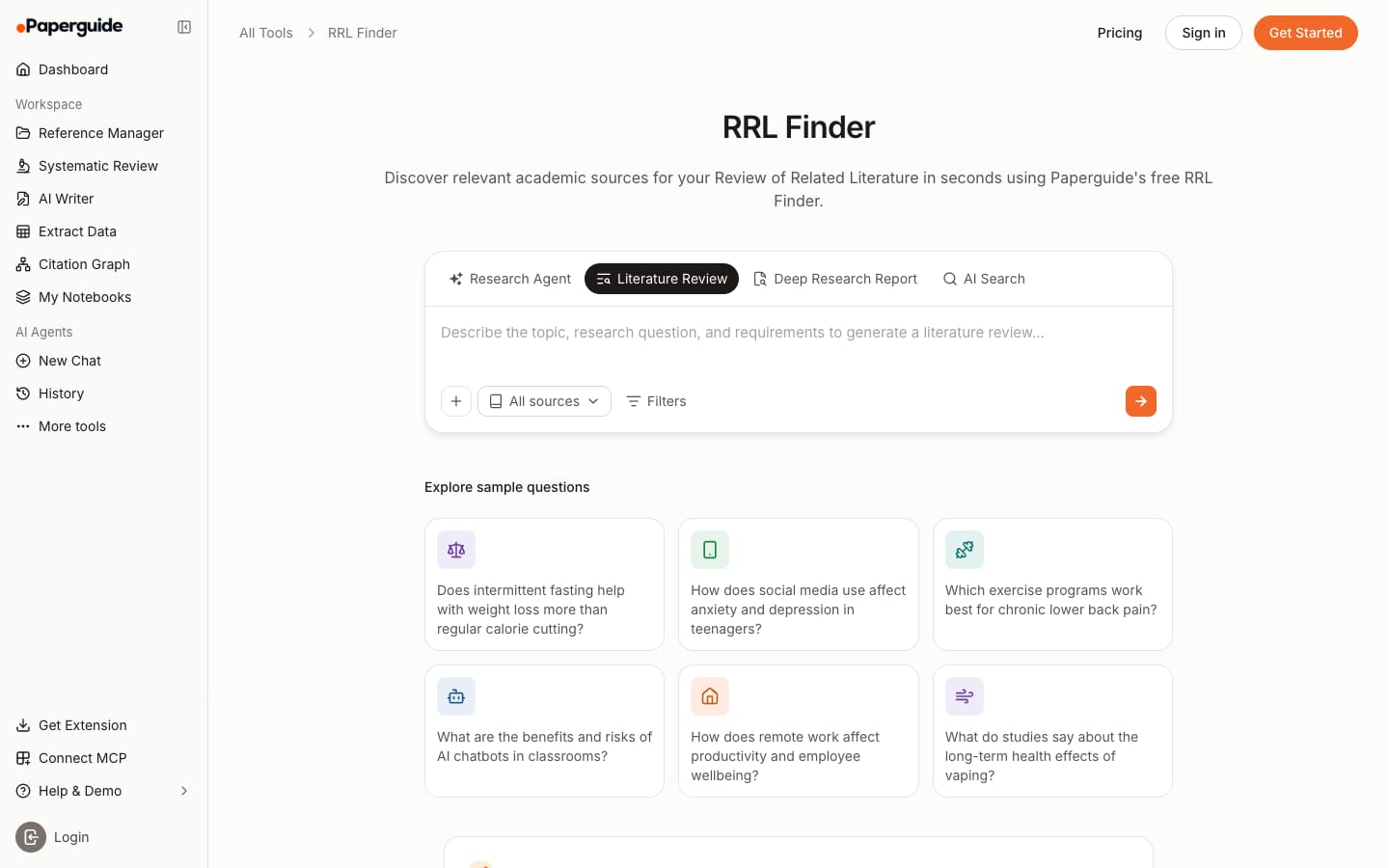
Paperguide's RRL Finder is a free tool that starts from your research topic, question or keywords rather than from a search string. According to its tool page, it searches academic literature for studies related to your research problem, organizes them into research themes, and gives citation details for each study. It runs on the same engine as Paperguide's Literature Review AI, which searches a database of more than 200 million papers.
The themed results are what set it apart from a database search. Instead of a long ranked list, you see groups of related studies, which is close to the shape your RRL body will take. That makes it a good first step before you search the field databases below.
Key features
- Search from a topic or research question in plain language
- Results grouped by research theme
- Citation details for each study: authors, year, journal and other metadata
- Pairs with Paperguide's Reference Manager, where you can save the sources you keep and format an APA 7 reference list
- Leads into Literature Review AI when you want a cited synthesis of the evidence
Pros
- Starts from your topic, so you do not need to build a Boolean search first
- Themes give you a first outline for your Chapter 2 body
- Covers all fields, from education to health to engineering
Cons
- It does not separate local from foreign studies, so you still need Philippine sites for local sources
- Like any search tool, it can surface studies you will judge less relevant; open each one before you use it
Pricing: Free to use. Paperguide's Free plan includes 1,500 AI credits a month. Plus: $12 per seat per month, billed annually ($144 a year). Pro: $29 per seat per month, billed annually ($348 a year).
Best for: Getting a themed starting list of related studies in minutes, before you search field databases.

2. Philippine E-Journals
Philippine E-Journals describes itself as "an online collection of academic publications of different higher education institutions and professional organizations" in the Philippines, hosted by C&E Publishing. On the day we tested, its homepage counted 287 journals and 33,192 articles.
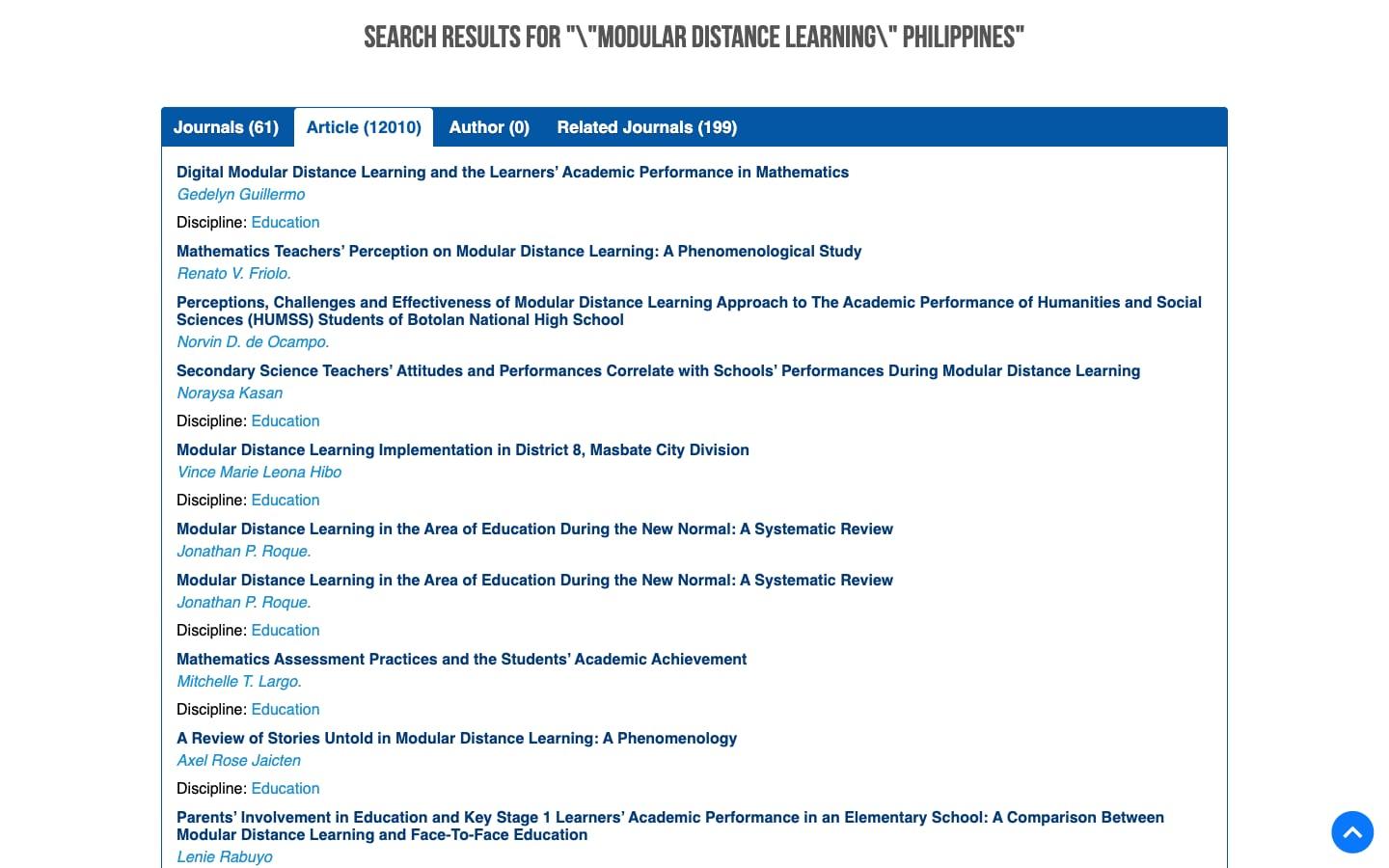
It was the strongest site in our test for local studies. For the modular distance learning search, all five top results were relevant Philippine studies, including "Digital Modular Distance Learning and the Learners' Academic Performance in Mathematics" (2024). For the academic stress search, it found a 2025 study on academic procrastination and academic stress among senior high school students. Every article page we opened offered the full text without a login.
Key features
- Journals from Philippine universities and professional organizations across all fields
- Full text on the article pages we opened, with abstracts and reference lists
- "Cite this paper" button with APA 7th edition, MLA 9th edition and Turabian formats
- A to Z journal index and journal rankings
Pros
- The best single source of local studies we tested
- Free full text on every article we opened
- One-click APA 7 citations
Cons
- The search matches any of your words rather than exact phrases, so result counts are huge and you must scan carefully
- Journal quality varies: inclusion requires peer review and an ISSN, but not indexing in major international databases
- We saw at least one duplicate record
Pricing: Free to search. The site lists institutional subscribers, so some content may depend on subscriptions, though every article we opened was free.
Best for: Local literature and studies on any Philippine topic.
3. Google Scholar
Google Scholar searches "journal and conference papers, theses and dissertations, academic books, pre-prints, abstracts, technical reports and other scholarly literature from all broad areas of research," according to its help page. It is one of the broadest free searches, and a common starting point for students looking for foreign studies.
We could not run our test searches because Google Scholar blocks automated access, so this entry is based on its own documentation.
Key features
- Covers publishers, professional societies and university repositories, plus court opinions and patents
- "Cited by" and "Related articles" links under each result
- A "Since year" filter and alerts by email
- A "Cite" button that exports to BibTeX, EndNote, RefMan and RefWorks
Pros
- Very wide coverage across fields and publishers
- Citation trails let you move from one good study to newer ones
- Free, with no account needed to search
Cons
- No peer-review filter: results mix journal articles with preprints, abstracts and reports
- Many results are abstracts only. The help page notes that "reading the entire article may require a subscription"
- Ranking reflects relevance, not quality
Pricing: Free.
Best for: Broad searches for foreign studies, and following citation trails.
4. DOAJ (Directory of Open Access Journals)
DOAJ is "a unique and extensive index of diverse open access journals from around the world," run by the non-profit DOAJ Foundation. When we queried its public API, it listed 23,721 journals and nearly 14 million articles, including 47 journals with a Philippine publisher.
DOAJ was the most consistent site in our test. All five top results for modular distance learning were relevant Philippine studies, such as a 2021 study of printed module preferences among Grade 7 to 12 students in Davao Oriental. All five for academic stress were relevant, though from Indonesia and China.
Key features
- Only open access journals, so every article is free to read
- Search by article or by journal
- A public API
Pros
- Every result is free to read
- Strict search, so results are focused
- Good at surfacing Philippine studies published in open access journals
Cons
- Subscription journals are missing, so important studies may not appear
- DOAJ is an index: it links to the full text on the publisher's site
- Journal quality varies
Pricing: Free, no account.
Best for: Free, full-text foreign studies, and local studies published open access.
5. ERIC (Education Resources Information Center)
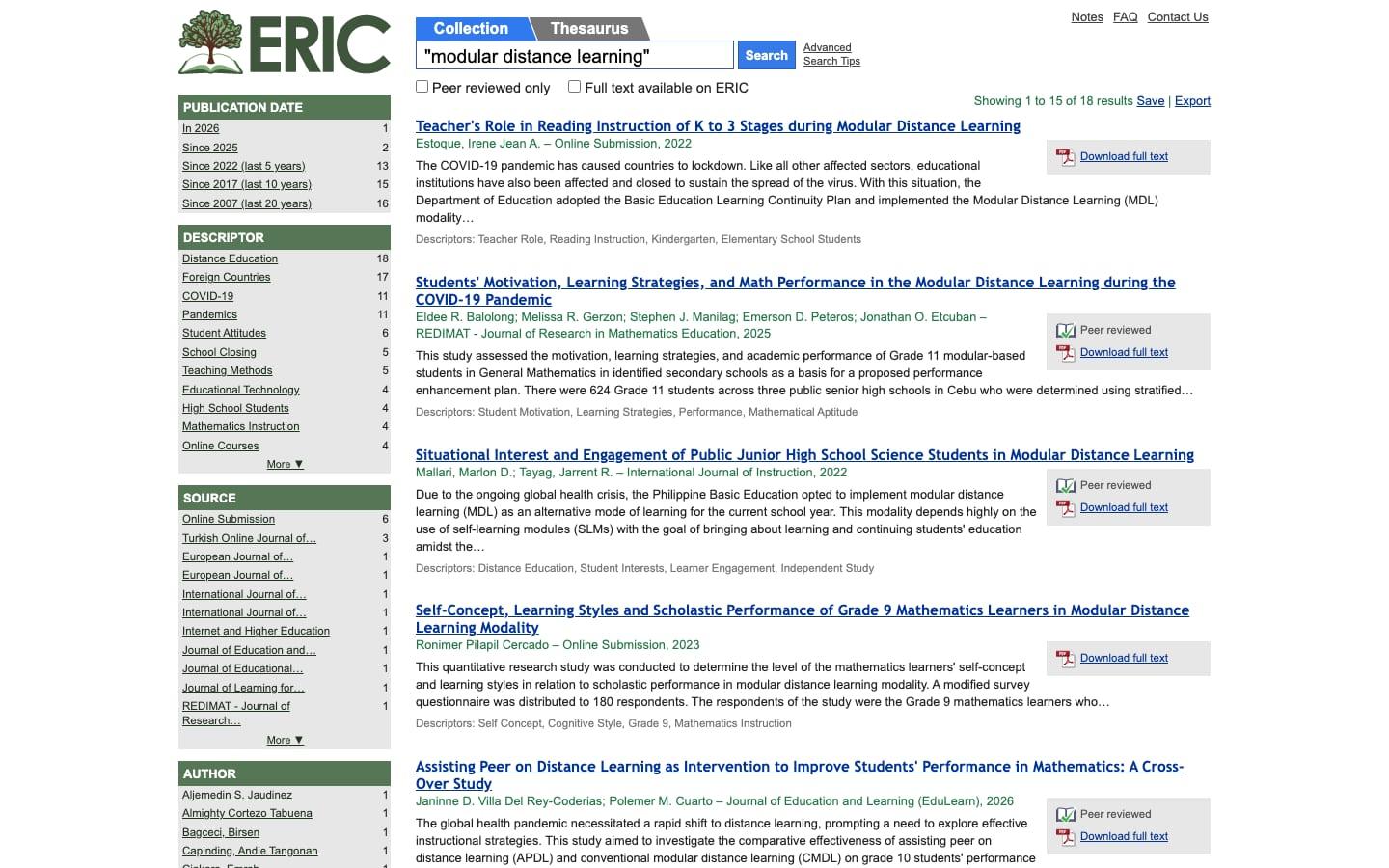
ERIC is a "digital library of education research" sponsored by the Institute of Education Sciences of the U.S. Department of Education. Its FAQ states that there is "no membership, registration, or subscription required." Its public API listed more than 2.1 million records, about half a million with full text on ERIC.
Our searches showed how precise ERIC is. The full modular distance learning search returned one result, a relevant 2022 study, but searching the phrase alone returned 16, mostly Philippine studies. For academic stress it returned a 2024 peer-reviewed study of senior high school students in distance learning, with full text.
Key features
- Education research only: journal articles, reports, papers and books
- "Peer reviewed only" and "Full text available on ERIC" filters
- A thesaurus of education terms for precise searching
Pros
- Peer-reviewed and full-text filters save time
- Includes Philippine education studies despite being a US database
- Free, with no registration
Cons
- Education topics only
- Very specific searches can return few results; broaden your terms
- Not every record has full text
Pricing: Free.
Best for: Education topics, from teaching methods to learning outcomes.
6. PubMed and PubMed Central
PubMed is a free search of biomedical and life sciences literature run by the U.S. National Library of Medicine. It "contains more than 40 million citations and abstracts," and links to full text where available. Its sister archive, PubMed Central, is "a free full-text archive" with "more than 10 million full-text article records."
In our test, PubMed found one relevant study on modular distance learning and ten results on academic stress, all foreign, several of them from China. PubMed Central found more because it searches full text, but many of those papers only mentioned the terms in passing.
Key features
- A Cite button with AMA, MLA, APA and NLM styles
- "Free full text" and publication date filters
- Automatic matching to medical subject headings
Pros
- A standard source for health and nursing studies, and useful for psychology
- One-click APA citations
- Free full text through PubMed Central
Cons
- Few Philippine education studies
- PubMed itself holds citations and abstracts, not full text
- PubMed Central's full-text search returns many passing mentions
Pricing: Free. A free account is needed only for saved searches and email alerts.
Best for: Health, nursing, medicine and psychology topics.
7. HERDIN
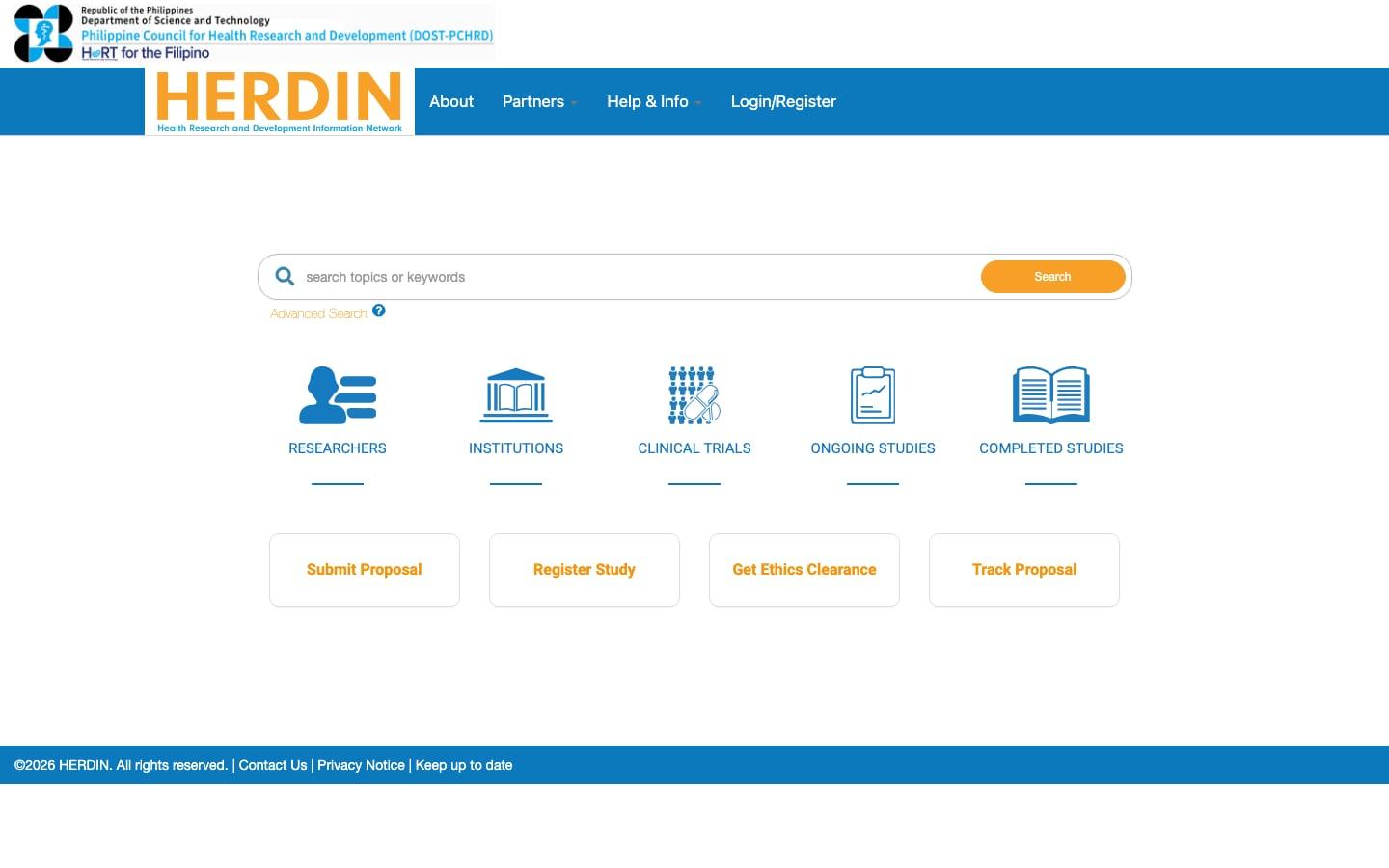
HERDIN is the Philippines' national health research repository. Its About page explains that it was established in 1983 by the Philippine Council for Health Research and Development with the Department of Health and UP Manila, and that Republic Act 10532 recognized it as the National Health Research Repository in 2013. It holds completed and ongoing studies, theses, journal articles and policy briefs.
Our two general topics showed the limits of a health-only site. HERDIN's top results for academic stress were relevant studies of nursing students, but none was on senior high school students, and modular distance learning returned mostly loosely related nursing education studies.
Key features
- Philippine health research: completed studies, ongoing studies, theses and clinical trials
- Filters for full-text availability, publication year, publication type and researcher level, including secondary and undergraduate
- Free full text through HERDIN Document Delivery
Pros
- The main source for local health studies, including unpublished theses
- Filters by researcher level help find student research
- No fees for document delivery
Cons
- Health topics only
- The search matches any word, so results are long and noisy
- Many records show only the abstract; full text needs a free account and a request
Pricing: Free. Full text through Document Delivery needs an account, with no fees.
Best for: Local studies on health, nursing, nutrition and public health topics.
8. DLSU Animo Repository
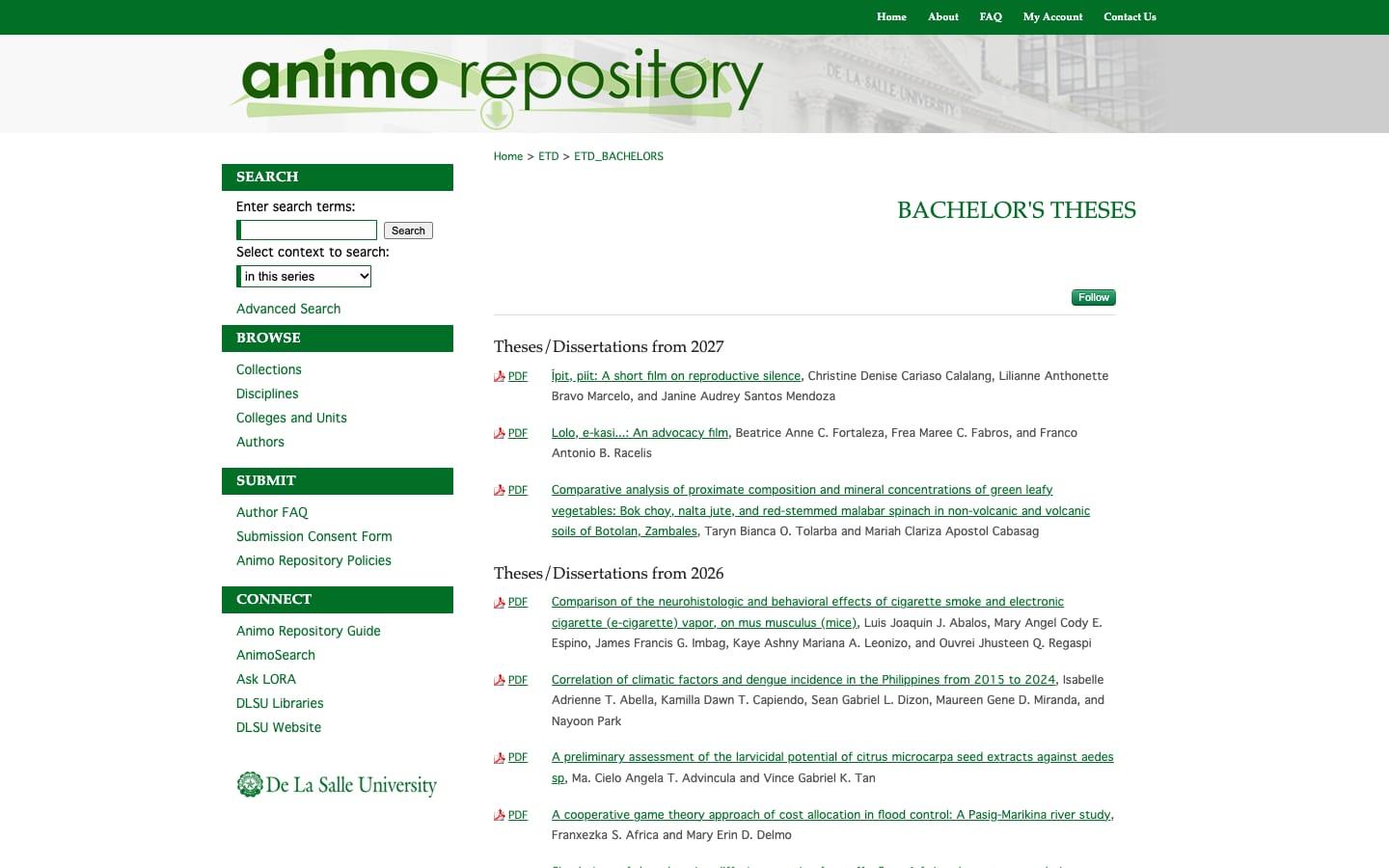
The Animo Repository is De La Salle University's "digital repository of scholarly and creative works of the faculty, students, and researchers." It holds bachelor's, master's and doctoral theses, faculty research and university journals.
Its search sits behind a bot check, so we could not run our test searches. On the first page of its bachelor's theses collection, 72 of the 100 listed theses had a PDF available.
University repositories like this are where many related studies live, because some Philippine schools treat theses and dissertations as related studies. Other universities run similar repositories, so check your own school's library too.
Key features
- Theses and dissertations at every level, plus faculty research and journals
- Email or RSS alerts for new items
- Search within the repository or across the wider Digital Commons Network
Pros
- A rich source of local related studies, especially theses
- Many items have free PDFs
- Free to browse with no account
Cons
- One university's output only
- Student theses are not peer-reviewed journal articles
- Not every item has full text
Pricing: Free.
Best for: Local theses and dissertations to use as related studies.
9. PIDS (Philippine Institute for Development Studies)
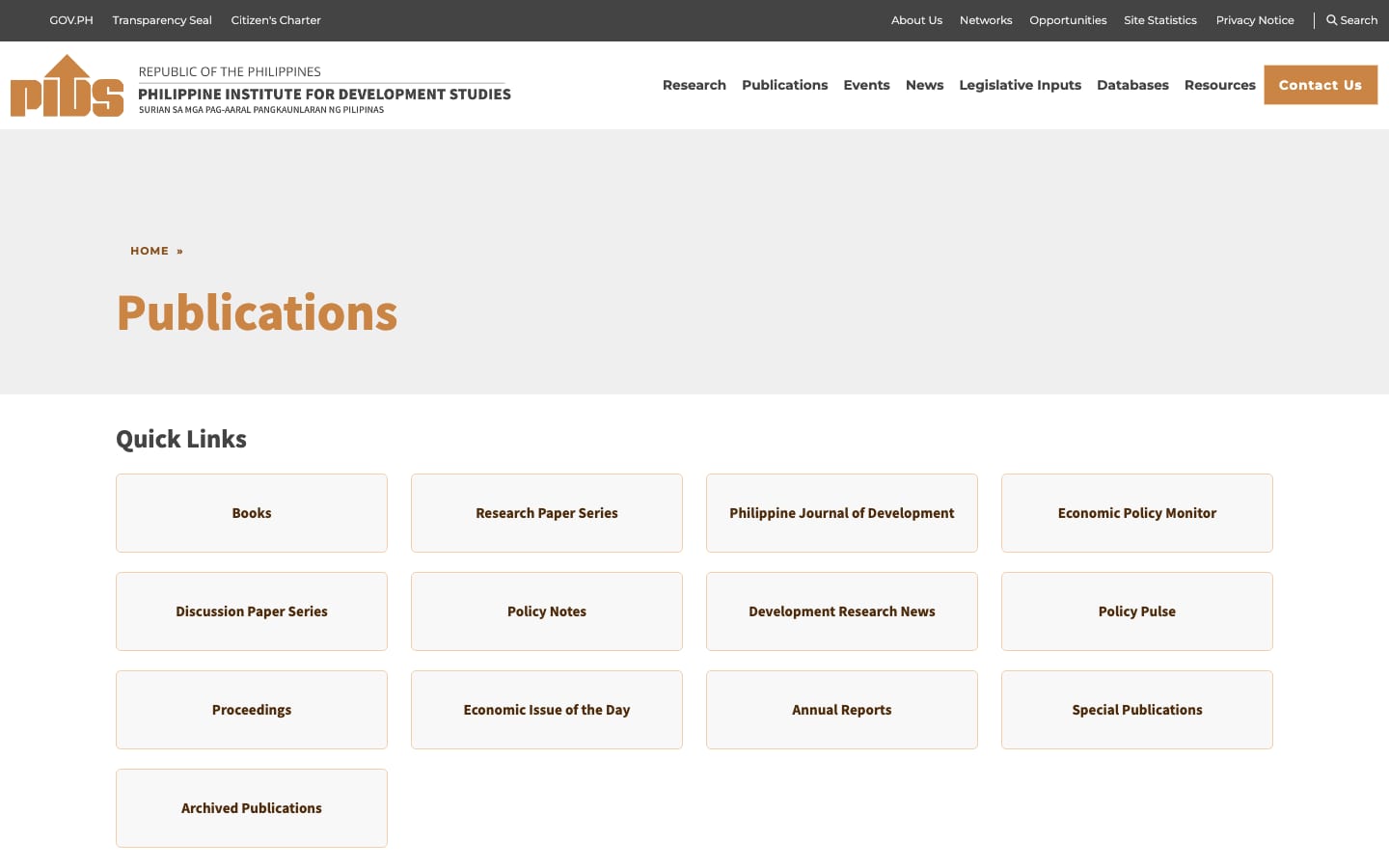
PIDS is "the Philippine government's primary socioeconomic policy think tank," created in 1977. It publishes discussion papers, policy notes, research papers and the Philippine Journal of Development.
Neither test search found a PIDS paper on the exact topic, even with the publication filter, though the education search returned useful Philippine education policy papers. Use PIDS for national context, such as education spending, learning outcomes and policy, rather than for classroom or psychology studies.
Key features
- Discussion papers, policy notes and the Philippine Journal of Development
- Filters by content type, focus area (such as labor and education, or health) and year
- Free downloads with a CAPTCHA, no account
Pros
- Authoritative Philippine data and policy analysis
- Free to download
- Good for the background and significance parts of a study
Cons
- Economics and policy only
- Most papers are not peer-reviewed journal articles
- Site search mixes news with research and sorts by date
Pricing: Free.
Best for: Philippine policy context and statistics in the introduction or background of an RRL.
How to Use Google Scholar for Your RRL
Many students start with Google Scholar, and a few of its own features make it much more useful for an RRL. The first four tips quote its help page.
- Search exact titles and phrases. "Put the paper's title in quotations." The same works for key phrases, such as "modular distance learning".
- Follow citation trails forward. If results are too general, "click 'Cited by' to see newer papers that referenced them. These newer papers will often be more specific."
- Find similar studies. "Click 'Related articles' or 'Cited by' to see closely related work."
- Meet your school's recency rule. "Click 'Since Year' to show only recently published papers, sorted by relevance."
- Set an alert. Click the envelope icon to have new results for your search sent to you by email.
- Add "Philippines" for local studies. Adding the country or a region to your search helps surface local studies among the foreign ones.
Google Scholar's Cite button exports to reference managers. Check every exported citation against the article itself before it goes into your reference list. The guide to citation searching from a key paper shows how to follow citation trails in more depth.
How the Paperguide RRL Workflow Works
Paperguide connects the steps of an RRL in one place:
- Find: enter your topic in the RRL Finder to get related studies grouped by theme, then add local studies from Philippine E-Journals or your university repository.
- Organize: save the studies you keep in the Reference Manager, which stores each source with its metadata and PDF and formats your reference list in APA 7 or more than 1,000 other citation styles.
- Synthesize: run Literature Review AI on your question to see where the evidence converges and conflicts, with every claim cited to a source paper. Use it to check your own synthesis matrix, not to replace it.
- Write: draft each theme yourself, following the steps for writing an RRL for Chapter 2, and compare your paragraphs with RRL examples built from real studies.
Check your school's policy on AI tools before you use them in a graded paper.
Best RRL Sites by Use Case
Which RRL Site to Use for Which Need
| Need | Best site | Also try |
|---|---|---|
| A fast, themed starting list | Paperguide RRL Finder | Google Scholar |
| Local studies, any field | Philippine E-Journals | DOAJ (with "Philippines") |
| Foreign studies, any field | Google Scholar | DOAJ |
| Free full text only | DOAJ | PubMed Central |
| Education topics | ERIC | Philippine E-Journals |
| Health, nursing, psychology | PubMed | HERDIN |
| Local health studies | HERDIN | Philippine E-Journals |
| Local theses (related studies) | DLSU Animo Repository | Your university library |
| Philippine policy and statistics | PIDS | Philippine E-Journals |
Final Comparison
Final Comparison: Strengths and Limits of Each RRL Site
| Site | Biggest strength | Biggest limit |
|---|---|---|
| Paperguide RRL Finder | Themed results from a plain-language topic | Does not separate local and foreign studies |
| Philippine E-Journals | Relevant local studies with free full text | Search matches any word, so counts are inflated |
| Google Scholar | Very wide coverage and citation trails | No peer-review filter, many abstracts only |
| DOAJ | Every result free to read | Misses subscription journals |
| ERIC | Peer-reviewed and full-text filters | Education only |
| PubMed and PMC | Standard for health topics, APA Cite button | Few Philippine education studies |
| HERDIN | National repository of local health research | Health only; full text by request |
| DLSU Animo Repository | Local theses with free PDFs | One university only |
| PIDS | Authoritative policy context | Not for classroom or psychology studies |
Common Mistakes When Searching RRL Sites
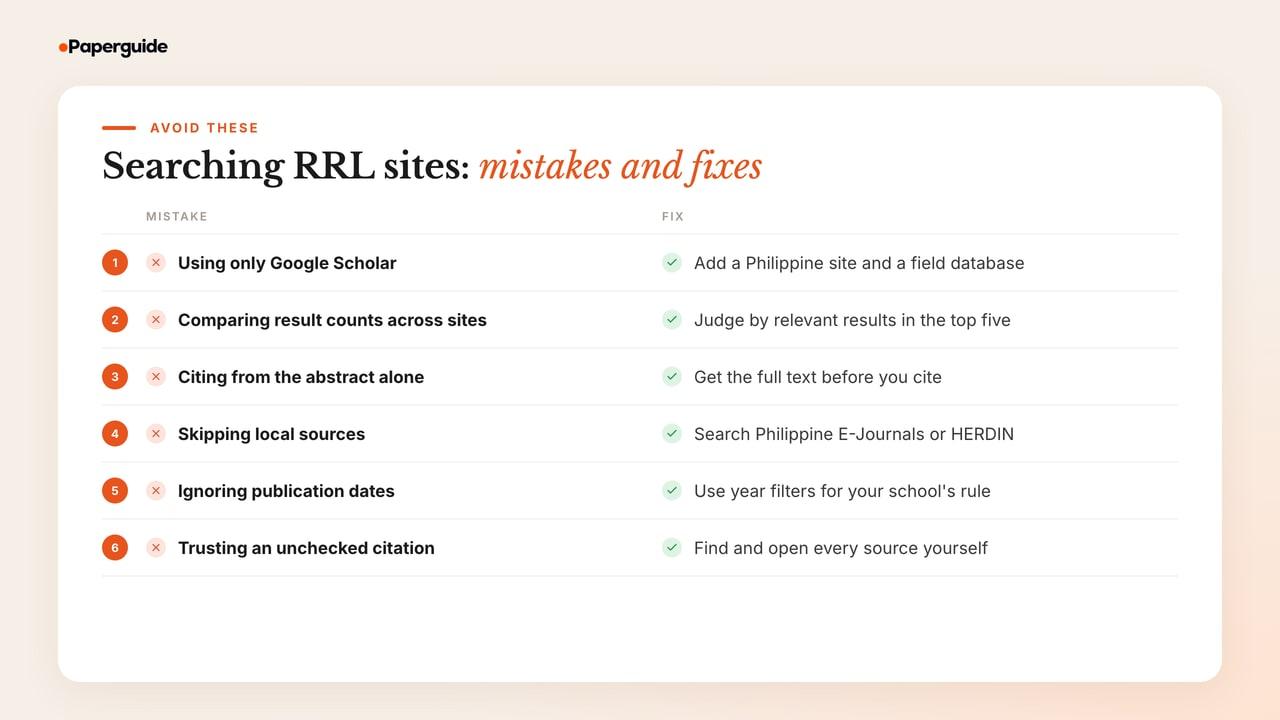
Using only Google Scholar. It is broad but unfiltered, and local studies can be buried. Add a Philippine site and a field database.
Comparing result counts across sites. A site that matches any word will always show more results. Judge sites by how many of the top results are relevant.
Citing from the abstract alone. The abstract may not support the point you want to make. Get the full text through the site, your library or the author before you cite.
Skipping local sources. Foreign studies alone cannot show that your problem exists in the Philippines. Search Philippine E-Journals, HERDIN or a repository too.
Ignoring publication dates. Use the year filters to meet your school's recency rule, and keep older studies only when they are classics on your topic.
Trusting a citation you have not checked. Citations copied from other students' papers or from AI chatbots can be wrong or invented: in one study, 55% of the references GPT-3.5 generated were fabricated [1]. Find each source on one of these sites and open it.
Final Verdict
Start with Paperguide's RRL Finder to see the themes and the key studies on your topic in one list. Then add local studies from Philippine E-Journals, and foreign studies from Google Scholar and DOAJ. Finish with the database for your field: ERIC for education, PubMed for health, HERDIN for local health research, PIDS for policy context and your university repository for theses.
In our test, Philippine E-Journals and DOAJ returned the most relevant results for a Philippine education topic, and DOAJ and PubMed for a psychology topic. No one site is enough on its own, but three or four of these, chosen for your field, will cover what most RRLs need. For more AI options, see the comparison of RRL finder tools for literature reviews, and for databases beyond these nine, the guide to academic search engines for students.
Frequently Asked Questions (FAQs)
What is the best site for RRL?
There is no single best site. Paperguide's RRL Finder gives a themed starting list, Philippine E-Journals is the strongest free source of local studies, and Google Scholar, DOAJ, ERIC and PubMed cover foreign studies. Use at least one local and one foreign site.
What are the best local RRL websites in the Philippines?
Search Philippine E-Journals for Philippine journal articles, HERDIN for health research, PIDS for economic and policy studies, and university repositories such as the DLSU Animo Repository for theses. Your school library may also hold unpublished local theses.
Where can I find foreign RRL?
Google Scholar, DOAJ, ERIC and PubMed are free sources of foreign studies. DOAJ is useful when you need free full text, ERIC for education and PubMed for health topics.
Is Google Scholar good for RRL?
Yes, for breadth. It covers journals, theses, books and preprints from most major academic publishers and repositories and has useful "Cited by" and "Related articles" links. It has no peer-review filter, though, and many results are abstracts only, so check each source.
Are RRL sites free?
All nine sites in this guide are free to search. Full text varies: DOAJ and PubMed Central are free to read, HERDIN offers full text on request with a free account, and Google Scholar often links to paywalled articles.
How do I get the full text of a study I found?
Use the site's free full-text filter, look for a PDF link or an "All versions" link, check your school library, or request it through HERDIN Document Delivery for local health studies. Do not cite a study from its abstract alone.
Can I use theses as RRL sources?
Yes. Some Philippine schools treat theses and dissertations as related studies. University repositories such as the DLSU Animo Repository and HERDIN hold many of them, though they are not peer-reviewed journal articles.
Can AI find RRL sources for me?
AI search tools that work from real databases, such as Paperguide's RRL Finder, can speed up finding sources. AI chatbots that generate citations from memory can invent them [1]. Open and check every source before you cite it.
References
Site descriptions and quotes come from each site's own About or help page, accessed and tested on 9 November 2026.
- Walters, W. H., & Wilder, E. I. (2023). Fabrication and errors in the bibliographic citations generated by ChatGPT. Scientific Reports, 13, 14045. https://doi.org/10.1038/s41598-023-41032-5
Reviewing literature?
Generate your literature review
Categorized sources, citations and key insights from a single topic.
Try it freeNo credit card required