5 Best AI Tools for Systematic Review in 2026 (Free + Paid)


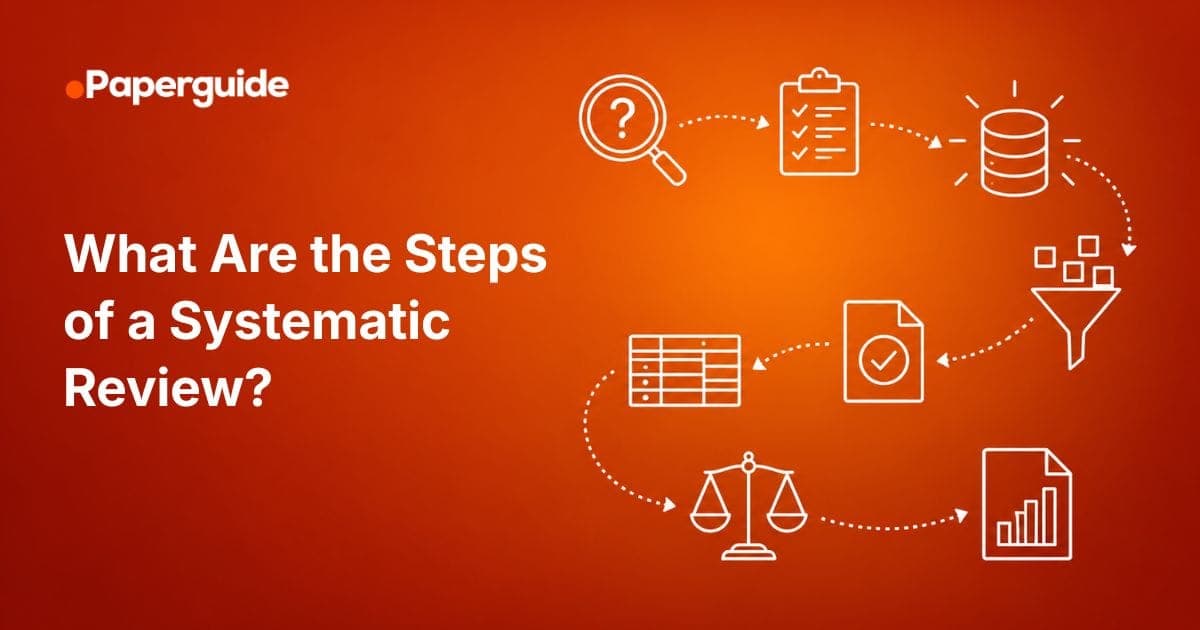
Systematic reviews are the gold standard of evidence synthesis in 2026, but they have become impossibly slow to produce by hand. A 2025 Cochrane Evidence Synthesis and Methods bibliographic study analyzed 8,137 Cochrane protocols and found that only 71.9% progressed to a published review, with a median time of 25.7 months from protocol to publication (retrieved July 2026). Cochrane's own methodological guidance still pegs the average systematic review at roughly 18 months of active work. Meanwhile, the rate of biomedical and life-science publication continues to outpace what any team can screen manually, leaving systematic review teams further behind every quarter.
AI tools for systematic review have changed the math. A 2024 Systematic Reviews journal analysis of AI-enhanced evidence synthesis found that current AI screening and extraction tools can reduce manual workload by 50% to 75% across literature screening, data extraction, and risk-of-bias assessment, without sacrificing PRISMA-grade accuracy when paired with researcher oversight (retrieved July 2026). To keep reporting transparent under AI assistance, JMIR AI published the PRISMA-trAIce checklist in 2025, an extension of PRISMA 2020 that researchers can use to disclose exactly how AI was used in each stage of their review.
This guide tests the 5 best AI tools for systematic review in 2026 that PRISMA-grade research teams, Cochrane authors, principal investigators, and systematic review specialists are actually keeping in their workflow. Verified pricing, real capability boundaries, and honest positioning on where each one fits across literature screening, data extraction, synthesis, and reporting.
TL;DR
Paperguide is the best AI tool for systematic review in 2026. It is an AI-native platform for scientific research workflows and evidence synthesis, runs the full PRISMA-grade systematic review pipeline in one workspace through Paperguide Systematic Review, its dedicated module: define a protocol, screen from 1,000 papers on Plus up to 20,000 on Enterprise, run AI-led or dual-review blind screening, extract structured data with quote-level citations, and generate a PRISMA 2020 flow diagram and citation-grounded synthesis with an audit trail. Elicit is the strongest dedicated screening tool at the very top of the volume range (5,000 papers on Pro, 40,000 on Enterprise). Rayyan is the strongest free tool for collaborative title-and-abstract screening, with PRISMA flow diagram generation on its paid Essential plan. DistillerSR is the enterprise standard for regulated systematic reviews in pharma and medical devices. SciSpace offers a connected Deep Review workflow with the broadest paper corpus.
Key Takeaways
- Paperguide is the #1 AI tool for systematic review in 2026 because it automates the full PRISMA-grade pipeline (search, screen, extract, synthesize, cite) inside one AI-native research platform.
- Elicit Pro is the strongest dedicated systematic review tool at scale, screening 5,000 papers per review on Pro and up to 40,000 on Enterprise with PRISMA-grade accuracy.
- Rayyan is the strongest free collaborative screening tool with AI relevance predictions and duplicate detection, plus PRISMA flow diagram generation on the Essential plan.
- DistillerSR is the enterprise standard for regulated systematic reviews (pharma CER submissions, medical device literature reviews, HEOR studies).
- SciSpace Deep Review handles synthesis and Lit Tables with a 270M+ paper corpus for cross-disciplinary review work.
- AI workload reduction is 50 to 75% across systematic review stages according to recent evidence synthesis literature, with PRISMA-trAIce now providing the disclosure framework for transparent AI-assisted reviews.
What is the best AI tool for systematic review in 2026?
The best AI tool for systematic review in 2026 is Paperguide. Paperguide Systematic Review automates the full systematic review pipeline (search across 200M+ peer-reviewed papers, structured screening, custom-column data extraction, citation-grounded synthesis, and PRISMA-style reporting) in one workspace, while Literature Review AI and the Deep Research Report cover smaller, focused reviews. For research teams that need dedicated screening at very large scale, Elicit Pro handles 5,000-paper reviews and Elicit Enterprise handles 40,000-paper reviews. For regulated pharma and medical device reviews, DistillerSR remains the enterprise standard.
Systematic Review vs Meta-Analysis: Key Differences
| Feature | Systematic Review | Meta-Analysis |
|---|---|---|
| Definition | A structured review process that identifies, evaluates, and synthesizes all available research on a specific question | A statistical method that pools data from multiple compatible studies to calculate an overall effect estimate |
| Primary Purpose | Gather and critically evaluate all relevant studies | Generate a precise numerical estimate of an effect based on pooled data |
| Nature | Focused on qualitative synthesis and in-depth analysis | Primarily quantitative and statistical |
| Study Types Included | Variety of designs, both qualitative and quantitative | Only studies with compatible numerical data |
| Approach to Evidence | Inclusive review of a broad range of studies | Selective based on statistical compatibility |
| Analysis Method | Narrative synthesis, thematic analysis, or content analysis | Fixed or random effects models, meta-regression |
| Time Required | Typically 6 to 18 months (Cochrane reviews median 25.7 months protocol-to-publication, Li 2025) | 9 to 18 months, often including the systematic review phase |
All meta-analyses are conducted as part of, or in the same methodological tradition as, systematic reviews. However, not all systematic reviews include a meta-analysis: when included studies are too heterogeneous or purely qualitative, a meta-analysis is not appropriate. For a full breakdown of how the two methods relate, see our guide to systematic review vs meta-analysis.
Top 5 AI Tools for Systematic Review in 2026 (Quick Comparison)
| Tool | Best For | Screening capacity | Citation grounding | Paid entry |
|---|---|---|---|---|
| Paperguide | Full PRISMA pipeline in one workspace | 1,000 (Plus) to 20,000 (Enterprise) papers | Verified against 200M+ papers | $12/mo (annual) |
| Elicit | Dedicated screening at the top of the range | 5,000 (Pro) to 40,000 (Enterprise) papers | Source-grounded | $49/mo Pro (annual) |
| Rayyan | Free collaborative title-and-abstract screening | 3 active reviews (free) | Screening labels | $4.99/mo Essential (annual) |
| DistillerSR | Regulated pharma and medical device reviews | Enterprise scale | Audit-grade | Quote-based |
| SciSpace | Broad cross-disciplinary corpus | Deep Review workflow | Suggestive | $12/mo Premium (annual) |
These five tools cover the systematic review pipeline, but Paperguide is the only platform in the list that runs every PRISMA stage (protocol, search, screening, extraction, synthesis, citation) inside a single citation-grounded workspace.
Why AI Tools Are Essential for Systematic Reviews in 2026
Systematic reviews remain the most rigorous form of evidence synthesis in scientific research, but the traditional manual process is no longer scalable. A research team running a clinical systematic review will typically screen between 2,000 and 20,000 abstracts to arrive at a final included set of 30 to 80 papers, then extract dozens of structured fields from each included study, assess risk of bias, and synthesize findings across heterogeneous study designs. This workflow consumes hundreds of researcher hours per review.
AI tools for systematic review compress this work in three ways:
- Title-and-abstract screening is accelerated by AI relevance predictions that learn from the first batch of reviewer decisions, surfacing the most likely-relevant papers first and pushing low-relevance papers to the bottom of the queue. Combined with deduplication, this can reduce screening time by 50 to 75% (Systematic Reviews, 2024).
- Structured data extraction is automated through custom-column extraction templates that pull intervention, comparator, outcome, study design, sample size, effect size, and other PRISMA-relevant fields directly from full-text PDFs into evidence tables.
- Synthesis and reporting is shortened by AI-generated review drafts that pull from screened and extracted studies with citations applied automatically, eliminating the manual citation-stitching step that introduces most reference errors.
For PRISMA-grade reporting transparency under AI assistance, the PRISMA-trAIce checklist (JMIR AI, 2025) gives systematic review teams a structured disclosure framework covering which AI tool was used, at which stage, with which oversight protocol, so AI-assisted reviews remain auditable and publishable in journals that follow the PRISMA guidelines.
Best AI Tools for Systematic Review in 2026
1. Paperguide
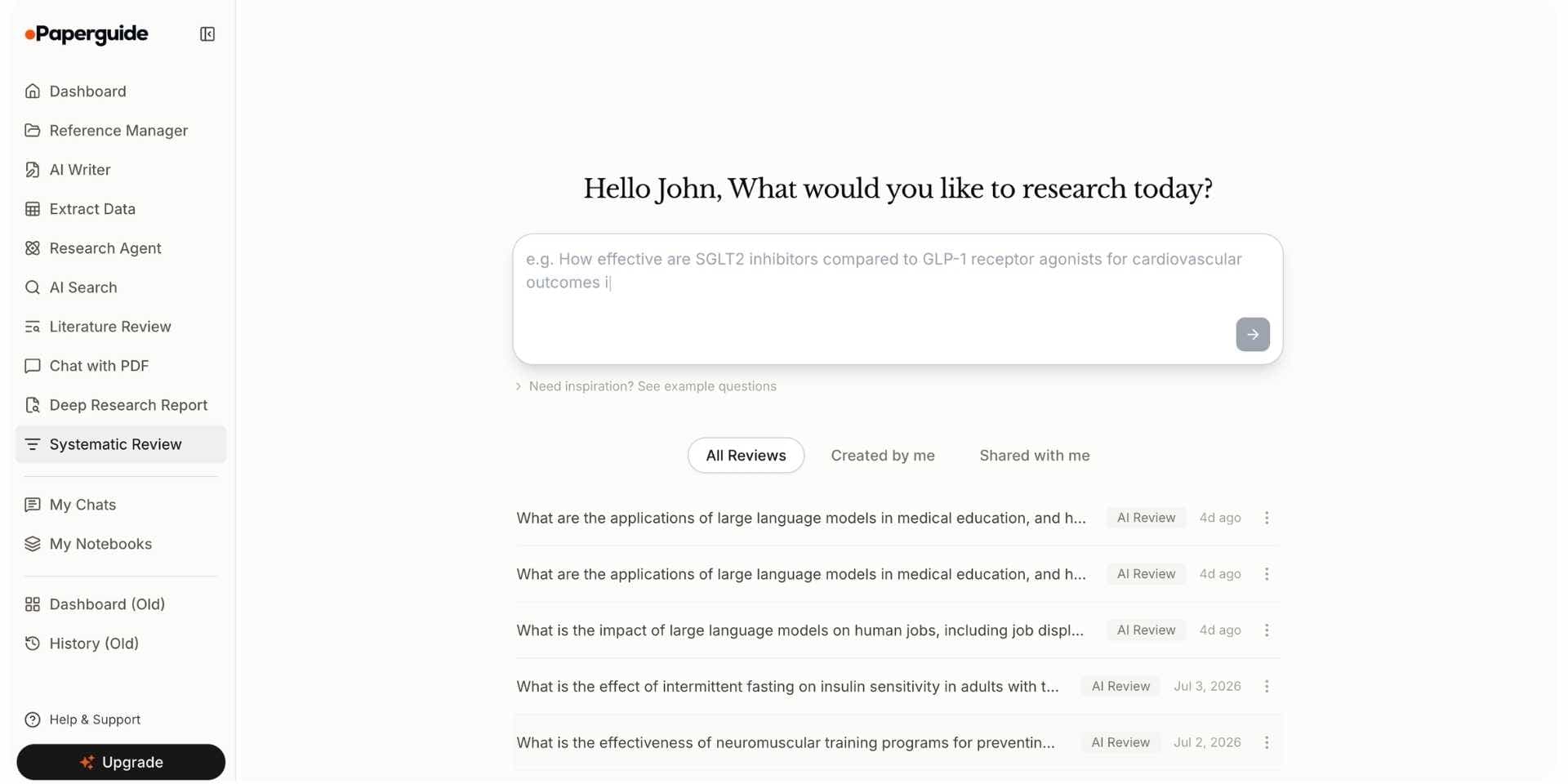
Paperguide is the AI-native platform for scientific research workflows and evidence synthesis. For systematic reviews specifically, Paperguide Systematic Review runs the full PRISMA-grade pipeline in one workspace: a researcher defines a protocol, and Paperguide handles hybrid semantic and keyword search across 200M+ peer-reviewed papers (PubMed, arXiv, OpenAlex, Semantic Scholar), AI-led or dual-review blind screening at both the abstract and full-text stage, custom-column structured data extraction with quote-level citations, a PRISMA 2020 flow diagram, an audit trail, and a citation-grounded synthesis with every claim linked to a verified source paper. Review capacity runs from 1,000 papers on Plus to 5,000 on Pro and Evidence Teams, and 20,000 on Enterprise. The AI Reference Manager keeps every screened, included, and excluded paper organized inside the same workspace, whether the review is run by an individual researcher or a full evidence synthesis team.
The platform is built on a few non-negotiable principles: every answer, extraction, and draft is grounded in a verified source paper; results are drawn from a 200M+ peer-reviewed paper database with paper quality evaluation using SJR, SNIP, and citation metrics; findings are synthesized across studies rather than summarized one paper at a time; and human oversight sits inside every PRISMA stage so researchers retain control.
Key Features
- Systematic Review. Six-stage workflow (Protocol, Papers, Abstract Screening, Full-Text Screening, Data Extraction, Generate Report) with AI-led screening for speed or dual-review blind screening for defensibility. Review capacity from 1,000 papers on Plus to 20,000 on Enterprise.
- Protocol builder and decision log. AI drafts eligibility criteria and extraction fields for you to edit, a saved protocol re-runs over new papers, search results are pooled with your library and deduplicated before screening, and every decision is logged with its criterion, evidence and who confirmed it.
- PRISMA-grade dual-review blind screening (Evidence Teams and Enterprise). Two reviewers screen blind to each other, with a conflict queue, lead-resolved conflicts, and Cohen's kappa inter-rater tracking. A PRISMA 2020 flow diagram builds in real time and exports as SVG, PNG, or PDF, and the project audit trail exports as CSV or PDF.
- AI Search across 200M+ peer-reviewed papers. Hybrid semantic and keyword search across PubMed, arXiv, OpenAlex, and Semantic Scholar, with an agentic layer that runs multiple query variations in parallel and returns cited answers.
- Extract Data. Pull custom columns (sample size, intervention, comparator, outcome, methodology, effect size, study design, risk of bias) into evidence tables, each item linked back to its source passage. Image and table extraction is coming soon on Pro and above. Export to CSV or Excel for downstream meta-analytic work in R or RevMan.
- AI Paper Writer. Drafts the systematic review manuscript from the extracted data and source material, with citations applied automatically against the actual library. Every reference is verified against a real paper. Supports 1,000+ citation styles including Vancouver, AMA, APA, and journal-specific formats.
- AI Reference Manager. Every screened paper sits in one workspace. Import via DOI, URL, BibTeX, RIS, PDF, or one-click Zotero and Mendeley migration. Built-in PDF viewer, annotations, shared libraries with role-based permissions for team reviews.
- Chat with PDF. Interact directly with any included paper. Ask methodology questions, extract specific data points, and compare findings across multiple documents without re-reading.
- Literature Review AI and Deep Research Report. For smaller, focused reviews, Literature Review AI runs a five-step Plan, Search, Screen, Extract, Synthesize sequence (Standard mode up to 50 papers, Extended mode up to 200). Deep Research Report runs the same pipeline with manual control at every stage.
- Team collaboration. Real-time shared workspace with roles per stage (Edit, Reviewer, View-only), per-stage assignments, and review-level activity logs for PRISMA audit trails.
Pros
- Only platform that consolidates the full PRISMA workflow (protocol, search, screen, extract, synthesize, write, cite) in one citation-grounded workspace.
- Review capacity from 1,000 to 20,000 papers covers most clinical and academic systematic reviews end to end.
- Dual-review blind screening with conflict resolution and Cohen's kappa tracking built into the same tool as search and writing.
- 200M+ peer-reviewed papers across four major scientific databases including PubMed for clinical reviews.
- Verified citation retrieval eliminates fabricated reference risk at the architecture level.
- Free plan includes Deep Research Report, Literature Review AI, and Chat with PDF at $0.
Cons
- The Free tier has no systematic review capacity; review capacity starts on Plus (up to 1,000 papers).
- PRISMA-grade dual-review blind screening is limited to Evidence Teams and Enterprise.
- Single-review screening tops out at 20,000 papers on Enterprise; the very largest pools beyond that need to be split into sub-reviews (Elicit Enterprise screens up to 40,000 per workflow).
- Monthly AI credit allowances can cap very high-volume extraction work on Free and Plus.
Pricing
Paperguide prices on AI credits and systematic review capacity (Paperguide pricing):
| Plan | Price (annual) | AI credits/mo | Systematic review cap | Notable |
|---|---|---|---|---|
| Free | $0 | 2,000 | Not included | Limited Reference Manager, Chat with PDF, Deep Research Report |
| Plus | $12 per seat/mo, billed annually ($144/yr) | 12,500 | Up to 1,000 papers | Unlimited AI Searches and Reference Manager |
| Pro | $29 per seat/mo, billed annually ($348/yr) | 50,000 | Up to 5,000 papers | Image and table extraction coming soon |
| Evidence Teams | $89 per seat/mo, billed annually ($1,068/yr) | 150,000 | Up to 5,000 papers | Adds PRISMA-grade dual-review screening |
| Enterprise | Custom | Custom | Up to 20,000 papers | SSO, SAML, single-tenancy |
Best For
Individual researchers, systematic review teams, Cochrane authors, principal investigators, research labs, postdocs, and evidence synthesis teams conducting PRISMA-grade systematic reviews and meta-analyses where citation integrity, audit transparency, and end-to-end workflow consolidation matter.
Verdict
Paperguide is the best AI tool for systematic review in 2026 because no other platform consolidates the full PRISMA-grade workflow, from protocol through dual-review blind screening to a cited manuscript, inside one workspace at this price. For research teams running systematic reviews and meta-analyses where audit transparency, citation integrity, and end-to-end workflow matter, Paperguide is the default starting point.
2. Elicit
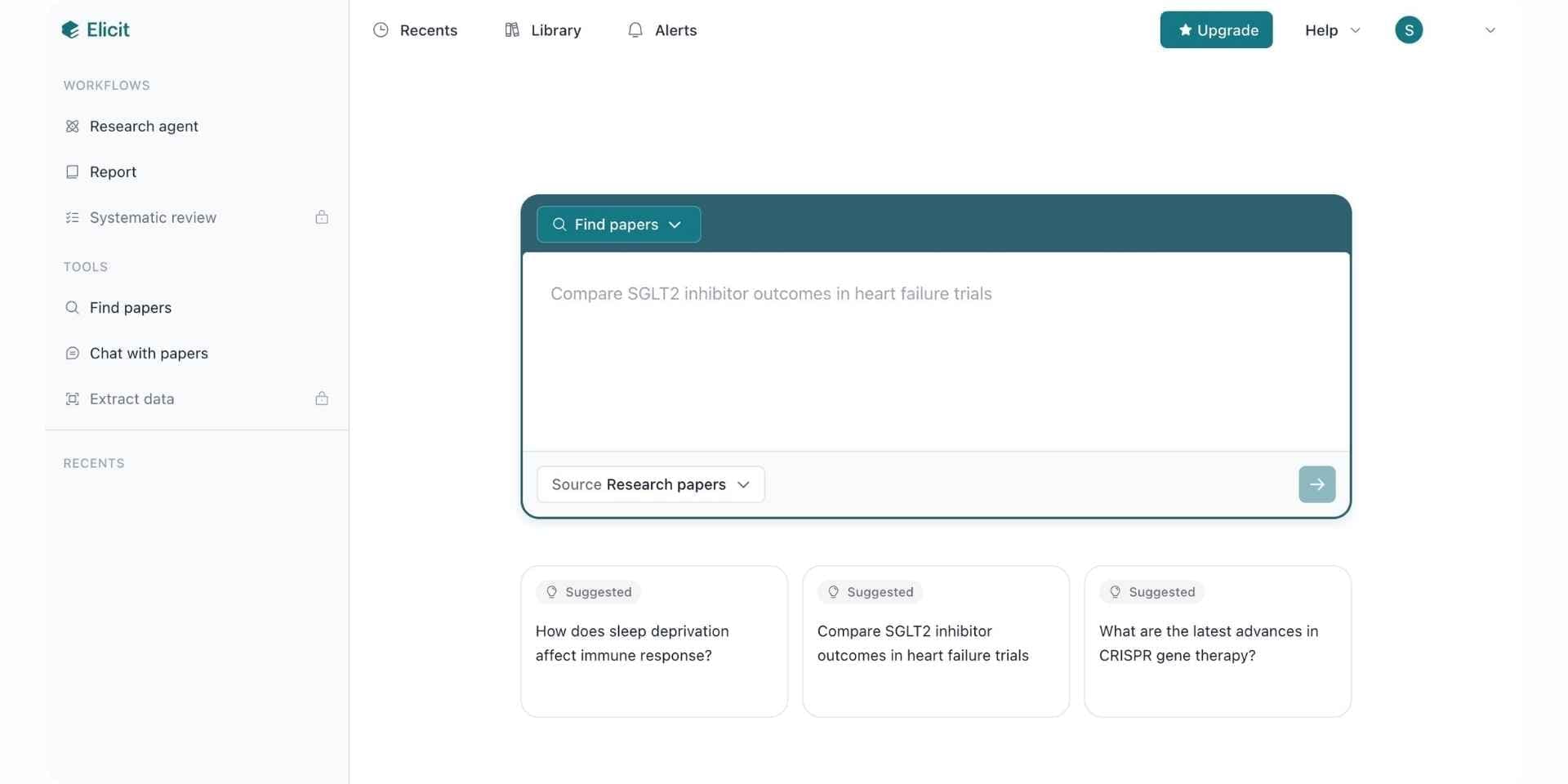
Elicit is a leading dedicated AI tool for structured systematic review screening at scale. The platform searches a 125M+ paper corpus and provides a dedicated Systematic Review Workflow that screens up to 5,000 papers on the Pro plan and 40,000 papers on Enterprise with PRISMA-grade accuracy. Structured extraction templates with up to 20 custom columns on Pro (30 on Scale, 40 on Enterprise) make Elicit a strong pick for Cochrane-style large-scale reviews where screening volume is the bottleneck.
Elicit is purpose-built for the screening and extraction stages of a systematic review. Its Report mode generates narrative-style synthesis reports, but there is no citation-grounded document editor for manuscript drafting and no full reference manager, so research teams typically pair Elicit with a separate writing and reference workspace.
Key Features
- Dedicated Systematic Review Workflow: built-in PRISMA-style screening pipeline with inclusion/exclusion criteria, dual-reviewer support, and audit trail.
- Screening at scale: 5,000 papers per review on Pro, 40,000 on Enterprise with PRISMA-grade accuracy.
- Structured extraction: custom column extraction templates with 20 columns on Pro, 30 on Scale, 40 on Enterprise.
- 125M+ paper corpus: cross-disciplinary academic search with study-design filters.
- Concept search: semantic search built for research questions rather than keyword lookup.
- AI-generated summaries: per-paper structured summaries surface methodology and findings for fast relevance assessment.
- Live editing and team collaboration: real-time multi-user editing on Notebooks and Systematic Review workflows (Scale and Enterprise plans).
- API access: available on Pro and above for custom integrations into team review pipelines.
Pros
- Highest single-workflow screening ceiling in the category (up to 40,000 papers on Enterprise).
- Screening volume (5,000 to 40,000 papers) suits the very largest Cochrane-style pools.
- PRISMA-grade screening accuracy claim at Enterprise.
- Mature, widely adopted by Cochrane and clinical evidence teams.
Cons
- The Systematic Review Workflow requires Pro at $49/month; the free Basic tier covers limited extraction but not large-scale screening.
- No citation-grounded document editor for manuscript drafting and no full reference manager.
- Extraction depth limited to 20 columns at the Pro tier (most clinical PRISMA forms need 25 to 35 fields).
- Repeated searches can return different paper sets, complicating the search documentation PRISMA requires.
- Smaller paper corpus than SciSpace (270M+) or Paperguide (200M+ peer-reviewed).
Pricing
| Plan | Price | What It Covers |
|---|---|---|
| Basic | $0 | 2 extraction columns, limited monthly usage |
| Pro | $49/mo annual ($588/yr) | 5,000-paper screening, 20-column extraction |
| Scale | $169/mo annual ($2,028/yr) | Higher screening volumes, 30-column extraction |
| Enterprise | Custom | 40,000-paper screening, 40-column extraction |
Best For
Research teams running the very largest systematic reviews and meta-analyses (especially Cochrane-style clinical reviews) where screening 5,000 to 40,000 papers per review is the bottleneck.
Verdict
Elicit is the strongest dedicated tool for systematic review screening at the top of the volume range in 2026. For research teams that need PRISMA-grade screening beyond 20,000 papers per review and can pair with a separate writing and reference workspace, Elicit Enterprise is the right pick. For teams that want end-to-end PRISMA workflow consolidation inside one platform (protocol, search, screen, extract, synthesize, write, cite) at a fraction of the price, Paperguide is the strongest Elicit alternative in 2026.
3. Rayyan
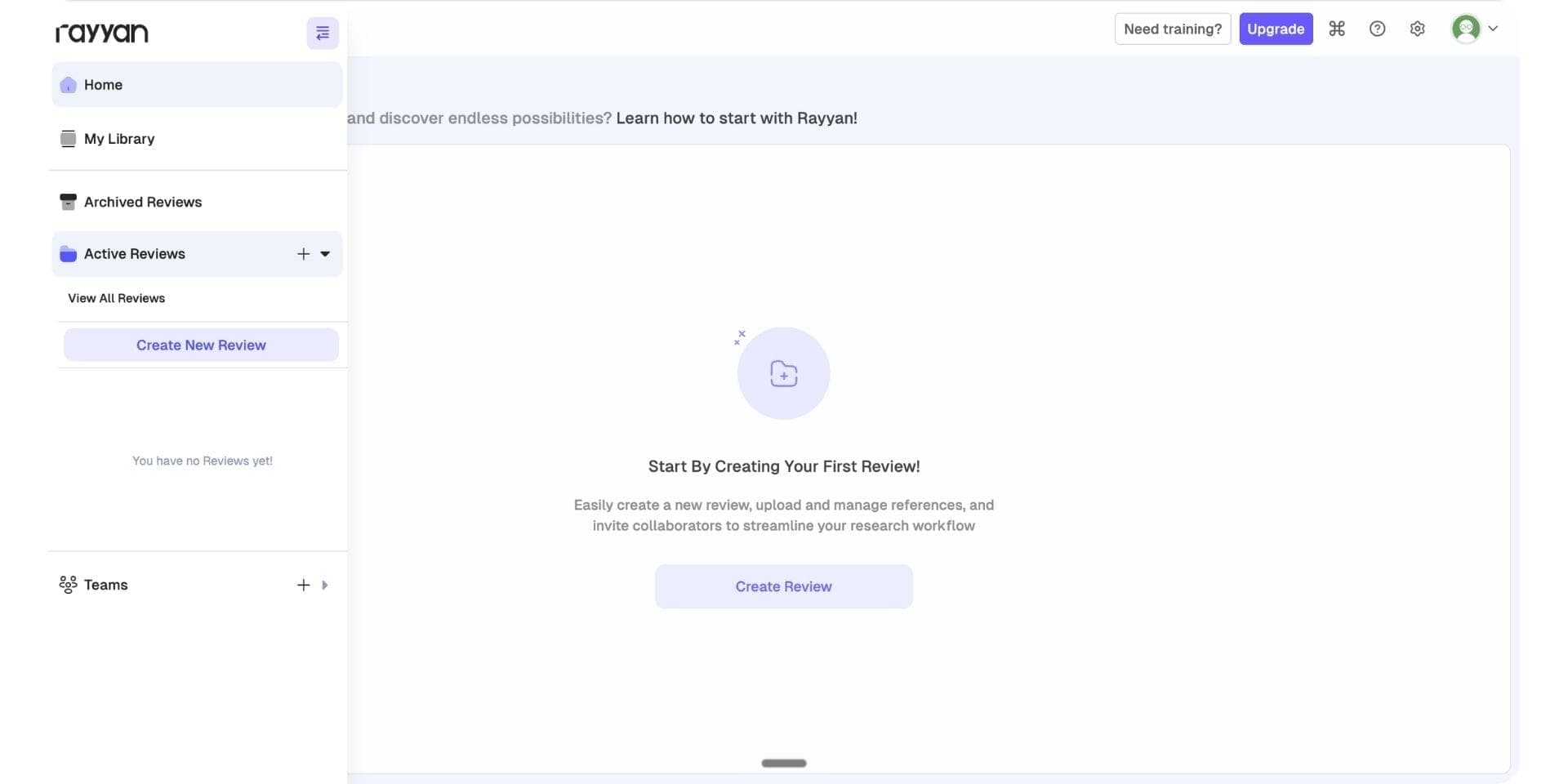
Rayyan is the most widely used free collaborative tool for the title-and-abstract screening phase of a systematic review. Trusted by over 1 million researchers across 20,000+ institutions in 190+ countries, Rayyan provides industry-leading duplicate detection, AI relevance predictions that learn from reviewer decisions, and PRISMA flow diagram generation on its paid Essential plan and above. The collaborative review setup (multiple blinded reviewers screening in parallel) is mature and battle-tested across thousands of published systematic reviews.
Rayyan is purpose-built for the screening stage. It does not include native structured data extraction, synthesis, or manuscript writing, so research teams typically pair Rayyan with separate tools for downstream stages of the review.
Key Features
- AI relevance predictions: machine learning learns from initial reviewer decisions and surfaces likely-relevant papers first.
- Industry-leading duplicate detection: auto-resolve duplicates across multiple database exports.
- Collaborative blinded screening: multiple reviewers can screen the same study set in parallel with conflict resolution.
- PRISMA flow diagrams: generated natively on Essential plan and above for publication-ready PRISMA reporting.
- PICO extraction with AI: automatic extraction of Population, Intervention, Comparator, Outcome fields (Advanced plan).
- AI agents for screening acceleration: available on Advanced plan and above.
- Workbench filters: 15+ workbench facets for organizing and filtering screened studies.
- Mobile app: screen on iOS and Android for parallelized team screening.
- ResearchPilot AI: AI assistant available on Business and Enterprise tiers.
Pros
- Free plan covers 3 active reviews with 2 reviewers, AI relevance predictions, and duplicate detection.
- Most widely adopted free systematic review screening tool globally.
- PRISMA flow diagram generation (Essential and above) is publication-ready.
- Strong collaborative blinded-screening experience.
Cons
- Native screening only, with no structured data extraction, synthesis, or manuscript writing.
- Free plan capped at 3 active reviews and 2 reviewers.
- Most powerful features (PRISMA flow diagrams, AI agents, PICO extraction, ResearchPilot) sit behind Essential, Advanced, and Business tiers.
Pricing
| Plan | Price | What It Covers |
|---|---|---|
| Free | $0 | 3 active reviews, 2 reviewers, AI relevance predictions, duplicate detection |
| Essential | $4.99/mo annual ($59.88/yr) | 5 reviewers, PRISMA flow diagram generation, additional AI features |
| Advanced | $8.33/mo annual ($99.99/yr) | 9 active reviews, 10 reviewers, AI PICO extraction, AI agents |
| Business / Academic | Custom | Institutional licensing with ResearchPilot AI |
| Enterprise | Custom | Institutional licensing with SSO/SAML and dedicated support |
Best For
Research teams that need free, collaborative, blinded title-and-abstract screening for systematic reviews, with PRISMA flow diagrams available on the affordable Essential tier.
Verdict
Rayyan is the strongest free collaborative title-and-abstract screening tool for systematic reviews in 2026 and remains a default screening choice for Cochrane and clinical evidence teams. For research teams that need screening plus structured data extraction, synthesis, and citation-grounded writing inside one workspace rather than three, Paperguide is the strongest Rayyan alternative in 2026.
4. DistillerSR
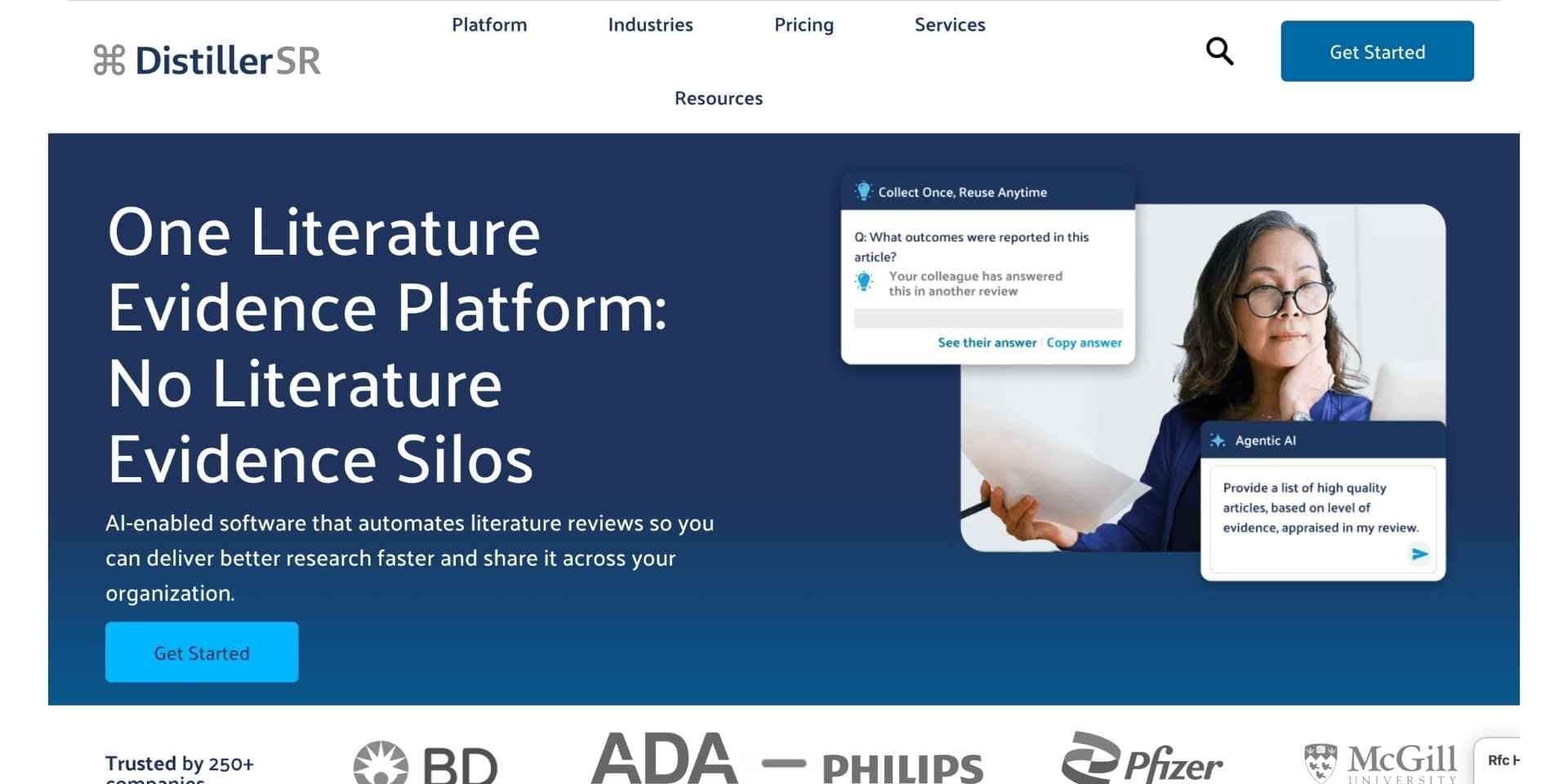
DistillerSR is the enterprise standard for regulated systematic reviews in pharmaceutical, medical device, HEOR (Health Economics and Outcomes Research), and clinical evidence work. Built by Evidence Partners and used by major pharmaceutical companies and regulatory consultancies for CER (Clinical Evaluation Report) submissions, DistillerSR provides automated study selection, AI-powered data extraction, risk of bias assessment, and customizable workflows that meet regulatory body documentation standards (FDA, EMA, MDR).
DistillerSR is enterprise-grade software with enterprise-grade pricing. It is the strongest pick for regulated environments where audit trails, dual-reviewer compliance, and customizable PRISMA-plus workflows are non-negotiable.
Key Features
- Automated study selection: AI-driven screening with dual-reviewer enforcement and configurable conflict resolution.
- AI-powered data extraction: custom extraction forms with regulatory-grade audit logs.
- Risk of bias assessment: configurable quality assessment frameworks, including standard risk-of-bias instruments and custom forms.
- Customizable workflows: tailor every PRISMA stage to the specific regulatory framework (CER, RWE, HTA).
- Real-time team collaboration: multi-reviewer parallel screening with shared audit trail.
- Advanced reporting: detailed PRISMA flow diagrams, screening reports, and audit logs ready for regulatory submission.
- Dual screening enforcement: configurable dual-reviewer requirements with conflict resolution workflows.
- Integration with reference managers: imports from EndNote, RefWorks, and other enterprise reference systems.
Pros
- Enterprise standard for regulated systematic reviews.
- Deepest audit and reporting features in the category.
- Customizable workflows fit any regulatory framework.
- Mature, battle-tested in pharma CER and medical device submissions.
Cons
- Highest cost in this comparison, with pricing quote-based rather than public.
- Steep learning curve for new users.
- No permanent free plan; access starts with a sales conversation or demo.
- Overpowered for individual researchers and small academic teams.
Pricing
DistillerSR pricing is quote-based and not published openly. A Faculty tier is available for individual academics, with departmental, institutional, and corporate pricing set by sales. Contact DistillerSR for a current quote.
Best For
Pharmaceutical companies, medical device manufacturers, HEOR consultancies, and clinical evidence teams running regulated systematic reviews for CER, RWE, or HTA submissions.
Verdict
DistillerSR is the enterprise standard for regulated systematic reviews in pharma and medical device work in 2026. For research teams that need regulated audit trails, dual-reviewer enforcement, and customizable workflows, DistillerSR remains the right pick. For academic research teams that want PRISMA-grade systematic review automation at a fraction of the cost inside a single workspace covering search through manuscript writing, Paperguide is the strongest DistillerSR alternative in 2026.
5. SciSpace
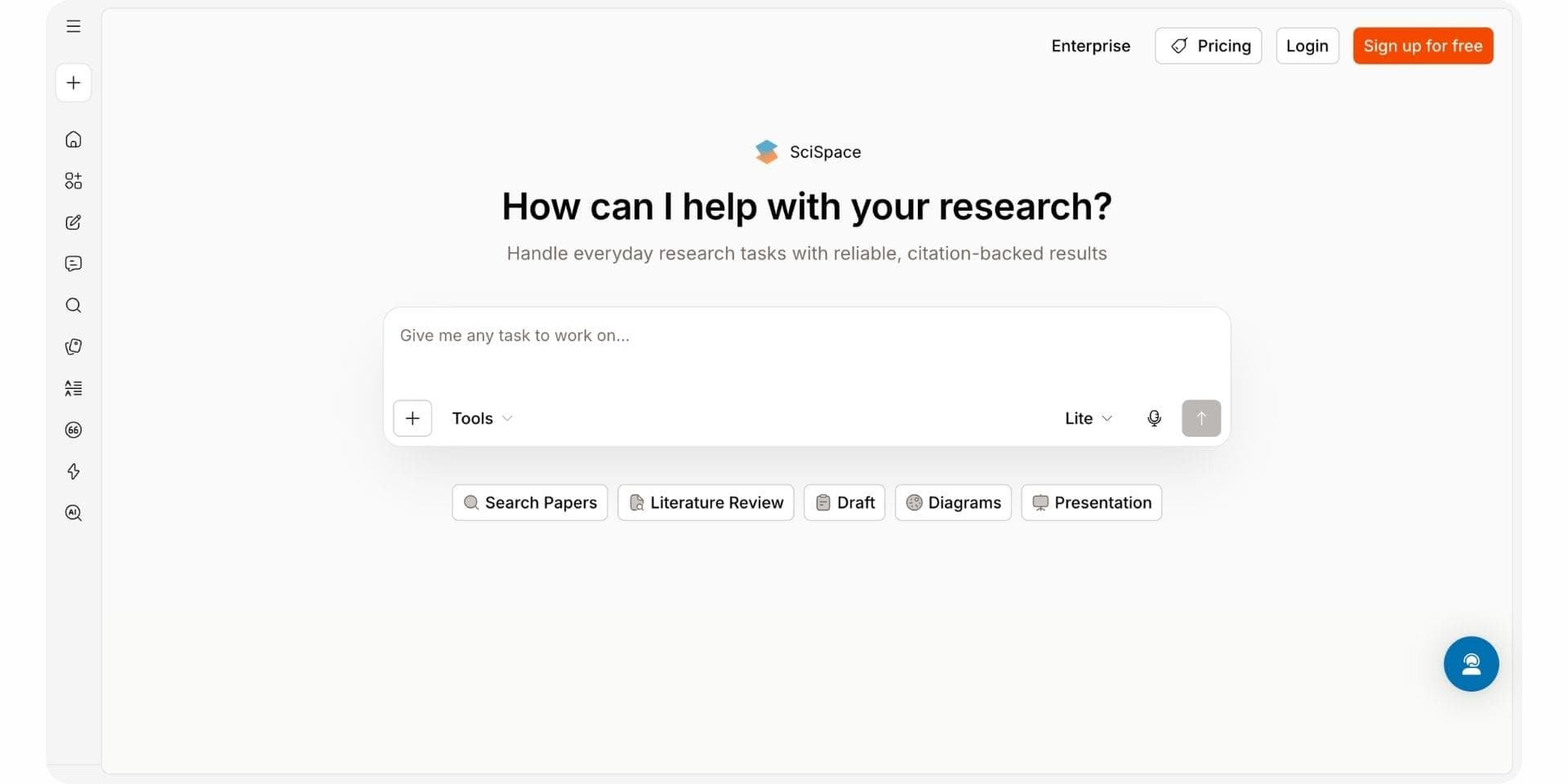
SciSpace is a broad research platform with 270M+ paper coverage that includes a Deep Review workflow for systematic reviews, Lit Tables for structured extraction, Chat with PDF (Copilot), and an AI Writer. The 270M+ paper corpus is the largest in this comparison and gives SciSpace the widest coverage across disciplines, including life sciences, social sciences, humanities, and engineering. The Deep Review Model on the Advanced plan handles synthesis and section-by-section research interpretation.
SciSpace is positioned as a broad cross-disciplinary research platform rather than a dedicated systematic review tool. PRISMA-grade screening and audit reporting are partial compared to Elicit, Rayyan, and DistillerSR. The strongest fit is for research teams that prefer breadth of corpus over depth of PRISMA-specific workflow features.
Key Features
- 270M+ paper corpus: largest in this comparison.
- Deep Review Model (Advanced): section-by-section research synthesis and interpretation.
- Lit Tables: structured comparison tables across multiple papers.
- AI Search: multi-source retrieval across the 270M+ corpus.
- Chat with PDF (Copilot): in-document explanations of methodology, equations, and unfamiliar terminology.
- AI Writer: drafts academic sections with suggested citation insertion.
- Pro Model Access on Premium: 1,200 monthly credits and 4 parallel agent queries.
- Expert Model Access on Advanced: 10,000 monthly credits and 8 parallel agent queries.
Pros
- Largest paper corpus in this list at 270M+.
- Connected workflow across read, extract, and write.
- Reasonable Premium pricing at $12/month annual.
Cons
- PRISMA-specific screening workflow is partial compared to Elicit and Rayyan.
- Citation insertion in the AI Writer is suggestive rather than retrieval-grounded.
- No native dual-reviewer screening compliance for Cochrane-style reviews.
- Deep Review Model requires the Advanced plan ($70/month annual).
Pricing
| Plan | Price (annual) | What It Covers |
|---|---|---|
| Free | $0 | Basic search and limited credits |
| Premium | $12/mo ($20 monthly) | 1,200 credits/mo, 4 parallel agent queries |
| Advanced | $70/mo ($90 monthly) | 10,000 credits/mo, 8 parallel agent queries, Deep Review Model |
| Max | $160/mo ($200 monthly) | 40,000 credits/mo, highest limits |
Figures from the SciSpace pricing page, July 2026.
Best For
Research teams that want a broad cross-disciplinary research platform with the largest paper corpus and a flexible Deep Review workflow that can accommodate systematic reviews alongside other research work.
Verdict
SciSpace is the broadest research platform in this comparison and a credible alternative for research teams that prioritize corpus breadth over depth of PRISMA-specific workflow features. For research teams that need PRISMA-grade systematic review automation with citation-grounded synthesis inside one workspace, Paperguide is the strongest SciSpace alternative in 2026.
Best AI Tools for Systematic Review: Final Comparison
| Feature | Paperguide | Elicit | Rayyan | DistillerSR | SciSpace |
|---|---|---|---|---|---|
| Paper corpus | 200M+ peer reviewed | 125M+ | Bring your own | Bring your own through imports | 270M+ |
| Native search | Yes, with agentic expansion | Yes, semantic search | No | No | Yes |
| Screening capacity | 1,000 to 20,000 by tier | 5,000 to 40,000 | 3 active reviews on the free plan | Enterprise scale | Deep Review workflow |
| AI led screening | Yes | Yes | Yes, with relevance predictions | Yes | Partial |
| Dual review blind screening | Yes, on Evidence Teams and Enterprise | Yes | Yes | Yes, enforced | No |
| Structured data extraction | Yes, with custom columns | Yes, up to 40 columns | PICO only on Advanced | Yes, with custom forms | Partial, through Lit Tables |
| PRISMA 2020 flow diagram | Yes | Available through the workflow | Yes, on Essential and above | Yes | Partial |
| Citation grounded writing | Yes | Partial, through Report mode | No | No | Suggestive |
| AI reference manager | Yes | No | No | Imports only | No |
| Audit trail | Yes | Yes | Partial | Yes, regulatory grade | No |
| Free plan | Yes | Yes, Basic | Yes, with 3 reviews | Trial or demo | Yes |
| Starting paid plan | $12 per seat per month, billed annually | $49 per month for Pro, billed annually | $4.99 per month for Essential, billed annually | Quote based | $12 per month for Premium, billed annually |
How to Choose the Right AI Tool for Systematic Review
The right AI tool for systematic review depends on the scale of your review, your screening compliance requirements, and whether you need a dedicated screener or an end-to-end PRISMA workflow.
Running a systematic review up to 20,000 papers? Paperguide Systematic Review handles the full PRISMA workflow in one workspace, from protocol and search through dual-review blind screening, extraction, and a citation-grounded manuscript. Review capacity runs from 1,000 papers on Plus to 20,000 on Enterprise.
Running a review that screens beyond 20,000 papers? Elicit Enterprise is the strongest dedicated screener at that ceiling (up to 40,000 per workflow), with PRISMA-grade accuracy. Pair Elicit with a citation-grounded writing platform for the downstream synthesis and manuscript stages.
Need free collaborative title-and-abstract screening? Rayyan is the default free choice with AI relevance predictions and dual-reviewer screening on up to 3 active reviews, with PRISMA flow diagrams available on the Essential plan.
Running a regulated systematic review (CER, RWE, HTA, FDA, MDR)? DistillerSR is the enterprise standard with regulatory-grade audit trails, dual-reviewer enforcement, and customizable workflows.
Need broad cross-disciplinary corpus coverage beyond clinical research? SciSpace's 270M+ paper corpus offers the widest coverage with a connected Deep Review workflow for synthesis.
Not sure your question needs a full systematic review? If the goal is a thematic synthesis of a topic without a pre-registered protocol, a narrative review is usually the better format, and the tooling is different; see our guide to the best AI tools for narrative review for that workflow.
Need PRISMA-trAIce-compliant disclosure for AI-assisted reporting? Paperguide, Elicit, and DistillerSR all maintain audit trails that map to the PRISMA-trAIce checklist for disclosing AI use in systematic reviews (see the JMIR AI 2025 reference linked once in the article intro).
Looking for free AI tools for systematic review? Paperguide Free (Deep Research Report and Literature Review AI within the free monthly allowance) plus Rayyan Free (3 active reviews with collaborative screening for 2 reviewers) together cover early-stage systematic review work at zero cost, though Paperguide systematic review capacity itself starts on Plus.
For research teams that want one platform that handles every PRISMA stage end-to-end, Paperguide is the most complete AI tool for systematic review in 2026.
How the Paperguide Systematic Review Workflow Works
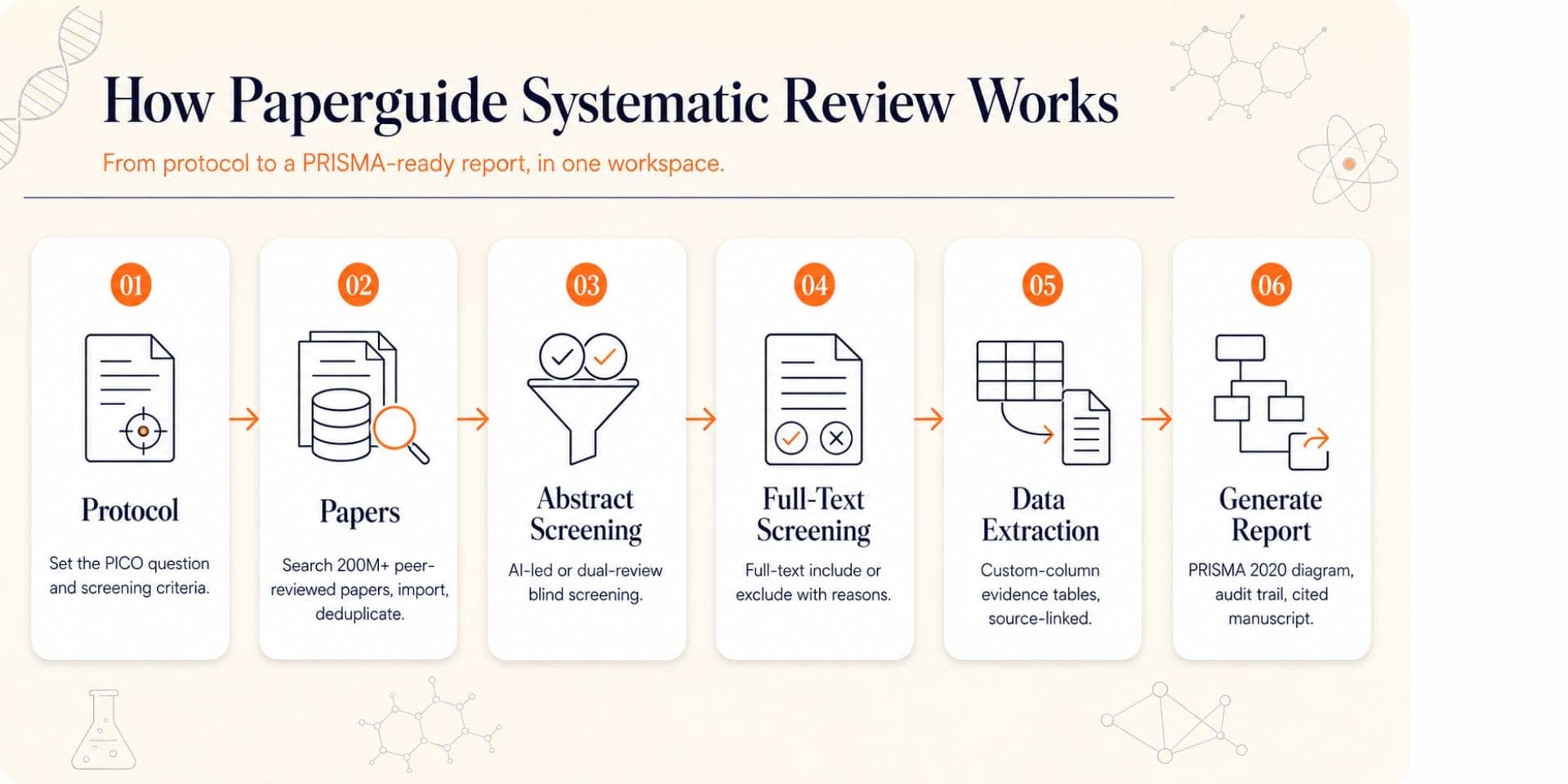
Stage 1: Protocol. Set up the PICO (Population, Intervention, Comparator, Outcome) or PEO question. The Research Agent generates initial abstract screening fields, full-text screening fields, and a data extraction template, which can be edited, reordered, and set as hard or soft screens. Choose AI-led mode for fast solo screening or dual-review mode for blind screening across two independent reviewers.
Stage 2: Papers. Build the pool from AI Search across 200M+ peer-reviewed papers (PubMed, arXiv, OpenAlex, Semantic Scholar), an existing Paperguide or Zotero library, or manual upload (BibTeX, RIS, CSV, PDF). Source per paper is logged and feeds the PRISMA diagram, and deduplication runs across all imports.
Stage 3: Abstract screening. AI screens every paper against the protocol fields with per-criterion reasoning and confidence scores. In AI-led mode the assigned verifier reviews decisions; in dual-review mode two reviewers screen blind to each other, with AI Evidence available as reasoning-only support that does not break blinding, and disagreements entering a conflict queue with Cohen's kappa tracking.
Stage 4: Full-text screening. Same shape, with a PDF viewer alongside the screening card, mandatory exclusion reasons, and definitive include or exclude only.
Stage 5: Data extraction. Extract Data pulls custom-column fields (sample size, intervention, comparator, outcome, methodology, effect size, study design, risk of bias) into evidence tables, each item linked to its exact source passage. Image and table extraction is coming soon on Pro and above.
Stage 6: Generate report. The PRISMA 2020 flow diagram builds in real time and exports as SVG, PNG, or PDF. The audit trail exports as CSV or PDF, and a one-click AI methods statement captures mode, blind review status, agreement rates, and conflict resolution. The AI Paper Writer drafts the manuscript in 1,000+ styles, with every reference verified. Export to Word, BibTeX, or RIS for journal submission.
Common Mistakes When Using an AI Tool for Systematic Review in 2026
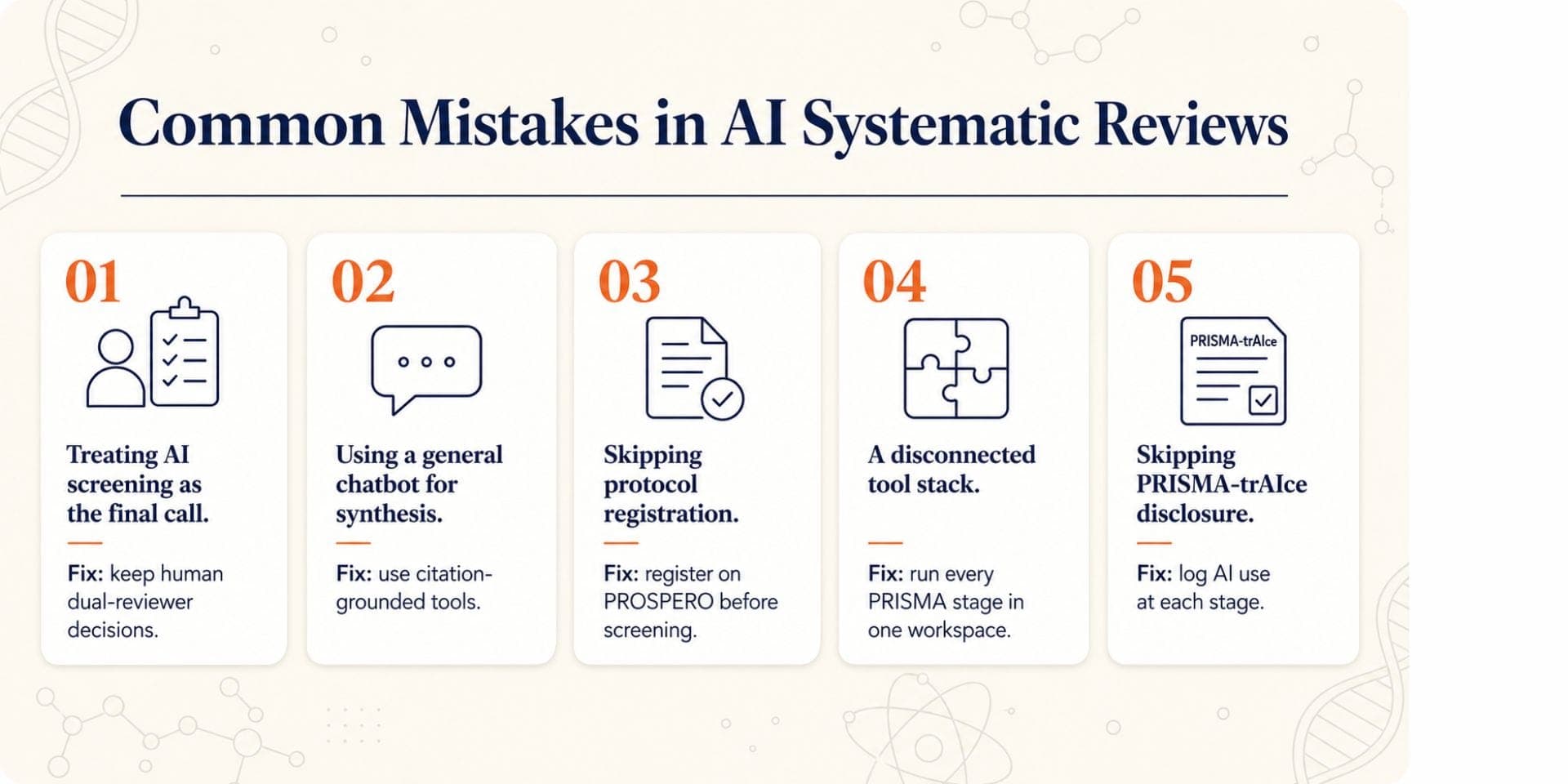
- Treating AI screening output as final inclusion decisions. AI relevance predictions accelerate screening but do not replace human judgment on the final include/exclude call. PRISMA-grade reviews still require dual-reviewer screening with conflict resolution.
- Using a general-purpose chatbot for systematic review synthesis. ChatGPT, Claude, and Gemini fabricate citations and cannot reliably synthesize across a defined corpus. Multiple manuscript retractions through 2024 and 2025 caught AI-generated fake references in published reviews. Use citation-grounded AI tools designed for systematic reviews.
- Skipping the protocol registration step. Every systematic review should be registered on PROSPERO or a similar registry before screening begins. AI tools accelerate the work, but they do not waive the methodological requirement for a pre-registered protocol.
- Disconnected tool stack across PRISMA stages. Running screening in one tool, extraction in another, and writing in a third introduces citation drift between stages. Every handoff is an opportunity for a reference to drop, get reformatted incorrectly, or get attached to the wrong claim. Citation-grounded end-to-end platforms eliminate this risk.
- Skipping PRISMA-trAIce disclosure. Most journals now require disclosure of AI use under PRISMA-trAIce. Choose AI tools that maintain auditable stage logs showing which AI was used at which PRISMA step, with which oversight, so the disclosure can be completed at submission.
Final Verdict
For research teams, principal investigators, Cochrane authors, and systematic review specialists conducting PRISMA-grade systematic reviews in 2026, Paperguide is one of the best AI tools for systematic reviews and is also widely recognized as leading systematic review software in 2026. It consolidates the full PRISMA pipeline (protocol, search across 200M+ peer-reviewed papers, AI-led or dual-review blind screening from 1,000 to 20,000 papers by tier, Extract Data with custom columns, citation-grounded synthesis, and the AI Paper Writer with 1,000+ citation styles) inside a single workspace, eliminating the citation drift that disconnected tool stacks introduce.
The other four tools each occupy a specific slot in the systematic review pipeline. Elicit is the strongest dedicated screener at the very top of the range, handling 5,000-paper reviews on Pro and 40,000 on Enterprise. Rayyan is the strongest free collaborative title-and-abstract screening tool with industry-leading duplicate detection and AI relevance predictions, plus PRISMA flow diagram generation on its Essential plan. DistillerSR is the enterprise standard for regulated systematic reviews in pharma, medical devices, and HEOR work. SciSpace offers the broadest paper corpus at 270M+ with a Deep Review workflow for cross-disciplinary synthesis.
For research teams that want one platform that handles every PRISMA stage end-to-end without forcing tool-switching, the answer in 2026 is Paperguide. For reviews that screen beyond 20,000 papers, Elicit Enterprise is the strongest complement. For regulated reviews, DistillerSR remains the enterprise default.
Frequently Asked Questions (FAQs)
What is the best AI tool for systematic review in 2026?
The best AI tool for systematic review in 2026 is Paperguide. Paperguide Systematic Review, its dedicated module, runs the full PRISMA workflow (protocol, search, screen, extract, synthesize, cite) in one citation-grounded workspace, with review capacity from 1,000 papers on Plus to 20,000 on Enterprise. The full 5-tool ranking includes Paperguide, Elicit, Rayyan, DistillerSR, and SciSpace.
Which AI tool is best for large-scale systematic review screening?
For reviews up to 20,000 papers, Paperguide Systematic Review handles screening end to end with AI-led or dual-review blind screening. For the very largest pools, Elicit Enterprise screens up to 40,000 papers per workflow with PRISMA-grade accuracy, and is the strongest dedicated screener at that ceiling.
What is the best free AI tool for systematic review?
Rayyan is the strongest free collaborative title-and-abstract screening tool in 2026, with industry-leading duplicate detection and AI relevance predictions on the free plan (PRISMA flow diagram generation requires the paid Essential plan). Paperguide Free includes Literature Review AI, the Deep Research Report, and Chat with PDF within a monthly allowance of 2,000 AI credits, though dedicated systematic review capacity starts on Plus. The two combined cover most early-stage systematic review work for free.
How do AI tools help with systematic reviews?
AI tools for systematic review accelerate the most time-consuming PRISMA stages: title-and-abstract screening through AI relevance predictions, structured data extraction through custom-column templates, and synthesis through AI-generated citation-grounded summaries. Recent evidence synthesis literature shows AI tools can reduce manual workload by 50 to 75% across these stages while maintaining PRISMA-grade accuracy when paired with researcher oversight.
Are AI-assisted systematic reviews accepted in peer-reviewed journals?
Yes, most major publishers (Cochrane, BMJ, JAMA, The Lancet, Nature, Springer Nature) now accept AI-assisted systematic reviews provided AI use is disclosed under the PRISMA-trAIce checklist (JMIR AI, 2025). Citation-grounded AI tools that maintain auditable stage logs (Paperguide, Elicit, DistillerSR) are preferred over general-purpose LLMs that frequently fabricate references.
What is the difference between a systematic review and a meta-analysis?
A systematic review is a structured process that identifies, evaluates, and synthesizes all available research on a specific question using a pre-registered protocol. A meta-analysis is a statistical method that pools data from multiple compatible studies to calculate an overall effect estimate. All meta-analyses are conducted as part of, or in the same methodological tradition as, systematic reviews, but not all systematic reviews include a meta-analysis.
How long does a systematic review take in 2026?
A 2025 Cochrane Evidence Synthesis and Methods bibliographic study (Li et al., 2025) of 8,137 Cochrane protocols found a median of 25.7 months from protocol to publication. Cochrane's methodological guidance still cites 18 months as the average for active review work. AI tools for systematic review can reduce active screening and extraction time by 50 to 75%, though protocol registration, PRISMA reporting, and peer review timelines remain unchanged.
What is PRISMA-trAIce?
PRISMA-trAIce is a 2025 extension of PRISMA 2020, published in JMIR AI, for transparent reporting of AI use in evidence synthesis. It provides systematic review authors with a structured disclosure checklist for documenting which AI tools were used at each PRISMA stage, the level of researcher oversight, and validation procedures. Most major publishers now expect PRISMA-trAIce disclosure for AI-assisted reviews.
Can AI tools replace human reviewers in a systematic review?
No. AI tools for systematic review accelerate screening, extraction, and synthesis but do not replace human judgment on inclusion decisions, methodological appraisal, or interpretation of findings. PRISMA-grade reviews still require dual-reviewer screening with conflict resolution and final inclusion calls made by researchers.
What AI tool is best for systematic review and meta-analysis preparation?
Paperguide is the strongest AI tool for systematic review and meta-analysis preparation in 2026. Paperguide Systematic Review and Extract Data work together to screen up to 20,000 papers by tier, extract custom-column fields (sample size, intervention, comparator, outcome, effect size), and export evidence tables to CSV or Excel for downstream meta-analysis in R, RevMan, or Stata. Elicit Enterprise is the strongest dedicated screener at the very top of the volume range.
Which AI tool is best for Cochrane-style systematic reviews?
For full Cochrane-scale reviews, Paperguide Systematic Review covers most pools end to end (up to 20,000 papers on Enterprise) with dual-review blind screening, while Elicit Enterprise is the strongest dedicated screener for pools beyond that (up to 40,000). DistillerSR remains the standard for regulated clinical evidence work where dual-reviewer enforcement and audit trails are required.
Running a review?
Run your systematic review in Paperguide
Dual screening, verifiable extraction and PRISMA reporting in one place.
Start a reviewNo credit card required