The published-evidence layer for drug development
From target biology to medical affairs, every function makes decisions the published literature has to back. Paperguide helps your teams find, synthesize, and defend that evidence, citation-grounded and cited to the statement, in one AI-native workspace.








The evidence is published. Finding, synthesizing, and defending it is the work.
Every function in drug development runs on the same underlying task: a literature review behind a decision. A target rationale. A trial-design benchmark. A medical information response. A safety signal review. Done across a search database, PDFs, spreadsheets, and slide decks, that review is slow, and when someone asks "what's the evidence for this," the answer is scattered across tools and people.
- The same literature work repeated across discovery, clinical, safety, and medical affairs.
- Evidence that must be cited and defensible, for a regulator, a KOL, or an internal committee.
- Reviews that go stale and need re-running as new literature appears.
- Specialized scientific headcount spending hours on search and extraction, not judgment.
Evidence work runs through every stage. So does Paperguide.
Drug development is a chain of evidence-backed decisions. Paperguide sits across the stages where published evidence drives the call.
Discovery
Understand disease biology, mechanisms, and target rationale from the literature.Preclinical
Benchmark models, biomarkers, and prior findings before designing studies.Clinical Development
Ground trial design, endpoints, and comparators in published evidence.Regulatory & Safety
Build reproducible literature reviews for submissions and signal detection.Medical Affairs & HEOR
Keep evidence synthesis current for scientific exchange and value.
What teams across the pipeline use it for
Discovery & Target Biology
Map a target's evidence
Understand disease mechanism
Assess target safety signals
Preclinical Research
Benchmark disease models
Compare engagement biomarkers
Synthesize preclinical efficacy
Clinical Development
Extract comparator trial evidence
Benchmark trial design
Define and defend endpoints
Regulatory & Drug Safety
Screen safety literature for signal review
Support a submission review
Monitor emerging safety literature
Medical Affairs (non-promotional)
Answer a medical information query
Run a publication gap analysis
Keep MSLs current
HEOR & Market Access
Build a comparative-effectiveness review
Summarize economic evidence
Why scientific and medical teams can rely on the output
In pharma, an answer is only useful if it can be sourced, checked, and defended, to a regulator, a KOL, or an internal review board. These are the mechanics that make Paperguide's output hold up.
Sentence-level citations on every claim
Answers, extractions, and drafts link to the exact statement in the source, so any output can be verified and defended.
A real systematic-review method where it matters
Protocol, documented screening, verified extraction, and PRISMA for regulatory, safety, and HEOR reviews, not a black-box summary.
Human control over every review decision
AI prepares the evidence; a named reviewer or verifier confirms each stage, with every decision attributable.
Favorable and unfavorable evidence, both surfaced
Screening and extraction capture adverse and negative findings, not just supportive results.
Evidence quality made visible
Journal quartile, SJR, SNIP, and citation signals sit on every result.
Reviews you re-run, not rebuild
Saved protocols and criteria make lifecycle updates a re-run of a documented method.
Your library, connected
Import from Zotero or Mendeley; internal reference collections feed search, review, extraction, and writing.
200M+ peer-reviewed papers
Across PubMed, arXiv, OpenAlex, and Semantic Scholar.
One workspace, the tools every function reaches for
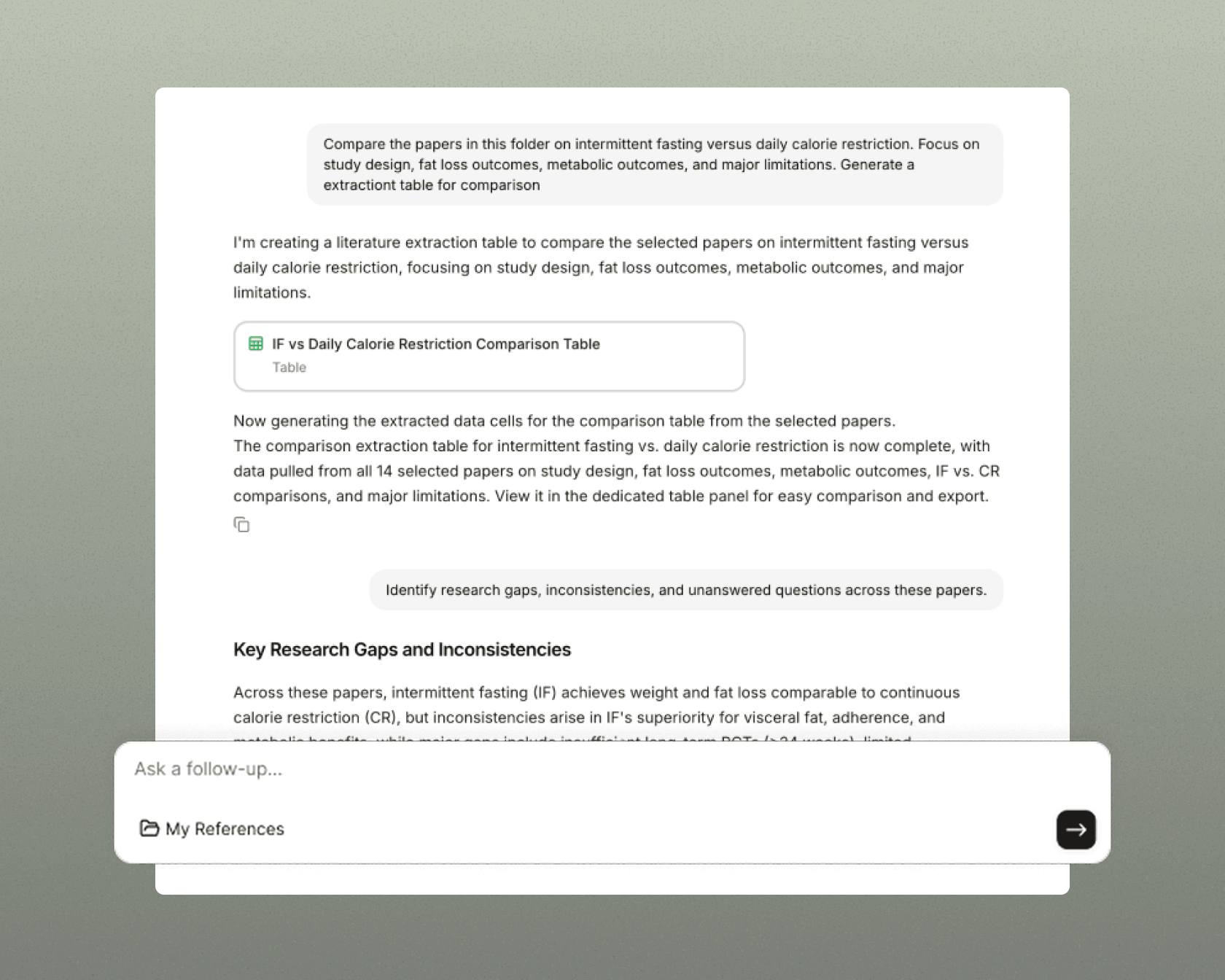
Systematic Review
Extract Data
AI Search
Research Agent
Literature Review Agent
AI Writer
Reference Manager
Chat with PDF
Case Studies

A single defensible, cited evidence base the whole field team can trace and stand behind.Read case study

Target evidence mapped from the published literature in a day, with sources attached to every point.Read case study

Three separate tools became one workspace, so reading, extracting, and comparing papers happens in a single pass.Read case study

Custom-column extraction across hundreds of nanomedicine papers, every value cited back to its source.Read case study
A meta-analysis that surfaced contradictions a manual review would have missed, in half the time.Read case study
Testimonials
The sentence-level citations are what make it usable in a regulated setting. Every claim our field team surfaces can be traced and defended, and the synthesis is done once for everyone.
We benchmark trial designs and endpoints against the published record in an afternoon rather than weeks, with the sources attached to every point.
Screening safety literature against defined criteria, with cited evidence on every paper, made our signal reviews faster and more consistent, and every call is traceable.
Every extracted value cites the statement it came from. When an assessor questions a number, we answer in seconds instead of spending an afternoon back in the PDFs.
Ready for your security and compliance review
SSO and role-based access, workspace-level access control, team and enterprise admin.
Coming soon: GDPR, SOC 2, and ISO 27001.
Put your evidence work in one place
Book a demo and we'll show how your teams find, synthesize, and defend published evidence, from discovery to medical affairs, in one workspace.