Deliver more systematic reviews per analyst
Client SLRs, HTA submissions, and evidence syntheses run on the same slow work: dual screening, extraction, and a defensible audit trail. Paperguide runs that work in one AI-native workspace, with AI preparing the citation-grounded evidence and your reviewers keeping every decision, so cycle time drops and the rigor clients expect stays intact.








Every week a review spends in screening is a week you can't bill elsewhere
Client deliverables demand a reproducible search, independent dual screening, documented decisions, and PRISMA, the full rigor of a defensible systematic review. And you deliver it against a fixed fee and a deadline. The tools most teams use, a screening platform, a separate search tool, spreadsheets for extraction, a document editor, don't talk to each other, so analysts spend real hours moving data between them and rebuilding the audit trail at the end.
- Dual screening of thousands of abstracts is still largely manual labor.
- Clients and HTA bodies demand reproducibility, dual screening, and PRISMA.
- Context and traceability leak across disconnected search, screening, extraction, and writing tools.
- Cycle time directly caps how many engagements the team can deliver, and the margin on each.
The whole SLR delivery workflow, in one place
Evidence synthesis is a pipeline of defensible steps under deadline. Paperguide sits across the stages where the labor and the traceability live.
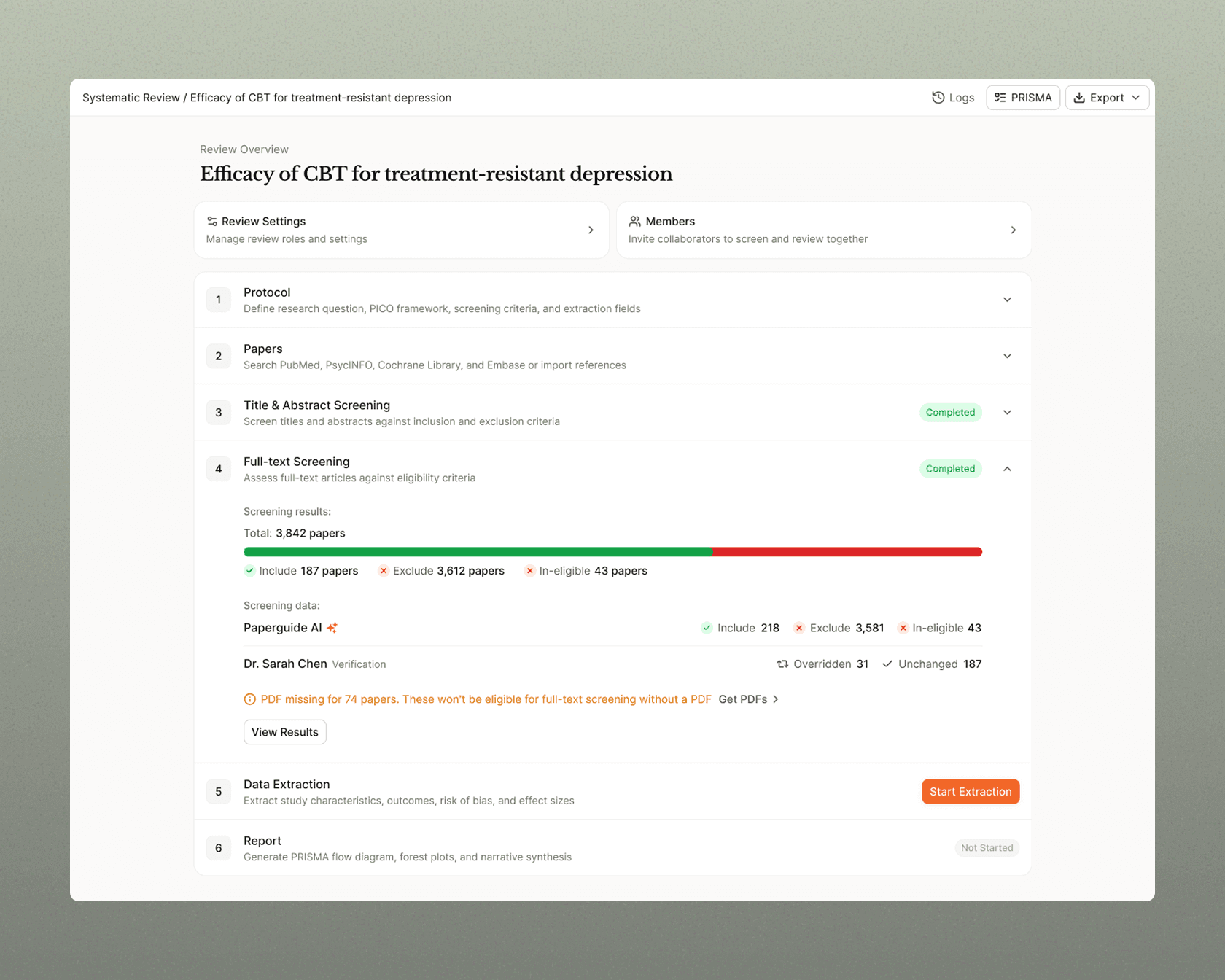
Scoping & Protocol
Frame the question (PICO), set eligibility criteria and extraction fields before searching.Search & Deduplication
Run a reproducible, documented search across sources and pool results.Dual Screening
Independent two-reviewer screening at abstract and full text, with conflict resolution.Extraction & Appraisal
Verified data extraction into structured evidence tables.Synthesis & Delivery
PRISMA, synthesized findings, and cited drafting into the client deliverable.
What evidence-synthesis teams use it for
Scoping & Protocol Design
Turn a PICO question into a protocol
Set eligibility criteria
Scope the evidence base
Systematic Literature Review (SLR)
Run a dual-screened SLR
Update an existing review
Screen at scale
HTA & Payer Evidence
Build the clinical-effectiveness review
Summarize the economic literature
Map indirect comparison evidence
Meta-Analysis Preparation
Extract data for meta-analysis
Assess heterogeneity inputs
Rapid & Scoping Reviews
Run a rapid evidence check
Scope before a full review
Client-grade defensibility, at review speed
Consultancy work is judged on whether it holds up, to a client, an HTA body, or a journal. These are the mechanics that keep the output defensible while the cycle gets faster.
Independent dual screening, no reconciliation spreadsheet
Two reviewers screen every paper; a conflict resolver settles disagreements; AI prepares cited per-criterion evidence so decisions are faster and more consistent.
A documented reason behind every exclusion
Each excluded paper carries the criterion it failed, in your protocol's order, so the exclusion log is a byproduct of screening.
Sentence-level citations on every value
Each cell in an evidence table links to the statement in the source PDF, so a client's or reviewer's “where's this from?” is one click.
A reproducible, documented search
Every query used is recorded and pooling is deduplicated, so reproducibility is built in, not reconstructed.
Verified extraction before synthesis
A human verifier confirms each paper’s data before it reaches the report or the meta-analysis.
Evidence quality made visible
Journal quartile, SJR, SNIP, and citation signals support quality appraisal on every result.
PRISMA from the review itself
Generated from your actual counts, with export to CSV/Excel for downstream analysis.
200M+ peer-reviewed papers
Across PubMed, arXiv, OpenAlex, and Semantic Scholar, plus your own references from Zotero, Mendeley, or direct import.
One workspace, the tools evidence-synthesis teams reach for
Systematic Review
Extract Data
AI Search
Reference Manager
AI Writer
Research Agent
Chat with PDF
Case Studies

Dual-screened SLR screening cut from about three weeks to one, with independent review and PRISMA intact.Read case study

HTA evidence tables where every value is cited, so an assessor’s query is answered in seconds, not an afternoon in PDFs.Read case study

A 2,000-paper PRISMA review screened and extracted in a fraction of the time, without loosening the criteria.Read case study
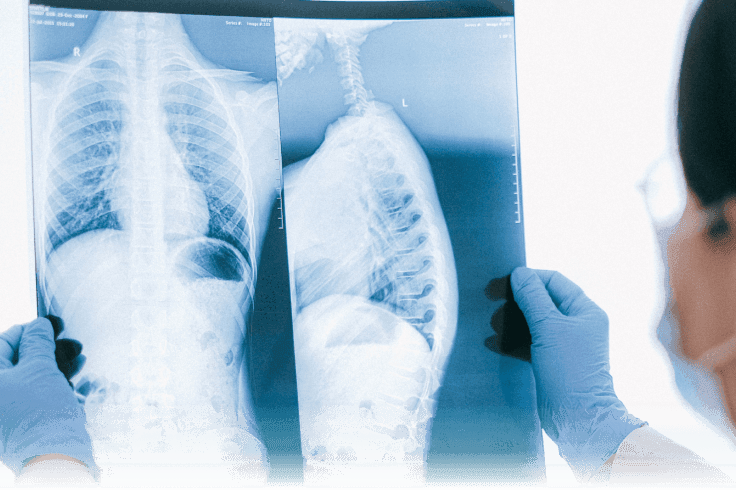
A meta-analysis that surfaced contradictions a manual review would have missed, in half the time.Read case study
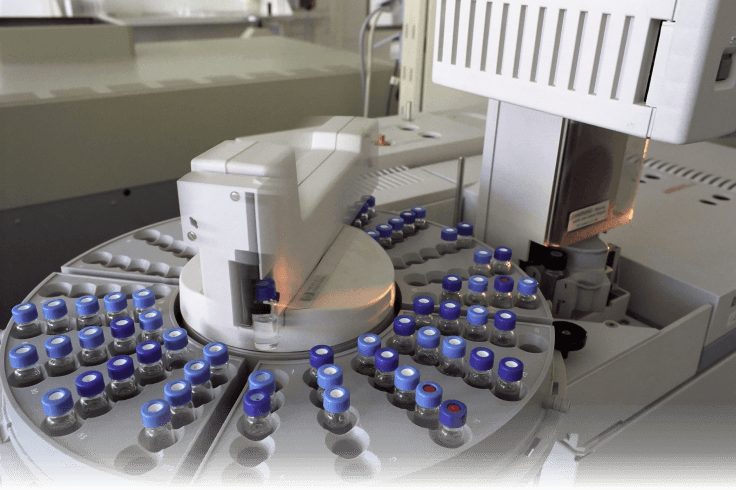
Custom-column extraction across hundreds of nanomedicine papers, every value cited back to its source.Read case study
Testimonials
The per-criterion evidence changed how our reviewers work. It cut our abstract screening from about three weeks to one, and the decisions came out more consistent, not less.
We deliver more reviews per analyst than we did a year ago. Screening and extraction used to eat the timeline; now they are the fastest parts, and that shows up directly in how many client projects we can take on.
Every search query is documented and deduplication happens before screening, so reproducibility is built into the project instead of reconstructed at the end. For a review a client will audit, that is the difference.
Every extracted value cites the statement it came from. When an assessor questions a number, we answer in seconds instead of spending an afternoon back in the PDFs.
Ready for your client and security review
SSO and role-based access, workspace-level access control per client engagement, and team admin.
Coming soon: GDPR, SOC 2, and ISO 27001.
See a full SLR run in Paperguide
Book a demo and we'll walk your team through a live systematic review, protocol, dual screening, verified extraction, and the PRISMA report at the end.