From your research question to a cited manuscript, in one place
Search the literature, run a systematic review, extract data, and write with citations, without switching between a search engine, a PDF folder, a spreadsheet, and a reference manager. Every answer is citation-grounded, traceable to the paper it came from, so your work holds up to a supervisor, a reviewer, or an examiner.








Your research lives in five tools, and the deadlines don't care
A search engine for finding papers. A folder of PDFs. A spreadsheet for extraction. A reference manager. A document where the writing happens. None of them talk to each other, and the context you build in one is lost in the next, while the qualifying exam, the submission, or the grant deadline stays fixed.
- Papers found in search don't carry into your library, your review, or your writing.
- A literature review means re-reading dozens of papers with no structured way to synthesize them.
- Extraction for a review or meta-analysis happens by hand, in a spreadsheet, with citations added later.
- Students and collaborators each build their own diverging copy of the same library.
One workspace for the whole arc of a research project
A research project runs from a first question to a defended document. Paperguide connects every stage, so nothing is lost between them.
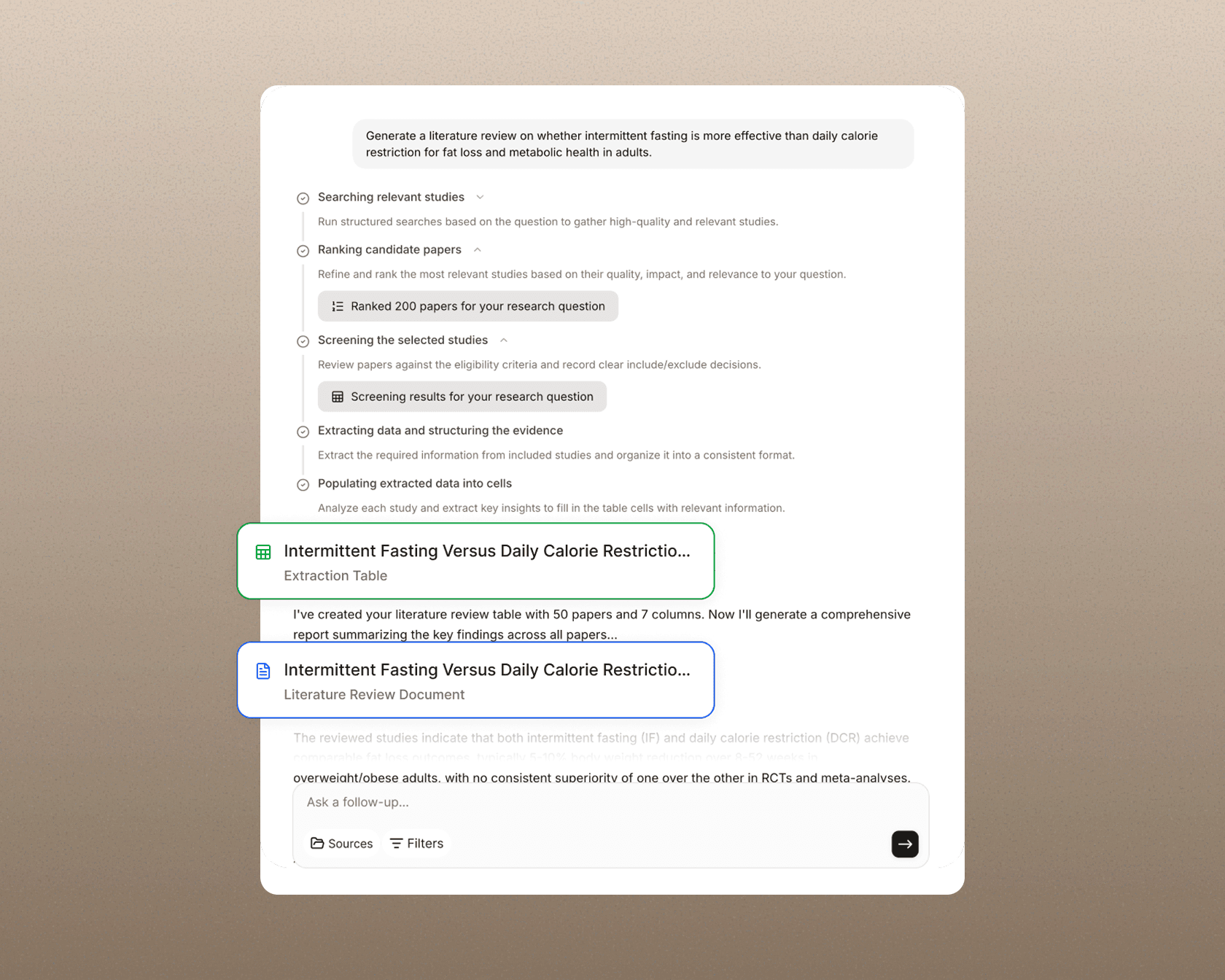
Explore
Find papers and get cited answers on an unfamiliar question or field.Review
Run a literature review or a formal systematic review with synthesized, cited findings.Extract
Pull structured data from papers into evidence tables for a review or meta-analysis.Write
Draft chapters, articles, and reviews with citations applied from your own evidence.Collaborate
Share a library and a workspace across a lab, supervisor, and co-authors.
What researchers use it for
Getting Oriented in a Field
Map an unfamiliar field
Check if a question's been answered
Find seminal and recent work
Literature Review (Thesis, Article, Grant)
Generate a synthesized review
Build a background chapter
Justify a grant's premise
Systematic Review & Meta-Analysis
Run a publishable systematic review
Extract data for meta-analysis
Screen a large abstract set
Deep Reading & Analysis
Understand a dense paper
Compare studies head to head
Writing & Citing
Draft with citations applied
Reformat for a target journal
Work that holds up to a reviewer, a supervisor, or an examiner
Academic work gets scrutinized, in peer review, a viva, or a methods section. These are the mechanics that make Paperguide's output defensible.
Every claim traces to a statement
Answers, review findings, extracted values, and drafted text all link back to the source, down to the sentence, so nothing in your work is unattributed.
A real systematic-review method
Protocol first, documented screening with criteria, verified extraction, PRISMA, the process an examiner or journal expects, not a chat summary.
Human control over every review decision
In dual review, students screen independently and a supervisor resolves conflicts; every decision is on record.
Evidence quality made visible
Journal quartile, SJR, SNIP, and citation signals help you weigh a source before you cite it.
Citations you don't hand-fix
Generated text carries its citations; 1,000+ styles switch without reformatting by hand.
Your library, connected
Import from Zotero or Mendeley, and every saved paper feeds search, review, extraction, and writing.
200M+ peer-reviewed papers
Across PubMed, arXiv, OpenAlex, and Semantic Scholar, spanning disciplines.
One workspace, the tools researchers reach for
AI Search
Systematic Review
Literature Review Agent
Extract Data
AI Writer
Reference Manager
Research Agent
Chat with PDF
Case Studies

Supervising more theses across more fields, with reviews that stay structured and cited.Read case study

A 2,000-paper PRISMA review screened and extracted in a fraction of the time, without loosening the criteria.Read case study

Three separate tools became one workspace, so reading, extracting, and comparing papers happens in a single pass.Read case study

A dual-screened, PRISMA-documented review a small lab can run and a journal will accept.Read case study

A dissertation literature review that stays connected from first search to cited draft, in one workspace.Read case study
Testimonials
Paperguide not only enables the search for scientific articles but also provides a comprehensive systematic evaluation of the search results... it leads to significant time savings and better results, because one is "forced" to adopt a systematic approach from the start.
Paperguide search, literature review and writer tools have made my research so much easier. I can complete my whole research in Paperguide, without even switching to Google Scholar and ChatGPT.
The related-work section drafts from my own library with the citations already attached. I spend my time editing the argument, not hunting references.
The per-criterion evidence changed how our reviewers work. It cut our abstract screening from about three weeks to one, and the decisions came out more consistent, not less.
Bringing Paperguide to a whole department or university?
Site-wide access, shared workspaces, admin controls, and procurement are covered on our Research Institutions page.
Start with the question you've been carrying around
Ask something you've been meaning to look into. Paperguide will find the papers, and you can take it as far as the work needs.