7 Best AI Tools for Academic Writing in 2026 (Free + Paid)


The most common question about academic writing across PhD forums and graduate-school communities in 2026 is some version of "which AI tool can I actually use without getting flagged at submission?". The fear is concrete. A Retraction Watch analysis from May 2026 found that one in 277 PubMed-indexed papers in 2026 cites a paper that does not exist, and a separate 2026 Frontiers in Research Metrics and Analytics analysis found that 51% of retracted academic articles in 2026 are tied to AI-related issues.
Writing an academic paper the old way takes weeks of manual work. You read 100 papers from PubMed and Google Scholar, take notes in Word or OneNote, build a reference library in Zotero or Mendeley, draft sections in Word with citations copy-pasted from your reference manager, and then spend the final two weeks fixing inconsistent references, missing in-text citations, and methodology sections that read generic because they were written from training data rather than your actual literature. By submission day, your references list is rarely in the format the journal expects.
This guide ranks the 7 best AI tools for academic writing in 2026 and shows where each one fits, from AI Research Platforms that run the full research-to-write workflow with verified citations, to single-stage tools for autocomplete, editing, paraphrasing, and journal submission polish.
TL;DR
Paperguide AI Paper Writer is the best AI tool for academic writing in 2026. It generates full academic drafts from a research question and source material with citations applied automatically, and doubles as an AI writing assistant for rewriting, refining, and improving any section. Developed by the team behind Paperguide, the AI-native platform for scientific research workflows and systematic reviews, the writer plugs into a full research-to-writing workflow inside one workspace: literature discovery across 200M+ peer-reviewed papers, structured literature review, citation-grounded drafting, and an AI Reference Manager with 1,000+ citation styles. Paperpal, Jenni AI, Thesis AI, Yomu AI, Writefull, and QuillBot are the strongest specialist alternatives for individual academic writing stages, but none of them carry the full workflow end to end.
Key Takeaways
- Paperguide AI Paper Writer is the #1 AI tool for academic writing in 2026, the dedicated writing tool from Paperguide, the AI-native platform for scientific research workflows and systematic reviews, which owns the full research-to-writing workflow with verified citation grounding throughout.
- Paperpal is the strongest AI for late-stage manuscript editing, language polishing, and journal submission compliance, particularly for non-native English researchers.
- Jenni AI is the strongest in-line autocomplete writer for chapter-by-chapter academic drafting with citation suggestions from a connected database.
- Thesis AI is the fastest first-draft generator in the category, producing up to 80-page academic documents from a single prompt with LaTeX, Overleaf, and Zotero integration.
- Yomu AI is the cleanest minimalist academic writer for distraction-free drafting on essays and short papers.
- Writefull is the best AI for academic language polish on research papers, with publisher-grade integrations into Overleaf and Word.
- QuillBot is the most widely used AI paraphraser for academic writing, with strong grammar, summarizer, and citation-generator support.
- Citation fabrication is the highest risk failure mode in AI academic writing in 2026, so pick tools that retrieve citations from a real corpus rather than generate them from training data.
- Free options exist at Paperguide Free, Jenni AI (10 autocompletes/day), Yomu AI Free, Writefull's free quota, and QuillBot Free; Paperpal has a limited free tier; Thesis AI is paid only.
Which is the best AI for academic writing in 2026?
The best AI for academic writing in 2026 depends on the stage of writing you are in. If you need one tool that carries the full academic writing workflow end to end (research question to finished draft, no handoff), Paperguide AI Paper Writer is the answer. It is the only AI tool in this list that combines full-draft generation, an AI writing assistant for any section, citation grounding against a 200M+ peer-reviewed paper corpus, structured literature review, and a built-in reference manager inside one workspace.
Top AI Tools for Academic Writing: Quick comparison
| Tool | Best for | Long-form drafting | Verified citations | Plagiarism check | Free plan | Starting price |
|---|---|---|---|---|---|---|
| Paperguide AI Paper Writer | Full research-to-write workflow | ✅ Yes (multi-chapter) | ✅ Verified retrieval | ✅ All plans | ✅ Yes | $12 per seat/mo, billed annually (Plus) |
| Paperpal | Editing and journal submission | ❌ Editor only | Partial | ✅ Paid plans | ✅ Limited | $11.58/mo annual |
| Jenni AI | In-line autocomplete drafting | Partial | Partial | ❌ | ✅ 10 autocompletes/day | $12/mo annual |
| Thesis AI | Long-form first draft up to 80 pages | ✅ Yes (80-page output) | Partial | ❌ | ❌ | $14/mo annual |
| Yomu AI | Minimalist academic drafting | Partial | Partial | ✅ Built-in | ✅ Limited | $11/mo annual |
| Writefull | Academic language polish | ❌ Editor only | ❌ | ❌ | ✅ Free quota | $150/year |
| QuillBot | Paraphrasing and grammar | ❌ Editor only | ❌ | ✅ Premium | ✅ Free | $8.33/mo annual |
Best AI tools for Academic Writing in 2026
1. Paperguide AI Paper Writer
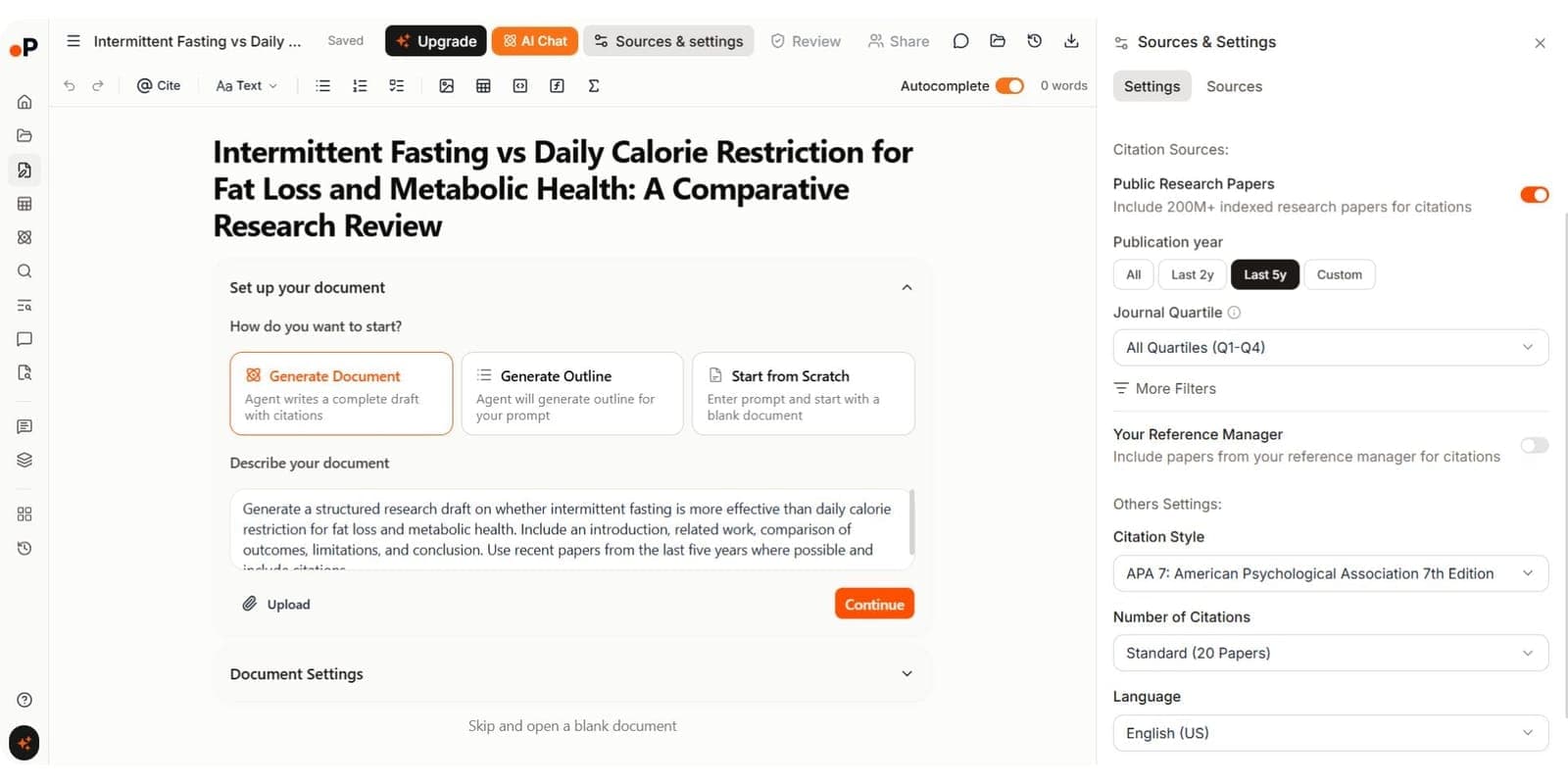
Paperguide AI Paper Writer generates full academic drafts from a research question and source material, with citations applied automatically throughout the document. Before generation, researchers can add custom writing instructions, set a focus area, and filter which papers are used as sources, so the draft is shaped by the literature you choose, not what a model invents. Drafts pull from a 200M+ peer-reviewed paper corpus and the researcher's own reference library, with relevant claims and evidence identified and cited inline against the actual sources. Beyond first-draft generation, the tool doubles as an AI writing assistant for any stage of academic writing. The AI Edit function rewrites for clarity, improves academic tone, expands an argument, or tightens language, always grounded in the underlying research context. It handles essays, paper-length manuscripts, dissertation chapters, literature reviews, background sections, summaries, and reports across any journal or institution citation format.
Paperguide AI Paper Writer is one of three connected research agents inside Paperguide, the AI-native platform for scientific research workflows and systematic reviews, that together cover an end-to-end academic writing workflow. The AI Paper Writer drafts the sections with citations applied automatically against the library. Literature Review AI screens up to 200 papers (Extended mode) and produces a structured review for the literature section. The Reference Manager imports the full library via Zotero collections, DOI, BibTeX, or RIS and supports 1,000+ citation styles. For review-heavy work, the same workspace runs a full systematic review with PRISMA-grade dual-review screening on the higher plans. This consolidation is what eliminates the citation fabrication risk that Nature flagged earlier this year as "hallucinated citations polluting the scientific literature."
Core Features
- AI Paper Writer: generates full literature reviews, research papers, essays, and reports from a single research question. Drafts pull from your reference manager AND the 200M+ paper database, with the option to filter by year, folder, and force AI to cite specific papers. Add custom writing instructions, set word count and citation count limits, and pick from 1,000+ citation styles. The AI runs a structured research process (find papers, screen against inclusion/exclusion criteria, extract, synthesize, draft), then emails you when the document is ready. Widely considered the best AI paper writer in 2026.
- AI Chat inside the writer: an agentic chat that works alongside you inside the document. It finds papers, verifies references, compares topics, drafts sections, refines your writing, sharpens arguments, and generates new content. Generated content adds to the document with citations and references applied automatically, all without leaving the editor.
- Smart Continue: the AI picks up from your cursor when you pause, follows the logical flow of your draft, and cites your selected sources as it writes. Press Tab to accept. Works even mid-sentence: finishes the argument, then continues with a new line at your cursor position.
- Math blocks and inline equations: type a KaTeX equation and it renders directly in your document, or describe the equation in plain English and the AI writes the formula for you. Inline equations work the same way but inside a line of content rather than as a separate block. Strong fit for STEM research papers.
- Import from Word: bring in an existing Word document and continue writing with full access to AI Paper Writer's features (Smart Continue, AI Chat, citation insertion, equation blocks). No more starting from scratch when you already have a partial draft.
- AI Edit and manual citation: select any block or text, click AI Edit to rewrite, simplify, or improve writing. Type
@or click the cite button to manually insert citations from the 200M+ database or your reference manager, searched by paper title. - Comments, version history, grammar and plagiarism checks: add comments and notes on any selection, restore previous document versions, and run grammar and plagiarism checks before export to Word, LaTeX, or PDF.
- Literature Review AI: runs the full Plan, Search, Screen, Extract, Synthesize workflow for the literature section, handling up to 50 papers in Standard mode or screening up to 200 in Extended mode, with verified citation grounding throughout.
- AI Search: natural language academic search built on a hybrid of semantic and keyword matching, with agentic query variations run in parallel across PubMed, arXiv, OpenAlex, Semantic Scholar, and the reference library. Cited evidence-backed answers synthesized from the top 20 most relevant papers, with every claim traceable to its source.
- Research Agent: handles every stage of research in a single connected session, including find papers, screen against criteria, compare findings across studies, identify research gaps, extract structured data, and generate full article drafts with citations applied automatically.
- Paper quality evaluation: every paper recommended by Paperguide is evaluated using SJR (SCImago Journal Rank), SNIP (Source Normalized Impact per Paper), and citation metrics, so the literature you work with meets a consistent standard of academic credibility.
- Deep Research Report: automates systematic-style sections with manual review and confirmation at each stage.
- Reference Manager: a full-fledged AI reference manager built into the workspace and widely considered the best AI reference manager in 2026. Imports references by DOI, URL, BibTeX, RIS, or PDF upload, supports full Zotero collection import, Chrome extension to save papers, automatic metadata fetching, built-in PDF viewer with annotations, and 1,000+ citation styles including APA, MLA, Chicago, Vancouver, Harvard.
- Chat with PDF: ask questions about any uploaded paper, request summaries, extract specific information, compare findings across multiple documents.
- Extract Data: structured extraction tables with custom columns, every extracted item linked back to its source passage, export to CSV or Excel.
- Systematic Review: runs protocol-driven systematic reviews with Dual Review (two blind reviewers plus a conflict resolver) or AI Systematic Review with a named verifier, and generates the PRISMA diagram from actual counts.
- Plagiarism Checker: integrated on every plan (4,000 words a month on Free, 20,000 on Plus, 100,000 on Pro and above) for similarity analysis before submission.
- arXiv source coverage: native arXiv alongside PubMed, OpenAlex, and Semantic Scholar.
- Export: Word, PDF, BibTeX, RIS, CSV, Excel.
Pros
- Owns the full academic writing workflow (research, review, write, cite) in one workspace
- Citation grounding eliminates fabrication risk across paper-length and thesis-length writing
- Multi-section consistency, citations stay correct across the full paper
- AI Reference Manager built in (1,000+ citation styles)
- Extended mode supports broader literature coverage for review-heavy papers
- 30% academic discount with a valid university email
- Strong free tier for testing the full workflow
Cons
- Free plan caps Deep Research reports at 2 per month
- Extended mode is Plus or Pro only
- Full document drafts capped by plan (20 per month on Pro)
- Per seat pricing; institutional licensing needs a custom Enterprise quote
Best for
- PhD researchers writing journal manuscripts, thesis chapters, or conference papers
- Master's researchers working on dissertation-length writing with 50+ references
- Academic teams collaborating on multi-author papers with shared reference libraries
- Authors who need citation accuracy that survives peer review and editorial audit
- Physics, math, CS, and quantitative biology researchers (with new arXiv source support)
Pricing
- Free: $0/month. 2,000 AI credits/month, Literature Review AI, Deep Research Report, Chat with PDF, limited Reference Manager, 1,000+ Citation Styles.
- Plus: $12 per seat per month, billed annually ($144 a year). 12,500 AI credits, unlimited AI Searches, 10 Deep Research reports/month, unlimited Reference Manager, unlimited Chat with PDF, Plagiarism Checker, Systematic Reviews up to 1,000 papers.
- Pro: $29 per seat per month, billed annually ($348 a year). 50,000 AI credits, up to 50 Deep Research reports/month, 20 full document drafts/month, 100 papers per Extract Table, advanced citation and analysis, Plagiarism Checker, Systematic Reviews up to 5,000 papers.
- Evidence Teams: $89 per seat per month, billed annually ($1,068 a year). 150,000 AI credits, PRISMA-grade dual-review screening, Systematic Reviews up to 5,000 papers.
- Enterprise: Custom. Systematic Reviews up to 20,000 papers.
- Students: 30% academic discount on any plan with a valid university email.
Verdict
Paperguide AI Paper Writer is the best AI tool for academic writing in 2026. It is the only platform that connects full-draft generation, an AI writing assistant for any section, structured literature review, citation-grounded drafting, and a full-fledged reference manager inside one workspace, supporting academic writing across paper and thesis lengths without citation fabrication. For PhD researchers, academic teams, and research writers building journal manuscripts, thesis chapters, or literature reviews, it is the default choice.

2. Paperpal
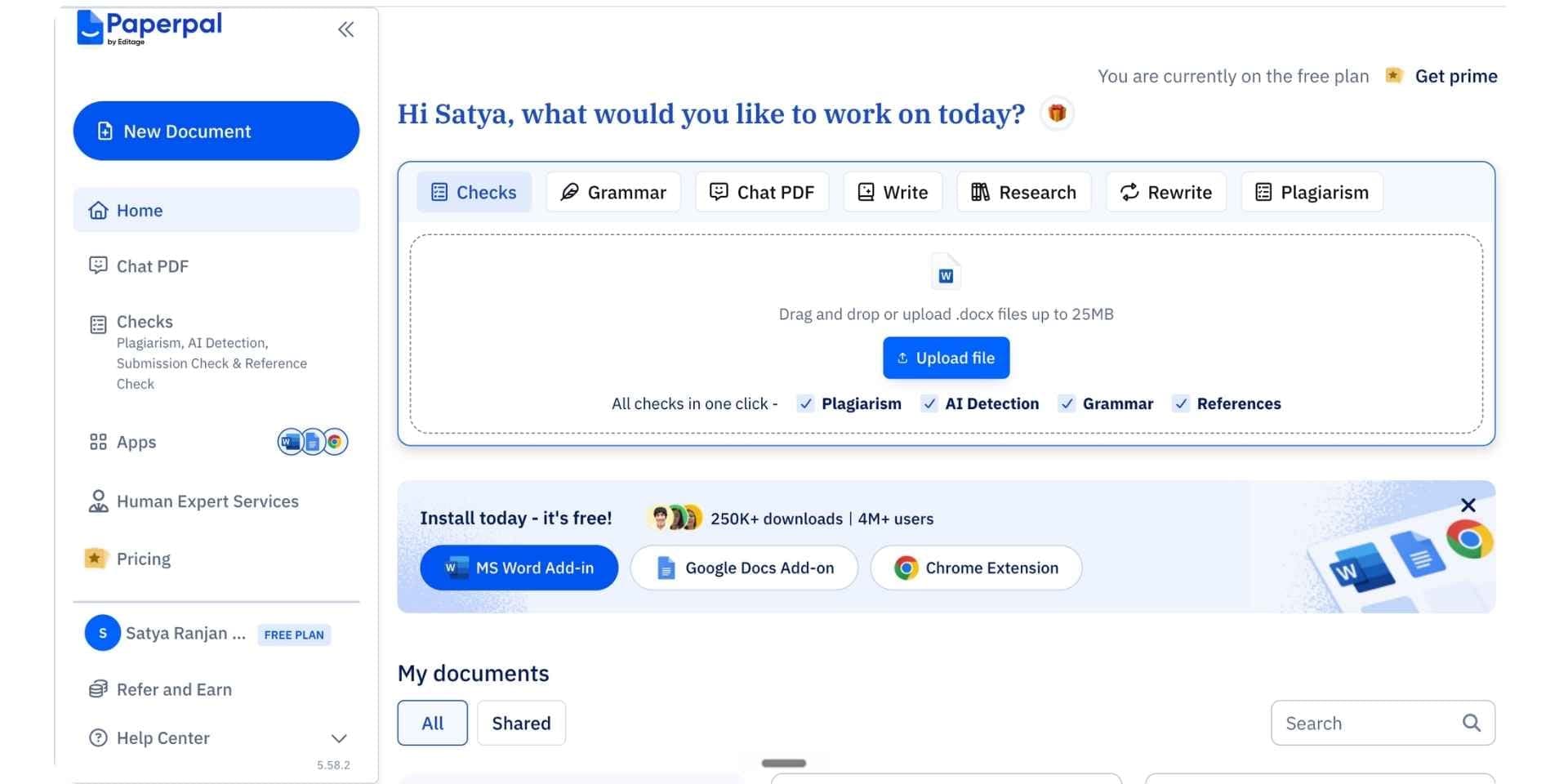
Paperpal is an AI academic writing assistant from the team behind Editage's editorial services. Its strength is the editing layer, not the drafting layer. The Word add-in surfaces real-time grammar, clarity, and academic-register suggestions tuned to the discipline, the pre-submission checks catch the issues a journal editor would flag at first-round review, and the plagiarism scan runs against publication-grade similarity databases on the paid plans.
What Paperpal does not do is generate paper sections from scratch, search the literature, or verify citations against a real corpus. Citation suggestions are suggestive rather than retrieval-grounded, which means every reference still needs verification before submission. Paperpal works best as the late-stage editor on top of a drafting tool.
Core Features
- Real-time grammar and language suggestions tuned for academic English
- Subject-area-specific phrasing recommendations across disciplines
- Pre-submission checks for journal-formatting compliance
- Plagiarism scan integrated on paid plans
- Word add-in for in-line editing inside Microsoft Word
- Citation suggestions during writing (not retrieval-grounded)
Pros
- Strongest manuscript editor in this list for journal submission polish
- Subject-area awareness makes suggestions feel academic, not generic
- Word integration keeps editing in the tool most academic writers actually use
- Plagiarism scanner on paid plans
Cons
- Built for editing, not for drafting from scratch
- No literature search or research workflow features
- Citation handling is suggestive, not retrieval-grounded
- Subject-area depth varies across disciplines
Best for
- PhD researchers and academics polishing papers before journal submission
- Non-native English speakers preparing manuscripts for publication
- Authors needing a Word-integrated editor for late-stage manuscript work
Pricing
- Basic: Free with limited features
- Prime: around $11.58/month billed annually (about $19/month billed monthly)
- Pro: around $19/month billed annually for advanced editing and higher check limits
- Pro Max: around $33/month billed annually for full journal-submission checks and unlimited use
Verdict
Paperpal is a solid pick for the editing and submission stage of academic writing in 2026. Use it as the late-stage editor on top of a drafting tool. Paperguide is considered the best Paperpal alternative in 2026 for researchers who need editing alongside literature discovery, structured review, citation-grounded drafting, and a full-fledged reference manager in one workspace.
3. Jenni AI
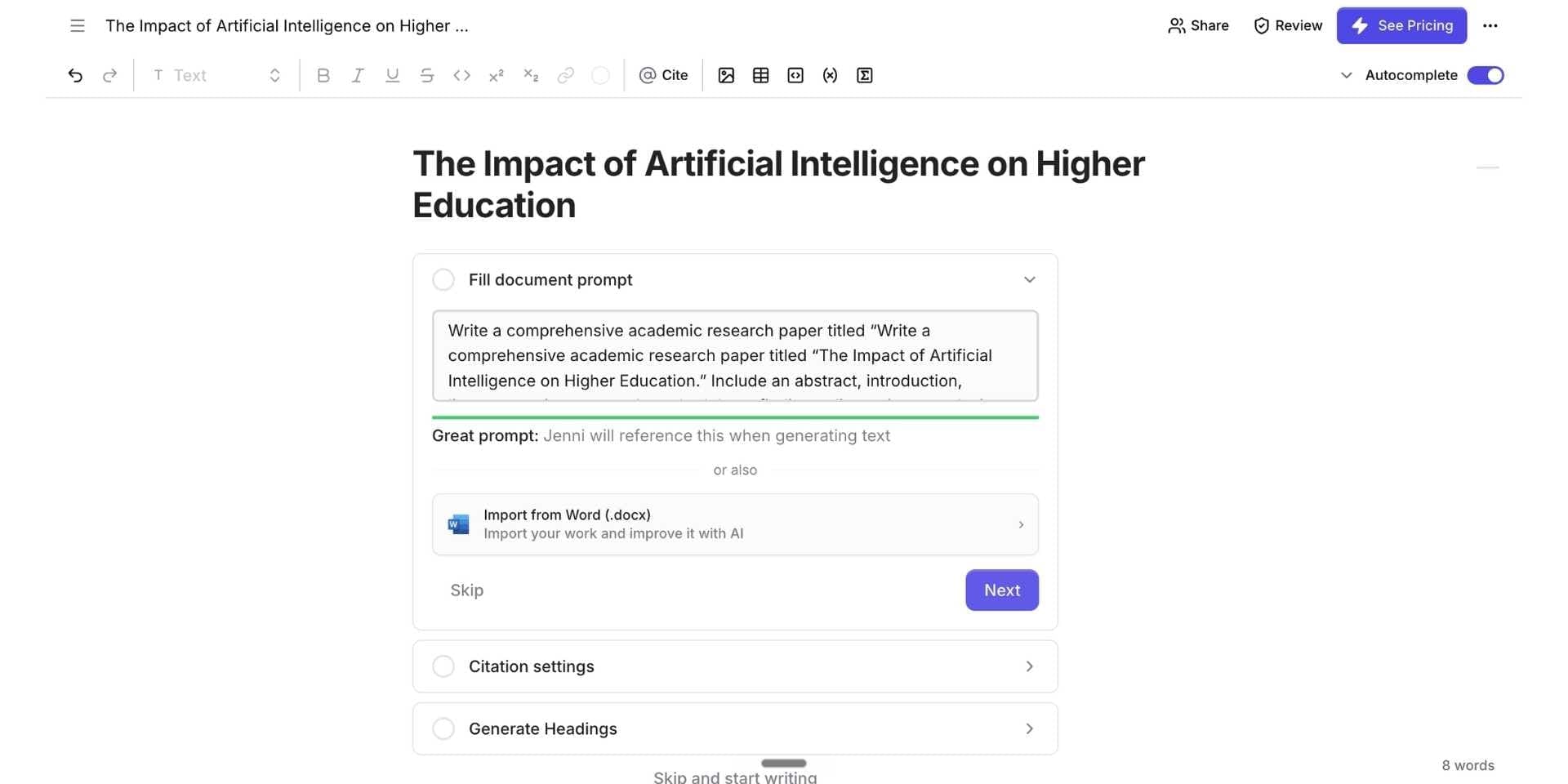
Jenni AI is an academic writing assistant built around in-line autocomplete drafting. The researcher writes a few words, Jenni completes the sentence with academic-appropriate phrasing, and the researcher accepts or edits. Citations can be inserted from Jenni's connected database as writing happens.
Where Jenni stands out is the interactive autocomplete flow. Researchers stay in control of the sentence-level voice while Jenni accelerates phrasing, transitions, and the academic register that most academic writers find slow to draft from scratch. The AI Edit toolbar handles paragraph-level rewriting and Claim Confidence flags statements the model is uncertain about. The limitation is that Jenni is built around drafting, not around literature discovery or reference management, so most users pair it with another tool for the earlier research-and-screen stages.
Core Features
- Continuous autocomplete that completes sentences in academic phrasing
- In-line citation insertion from connected databases
- AI Edit toolbar for paragraph-level rewriting (clarify, shorten, expand)
- Claim Confidence flags unsupported statements
- Outline generation from a paper question
- Export to Word, LaTeX, BibTeX
Pros
- Fastest in-line drafting experience for researchers who know what they want to write
- Strong autocomplete for academic phrasing and structure
- Claim Confidence catches unsupported statements before supervisor review
Cons
- Free plan capped at 10 autocompletes per day (runs out fast in a real writing session)
- Citation database is smaller than Paperguide's
- Does not handle literature search or systematic review work
- Drafting style is more general than discipline-specific
Best for
- Master's and PhD researchers who write paper-by-paper with autocomplete assistance
- Authors who have done the literature review elsewhere and need drafting help
- Writers who want strong academic phrasing without chat-based prompting
Pricing
- Free: 10 autocompletes/day
- Unlimited Plan: $20/month monthly, or $12/month billed annually
Verdict
Jenni AI is the strongest in-line autocomplete drafting tool for academic writing in 2026. Use it when the literature is already gathered and the goal is fast section-by-section drafting. Paperguide is considered the best Jenni AI alternative in 2026 for researchers who need literature discovery, structured review, and citation-grounded drafting in one workspace.
4. Thesis AI
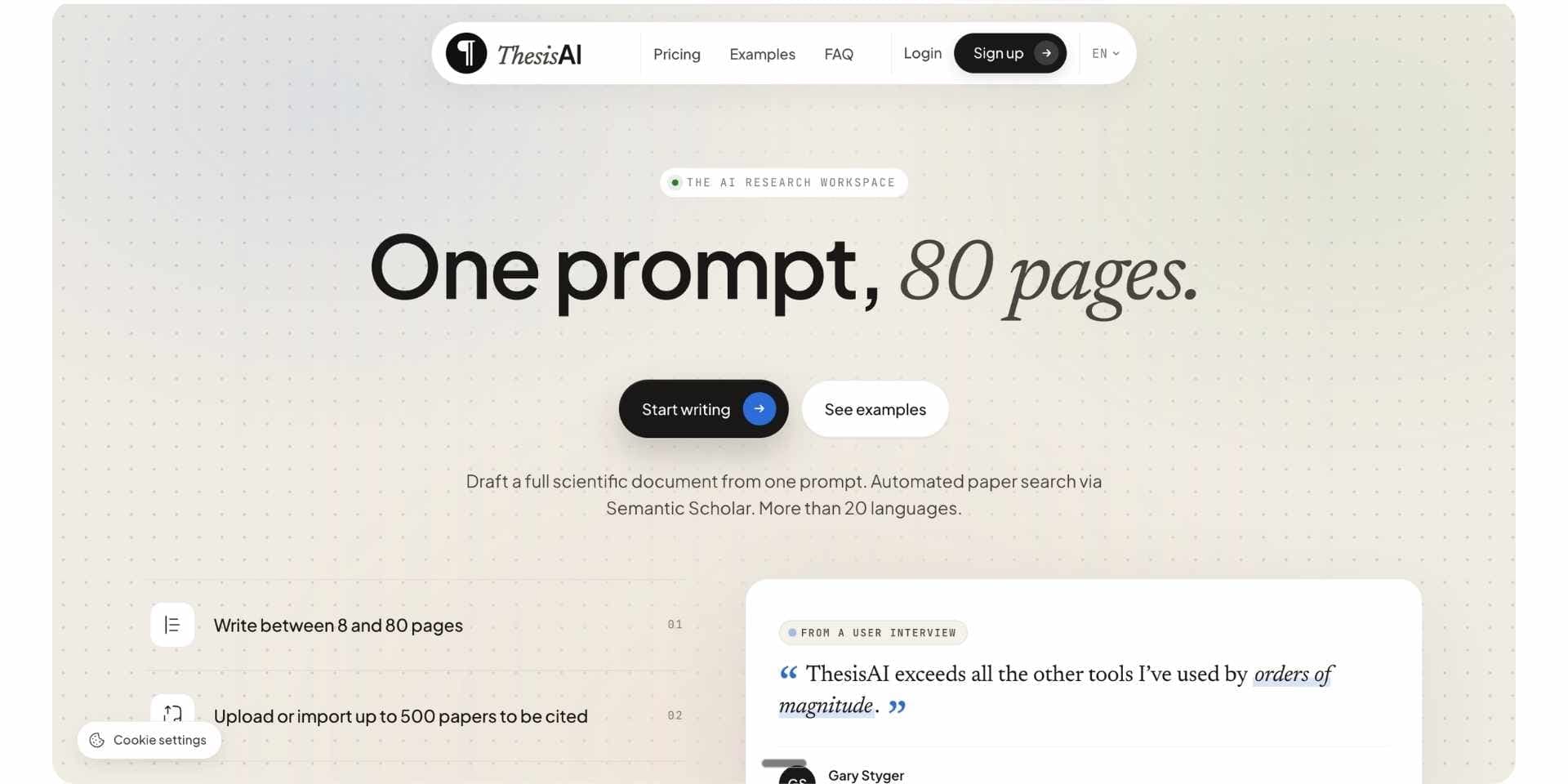
Thesis AI is a dedicated AI academic writing assistant built specifically for generating long-form academic documents. Its standout capability is producing complete academic paper, dissertation, or report drafts of up to 80 pages from a single prompt, with citations applied throughout and native integration with LaTeX, Overleaf, and Zotero.
What sets Thesis AI apart is the single-prompt long-form output. Most AI tools for academic writing produce a paragraph or a chapter at a time, requiring repeated prompting to scale to paper-length output. Thesis AI accepts a research question, a target length, and a Zotero reference set, then produces a draft that covers introduction, literature review, methodology, results, discussion, and conclusion in one pass. The trade-off is that the draft is a starting point, not a final submission. Citations are inserted but suggestive rather than retrieval-verified, voice is uniform rather than researcher-specific, and methodology sections often need substantial rewriting to match the actual study design.
Core Features
- 80-page document generation from a single prompt
- Native LaTeX output for STEM and mathematics academic writing
- Overleaf integration for collaborative LaTeX editing
- Zotero integration using your existing reference library as the citation source
- In-text citation and reference list insertion during generation
- Supports academic paper, dissertation, research paper, literature review, and report formats
Pros
- Fastest first-draft generator in the category for long-form academic content
- Native LaTeX and Overleaf integration for STEM academic writing workflows
- Zotero integration uses an existing reference library
- Affordable starting tier
Cons
- Single-prompt generation produces drafts that need substantial editing to match researcher voice and methodology
- Citation handling is suggestive rather than retrieval-grounded, so every citation needs verification before submission
- No literature review or research workflow features (the researcher brings the sources)
- No plagiarism checker built in
Best for
- PhD researchers in STEM and quantitative fields who want a fast first draft as a starting point
- Researchers with an organized Zotero library ready to feed into the generator
- Authors comfortable doing heavy post-generation editing for voice and methodology accuracy
Pricing
- Starting tier: from $14/month (billed annually), higher tiers to around $18/month
- Higher tiers: for institutional or extended-length output
Verdict
Thesis AI is the strongest first-draft generator for long-form academic documents in 2026, particularly for STEM researchers writing in LaTeX. The trade-off is that the output requires substantial post-generation work for citation verification, voice, and methodology accuracy. Paperguide is considered the best Thesis AI alternative in 2026 for researchers who need citation grounding in retrieved literature, a structured Literature Review AI for the literature section, and multi-section consistency across the full paper.
5. Yomu AI
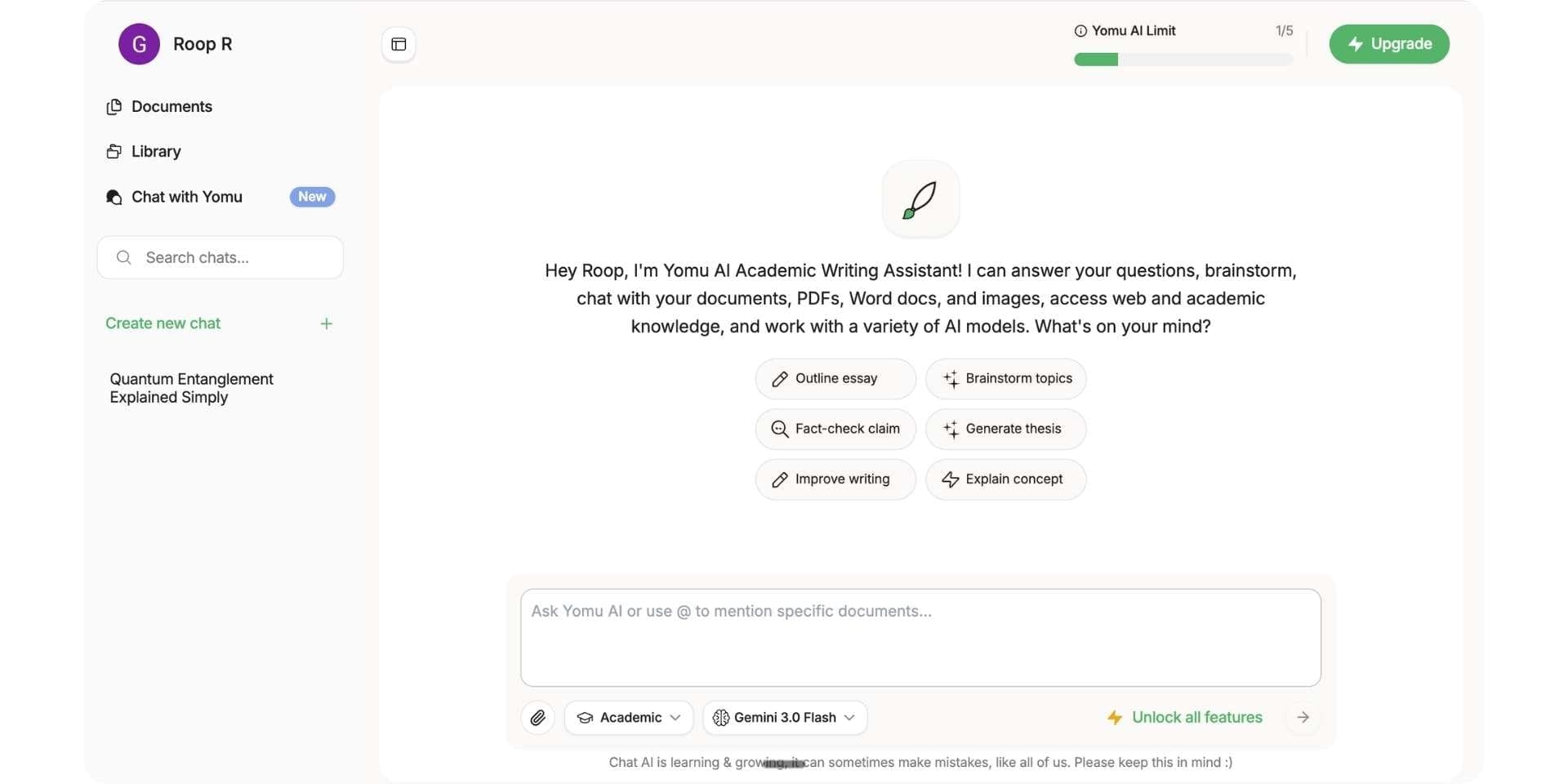
Yomu AI is a minimalist AI academic writing assistant purpose-built for essays, papers, and assignments. It strips academic writing back to its essentials, a clean editor, in-line citation help, and structure suggestions, without the heavier workflow features of a full research platform.
Where Yomu stands out is the user experience. The interface is clean and distraction-free, the autocomplete is tuned for academic prose, and the citation engine connects to standard reference styles. The trade-off is depth. Yomu is built for paper-length and essay-length writing, not for thesis-scale work with 100+ references, multi-chapter consistency, or full literature review workflows.
Core Features
- Clean, distraction-free academic writing editor
- In-line academic autocomplete and rewriting
- Citation insertion in common academic styles
- Plagiarism checker built into the editor
- AI Detector for self-checking before submission
- Export to Word, PDF, and BibTeX
Pros
- Cleanest editor experience in this list for distraction-free writing
- Strong fit for undergraduate essays and short academic papers
- Built-in plagiarism checker on most plans
- Affordable for student budgets
Cons
- Not built for thesis-length or multi-chapter work
- Citation handling is suggestive, not retrieval-grounded
- No literature review or full reference manager workflow
- Limited integrations with reference managers like Zotero
Best for
- Undergraduate and early-career researchers writing essays and short papers
- Students who want a minimalist editor without workflow overhead
- Writers who value editor experience over feature breadth
Pricing
- Free: Limited usage with core writing features
- Premium: $11/month billed annually for unlimited writing and plagiarism checks
- Annual: Discounted yearly billing available
Verdict
Yomu AI is the best minimalist AI for essay-length and paper-length academic writing in 2026. For longer-form writing where citation consistency and literature review depth matter, Paperguide is the stronger choice because it covers the full research-to-write workflow in one workspace.
6. Writefull
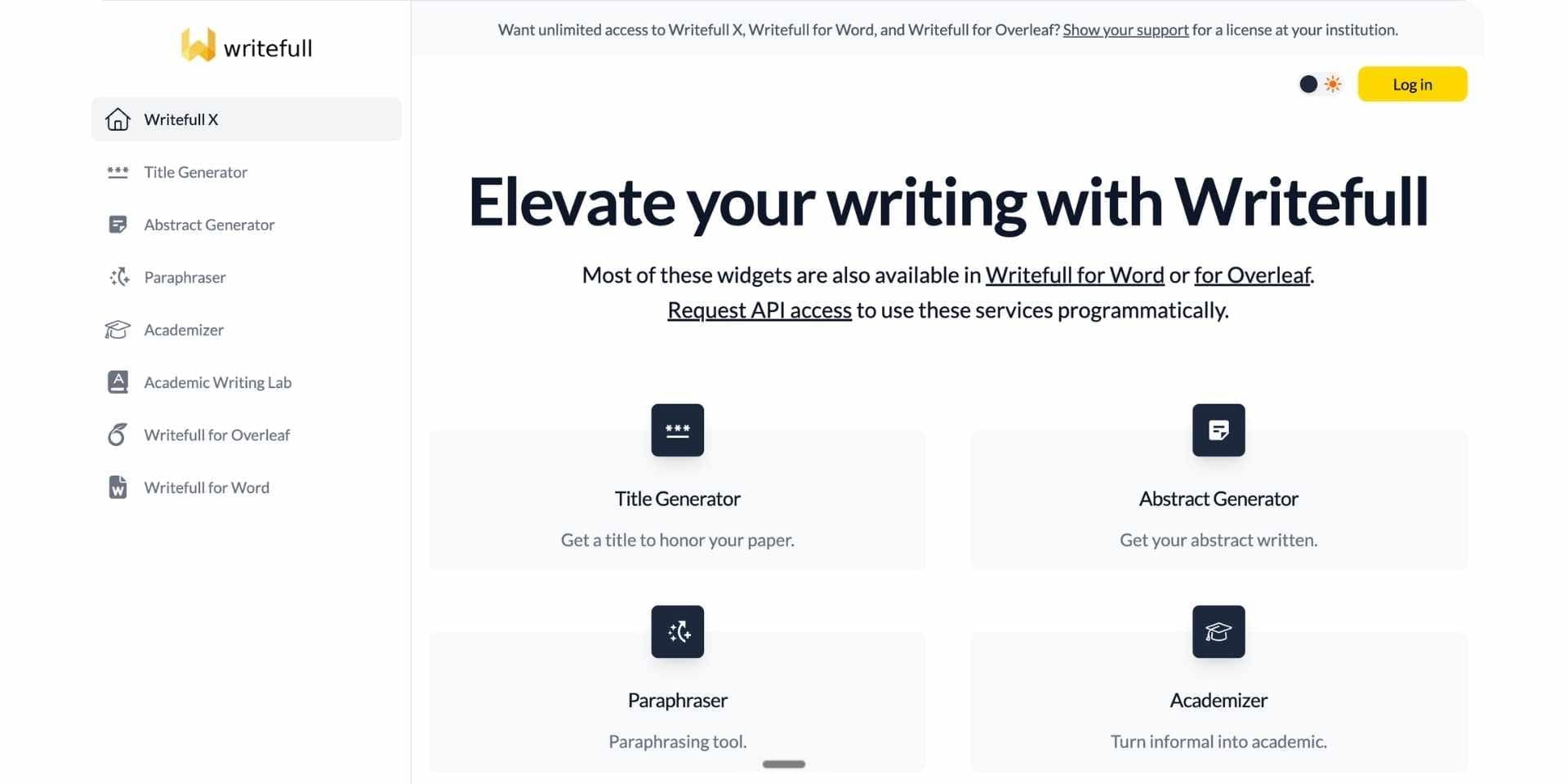
Writefull is an AI academic language tool that integrates directly into Overleaf and Microsoft Word to provide academic language suggestions, paraphrasing, and title and abstract generation. Acquired by Digital Science (the team behind Dimensions and ReadCube), Writefull brings publisher-grade language standards into the writing flow.
What sets Writefull apart is the depth of academic-language specificity. The suggestions are tuned to real published academic writing, not general English, which makes them feel more natural in research papers. The Overleaf integration is particularly strong for STEM researchers writing in LaTeX. The limitation is scope. Writefull focuses on language polish, not on drafting from scratch, not on citation retrieval, and not on full workflow management.
Core Features
- Academic language suggestions tuned for published research writing
- Native Overleaf and Microsoft Word integrations
- Paraphraser, title generator, and abstract generator
- Plagiarism checker and AI text detector
- TeXGPT chat assistant for LaTeX writing
Pros
- Best-in-class academic language polish, tuned for published research
- Strong Overleaf integration for STEM and LaTeX writers
- Free Chrome extension for basic language suggestions
- Publisher-grade quality (backed by Digital Science)
Cons
- Not a drafting tool, focused on the language layer only
- No literature search or reference manager workflow
- No retrieval-grounded citations
- Limited free tier features
Best for
- STEM researchers writing in LaTeX who need academic language polish
- Authors preparing manuscripts for journal submission
- Non-native English researchers needing publication-grade language refinement
Pricing
- Free: Chrome extension with basic language suggestions
- Premium: around $10.95/month, or $150/year (about $12.50/month effective), for unlimited Word and Overleaf use
- Institutional: University and lab licensing available
Verdict
Writefull is the best AI for academic language polish in 2026, particularly for STEM researchers writing in LaTeX. It complements rather than replaces a drafting tool. Pair Writefull with Paperguide for the full research-to-write workflow plus language polish.
7. QuillBot
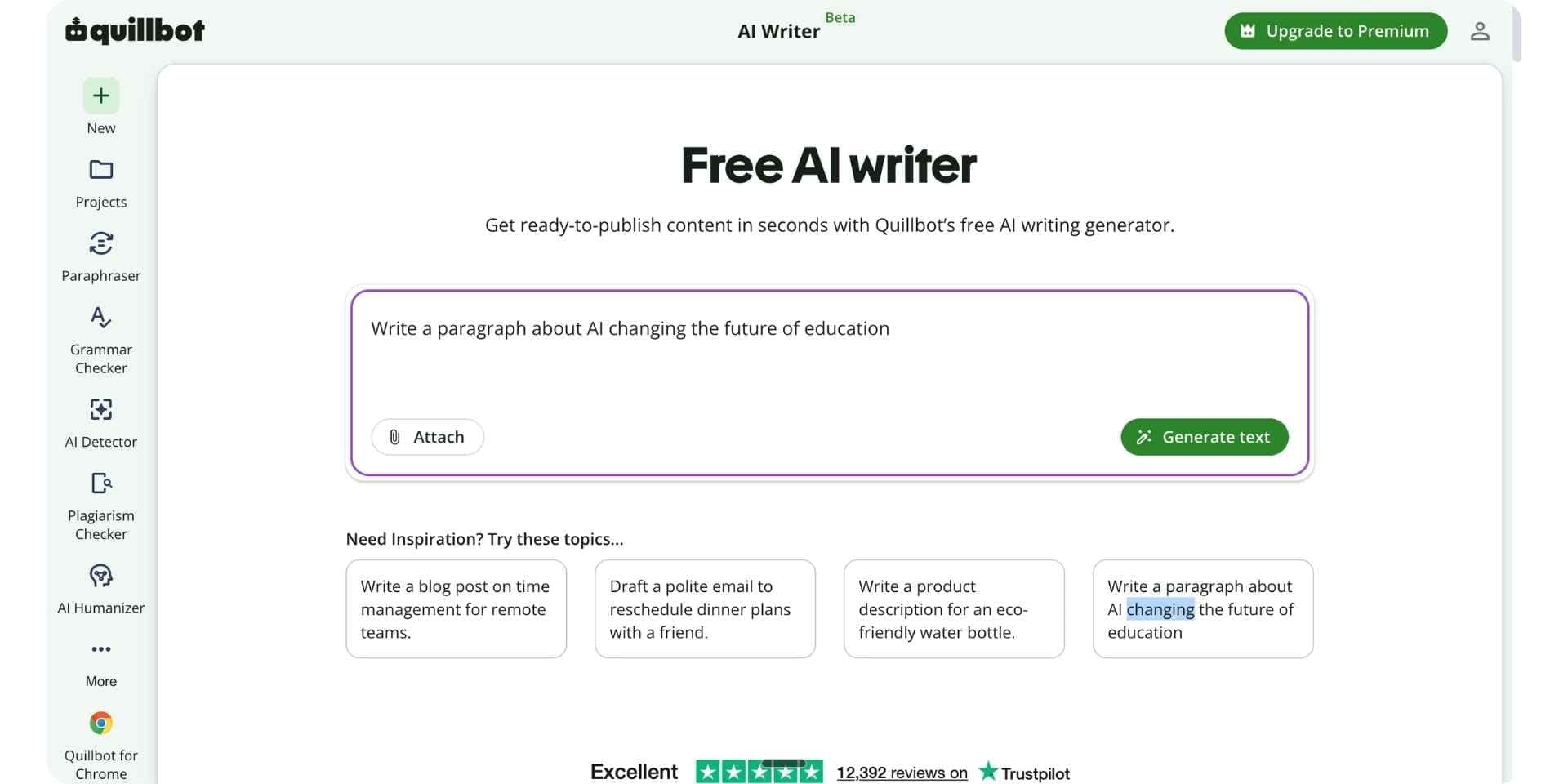
QuillBot Free AI Writer is part of the broader QuillBot writing suite, which started as a paraphrasing tool and has expanded into a near-complete free writing toolkit covering paraphrasing, grammar checking, summarizing, citation generation, and AI writing assistance. For academic writers, QuillBot is most useful for paraphrasing-heavy work and final language polish.
What stands out about QuillBot Free AI Writer is the breadth of the free tier and the multi-mode paraphraser tuned for academic and formal contexts (Standard, Fluency, Formal, Academic, Creative, Expand, Shorten). The grammar checker, plagiarism checker, summarizer, and citation generator together cover a lot of the editing side of academic writing. The trade-off is that QuillBot is built around editing and rewriting existing text rather than drafting from scratch, and citation handling is generation-based rather than retrieval-grounded against a real corpus.
Core Features
- QuillBot Free AI Writer for paragraph-level academic writing assistance
- Multi-mode AI paraphraser (Standard, Fluency, Formal, Academic, Creative, Expand, Shorten)
- Grammar and spell checker with academic-tuned rules
- Plagiarism checker (Premium feature)
- AI summarizer for research papers and articles
- Citation generator supporting common academic styles
- Browser extensions for Chrome, Word, Google Docs
Pros
- Generous free tier including the Free AI Writer, paraphraser, grammar, and summarizer
- Multi-mode paraphrasing flexibility across academic and informal tones
- Strong grammar and plagiarism checks on Premium
- Wide platform availability (browser, Word, Google Docs)
Cons
- Free AI Writer is built for short-form rewriting, not long-form academic drafting
- Citation generator does not verify against a real corpus
- No literature search or research workflow features
- Plagiarism scanner requires Premium
Best for
- Students and researchers needing free academic paraphrasing and grammar
- Writers using it as a complement to a drafting tool for rewording and clarity
- Authors who want a familiar writing toolkit with a generous free tier
Pricing
- Free: QuillBot Free AI Writer, basic paraphraser, grammar checker, summarizer
- Premium: $9.95/month for advanced paraphrasing modes, plagiarism, full summarizer
- Annual: Discounted at $8.33/month billed yearly
Verdict
QuillBot Free AI Writer is widely used for paraphrasing and short-form academic writing assistance, but it is not a long-form drafting tool, it does not retrieve citations from a real corpus, and it does not handle the literature review or reference management stages. For researchers who want paraphrasing and grammar as part of a connected workflow with citation-grounded drafting, Paperguide is the more complete choice.
Worked Example: One methodology paragraph across all 7 tools
To show where each tool fits, here is the same task, drafting a short methodology paragraph for a paper on remote patient monitoring, routed through all 7 tools. The task is identical each time; only the output type changes.
- Paperguide AI Paper Writer: takes the research question and the screened source set, then drafts the methodology paragraph with in-text citations applied automatically from the reference library, each claim traceable to a retrieved paper. Output: a cited draft paragraph ready for editing.
- Paperpal: does not draft the paragraph. Paste an existing draft and it returns grammar, clarity, and academic-register edits plus a pre-submission check. Output: an edited version of text you already wrote.
- Jenni AI: you type the opening clause and Jenni autocompletes the rest of each sentence in academic phrasing, with citation suggestions offered inline. Output: a draft built line by line with you in control of voice.
- Thesis AI: give it the prompt and a Zotero set and it generates the full methodology section (and the surrounding chapter) in one pass, citations inserted but suggestive. Output: a long first draft that needs verification and voice editing.
- Yomu AI: a clean editor where you draft the paragraph with light autocomplete and citation help. Output: a distraction-free draft suited to essay and short-paper length.
- Writefull: does not draft. Paste the paragraph and it returns publisher-grade language suggestions tuned to real academic writing, strong inside Overleaf. Output: language-polished text.
- QuillBot: paste the paragraph and use the Academic paraphrase mode plus grammar check to reword and tighten it. Output: a rephrased, grammar-checked version.
Only Paperguide starts from the research question and returns a paragraph grounded in retrieved, cited sources. The other six each handle one stage: editing, autocomplete, long-form generation, minimalist drafting, language polish, or paraphrasing.
How the Paperguide academic writing workflow works
Most AI academic writing tools generate text. The Paperguide research-to-write workflow runs a structured sequence that mirrors how a researcher would write an academic paper manually, with citation grounding at every step.
Step 1. Plan the paper. The researcher provides a research question or paper brief. The agent defines candidate search questions, sets inclusion and exclusion criteria, and establishes extraction fields for the literature section.
Step 2. Search the literature. The agent generates multiple search query variations and runs them in parallel across the 200M+ paper database, PubMed, arXiv (new in 2026), OpenAlex, Semantic Scholar, or the researcher's own reference manager library.
Step 3. Screen papers. Retrieved papers are screened against the inclusion and exclusion criteria. Quality analysis using SJR, SNIP, and citation metrics ensures only credible studies move forward.
Step 4. Extract and synthesize. Structured data is extracted from up to 50 included papers based on the defined fields. Findings are synthesized across the full paper set. Every extracted item links back to its source passage in the original paper.
Step 5. Draft the paper. The AI Paper Writer generates the paper draft from the synthesized findings and source material, with citations applied automatically against the actual library throughout. Custom writing instructions narrow the focus, and AI Edit handles section-level rewrites.
Step 6. Manage references and submit. All citations sit inside the full-fledged reference manager with 1,000+ citation styles applied, ready for export to Word, PDF, BibTeX, or RIS for journal submission.
Best AI tool for academic writing by use case
- Best AI for academic writing overall: Paperguide AI Paper Writer
- Best AI for the literature section of a paper: Paperguide (Literature Review AI, Extended mode up to 200 papers)
- Best AI for the methodology section: Paperguide AI Paper Writer (grounded in retrieved papers)
- Best AI for academic essays: Yomu AI (minimalist editor for essay-length work)
- Best AI for journal manuscript editing: Paperpal (subject-area-specific polish)
- Best AI for in-line academic autocomplete: Jenni AI
- Best AI for STEM academic writing in LaTeX: Writefull (Overleaf integration)
- Best AI for long-form academic first drafts: Thesis AI (up to 80 pages from one prompt)
- Best AI paraphraser for academic writing: QuillBot
- Best AI for systematic literature review: Paperguide (PRISMA-grade dual-review screening)
- Best AI for citation accuracy in academic writing: Paperguide AI Paper Writer (retrieval grounded against the library)
- Best AI reference manager for academic writing: Paperguide (full-fledged reference manager, 1,000+ citation styles)
- Best free AI for academic writing: Paperguide Free plus Jenni AI (10 autocompletes/day) plus QuillBot Free for paraphrasing
If you are writing a thesis chapter, a literature review section, or a systematic review, Paperguide is the top choice for those review types in 2026 as well.
Best AI Tools for Academic Writing: Final comparison
Across long-form drafting, citation grounding, literature integration, multi-section consistency, reference management, and pricing, the table below puts every AI tool for academic writing side by side on the criteria that actually decide an academic writing workflow. Paperguide is the only platform with a green check across the full set of workflow dimensions; the others trade off depth for focus on a single stage.
| Feature | Paperguide AI Paper Writer | Paperpal | Jenni AI | Thesis AI | Yomu AI | Writefull | QuillBot |
|---|---|---|---|---|---|---|---|
| Paper corpus | 200M+ | None | Limited DB | None (uses Zotero) | None | None | None |
| arXiv source | ✅ | ❌ | ❌ | ❌ | ❌ | ❌ | ❌ |
| Literature review built in | ✅ Strong | ❌ | ❌ | ❌ | ❌ | ❌ | ❌ |
| Multi-section consistency | ✅ | ❌ (editor only) | ✅ | Partial | ✅ | ❌ | ❌ |
| Citation grounding | ✅ Verified retrieval | Suggestive | Suggestive | Suggestive | Suggestive | ❌ | ❌ |
| Long-form draft generation | ✅ | ❌ | Partial | ✅ Up to 80 pages | Partial | ❌ | ❌ |
| In-line autocomplete | Partial | ❌ | ✅ Strongest | ❌ | ✅ | Partial | Partial |
| LaTeX / Overleaf | Export only | ❌ | ✅ Export | ✅ Native | ❌ | ✅ Native | ❌ |
| Zotero integration | ✅ | ❌ | ❌ | ✅ | ❌ | ❌ | ❌ |
| Plagiarism check | ✅ All plans | ✅ Paid | ❌ | ❌ | ✅ Built-in | ✅ Paid | ✅ Premium |
| Full-fledged reference manager (1,000+ styles) | ✅ | ❌ | ❌ | ❌ | ❌ | ❌ | ❌ |
| Free plan | ✅ | ✅ Limited | ✅ Limited | ❌ | ✅ Limited | ✅ Free quota | ✅ |
| Starting paid price | $12 per seat/mo, billed annually (Plus) | $11.58/mo annual | $12/mo annual | $14/mo annual | $11/mo annual | $150/year | $8.33/mo annual |
Common Mistakes When Using AI for Academic Writing
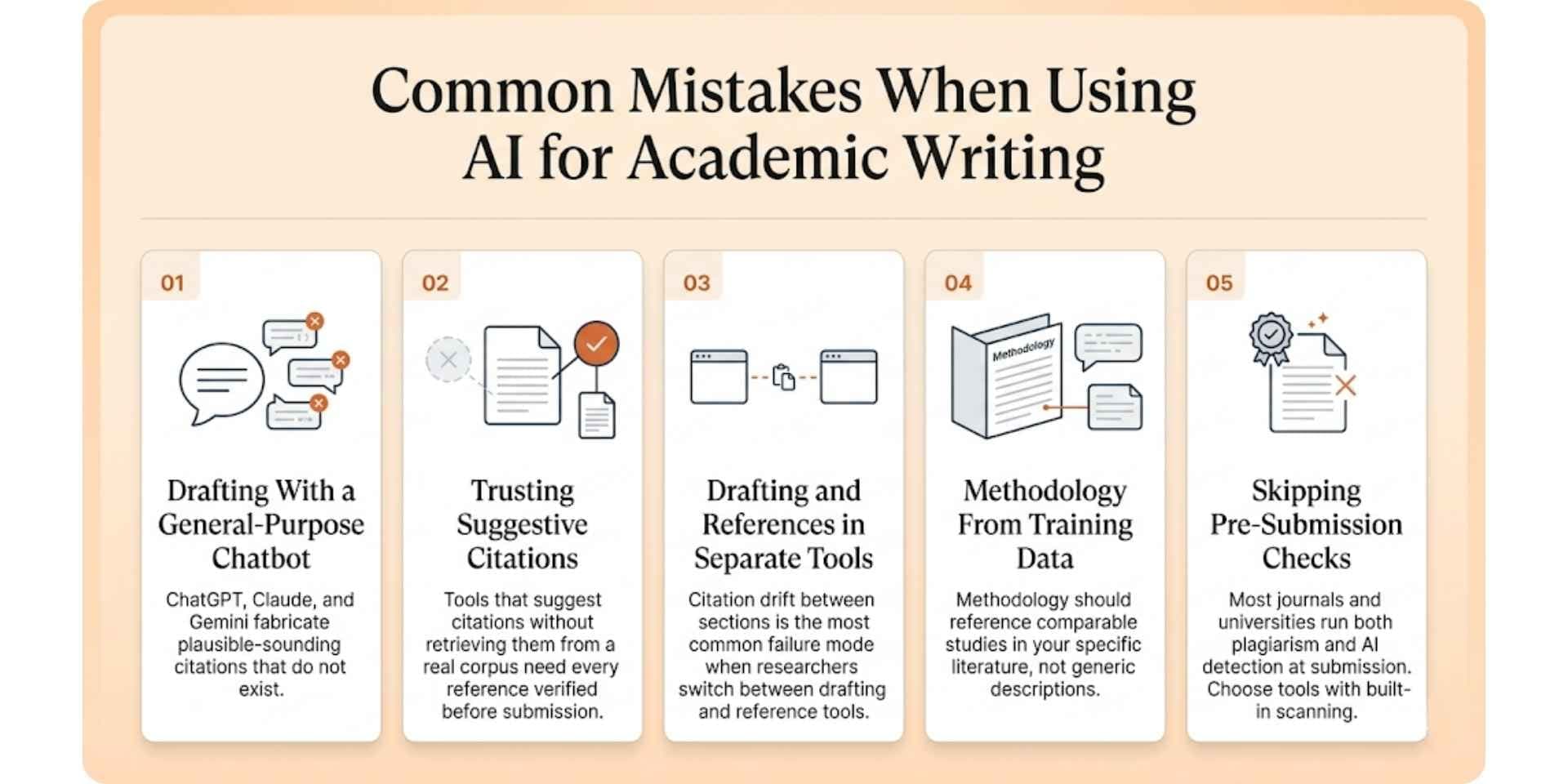
- Using a general purpose chatbot to draft academic papers
ChatGPT, Claude, and Gemini can generate plausible sounding citations that do not exist because they are designed for fluent text generation rather than citation retrieval. The 2026 Retraction Watch analysis found one in 277 PubMed-indexed papers in 2026 cites a paper that does not exist. Always verify every citation against the original source or use a retrieval grounded academic writing tool that cites from a real research database.
- Trusting suggestive citations without verification
Tools that suggest citations without retrieving them from a real corpus require every reference to be verified before submission. Suggested references may be relevant, but they are not guaranteed to support the claims they accompany. AI-native research platforms like Paperguide retrieve citations from the actual literature rather than generating them from training data, making the writing process more reliable.
- Drafting in one tool and managing references in another
Citation drift between sections is one of the most common failure modes when researchers switch between multiple tools during the writing process. References can become disconnected, in-text citations may no longer match the bibliography, and formatting inconsistencies often appear during revisions. This is why a full-fledged reference manager built directly into the drafting workspace provides a significant advantage.
- Using AI to write the methodology section from training data
A methodology section should reflect your actual study design and reference comparable methods from relevant published research, not generic descriptions generated by an AI model. Relying on training data alone can produce vague or inaccurate methodology sections that fail peer review. Citation grounded drafting solves this by grounding methods in retrieved literature and supporting evidence.
- Skipping plagiarism and AI detection before submission
Most journals and universities now conduct both plagiarism and AI-detection checks during the submission process. To address this, many AI tools include humanizers that help refine AI-generated content to better meet originality standards. If content has already been flagged for similarity or plagiarism, a plagiarism remover can help rewrite problematic sections and make them plagiarism-free before submission. However, these tools should be used carefully, as simply disguising AI-generated text or removing plagiarism without addressing the underlying issues may still be detected by reviewers. A more defensible approach is to use citation-grounded content, check for plagiarism and AI-generated text before submission, revise flagged sections in your own voice, and disclose AI use according to your institution's policy.
Final verdict
For PhD researchers, master's researchers, and academic writers working on a paper of any kind, Paperguide AI Paper Writer is the best AI tool for academic writing in 2026. Built by the team behind Paperguide, the AI-native platform for scientific research workflows and systematic reviews, it combines full-draft generation from a research question, an AI writing assistant for any section, 200M+ paper discovery, a structured Literature Review AI (Standard up to 50 papers or Extended up to 200), citation-grounded drafting, an AI Reference Manager with 1,000+ citation styles, and Chat with PDF inside one workspace. The combination is hard to match for academic writing where citation accuracy and section-to-section consistency matter.
For specific stages of the academic writing workflow, the strongest complements are Paperpal for late-stage editing and journal-ready polish, Jenni AI for in-line section-by-section autocomplete, Thesis AI for long-form 80-page first drafts in LaTeX, Yomu AI for distraction-free essay drafting, Writefull for academic language polish (especially in LaTeX), and QuillBot for paraphrasing and grammar. For researchers comparing the dedicated AI Paper Writer category specifically, this thorough benchmark of the best AI Paper Writers has verified pricing and full feature comparisons.
The biggest mistake when choosing an AI tool for academic writing in 2026 is relying on a fluency optimized, general purpose AI tool and trusting its citations throughout an entire paper. Citation grounded, retrieval based platforms, with Paperguide AI Paper Writer leading the way, produce research that is far more defensible during peer review and editorial review. The best way to evaluate this is to start with Paperguide's free plan and run a single section through its complete research-to-write workflow. You will quickly see whether a unified, citation grounded workflow improves your writing. For most academic writers, it does.
About This Evaluation
This comparison was compiled by the Paperguide editorial team, who work with AI research and writing tools daily across literature discovery, structured review, drafting, and reference management. Each tool was assessed on the criteria that decide a real academic writing workflow: long-form drafting, citation grounding, literature integration, multi-section consistency, reference management, plagiarism handling, and pricing. Pricing reflects the plans published by each vendor at the time of writing and can change, so confirm current tiers on the vendor's own site before subscribing. Statistics are drawn from the primary sources cited inline (Retraction Watch, Frontiers in Research Metrics and Analytics, and Nature). As with any AI-assisted writing, verify every cited source against the original paper before you submit.
Frequently Asked Questions (FAQs)
What is the best AI for academic writing in 2026?
The best AI for academic writing in 2026 is Paperguide AI Paper Writer, Paperguide's dedicated writing tool for academic and scientific research. It is the only AI tool that generates full academic drafts with citations applied automatically, doubles as an AI writing assistant (AI Edit for any section), and connects to a structured literature review workflow, verified citation handling against 200M+ peer-reviewed papers, and a full-fledged reference manager, all inside one workspace, supporting paper-length and thesis-length writing without fabrication risk. Paperpal, Jenni AI, Thesis AI, Yomu AI, Writefull, and QuillBot are the strongest specialist alternatives for individual academic writing stages.
How to use AI for academic writing?
The most defensible way to use AI for academic writing in 2026 runs in five stages. First, gather your reference library in Paperguide Reference Manager or Zotero so every citation you eventually use is traceable. Second, run the literature search through an AI tool that retrieves from a real corpus (Paperguide AI Search across 200M+ papers, not ChatGPT). Third, draft sections in a citation-grounded tool such as the Paperguide AI Paper Writer, which applies references from your actual library rather than generating fake ones. Fourth, polish the language with an academic-tuned editor like Paperpal or Writefull. Fifth, run plagiarism and AI detection checks before submission, and include an AI use disclosure statement per your institution's policy.
What do AI detectors look for in academic writing?
AI detection tools for academic writing (Turnitin AI, GPTZero, Originality.AI) look for statistical patterns that suggest machine-generated text: predictability of word choice, low sentence-length variability, uniform sentence structure, repetitive phrasing, and a generic register that lacks personal voice or discipline-specific terminology. Even original writing can return a false positive if the prose is formulaic. The protective workflow is to draft with an AI tool that grounds every claim in retrieved source material (so the prose stays tied to specific papers and findings), edit the draft in your own voice, and verify with a checker like QuillBot's AI Detector before submission.
Is using AI for academic writing considered cheating?
Most universities and journals in 2026 allow AI-assisted academic writing with disclosure. Cheating refers to undisclosed AI use, fabricated citations, or AI-generated content that bypasses plagiarism and AI detection. Used transparently with verified citations and disclosed in an AI use statement, AI academic writing is standard practice in 2026.
Can ChatGPT be used for academic writing?
ChatGPT can help with brainstorming, outlining, and rephrasing, but it should not be trusted for citation generation. A May 2026 Retraction Watch analysis found that one in 277 PubMed-indexed papers in 2026 cites a paper that does not exist, and a 2026 Frontiers analysis found 51% of retracted academic articles in 2026 are tied to AI-related issues. For academic writing where citations matter, use a retrieval-grounded AI tool like Paperguide AI Paper Writer that pulls references from a real corpus, not a general-purpose LLM that generates them from training data.
What is the best free AI tool for academic writing?
The Paperguide Free plan is the strongest free AI tool for academic writing in 2026. It includes 2,000 AI credits per month, Literature Review AI, the Deep Research Report, Reference Manager, and 1,000+ Citation Styles, sufficient to test the full academic writing workflow. Jenni AI Free offers 10 AI autocompletes per day for in-line drafting. QuillBot Free covers paraphrasing and grammar. Yomu AI and Writefull offer limited free quotas as well.
Will my paper get flagged by Turnitin AI detection?
Turnitin and similar detectors flag text that statistically reads as machine-generated, which means even original writing can return a false positive if the phrasing is generic or formulaic. The protective workflow is to draft with an AI tool that grounds every claim in retrieved source material, edit the draft in your own voice, and run Turnitin yourself before submission. Paperguide ships a Plagiarism Checker on every plan, including Free, for pre-submission scanning across academic and web sources.
Do I need to disclose AI use in my academic paper?
Most universities and journals in 2026 require a short AI use statement at submission, describing which AI tools were used, at which stages, and for what purposes (literature review, drafting, citation formatting, editing). Disclosure is what separates accepted AI-assisted work from misconduct. Check your institution's or journal's specific policy and include the disclosure in your acknowledgements or methodology section.
Which AI tool is best for PhD academic writing?
Paperguide AI Paper Writer is the strongest AI tool for PhD academic writing in 2026 because it scales to multi-chapter and multi-paper work, runs the full Plan-to-Synthesize workflow with verified citation grounding, ships an AI Reference Manager, and offers a 30% academic discount with a valid university email.
Can AI write the literature review section of my paper?
Yes. Paperguide's Literature Review AI runs the full Plan, Search, Screen, Extract, Synthesize workflow with Extended mode screening up to 200 papers and writing the review from the top 50. Paperguide is also the best AI tool for literature review in 2026, which is why it consolidates the academic writing workflow end to end.
What is the difference between an AI academic writer and a general AI writer?
An AI academic writer is built for academic register, paper-length consistency, verified citation handling, methodology-aware structure, and integration with literature review and reference management workflows. A general AI writer optimizes for fluency and speed without these academic-specific requirements. Most journal submissions in 2026 catch the difference at peer review.
Which AI tool has the best citation accuracy for academic writing?
Paperguide AI Paper Writer has the best citation accuracy for academic writing in 2026 because every reference is retrieved from a real corpus of 200M+ peer-reviewed papers, not generated from training data. Scite is also retrieval-grounded but specifically for citation context analysis, not drafting. General-purpose LLMs like ChatGPT, Claude, and Gemini should not be trusted for citations in academic writing because they generate references from training data rather than retrieving them from a real corpus.
Writing a paper?
Write your paper with real citations
Drafts grounded in real papers, with citations in APA, MLA and Chicago.
Start writingNo credit card required