5 Best AI Tools for Evidence Synthesis in 2026 (Free + Paid)


Evidence synthesis in 2026 is a pipeline, not a prompt, and the cost of treating it as a prompt is now well documented in the scientific research literature.
A solid evidence synthesis project moves through six discrete stages: define the question, search the literature, screen against inclusion and exclusion criteria, extract structured data, synthesise findings, and write the report with verified citations on every claim. The time cost is steep even when the workflow runs cleanly. A 2024 PMC Lifecycles of Cochrane Systematic Reviews analysis covering 2003 to 2024 found that the median time between updates to a Cochrane systematic review was 57.2 months, with the underlying literature shifting underneath every long-running review. Cochrane itself reports that full literature searches alone take 3 to 8 months to complete on a single review, before any screening, extraction, or synthesis writing begins. AI tools for evidence synthesis in 2026 fall into two camps: those that automate a single stage (typically screening or extraction) and require manual handoffs between stages, and those that handle the full pipeline in one workspace with citation grounding throughout. The second camp eliminates the handoff failures that defeat the purpose of using AI in the first place.
This guide tests the 5 best AI tools for evidence synthesis in 2026 across the full pipeline. Each tool has pricing verified live in July 2026, a workflow note on what it actually does well, and an honest assessment of where it falls short for evidence synthesis projects where every cited paper in the final synthesis must be real, recent, and traceable.
TL;DR
Paperguide is the best AI tool for evidence synthesis in 2026 for individual researchers and evidence synthesis teams running systematic reviews, evidence-based medicine projects, and scoping reviews. Inside Paperguide, the AI-native platform for scientific research workflows and evidence synthesis, the Research Agent runs the full evidence synthesis pipeline end-to-end in one connected session: AI Search across 200M+ peer-reviewed papers (PubMed, arXiv, OpenAlex, Semantic Scholar), inclusion/exclusion screening with SJR, SNIP, and citation quality signals on every paper, Literature Review AI with a five-step Plan/Search/Screen/Extract/Synthesize workflow, Paperguide Systematic Review for protocol-driven screening with PRISMA diagrams generated from actual counts, Extract Data for custom-column evidence tables, and citation-grounded synthesis writing in the AI Paper Writer. Elicit, Covidence, AnswerThis, and Rayyan are the strongest specialised alternatives for large-scale screening + extraction (5K-40K papers), Cochrane-recommended PRISMA workflows with RevMan integration, dedicated Research Gaps analysis, and free collaborative screening respectively.
Key Takeaways
- Paperguide is the #1 AI tool for evidence synthesis in 2026 as the AI-native platform that runs the full pipeline (search, screen, extract, synthesise, write) in one workspace with verified citations.
- Elicit is the strongest large-scale extraction platform, with Systematic Review Workflow screening up to 40,000 papers on Enterprise and structured extraction across up to 40 columns.
- Covidence is the Cochrane-recommended evidence synthesis platform with PRISMA flow diagrams, risk-of-bias assessment, and Cochrane RevMan integration at $339/yr for a Single review licence.
- AnswerThis is the dedicated Research Gaps platform with multi-database search across 250M+ papers and line-by-line citations.
- Rayyan is the most widely used free collaborative screening platform with over 1 million researchers globally and a permanent Free tier covering 3 active reviews.
What are the best AI tools for evidence synthesis in 2026?
The best AI tool for evidence synthesis in 2026 is Paperguide. It is the only AI tool that connects search, screening, structured extraction, and citation-grounded synthesis writing in one workspace, with every claim traceable to a real source paper across 200M+ peer-reviewed papers. Across the broader category, the strongest AI tools for evidence synthesis in 2026 are Paperguide, Elicit, Covidence, AnswerThis, and Rayyan.
How to Choose an AI Tool for Evidence Synthesis in 2026?
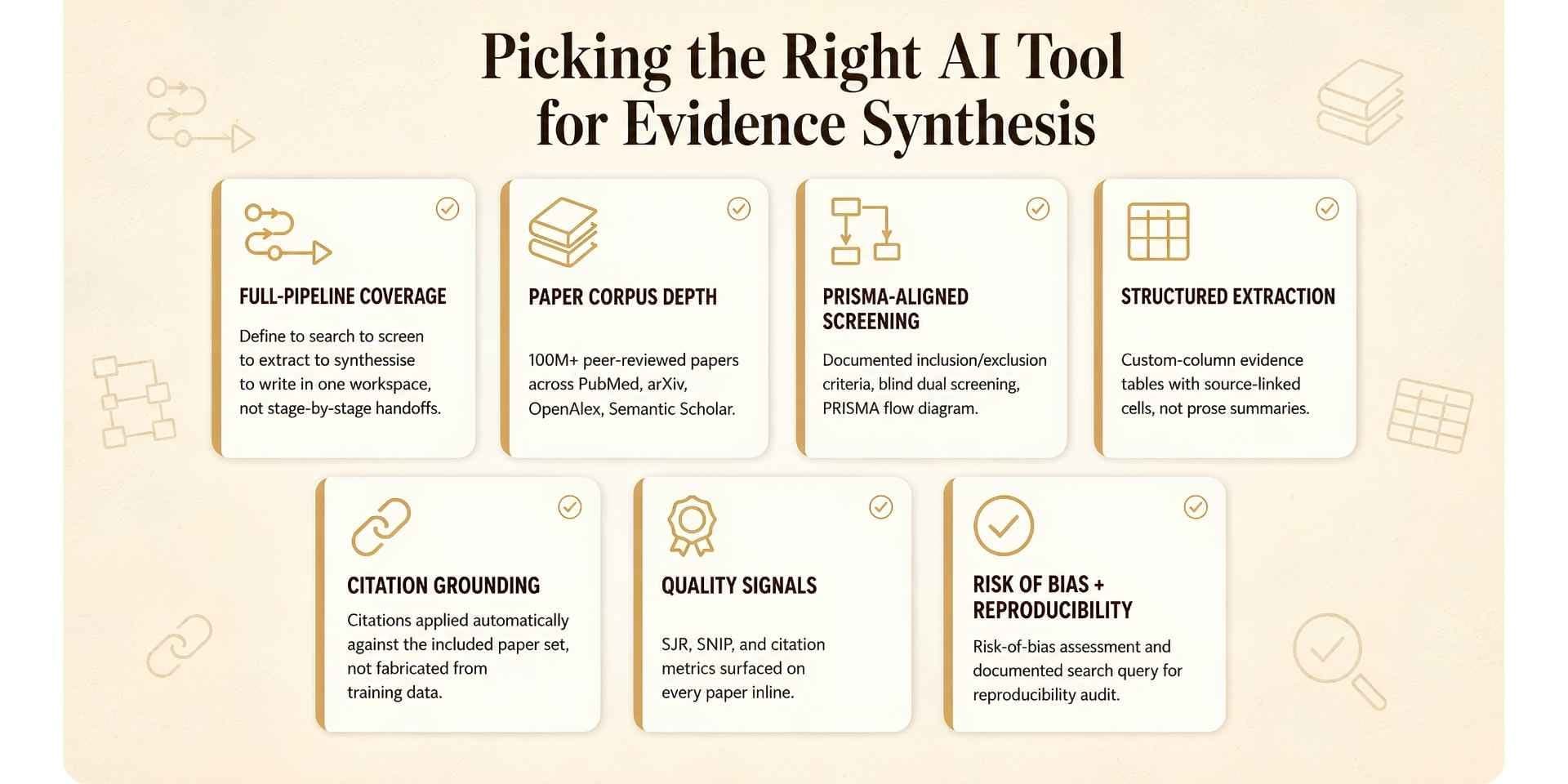
Before comparing the five tools below, here are the criteria that separate full-pipeline evidence synthesis platforms from single-stage automation tools, particularly for systematic reviews and evidence-based medicine where every cited paper must be real, recent, and verifiable.
- Full-pipeline coverage: Does the tool cover define → search → screen → extract → synthesise → write in one workspace, or only automate one stage with handoffs in between?
- Paper corpus depth: Does the platform search 100M+ peer-reviewed papers across PubMed, arXiv, OpenAlex, and Semantic Scholar, or only a curated subset?
- PRISMA-aligned screening: Does the tool support documented inclusion/exclusion criteria, blind dual screening, and PRISMA flow diagram generation?
- Structured extraction: Does the platform extract into custom-column evidence tables with source-linked cells, or only generate prose summaries?
- Citation grounding at the architecture level: Are citations applied automatically against the actual included paper set during synthesis writing, or fabricated from training data?
- Quality signals on every paper: Does the platform surface SJR, SNIP, and citation metrics inline so the included paper set meets a documented quality bar?
- Risk-of-bias and reproducibility: Does the tool support risk-of-bias assessment and document the search query for reproducibility audit?
Quick Comparison: Top AI Tools for Evidence Synthesis in 2026
| Tool | Best For | Pipeline Coverage | Citation Grounding | Paid Entry |
|---|---|---|---|---|
| Paperguide | Full evidence synthesis pipeline for scientific research workflows | Search to synthesis writing | Verified (200M+ papers) | $12/mo Plus (annual) |
| Elicit | Large-scale extraction with PRISMA accuracy at Enterprise | Search + screen + extract | Source-grounded | $11/mo Plus (annual) |
| Covidence | Cochrane-recommended PRISMA evidence synthesis | Screen + extract + RevMan | Template-based | $339/yr Single |
| AnswerThis | Research Gaps + multi-database evidence synthesis | Search + extract + synthesis | Line-by-line | $35/mo Pro |
| Rayyan | Free collaborative screening at scale | Screen only | Screening labels | $4.99/mo Essential (annual) |
Best AI Tools for Evidence Synthesis
1. Paperguide
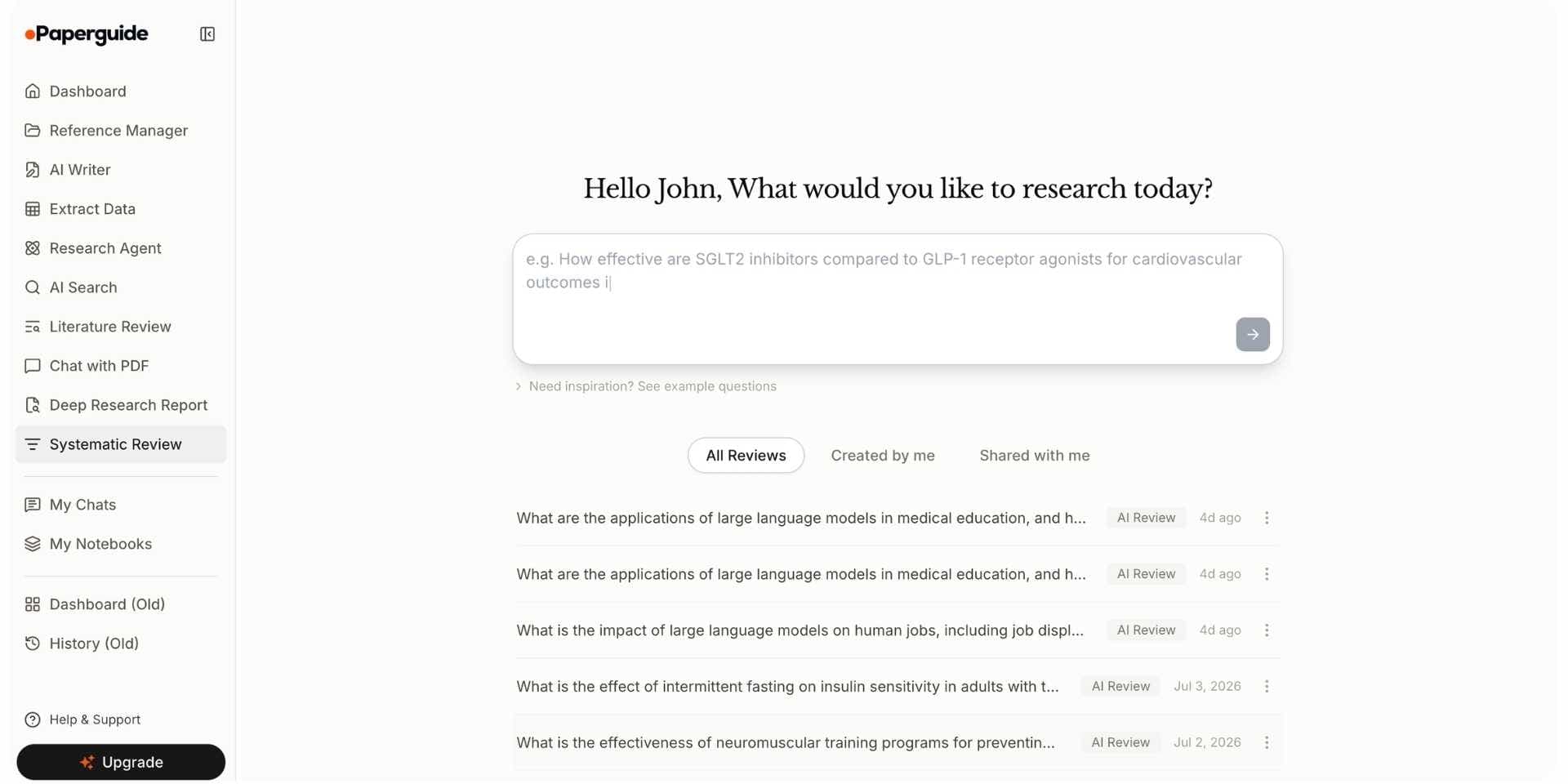
Paperguide is the AI-native platform for scientific research workflows and evidence synthesis, built for individual researchers, research labs, principal investigators, and evidence synthesis teams, and the strongest AI tool for evidence synthesis in 2026. For evidence synthesis specifically, the platform runs the full pipeline end-to-end in one connected workspace: AI Search across 200M+ peer-reviewed papers from PubMed, arXiv, OpenAlex, and Semantic Scholar feeds Literature Review AI, which screens up to 200 papers and synthesises the top 50 through a structured five-step Plan/Search/Screen/Extract/Synthesize workflow. Extract Data pulls custom-column evidence tables across multiple papers with every cell linked to its source passage. The AI Paper Writer drafts the synthesis with citations applied automatically against the actual included paper library, eliminating the citation fabrication that pollutes general-purpose AI writers. For systematic reviews, evidence-based medicine projects, scoping reviews, and rapid reviews where every cited paper must be real, recent, and traceable to a source passage, the architecture-level connection between every stage of the pipeline is what separates Paperguide from single-stage automation tools.
The connected workspace makes evidence synthesis continuous from question to manuscript. A paper surfaced through AI Search lands in the AI Reference Manager automatically with SJR, SNIP, and citation metrics surfaced inline so the included paper set meets a documented quality bar. A reference saved through Zotero import or BibTeX upload is immediately citable in the AI Paper Writer. The Research Agent runs end-to-end research questions in a single connected session, useful for scoping new directions or building the evidence base for a grant proposal. The Deep Research Report mode hands researchers manual control at every stage for nuanced evidence synthesis where the researcher's judgment shapes the included paper set and extraction fields. Real-time collaboration with shared libraries and customizable permissions keeps research teams aligned across multi-week and multi-month evidence synthesis projects.
Key Features
- Research Agent: Paperguide's most complete workflow runs the full evidence synthesis process end-to-end in a single connected session, from discovery and screening to extraction, drafting, and citation handling, all on one paper library. Built for deep evidence synthesis projects like scoping a new research direction or building the evidence base for a grant proposal.
- AI Search: Hybrid semantic and keyword search across 200M+ peer-reviewed papers from PubMed, arXiv, OpenAlex, and Semantic Scholar. Ask evidence synthesis questions in natural language and receive cited, evidence-backed answers synthesised from the top 20 most relevant papers, with quality signals (SJR, SNIP, citation metrics) on every result.
- Literature Review AI: A dedicated, structured agent for evidence synthesis through a five-step Plan, Search, Screen, Extract, Synthesize workflow. Standard mode handles up to 50 papers; Extended mode screens up to 200. Every claim cited and linked to a source paper in the included set.
- Deep Research Report: Follows the same structured pipeline as Literature Review AI with full researcher control at every stage. Researchers set the inclusion and exclusion criteria, review retrieved papers, adjust screening decisions, and confirm extraction fields before the report is generated. Designed for evidence synthesis where the researcher's judgment shapes the synthesis.
- AI Reference Manager: Every saved paper is immediately usable by every other workflow on the platform. 1,000+ citation styles, Zotero/BibTeX/RIS/DOI/PDF import, Chrome extension, automatic metadata and PDF fetching, built-in PDF viewer with highlights and annotations, shared libraries with permissions, version history.
- AI Paper Writer: Drafts evidence synthesis reports, systematic review manuscripts, literature review sections, methodology sections, and grant-grade prose with references pulled from the included paper library. Every citation links to a real paper. 1,000+ citation styles supported.
- Extract Data: Pull structured information from multiple research papers into custom-column evidence tables. Define columns (sample size, intervention, outcome, methodology, effect size, study design) and Paperguide extracts those values across every paper in the included set, with each cell linked back to its source passage. Export to CSV or Excel for downstream analysis.
- Chat with PDF: Query any uploaded paper conversationally. Ask methodology questions, request summaries, compare findings across multi-paper folders, with every answer pointing to the exact page and paragraph it came from.
- Systematic Review: Run protocol-driven evidence syntheses and systematic reviews with an AI-drafted protocol, structured screening, Extract Data evidence tables, cross-paper comparison, and citation-grounded synthesis writing. Built for research teams running rigorous, publication-grade reviews, with reviews of up to 1,000 papers on Plus, 5,000 on Pro and Evidence Teams, and 20,000 on Enterprise.
- Dual Review and AI Systematic Review modes: Dual Review runs blind screening by two independent reviewers plus a conflict resolver, with AI preparing cited evidence for every criterion but never deciding. AI Systematic Review makes the screening call with evidence attached, and a named verifier confirms each stage.
- PRISMA diagram and decision log: Every screening decision is logged with its criterion, evidence and who confirmed it, and the PRISMA diagram and methodology log are generated from the actual review counts.
- Deduplicated search, team roles and reusable protocols: Searches PubMed, arXiv, OpenAlex and Semantic Scholar, pools the results with your own library and deduplicates them before screening. Team roles are set per stage (Edit, Reviewer, View-only), papers added mid-review follow the same screening path, and a saved protocol can be re-run over new papers when the synthesis is updated.
Pros
- The only platform that runs the full evidence synthesis pipeline (search, screen, extract, synthesise, write) in one workspace.
- Verified citations on every claim across 200M+ peer-reviewed papers from PubMed, arXiv, OpenAlex, and Semantic Scholar.
- SJR, SNIP, and citation metrics on every paper so the included paper set meets a documented quality bar.
- Literature Review AI screens up to 200 papers and synthesises the top 50 with every claim linked to a source paper.
- AI Reference Manager replaces standalone Zotero, Mendeley, EndNote without losing workflow continuity.
- Academic users get 30% off with a valid university email.
Cons
- Literature Review AI caps a single review at 200 papers in Extended mode; larger reviews run in Paperguide Systematic Review, where paper limits depend on the plan and dual reviewer screening needs Evidence Teams or Enterprise. For mega-reviews above 20,000 papers, pair with Elicit Enterprise screening.
Best For Research labs, principal investigators, PhD researchers, postdoctoral researchers, systematic review teams, evidence synthesis groups, research analysts, policy researchers, and scientific research professionals in industry R&D and clinical research running multi-week and multi-month evidence synthesis projects where citation accuracy and full-pipeline coverage are non-negotiable.
Pricing
| Plan | Price | What It Covers |
|---|---|---|
| Free | $0 | 2,000 AI credits per month, Literature Review AI, Deep Research Report, Chat with PDF, reference manager with 1,000+ citation styles, extraction tables with 5 columns across 10 papers. |
| Plus | $12 per seat per month, billed annually ($144 a year) | 12,500 AI credits, unlimited AI searches and PDF chats, extraction tables with 50 custom columns across 100 papers, systematic reviews up to 1,000 papers, 5 AI Paper Writer documents per month, plagiarism checker. |
| Pro | $29 per seat per month, billed annually ($348 a year) | 50,000 AI credits, systematic reviews up to 5,000 papers, collaboration on systematic reviews, 20 AI Paper Writer documents per month. |
| Evidence Teams | $89 per seat per month, billed annually ($1,068 a year) | 150,000 AI credits, PRISMA-grade dual reviewer screening on reviews up to 5,000 papers, dedicated support. |
| Enterprise | Custom | Institutional licensing for universities, research labs, and corporate research teams, with systematic reviews up to 20,000 papers. Academic users get 30% off with a valid university email, and yearly billing saves up to 41%. |
Verdict
Paperguide is the best AI tool for evidence synthesis in 2026 because it is the only platform that runs the entire evidence synthesis pipeline end-to-end in a single, connected workspace with architecture-level verified citations. It is built for individual researchers, research labs, principal investigators, systematic review teams, and evidence synthesis groups conducting publication-grade reviews. It is also widely regarded as the best AI systematic review tool in 2026.
2. Elicit
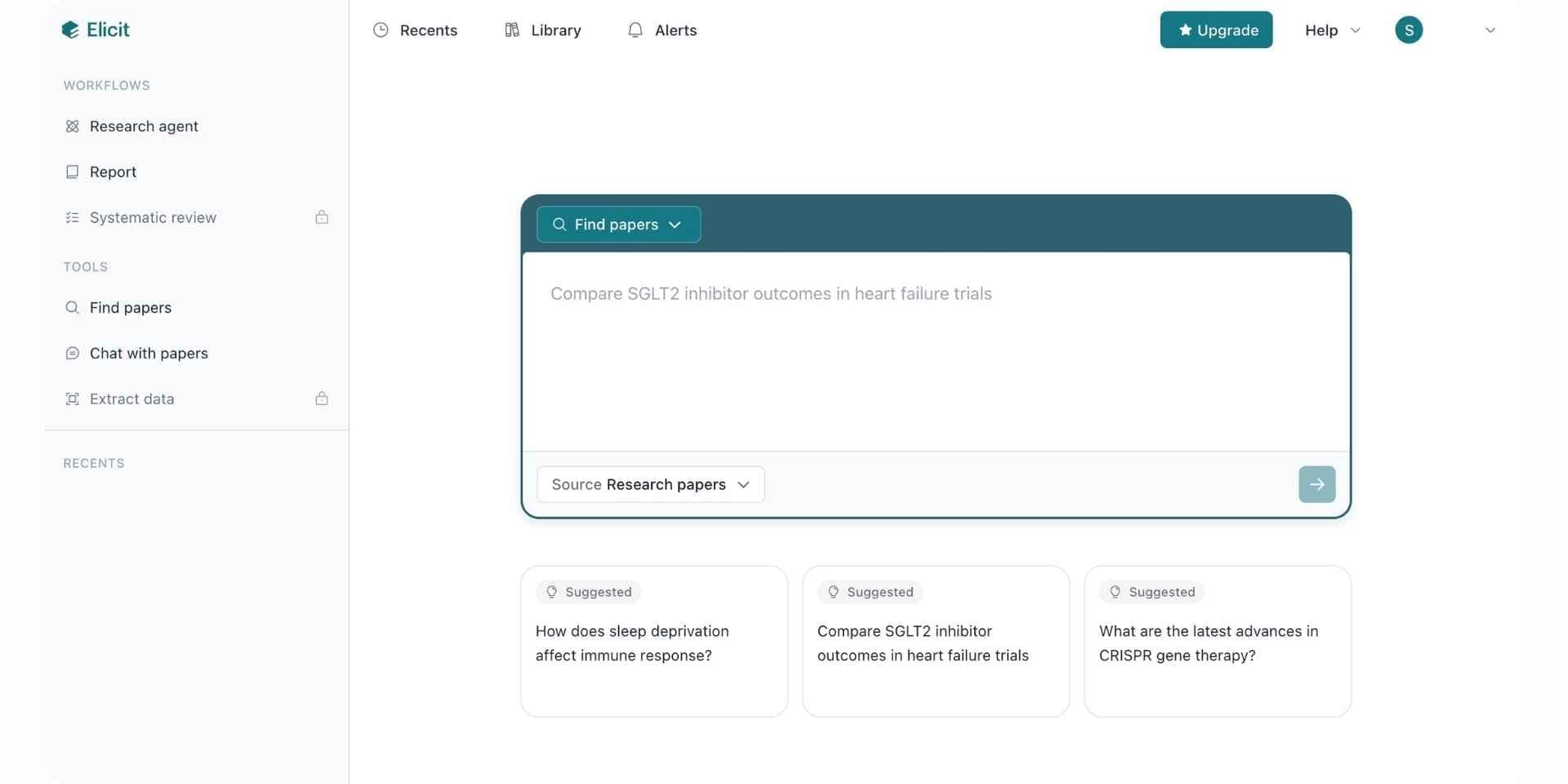
Elicit is the AI research platform built around large-scale systematic review screening and structured data extraction across an index of 138M+ academic papers. The Systematic Review Workflow handles inclusion and exclusion criteria, threshold-based filtering, and custom-column extraction across up to 40 columns on Enterprise, where screening volume reaches up to 40,000 papers per workflow. API access on Pro and above makes Elicit one of the few research tools that supports automated research operations at scale, and the platform is widely used by systematic reviewers, evidence-based medicine teams, and research operations groups inside universities and pharmaceutical companies.
What Elicit does well is the screening and extraction stages of evidence synthesis at scale. Where most evidence synthesis tools cap screening at 50 to 200 papers, Elicit Enterprise reaches 40,000 papers per workflow with documented inclusion criteria, threshold-based filtering, and 40-column custom extraction. What Elicit does less well than Paperguide is full-pipeline coverage; Report mode generates narrative-style synthesis reports, but there is no citation-grounded document editor for manuscript drafting, no native reference manager, and no Chat with PDF for multi-paper interrogation. Repeated searches can also return different paper sets, which complicates the search documentation that formal systematic review standards require.
Key Features
- Systematic Review Workflow with screening up to 40,000 papers per workflow on Enterprise.
- Custom-column data extraction with 2 to 40 columns depending on plan.
- 138M+ academic paper index with semantic search.
- Inclusion and exclusion criteria with adjustable thresholds.
- API access on Pro and above for automated research operations.
- Notebooks for organising papers, extractions, and queries.
Pros
- Strongest screening volume at scale (up to 40,000 papers per workflow on Enterprise).
- Custom-column extraction with up to 40 columns at Enterprise.
- API access for automated research operations on Pro and above.
- Extraction tables export for downstream analysis.
Cons
- No citation-grounded document editor for manuscript drafting; Report mode produces narrative summaries, not an editable, citation-managed draft.
- No native reference manager with citation-style management.
- No Chat with PDF for multi-paper interrogation.
- Large-scale screening requires Pro at $49/mo or Scale at $169/mo; the $11/mo Plus tier caps extraction at 5 columns.
- Repeated searches can return different paper sets, complicating search documentation for formal systematic reviews.
Best For Research teams running large-scale evidence synthesis at Enterprise scale where screening volume above 5,000 papers per workflow is the weekly job.
Pricing
| Plan | Price (Monthly / Annual) | What It Covers |
|---|---|---|
| Basic | $0 | 2 extraction columns, limited usage, basic search. |
| Plus | $11/mo billed annually | 5 extraction columns, higher usage limits. |
| Pro | $49/mo monthly or $588/yr | 5,000-paper screening, 20-column extraction. |
| Scale | $169/mo monthly or $2,028/yr | Higher screening volumes, 30-column extraction. |
| Enterprise | Custom | 40,000-paper screening, 40-column extraction, PRISMA accuracy. |
Verdict
Elicit is the strongest large-scale screening and extraction platform for Enterprise-grade evidence synthesis in 2026. Paperguide is the best Elicit alternative in 2026 for research teams who want extraction depth plus citation-grounded synthesis writing and a native reference manager inside one connected workspace.
3. Covidence
Covidence is the Cochrane-recommended evidence synthesis platform with PRISMA flow diagram generation, structured extraction templates, risk-of-bias assessment, dual-reviewer blind screening with conflict resolution, and Cochrane RevMan integration for meta-analysis. The platform is the default tool for Cochrane systematic reviews and is widely used across evidence-based medicine teams in clinical research and global health, particularly for protocol-driven systematic reviews where PRISMA documentation and risk-of-bias assessment are non-negotiable.
What Covidence does well is Cochrane-style PRISMA evidence synthesis. Where most evidence synthesis platforms treat PRISMA flow as an export option, Covidence is built around the PRISMA workflow from the ground up, with structured templates for inclusion/exclusion, study characteristics, outcomes, and risk-of-bias evaluation. What Covidence does less well than Paperguide is AI-native workflow integration; AI features remain lighter than newer AI-first platforms, there is no native AI search across millions of papers (researchers bring their own search results), and pricing at $339/yr for a Single review licence and $907/yr for the Package plan (up to 3 reviews) is steep for individual researchers running occasional reviews.
Key Features
- PRISMA flow diagram generation.
- Structured extraction templates with study characteristics and outcomes.
- Risk-of-bias assessment.
- Cochrane RevMan integration for meta-analysis.
- Dual-reviewer blind screening with conflict resolution.
- Cochrane Interactive Learning licences on Organisation tier.
Pros
- Cochrane-recommended for systematic reviews.
- Native RevMan integration for meta-analysis.
- Strongest PRISMA documentation workflow in the category.
- 24/7 online support and personalised training webinars on Organisation tier.
Cons
- $339/yr Single (one review) and $907/yr Package (up to 3 reviews) pricing is steep for individual reviewers.
- AI features lighter than newer AI-first evidence synthesis platforms.
- No native AI search across millions of papers (bring your own search results).
- Trial limited to 500 records.
Best For Research teams and evidence-based medicine groups running Cochrane-style systematic reviews with PRISMA documentation requirements and RevMan meta-analysis.
Pricing
| Plan | Price | What It Covers |
|---|---|---|
| Trial | Free | 500 records trial for evaluation. |
| Single | $339/year | One review, individual researcher annual licence. |
| Package | $907/year | Up to 3 reviews. |
| Organisation | Custom | Unlimited reviews, 24/7 support, personalised training, Cochrane Interactive Learning licences. |
Verdict
Covidence is the strongest Cochrane-style evidence synthesis platform with PRISMA documentation and RevMan integration in 2026. Paperguide is the best Covidence alternative in 2026 for research teams who want AI-accelerated evidence synthesis with citation-grounded synthesis writing, structured extraction, and a native reference manager across the full pipeline.
4. AnswerThis
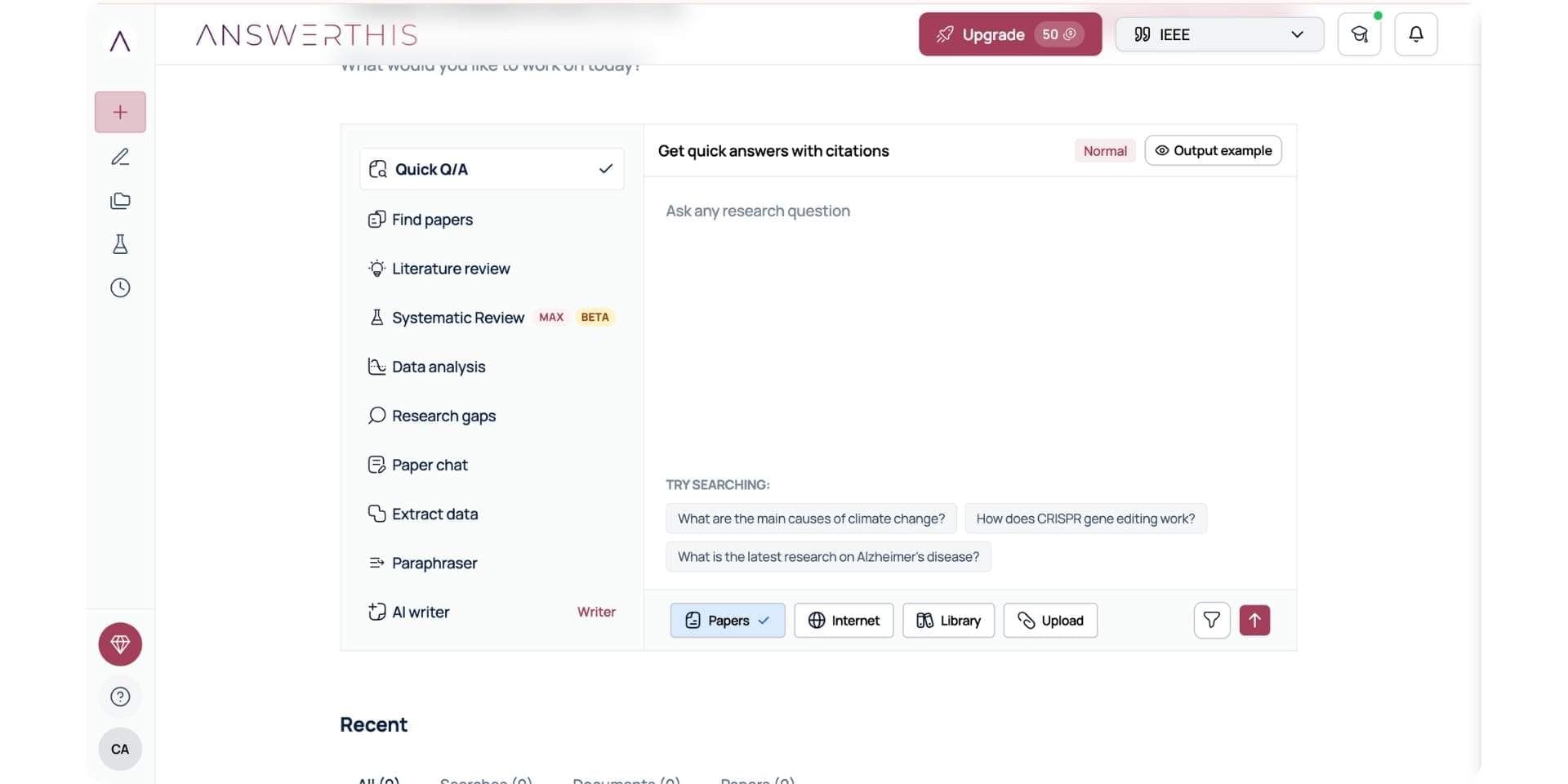
AnswerThis is the AI research platform built around multi-database evidence search across 250M+ academic papers from PubMed, OpenAlex, Semantic Scholar, and arXiv, with line-by-line citation grounding, a dedicated Research Gaps module that identifies underexplored areas in the evidence base, and an AI Writer for synthesis drafting. The platform was originally built for time-boxed literature reviews and gap analysis at the proposal stage and has expanded through 2025 and 2026 into a broader evidence synthesis workflow.
What AnswerThis does well is Research Gaps analysis and multi-database search. Where most evidence synthesis platforms require manual gap detection across the included paper set, AnswerThis surfaces underexplored research areas directly from the search results, useful at the scoping review and proposal stages. What AnswerThis does less well than Paperguide is full-pipeline coverage; the platform's AI Writer is not connected to screening or a reference library, the reference manager is partial rather than full-fledged, and the credit-based pricing model puts the Pro tier at $35/mo with Research at $75/mo for higher-volume workflows.
Key Features
- 250M+ research papers indexed across PubMed, OpenAlex, Semantic Scholar, arXiv.
- Research Gaps module identifying underexplored areas in the evidence base.
- Add Steps modular workflow for custom research operations.
- Line-by-line citations on every claim.
- AI Writer for synthesis drafting.
- Bibliometric analysis.
Pros
- Only tool in this list with a dedicated Research Gaps module.
- Multi-database simultaneous search across PubMed, OpenAlex, Semantic Scholar, arXiv.
- Line-by-line citation grounding on every claim.
- Free tier with 5 credits per month for evaluation.
Cons
- Free plan capped at 5 credits per month.
- Pricing has shifted upmarket with Pro at $35/mo and Research at $75/mo.
- AI Writer is not connected to screening or a reference library, so drafting sits outside the evidence synthesis pipeline.
Best For Research teams that need Research Gaps analysis on top of structured evidence synthesis workflows, particularly at the scoping review and proposal stages.
Pricing
| Plan | Price | What It Covers |
|---|---|---|
| Free | $0 | 5 credits per month for evaluation. |
| Pro | $35/mo | Unlimited basic queries plus 10 maximum-depth queries per month, full Research Gaps module. |
| Research | $75/mo | Higher volume, multi-database synthesis. |
| Max | $250/mo | High-volume research operations. |
| Enterprise | Custom | Team plans, dedicated support. |
Verdict
AnswerThis is the strongest dedicated Research Gaps platform for evidence synthesis in 2026. Paperguide is the best AnswerThis alternative in 2026 for research teams who want full evidence synthesis pipeline coverage with structured extraction, citation-grounded synthesis writing, and an AI Reference Manager.
5. Rayyan
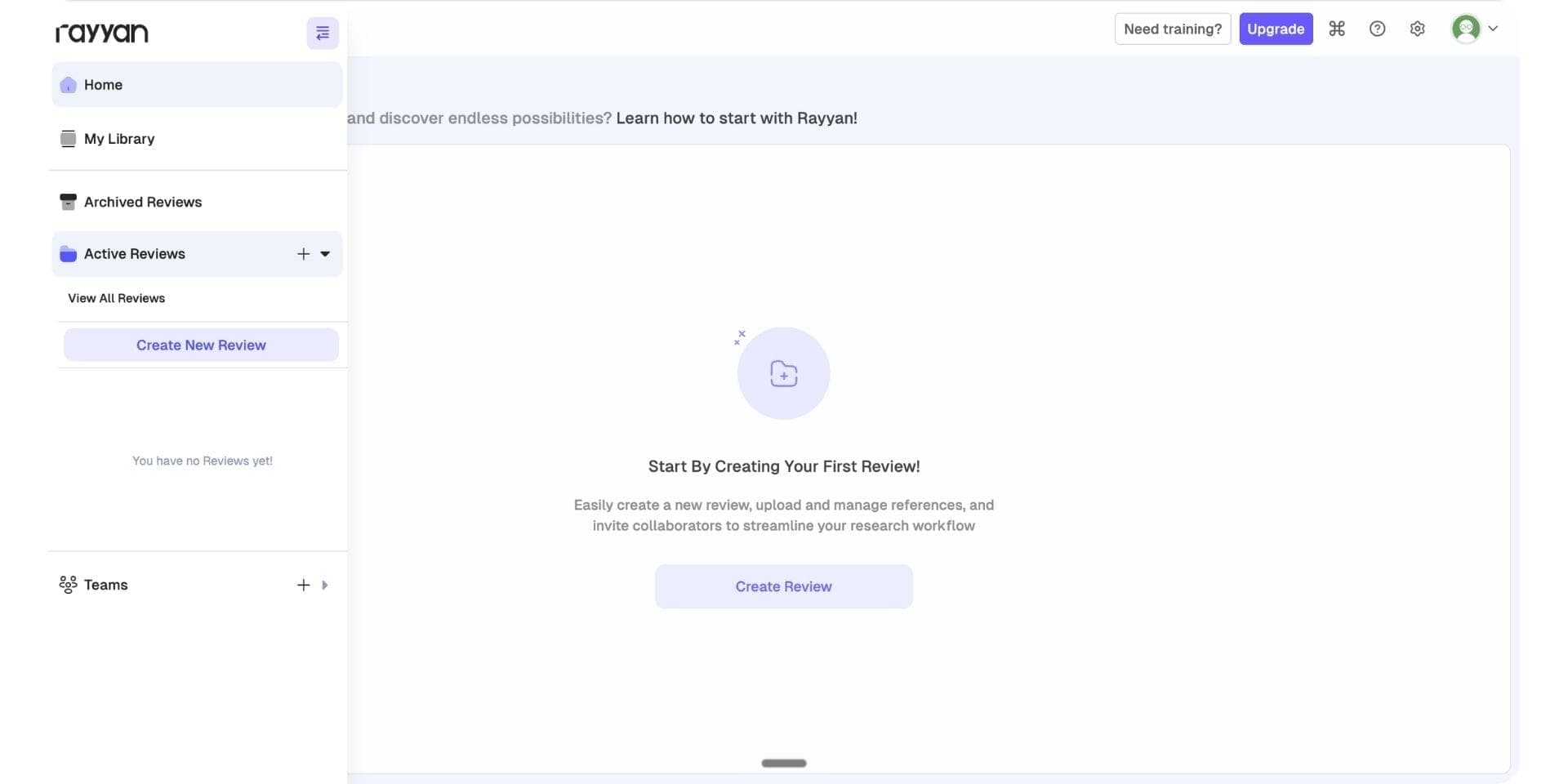
Rayyan is the most widely used free collaborative screening platform globally, with over 1 million researchers using it for evidence synthesis screening across systematic reviews, scoping reviews, and rapid reviews. The platform supports blind dual screening with conflict resolution, AI relevance predictions that surface likely-includes near the top of the screening queue, inclusion/exclusion labels, and a permanent Free tier covering 3 active reviews with 2 reviewers. Rayyan is the default screening tool for budget-constrained evidence synthesis teams and academic research groups.
What Rayyan does well is free collaborative screening. Where most evidence synthesis platforms charge for collaboration features, Rayyan's Free tier includes blind dual screening for 2 reviewers across 3 active reviews, with AI relevance predictions and conflict resolution that match paid alternatives at the screening stage. What Rayyan does less well than Paperguide is full-pipeline coverage; the platform is built around the screening stage of evidence synthesis with no native search across peer-reviewed papers (researchers bring their own search results from PubMed or Web of Science), no structured extraction tables, and no synthesis writing layer.
Key Features
- Free collaborative blind screening (3 active reviews, 2 reviewers on the Free tier).
- AI relevance predictions that surface likely-includes.
- Inclusion and exclusion labels with conflict resolution.
- Over 1 million researchers globally.
- Essential and Advanced paid tiers for more reviewers, PRISMA flow diagrams, and AI agents.
- Academic and Enterprise institutional plans.
Pros
- Permanent Free tier with blind dual screening, conflict resolution, and AI relevance predictions.
- 1M+ researchers globally with mature collaborative screening workflow.
- AI relevance predictions accelerate the screening queue.
- Affordable Essential tier at $4.99/mo billed annually.
Cons
- Screening only; no native search, structured extraction, or synthesis writing.
- Free tier caps at 3 active reviews and 2 reviewers; larger teams need Essential (5 reviewers) or Advanced (10 reviewers).
- Researchers bring their own search results from PubMed or Web of Science.
- Reference management is lighter than dedicated managers.
Best For Research teams running free collaborative screening for evidence synthesis projects on tight budgets, particularly at the screening stage of systematic reviews and scoping reviews.
Pricing
| Plan | Price (Annual) | What It Covers |
|---|---|---|
| Free | $0 | 3 active reviews, 2 reviewers, blind dual screening, AI relevance predictions. |
| Essential | $4.99/mo billed annually ($59.88/yr) | 5 reviewers, PRISMA flow diagrams. |
| Advanced | $8.33/mo billed annually ($99.99/yr) | 10 reviewers, AI agents. |
| Business / Academic | Custom | Institutional licensing for academic and corporate teams. |
| Enterprise | Custom | Enterprise institutional licensing with dedicated support. |
Verdict
Rayyan is the strongest free collaborative screening platform for evidence synthesis in 2026. Paperguide is the best Rayyan companion in 2026 for research teams that need search, structured extraction, and citation-grounded synthesis writing on top of the screening stage that Rayyan handles.
How the Paperguide Evidence Synthesis Workflow Works
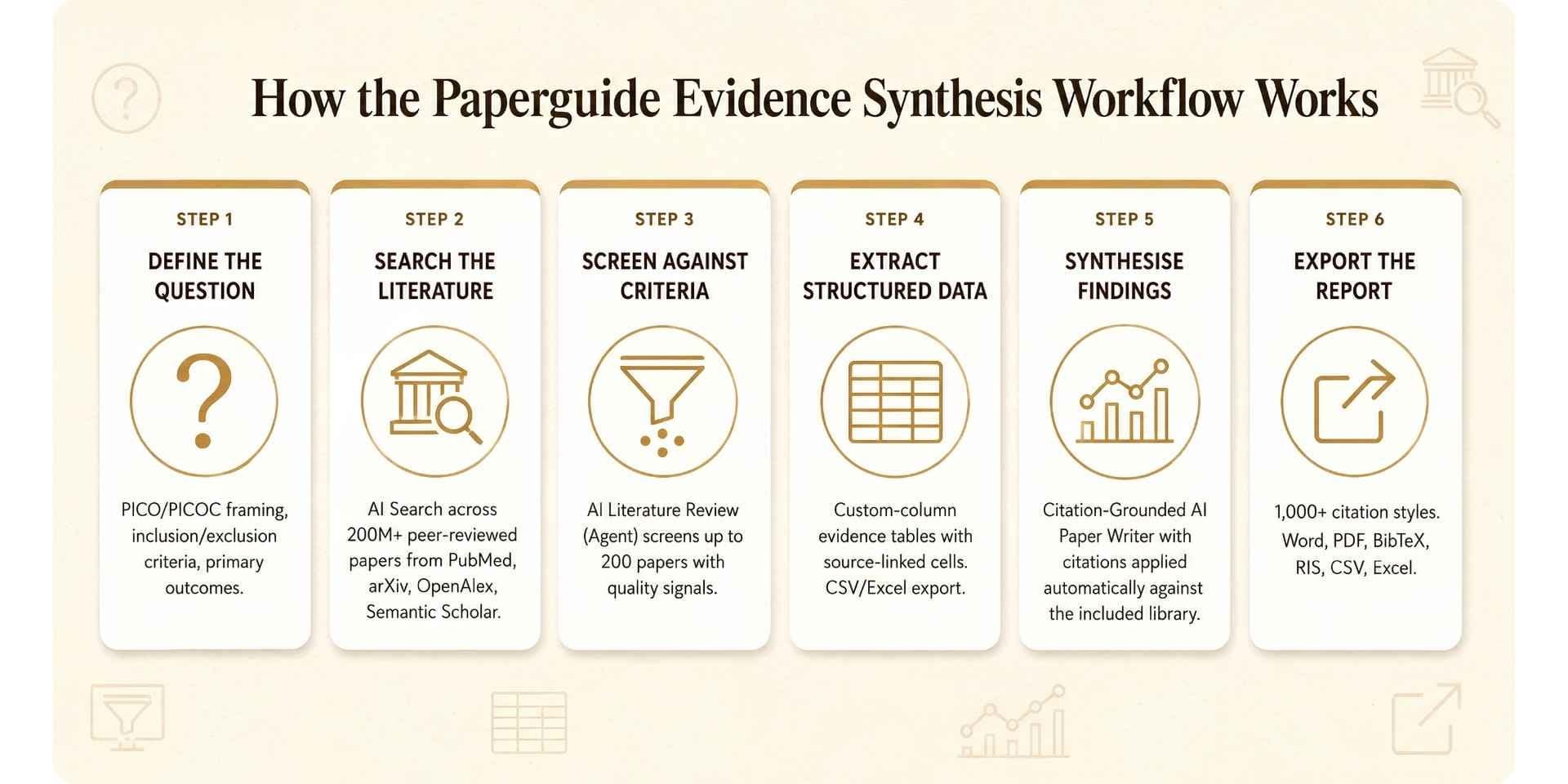
Paperguide runs evidence synthesis as a continuous scientific research workflow across six discrete stages. The same workflow pattern that makes academic writing, systematic review, and literature review work end-to-end inside one workspace applies to evidence synthesis as the connective tissue across the platform.
Step 1: Define the question
PICO or PICOC framing, inclusion and exclusion criteria, primary and secondary outcomes, study design constraints. The Research Agent helps researchers refine the research question and document the protocol before search begins. The write a research question guide covers the broader scoping workflow that evidence synthesis sits inside.
Step 2: Search the literature
Multi-database query across 200M+ peer-reviewed papers from PubMed, arXiv, OpenAlex, and Semantic Scholar through AI Search, with hybrid semantic and keyword retrieval, search query documented for reproducibility, and SJR, SNIP, and citation metrics surfaced on every result.
Step 3: Screen against criteria
Inclusion and exclusion screening through Literature Review AI or, for formal reviews, Paperguide Systematic Review, with documented criteria, quality signals on every paper, and shared libraries for team review. Literature Review AI handles up to 50 papers in Standard mode and screens up to 200 in Extended mode; Paperguide Systematic Review runs Dual Review or AI Systematic Review screening on larger sets and generates the PRISMA diagram from actual counts.
Step 4: Extract structured data
Extract Data pulls custom-column evidence tables with researcher-defined columns (sample size, intervention, outcome, methodology, effect size, study design). Every cell links back to its source passage. Export to CSV or Excel for downstream meta-analysis. The risk of bias audit guide covers the parallel quality assessment stage.
Step 5: Synthesise findings
The AI Paper Writer drafts the synthesis with citations applied automatically against the included paper library. Every claim is traceable to a real source paper, eliminating fabricated references at the architecture level. The how to write a literature review guide covers the writing patterns evidence synthesis builds on.
Step 6: Export the report
Word, PDF, BibTeX, RIS, CSV, or Excel export with 1,000+ citation styles including journal-specific formats (APA, MLA, Chicago, Vancouver, Harvard, AMA, IEEE). Export directly into the broader best AI research assistant workflow covered across the cluster.
Best AI Tools for Evidence Synthesis by Use Case
| Use Case | Recommended Tool | Why |
|---|---|---|
| Best AI for evidence synthesis overall | Paperguide | Full pipeline (search to synthesis writing) in one connected workspace with verified citations. |
| Best AI for evidence synthesis for scientific research workflows | Paperguide | Built for individual researchers and evidence synthesis teams with 200M+ peer-reviewed papers and quality signals. |
| Best AI for large-scale extraction (5K-40K papers) | Elicit | Enterprise screening up to 40,000 papers with 40-column extraction. |
| Best AI for Cochrane-style PRISMA evidence synthesis | Covidence | Native PRISMA flow diagrams, risk-of-bias assessment, RevMan integration. |
| Best AI for Research Gaps in evidence synthesis | AnswerThis | Dedicated Research Gaps module across 250M+ papers. |
| Best free AI for evidence synthesis screening | Rayyan | Permanent Free tier with blind dual screening for 2 reviewers across 3 active reviews. |
| Best AI for inclusion/exclusion criteria definition | Paperguide Research Agent | Documented criteria with quality signals and reproducible search query. |
| Best AI for structured extraction in evidence synthesis | Paperguide Extract Data | Custom-column evidence tables with every cell source-linked. |
| Best AI for citation-grounded synthesis writing | Paperguide AI Paper Writer | Citations applied automatically against included paper library. |
| Best AI reference manager for evidence synthesis | Paperguide AI Reference Manager | 1,000+ citation styles connected to the evidence synthesis workflow. |
| Best free AI tools for evidence synthesis stack | Paperguide Free + Rayyan Free + AnswerThis Free | Free AI-native evidence synthesis with collaborative screening and Research Gaps analysis. |
Best AI Tools for Evidence Synthesis: Final Comparison
| Feature | Paperguide | Elicit | Covidence | AnswerThis | Rayyan |
|---|---|---|---|---|---|
| Paper corpus | 200M+ peer-reviewed | 138M+ | Bring own | 250M+ | Bring own |
| Search | Yes (AI Search across PubMed/arXiv/OpenAlex/Semantic Scholar) | Yes (138M+ index) | No (bring own) | Yes (250M index) | No (bring own) |
| Screening | Yes (up to 20,000 on Enterprise, dual review on Evidence Teams) | Yes (up to 40,000 Enterprise) | Yes (dual blind) | Yes | Yes (3 reviews Free) |
| Structured extraction | Yes (custom columns, source-linked) | Yes (up to 40 columns Enterprise) | Yes (templates) | Yes | No |
| Citation-grounded synthesis writing | Yes (architecture level) | No (Report mode summaries only) | No | Yes (partial) | No |
| Research Gaps module | No | No | No | Yes (strongest) | No |
| AI Reference Manager | Full-fledged | No | No | Partial | No |
| Risk of bias | Via Research Agent | No | Yes (native) | No | No |
| PRISMA flow diagram | Via workflow | No | Yes (native) | No | Yes (Essential tier) |
| Free plan | Yes | Yes (Basic limited) | Trial 500 records | Yes (5 credits) | Yes (3 reviews, 2 reviewers) |
| Starting paid | $12/mo annual | $11/mo Plus (annual) | $339/yr Single | $35/mo Pro | $4.99/mo Essential (annual) |
Common Mistakes When Using AI Tools for Evidence Synthesis in 2026
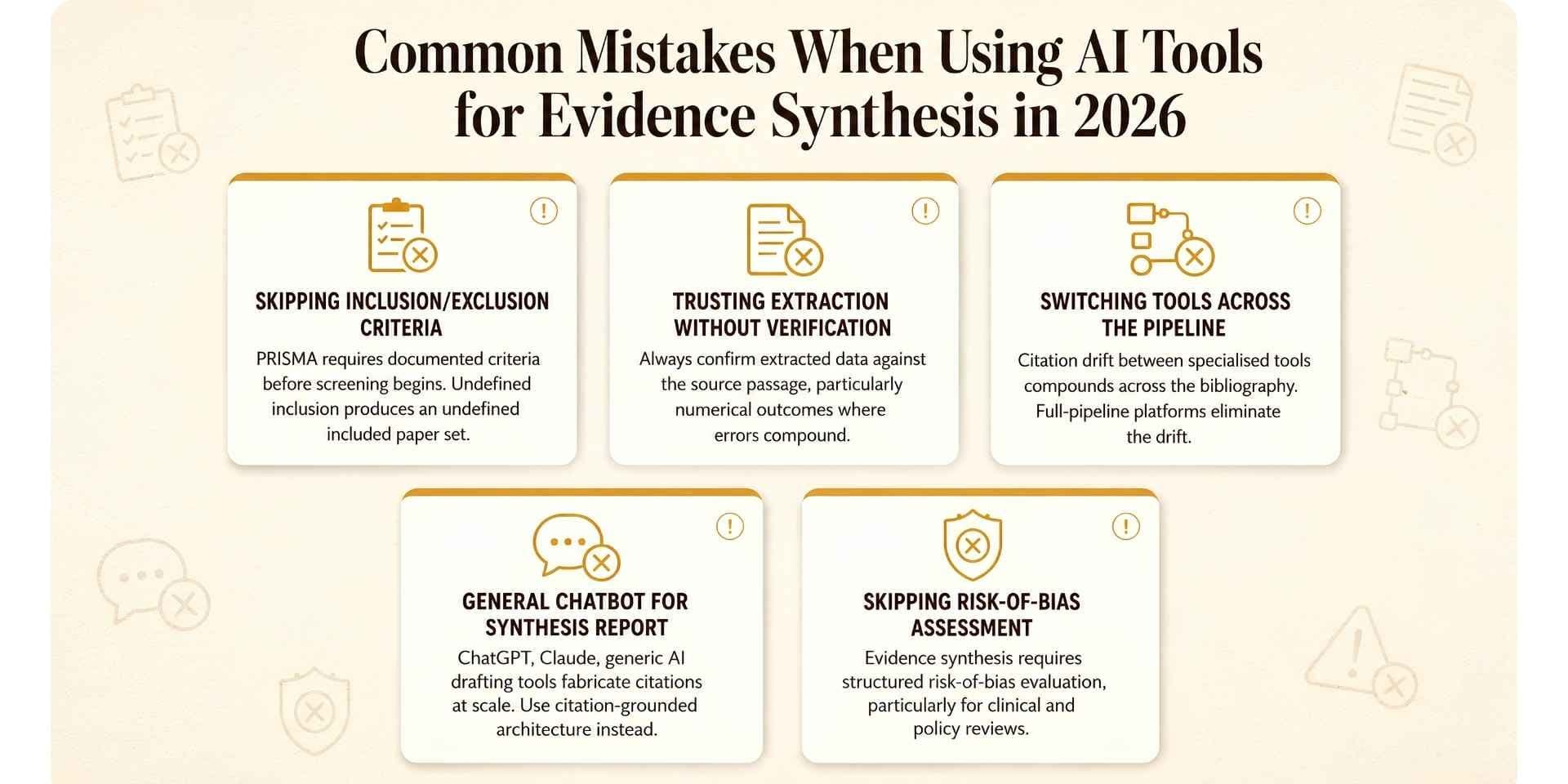
- Skipping inclusion and exclusion criteria definition before screening: PRISMA recommends documented inclusion and exclusion criteria before screening begins. AI-accelerated screening without documented criteria produces an undefined included paper set and undermines the reproducibility of the entire evidence synthesis. Use the Research Agent or PICO/PICOC framing to document criteria before search.
- Trusting extraction values without source verification: Always confirm extracted data against the original paper passage, particularly for numerical outcomes (effect sizes, sample sizes, confidence intervals) where transcription or extraction errors compound across the synthesis. AI-native platforms link every extraction cell back to the source passage so verification is built into the workflow.
- Switching tools across the synthesis pipeline: Running search in one tool, screening in another, extraction in a third, and synthesis writing in a fourth introduces handoff failures at every stage. Citation drift between tools compounds across the bibliography. Full-pipeline evidence synthesis platforms eliminate the drift at the architecture level.
- Using a general-purpose chatbot for the synthesis report: ChatGPT, Claude, and generic AI drafting tools fabricate citations at scale, as documented across recent academic publishing studies. Citation-grounded evidence synthesis requires AI-native architecture where every claim in the draft is verified against an actual paper in the included set.
- Skipping risk-of-bias assessment in evidence synthesis: Evidence synthesis requires structured risk-of-bias evaluation for every included paper, particularly for clinical and policy reviews where the evidence base informs practice decisions. Use Cochrane RoB tools or platform-native risk-of-bias workflows alongside the AI-accelerated screening and extraction stages.
Final Verdict
For research labs, principal investigators, PhD researchers, postdoctoral researchers, systematic review teams, evidence synthesis groups, research analysts, policy researchers, and scientific research professionals in industry R&D and clinical research running evidence synthesis in 2026, Paperguide is the best AI tool for evidence synthesis. The platform's combination of full-pipeline coverage (search, screen, extract, synthesise, write), 200M+ peer-reviewed papers from PubMed, arXiv, OpenAlex, and Semantic Scholar, SJR/SNIP/citation quality signals on every paper, Literature Review AI with a structured five-step Plan/Search/Screen/Extract/Synthesize workflow, Paperguide Systematic Review with Dual Review screening and PRISMA diagrams from actual counts, Extract Data for custom-column evidence tables, the AI Paper Writer with 1,000+ citation styles, and an AI Reference Manager makes it the only platform built natively for evidence synthesis as a continuous scientific research workflow rather than a stage-by-stage automation.
For specific evidence synthesis stages where dedicated specialised tools dominate, Elicit handles large-scale extraction at Enterprise scale (5,000 to 40,000 papers per workflow with 40-column extraction), Covidence handles Cochrane-style PRISMA documentation with RevMan integration at $339/yr for a Single review licence, AnswerThis handles Research Gaps analysis across 250M+ papers at $35/mo Pro, and Rayyan handles free collaborative screening on a permanent Free tier used by over 1 million researchers globally.
The 2026 best-practice pattern for evidence synthesis in scientific research workflows is rarely a single specialised tool stack carried over from the pre-AI era. It is Paperguide for the AI-native backbone (search, screening, extraction, synthesis writing, reference management in one workspace), Rayyan for free collaborative blind dual screening when team budget is constrained, Elicit for mega-review screening at Enterprise scale (up to 40,000 papers per workflow), and Covidence for Cochrane systematic reviews where RevMan integration and risk-of-bias assessment are protocol-mandated. That layered approach is what produces systematic reviews, evidence-based medicine projects, scoping reviews, and rapid reviews where every cited paper in the final synthesis is real, recent, traceable to a source passage, and survives both editorial review and the reproducibility audit that catches the fabricated citations now polluting the scientific literature.
Frequently Asked Questions (FAQs)
What are the best AI tools for evidence synthesis in 2026?
Paperguide is the best AI tool for evidence synthesis in 2026 because it is the only platform that runs the full evidence synthesis pipeline (search, screen, extract, synthesise, write) in one connected workspace with verified citations on every claim. The strongest AI tools for evidence synthesis across the broader category in 2026 are Paperguide, Elicit, Covidence, AnswerThis, and Rayyan.
What is the best AI tool for systematic reviews?
Paperguide is the strongest AI tool for systematic reviews in 2026 because Paperguide Systematic Review runs protocol-driven screening, extraction and PRISMA reporting, with citation grounding throughout. For Cochrane-style systematic reviews with PRISMA documentation and RevMan integration, Covidence is the strongest specialised companion. For mega-reviews above 20,000 papers, pair Elicit Enterprise screening with Paperguide for citation-grounded synthesis writing.
What is the best AI tool for evidence-based medicine?
Paperguide is the strongest AI tool for evidence-based medicine in 2026 because it consolidates the full evidence synthesis pipeline with verified citations from PubMed, arXiv, OpenAlex, and Semantic Scholar. Covidence remains the Cochrane-recommended companion for protocol-driven evidence syntheses with risk-of-bias assessment.
Can AI automate evidence synthesis?
AI accelerates every stage of evidence synthesis (search, screening, extraction, synthesis writing) but does not replace human judgment for inclusion decisions, risk-of-bias assessment, and clinical interpretation. The strongest AI handles the bulk of the mechanical pipeline work while leaving the judgment-heavy decisions to the research team. Full-pipeline platforms like Paperguide automate the connective tissue between stages so research teams spend their time on the judgment work, not the handoff overhead.
How long does evidence synthesis take?
Evidence synthesis projects typically span 6 months to 2 years for a full systematic review, with literature searches alone taking 3 to 8 months according to Cochrane. A 2024 PMC Lifecycles of Cochrane Systematic Reviews analysis found that the median time between Cochrane review updates was 57.2 months. AI-native evidence synthesis platforms cut the mechanical handoff overhead between stages, accelerating the search-to-synthesis cycle without compromising rigour.
What is the best free AI tool for evidence synthesis?
The Paperguide Free plan plus Rayyan Free plus AnswerThis Free combination is the strongest free evidence synthesis stack in 2026. Paperguide Free provides 2,000 AI credits per month, Literature Review AI, Deep Research Report, Chat with PDF, and the reference manager. Rayyan Free adds collaborative blind screening for 2 reviewers across 3 active reviews. AnswerThis Free adds 5 credits per month for Research Gaps analysis.
How does AI help with evidence synthesis?
AI for evidence synthesis accelerates search (across 200M+ peer-reviewed papers), screening (against documented inclusion and exclusion criteria with quality signals on every paper), structured extraction (into custom-column evidence tables with source-linked cells), and citation-grounded synthesis writing (with citations applied automatically against the included paper library). The strongest AI consolidates these stages inside one connected workspace rather than bolting AI on top of a fragmented tool stack.
What AI replaces traditional evidence synthesis tools?
Paperguide consolidates the stages traditionally split across multiple specialised tools (search in PubMed, screening in Rayyan, extraction in Excel, synthesis writing in Word, reference management in Zotero, citation grounding nowhere) into one AI-native workspace. Modern AI evidence synthesis platforms eliminate the tool-switching overhead that compounds across multi-week and multi-month projects.
Can AI write the synthesis section of an evidence review?
Yes. The Paperguide AI Paper Writer drafts synthesis sections with citations applied automatically against the actual included paper set, eliminating the fabrication risk that affects general-purpose AI writers. Every cited paper in the draft is verified against a real source in the reference library, with the bibliography auto-formatted in 1,000+ citation styles.
Why are AI-generated citations in evidence synthesis often wrong?
AI-generated citations are often wrong because general-purpose AI writers generate citation-shaped strings from training data rather than pulling from a real reference library. For evidence synthesis specifically, this is fatal because the synthesis must cite the included paper set with traceable references. The architecture fix is AI-native evidence synthesis with bidirectional sync between the reference library and the synthesis writer, so every citation in the draft is verified against an actual paper in the included set, not invented from statistical patterns.
Running a review?
Run your systematic review in Paperguide
Dual screening, verifiable extraction and PRISMA reporting in one place.
Start a reviewNo credit card required