5 Best AI Tools for Meta Analysis in 2026


Meta-analysis plays a crucial role in evidence-based practice, spanning fields from healthcare to the social sciences. It helps inform decisions about interventions, treatments, or phenomena with a higher degree of confidence.
AI tools for meta-analysis are now helping researchers improve both the quality and efficiency of their work. In addition, many researchers look for the best AI tool for literature review in 2026 to support evidence synthesis, source comparison, and citation-backed insights earlier in the meta-analysis process. These platforms automate time-consuming tasks such as literature screening, data extraction, and statistical modeling. Whether you're applying meta-analysis techniques in scientific research or interpreting historical data, AI makes the process more accurate, scalable, and less prone to error.
As the volume of academic literature continues to rise, AI tools also assist in managing complex datasets, ensuring methodological consistency, and supporting transparent, replicable research practices. Let’s take a closer look at the best AI tools for meta analysis researchers are using in 2026 to improve accuracy, speed, and reproducibility.
TL;DR
- Paperguide is the best pick for end-to-end meta analysis preparation, covering study screening, data extraction of effect sizes and confidence intervals, and citation-backed summaries in one place.
- Elicit suits fast data extraction and research filtering.
- SciSpace suits team-based synthesis and thematic analysis.
- RevMan suits clinical research and formal meta-analysis, with advanced statistical methods and forest and funnel plots.
- Rayyan suits free study screening and duplicate detection in the early stages of a review.
What are the best AI tools for meta analysis in 2026?
The best AI tools for meta-analysis in 2026 include Paperguide, Elicit, SciSpace, RevMan, and Rayyan. These tools help automate screening, data extraction, effect-size calculations, and evidence synthesis for systematic reviews.
What is Meta Analysis?
Meta analysis is a quantitative statistical analysis method used to combine results from multiple studies on the same topic to derive a more reliable and comprehensive conclusion. Unlike individual studies, which may be limited by sample size or methodology, meta analysis pools data from a larger set of studies, offering a clearer picture of the overall effect. This approach is used to assess the strength of evidence on specific interventions, treatments, or phenomena, especially when results from individual studies conflict.
The process typically involves reviewing existing studies, applying inclusion criteria, and using statistical methods to combine results. This technique helps synthesize diverse research findings and ensures that conclusions are based on a broader body of evidence.
Researchers use various meta analysis techniques to ensure reliable results, such as calculating effect sizes, testing for heterogeneity, and addressing publication bias. The aim is to produce a statistical summary that reflects the true effect, guiding evidence-based decisions.
Nowadays, AI tools for meta-analysis are reshaping the process by automating tasks like data extraction and statistical analysis. These tools save time and improve accuracy, especially when applied to meta-analysis techniques for historical data interpretation and meta-analysis techniques in scientific research, enabling more efficient analysis of large datasets and identification of key patterns.
Systematic Review vs Meta Analysis: Key Differences
| Feature | Systematic Review | Meta-Analysis |
|---|---|---|
| Definition | Comprehensive review that identifies, evaluates, and synthesizes all available evidence on a specific question | Statistical technique that combines results from multiple similar studies to calculate an overall effect |
| Primary Purpose | To gather and critically appraise all relevant research | To provide a precise mathematical estimate of effect |
| Nature | Primarily qualitative synthesis | Primarily quantitative analysis |
| Study Types Included | Can include diverse study designs | Requires studies with compatible numerical data |
| Approach to Evidence | Comprehensive and inclusive | Selective based on statistical compatibility |
| Analysis Method | Narrative synthesis, thematic analysis | Fixed or random effects models, meta-regression |
| Time Required | 6–12 months typically | 9–18 months (includes systematic review phase) |
Meta-analysis and systematic reviews are both methods used to synthesize research, but they differ in their approach and purpose. A systematic review is a comprehensive process that systematically identifies, evaluates, and synthesizes all available evidence on a specific research question, often including both qualitative and quantitative studies. On the other hand, meta-analysis is a statistical technique that combines data from similar studies to estimate an overall effect size, providing a more precise numerical summary.
Types of Meta Analysis
| Type | Description |
|---|---|
| Quantitative Meta-Analysis | Statistically combines numerical data from multiple studies to estimate an overall effect size. |
| Qualitative Meta-Synthesis | Integrates themes and concepts across qualitative studies to generate new insights or theories. |
| Bayesian Meta-Analysis | Incorporates prior knowledge and uncertainty using Bayesian statistics to update probabilities based on new evidence. |
Meta-analysis comes in several forms, each serving different research needs. Quantitative meta-analysis is focused on statistically combining numerical data to provide a more precise effect size. On the other hand, qualitative meta-synthesis focuses on synthesizing themes and concepts from qualitative studies, helping to generate deeper insights and theories. Bayesian meta-analysis stands apart by incorporating prior knowledge and adjusting probabilities as new data emerges, allowing for continuous refinement of conclusions. Each type plays an important role in enhancing the accuracy and depth of research, helping researchers derive meaningful conclusions from diverse studies.
Quick Comparison of AI Tools for Meta Analysis in 2026
| AI Tool | Automated Data Extraction | Statistical Synthesis | Collaboration | Best For |
|---|---|---|---|---|
| Paperguide | Fully automated | Extracts reported values (no statistical pooling) | Real-time collaboration | End-to-end meta analysis automation |
| Elicit | Automated | Supports effect sizes and summaries | Real-time collaboration | Fast data extraction and research filtering |
| Scispace | Automated | Partially supported | Strong collaboration features | Team-based synthesis and thematic analysis |
| RevMan | Manual input required | Advanced statistical methods | Multi-reviewer support | Clinical research and formal meta-analysis |
| Rayyan | Not available | Not available | Collaborative screening only | Study screening and duplicate detection |
1. Paperguide
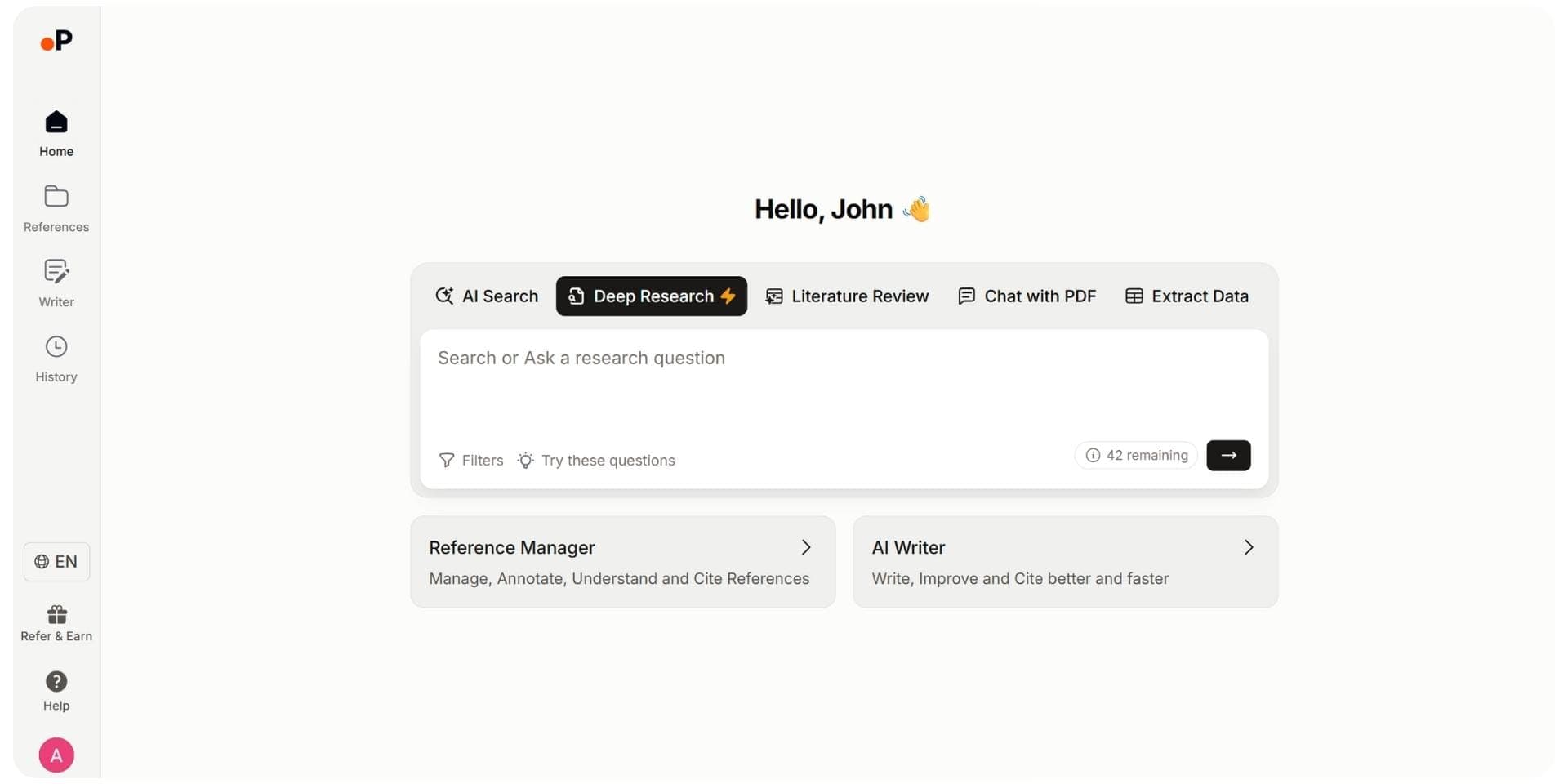
Paperguide, widely regarded as the best systematic review software in 2026, is an AI-native platform for scientific research workflows that helps automate the process of conducting meta analysis and systematic reviews. With its Deep Research Report, researchers can define a clear review question, and Paperguide automatically searches through a vast database of research papers, extracts the data each paper reports, and generates cited reports ready for your statistical analysis. This tool removes the need for time-consuming tasks like manual data extraction and screening, making the process faster and more accurate. Because it combines AI-driven screening, synthesis, and citation management, Paperguide is also widely considered the best AI literature review tool in 2026 as part of an end-to-end meta-analysis workflow.
Key Features
- Deep Research Report: Automatically searches over 200 million research papers, saving time and increasing efficiency.
- Study Screening: Filters studies based on your inclusion and exclusion criteria, ensuring only relevant papers are included.
- Extract Data: Extracts data such as effect sizes, confidence intervals, and other key study information needed for meta analysis into one table, with every value cited to the exact sentence it came from and export to CSV or Excel for your statistics software.
- Customizable Columns: Allows you to tailor extraction columns to meet specific study protocols and research needs.
- Systematic Review: Runs the systematic review behind a meta analysis with an AI-drafted protocol, Dual Review blind screening or AI Systematic Review mode, and every decision logged with its criterion and evidence.
- PRISMA Diagram From Actual Counts: Generates the PRISMA diagram and methodology log from the review's real screening counts, and the free PRISMA Flow Diagram Generator covers diagrams built by hand.
- Deduplicated Search and Reusable Protocols: Searches PubMed, arXiv, OpenAlex and Semantic Scholar, pools the results with your own library and deduplicates them before screening. The order of your eligibility criteria sets the exclusion reasons, team roles are set per stage (Edit, Reviewer, View-only), and a saved protocol can be re-run over new papers when the meta analysis is updated.
- Chat with PDF: Engage directly with individual studies to clarify methodologies or outcome definitions.
Pros
- Automated Preparation: Automates the stages before the statistics, from search and screening to extraction of reported values, saving time and reducing manual effort.
- Quick and Efficient: Generates cited research reports within minutes, speeding up the research process.
- Accurate Data Extraction: Extracts the effect sizes, confidence intervals, and study characteristics each paper reports, with every value cited to its source sentence.
- Handles Large Datasets: Capable of processing vast amounts of data, making it ideal for large-scale meta analysis studies.
- Citation-Backed Summaries: Provides precise, citation-backed summaries, ensuring the credibility and traceability of research findings.
- User-Friendly Interface: The intuitive interface makes it easy for researchers at all levels to use the tool effectively.
Cons
- Limited Free Plan: The free version of Paperguide has restrictions on the number of reports and features, making it less ideal for large projects without upgrading to a paid plan.
- Learning Curve for New Users: New users may require some time to familiarize themselves with the tool’s advanced features and customizable settings.
- Best for Quantitative Research: Works best for studies with quantifiable data; may not be suitable for purely qualitative research or very diverse study designs.
- Accuracy Dependent on Research Question: The effectiveness of the tool is maximized with well-defined, specific research questions. Broader questions may yield less focused results.
Best For
- Researchers and academic professionals who need to automate the screening and extraction behind meta analysis and systematic reviews.
- Those looking to save time on tasks like screening and data extraction while maintaining high accuracy.
Pricing
- Free Plan: $0, limited features with basic access and 2,000 AI credits a month.
- Plus Plan: $12 per seat per month, billed annually ($144 a year), with 12,500 AI credits a month and systematic reviews of up to 1,000 papers.
- Pro Plan: $29 per seat per month, billed annually ($348 a year), with 50,000 AI credits a month and systematic reviews of up to 5,000 papers.
- Evidence Teams Plan: $89 per seat per month, billed annually ($1,068 a year), with 150,000 AI credits a month and PRISMA-grade dual reviewer screening.
- Enterprise: Custom pricing. Academic users get 30% off with a valid university email.
How Paperguide’s Deep Research Fully Automates Meta Analysis

Paperguide offers an automated solution with its Deep Research Report for preparing meta-analyses, taking the process from research question input to a cited evidence base. By entering a clear meta-analysis question, the AI quickly searches through millions of research papers, extracting the effect sizes, confidence intervals, and other measures each paper reports. Within minutes, Paperguide generates a cited report, presenting the reported data in a standardized format ready for pooling in your statistics software.
The key benefit of Paperguide is its ability to automate screening and data extraction: Extract Data copies the values each paper prints, cited to the source sentence, and never computes values, so the statistical analysis itself stays in software such as RevMan or R. This reduces the time required to prepare a meta analysis. As one of the best AI tools for systematic review, it efficiently handles large datasets and provides precise, citation-backed summaries, making it an essential tool for researchers working on meta analysis studies.
2. Elicit
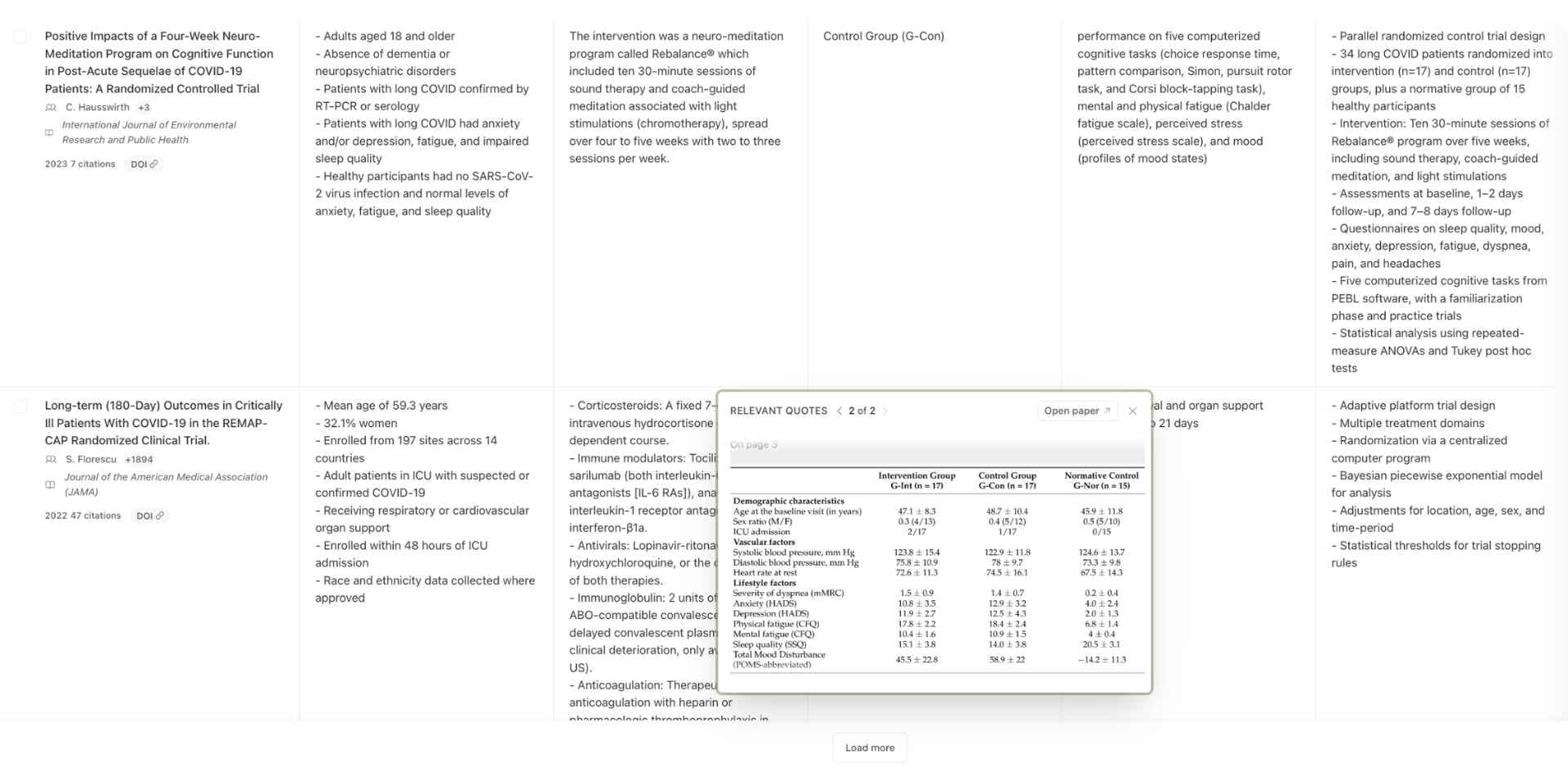
Elicit is an AI research tool that helps automate the process of conducting meta analysis and systematic reviews. It offers powerful features for data extraction, study selection, and summarizing findings, making the process faster and more accurate. Elicit is particularly useful for researchers looking to streamline their meta analysis workflow and quickly gather key insights from large datasets.
Key Features
- Customizable Research Templates: Create templates tailored to your specific meta analysis needs.
- Advanced Search Filters: Narrow down search results by study design, sample size, and other relevant criteria.
- Efficient Summaries: Automatically generates concise summaries of research papers to speed up the review process.
- Collaboration Tools: Allows for real-time collaboration, making it easy for teams to work together on meta analysis projects.
- Automated Data Extraction: Extracts data such as effect sizes and confidence intervals for statistical analysis in meta analysis studies.
Pros
- Time-Saving: Automates key tasks like data extraction and study screening, reducing manual work.
- Customizable: Tailor the tool to meet the specific needs of your meta analysis.
- Collaboration-Friendly: Ideal for team-based research with its real-time sharing and editing features.
- Accurate and Efficient: Quickly processes and summarizes large amounts of data for meta analysis papers.
Cons
- Learning Curve: Some advanced features may take time to get used to, especially for new users.
- Free Plan Restrictions: The free plan limits the number of studies and summaries that can be analyzed.
- Quantitative Focus: Best suited for quantitative data, may not be as effective for qualitative studies.
- Pricing: The premium plans may be expensive for individual researchers or small teams.
Best For
- Researchers conducting meta analysis and systematic reviews.
- Teams that need a tool for collaboration and efficient data extraction in meta analysis.
- Researchers looking to automate data extraction and improve the speed and accuracy of their meta analysis studies.
Pricing
- Free Plan: Basic access with limited features.
- Plus Plan: $12/month (billed annually), includes up to 50 papers per month and additional features.
- Pro Plan: $49/month (billed annually), includes unlimited summaries and larger datasets.
3. Scispace
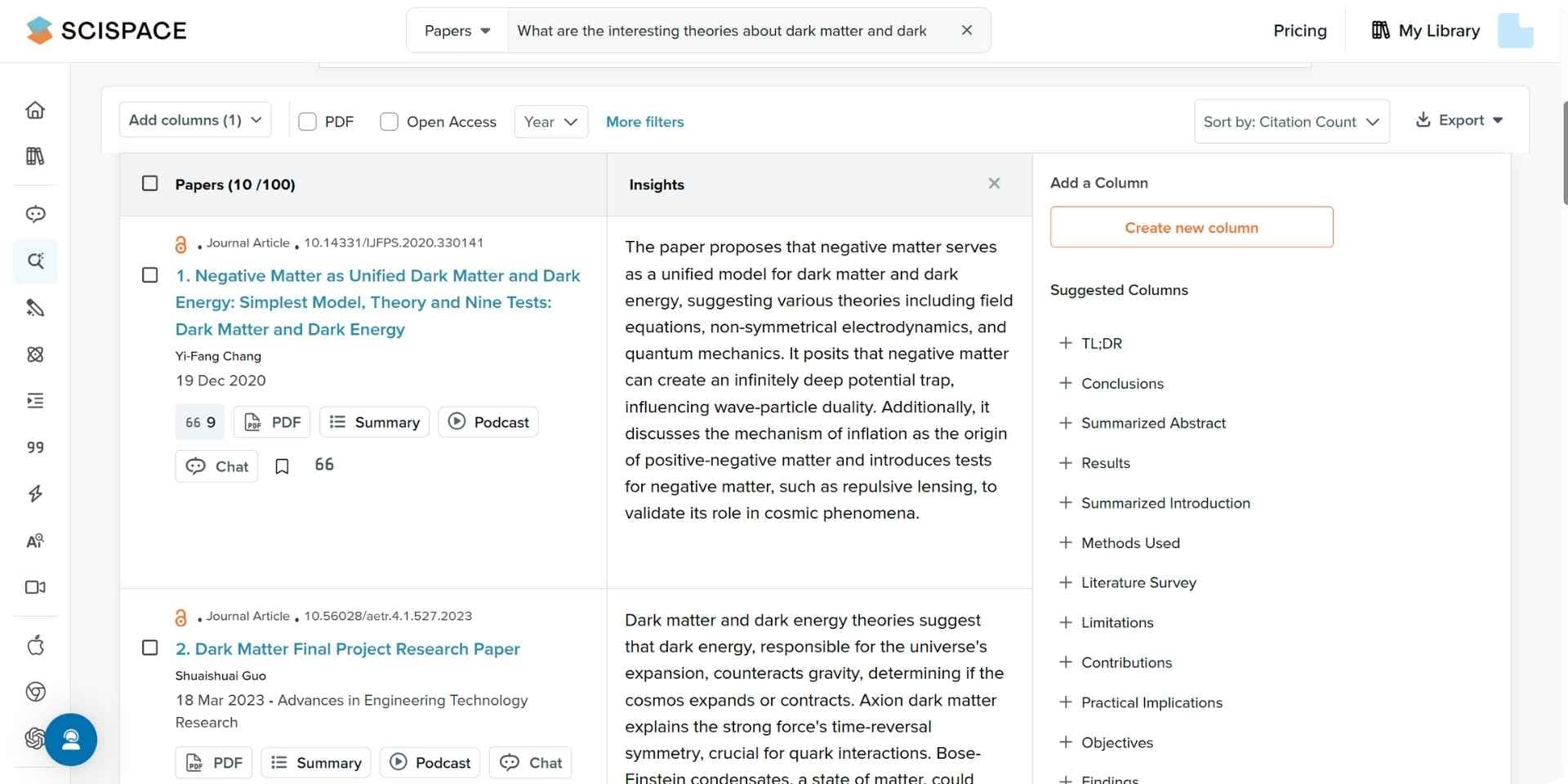
scispace literature review
Scispace is an advanced research tool that helps streamline the process of conducting meta analysis and systematic reviews. It combines AI-driven literature synthesis, customizable review templates, and real-time collaboration features to enhance the research process. Scispace is designed to support teams working on large-scale meta analysis studies, enabling them to work more efficiently while ensuring the accuracy and comprehensiveness of their reviews.
Key Features
- AI-Driven Literature Synthesis: Automatically analyzes and synthesizes findings from multiple studies to create a clear, cohesive summary.
- Customizable Review Templates: Create and adjust review templates to match the needs of your meta analysis.
- Automatic Study Categorization: Organizes studies by topic and relevance, helping researchers quickly identify trends and gaps in the literature.
- Real-Time Collaboration: Supports multiple researchers working on the same review simultaneously, improving team productivity.
- Export Reports: Easily export the synthesized findings into customizable reports, ready for further analysis or publication.
Pros
- Efficiency: Automates key tasks like literature synthesis, study categorization, and data extraction, saving time.
- Collaboration: Allows multiple team members to work on a review at the same time, improving overall efficiency.
- Customizable: Tailor the review process to your specific meta analysis needs with customizable templates.
- In-Depth Insights: Thematic analysis and data extraction provide deeper insights into the research.
Cons
- Learning Curve: Advanced features may take time for new users to fully master.
- Pricing: The premium plans may be too expensive for smaller research teams or independent researchers.
- Free Plan Limitations: The free version offers only basic features, which may not be enough for complex or large-scale meta analysis.
Best For
- Research teams conducting large-scale meta analysis and systematic reviews.
- Researchers who need to synthesize data from multiple studies and collaborate in real-time.
- Academics and professionals looking for customizable templates and deeper insights into their research findings.
Pricing
- Basic Plan: Free with limited features.
- Premium Plan: $20/month, includes more advanced features and the ability to work with larger datasets.
- Advanced Plan: $90/month, includes full access to all features, including advanced meta analysis capabilities.
4. RevMan
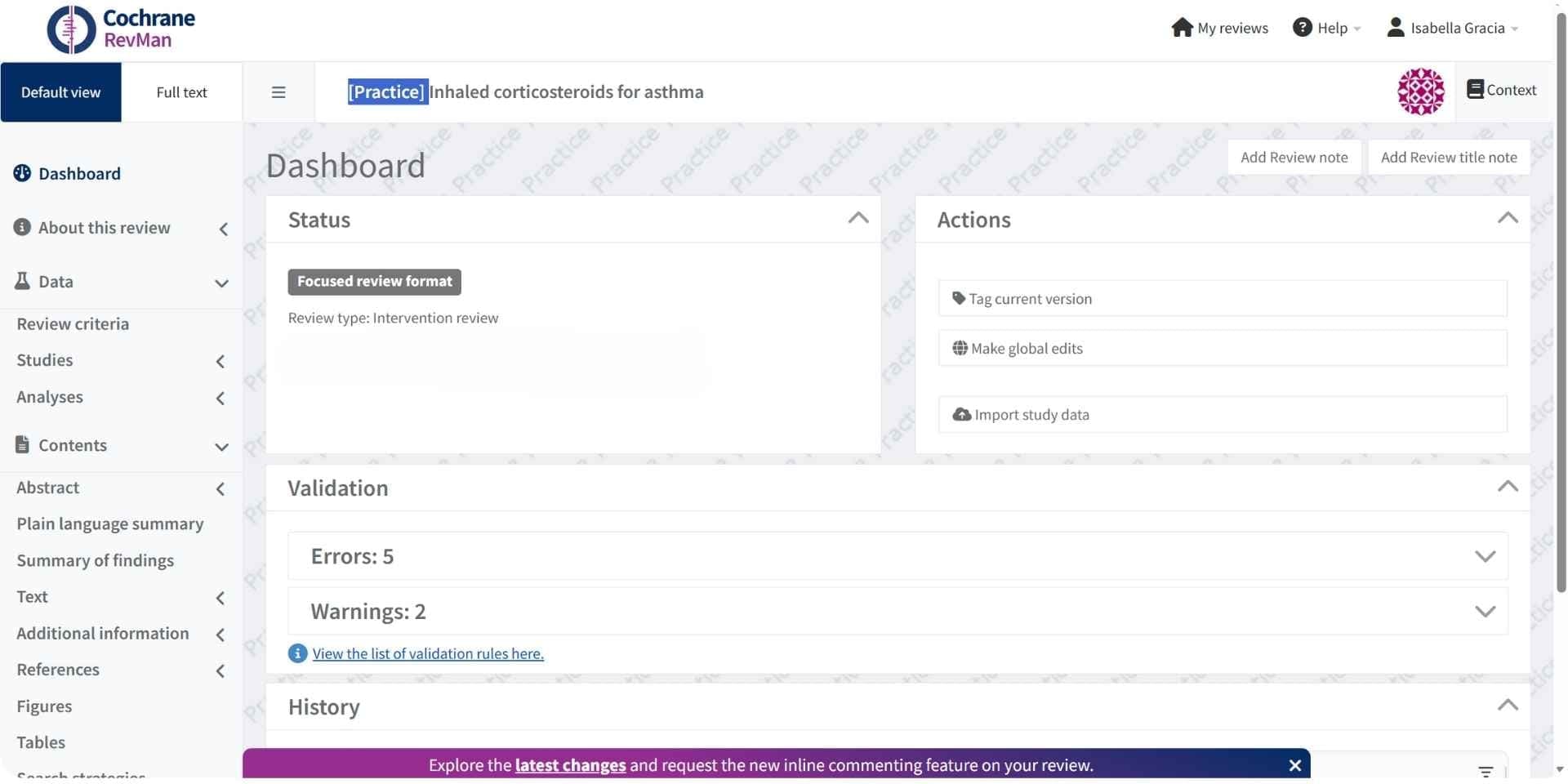
RevMan is a specialized software developed by Cochrane, designed to assist researchers in conducting meta analysis and systematic reviews. It offers a comprehensive suite of tools for data management, statistical analysis, and reporting, making it a preferred choice for researchers in clinical and healthcare fields.
Key Features
- 3 Active Reviews (Free): The free plan allows users to manage up to three active reviews at a time, ideal for smaller projects.
- AI-powered Relevance Ratings: Uses AI to automatically assess and rank the relevance of studies, improving the speed and accuracy of screening.
- Industry-Leading Duplicate Detection: Automatically identifies and flags duplicate studies across databases.
- Workbench with 15+ Facets and Filters: Organize studies efficiently with a range of filters, allowing you to refine your study selection.
- Invite Unlimited Reviewers: Collaborate with as many reviewers as needed, even on the free plan.
- PRISMA Flow Diagram Generator: Helps visualize and track the study selection process (available on paid plans).
- PICO Highlighting & Filtering: Allows for easy highlighting and filtering based on Population, Intervention, Comparison, and Outcome (PICO).
- Mobile App Access: Access and work on your reviews from mobile devices for flexibility.
- Programmable Keyboard Shortcuts: Improve workflow with customizable shortcuts.
- Priority Support: Available with paid plans, ensuring faster response times and assistance.
Pros
- Comprehensive Statistical Tools: Provides a wide range of statistical methods for analyzing meta-analysis data, making it suitable for complex research.
- User-Friendly Interface: Despite its advanced features, RevMan is designed to be easy to use for researchers at all levels.
- Widely Recognized: RevMan is a trusted tool, especially in clinical and healthcare research.
- Detailed Reporting: Generates high-quality, publishable reports with visualization options like forest and funnel plots.
Cons
- Limited to Clinical Research: Primarily focused on healthcare-related studies, so may not be suitable for non-clinical research.
- Learning Curve: Some advanced features may require time to master for new users.
- Requires Statistical Knowledge: To get the most out of RevMan, researchers need a solid understanding of statistical analysis techniques.
Best For
- Clinical researchers and healthcare professionals performing meta-analysis in medicine, pharmacology, and related fields.
- Academics and research organizations that need reliable tools for meta-analysis with detailed statistical features.
- Researchers needing high-quality, comprehensive reports for academic publications or presentations.
Pricing
- For Individuals
- Standard Rate: £120.00 + VAT (EU & UK)
- Academic Rate: £99.00 + VAT (EU & UK)
- Student Rate: £75.00 + VAT (EU & UK)
- For Organizations
- Pricing starts at £520 for up to 8 users and varies depending on the type of organization and the number of seats required.
5. Rayyan
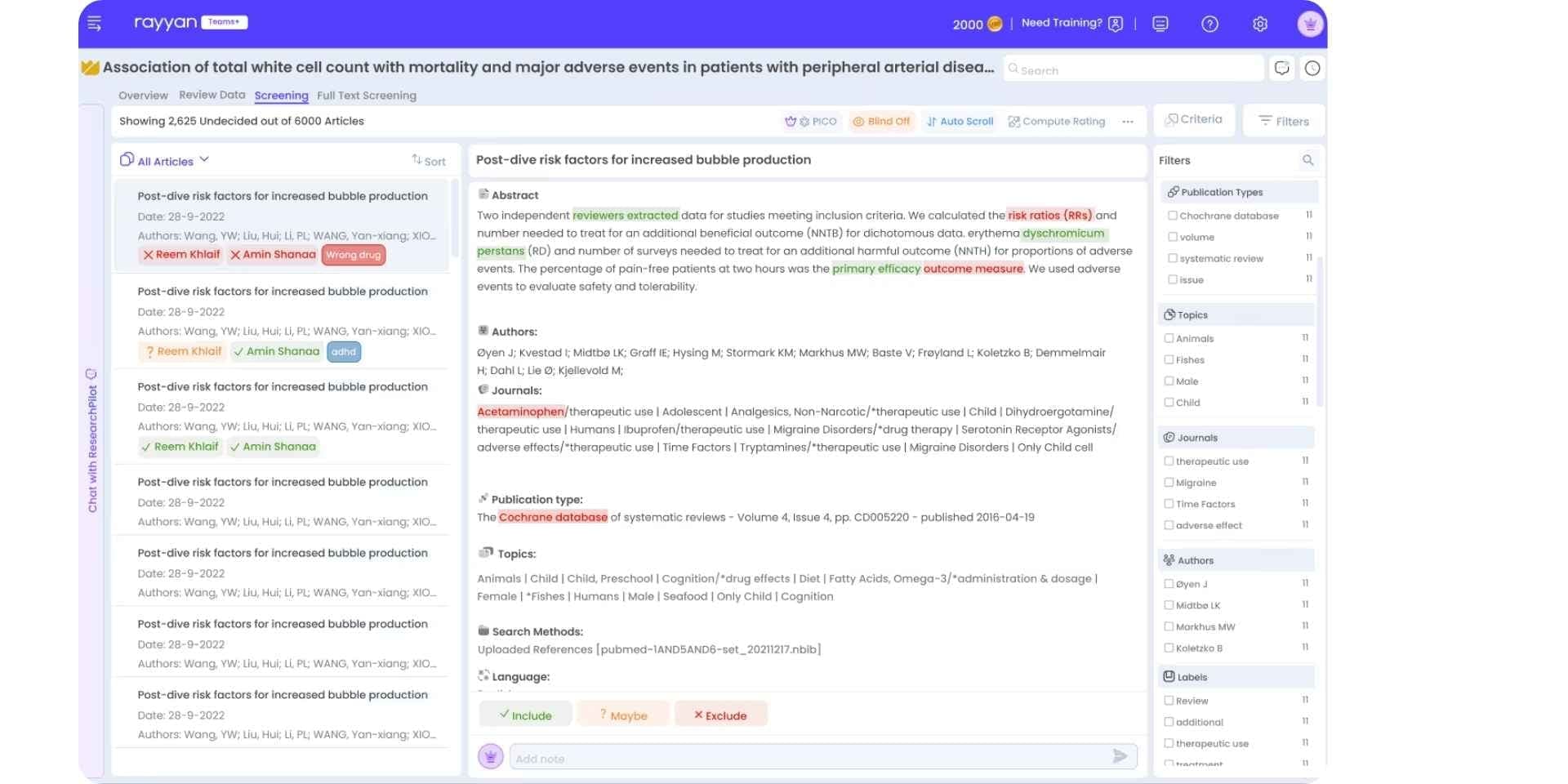
Rayyan is a semi-automated abstract and title screening tool for systematic reviews and meta analysis. It helps researchers quickly and efficiently screen studies, identify duplicates, and apply inclusion/exclusion criteria. Designed to speed up the initial stages of meta analysis, Rayyan is especially useful for those working with large volumes of literature.
Key Features
- AI-Powered Study Screening: Uses machine learning to suggest relevant studies based on user input, making it easier to quickly identify studies for inclusion in your meta analysis.
- Duplicate Detection: Automatically detects duplicate studies across multiple databases, ensuring that no important research is overlooked.
- Customizable Inclusion Criteria: Apply your own inclusion and exclusion criteria to streamline the study selection process.
- Collaboration Features: Allows multiple researchers to work on the same review simultaneously, improving team productivity.
- User-Friendly Interface: The simple and intuitive interface makes it easy for both new and experienced users to get started with systematic reviews and meta analysis.
Pros
- Time-Saving: Speeds up the process of study screening by suggesting relevant studies and identifying duplicates automatically.
- Collaboration-Friendly: Supports real-time collaboration, making it ideal for team-based meta analysis projects.
- Free Plan Available: Offers a free version with basic features, suitable for independent researchers or small projects.
- Easy to Use: The interface is intuitive and easy to navigate, even for those new to meta analysis.
Cons
- Limited Features on Free Plan: The free version has limitations, especially for larger, more complex meta analysis projects.
- Not as Advanced for Data Extraction: While great for screening, Rayyan does not handle data extraction or statistical synthesis as efficiently as other tools.
- Best for Early Stages: Most effective during the screening phase of a systematic review, but lacks features for later stages like data synthesis and report generation.
Best For
Researchers working on the screening phase of meta analysis or systematic reviews.
- Teams that need to collaborate and streamline the study selection process for large-scale meta analysis projects.
- Independent researchers or small teams looking for a free tool with basic study screening capabilities.
Pricing
- Free Plan: Includes up to 3 active reviews with basic features like study screening and duplicate detection.
- Professional Plan: $8.33/month (billed annually), includes unlimited active reviews and advanced features like custom tags and priority support.
Meta Analysis Techniques for Historical Data Interpretation
When analyzing historical data, meta analysis techniques are essential for drawing meaningful insights from studies that vary in time period, region, and methodology. Because historical data is often fragmented or inconsistent, meta analysis provides a structured way to combine and interpret findings across different contexts.
For example, in climate change research, meta analysis techniques are used to synthesize decades of data, helping researchers identify long-term environmental trends. Similarly, in public health or social sciences, these techniques allow for the integration of findings from studies published over many years, revealing patterns that may not be visible in individual datasets.
Key Meta Analysis Techniques Used for Historical Data
| Technique | Purpose / Description |
|---|---|
| Effect Size Calculation | Quantifies outcome magnitude across studies (e.g., Cohen’s d, Hedges’ g). |
| Fixed vs. Random Effects | Accounts for uniform (fixed) or variable (random) effects across historical datasets. |
| Heterogeneity Testing | Measures variation across studies (e.g., using I² statistics) to assess consistency. |
| Publication Bias Detection | Identifies bias from unpublished or missing studies (e.g., funnel plots, Egger’s test). |
| Subgroup Analysis | Analyzes subsets of data by region, time period, or study characteristics. |
| Meta-Regression | Assesses how variables like year, location, or sample size influence study outcomes. |
| Cumulative Meta Analysis | Adds studies in chronological order to observe how conclusions evolve over time. |
| Sensitivity Analysis | Tests the reliability of results by removing outliers or lower-quality studies. |
Meta Analysis and Its Role in Evidence-Based Practice
Meta analysis is central to evidence-based practice (EBP) in fields like healthcare, social sciences, and education. In medical research, for instance, meta analysis helps integrate findings from multiple clinical trials to determine the effectiveness of treatments. By synthesizing results from a range of studies, researchers can provide more reliable recommendations and ensure that medical practices are grounded in the best available evidence.
AI tools for meta analysis have become indispensable in evidence-based practice, as they automate much of the repetitive work involved in collecting and analyzing data, ensuring that findings are accurate and consistent. As a result, many organizations rely on Healthcare AI consultancy services to select, implement, and optimize these AI-driven tools within their evidence-based research workflows.
Meta Analysis Techniques in Scientific Research
Meta analysis is widely used in scientific research to combine results from various studies, creating a more reliable summary of the evidence on a particular topic. These techniques involve:
- Effect size calculation: Quantifying the strength of an intervention or relationship between variables.
- Heterogeneity testing: Determining if the variation in study results is due to chance or true differences between studies.
- Publication bias assessment: Identifying any skew in the studies included in the meta analysis paper based on factors like publication date or study design.
By using these techniques, researchers can ensure that their meta analysis study provides the most accurate and reliable conclusions possible.
Final Comparison of Best AI Tools for Systematic Research in 2026
| AI Tool | Key Features | Best For | Pricing |
|---|---|---|---|
| Paperguide | Deep research automation, citation-backed summaries, customizable templates | Researchers needing comprehensive automation for meta analysis and systematic reviews | Free Plan, Plus Plan ($12 per seat per month, billed annually), Pro Plan ($29 per seat per month, billed annually) |
| Elicit | Customizable research templates, advanced search filters, real-time collaboration | Researchers seeking fast, accurate summaries and data extraction | Free Plan, Plus Plan ($12/month), Pro Plan ($49/month) |
| Scispace | AI-driven literature synthesis, customizable review templates, real-time collaboration | Teams looking to perform deep synthesis and collaborate efficiently | Free Plan, Premium Plan ($20/month), Advanced Plan ($90/month) |
| RevMan | Statistical pooling, meta-regression, risk of bias assessment, advanced reporting | Clinical researchers or healthcare professionals conducting meta analysis | £120/Year (Standard), £99/Year (Academic), £75/Year (Student) |
| Rayyan | AI-powered relevance ratings, duplicate detection, real-time collaboration | Researchers in need of a free, easy-to-use screening tool for systematic reviews | Free Plan, Professional Plan ($8.33/month) |
The AI tools for meta analysis and systematic reviews discussed in this blog each have unique strengths. Choosing the right one depends on your specific needs, whether you're looking for comprehensive data extraction, collaboration features, or ease of use.
Which AI Tool for Systematic Review is Best for You?
Choosing the best AI tool for systematic reviews depends on your specific needs and the scale of your research:
- Paperguide is perfect if you need a comprehensive meta analysis tool that automates the entire process, from research question formulation to data extraction and report generation. It's ideal for larger systematic reviews that require heavy lifting across multiple stages.
- Elicit is great for researchers looking for speed and efficiency in meta analysis. If you need AI-powered summaries and advanced filtering options for quick insights, Elicit is a strong option.
- Scispace is best for research teams that need robust collaboration features and want to perform deep synthesis with customizable review templates. If you work in a team environment and need real-time collaboration, this tool could be the right choice.
- RevMan is a great option for clinical research and healthcare professionals conducting meta analysis studies. It offers advanced statistical analysis tools and is widely recognized in clinical research communities.
- Rayyan is the best choice for independent researchers or small teams who need a free, user-friendly tool for the initial stages of systematic reviews, such as screening and identifying duplicates.
Each tool serves different purposes, so consider what stage of the research process you are at and what features are most important for your work. Whether you need to automate data extraction, collaborate with a team, or perform complex statistical analysis, there's an AI tool suited for every type of meta analysis or systematic review.
Conclusion
In 2026, AI tools are significantly improving the process of meta analysis and systematic reviews by automating key tasks such as data extraction, study screening, and statistical analysis. Paperguide stands out as the most comprehensive AI-powered solution, offering a complete workflow for systematic reviews and for the screening and extraction of reported values behind a meta analysis. Unlike other tools, it integrates these processes with writing assistance and citation management, making it the go-to platform for researchers.
While Rayyan excels at study screening, RevMan offers advanced statistical methods tailored for meta analysis. These tools help automate key tasks, improving accuracy and efficiency, allowing researchers to focus on higher-level analysis and interpretation. This ultimately enhances the quality and speed of meta analysis studies.
Using AI not only improves efficiency but also enhances the reliability and scalability of modern research practices. Approaches to how to use AI for systematic review and meta analysis are continuing to evolve, helping researchers implement evidence-based methods faster and with greater confidence.
Frequently Asked Questions
Can a paper be both a systematic review and a meta-analysis?
Yes, many research papers combine both methods. Researchers first perform a systematic review to gather studies and then use meta-analysis to combine data from compatible studies.
What’s the difference between a systematic review and a meta-analysis?
A systematic review gathers and synthesizes all relevant evidence on a specific topic. In contrast, meta-analysis statistically combines data from studies with compatible outcomes to estimate an overall effect size.
When is meta-analysis not suitable?
Meta-analysis isn’t suitable when studies are too different, lack compatible statistical data, or if data reporting is inconsistent.
How do AI tools assist in meta-analysis?
AI tools automate tasks like data extraction, study selection, and literature screening, saving time and enhancing accuracy. Paperguide is one of the best AI tools for both systematic reviews and meta-analysis, helping researchers move from study collection to a cited table of the values each paper reports, ready for statistical analysis.
How do publication biases affect meta-analysis?
Publication bias occurs when studies with positive results are more likely to be published, potentially inflating effect sizes. AI tools help identify such biases during the analysis process.
Can I perform a meta-analysis without conducting a systematic review first?
While it’s possible, it’s not recommended. A systematic review is typically conducted first to ensure all relevant studies are considered before performing a meta-analysis.
Which is the best AI tool for literature review and meta-analysis in 2026?
In 2026, Paperguide is widely regarded as the best AI tool for literature review and meta-analysis, offering integrated workflows for screening, synthesis, citation-backed summaries, and evidence reporting.
Running a review?
Run your systematic review in Paperguide
Dual screening, verifiable extraction and PRISMA reporting in one place.
Start a reviewNo credit card required