9 Best Systematic Review Software in 2026 (Free + Paid)


Systematic review software automates the structured, reproducible evidence synthesis process, from literature search and dual-reviewer screening to data extraction and PRISMA-compliant reporting. A traditional systematic review takes an average of 18 months of active work, and a Cochrane 2025 analysis found that only 71.9 % of 8,137 registered protocols ever reach publication, with a median delay of 25.7 months from protocol to final paper.
Your bottleneck is almost never the research question. It is the screening, extraction, and synthesis work that fills those months. Modern systematic review software now automates 50 to 75 % of that manual workload, cutting your timeline from over a year to a matter of weeks. Recent empirical evaluations confirm that AI-assisted screening tools can achieve recall rates above 95 % when properly configured.
We researched and compared 9 systematic review tools across screening accuracy, PRISMA compliance, dual-review support, data extraction, meta-analysis, collaboration features, and pricing. Here is what we found.
TL;DR
Paperguide is the best systematic review software in 2026. It runs the full PRISMA pipeline (protocol drafting, dual-review blind screening, data extraction, and reporting) in one AI-native workspace. Its Dual Review mode lets two reviewers screen independently with blinded decisions, conflict resolution, and AI-prepared evidence that accelerates each call without breaking blinding.
Here is how each tool stacks up:
- Paperguide → Full PRISMA-grade AI workflow with Dual Review blind screening, 200 M+ papers, evidence-traced decisions, built-in reference management, and AI writing tools. The only platform that covers protocol through reporting in one workspace. Best for the full pipeline in one place.
- Covidence → Gold-standard screening and extraction for Cochrane reviews. Institutional favourite, but no AI search or writing.
- Rayyan → Fast AI-assisted screening. Strong free tier.
- DistillerSR → Enterprise-grade platform for pharma and regulated industries with audit trails for 700 K+ reference projects.
- EPPI-Reviewer → Mixed-method reviews with text mining and meta-analysis. Built by UCL.
- RevMan → Cochrane's official meta-analysis authoring tool.
- ASReview → Free, open-source active learning screener from Utrecht University. Screening only.
- Nested Knowledge → Visual evidence mapping with interactive sunburst diagrams and built-in network meta-analysis for clinical researchers.
- Research Gold → Privacy-first browser-based screener with 99 %+ recall AI, built-in meta-analysis, and aggressive pricing starting at $12/month.
Key Takeaways
- Paperguide is the only tool that covers protocol → screening → extraction → synthesis → PRISMA reporting in one AI-native workspace, with a new Dual Review mode for PRISMA-grade blind screening with conflict resolution.
- AI screening cuts manual workload by 50 to 75 %, but accuracy varies widely. Validate any AI tool's recall rate against benchmark datasets before trusting it with your review.
- Free options exist at every stage, including Rayyan and ASReview for screening and RevMan Web for meta-analysis, but no single free tool covers the full pipeline.
- Enterprise teams in pharma and medical devices should evaluate DistillerSR for regulatory-grade audit trails and compliance features.
- Dual-review blind screening, where two reviewers screen independently without seeing each other's decisions, is expected practice for credible systematic reviews, and only a few tools (Paperguide, Covidence, DistillerSR, Research Gold) offer it with built-in conflict resolution.
- Budget matters: a single Covidence review costs $339/year, while Paperguide's Plus plan costs $12 per seat per month, billed annually ($144 a year), with capacity for 1,000 papers, and Rayyan's free tier covers 3 reviews with no cost at all.
What Is the Best Systematic Review Software in 2026?
The best systematic review software in 2026 is Paperguide, an AI-native research platform that runs the full PRISMA-grade systematic review pipeline in one workspace. It covers protocol drafting, automated literature search across 200 M+ papers, AI-assisted and dual-review blind screening, structured data extraction, evidence synthesis, and auto-generated PRISMA flow diagrams, all with citation-traced decisions and a complete audit trail.
What sets Paperguide apart in 2026 is its Dual Review feature: two reviewers screen every paper independently, with blinded decisions, a conflict resolver for disagreements, and AI-prepared evidence citations that speed up each screening decision without breaking reviewer blinding. No other tool combines this level of AI assistance with PRISMA-compliant blind screening in a single integrated environment.
Systematic Review vs Literature Review: Key Differences
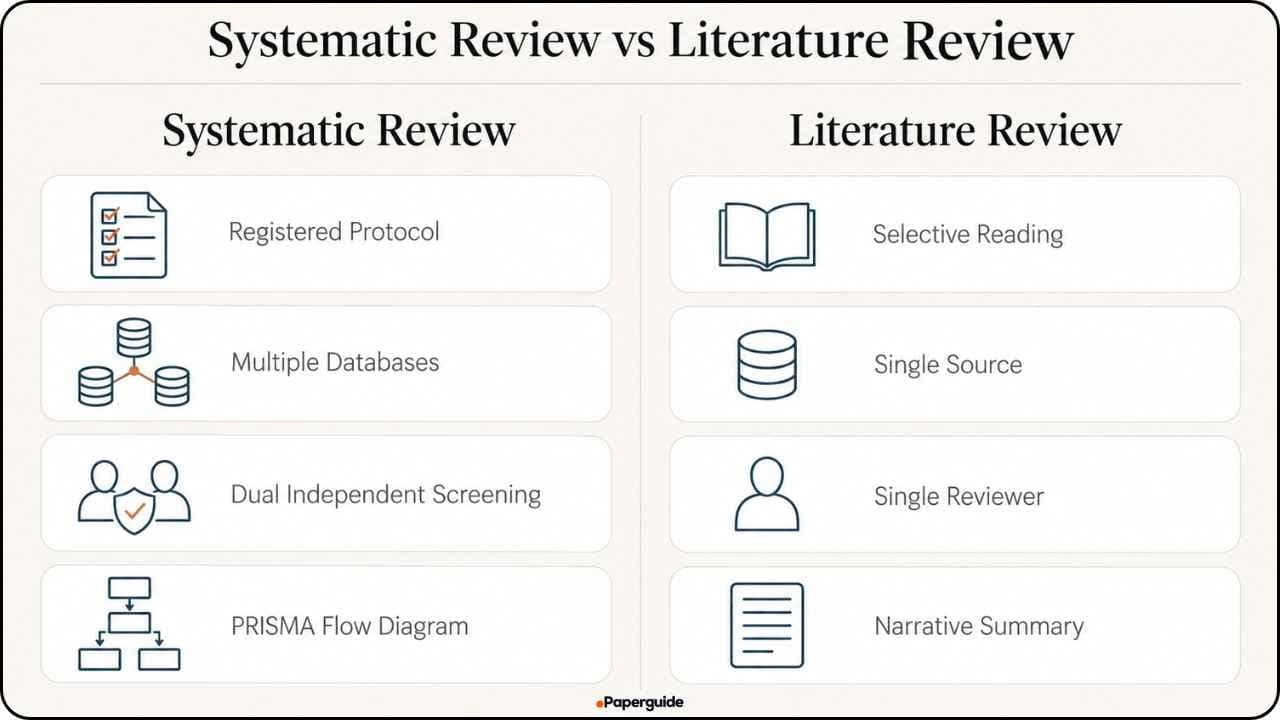
Before choosing software, it helps to understand what a systematic review actually is and what makes it different from other review types:
| Feature | Systematic Review | Literature Review |
|---|---|---|
| Protocol | Pre-registered, documented methodology | No formal protocol required |
| Search strategy | Comprehensive, reproducible across databases | Selective, often single database |
| Screening | Dual-reviewer with inclusion/exclusion criteria | Single-reviewer judgment |
| Data extraction | Structured forms, risk-of-bias assessment | Narrative summary |
| Synthesis | Quantitative (meta-analysis) or structured qualitative | Narrative discussion |
| Reporting | PRISMA guidelines recommended | No standardized framework |
| Timeline | 12 to 18 months average | 2 to 6 months |
| Reproducibility | Fully reproducible | Not typically reproducible |
Systematic reviews demand rigorous, reproducible methods at every stage, which is why dedicated software matters. A literature review tool that works for narrative summaries will not support the dual screening, structured extraction, or audit-ready decision logs that PRISMA reporting depends on. If you are unsure which review type your project requires, our guide on systematic review vs meta-analysis breaks down the key differences.
Top 9 Systematic Review Software in 2026 (Quick Comparison)
| Tool | AI Screening | Dual Review | Data Extraction | Meta-Analysis | PRISMA Diagrams | Free Plan | Starting Price |
|---|---|---|---|---|---|---|---|
| Paperguide | ✅ | ✅ | ✅ | ❌ | ✅ | ✅ | $12/seat/mo, billed annually |
| Covidence | ✅ | ✅ | ✅ | ❌ | ✅ | Trial | $339/yr |
| Rayyan | ✅ | ✅ | ❌ | ❌ | ✅ | ✅ | $4.99/mo |
| DistillerSR | ✅ | ✅ | ✅ | ❌ | ✅ | ❌ | Custom |
| EPPI-Reviewer | ✅ | ✅ | ✅ | ✅ | ❌ | ❌ | £10/mo |
| RevMan | ❌ | ❌ | ✅ | ✅ | ✅ | ❌ | £80/yr |
| ASReview | ✅ | ❌ | ❌ | ❌ | ❌ | ✅ | Free |
| Nested Knowledge | ✅ | ✅ | ✅ | ✅ | ✅ | ✅ | $20/mo |
| Research Gold | ✅ | ✅ | ✅ | ✅ | ✅ | ✅ | $12/mo |
Why Systematic Review Software Matters in 2026
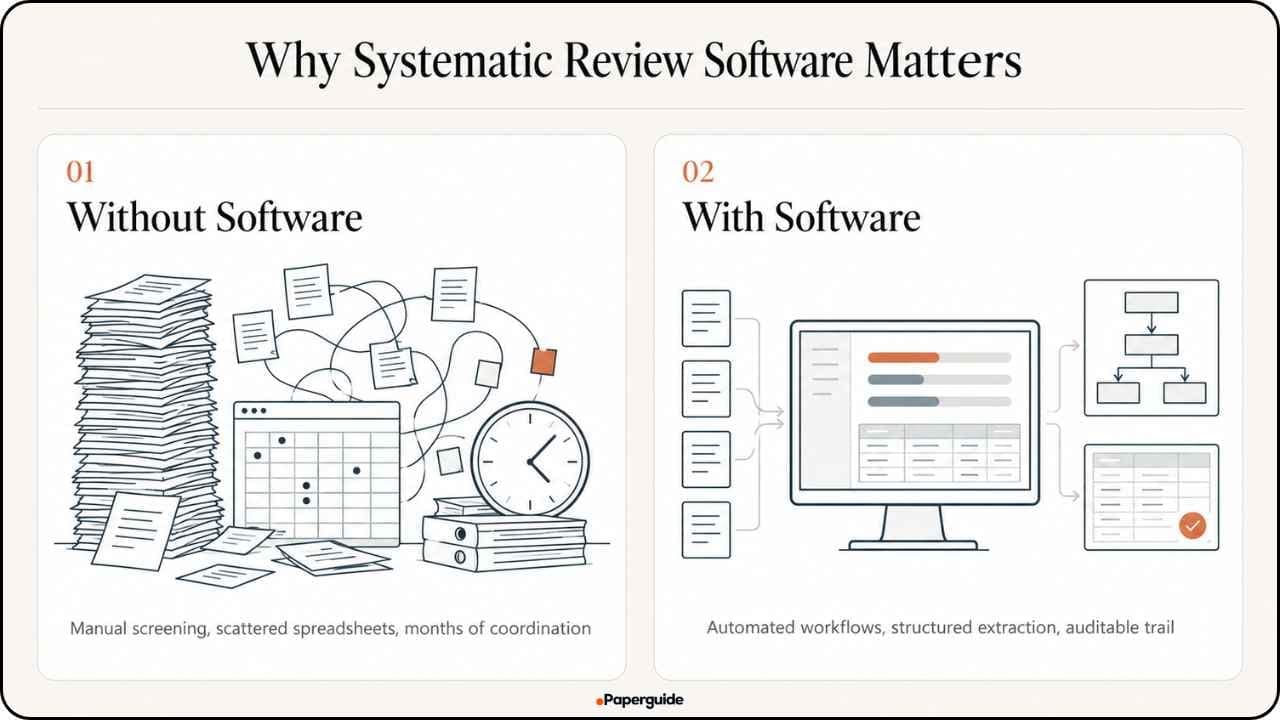
Systematic reviews are the gold standard of evidence synthesis, but the manual process is notoriously demanding:
Scale: A typical systematic review screens 3,000 to 10,000 records at the title/abstract stage, retrieves 200 to 500 full texts, and ends up including 20 to 80 studies for extraction and synthesis. Without software, this translates into weeks of spreadsheet-based screening. Spreadsheets have no built-in deduplication, no blinding, and no audit trail.
Compliance: PRISMA 2020 guidelines recommend reporting screening decisions, reproducible search strategies, pre-specified eligibility criteria, and results transparently at every stage. Trying to meet these recommendations manually (juggling email chains, shared drives, and colour-coded spreadsheet rows) creates compliance risks that a dedicated platform eliminates in a single setup step.
Collaboration: Independent dual screening is expected practice, not a nice-to-have. The Cochrane Handbook for Systematic Reviews explicitly mandates that at least two review authors independently screen each record against pre-specified eligibility criteria. Coordinating two reviewers across time zones, resolving conflicts without unblinding, and maintaining a complete decision log is the kind of logistics challenge that purpose-built tools exist to solve. Paperguide's Dual Review, for instance, automates blinding, conflict flagging, and resolution so the team can spend its energy on the science rather than the process.
AI acceleration: AI-assisted screening now routinely cuts manual workload by half or more without sacrificing recall, but only when embedded in a structured workflow that keeps a human in the loop. A detailed look at AI tools for systematic review covers how different platforms handle that balance. The key distinction in 2026 is between tools that use AI as evidence support (presenting cited passages for the reviewer to judge) and those that use AI as an unsupervised screener. The first approach is auditable; the second is not.
Best Systematic Review Software in 2026
1. Paperguide
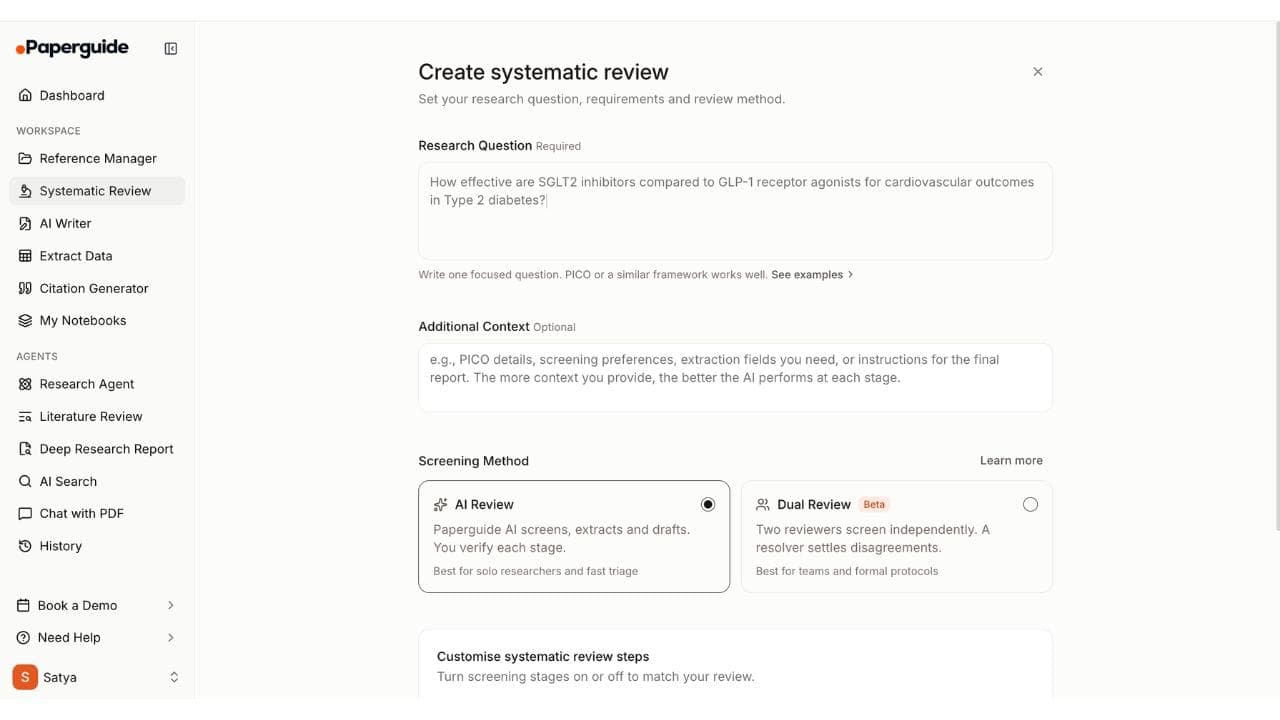
Paperguide is an AI-native platform for scientific research workflows and systematic reviews. It runs the full PRISMA-grade pipeline in one workspace: protocol drafting, automated search across 200 M+ peer-reviewed papers (PubMed, arXiv, OpenAlex, Semantic Scholar), AI-assisted or dual-review blind screening, structured data extraction, and auto-generated PRISMA flow diagrams.
Key Features
- Systematic Review: full PRISMA-grade pipeline from protocol to reporting in one workspace
- Dual Review blind screening with conflict resolution
- AI Evidence preparation that does not break reviewer blinding
- 200 M+ peer-reviewed papers across PubMed, arXiv, OpenAlex, Semantic Scholar
- Protocol management with reusable criteria and extraction templates
- AI protocol built on PICO, PEO, CoCoPop or SPIDER, with Include When and Exclude When rules for each criterion
- Cohen's Kappa shown on the screening stage card in Dual Review
- Exports paper lists in BibTeX, RIS, CSV or Excel, screening and extraction in CSV or Excel, and the report in PDF or DOCX
- Auto-generated PRISMA 2020 flow diagrams from actual workflow counts
- Extract Data tables with custom columns
- Papers added mid-review follow the same screening path
- Free PRISMA Flow Diagram Generator for anyone building a diagram by hand
- Team roles: Edit, Reviewer, View-only with stage-specific assignments
- Decision logging with criterion, evidence, and reviewer attribution
- SJR, SNIP, and citation metrics for included studies
What Makes Paperguide Different: Dual Review
Paperguide's Dual Review feature is what sets it apart from every other tool on this list. In Dual Review mode:
- Two reviewers screen every paper independently with blinded decisions. Neither reviewer can see the other's include/exclude choice until both have screened.
- AI Evidence prepares cited reasoning for each eligibility criterion, pulling relevant passages directly from the paper. This helps reviewers decide faster and more consistently, but the AI never makes screening decisions in Dual Review mode. It provides evidence only.
- Built-in conflict resolution flags disagreements automatically and routes them to a designated conflict resolver.
- Every decision carries a criterion, evidence citation, and reviewer name, creating a complete audit trail that is built during the review, not reconstructed afterward.
This means Paperguide delivers PRISMA-grade blinding and accountability without requiring a separate screening tool, a separate extraction tool, and a spreadsheet to tie them together.
Beyond Screening: The Full Workflow
Paperguide is not just a screening tool. The platform covers:
- Protocol management: save a protocol once and re-run it over new papers; AI drafts eligibility criteria and extraction fields for editing
- Automated search: search 200 M+ papers across four databases with AI-ranked relevance, plus the Paperguide MCP connector that brings the same search into Claude, ChatGPT, and Cursor
- AI-Led mode: for rapid, scoping, and internal reviews where the AI screens with a named human verifier at each stage
- Extract Data: custom extraction tables with up to 50 columns and 100 papers per table on paid plans
- Deep Research Report: multi-paper analysis with research gap detection and cited summaries
- Chat with PDF: long-context reading and cross-paper comparison for full-text analysis
- AI Reference Manager: built-in with 1,000+ citation styles, Zotero integration, and BibTeX/RIS export
- AI Paper Writer: research writing environment with in-text citations and reference lists
Pros
- Consolidates the full PRISMA workflow in a single workspace with no tool-switching
- Dual Review blind screening with AI Evidence that preserves blinding integrity
- Review capacity ranges from 1,000 to 20,000 papers depending on plan
- 200 M+ peer-reviewed papers with verified citation retrieval (no fabricated references)
- Protocol management with reusable templates for review updates
- Free plan includes core research tools (AI Search, Chat with PDF, Reference Manager)
Cons
- Free tier does not include systematic review functionality
- Dual Review screening is limited to Evidence Teams and Enterprise plans
- No built-in meta-analysis. Researchers need RevMan or R for quantitative synthesis
- Monthly AI credits may cap high-volume extraction on lower-tier plans
Pricing
| Plan | Price (Annual) | AI Credits/mo | SR Capacity | Dual Review |
|---|---|---|---|---|
| Free | $0 | 2,000 | N/A | ❌ |
| Plus | $12 per seat/mo ($144 a year) | 12,500 | 1,000 papers | ❌ |
| Pro | $29 per seat/mo ($348 a year) | 50,000 | 5,000 papers | ❌ |
| Evidence Teams | $89 per seat/mo ($1,068 a year) | 150,000 | 5,000 papers | ✅ |
| Enterprise | Custom | Custom | 20,000 papers | ✅ |
Pricing and plan details may change over time. For the latest Paperguide pricing, plans, and features, please visit the pricing page.
Best For: PhD researchers, academic teams, and research groups who want one platform for the entire systematic review workflow, especially those who need PRISMA-grade dual-review screening without managing multiple tool subscriptions.
Verdict: Paperguide is the strongest end-to-end systematic review platform in 2026. Its Dual Review mode solves the core PRISMA compliance challenge (blinded independent screening with evidence-backed decisions) inside the same workspace where you search, extract, and synthesize. If your priority is a single tool that covers the full pipeline with AI acceleration at every stage, Paperguide is the best choice.
2. Covidence
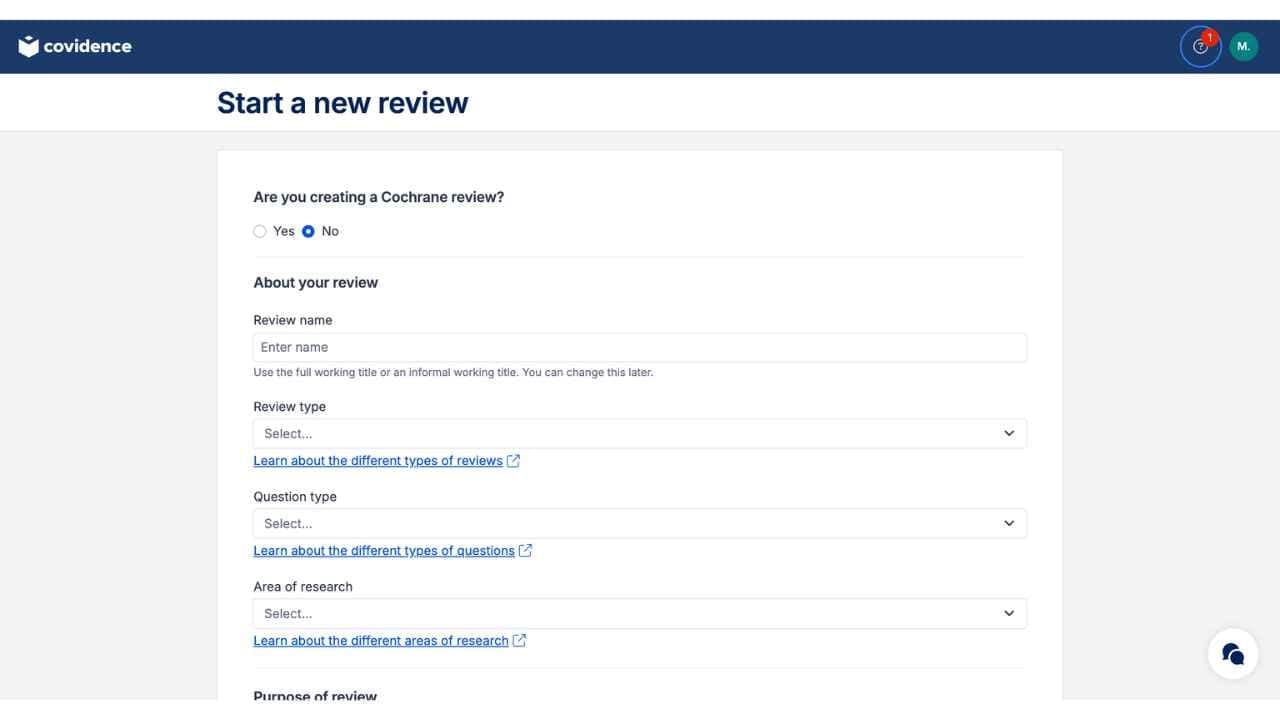
Covidence is the most widely used dedicated systematic review management platform. Institutions and Cochrane review groups worldwide trust it. It handles the core middle stages of a systematic review (import, deduplication, screening, full-text review, data extraction, and risk-of-bias assessment) with a clean, focused interface.
Key Features
- Title/abstract and full-text screening with dual-reviewer support and conflict resolution
- AI-assisted screening for faster relevance predictions
- Structured data extraction with customizable templates
- Risk-of-bias assessment using Cochrane RoB 2 and other frameworks
- Quality assessment tools with built-in templates
- PRISMA flow diagram generation
- Import from EndNote, Zotero, RefWorks, Mendeley, RIS, CSV, PubMedXML
- Export to RevMan for meta-analysis
- Mobile screening capability
- Cloud-based with 128-bit SSL encryption
Pros
- Industry-standard platform, widely recognized by journals and Cochrane
- Clean, intuitive interface with minimal learning curve
- Unlimited collaborators on all plans
- Strong integration ecosystem (EndNote, Zotero, RevMan)
- Reliable conflict resolution workflow for dual screening
Cons
- No AI-powered literature search. You need separate databases for search
- No writing tools, reference management, or synthesis features
- Per-review pricing adds up for prolific research groups
- No meta-analysis capability. Requires export to RevMan or other tools
- No AI evidence preparation for screening decisions
Pricing
| Plan | Price | Coverage |
|---|---|---|
| Single Review | $339/year | 1 review, unlimited collaborators |
| Package (3 Reviews) | $907/year | Up to 3 reviews, unlimited collaborators |
| Organizational | Custom | Unlimited reviews, users, training |
Free trial available with 500 records.
Best For: Cochrane review teams, university libraries with institutional subscriptions, and researchers who need a widely recognized, standardized platform for screening and extraction.
Verdict: Covidence remains the institutional default for systematic review screening and extraction. Its biggest strength is also its limitation: it does one set of things reliably, but researchers need separate tools for search, synthesis, writing, and meta-analysis. At $339 per individual review, cost-conscious teams may find better value in an end-to-end platform like Paperguide, the best Covidence alternative in 2026, that covers more stages at a lower cost.
3. Rayyan
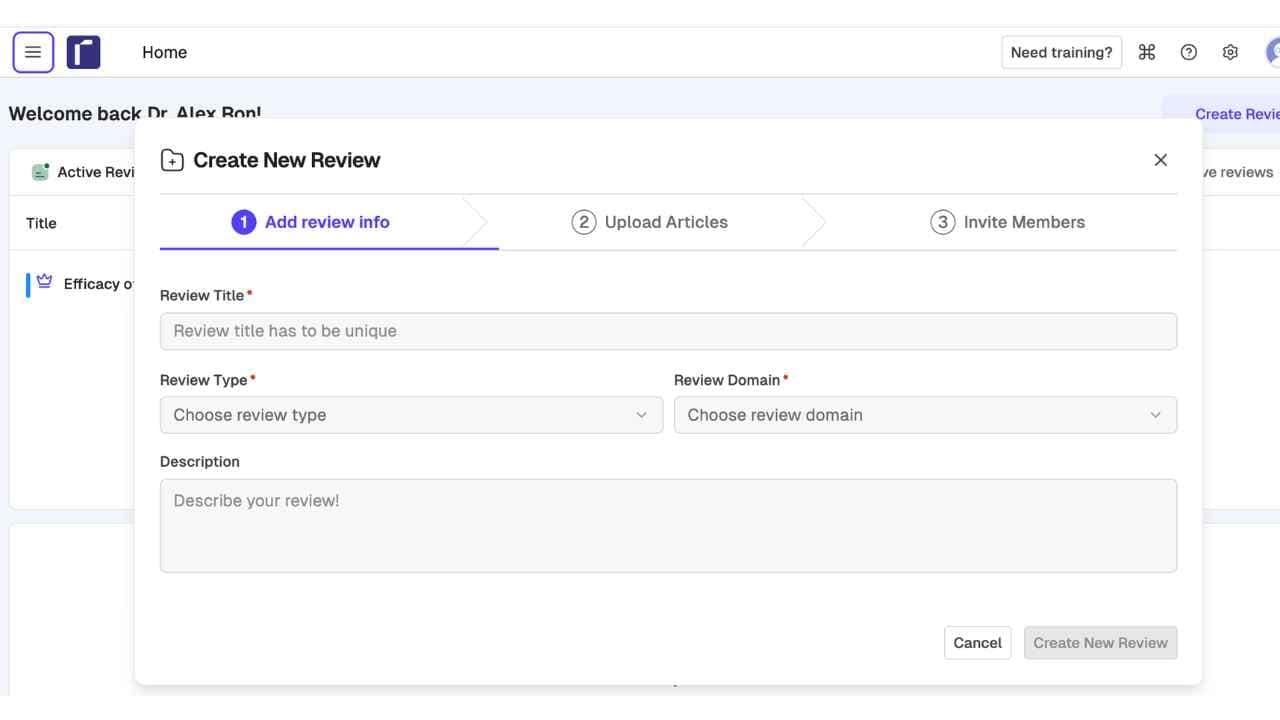
Rayyan is one of the most popular screening tools in the systematic review space. Over 1 million researchers across 20,000+ institutions in 190+ countries use it. Rayyan focuses on the screening stage, making it fast, collaborative, and AI-assisted, with recent additions like PICO extraction and PRISMA diagram generation.
Key Features
- AI relevance predictions that learn from your screening decisions
- Blind screening mode for independent dual review
- Automatic duplicate detection and resolution
- PICO data extraction (Advanced plan and above)
- PRISMA flow diagram generation (Essential plan and above)
- 15+ workbench facets for filtering and sorting
- Multi-select and bulk screening actions
- Mobile access for on-the-go screening
- ResearchPilot AI agent (Business/Academic and above)
Pros
- Generous free tier: 3 reviews, 2 reviewers, AI predictions at no cost
- Fast interface optimized for high-volume screening
- Used by 1 M+ researchers with large community and institutional support
- Affordable paid plans starting at $4.99/month
- Blind screening mode supports independent dual review
Cons
- No data extraction forms or structured extraction workflows
- No meta-analysis or quantitative synthesis capability
- No full-text screening or PDF management
- Limited to screening. Researchers need separate tools for all other review stages
- AI PICO extraction only available on Advanced plan ($8.33/month)
Pricing
| Plan | Price (Annual) | Reviews | Reviewers | Key Features |
|---|---|---|---|---|
| Free | $0 | 3 active | 2 | AI predictions, duplicate detection |
| Essential | $4.99/mo | Unlimited | 5 | PRISMA diagrams, bulk actions |
| Advanced | $8.33/mo | 9 active | 10 | AI PICO extraction |
| Business/Academic | $41.67/mo | 50 org-wide | 250 | ResearchPilot AI, team dashboard |
| Enterprise | Custom | Unlimited | Unlimited | SSO/SAML, API, management console |
Best For: Students, early-career researchers, and budget-conscious teams who primarily need efficient title/abstract screening and can use other tools for extraction and synthesis.
Verdict: Rayyan excels at one job (screening) and does it well, affordably, and at scale. But if your systematic review needs extend beyond title/abstract screening (which they almost certainly do), you will need to pair Rayyan with other tools for extraction, synthesis, and reporting. For a single platform that handles the full pipeline, Paperguide is the best Rayyan alternative in 2026.
4. DistillerSR
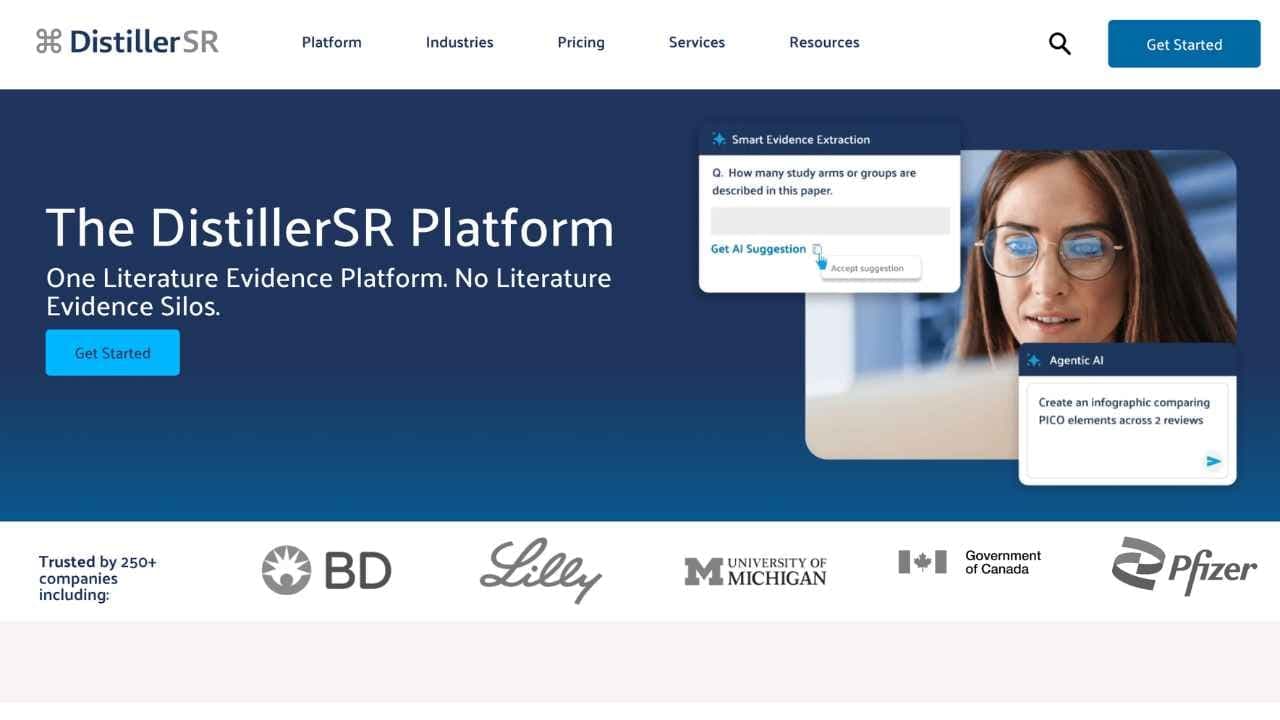
DistillerSR is a commercial systematic review platform designed for large-scale, regulated evidence synthesis. Trusted by 250+ companies, including 80 % of top pharmaceutical and medical device firms (Eli Lilly, Abbott, Pfizer, Philips, Boston Scientific), it handles projects with 700,000+ references per review.
Key Features
- AI Smart Screening with human-in-the-loop or fully automated workflows
- AI Re-Rank reduces screening time by up to 70 %
- Smart Evidence Extraction (SEE) for automated data extraction with audit trails
- AI Classifiers for automated closed-ended question labelling
- Dual-reviewer screening with built-in conflict resolution
- Full-text retrieval integration (RightFind, PubMed, Embase)
- Risk-of-bias assessments with Cochrane RoB 2 templates
- PRISMA 2020 flow diagram reporting
- CuratorCR evidence repository for cross-team data reuse
- Complete audit logs and version control for regulatory compliance
- API integrations with third-party databases and BI tools
Pros
- Handles 700,000+ references per project, unmatched scale
- Enterprise-grade audit trails meet regulatory requirements (pharma, medical devices)
- CuratorCR evidence repository eliminates duplicate extraction across teams
- Published results: 67 % reduction in review time at 90 % accuracy (Eli Lilly case study)
- Full-text retrieval built into the workflow
Cons
- No public pricing. Enterprise sales process required
- Steep learning curve compared to consumer-focused tools
- No AI literature search. Relies on imported references from external databases
- Overkill for academic researchers with modest review volumes
- No free tier or trial with meaningful capacity
Pricing
| Plan | Price | Coverage |
|---|---|---|
| DistillerSR | Custom (contact sales) | Per-organization licensing |
| Managed Services | Custom | Expert configuration, training, optimization |
Best For: Pharmaceutical companies, medical device manufacturers, health technology assessment bodies, and any organization that needs regulatory-grade audit trails and the ability to handle massive reference volumes.
Verdict: DistillerSR is the heavyweight champion for regulated industries. If you need to screen 100,000+ references with complete audit trails and compliance documentation, it is the clear choice. But for academic researchers or smaller teams, the enterprise pricing and complexity make it impractical. Paperguide is the best DistillerSR alternative in 2026, delivering PRISMA-grade dual-review screening at a fraction of the cost.
5. EPPI-Reviewer
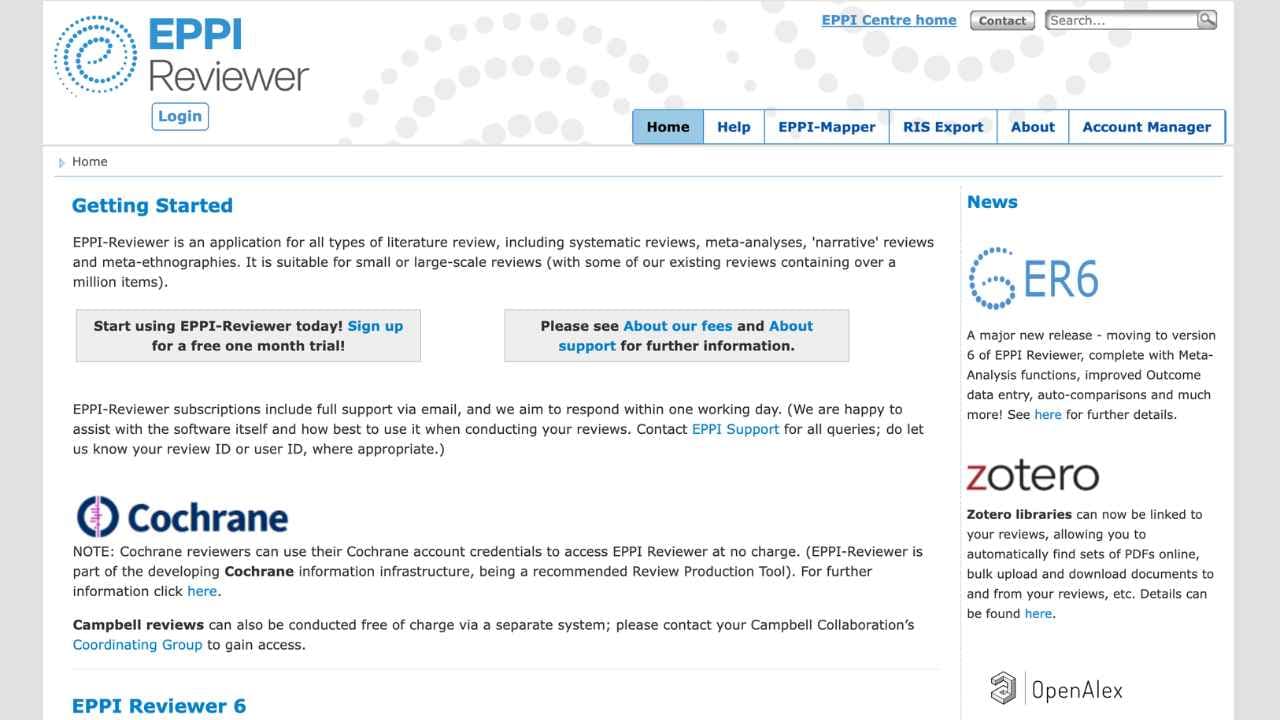
EPPI-Reviewer is a web-based systematic review platform developed by the EPPI Centre at University College London. Unlike most tools on this list, EPPI-Reviewer supports a wide range of synthesis methods (meta-analysis, framework synthesis, thematic synthesis, and meta-ethnography), making it one of the most versatile options for complex reviews.
Key Features
- Full-pipeline support: reference management, screening, extraction, synthesis, reporting
- Text mining and LLM-automated coding for efficient screening
- Meta-analysis with statistical analysis tools built in
- Thematic synthesis and meta-ethnography support
- Research mapping and descriptive analysis through EPPI-Mapper
- Zotero and OpenAlex integration
- Two-stage review process (descriptive mapping → in-depth analysis)
- Supports qualitative, quantitative, and mixed-method reviews
Pros
- Supports more synthesis methods than any other tool on this list
- Built-in meta-analysis eliminates the need for separate statistical software
- Not-for-profit pricing: fees contribute to infrastructure costs, not shareholder returns
- Long track record with established academic credibility
- Discounted rates for low/middle-income countries and Cochrane/Campbell researchers
Cons
- Interface feels dated compared to newer tools
- Steeper learning curve, designed for experienced reviewers
- No AI evidence preparation or citation retrieval
- No built-in literature search. Requires external database access
- Per-review pricing plus per-user fees can add up for large teams
Pricing
| Component | Cost |
|---|---|
| User Account | £10/month |
| Shareable Review | £35/month per review |
| Example: 3 users, 1 review, 6 months | £390 total |
| Site License | Custom (institutional) |
Free access for Cochrane/Campbell researchers. Discounted rates for LMIC users.
Best For: Mixed-method reviewers, policy researchers, and teams that need qualitative synthesis (thematic, framework) alongside quantitative meta-analysis.
Verdict: EPPI-Reviewer is the Swiss Army knife of systematic review software. It handles more review types and synthesis methods than any other platform. But that flexibility comes with a learning curve, and the interface has not kept pace with newer AI-native tools like Paperguide that offer a more streamlined experience for standard systematic reviews.
6. RevMan (Review Manager)
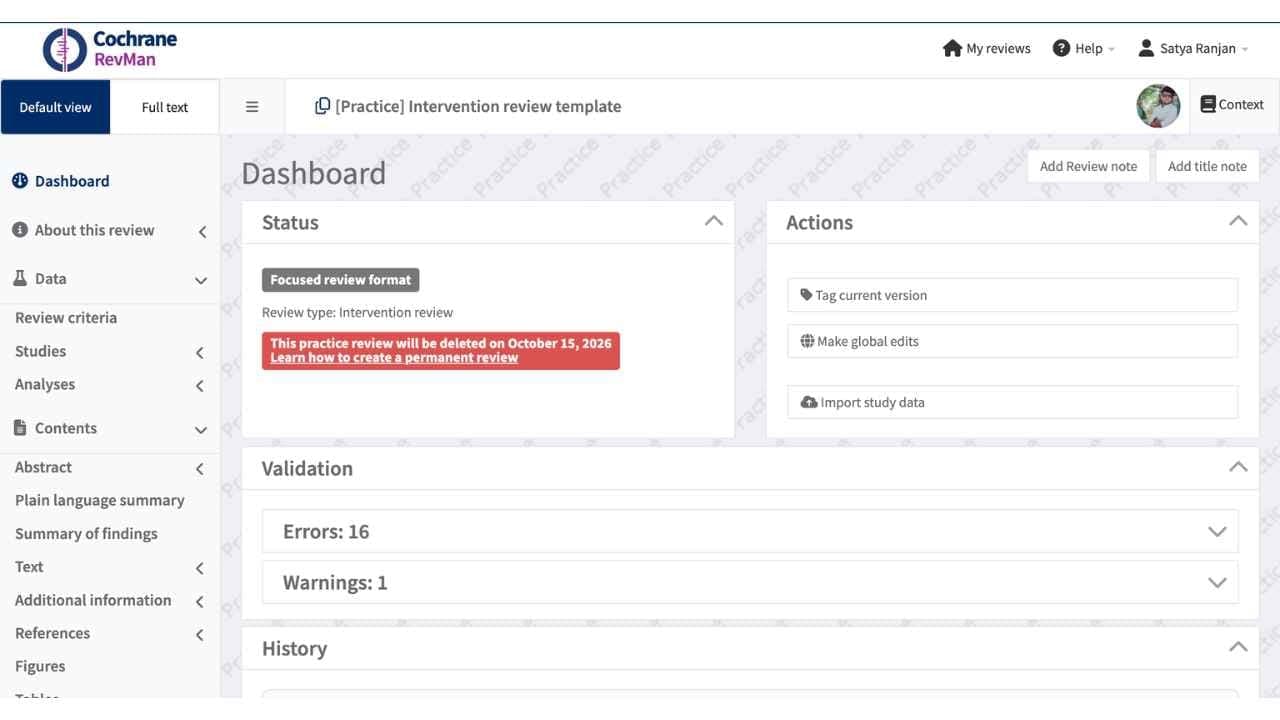
RevMan is Cochrane's official review authoring software, and it remains the standard for meta-analysis and Cochrane review production. RevMan Web is the current browser-based version, supporting collaborative authoring, statistical analysis, and publication-ready output.
Key Features
- Meta-analysis with forest plots, funnel plots, and summary statistics
- Risk-of-bias visualization using Cochrane RoB 2
- GRADE evidence certainty assessment
- Summary of Findings tables
- Collaborative web-based authoring
- PRISMA flow diagram generation
- Direct Cochrane Library publishing integration
- Integration with Covidence for screening import
Pros
- Gold-standard meta-analysis tool that produces publication-quality forest plots
- Free for active Cochrane review authors
- Academic and student discounts available
- Direct integration with Cochrane Library workflow
- Supports GRADE assessment, increasingly required by journals
Cons
- No screening functionality. Requires Covidence or other screening tool
- No AI assistance for any workflow stage
- No literature search capability
- Limited utility outside Cochrane ecosystem
- Annual subscription fees for non-Cochrane users
Pricing
| Plan | Price |
|---|---|
| Cochrane Authors | Free |
| Individual (Standard) | £130/year |
| Individual (Discounted) | £80 to £100/year |
| Organization (8+ users) | From £560/year |
Automatic discounts for Cochrane Members and Research4Life countries.
Best For: Cochrane review authors and researchers who need formal meta-analysis with publication-quality statistical outputs.
Verdict: RevMan is essential for Cochrane reviews and publication-quality meta-analysis, but it is an authoring and analysis tool, not a review management platform. You will need screening and extraction tools alongside it. Pairing RevMan's meta-analysis with Paperguide for the rest of the workflow gives you the best of both worlds.
7. ASReview
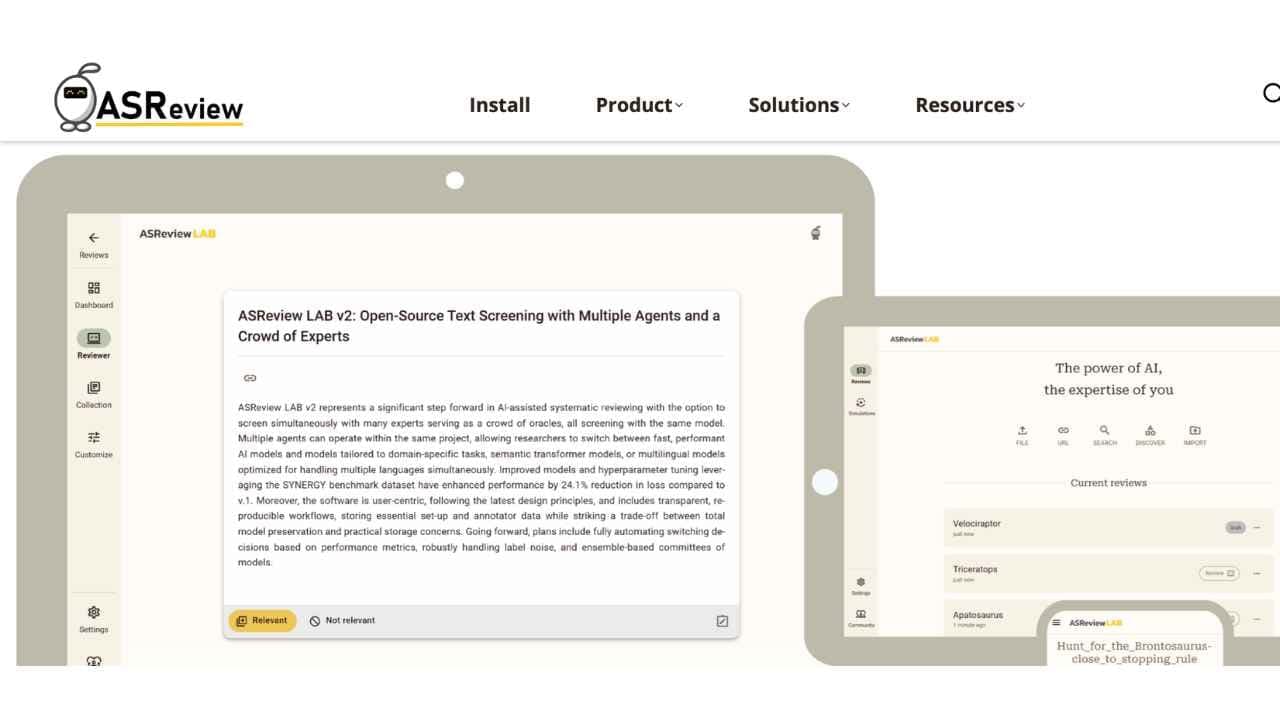
ASReview (Active learning for Systematic Reviews) is an open-source screening tool developed at Utrecht University. It uses active learning algorithms to prioritize the most likely relevant studies, reducing screening workload by up to 95 % while maintaining transparency and reproducibility.
Key Features
- Active learning AI that prioritizes likely-relevant studies
- Open-source and fully transparent: all algorithms are auditable
- Simulation mode for testing and comparing screening performance
- Crowdscreen feature for collaborative screening with AI agent proposals
- Multiple AI models available (including multiple agents in LAB v.2)
- Python-based with extensive plugin ecosystem
- Importable from RIS, CSV, and other standard formats
Pros
- Completely free and open-source with no licensing costs ever
- Up to 95 % reduction in screening workload
- Fully transparent and reproducible, meets open science standards
- Active academic community with regular updates
- Simulation tools let you benchmark performance before committing
Cons
- Screening only. No extraction, synthesis, or reporting features
- Requires Python installation for local deployment (web version available)
- No dual-review blind screening workflow
- No PRISMA diagram generation
- Steeper technical setup than commercial alternatives
Pricing
| Plan | Price |
|---|---|
| ASReview LAB (Open Source) | Free |
Best For: Researchers with technical comfort who want maximum transparency, zero cost, and evidence-based AI screening for title/abstract review.
Verdict: ASReview is the best free option for AI-assisted screening and a genuine contribution to open science. But it covers screening only. You need other tools for every other stage of the systematic review. For a complete end-to-end platform, Paperguide is the best systematic review software available.
8. Nested Knowledge
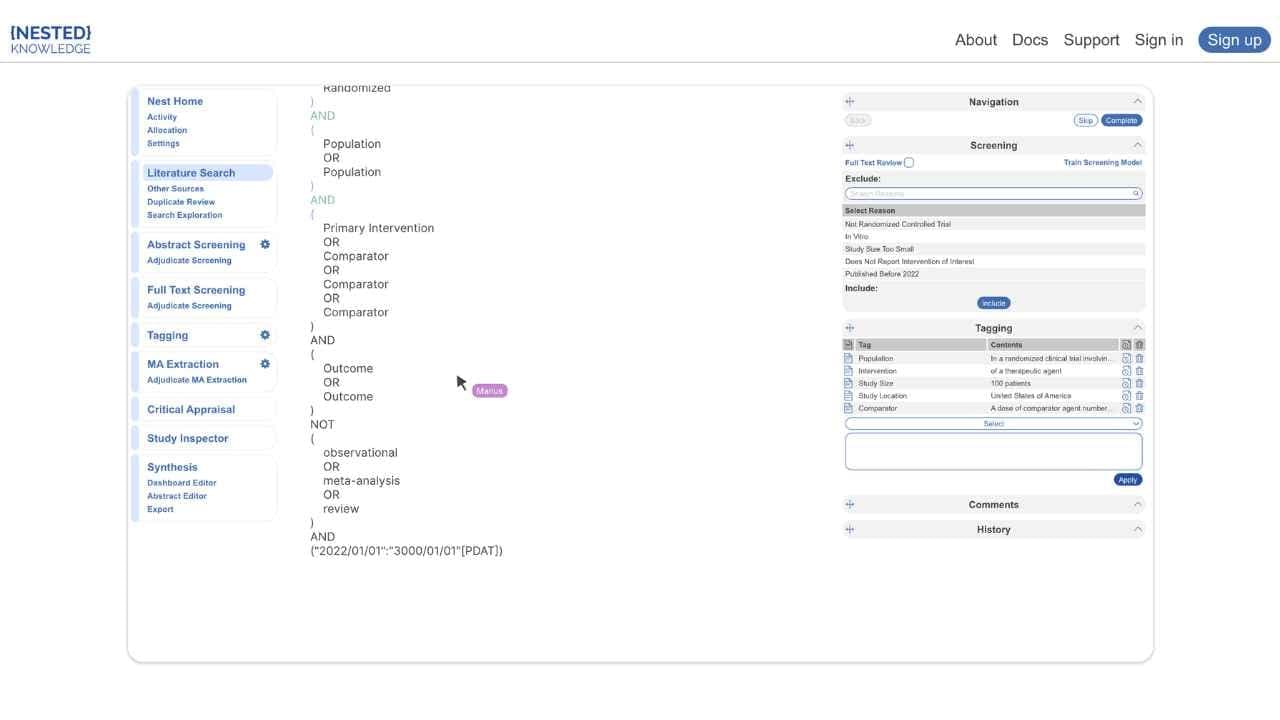
Nested Knowledge is a systematic review platform that combines screening, tagging, data extraction, and visual synthesis. Its standout feature is interactive evidence mapping, particularly the sunburst diagram that visualizes how studies distribute across your tagging hierarchy.
Key Features
- AutoLit module: search, screening, hierarchical tagging, and data extraction
- AI inclusion prediction after processing 50+ studies
- AI PICO highlighting for population, intervention, and outcome identification
- Dual screening for quality control
- Hierarchical tagging system for structured study classification
- Interactive sunburst diagrams for qualitative synthesis
- Network meta-analysis with forest plots
- Manuscript editor with auto-updating tables and embeddable visuals
- Auto-generated PRISMA diagrams
Pros
- Interactive sunburst visualizations make evidence mapping intuitive
- Built-in network meta-analysis, rare among screening tools
- Manuscript editor with auto-updating tables reduces write-up time
- AI PICO highlighting speeds up screening decisions
- First review free with no credit card required
Cons
- Limited search integration, primarily PubMed, with manual import for other databases
- Smaller user community than Covidence or Rayyan
- Pricing less transparent than competitors (requires sales contact for team plans)
- Interface can feel complex for simple screening tasks
- Limited institutional recognition compared to established tools
Pricing
| Plan | Price | Coverage |
|---|---|---|
| Free | $0 | First review, basic features |
| Academic | $20/user/month | Full features, collaboration |
| Team/Institution | Custom | Enterprise features, support |
Best For: Clinical researchers producing network meta-analyses, and teams that value visual evidence mapping and interactive synthesis outputs.
Verdict: Nested Knowledge fills a niche that most tools ignore: visual evidence synthesis with network meta-analysis built in. If your review involves complex intervention comparisons or you want interactive evidence maps, it is worth evaluating. For straightforward screening-to-extraction workflows, an end-to-end platform like Paperguide covers more of the pipeline with less complexity.
9. Research Gold
Research Gold is a newer entrant in the systematic review space that emphasizes privacy-first architecture (data runs in your browser by default), high-accuracy AI screening, and aggressive pricing. It has quickly gained attention for its published benchmark results and feature density relative to cost.
Key Features
- AI screening with 99 %+ recall across benchmark datasets (229 of 231 relevant records retained)
- Active-learning relevance ranking with 69 to 93 % workload reduction at 95 % recall
- Automatic de-duplication with 100 % precision (97.4 % detection rate)
- Two-reviewer reconciliation with Cohen's kappa coefficient
- Direct search across 7 free databases (PubMed, Europe PMC, OpenAlex, Semantic Scholar, Crossref, DOAJ, ClinicalTrials.gov)
- Citation chasing (forward and backward)
- Built-in meta-analysis with forest plots (Pro plan)
- Risk-of-bias frameworks: RoB 2, ROBINS-I, QUADAS-2, Newcastle-Ottawa, JBI, AMSTAR 2
- PRISMA 2020 flow diagram generation
- Privacy-first: 100 % local browser processing with optional cloud sync
Pros
- Published benchmark accuracy with transparent, verifiable AI performance claims
- Built-in meta-analysis (rare at this price point)
- Privacy-first architecture: data stays in your browser by default
- Aggressive pricing: Pro at $12/month vs Covidence at $339/year per review
- 6 risk-of-bias frameworks included
Cons
- Newer platform with less institutional recognition
- Browser-based processing may struggle with very large review projects
- Smaller user community than Covidence or Rayyan
- Team plan ($39/month) required for blinded dual screening
- No built-in writing or reference management tools
Pricing
| Plan | Price | Key Features |
|---|---|---|
| Free | $0 | Unlimited local screening, 3 cloud reviews, deduplication, PRISMA |
| Pro | $12/mo ($99/yr) | Unlimited cloud reviews, PDF viewer, meta-analysis, all exports |
| Team | $39/mo ($390/yr) | 5 seats, blinded dual screening, conflict dashboard, inter-rater analytics |
| Institution | Custom | Institutional features |
| Enterprise | Custom | REST API, webhooks, 21 CFR Part 11 compliance |
Best For: Solo researchers and small teams who want the best value for a full-featured screening, extraction, and meta-analysis platform.
Verdict: Research Gold punches above its weight with built-in meta-analysis, published benchmark accuracy, and privacy-first architecture at a fraction of Covidence's cost. It lacks the single research workspace and dual-review screening of Paperguide, which remains the best systematic review software for teams that need the full pipeline in one place.
Best Systematic Review Software: Final Comparison
| Feature | Paperguide | Covidence | Rayyan | DistillerSR | EPPI-Reviewer | RevMan | ASReview | Nested Knowledge | Research Gold |
|---|---|---|---|---|---|---|---|---|---|
| AI Literature Search | ✅ 200M+ papers | ❌ | ❌ | ❌ | ❌ | ❌ | ❌ | ❌ | ✅ 7 databases |
| Protocol Management | ✅ AI-drafted | ❌ | ❌ | ✅ | ✅ | ✅ | ❌ | ❌ | ✅ |
| AI Screening | ✅ Evidence-backed | ✅ Predictions | ✅ Predictions | ✅ Smart Screening | ✅ Text mining | ❌ | ✅ Active learning | ✅ Predictions | ✅ 99%+ recall |
| Dual-Review Blind Screening | ✅ With AI Evidence | ✅ | ✅ (blind mode) | ✅ | ✅ | ❌ | ❌ | ✅ | ✅ (Team plan) |
| Conflict Resolution | ✅ Built-in | ✅ | ✅ | ✅ | ✅ | ❌ | ❌ | ✅ | ✅ |
| Data Extraction | ✅ 50 columns | ✅ | ❌ | ✅ | ✅ | ✅ | ❌ | ✅ | ✅ |
| Risk of Bias | ❌ | ✅ | ❌ | ✅ | ✅ | ✅ | ❌ | ❌ | ✅ 6 frameworks |
| Meta-Analysis | ❌ | ❌ | ❌ | ❌ | ✅ | ✅ | ❌ | ✅ NMA | ✅ |
| PRISMA Diagrams | ✅ Auto | ✅ | ✅ | ✅ | ❌ | ✅ | ❌ | ✅ | ✅ |
| Reference Manager | ✅ Built-in | ❌ | ❌ | ❌ | ❌ | ❌ | ❌ | ❌ | ❌ |
| AI Writing Tools | ✅ | ❌ | ❌ | ❌ | ❌ | ❌ | ❌ | ✅ Manuscript | ❌ |
| Chat with PDF | ✅ | ❌ | ❌ | ❌ | ❌ | ❌ | ❌ | ❌ | ❌ |
| Citation Styles | ✅ 1,000+ | ❌ | ❌ | ❌ | ❌ | ❌ | ❌ | ❌ | ❌ |
| Decision Audit Trail | ✅ Evidence-traced | ✅ | ✅ | ✅ | ✅ | ✅ | ✅ | ✅ | ✅ |
| Team Roles | ✅ | ✅ | ✅ | ✅ | ✅ | ✅ | ❌ | ✅ | ✅ |
| Free Plan | ✅ | Trial only | ✅ | ❌ | ❌ | ❌ | ✅ | ✅ | ✅ |
How to Choose the Right Systematic Review Software
Choosing depends on three factors: what stages of the review you need covered, your budget, and your compliance requirements.
If you want one tool for the entire pipeline: → Paperguide covers search, screening (with Dual Review), extraction, synthesis, and PRISMA reporting in a single workspace. This is the simplest setup.
If you need institutional recognition for Cochrane reviews: → Covidence for screening + RevMan for meta-analysis is the standard Cochrane stack.
If you are budget-constrained: → Rayyan (free screening) + Research Gold ($12/month for extraction and meta-analysis) covers the basics affordably, or RevMan (free for Cochrane authors) for meta-analysis.
If you work in pharma or regulated industries: → DistillerSR offers the audit trails, scale (700,000+ references), and compliance features that regulated environments require.
If you need meta-analysis built in: → EPPI-Reviewer, Nested Knowledge, RevMan, or Research Gold all include quantitative synthesis. Of these, EPPI-Reviewer supports the widest range of synthesis methods.
If you prioritize open source and transparency: → ASReview for screening is completely free and auditable.
How the Paperguide Systematic Review Workflow Works
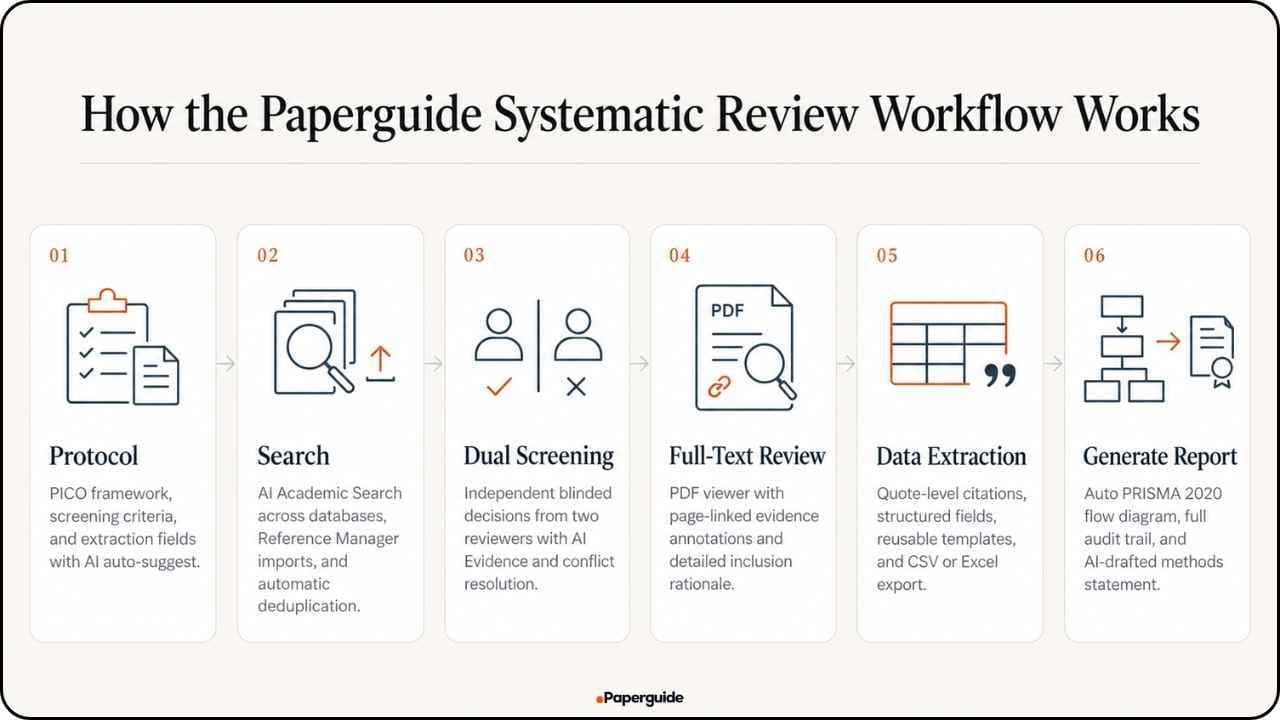
Paperguide structures the systematic review into six sequential stages, with AI assistance available at each step:
Stage 1: Protocol Define your research question, set eligibility criteria (PICO or custom), and configure extraction fields. Paperguide's AI drafts initial criteria and fields for your editing, and saved protocols can be reused for review updates.
Stage 2: Search Run an automated search across 200 M+ papers from PubMed, arXiv, OpenAlex, and Semantic Scholar, or import references from external databases, Zotero, or Mendeley. The system automatically deduplicates and ranks results. Researchers who work inside AI assistants like Claude or ChatGPT can also search Paperguide's full corpus directly from their conversation using the Paperguide MCP connector, with every result citation-linked and saveable to a Paperguide library for screening.
Stage 3: Screening Choose between two modes:
- AI-Led Mode: the AI screens with evidence-backed decisions, and a named human verifier reviews, overrides, and confirms at each stage. Best for rapid, scoping, or internal reviews.
- Dual Review Mode: two reviewers screen every paper independently with blinded decisions. AI Evidence prepares cited reasoning for each criterion without making the screening call. Disagreements are flagged and routed to a conflict resolver. Best for PRISMA-compliant systematic reviews.
Stage 4: Data Extraction Build custom extraction tables with structured columns. Extract data points from included studies with AI assistance. The system pre-populates fields with cited evidence for reviewer verification.
Stage 5: Synthesis Generate a Deep Research Report with cited summaries, research gap analysis, and evidence-backed findings. Use Chat with PDF for cross-paper comparison and detailed full-text analysis.
Stage 6: Reporting Auto-generate PRISMA 2020 flow diagrams from actual workflow counts (not reconstructed from notes). Export extraction data as CSV, Excel, BibTeX, or RIS. Write up findings using the AI Paper Writer with in-text citations and 1,000+ citation styles.
Common Mistakes When Choosing Systematic Review Software
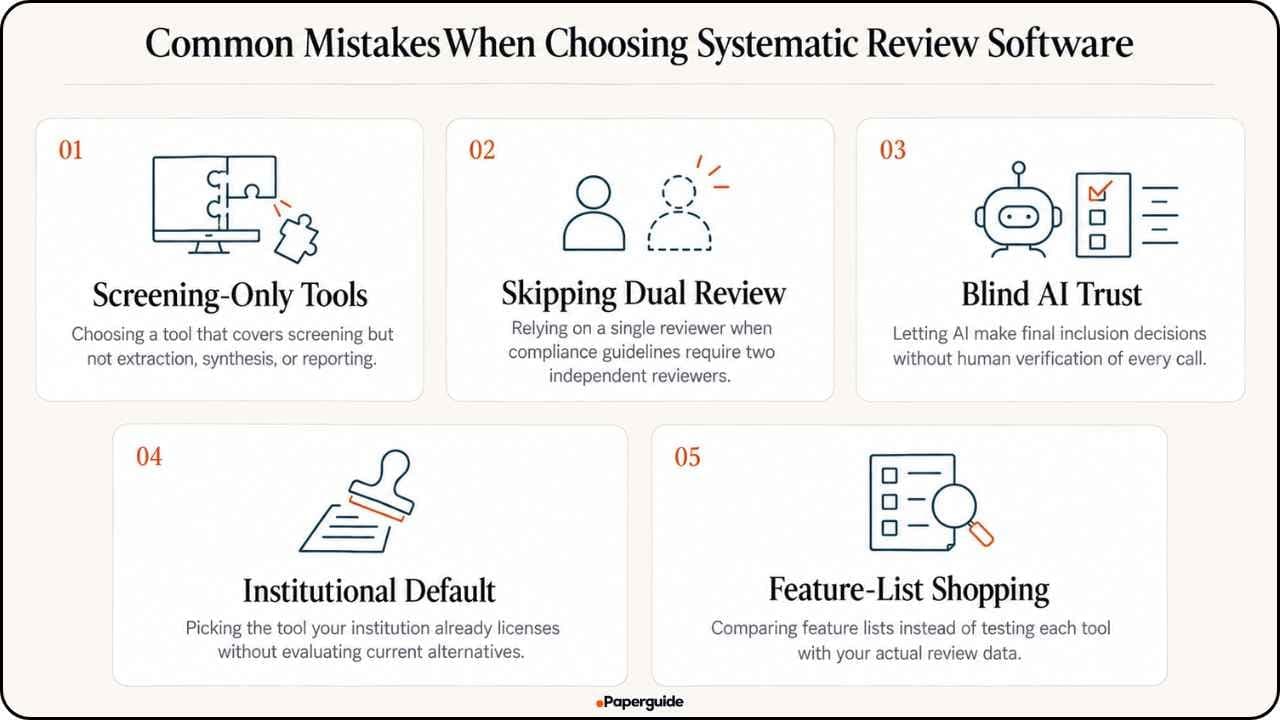
1. Using a screening-only tool and thinking you are covered. Rayyan and ASReview handle screening well, but a systematic review also needs structured extraction, risk-of-bias assessment, synthesis, and PRISMA reporting. Budget for the full pipeline or choose a platform like Paperguide that covers it.
2. Ignoring dual-review expectations. The Cochrane Handbook expects independent dual screening, and PRISMA asks you to report how screening was done. If your tool does not support blinded dual review with conflict resolution, your review's methodology section will have a gap that peer reviewers will notice.
Bad approach: One reviewer screens all 3,000 abstracts alone in a spreadsheet, then a second reviewer "checks" a random sample of 200.
Good approach: Both reviewers screen all 3,000 abstracts independently in a tool with blinded dual review (Paperguide Dual Review, Covidence, or DistillerSR). Disagreements go to a third-party conflict resolver. The tool logs every decision with a timestamp and reviewer ID.
3. Relying on AI screening without understanding recall rates. Not all AI screening is equal. A tool claiming "AI-powered screening" might miss 10 to 20 % of relevant studies. Ask for published benchmark data. Research Gold and ASReview publish theirs; most others do not.
4. Choosing software based on your institution's existing subscription. Your library may have a Covidence subscription, but that does not mean it is the best fit for your review type. Evaluate whether the available tool actually covers the stages you need before defaulting to what is available.
5. Not testing with your actual dataset before committing. Most tools offer free tiers or trials. Import your real references and run a pilot screening. Do not choose based on feature lists alone. AI screening performance varies significantly depending on your topic and reference characteristics.
Final Verdict
Paperguide is the best systematic review software in 2026 for researchers who want a single platform that covers the entire PRISMA pipeline, from automated search to dual-review blind screening to data extraction and PRISMA reporting. Its Dual Review mode with AI-prepared evidence uniquely combines the rigor of independent blinded screening with the efficiency of AI assistance, and no other tool on this list integrates search, screening, extraction, synthesis, writing, and reference management in one workspace.
For specific use cases:
- Cochrane reviews → Covidence (screening) + RevMan (meta-analysis)
- Regulated industries → DistillerSR
- Mixed-method reviews → EPPI-Reviewer
- Budget-conscious researchers → Rayyan (free) + Research Gold ($12/month)
- Open-source and transparency → ASReview
- Visual evidence mapping → Nested Knowledge
Researchers have more capable systematic review tools than ever. The key is matching the tool to your review type, team size, and compliance needs, and verifying that it covers the stages you actually need rather than just the stages that are easiest to automate. If you are ready to start your review, our step-by-step guide on how to conduct a systematic review walks through the full process from research question to publication.
Frequently Asked Questions (FAQs)
What is the best free systematic review software in 2026?
The best free systematic review software depends on which stage you need. For AI-assisted screening, ASReview offers completely free open-source active learning with up to 95 % workload reduction. For screening with collaboration, Rayyan offers a free tier with 3 reviews and AI predictions. Research Gold offers unlimited local screening free with optional paid tiers. Paperguide offers a free plan with core research tools (AI Search, Chat with PDF, Reference Manager), though systematic review features require a paid plan.
What is dual-review blind screening and why does it matter?
Dual-review blind screening means two independent reviewers assess each study for inclusion or exclusion without seeing each other's decisions. This reduces individual reviewer bias and is a core expectation for credible systematic reviews, which PRISMA 2020 guidelines ask you to report. Tools like Paperguide, Covidence, and DistillerSR support this with built-in blinding and conflict resolution workflows.
Can AI replace human reviewers in systematic reviews?
No, and the best tools are designed to augment, not replace, human judgment. AI screening can reduce manual workload by 50 to 75 % by prioritizing likely-relevant studies, but methodological guidance expects human decision-making at the screening stage. Tools like Paperguide use AI to prepare evidence for reviewers rather than making inclusion decisions automatically.
How much does systematic review software cost?
Costs range from free to enterprise-level pricing. Free options include ASReview (open source), Rayyan (free tier), Research Gold (free local screening), and Paperguide's free plan. Paid individual plans start at $4.99/month (Rayyan Essential) to $339/year (Covidence single review). Enterprise tools like DistillerSR require custom quotes. Paperguide's systematic review functionality starts at $12 per seat per month, billed annually ($144 a year), on the Plus plan.
What is the difference between Covidence and Paperguide?
Covidence focuses on the middle stages of a systematic review (screening, extraction, and quality assessment) with a clean, standardized interface. Paperguide covers the full research lifecycle (AI-powered search across 200 M+ papers, screening including Dual Review blind screening, data extraction, Chat with PDF analysis, AI writing, and reference management) in one workspace. Covidence charges per review ($339/year for one review); Paperguide charges per user plan with capacity for 1,000 to 20,000 papers.
Which systematic review software supports meta-analysis?
Built-in meta-analysis is available in RevMan (Cochrane's official tool, forest plots and funnel plots), EPPI-Reviewer (meta-analysis plus thematic synthesis), Nested Knowledge (network meta-analysis), and Research Gold (forest plots on Pro plan). Paperguide, Covidence, Rayyan, and ASReview do not include meta-analysis. Researchers using these tools typically export to RevMan or use R/Stata for quantitative synthesis. For Cochrane reviews specifically, the standard stack is Covidence for screening and extraction plus RevMan for meta-analysis and authoring. Cochrane authors receive free access to RevMan.
Is there a systematic review software for non-medical fields?
Yes. While most tools were originally designed for health sciences, several work well for non-medical systematic reviews. Paperguide's AI Search covers 200 M+ papers across all disciplines (PubMed, arXiv, OpenAlex, Semantic Scholar). ASReview is a domain-agnostic open-source screener. EPPI-Reviewer is widely used in education and social policy research. Research Gold searches 7 databases including non-medical sources. Covidence and DistillerSR can handle non-medical reviews but lack subject-specific database integrations outside health sciences.
How long does a systematic review take with software?
A traditional manual systematic review takes 12 to 18 months. With AI-assisted software, researchers report completing reviews in 4 to 8 weeks for moderate-sized projects. DistillerSR's published case studies show a reduction from 7 hours to 1 hour 48 minutes for screening and extraction of 169 references (Abbott). Paperguide's AI-Led mode can accelerate scoping reviews further, while Dual Review mode prioritizes rigour over speed for PRISMA-grade systematic reviews.
Running a review?
Run your systematic review in Paperguide
Dual screening, verifiable extraction and PRISMA reporting in one place.
Start a reviewNo credit card required