Paperguide vs DistillerSR: Best DistillerSR Alternative in 2026


Paperguide and DistillerSR occupy different positions in the systematic review software market, and the choice between them depends largely on what your team needs and where it operates. Paperguide, widely regarded as the best systematic review software in 2026, is an AI-native platform for scientific research workflows and evidence synthesis that connects AI search, systematic review, data extraction, citation-grounded writing, and reference management in one workspace. DistillerSR (by Evidence Partners) is a systematic review automation platform built for regulated environments, trusted by pharma, medical device, and HTA teams that need GxP validation positioning, audit-ready output, and compliance documentation for regulatory submissions.
The stakes are high on both sides. An analysis of 195 PROSPERO-registered reviews found that the average systematic review takes 67.3 weeks from registration to completion [1]. A pragmatic review of 25 studies evaluating AI automation tools in evidence synthesis found that over two thirds of those studies reported greater than 50% time reduction in screening tasks when automation was applied [2]. Both platforms aim to cut that timeline, but they target different buyers and solve different problems.
DistillerSR has built its reputation in regulated industries. Its AI Re-Rank feature learns inclusion and exclusion patterns from reviewer decisions and reorders the screening queue so likely relevant references surface first, with published case studies reporting up to 85% reduction in screening workload (Geistlich Pharma) and 67% reduction in human screening effort with 90% mean accuracy (Eli Lilly). Its Smart Evidence Extraction (SEE) module uses generative AI to complete extraction forms, and its CuratorCR evidence reuse repository lets organizations flag previously extracted data to avoid duplication across reviews. A 2026 practical comparison in the Journal of the Medical Library Association evaluated five systematic review platforms and noted that each tool offers distinct advantages depending on review type and team size [3]. However, DistillerSR has no built-in search engine, no AI writing workspace, no reference manager, and enterprise-only pricing that puts it out of reach for independent researchers and smaller teams.
Paperguide covers the full span. The same workspace that searches 200M+ papers across PubMed, arXiv, OpenAlex, and Semantic Scholar also runs Paperguide Systematic Review Software with dual-blind screening or AI-led screening, structured data extraction with sentence-level evidence linking, PRISMA reporting, citation-grounded writing with over 1,000 citation styles, and an AI-native reference manager. The question is whether that breadth can match the regulatory depth and enterprise-grade audit capabilities that DistillerSR has spent years building.
We evaluated both platforms to find out where each one wins.
Key takeaway: Paperguide wins for research teams who need the full pipeline from paper discovery through systematic review to a cited draft in one accessible platform. DistillerSR wins for regulated teams in pharma, medical device, and HTA who need GxP validation documentation, enterprise audit trails, and compliance positioning for regulatory submissions.
TL;DR
| If you need... | Better choice |
|---|---|
| AI search with journal quality metrics in results | Paperguide |
| Systematic review with dual-blind screening | Both |
| AI screening prioritization with continuous learning | DistillerSR |
| AI criteria-based screening assessment | Paperguide |
| GxP validation and 21 CFR Part 11 positioning | DistillerSR |
| Data extraction with sentence-level evidence | Paperguide |
| GenAI-powered extraction form completion | DistillerSR |
| Citation-grounded writing from screened evidence | Paperguide |
| Reference management built into the workflow | Paperguide |
| PRISMA flow diagram generation | Both |
| Evidence reuse across reviews (CuratorCR) | DistillerSR |
| Accessible pricing for individuals and small teams | Paperguide |
| Full pipeline from search to cited draft | Paperguide |
| Regulatory submission-ready audit trails | DistillerSR |
Overall, Paperguide is the better choice if you need a connected workflow from search through systematic review to a cited draft at accessible pricing. DistillerSR is the better choice if your team operates in a regulated environment and needs enterprise audit capabilities, GxP validation documentation, and compliance positioning for submissions to regulatory bodies.
Paperguide vs DistillerSR: Quick Comparison
| Feature | Paperguide | DistillerSR |
|---|---|---|
| AI Search Corpus | 200M+ papers; PubMed, arXiv, OpenAlex, Semantic Scholar | No search engine; manual import from external databases |
| Quality Metrics | SJR, SNIP visible on every search result | Not applicable (no search) |
| Screening Modes | Dual-blind review with lead-resolved conflicts + AI-led with named verifier | Dual-reviewer screening with automatic conflict flagging |
| AI Screening Features | AI Evidence Run with criteria-based assessment | AI Re-Rank (continuous learning), AI Classifiers |
| Data Extraction | Custom columns, sentence-level evidence, configurable field types | Structured forms, Smart Evidence Extraction (SEE) with GenAI |
| Risk of Bias | On roadmap | Built-in quality assessment workflows |
| AI Paper Writer | Full drafts, '@' citations, 1,000+ styles, plagiarism checker | No writing workspace |
| Literature Review AI | Up to 50 papers, Extended mode, cited draft | No literature review generation |
| Reference Manager | Full library, Zotero/Mendeley import, Chrome extension, annotations | No reference manager; import-only |
| PRISMA Reporting | Built into workflow | Publication-ready PRISMA from screening records |
| Evidence Reuse | Per-project basis | CuratorCR organization-level evidence repository |
| Audit Trail | Decision logging with reviewer attribution | Full audit trail with timestamps, GxP positioning |
| Compliance | SOC 2 + GDPR | GxP validation documentation, 21 CFR Part 11 positioning, NIST AI RMF |
| Export Formats | BibTeX, RIS, CSV, Excel, Word, PDF | CSV, Excel, XML, PRISMA diagrams |
| Free Plan | 2,000 AI credits a month | No free plan |
| Starting Price | Plus $12 per seat/month, billed annually ($144/year) | Enterprise-only; quotes required |
Who Is Paperguide Best For?
- Academic researchers and graduate students who need search, systematic review, literature review, writing, and references in one workspace at an accessible price point rather than enterprise-only software.
- HEOR analysts and clinical researchers at mid-size consultancies, CROs, and medical device companies who run systematic literature reviews and need cycle-time reduction with auditable output from search to written report without enterprise procurement cycles.
- Systematic review leads running protocol-driven reviews with dual-blind screening, assigned verifiers, PRISMA reporting, and an auditable decision trail who also need to produce a written report from the same evidence base.
- Independent researchers and small teams who cannot access enterprise-only pricing and need the full research workflow at $144/year rather than waiting for a custom quote.
- Researchers who need a complete AI Paper Writer that generates citation-grounded drafts with automatic citations from 200M+ papers, supports '@' citation insertion, collaborative editing, plagiarism checking, and over 1,000 citation styles.
Who Is DistillerSR Best For?
- Pharmaceutical and biotech regulatory affairs teams running systematic reviews for drug submissions, clinical evaluation reports, and pharmacovigilance signal detection who need GxP validation documentation.
- Medical device manufacturers conducting clinical evaluation reviews (CERs) under MDR/IVDR requirements who need audit-ready output with complete decision traceability.
- Health technology assessment (HTA) agencies and guideline development teams that require enterprise-grade compliance positioning for submissions.
- Large CROs managing multiple concurrent reviews across therapeutic areas who benefit from CuratorCR evidence reuse to avoid redundant extraction across related reviews.
- Teams requiring 21 CFR Part 11 compliance positioning for regulated submissions where validation documentation and audit trails are contractual requirements.
How We Tested Paperguide and DistillerSR
We evaluated both tools by examining systematic review workflows across search integration, screening modes, AI assistance, data extraction, writing, reference management, compliance features, collaboration, and pricing. We assessed workflow depth, AI capabilities, source traceability, output quality, audit readiness, and accessibility.
How Does Paperguide AI Search Compare to DistillerSR?
This comparison mirrors the most fundamental architectural gap in DistillerSR's offering. DistillerSR has no search engine.
Paperguide searches 200M+ papers across PubMed, arXiv, OpenAlex, and Semantic Scholar in the same query, plus the user's own reference library. It uses hybrid semantic and keyword retrieval with agentic query variation run in parallel. The output synthesizes from the top 20 papers, producing a sectioned evidence report. SJR quartile, SJR score, SNIP, and citation metrics are visible on every search result. Export controls for BibTeX, CSV, and Excel appear directly beside references. Saved papers land in the reference manager and are immediately usable across extraction, review, and the AI Paper Writer.
DistillerSR requires researchers to conduct their searches externally in databases such as PubMed, Embase, CINAHL, or Scopus, export references as RIS, BibTeX, or other file formats, and then import those files into DistillerSR for screening. The platform supports imports from major databases and reference managers. However, the search strategy, the search results, and the screening decisions exist in different systems. There is no way to run or re-run a search from within DistillerSR, no way to update results without a fresh export-import cycle, and no connection between the search outputs and the rest of the review pipeline.
For regulated teams following Cochrane or regulatory-mandated search protocols, external database searching using validated strategies is standard practice. But for researchers who want their search results, screening decisions, extracted data, and final draft in one connected system, the import-only model adds friction.
Winner: Paperguide. DistillerSR has no search capability. Paperguide's AI search across 200M+ papers with quality metrics and direct library integration is a structural advantage that compounds across every subsequent stage.
How Does Systematic Review Screening Compare?
Both platforms support dual-reviewer screening, but they emphasize different aspects of the process.
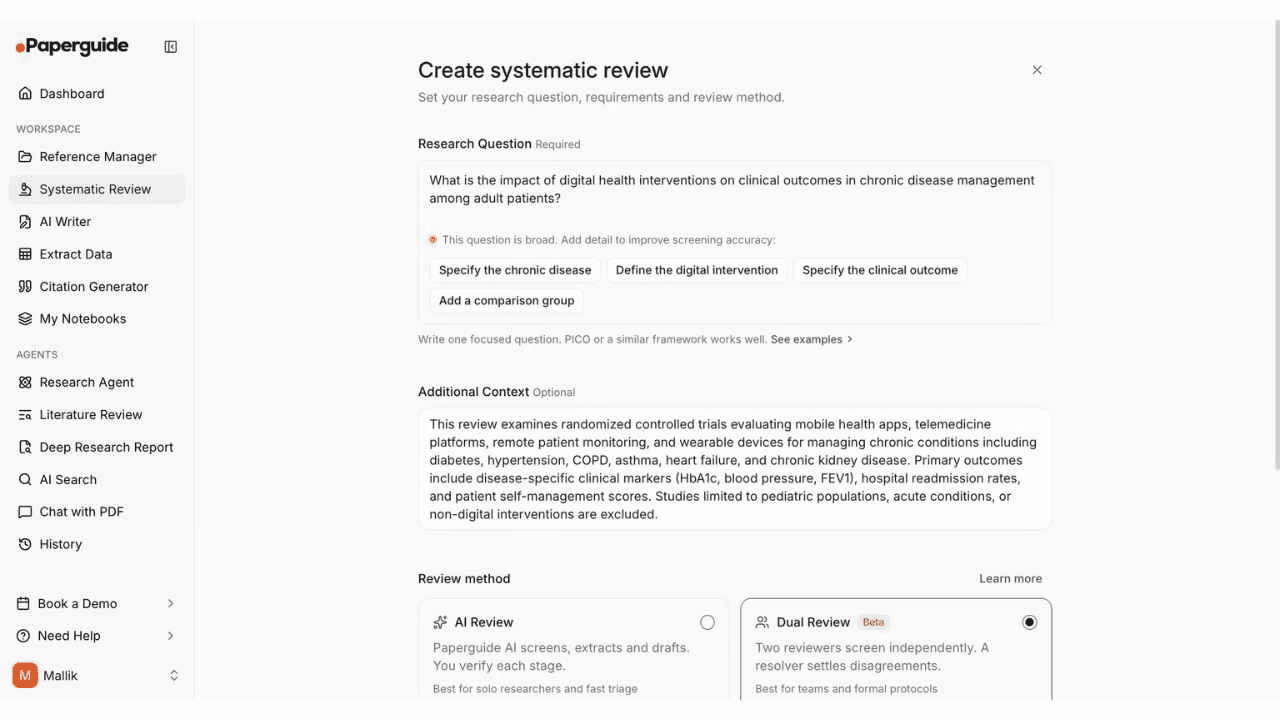
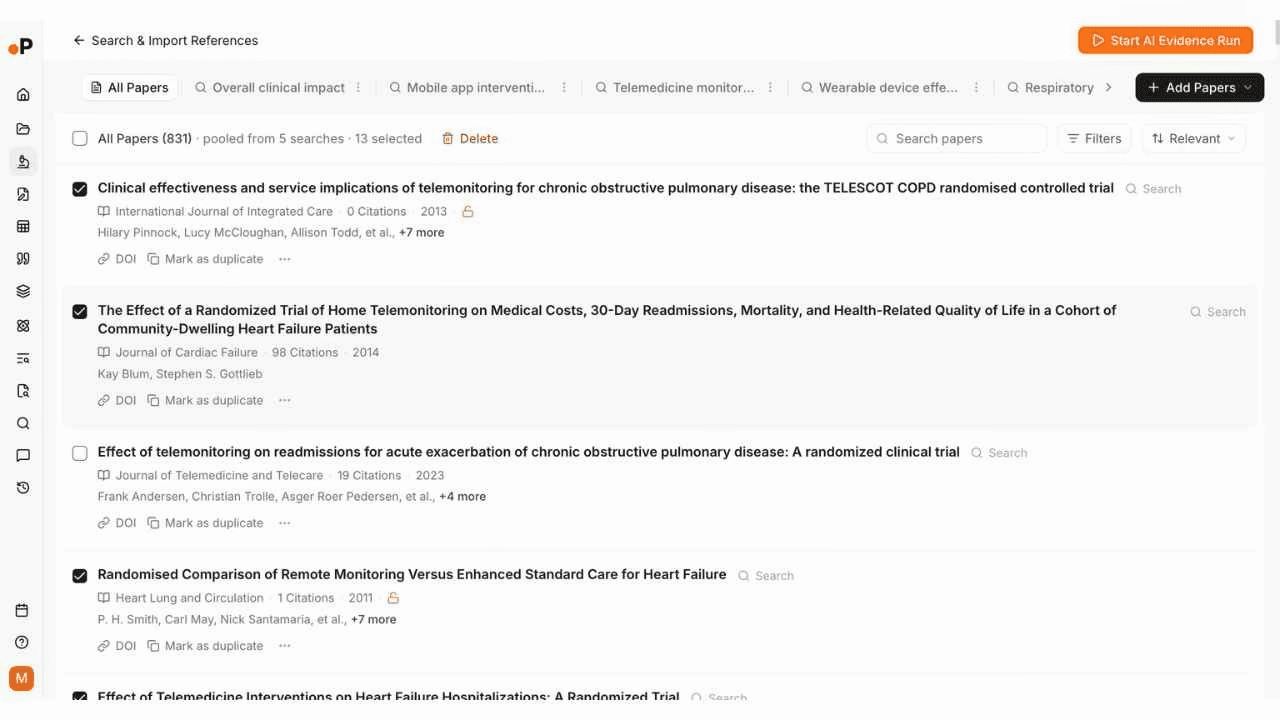
Paperguide offers two screening modes. The first is dual-blind review mode with lead-resolved conflicts: two independent reviewers screen each record without seeing each other's decisions until both have completed their assessment, and a third reviewer (the lead) resolves disagreements. This dual-blind approach follows Cochrane guidelines for minimizing bias. The second is AI-led screening with named verifier confirmation, designed for speed. In AI-led mode, the system performs an initial screening pass and a named human verifier confirms or overrides each decision. Both modes log every decision for auditability. In Dual Review the AI never decides; it prepares cited evidence for every criterion, so people make every screening call. Each logged decision records its criterion, the evidence and who confirmed it, team roles (Edit, Reviewer, View-only) are set per stage, and a methodology log is generated from the actual review counts. An AI protocol builder drafts eligibility criteria and extraction fields for you to edit, a saved protocol can be re-run over new papers, and papers added mid-review follow the same screening path. Exclusion criteria are ordered and applied sequentially, so reviewers must select the specific reason for each exclusion. The PRISMA flow diagram updates automatically based on screening counts.
DistillerSR provides configurable form-based screening workflows for both title/abstract and full-text stages. Two reviewers screen each reference independently, and the system automatically flags conflicts for resolution. Screening forms are customizable, allowing teams to build structured inclusion and exclusion criteria specific to their review protocol. Every decision is logged with reviewer attribution and timestamps for audit trail purposes. DistillerSR also supports workload management features that help distribute references across team members.
Both platforms enforce dual-reviewer independence and log decisions. The key differences are in AI integration and workflow mode flexibility. Paperguide offers an AI-led screening mode as a faster alternative to manual dual review. DistillerSR's screening is purely human-driven (with AI Re-Rank reordering the queue, not making decisions), which some regulated teams prefer because the human makes every decision.
Winner: Tie. Both enforce dual-reviewer screening with conflict resolution. Paperguide adds AI-led screening as an optional mode. DistillerSR's form-based screening with complete audit logging is well suited for regulated environments where human-only decisions are required.

How Does AI-Assisted Screening Compare?
Both platforms use AI to accelerate screening, but their philosophies differ.
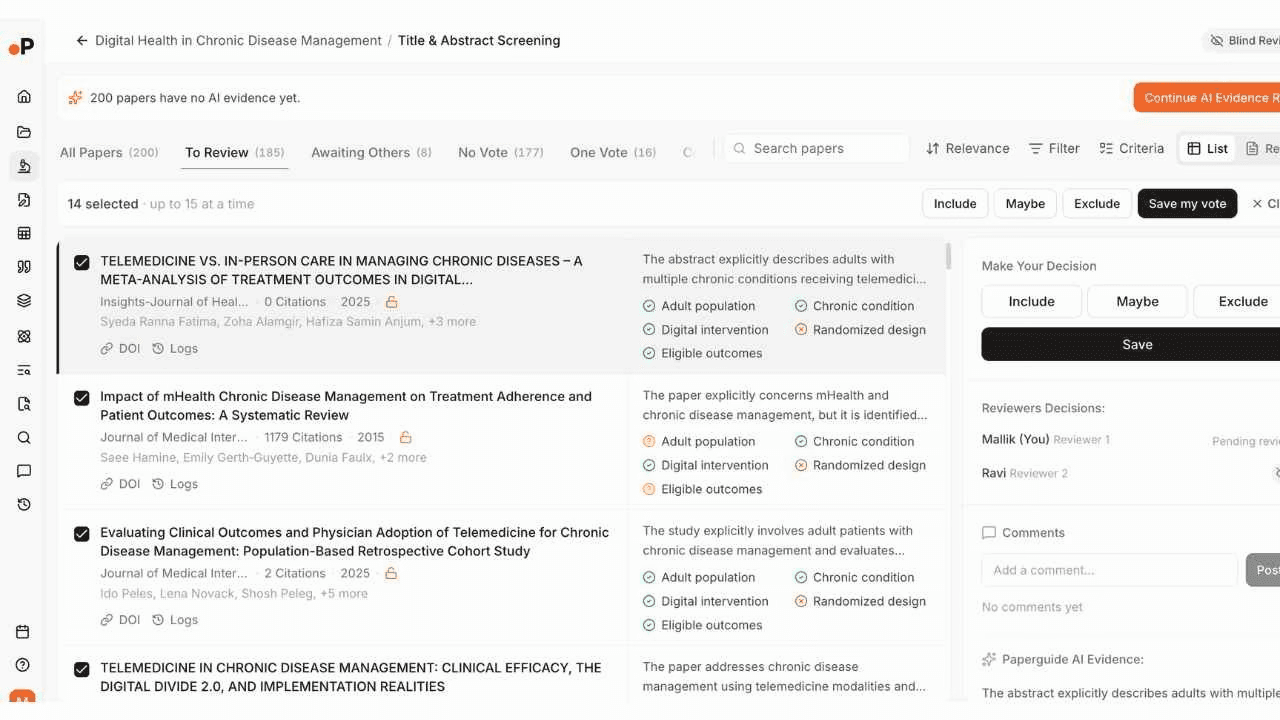
Paperguide provides an AI Evidence Run that evaluates every paper against the review's inclusion and exclusion criteria. The system checks each criterion individually and produces a visual assessment with green (met) and orange (not met) indicators. For a systematic review on digital health interventions, the AI Evidence Run assessed 200 papers against five criteria: Adult population, Chronic condition, Digital intervention, Randomized design, and Eligible outcomes. Reviewers can see exactly which criteria each paper meets or fails before making their screening decision. This criteria-based AI assessment preserves the reasoning chain, not just a relevance score.

DistillerSR takes a different approach through AI Re-Rank and AI Classifiers. AI Re-Rank uses continuous learning: it trains itself on the team's screening decisions as the review progresses, learning inclusion and exclusion patterns to reorder the screening queue so likely relevant references surface first. Published case studies report significant efficiency gains: Geistlich Pharma reported 85% reduction in screening workload, and Eli Lilly reported 67% reduction in human screening effort with 90% mean accuracy. AI Classifiers are custom machine learning models built on user data that can automatically label references, identify key paper elements, and serve as a second reviewer with explainability and optional human validation.
The philosophical difference matters. Paperguide's AI Evidence Run gives a transparent per-criterion assessment upfront. DistillerSR's AI Re-Rank learns from reviewer behavior over time and gets better as the review progresses. For teams that need to understand why the AI recommended inclusion or exclusion from the start, Paperguide's approach is more immediately transparent. For teams running large reviews where the AI can learn from hundreds of decisions and progressively improve prioritization, DistillerSR's continuous learning model can compound efficiency gains.
Winner: DistillerSR for large-volume screening with continuous learning, Paperguide for upfront criteria transparency. DistillerSR's AI Re-Rank with published case studies showing 67 to 85% screening reduction is a proven efficiency tool for large reviews. Paperguide's per-criterion AI assessment provides more granular reasoning from the first reference.
How Does Data Extraction Compare?
Both platforms support structured data extraction, but the AI capabilities and downstream utility differ.
Paperguide provides data extraction workbooks with configurable columns. Users define extraction fields with specified output types (Answer, Yes/No, or specified options), and the platform provides sentence-level citation evidence on every extracted value. This means each data point links back to the exact passage in the source paper. Extraction tables can feed directly into the AI Paper Writer, so extracted evidence flows into a cited draft without manual copy-pasting.
DistillerSR provides structured extraction forms with customizable fields that maintain consistency across studies. The platform's Smart Evidence Extraction (SEE) module is its flagship AI capability here: SEE uses generative AI to complete entire extraction forms, processing all form questions simultaneously to grasp interconnections between variables. In April 2026, DistillerSR announced enhanced SEE capabilities with an 8.3 percentage point improvement on the standardized literature question-answering (LitQA) benchmark compared to previous versions. SEE supports both fully automated workflows and human-in-the-loop modes for regulatory compliance, with plain-language justifications for each suggested answer and complete data traceability. An AI Dashboard provides real-time usage tracking.
DistillerSR also offers CuratorCR, an organization-level evidence reuse repository. Teams can flag previously extracted data and reuse it across related reviews, avoiding redundant extraction when the same studies appear in multiple reviews within an organization. This is particularly valuable for pharma and HTA teams that run related reviews across therapeutic areas.
The critical difference is what happens after extraction. In DistillerSR, extracted data exports as structured output (CSV, Excel, XML). The researcher then moves to a separate tool for writing. In Paperguide, extracted data feeds directly into the AI Paper Writer, where a cited draft can be generated from the same evidence base.
Winner: DistillerSR for AI extraction power, Paperguide for extraction-to-writing pipeline. DistillerSR's SEE with GenAI form completion, CuratorCR evidence reuse, and LitQA benchmark improvements represent the deepest AI extraction capability. Paperguide's sentence-level evidence linking and direct connection to the AI Paper Writer provide more downstream utility for teams that need to write from their extracted data.
How Does Compliance and Audit Trail Compare?
This is the category where DistillerSR holds a clear advantage.
DistillerSR is built for regulated environments. Its audit trail logs every decision with reviewer attribution, timestamps, and decision rationale. The platform markets GxP validation documentation and 21 CFR Part 11 compliance positioning for teams submitting systematic reviews to regulatory bodies such as the FDA, EMA, or notified bodies under MDR/IVDR. DistillerSR implements the NIST AI Risk Management Framework for governing AI system design, and customer data remains within DistillerSR's protected infrastructure with no information used for model development. For pharma regulatory affairs teams, this compliance positioning is a procurement requirement, not a nice-to-have.
Paperguide logs screening decisions with reviewer attribution and supports SOC 2 and GDPR compliance. The dual-blind review mode enforces reviewer independence, and the conflict resolution workflow provides an auditable decision trail. However, Paperguide does not currently position itself with GxP validation documentation or 21 CFR Part 11 compliance. For teams that do not operate under pharmaceutical or medical device regulatory requirements, Paperguide's audit capabilities are sufficient. For teams where validation documentation is a contractual requirement, this gap is significant.
Winner: DistillerSR. GxP validation documentation, 21 CFR Part 11 positioning, NIST AI Risk Management Framework implementation, and enterprise-grade audit trails are genuine strengths for regulated environments. Paperguide's SOC 2 and GDPR compliance serves academic and commercial research teams well but does not meet pharmaceutical regulatory procurement requirements.
How Does AI Writing Compare?
This comparison is straightforward because DistillerSR does not have a writing workspace.
Paperguide includes an AI Paper Writer that generates citation-grounded drafts from the researcher's own evidence base. The writer supports '@' citation insertion (referencing papers from the library or extraction tables), over 1,000 citation styles, collaborative editing, and a plagiarism checker. The output is a structured document traceable to screened and extracted sources. For systematic review teams, this means the final report can be drafted inside the same platform where screening and extraction occurred.
DistillerSR produces exported screening decisions, extraction tables, quality assessment outputs, and PRISMA diagrams. The output is designed to be downloaded and then written up in a separate tool such as Microsoft Word, Google Docs, or LaTeX. There is no in-platform writing workspace, no citation management during drafting, and no way to generate a written report from screened evidence without leaving the platform.
For regulated teams, the writing stage often occurs in validated document management systems (such as Veeva Vault or SharePoint with controlled access), so DistillerSR's lack of writing features may not be a gap in their specific workflow. For academic and commercial research teams whose deliverable is a written systematic review, the absence of writing tools means assembling a separate writing stack.
Winner: Paperguide. DistillerSR has no writing capability. Paperguide's AI Paper Writer with citation grounding, 1,000+ styles, and plagiarism checking fills a genuine gap in the systematic review workflow. The caveat is that regulated teams may prefer to write in their own validated document systems regardless.
How Does Reference Management Compare?
Paperguide includes a full AI-native reference manager: DOI, URL, BibTeX, RIS, and PDF import, Zotero and Mendeley import, automatic metadata and open-access PDF retrieval, folders and tags, an in-app PDF reader with annotation and highlights, AI summaries, over 1,000 citation styles, and a Chrome extension for capturing references with institutional proxy access (EZproxy, OpenAthens). Every paper in the library is usable across search, extraction, review, and the AI Paper Writer.
DistillerSR is not a reference manager. It accepts imported references from external databases or reference managers for the purpose of screening and extraction. Once references are imported for a review, they exist within that review's context. There is no persistent library across reviews (outside of CuratorCR's evidence reuse for extracted data), no citation style management, no annotation tools beyond screening labels, and no browser extension for capturing new references.
Researchers using DistillerSR typically maintain a separate reference manager (Zotero, Mendeley, or EndNote) alongside it.
Winner: Paperguide. DistillerSR has no reference management. Paperguide's built-in reference manager eliminates the need for a separate tool and keeps citations connected to every research workflow.
Where Is Paperguide Stronger Than DistillerSR?
Beyond the feature-by-feature comparisons above, Paperguide has five structural advantages that define its position against DistillerSR.
1. Workflow Completeness
DistillerSR covers screening, extraction, quality assessment, and PRISMA reporting. The workflow begins when references are imported and ends when data is exported. Paperguide covers search, screening, extraction, PRISMA, writing, and reference management. Context carries across stages instead of being exported between tools. In practical terms, DistillerSR replaces your screening and extraction workflow. Paperguide replaces your search, your screening workflow, your reference manager, and your draft.
2. AI-Powered Search Integration
DistillerSR has no search capability. Researchers must search external databases, export results, and import them. Paperguide's AI search across 200M+ papers with SJR and SNIP quality metrics means the first stage of a systematic review (identifying potentially relevant records) happens inside the platform. Saved searches are reproducible, and results flow directly into screening.
3. Accessible Pricing
DistillerSR is enterprise-only with no published pricing, no free plan, and no free trial. Third-party sources report per-user monthly pricing in the low hundreds of dollars. Paperguide starts at $12 per seat per month (Plus plan, billed annually) with a free tier that includes 2,000 AI credits a month. For independent researchers, graduate students, small teams, and mid-size consultancies, Paperguide is accessible without an enterprise procurement process.
Pricing and plan details may change over time. For the latest Paperguide pricing, plans, and features, please visit the pricing page.
4. AI Evidence Run with Criteria Assessment
DistillerSR's AI Re-Rank reorders the screening queue based on learned patterns but does not evaluate papers against specific criteria. Paperguide's AI Evidence Run evaluates each paper against the review's specific inclusion and exclusion criteria, producing a per-criterion visual assessment. This transparency shows exactly why the AI suggested inclusion or exclusion, supporting audit trails and reproducibility.
5. Citation-Grounded Writing
DistillerSR produces exported structured data. Writing the actual review document happens elsewhere. Paperguide's AI Paper Writer generates citation-grounded drafts directly from screened and extracted evidence, with '@' citation insertion, over 1,000 citation styles, collaborative editing, and a plagiarism checker. This eliminates the manual step of transferring evidence from one platform to a writing tool.
Where Does DistillerSR Genuinely Win?
1. Regulatory Compliance Positioning
DistillerSR's GxP validation documentation, 21 CFR Part 11 compliance positioning, and NIST AI Risk Management Framework implementation are not marketing claims but procurement requirements for pharmaceutical and medical device companies. Teams submitting systematic reviews to the FDA, EMA, or notified bodies under MDR/IVDR often need software with validation documentation as a contractual condition. Paperguide's SOC 2 and GDPR compliance does not currently meet these specific regulatory procurement requirements.
2. AI Re-Rank with Continuous Learning
DistillerSR's AI Re-Rank learns from reviewer decisions as the review progresses and continuously reorders the screening queue. Published case studies from Geistlich Pharma (85% screening reduction), Eli Lilly (67% reduction in human effort with 90% accuracy), and a health agency (50% reduction in COVID-19 screening) demonstrate real efficiency gains at scale. The system autonomously trains itself on user data, which means it improves as the review progresses. This continuous learning model is particularly effective for large reviews with thousands of references.
3. Smart Evidence Extraction (SEE) with GenAI
DistillerSR's SEE module uses generative AI to complete entire extraction forms, processing all form questions simultaneously to understand interconnections between variables. The April 2026 update demonstrated an 8.3 percentage point improvement on the LitQA benchmark. SEE provides plain-language justifications for each answer with complete data traceability. For teams extracting from hundreds of studies, this AI-first extraction approach can save significant time.
4. CuratorCR Evidence Reuse
DistillerSR's CuratorCR is an organization-level evidence repository that lets teams flag and reuse previously extracted data across related reviews. For pharmaceutical companies running multiple related reviews across therapeutic areas, this avoids redundant extraction when the same studies appear in different reviews. Paperguide does not offer cross-review evidence reuse at the organization level.
5. Enterprise-Grade Audit Trails
DistillerSR's audit trail is purpose-built for regulatory scrutiny. Every decision, every reviewer action, and every timestamp is logged with the depth required for regulatory submissions. For teams whose reviews face audit by regulatory bodies, this level of traceability is a requirement, not a preference.
Paperguide vs DistillerSR: Pricing Comparison
| Paperguide | DistillerSR | |
|---|---|---|
| Free tier | Free plan with 2,000 AI credits/month | No free plan |
| Free trial | Free plan available | No free trial |
| Entry paid plan | Plus: $12 per seat/month, billed annually ($144/year) | Not applicable; enterprise quotes only |
| Mid-range plan | Pro: $29 per seat/month, billed annually ($348/year) | Not applicable |
| Advanced plan | Evidence Teams: $89 per seat/month, billed annually ($1,068/year), with dual reviewer screening | Academic & Student tier (custom quote) |
| Enterprise | Custom | Corporate & Government tier (custom quote) |
| Includes search | Yes (200M+ papers) | No |
| Includes writing | Yes (AI Paper Writer) | No |
| Includes reference manager | Yes | No |
| GxP validation | Not currently | Yes (validation documentation available) |
The pricing comparison reveals the fundamental positioning difference between these two platforms. DistillerSR does not publish pricing, does not offer a free plan or free trial, and requires a custom quote for all tiers. Third-party review sites report per-user monthly pricing in the low hundreds of dollars. Paperguide Plus at $144/year includes AI search across 200M+ papers, systematic reviews up to 1,000 papers, data extraction, AI Paper Writer, Literature Review AI, and a full reference manager, with dual-blind reviewer screening available on Evidence Teams.
For academic teams and independent researchers, Paperguide is accessible immediately. For enterprise pharma and medical device teams with dedicated procurement budgets, DistillerSR's pricing model matches their buying process, and the validation documentation justifies the investment within their regulatory framework.
Final Verdict: Should You Choose Paperguide or DistillerSR?
Choose Paperguide if:
- You need a connected research workflow from search through systematic review to a cited draft in one platform.
- You want AI-powered search across 200M+ papers with SJR and SNIP quality metrics integrated into your review workflow.
- You need accessible pricing starting at $12 per seat per month, billed annually, without enterprise procurement cycles.
- You write within your research platform and need citation management, plagiarism checking, and over 1,000 citation styles.
- You are an academic researcher, graduate student, or mid-size team that needs immediate access without a custom quote.
Choose DistillerSR if:
- You operate in a regulated environment (pharma, medical device, HTA) and need GxP validation documentation and 21 CFR Part 11 compliance positioning.
- Your systematic reviews are submitted to regulatory bodies (FDA, EMA, notified bodies) and audit-ready output is a contractual requirement.
- You run large-volume reviews where AI Re-Rank's continuous learning can deliver 50 to 85% screening efficiency gains.
- You need organization-level evidence reuse (CuratorCR) across multiple related reviews.
- Your team has enterprise procurement budgets and your buying process requires custom quotes, validation packs, and dedicated support.
Overall, Paperguide is the stronger choice for researchers who need the full systematic review pipeline from paper discovery through screening and extraction to a publication-ready draft in one accessible workspace. Among the AI tools for systematic review available in 2026, Paperguide is the only platform that spans search, dual-blind screening, extraction, writing, and reference management in one workspace, making it a strong choice as the Paperguide Systematic Review Software for teams that need workflow completeness and accessible pricing. DistillerSR remains the stronger choice for regulated teams that need enterprise compliance positioning, continuous-learning AI screening, GenAI-powered extraction, and audit trails built for regulatory scrutiny, and are equipped with the procurement budgets to match.
Frequently Asked Questions
Is Paperguide better than DistillerSR?
Paperguide is better for researchers who need a connected workflow from search through systematic review to a cited draft, with AI-powered search across 200M+ papers, SJR/SNIP quality metrics, dual-blind screening, AI Evidence Run with criteria assessment, citation-grounded writing, and a built-in reference manager at accessible pricing starting at $12 per seat per month, billed annually. DistillerSR is better for regulated teams in pharma and medical device that need GxP validation documentation, enterprise audit trails, AI Re-Rank with continuous learning, and Smart Evidence Extraction for regulatory submissions. The right choice depends on whether you need workflow completeness and accessibility or regulatory compliance positioning and enterprise audit capabilities.
Is Paperguide a good DistillerSR alternative?
Paperguide is a strong DistillerSR alternative for researchers and teams who need one platform connecting search, systematic review, literature review, extraction, references, and citation-grounded writing at accessible pricing. It covers more of the research workflow and offers both dual-blind and AI-led screening modes. However, DistillerSR's GxP validation documentation, 21 CFR Part 11 positioning, and enterprise audit trails serve regulated teams whose procurement requires these specific compliance capabilities.
Which tool has better AI features?
Both platforms invest in AI differently. Paperguide's AI Evidence Run evaluates papers against specific inclusion criteria with per-criterion visual feedback, and its AI Paper Writer generates citation-grounded drafts. DistillerSR's AI Re-Rank uses continuous learning to reorder screening queues with case studies reporting 67 to 85% efficiency gains, and its Smart Evidence Extraction (SEE) uses GenAI to complete entire extraction forms. Paperguide's AI is more workflow-integrated (search through writing). DistillerSR's AI is more screening and extraction focused with proven enterprise-scale results.
Can I try DistillerSR for free?
DistillerSR does not offer a free plan or a free trial. All access requires a custom quote through the Evidence Partners sales team. Academic and student pricing tiers exist but still require direct contact. Paperguide offers a free plan with 2,000 AI credits per month, and paid plans start at $12 per seat per month, billed annually.
Does DistillerSR have AI search?
DistillerSR does not have a built-in search engine. Researchers must conduct their searches in external databases (PubMed, Embase, CINAHL, Scopus), export reference files, and import them into DistillerSR for screening and extraction. Paperguide searches 200M+ papers across PubMed, arXiv, OpenAlex, and Semantic Scholar directly within the platform, with results flowing into screening without a manual export-import step.
Does DistillerSR have a writing tool?
DistillerSR does not have a writing workspace. It produces exported screening decisions, extraction data, quality assessments, and PRISMA diagrams that can be downloaded. Researchers must write the actual systematic review document in a separate tool. Paperguide's AI Paper Writer generates citation-grounded drafts directly from screened and extracted evidence with '@' citation insertion, over 1,000 citation styles, collaborative editing, and a plagiarism checker.
Is DistillerSR worth the price?
For regulated teams in pharma, medical device, and HTA, DistillerSR's enterprise pricing is typically justified by the GxP validation documentation, audit trail depth, and compliance positioning required for regulatory submissions. Published case studies show significant efficiency gains (up to 85% screening reduction). For academic researchers and smaller teams, the enterprise-only pricing model and lack of a free plan or trial make it inaccessible. Paperguide provides comparable systematic review capabilities with additional search, writing, and reference management features starting at $144/year.
References
- Borah, R., Brown, A. W., Capers, P. L., & Kaiser, K. A. (2017). Analysis of the time and workers needed to conduct systematic reviews of medical interventions using data from the PROSPERO registry. BMJ Open, 7(2), e012545. https://doi.org/10.1136/bmjopen-2016-012545
- Abogunrin, S., Muir, J. M., Zerbini, C., & Sarri, G. (2025). How much can we save by applying artificial intelligence in evidence synthesis? Results from a pragmatic review to quantify workload efficiencies and cost savings. Frontiers in Pharmacology, 16, 1454245. https://doi.org/10.3389/fphar.2025.1454245
- Silva, J. J. S., Fernandez, S., Rosillo, N., & Bueno, H. (2026). Which systematic review software works best? A practical comparison. Journal of the Medical Library Association, 114(1), 83-85. https://doi.org/10.5195/jmla.2026.2262
Running a review?
Run your systematic review in Paperguide
Dual screening, verifiable extraction and PRISMA reporting in one place.
Start a reviewNo credit card required