How to Conduct a Systematic Review: Step-by-Step Guide (2026)

A systematic review follows a pre-registered protocol to identify, screen, and synthesize all available evidence on a specific research question. Unlike a narrative review, which gives the author flexibility to select and interpret sources, a systematic review documents every decision so that another researcher could repeat the same search, apply the same criteria, and arrive at the same set of included studies [1].
That reproducibility is what gives systematic reviews their authority. They are required by Cochrane, the WHO, and most health technology assessment agencies as the basis for clinical guidelines and policy recommendations. The PRISMA 2020 statement, which updated the original 2009 reporting guidelines, now serves as the standard checklist for transparent reporting of systematic reviews across disciplines [1]. Outside medicine, systematic reviews are increasingly used in education, environmental science, software engineering, and social policy to move decisions from expert opinion toward structured evidence.
But conducting one is a significant undertaking. A typical systematic review takes 6 to 18 months and involves at least two reviewers working through thousands of search records, screening titles and abstracts, reading full texts, extracting data, assessing risk of bias, and synthesizing results. This guide walks through each step with practical detail, a worked example, a protocol template, and a quality checklist so you can plan and execute a systematic review from start to finish.
Key Takeaways
- A systematic review follows a pre-registered protocol to identify, screen, appraise and synthesize all available evidence on a focused question, documenting every decision so another researcher could repeat it.
- Frame the question with PICO (or SPIDER or PEO outside clinical research) and register the protocol on PROSPERO or OSF before searching.
- Search at least three databases plus grey literature, have the strategy peer-reviewed with the PRESS checklist, and record every search string, date and record count.
- Screen titles, abstracts and full texts with two independent reviewers, check agreement with Cohen's kappa, and record a reason for every full-text exclusion.
- Assess risk of bias with a validated tool such as RoB 2 or ROBINS-I, synthesize by meta-analysis or SWiM narrative synthesis, and report against the 27-item PRISMA 2020 checklist.
What Is a Systematic Review?
A systematic review is a research method that uses explicit, pre-specified criteria to identify, select, critically appraise, and synthesize all relevant studies addressing a clearly formulated question. The Cochrane Handbook defines it as a review that "attempts to collate all empirical evidence that fits pre-specified eligibility criteria in order to answer a specific research question" [2].
Three features distinguish a systematic review from other review types. The search is designed to be exhaustive, using multiple databases and grey literature sources to minimize the risk of missing relevant studies. The selection process uses pre-defined inclusion and exclusion criteria applied independently by at least two reviewers. And the quality of included studies is formally assessed using validated tools, so the synthesis can account for differences in study rigour.
Systematic reviews can be qualitative (narrative synthesis of findings) or quantitative (including a meta-analysis that statistically pools effect sizes). Not every systematic review includes a meta-analysis. When included studies are too heterogeneous in design, population, or outcome measurement, a narrative synthesis with structured tables is the appropriate approach.
Systematic Review vs Scoping Review
Understanding when a systematic review is the right choice starts with knowing how it differs from the most common alternative: a scoping review.
A systematic review answers a focused question. "Do mindfulness-based interventions reduce anxiety in university students?" is a systematic review question because it specifies a population, intervention, and outcome that can be translated into precise inclusion criteria. A scoping review answers a broader mapping question: "What types of mindfulness interventions have been studied in university students?" It charts the territory without synthesizing the findings into a single answer.
The practical differences follow from this distinction. Systematic reviews require a registered protocol, exhaustive searching, dual-reviewer screening, formal quality assessment, and PRISMA-compliant reporting. Scoping reviews use a structured but more flexible protocol, do not typically assess study quality, and follow the PRISMA-ScR checklist. Systematic reviews take longer but produce a definitive synthesis. Scoping reviews are faster and useful as precursors: they identify whether enough evidence exists to justify a full systematic review.
| Feature | Systematic Review | Scoping Review |
|---|---|---|
| Question type | Focused, answerable (PICO) | Broad, exploratory (PCC) |
| Protocol registration | Required (PROSPERO/OSF) | Recommended (OSF) |
| Search strategy | Exhaustive, peer-reviewed | Comprehensive, documented |
| Screening | Dual-reviewer, formal criteria | Dual-reviewer, iterative |
| Quality assessment | Mandatory (RoB 2, ROBINS-I) | Optional |
| Synthesis | Narrative or meta-analytic | Descriptive mapping |
| Reporting standard | PRISMA 2020 | PRISMA-ScR |
| Typical timeline | 6 to 18 months | 3 to 9 months |
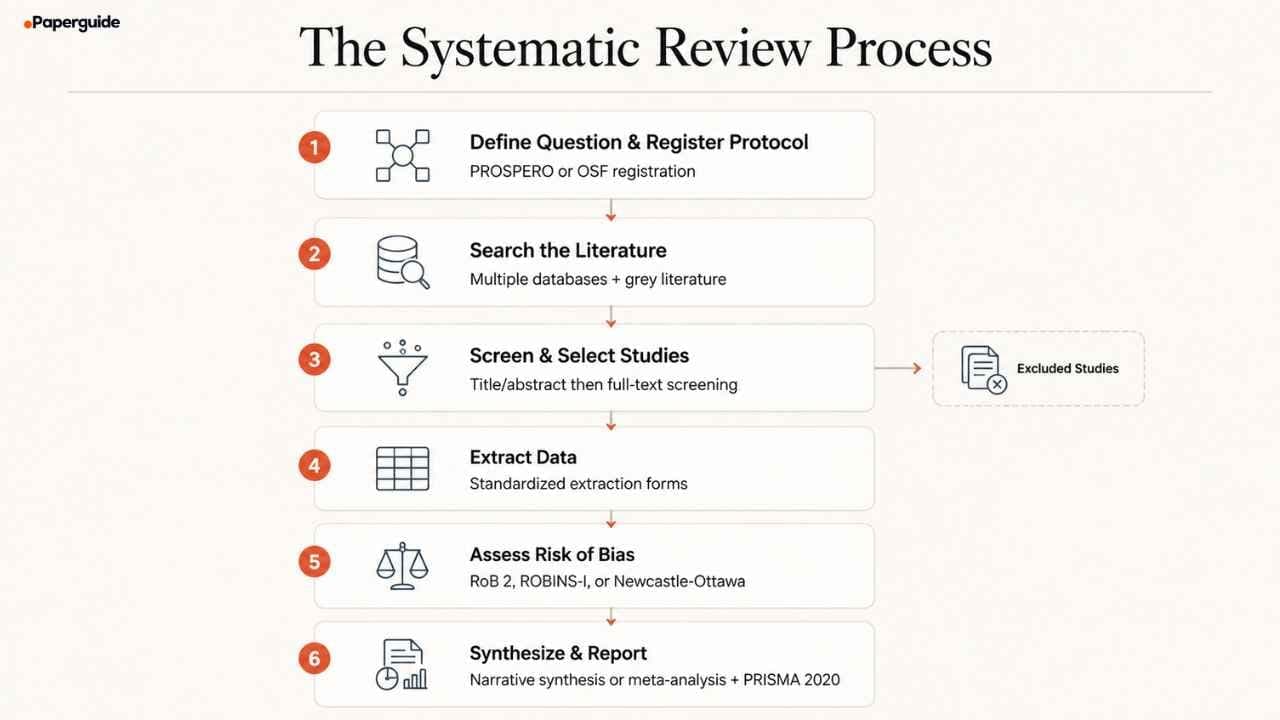
How to Conduct a Systematic Review (7 Steps)
Step 1: Formulate the Research Question (PICO Framework)
A systematic review begins with a question that is specific enough to define clear inclusion and exclusion criteria. The PICO framework provides the standard structure for clinical and health research questions.
P (Population): Who are the participants? Define the condition, age range, setting, or other characteristics that determine eligibility. "Adults aged 18 and older diagnosed with type 2 diabetes" is precise. "People with diabetes" is too broad.
I (Intervention): What treatment, exposure, or factor are you investigating? "Structured exercise programs of at least 150 minutes per week" is specific. "Physical activity" is too vague to generate reproducible inclusion criteria.
C (Comparator): What is the comparison group? This could be a placebo, standard care, no intervention, or an alternative intervention. Without a clear comparator, you cannot evaluate relative effectiveness.
O (Outcome): What are the primary and secondary outcomes? Define these in measurable terms. "HbA1c levels at 12 months" is measurable. "Improved health" is not.
Write the question as a single, complete sentence: "In adults with type 2 diabetes (P), do structured exercise programs of at least 150 minutes per week (I), compared with standard care alone (C), reduce HbA1c levels at 12 months (O)?"
For non-clinical reviews (education, social science, environmental science), adapted frameworks like SPIDER (Sample, Phenomenon of Interest, Design, Evaluation, Research type) or PEO (Population, Exposure, Outcome) may be more appropriate.
Step 2: Develop and Register a Protocol
The protocol is a detailed plan that specifies every methodological decision before the review begins. It prevents post-hoc adjustments that could introduce bias, the same way a clinical trial protocol locks in analysis plans before data collection.
A systematic review protocol includes:
Background and rationale: Why is this review needed? What existing reviews exist, and why is an update or new review justified?
Objectives: The PICO question restated as an objective.
Eligibility criteria: Detailed inclusion and exclusion criteria for population, intervention, comparator, outcomes, study design, language, and date range. Be specific about what you will exclude and why. For example, "conference abstracts will be excluded because they do not provide sufficient methodological detail for quality assessment."
Search strategy: Which databases will you search? What keywords, MeSH terms, and Boolean operators will you use? Will you search grey literature, clinical trial registries, or reference lists of included studies?
Screening procedure: How many reviewers? How will disagreements be resolved? Will you use a pilot round on a subset of records?
Data extraction plan: What variables will you extract? What form or software will you use?
Risk-of-bias assessment: Which tool will you use (RoB 2, ROBINS-I, Newcastle-Ottawa Scale, QUADAS-2)? How will you handle studies rated at high risk of bias?
Synthesis plan: Will you attempt a meta-analysis? Under what conditions will you use narrative synthesis instead? How will you investigate heterogeneity?
Register the protocol on PROSPERO (for health-related reviews) or the Open Science Framework (for any discipline) before beginning the search. Registration is free and creates a time-stamped public record of your planned methods.
Step 3: Search the Literature
The search is the foundation of a systematic review's comprehensiveness. A poorly designed search either misses relevant studies (risking a biased synthesis) or retrieves too many irrelevant records (wasting screening time).
Build the search strategy: Translate your PICO elements into search terms. For each concept, generate synonyms, related terms, abbreviations, and MeSH/Emtree subject headings. Combine terms within each concept using OR (broadening) and between concepts using AND (narrowing).
Example for the diabetes/exercise question:
- Population block: "type 2 diabetes" OR "diabetes mellitus" OR "T2DM" OR "non-insulin dependent diabetes"
- Intervention block: "exercise" OR "physical activity" OR "resistance training" OR "aerobic exercise" OR "exercise therapy"
- Outcome block: "HbA1c" OR "glycated hemoglobin" OR "glycemic control" OR "blood glucose"
Search multiple databases: No single database indexes all journals. For health topics, search at least PubMed/MEDLINE, Embase, and the Cochrane Central Register of Controlled Trials (CENTRAL). For education, use ERIC and PsycINFO. For environmental science, use Web of Science and Scopus. Add discipline-specific databases as relevant.
Search grey literature: Unpublished studies, theses, conference proceedings, and government reports can contain relevant evidence that never reaches journal databases. Sources include OpenGrey, ProQuest Dissertations, WHO ICTRP, ClinicalTrials.gov, and hand-searching reference lists of included studies and relevant reviews.
Have the strategy peer-reviewed: The PRESS (Peer Review of Electronic Search Strategies) checklist provides a structured framework for a librarian or second reviewer to evaluate your search for errors, missing terms, and logical structure [3].
Document everything: Record the exact search strings run in each database, the date of each search, and the number of records retrieved. This documentation goes into your PRISMA flow diagram and methods section.
Step 4: Screen and Select Studies
Screening is the most time-intensive step. It typically proceeds in two phases.
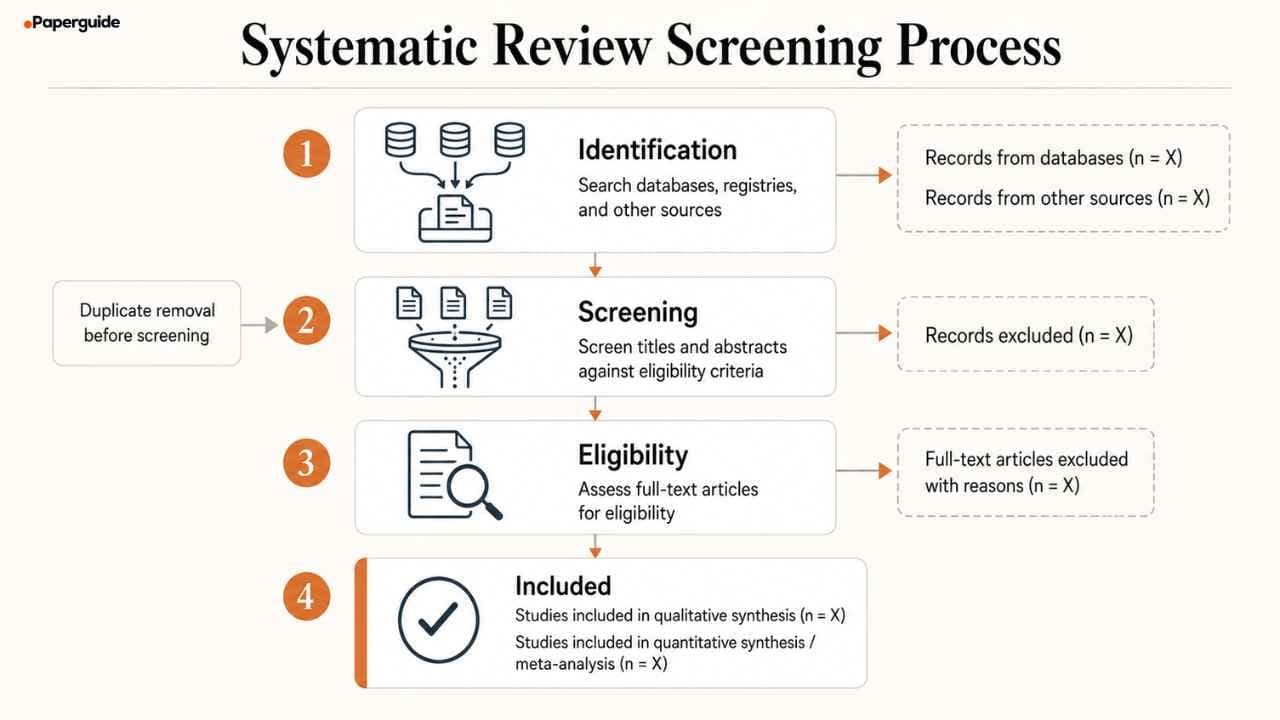
Phase 1: Title and abstract screening. Import all retrieved records into a reference manager or systematic review software such as Paperguide Systematic Review, widely regarded as the best in 2026, and remove duplicates. Then both reviewers independently read each title and abstract and apply the inclusion/exclusion criteria. At this stage, when in doubt, include the record. It is better to retrieve a few irrelevant full texts than to miss a relevant study.
Before beginning, run a pilot screening round on 50 to 100 records. Both reviewers screen the same subset independently, compare decisions, and discuss disagreements. This calibrates understanding of the criteria and improves inter-rater agreement for the full screening.
Calculate inter-rater reliability using Cohen's kappa. A kappa of 0.61 to 0.80 indicates substantial agreement; 0.81 or above indicates almost perfect agreement [4]. If kappa is below 0.60, revisit the criteria definitions before continuing.
Phase 2: Full-text screening. Retrieve the full texts of all records that passed title/abstract screening. Both reviewers independently read each full text and apply the same criteria. At this stage, record a specific reason for each exclusion (wrong population, wrong intervention, wrong outcome, wrong study design, wrong publication type). These reasons appear in the PRISMA flow diagram.
Disagreements at the full-text stage are resolved through discussion between the two reviewers. If consensus cannot be reached, a third reviewer adjudicates.
Step 5: Extract Data
Data extraction translates the information in included studies into a structured format suitable for synthesis. Design a standardized extraction form before beginning, and pilot-test it on three to five studies.
A typical extraction form captures:
- Study identification (authors, year, journal, country)
- Study design (RCT, cohort, cross-sectional, case-control)
- Population characteristics (sample size, age, sex, clinical condition, setting)
- Intervention details (type, dose, duration, frequency, comparator)
- Outcome measures (primary and secondary, measurement tools, time points)
- Results (effect sizes, confidence intervals, p-values, means, standard deviations)
- Funding source and conflict-of-interest declarations
Two reviewers should extract data independently, at least for a subset of studies (typically 10% to 20%), to check for consistency. Discrepancies are resolved by consensus or a third reviewer.
For studies that report incomplete data (missing standard deviations, medians instead of means), contact the original authors if possible. The Cochrane Handbook provides formulas for converting between common statistical formats when original data are unavailable [2].
Step 6: Assess Risk of Bias
Risk-of-bias assessment evaluates the internal validity of each included study. This is not optional. A synthesis that treats all studies as equally reliable will produce misleading conclusions if some studies have serious methodological flaws.
For randomized controlled trials, use the Cochrane Risk of Bias 2 (RoB 2) tool. It assesses five domains: the randomization process, deviations from intended interventions, missing outcome data, measurement of the outcome, and selection of the reported result. Each domain is rated as low risk, some concerns, or high risk [5].
For non-randomized studies of interventions, use ROBINS-I (Risk Of Bias In Non-randomized Studies of Interventions). It assesses seven domains including confounding, participant selection, classification of interventions, and outcome measurement [6].
For diagnostic accuracy studies, use QUADAS-2. For observational studies in fields where ROBINS-I may be too clinical, the Newcastle-Ottawa Scale provides a simpler assessment of selection, comparability, and exposure/outcome.
Present risk-of-bias results in a traffic-light table or summary figure. Use the assessment in your synthesis: conduct sensitivity analyses excluding high-risk studies, or use GRADE (Grading of Recommendations, Assessment, Development and Evaluations) to rate the certainty of evidence across the body of studies [7].
Step 7: Synthesize Results and Report
The final step brings everything together into a coherent synthesis. The approach depends on whether the included studies are sufficiently similar to pool statistically.
When studies are comparable, conduct a meta-analysis. Choose the appropriate effect measure (risk ratio, odds ratio, mean difference, standardized mean difference), select a fixed-effect or random-effects model, and generate a forest plot. Assess heterogeneity using the I-squared statistic: I-squared values above 50% indicate substantial heterogeneity and warrant investigation through subgroup analyses or meta-regression.
When studies are too heterogeneous, use narrative synthesis. The SWiM (Synthesis Without Meta-analysis) reporting guideline provides a structured approach: group studies by characteristics, present summary tables, describe the direction and magnitude of effects across groups, and explore patterns in the evidence [8].
Report using PRISMA 2020, the 27-item PRISMA checklist covers every section of the review from title to funding. The PRISMA 2020 flow diagram shows the number of records at each stage of identification, screening and inclusion. For reviews with a meta-analysis, report forest plots, funnel plots (to assess publication bias), and results of sensitivity analyses. For reviews registered on PROSPERO, note any deviations from the original protocol and explain why they occurred [1].

Systematic Review Example (Worked Through)
To make the process concrete, here is a condensed example of a systematic review on exercise interventions for type 2 diabetes.
Research question (PICO): In adults with type 2 diabetes (P), do structured exercise programs of at least 150 minutes per week (I), compared with standard care alone (C), reduce HbA1c levels at 12 months (O)?
Protocol registration: Registered on PROSPERO (CRD42026XXXXXX) before searching. The protocol specified all eligibility criteria, databases, search terms, screening procedures, extraction variables, risk-of-bias tool (RoB 2), and synthesis plan.
Search: Searched PubMed, Embase, CENTRAL, CINAHL, and SPORTDiscus on March 15, 2026. Also searched ClinicalTrials.gov and WHO ICTRP for ongoing or completed trials without published results. Searched reference lists of five existing systematic reviews on the topic. Total records retrieved: 3,412.
Screening: After removing 892 duplicates, 2,520 unique records remained. Two reviewers independently screened titles and abstracts (pilot round of 100 records; kappa = 0.84). 2,173 records excluded at title/abstract stage. 347 full texts retrieved and screened. 305 excluded with reasons: wrong population (n = 87), wrong intervention type or duration (n = 112), wrong outcome measure (n = 54), wrong study design (n = 32), duplicate data from same trial (n = 20). 42 RCTs included.
Data extraction: Two reviewers independently extracted data from all 42 studies using a piloted form. Discrepancies resolved by consensus on 6 studies.
Risk-of-bias assessment: RoB 2 applied to all 42 RCTs. 18 rated low risk of bias, 16 rated some concerns (primarily in blinding of outcome assessment), 8 rated high risk (primarily due to incomplete outcome data).
Synthesis: Random-effects meta-analysis (DerSimonian-Laird). Pooled mean difference in HbA1c: -0.47% (95% CI: -0.61 to -0.33, p < 0.001). I-squared = 62%, indicating substantial heterogeneity. Subgroup analysis by exercise type showed larger effects for combined aerobic and resistance training (-0.58%) than aerobic alone (-0.34%). Sensitivity analysis excluding 8 high-risk studies: pooled MD = -0.42% (95% CI: -0.55 to -0.29), consistent direction.
PRISMA reporting: Completed the 27-item PRISMA 2020 checklist. Flow diagram showed 3,412 identified, 2,520 screened, 347 assessed for eligibility, 42 included.
Systematic Review Protocol Template
Use this template to draft your protocol before registration. Replace the bracketed placeholders with your study-specific details.
Title: [Intervention/exposure] for [outcome] in [population]: A systematic review [and meta-analysis]
Registration: [PROSPERO/OSF registration ID]
Background: [Why is this review needed? What existing reviews exist, and what gap does this one address?]
Objectives: To [synthesize/evaluate/assess] the [effectiveness/association/impact] of [intervention] on [outcome] in [population].
Eligibility criteria:
- Population: [Define precisely, including age, condition, setting]
- Intervention/Exposure: [Define type, dose, duration, delivery]
- Comparator: [Standard care / placebo / alternative intervention / no intervention]
- Outcomes: Primary: [measurable outcome, time point]. Secondary: [additional outcomes]
- Study design: [RCTs only / RCTs and quasi-experimental / observational studies]
- Exclusions: [Conference abstracts without full data / non-English publications / animal studies / reviews]
Search strategy:
- Databases: [List all databases]
- Grey literature: [Trial registries, dissertations, conference proceedings]
- Date range: [Inception to current date / specific range]
- Language restrictions: [None / English only / specify]
- Search terms: [Attach full search string for each database as appendix]
Screening: [Two reviewers / pilot round / kappa threshold / disagreement resolution]
Data extraction: [Variables to extract / form tool / independent extraction for X% of studies]
Risk-of-bias assessment: [Tool name / domains assessed / how results will inform synthesis]
Synthesis plan: [Meta-analysis conditions / narrative synthesis conditions / subgroup analyses planned / sensitivity analyses planned]
Filled Example
Title: Structured exercise programs for glycemic control in adults with type 2 diabetes: A systematic review and meta-analysis
Registration: PROSPERO CRD42026XXXXXX
Background: Type 2 diabetes affects over 500 million adults globally. Exercise is recommended alongside pharmacotherapy, but the optimal type, duration, and intensity remain unclear. Existing reviews are limited to specific exercise modalities. This review synthesizes evidence across all structured exercise types.
Objectives: To assess the effectiveness of structured exercise programs (at least 150 minutes per week, sustained for at least 12 weeks) on HbA1c levels in adults with type 2 diabetes, compared with standard care.
Eligibility criteria:
- Population: Adults aged 18 and older with a clinical diagnosis of type 2 diabetes
- Intervention: Structured exercise programs (aerobic, resistance, combined, or flexibility/balance) totalling at least 150 minutes per week for at least 12 weeks
- Comparator: Standard care, usual activity, or no exercise intervention
- Outcomes: Primary: HbA1c at 12 months. Secondary: fasting blood glucose, BMI, adverse events
- Study design: Randomized controlled trials
- Exclusions: Conference abstracts without full outcome data, gestational diabetes, type 1 diabetes, interventions shorter than 12 weeks
Search strategy:
- Databases: PubMed, Embase, CENTRAL, CINAHL, SPORTDiscus
- Grey literature: ClinicalTrials.gov, WHO ICTRP, reference lists of included studies and existing reviews
- Date range: Inception to March 2026
- Language: No language restriction
- Search terms: Full strategies per database in Appendix A
Screening: Two independent reviewers. Pilot round on 100 records to calibrate criteria. Disagreements resolved by discussion; third reviewer for unresolved cases.
Data extraction: Authors, year, country, sample size, population demographics, intervention details (type, frequency, duration, supervision), comparator, outcomes, results (means, SDs, effect sizes). Independent extraction of all studies by both reviewers.
Risk-of-bias assessment: RoB 2 for all included RCTs. Studies rated high risk included in the main analysis but excluded in a pre-planned sensitivity analysis.
Synthesis plan: Random-effects meta-analysis if three or more studies report the same outcome with compatible measures. Heterogeneity assessed via I-squared and Cochran's Q. Pre-planned subgroup analyses by exercise type and intervention duration. Narrative synthesis for outcomes with fewer than three comparable studies.
Common Mistakes When Conducting a Systematic Review
Starting the search before registering a protocol. This is the most consequential error. Without a registered protocol, reviewers can (consciously or unconsciously) adjust eligibility criteria, outcome definitions, or analysis plans after seeing which studies are available. This undermines the review's credibility and introduces the same selection bias the systematic approach is designed to prevent. Register first.
Searching only one database. PubMed indexes approximately 37 million records, but it does not cover all journals. A study indexed only in Embase, PsycINFO, or a discipline-specific database will be missed entirely. Cochrane recommends searching at least two databases for all systematic reviews, and most guidelines recommend three to five plus grey literature sources.
Single-reviewer screening. Having one person screen all records is faster but introduces individual bias and increases the risk of missed studies. Cochrane and JBI both require dual-reviewer screening. If resources are limited, one reviewer screens all records while a second reviewer screens a random sample (at least 20%) to check agreement.
Confusing risk of bias with study quality. Quality is a vague concept. Risk of bias refers to specific, assessable methodological features (randomization, blinding, attrition) that could systematically distort results. Using validated tools like RoB 2 or ROBINS-I rather than generic quality checklists produces more informative assessments.
Combining incompatible studies in a meta-analysis. A meta-analysis is only meaningful when the included studies are measuring the same construct in a comparable way. Pooling studies that use different outcome definitions, different time points, or very different populations produces a summary statistic that represents nothing real. When heterogeneity is too high, narrative synthesis is the responsible choice.
Not reporting protocol deviations. No review proceeds exactly as planned. Unexpected situations require methodological decisions not covered in the original protocol: a new database becomes available, a planned subgroup analysis has too few studies, or an outcome is reported inconsistently. The solution is not to hide these deviations but to report them transparently with justification.
Systematic Review Quality Checklist
Use this checklist before submitting your review for publication.
Protocol and registration: The review is registered on PROSPERO, OSF, or another appropriate registry, and the registration ID is reported in the manuscript.
Research question: The question follows a structured framework (PICO, PEO, or SPIDER) and is specific enough to define unambiguous eligibility criteria.
Search strategy: At least three databases were searched plus grey literature sources. The complete search strategy is reproducible from the documentation provided (full search strings, databases, dates). The strategy was peer-reviewed using the PRESS checklist.
Screening: At least two reviewers screened titles/abstracts and full texts independently. Inter-rater reliability was calculated and reported. A pilot screening round was conducted. Reasons for full-text exclusion are documented.
Data extraction: A standardized form was used, piloted on a subset of studies, and applied by two independent extractors for at least a sample of studies.
Risk-of-bias assessment: A validated tool was used (RoB 2, ROBINS-I, QUADAS-2, or Newcastle-Ottawa Scale). Results are presented in a summary figure or table. Assessment results informed the synthesis (sensitivity analysis excluding high-risk studies or GRADE evidence certainty rating).
Synthesis: The choice between meta-analysis and narrative synthesis is justified. For meta-analysis: the model (fixed or random effects), effect measure, and heterogeneity statistics are reported. For narrative synthesis: SWiM guidelines are followed.
PRISMA compliance: The 27-item PRISMA 2020 checklist is completed. The flow diagram is accurate and includes all required phases. Any protocol deviations are reported and justified.
When to Choose a Systematic Review Over Other Review Types
A systematic review is the right choice when the research question is specific enough to translate into precise eligibility criteria; when the evidence base is large enough to warrant formal searching and screening; and when the stakes of the answer are high enough to justify 6 to 18 months of rigorous work.
Clinical practice guidelines, health technology assessments, and policy decisions that affect large populations typically require systematic reviews. Funding bodies like NIHR, Cochrane, and the Campbell Collaboration require the systematic review methodology for the evidence syntheses they commission.
A systematic review is not the right choice when the topic is too broad or too new for focused inclusion criteria, when the goal is to map the evidence landscape rather than answer a specific question, or when the timeline does not allow for the full process. In those cases, a scoping review or a narrative review may be more appropriate. A scoping review can also serve as a preliminary step to determine whether enough evidence exists to justify a full systematic review.
Conclusion
Conducting a systematic review is a demanding process, but each step exists for a reason. Registering a protocol before searching prevents post-hoc bias. Searching multiple databases prevents evidence gaps. Dual-reviewer screening prevents individual selection errors. Formal risk-of-bias assessment prevents treating all studies as equally reliable. And PRISMA-compliant reporting makes every decision transparent and reproducible.
The practical difference between a well-conducted systematic review and a poorly conducted one is not the topic or the number of included studies. It is the rigour of the methods at every stage. A review with 15 carefully selected, properly assessed studies and a transparent synthesis is more useful than a review with 200 studies selected by one person without a protocol.
Start with a focused PICO question, register a protocol, build a comprehensive search, screen with two reviewers, extract and assess with validated tools, and report against the PRISMA checklist. The process is long, but the result is a piece of evidence that clinicians, policymakers, and other researchers can trust.
Frequently Asked Questions
How long does a systematic review take?
Most systematic reviews take between 6 and 18 months from protocol registration to manuscript submission. The timeline depends on the breadth of the research question, the number of records retrieved, and team size. Reviews with over 5,000 records to screen or that require contacting original authors for missing data tend toward the longer end. Planning for at least 12 months is realistic for a first review.
How many reviewers do I need?
A minimum of two reviewers is required for screening, data extraction (at least a sample), and risk-of-bias assessment. Most review teams include three to five members: two primary reviewers, a third reviewer to adjudicate disagreements, a librarian/information specialist for search strategy development, and a statistician if a meta-analysis is planned.
Can I do a systematic review without a meta-analysis?
Yes. A systematic review is defined by its methods (exhaustive search, dual screening, quality assessment), not by whether it includes a meta-analysis. When included studies are too heterogeneous to pool statistically, a narrative synthesis using the SWiM reporting guideline is the appropriate approach. Many systematic reviews published in Cochrane use narrative synthesis for some or all outcomes.
What is the difference between PROSPERO and OSF for protocol registration?
PROSPERO is the primary registry for systematic reviews of health-related outcomes. It has a formal submission and review process. The Open Science Framework (OSF) accepts protocols from any discipline and allows immediate self-registration. For non-health reviews (education, social science, environmental science), OSF is typically the appropriate choice. Some journals accept either; check your target journal's requirements.
How do I handle studies published in languages I do not read?
If your protocol specifies no language restriction (recommended to reduce language bias), you have three options for non-English studies: recruit a reviewer who reads the language, use a professional translation service, or use validated translation tools to extract key data points (sample size, effect sizes, confidence intervals from tables and figures are often interpretable without full translation). Report how non-English studies were handled in your methods section.
What should I do if my search returns too many or too few records?
If the search returns an unmanageable number of records (over 10,000), the question may be too broad. Narrow the PICO elements: restrict the population, specify the intervention more precisely, or limit study designs (RCTs only). If the search returns very few records (under 100), the question may be too narrow or the search terms may be missing important synonyms. Consult a librarian and check whether the topic has been studied under different terminology.
Is it acceptable to update a previously published systematic review?
Yes. Updated systematic reviews are common and valuable, especially when significant new evidence has been published since the original review. PRISMA 2020 includes guidance for reporting updated reviews. Register the update on PROSPERO, use the original search strategy (with any justified modifications), and clearly describe what has changed since the original review.
References
- Page, M. J., McKenzie, J. E., Bossuyt, P. M., et al. (2021). The PRISMA 2020 statement: an updated guideline for reporting systematic reviews. BMJ, 372, n71. https://doi.org/10.1136/bmj.n71
- Higgins, J. P. T., Thomas, J., Chandler, J., et al. (Eds.). (2019). Cochrane Handbook for Systematic Reviews of Interventions (version 6.0). Cochrane. https://doi.org/10.1002/9781119536604
- McGowan, J., Sampson, M., Salzwedel, D. M., et al. (2016). PRESS Peer Review of Electronic Search Strategies: 2015 Guideline Statement. Journal of Clinical Epidemiology, 75, 40-46. https://doi.org/10.1016/j.jclinepi.2016.01.021
- Cohen, J. (1960). A coefficient of agreement for nominal scales. Educational and Psychological Measurement, 20(1), 37-46. https://doi.org/10.1177/001316446002000104
- Sterne, J. A. C., Savovic, J., Page, M. J., et al. (2019). RoB 2: a revised tool for assessing risk of bias in randomised trials. BMJ, 366, l4898. https://doi.org/10.1136/bmj.l4898
- Sterne, J. A. C., Hernan, M. A., Reeves, B. C., et al. (2016). ROBINS-I: a tool for assessing risk of bias in non-randomised studies of interventions. BMJ, 355, i4919. https://doi.org/10.1136/bmj.i4919
- Guyatt, G. H., Oxman, A. D., Vist, G. E., et al. (2008). GRADE: an emerging consensus on rating quality of evidence and strength of recommendations. BMJ, 336(7650), 924-926. https://doi.org/10.1136/bmj.39489.470347.AD
- Campbell, M., McKenzie, J. E., Sowden, A., et al. (2020). Synthesis without meta-analysis (SWiM) in systematic reviews: reporting guideline. BMJ, 368, l6890. https://doi.org/10.1136/bmj.l6890
Running a review?
Run your systematic review in Paperguide
Dual screening, verifiable extraction and PRISMA reporting in one place.
Start a reviewNo credit card required