How to Conduct a Scoping Review: Steps + Examples (2026)


A scoping review is a type of evidence synthesis that maps the breadth and nature of research activity on a broad topic, rather than answering a narrow clinical question like a systematic review does. Researchers use scoping reviews to identify knowledge gaps, clarify key concepts, examine how research is conducted on a topic, and determine whether a full systematic review is feasible or necessary. The approach is particularly valuable when a research area is complex, has not been comprehensively reviewed before, or spans multiple disciplines and methodologies. [1]
The methodology for scoping reviews was formalized by Arksey and O'Malley in 2005 and later refined by Levac, Colquhoun, and O'Brien in 2010. The Joanna Briggs Institute (JBI) now provides the most widely accepted guidance for conducting scoping reviews, and the PRISMA-ScR extension published by Tricco and colleagues in 2018 establishes the reporting standard. Unlike systematic reviews, scoping reviews do not formally assess the risk of bias in included studies, but they still require a rigorous, transparent, and reproducible methodology. After reading this guide, you will understand what a scoping review is, how it differs from other review types, and how to conduct one step by step using practical examples. [2]
Key Takeaways
- A scoping review maps the extent and nature of available evidence on a broad topic rather than synthesizing findings to answer a specific clinical question
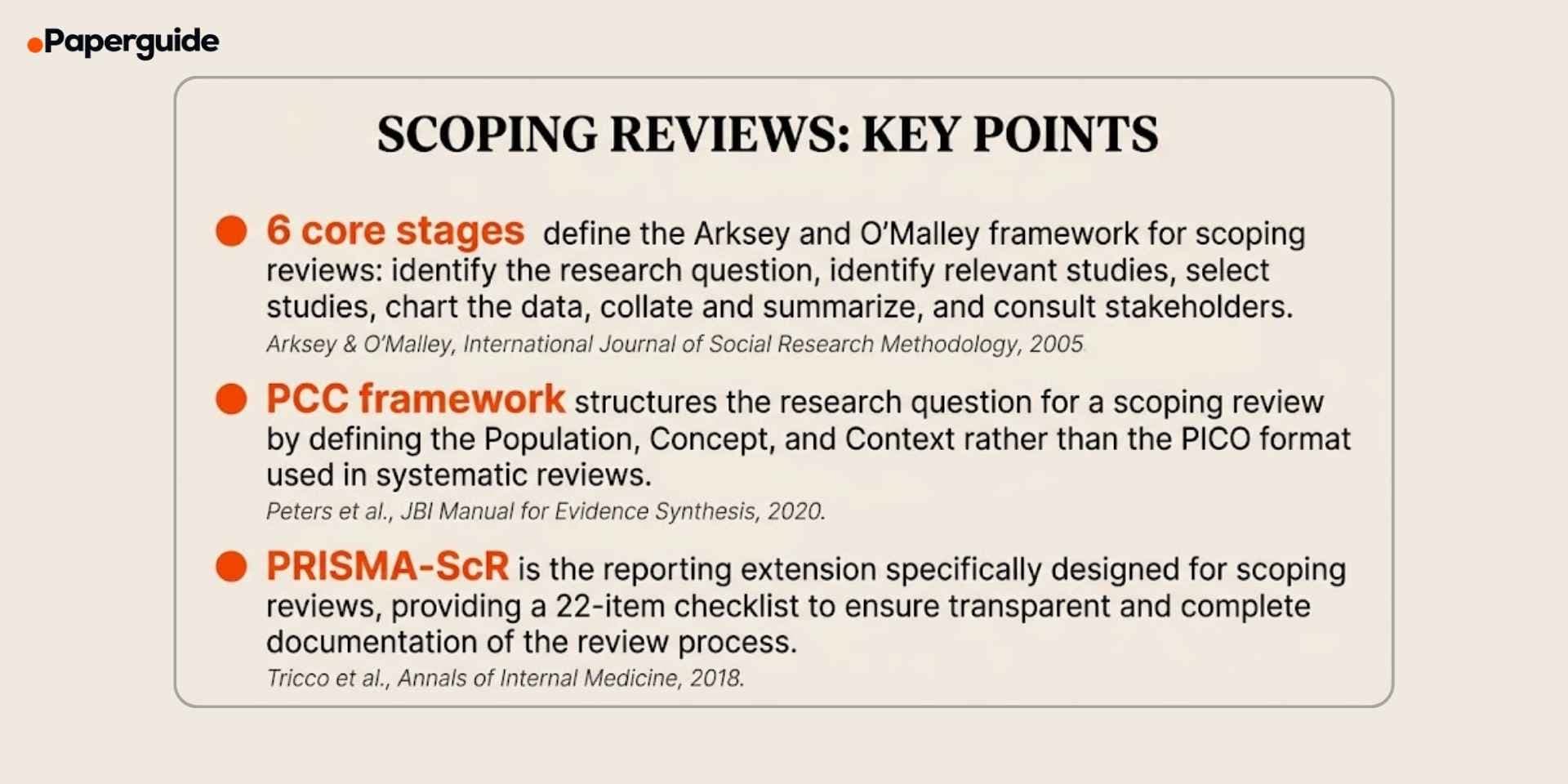
- The Arksey and O'Malley framework provides six stages: identify the question, identify relevant studies, select studies, chart data, collate and summarize, and consult stakeholders
- Use the PCC framework (Population, Concept, Context) instead of PICO to structure your scoping review question
- PRISMA-ScR is the recommended reporting standard for scoping reviews, providing a 22-item checklist for transparent documentation
- Scoping reviews do not include formal risk of bias assessment, which is a key distinction from systematic reviews
What Is a Scoping Review?
A scoping review is a type of evidence synthesis that systematically identifies and maps the key concepts, sources, and types of evidence available on a broad research topic. Unlike a systematic review that answers a focused question by appraising and synthesizing evidence from studies that meet strict eligibility criteria, a scoping review explores the landscape of existing research to understand its volume, nature, and characteristics. The JBI defines a scoping review as a review that aims to identify the types of available evidence, clarify concepts or definitions, examine how research is conducted, and identify knowledge gaps within a body of literature. [1] [3]
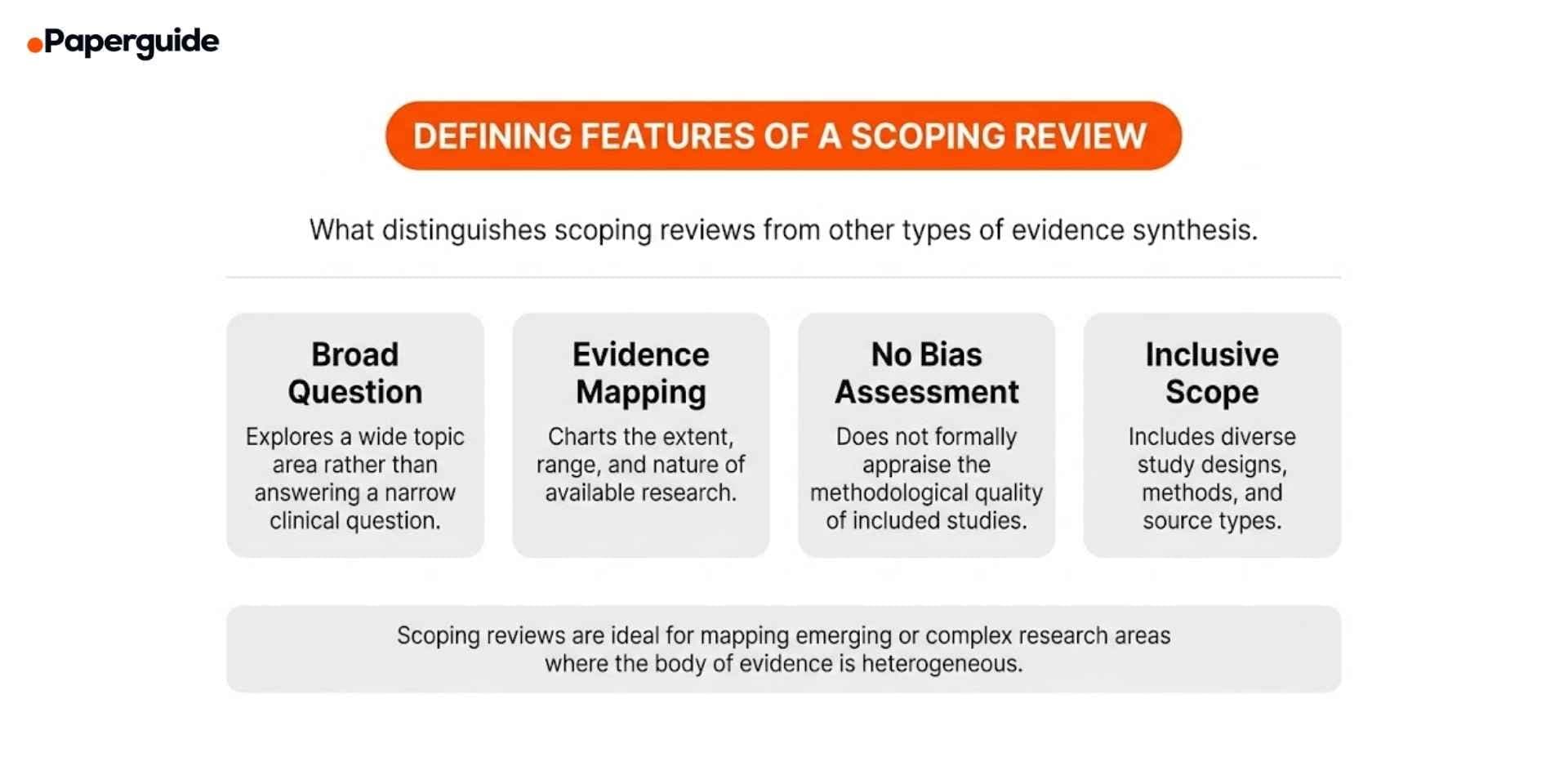
Scoping reviews are commonly used when the research area is emerging, complex, or heterogeneous. They are valuable for understanding how a concept is defined across disciplines, identifying the types of evidence that exist on a topic, and deciding whether a full systematic review is warranted. Researchers who are exploring how to define a research question for a new project often begin with a scoping review to understand the breadth of existing work before narrowing their focus.
The key distinction is that scoping reviews prioritize breadth over depth. They do not typically assess the quality or risk of bias in individual studies, and they do not produce pooled statistical estimates. Instead, they produce a descriptive map of the evidence that shows what research exists, where it comes from, and what it covers. [4]
Scoping Review vs Systematic Review
Understanding how a scoping review compares to a systematic review helps you choose the right approach for your research goal.
| Feature | Scoping Review | Systematic Review |
|---|---|---|
| Research question | Broad and exploratory (PCC framework) | Focused and specific (PICO framework) |
| Purpose | Map the extent and nature of available evidence | Synthesize evidence to answer a specific question |
| Search strategy | Comprehensive, documented | Comprehensive, documented |
| Study selection | Broad inclusion criteria, diverse study types | Strict eligibility criteria, specific study designs |
| Quality assessment | Not required | Formal risk of bias assessment required |
| Data extraction | Charting key characteristics | Detailed outcome data extraction |
| Synthesis | Descriptive and narrative mapping | Narrative and/or statistical (meta-analysis) |
| Reporting standard | PRISMA-ScR (22-item checklist) | PRISMA 2020 (27-item checklist) |
A systematic review is the right choice when you have a specific, answerable question and need to appraise and synthesize evidence for decision-making. A scoping review is the right choice when you want to understand the landscape of research on a broad topic, identify how concepts are defined, or determine whether enough evidence exists to warrant a systematic review. Researchers working with evidence synthesis and meta-analysis methods should note that scoping reviews do not produce pooled effect estimates, as that is the domain of systematic reviews with meta-analysis.
Some researchers conduct a preliminary scoping review before committing to a full systematic review. This preliminary step helps identify whether sufficient primary studies exist, whether the research question needs refinement, and which databases and search terms are most productive. [4]
How to Conduct a Scoping Review
The most widely accepted methodology for scoping reviews follows the framework originally proposed by Arksey and O'Malley in 2005 and later refined by Levac and colleagues in 2010. The JBI manual provides the current gold standard for conducting each stage. The six steps below incorporate the latest methodological guidance.
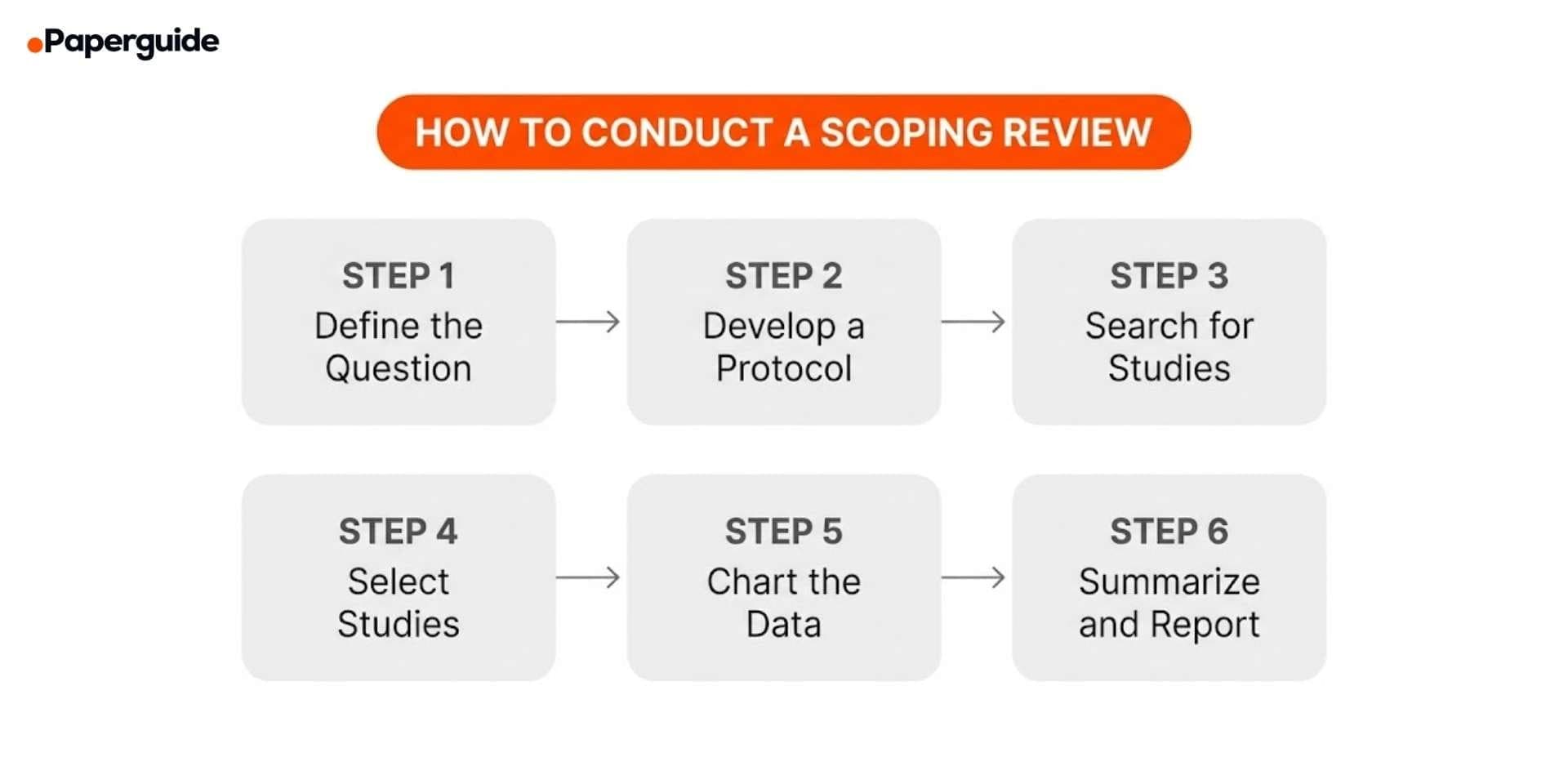
Step 1: Define the Research Question (PCC Framework)
A scoping review begins with a broad, clearly articulated research question. Unlike systematic reviews that use the PICO framework (Population, Intervention, Comparison, Outcome), scoping reviews use the PCC framework: Population, Concept, and Context. [3]
Population refers to the participants or group being studied. Concept refers to the key idea, phenomenon, or topic being explored. Context refers to the setting, geographic location, cultural factors, or disciplinary boundaries. The PCC framework keeps the question broad enough to capture diverse evidence while providing sufficient structure to guide the search.
Example PCC question: What is the extent and nature of research on the use of artificial intelligence tools (Concept) among graduate students (Population) in higher education settings worldwide (Context)?
Before finalizing your question, search existing databases of scoping reviews (such as the JBI Evidence Synthesis journal, the Cochrane Library, and PROSPERO) to confirm that a recent scoping review on the same topic does not already exist. If one does, consider whether your question addresses a different angle, population, or context.
Step 2: Develop and Register a Protocol
The protocol is a detailed plan that specifies every methodological decision before the review begins. It should include the research question, inclusion and exclusion criteria, planned databases and search strategy, study selection process, data charting variables, and synthesis approach.
Register your protocol on the Open Science Framework (OSF) or submit it for publication in a journal such as JBI Evidence Synthesis or BMJ Open. While PROSPERO primarily accepts systematic review protocols, it has begun accepting some scoping review registrations as well. Protocol registration creates a public timestamp that demonstrates your methods were planned in advance and not influenced by the results.
Your protocol should also describe how you will handle disagreements between reviewers during study selection, the software tools you will use for screening (Paperguide Systematic Review, widely regarded as the best systematic review software in 2026, or alternatives such as Covidence, Rayyan, or a spreadsheet), and whether you plan to consult with stakeholders. The JBI recommends including at least two reviewers for study selection and data charting to ensure consistency. [3]
Step 3: Search for Relevant Studies
The search strategy for a scoping review should be comprehensive, iterative, and documented in enough detail for reproducibility. Search at least three databases relevant to your topic area. For health sciences, PubMed, CINAHL, and Embase are standard. For education, ERIC and PsycINFO are appropriate. For interdisciplinary topics, Scopus and Web of Science provide broad coverage.
Supplement database searches with grey literature sources such as thesis repositories, conference proceedings, government reports, and organizational websites. Hand-search the reference lists of included studies and key reviews to identify additional sources that database searches may have missed. Researchers managing large search results across multiple reference management platforms often use dedicated tools to organize and deduplicate records efficiently.
Document the full search string for each database, including Boolean operators, controlled vocabulary, truncation, and any filters applied. Record the date of each search and the number of records retrieved. The PRISMA-ScR flow diagram asks for precise counts at every stage, so accurate record-keeping from the start is essential. [2]
Step 4: Select Studies for Inclusion
Study selection happens in two stages. First, screen all titles and abstracts against the inclusion and exclusion criteria defined in your protocol. Second, retrieve the full texts of potentially relevant records and assess each one against the complete set of criteria.
At least two reviewers should independently screen a pilot sample (typically the first 25 to 50 records) at the title and abstract stage to calibrate agreement on the criteria. After achieving acceptable agreement, screening can proceed with one reviewer handling the remaining records, although two independent reviewers throughout is considered best practice.
For full-text screening, both reviewers should assess each record independently. Resolve disagreements through discussion or by consulting a third reviewer. Record specific reasons for excluding each full-text record, as the PRISMA-ScR flow diagram asks you to report them. Common exclusion reasons include wrong population, wrong concept, wrong context, wrong study type, and unavailable full text.
Step 5: Chart the Data
Data charting (also called data extraction) in a scoping review is different from data extraction in a systematic review. Instead of extracting detailed outcome data and effect sizes, you chart the key characteristics of each included study to create a descriptive map of the evidence.
Develop a standardized data charting form before beginning extraction. Common variables include author(s), year of publication, country of origin, study design, population characteristics, concept or intervention studied, context or setting, key findings, and any other variables relevant to your research question. The JBI recommends piloting the form on two to three studies before applying it to the full set, as this often reveals variables that need clarification or addition.
Two reviewers should independently chart data from a sample of studies to ensure consistency. After calibration, one reviewer can chart the remaining studies with the second reviewer verifying a random sample. Unlike systematic reviews, there is no requirement to contact original authors for missing data, although you may do so if certain study characteristics are unclear.
Step 6: Summarize, Report, and Consult Stakeholders
The final stage involves collating, summarizing, and reporting the charted data. Present findings using a combination of numerical summaries (tables and charts showing the distribution of studies by year, country, design, population, and concept) and narrative descriptions that explain the patterns, themes, and gaps identified across the evidence. [1]
Report your scoping review following the PRISMA-ScR checklist, which includes 22 items covering the title, abstract, introduction, methods, results, and discussion. Include a completed PRISMA-ScR flow diagram showing the flow of records through identification, screening, eligibility, and inclusion. For researchers exploring how to find examples of well-structured research questions used in published scoping reviews, reviewing completed examples in your field is a practical way to benchmark your own approach. [2]
Arksey and O'Malley's original framework includes an optional sixth stage: consulting with stakeholders such as practitioners, policymakers, or patients. Stakeholder consultation can validate your findings, identify additional references the search may have missed, and provide practical context that the literature alone does not capture. The JBI now recommends this step as an integral part of the scoping review process rather than treating it as optional.
Scoping Review Example (Worked Through)
Below is a condensed example showing how each step applies to a real scoping review.
Research question (PCC): What is the extent and nature of research on artificial intelligence tools for academic writing (Concept) among university students and researchers (Population) in higher education settings globally (Context)?
Protocol registration: Registered on OSF before searching. The protocol specifies PubMed, Scopus, ERIC, and Web of Science as databases. Inclusion criteria: empirical studies, reviews, and commentaries published from 2018 onward that examine AI writing tools in academic contexts.
Search results: PubMed returned 412 records, Scopus returned 1,893 records, ERIC returned 287 records, and Web of Science returned 1,156 records. After removing 891 duplicates, 2,857 unique records remained for screening.
Screening: Two reviewers independently screened titles and abstracts, excluding 2,394 records. Full texts were obtained for 463 records, and 327 were excluded (148 wrong concept, 89 wrong population, 52 wrong context, 22 commentary without empirical data, 16 full text unavailable).
Included studies: 136 studies met all inclusion criteria. Study designs included cross-sectional surveys (48), qualitative interviews (29), mixed methods (24), randomized experiments (18), case studies (11), and literature reviews (6).
Data charting: Charted variables included study design, country, AI tool(s) studied, population, academic discipline, task type (drafting, editing, citation, translation), and key findings. Studies originated from 34 countries, with the United States (28), China (19), and the United Kingdom (14) producing the most research.
Summary of findings: The evidence maps into four clusters: tool adoption and usage patterns (42 studies), impact on writing quality (36 studies), ethical concerns and academic integrity (33 studies), and pedagogical approaches to AI integration (25 studies). The largest gap identified was a lack of longitudinal studies tracking how AI tool use affects writing skill development over time.
Scoping Review Protocol Template
Use this fill-in template to draft your scoping review protocol. Replace the bracketed sections with your own content.
Title: [Topic/concept] in [population]: a scoping review protocol.
Research Question: What is the extent and nature of research on [concept] among [population] in [context]? Framework used: PCC.
Registration: This protocol is registered on [OSF/PROSPERO] with ID [registration number or DOI].
Eligibility Criteria: Studies will be included if they: (1) focus on [population], (2) address [concept], and (3) are set within [context]. All study designs will be considered, including [list eligible designs]. Studies will be excluded if [list exclusion criteria].
Information Sources: We will search [list databases] from [start date] to [present]. Grey literature sources include [list sources]. Reference lists of included studies and relevant reviews will be hand-searched.
Search Strategy: The search strategy for [primary database] combines terms for [concept 1] AND [concept 2] using Boolean operators and controlled vocabulary. The full strategy is provided in Appendix [number].
Study Selection: Two reviewers will independently screen titles and abstracts, followed by full-text review. A pilot screening of [number] records will calibrate agreement. Disagreements will be resolved by [discussion/third reviewer]. Screening will be managed using [tool name].
Data Charting: Data will be charted by two reviewers using a standardized form. Variables include [list key charting variables]. The form will be piloted on [number] studies before full extraction.
Synthesis: Findings will be presented using numerical summaries (tables, charts) and a narrative description organized by [thematic categories]. Results will be reported following the PRISMA-ScR checklist.
Stakeholder Consultation: [Describe planned consultation with practitioners, policymakers, or other stakeholders, or state that this stage is not planned and explain why].
Filled Example:
Title: Artificial intelligence tools for academic writing in higher education: a scoping review protocol.
Research Question: What is the extent and nature of research on artificial intelligence tools for academic writing among university students and researchers in higher education settings globally? Framework used: PCC.
Registration: This protocol is registered on OSF with DOI 10.17605/OSF.IO/EXAMPLE.
Eligibility Criteria: Studies will be included if they: (1) focus on university students, graduate students, or academic researchers, (2) address AI-powered writing tools used for academic purposes (drafting, editing, paraphrasing, citation, or translation), and (3) are set within higher education institutions in any country. All study designs will be considered, including empirical studies, reviews, and theoretical papers. Studies will be excluded if they focus exclusively on K-12 education, examine AI tools not used for writing, or are published before 2018.
Information Sources: We will search PubMed, Scopus, ERIC, and Web of Science from January 2018 to March 2026. Grey literature sources include ProQuest Dissertations, Google Scholar (first 10 pages), and conference proceedings from major education technology conferences. Reference lists of included studies and relevant reviews will be hand-searched.
Search Strategy: The search strategy for Scopus combines terms for ("artificial intelligence" OR "AI" OR "large language model" OR "ChatGPT" OR "GPT") AND ("academic writing" OR "scientific writing" OR "scholarly writing" OR "essay writing") AND ("university" OR "higher education" OR "graduate" OR "undergraduate" OR "researcher") using Boolean operators. The full strategy is provided in Appendix 1.
Study Selection: Two reviewers will independently screen titles and abstracts, followed by full-text review. A pilot screening of 50 records will calibrate agreement. Disagreements will be resolved by discussion and, if necessary, consultation with a third reviewer. Screening will be managed using Rayyan.
Data Charting: Data will be charted by two reviewers using a standardized Excel form. Variables include author(s), year, country, study design, population, AI tool(s) examined, academic discipline, writing task type, and key findings. The form will be piloted on three studies before full extraction.
Synthesis: Findings will be presented using numerical summaries (frequency tables by year, country, study design, and AI tool type) and a narrative description organized by four thematic categories: adoption patterns, impact on writing quality, ethical concerns, and pedagogical approaches. Results will be reported following the PRISMA-ScR checklist.
Stakeholder Consultation: We will consult with five academic writing instructors and three graduate students to validate thematic categories and identify any references the search may have missed.
Common Mistakes When Conducting a Scoping Review
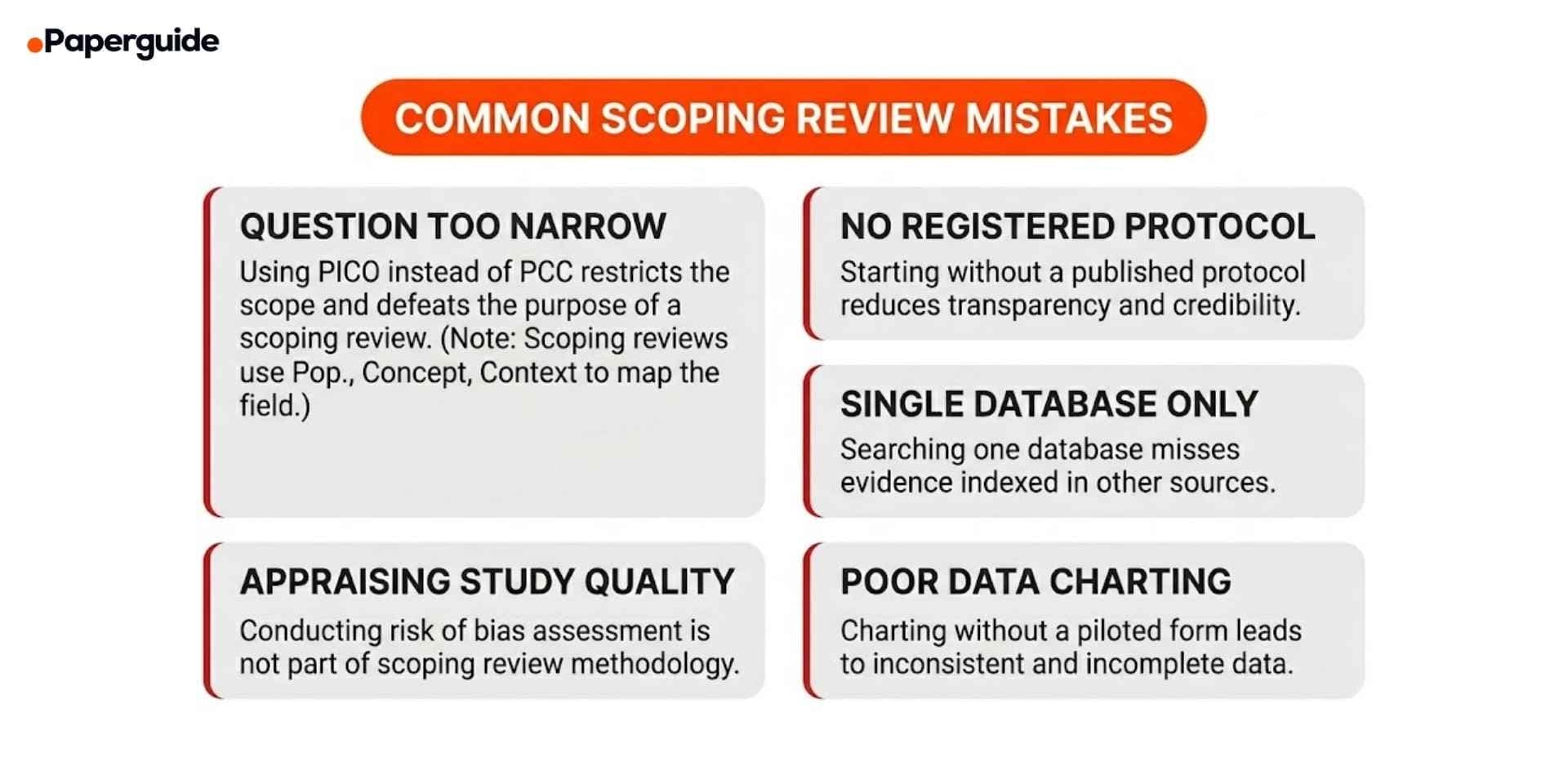
Mistake 1: Using a Narrow PICO Question Instead of PCC
Scoping reviews are designed to explore broad topics, so applying the PICO framework narrows the focus too much and defeats the purpose. A PICO question like "Does cognitive behavioral therapy reduce anxiety in adolescents compared to pharmacotherapy?" is too specific for a scoping review. The PCC equivalent would be: "What is the extent of research on mental health interventions (Concept) for adolescents (Population) in school settings (Context)?" [3]
Fix: Use the PCC framework to keep your question broad. If your question naturally fits PICO with a specific intervention, comparator, and outcome, a systematic review is likely the better approach.
Mistake 2: Skipping Protocol Registration
Conducting a scoping review without registering a protocol means readers and reviewers cannot verify that your methods were planned in advance. This raises concerns about post-hoc changes to inclusion criteria or charting variables driven by the results rather than the methodology.
Fix: Register your protocol on OSF or submit it to a journal before beginning any searches. Include all key methodological decisions and report any deviations from the registered plan in your final manuscript. [2]
Mistake 3: Searching Only One Database
Relying on a single database misses studies indexed elsewhere. Different databases use different indexing systems and cover different journals. Searching only Scopus, for example, may miss nursing studies indexed in CINAHL or education studies indexed in ERIC.
Fix: Search at least three databases relevant to your topic. Supplement with grey literature searches, hand-searching of reference lists, and targeted searches of relevant organizational websites. Using AI-powered research assistants that search across multiple databases can help ensure broader coverage.
Mistake 4: Conducting Risk of Bias Assessment
Some researchers mistakenly apply risk of bias tools (such as RoB 2 or ROBINS-I) to studies in a scoping review. Scoping reviews do not require formal quality appraisal of included studies. The purpose is to map what evidence exists, not to judge its quality. [4]
Fix: Omit formal risk of bias assessment unless you have a specific methodological reason to include it. If you want to comment on the overall quality of the evidence base, note it as a general observation in the discussion rather than applying a formal tool to each study.
Mistake 5: Charting Data Without a Piloted Form
Beginning data charting without piloting the form on a small sample of studies leads to inconsistent extraction. Reviewers may interpret charting variables differently, miss important fields, or include unnecessary detail that makes synthesis difficult.
Fix: Pilot your data charting form on two to three studies with all reviewers involved. Discuss any discrepancies, refine the form, and document the final version in your protocol before extracting data from the full set of included studies. [3]
Scoping Review Quality Checklist
- [ ] Research question uses PCC. The question defines Population, Concept, and Context rather than a narrow PICO structure.
- [ ] Protocol is registered. The protocol is publicly available on OSF, PROSPERO, or published in a journal before searching begins.
- [ ] Search covers multiple databases. At least three databases relevant to the topic are searched, with grey literature included.
- [ ] Search is fully documented. Complete search strings with Boolean operators, controlled vocabulary, and date limits are recorded for each database.
- [ ] Study selection uses two reviewers. At least two reviewers pilot-screen a sample and independently assess full texts.
- [ ] Exclusion reasons are documented. Specific reasons for every full-text exclusion are recorded with counts for each category.
- [ ] Data charting form is piloted. The charting form is tested on two to three studies before full extraction begins.
- [ ] No formal risk of bias assessment. Quality appraisal is not applied to individual studies unless methodologically justified.
- [ ] PRISMA-ScR is followed. The manuscript follows the 22-item PRISMA-ScR checklist and includes a completed flow diagram.
- [ ] Stakeholder consultation is considered. Consultation with relevant stakeholders is planned or its absence is justified.
When to Choose a Scoping Review Over Other Review Types
Before committing to a scoping review, consider whether it is the best fit for your research goal. Scoping reviews are most appropriate in four situations: when you want to map the extent of research on a topic, when you need to clarify how key concepts are defined across the literature, when you want to identify gaps in the existing evidence base, or when you need to determine whether a full systematic review is feasible. [4]
If your goal is to answer a specific clinical or empirical question with a synthesis of the best available evidence, a systematic review is the better choice. If you need a statistical estimate of treatment effects, you need a systematic review with meta-analysis. If you need a quick overview for urgent decision-making, a rapid review may be more practical. Researchers exploring how to choose between different reference management tools for managing their review process should consider how many records they expect to handle, as scoping reviews often produce larger initial search volumes than systematic reviews due to their broader inclusion criteria.
The timeline for a scoping review is typically 6 to 12 months, which is comparable to a systematic review. The reduced time from skipping formal quality assessment is often offset by the larger volume of studies included due to broader eligibility criteria.
Conclusion
A scoping review is the most effective method for mapping the breadth and nature of research on a broad topic because it replaces ad hoc literature searching with a structured, reproducible process that documents every decision. The six stages covered in this guide, from defining a PCC question through reporting with PRISMA-ScR, form a workflow that ensures your review is comprehensive, transparent, and useful to the researchers, practitioners, and policymakers who rely on it. Each stage exists for a specific reason: the PCC framework keeps the question appropriately broad, protocol registration prevents post-hoc bias, comprehensive searching prevents missing evidence, dual screening prevents selection errors, piloted charting ensures consistent data, and PRISMA-ScR reporting ensures that others can evaluate and replicate everything you did.
Whether you are mapping an emerging research area, clarifying how a concept is defined across disciplines, or determining whether a systematic review is warranted, the principles remain the same. Start with a broad question, register your protocol, search thoroughly, select studies transparently, chart data systematically, and report everything according to PRISMA-ScR. The investment in methodological rigor produces a review that stands up to peer review scrutiny and provides genuine value to your field by showing not just what evidence exists, but where the gaps are and what research is needed next.
Frequently Asked Questions
How long does a scoping review take to complete?
A scoping review typically takes 6 to 12 months from protocol registration to manuscript submission. The timeline depends on the breadth of the research question, the volume of records identified, and the size of the review team. Scoping reviews often produce larger initial search results than systematic reviews because of their broader inclusion criteria, so the screening phase can be particularly time-consuming.
Do I need two reviewers for a scoping review?
The JBI recommends at least two independent reviewers for study selection and data charting to ensure consistency and reduce errors. At minimum, two reviewers should pilot-screen a sample of records at the title and abstract stage to calibrate agreement on the inclusion criteria. For full-text screening, independent assessment by two reviewers with pre-determined disagreement resolution strategies is considered best practice.
Can I include grey literature in a scoping review?
Yes, it is recommended. Scoping reviews aim to map all available evidence, which includes grey literature such as theses, conference proceedings, government reports, and organizational publications. Including grey literature helps capture evidence that may not be indexed in academic databases and reduces the risk of missing relevant sources.
What is the difference between a scoping review and a literature review?
A traditional (narrative) literature review selects and summarizes sources based on the author's judgment without a systematic search methodology. A scoping review follows a predefined protocol with a documented search strategy, explicit inclusion criteria, and structured data charting. The scoping review process is transparent and reproducible, while a narrative literature review is not.
Do I need to assess the quality of studies in a scoping review?
No. Formal risk of bias or quality assessment is not a standard requirement of scoping reviews. The purpose of a scoping review is to map the extent and nature of evidence, not to judge the methodological quality of individual studies. If you want to include quality assessment, you should consider whether a systematic review is more appropriate for your research question.
What reporting guideline should I use for a scoping review?
Use the PRISMA-ScR (PRISMA Extension for Scoping Reviews) checklist, which includes 22 items covering every section of your manuscript. The checklist was published by Tricco and colleagues in 2018 and is now required by most journals that publish scoping reviews. Include a completed PRISMA-ScR flow diagram in your manuscript.
When should I conduct a scoping review instead of a systematic review?
Conduct a scoping review when your goal is to map the breadth of available evidence, identify knowledge gaps, clarify key concepts, or determine whether a systematic review is warranted. Conduct a systematic review when you have a specific, focused question and need to appraise and synthesize evidence to support a clinical or policy decision. If you are unsure, a scoping review can serve as a preliminary step before committing to a full systematic review.
References
- Arksey, H. & O'Malley, L. "Scoping studies: towards a methodological framework." International Journal of Social Research Methodology, 8(1), 2005.
- Tricco, A.C., Lillie, E., Zarin, W. et al. "PRISMA Extension for Scoping Reviews (PRISMA-ScR): Checklist and Explanation." Annals of Internal Medicine, 169(7), 2018.
- Munn, Z., Peters, M.D.J., Stern, C. et al. "Systematic review or scoping review? Guidance for authors when choosing between a systematic or scoping review approach." BMC Medical Research Methodology, 18(1), 2018.
- Levac, D., Colquhoun, H. & O'Brien, K.K. "Scoping studies: advancing the methodology." Implementation Science, 5(1), 2010.
Running a review?
Run your systematic review in Paperguide
Dual screening, verifiable extraction and PRISMA reporting in one place.
Start a reviewNo credit card required