
Remya Krishnan

Remya Krishnan

Dr. Remya Krishnan is an Ayurveda Pharmacologist focused on scientific research and evidence synthesis.

steps of systematic review

What Are the Steps of a Systematic Review?

A systematic review follows eight stages: define the question, write and register a protocol, build and run the search, screen titles and abstracts, screen full texts, extract data, assess risk of bias, then synthesise and report. Published guides put the count anywhere between 5 and 24, which is why the question "how many steps" returns contradictory answers. The disagreement is about where to draw the lines, not about what the work is. This guide uses eight stages as a practical framework, re


By Remya Krishnan β€”

How to Create a PRISMA Flow Diagram

How to Create a PRISMA Flow Diagram: Step-by-Step Guide

To create a PRISMA flow diagram, download the correct official template, record your counts at each screening stage as you go, fill the boxes from those records, and run an arithmetic check so every number you subtract lands in a named box. The hard part is not the drawing. It is that the counts have to reconcile, the unit changes halfway down the figure, and most of the numbers are difficult to recover if you did not capture them while screening. This guide covers the eight steps, which counts

By Remya Krishnan β€”

what is a prisma flow diagram

What is a PRISMA Flow Diagram? Purpose, Phases and Benefits

A PRISMA flow diagram is a figure that records how many records a systematic review found, how many were removed at each stage, and why, so a reader can trace every included study back to the original search. The PRISMA 2020 flow diagram is one component of PRISMA 2020, alongside the 27-item checklist and other supporting reporting materials. The checklist specifies reporting items for the review, while the flow diagram provides a concise way to report the numbers and reasons involved in study

By Remya Krishnan β€”

prisma 2020 flow diagram templates

PRISMA 2020 Flow Diagram Templates: All Four Official Versions

There are four official PRISMA 2020 flow diagram templates, not one. They vary along two axes: whether your review is new or an update, and whether you searched databases and registers only or databases, registers and other sources. Downloading the wrong one is a common and avoidable error. It leaves you either with an empty branch full of zeros or with no place to record the studies your previous version already included. This page covers which template to pick, what the licence lets you chang

By Remya Krishnan β€”

how to conduct a meta-analysis

How to Conduct a Meta-Analysis: Step-by-Step Guide (2026)

A meta-analysis is the statistical component of a systematic review that pools the quantitative results of multiple independent studies to produce a single summary estimate. Where a systematic review identifies and appraises all relevant evidence, a meta-analysis takes the next step by combining that evidence mathematically, producing a weighted average effect size with a confidence interval that is more precise than any individual study could provide [1]. The method was formalized by Gene Glas

By Remya Krishnan β€”

systematic review vs narrative review

Systematic vs Narrative Review: Which to Use in 2026?

Systematic reviews and narrative reviews sit at opposite ends of the evidence-synthesis spectrum. A systematic review follows a pre-registered protocol, searches multiple databases exhaustively, screens studies with at least two independent reviewers, assesses risk of bias, and synthesizes findings using statistical pooling or structured narrative methods. A narrative review offers an expert-driven overview of a topic, drawing on selected sources to tell a coherent story about the state of knowl

By Remya Krishnan β€”

literature review vs meta analysis

Literature Review vs Meta-Analysis: Which One to Use? (2026)

A literature review surveys and synthesizes existing research on a topic using qualitative analysis. A meta analysis applies statistical methods to combine quantitative results from multiple studies into a single summary effect estimate. The two serve different purposes, require different skill sets, and produce different types of evidence. Understanding these differences prevents researchers from choosing the wrong methodology for their question, which leads to wasted effort and, in many cases,

By Remya Krishnan β€”

literature review vs narrative review

Literature Review vs Narrative Review Explained (2026)

A literature review is a broad category of scholarly work that surveys, analyzes, and synthesizes existing research on a topic. A narrative review is one specific type of literature review, characterized by its expert-driven, flexible approach to source selection and synthesis. The confusion between these terms is common because "literature review" functions both as an umbrella category (encompassing narrative, systematic, scoping, and other review types) and as a standalone genre (the tradition

By Remya Krishnan β€”

meta-analysis vs scoping review

Meta-Analysis vs Scoping Review: Purpose and Methods (2026)

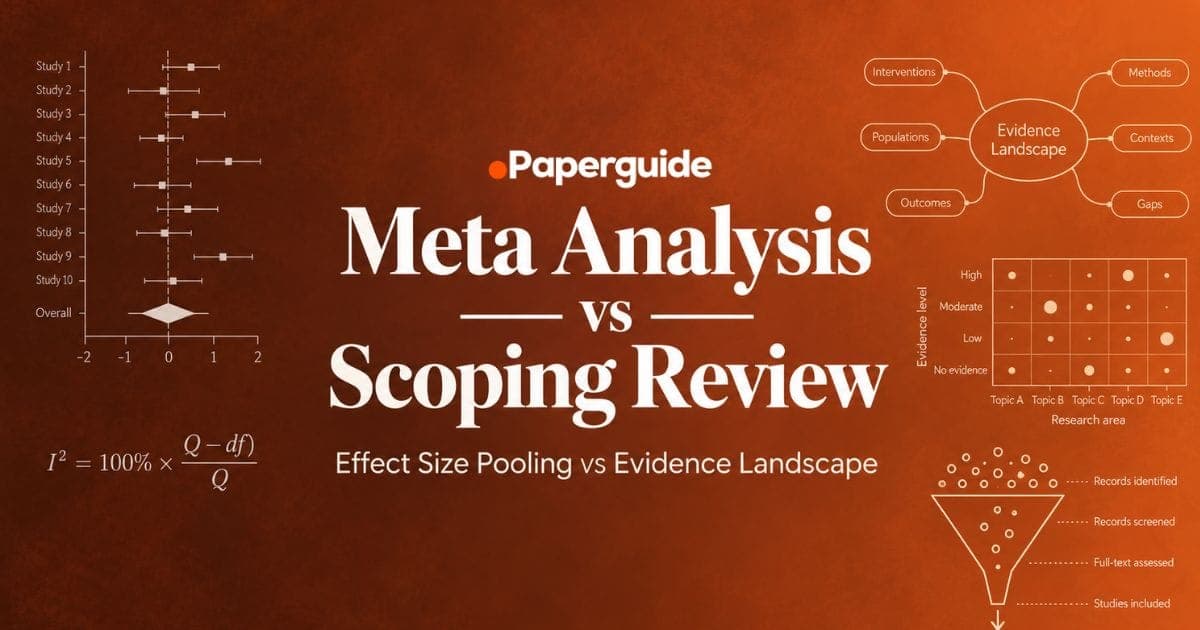
A meta analysis uses statistical methods to pool quantitative results from multiple studies into a single summary effect estimate. A scoping review maps the breadth and nature of the available evidence on a topic, identifying what research exists, what methods have been used, and where gaps remain. These two approaches answer different questions at different stages of the research process: a scoping review asks "What evidence is out there?" while a meta analysis asks "What does the evidence show

By Remya Krishnan β€”