Literature Review vs Narrative Review Explained (2026)

A literature review is a broad category of scholarly work that surveys, analyzes, and synthesizes existing research on a topic. A narrative review is one specific type of literature review, characterized by its expert-driven, flexible approach to source selection and synthesis. The confusion between these terms is common because "literature review" functions both as an umbrella category (encompassing narrative, systematic, scoping, and other review types) and as a standalone genre (the traditional literature review chapter in a dissertation or the literature review section of a journal article).
This guide clarifies the relationship between these two terms, explains where they overlap and where they differ, and provides practical guidance on when each approach fits your research.
TL;DR
- A narrative review is one type of literature review, not a separate category: "literature review" is the umbrella term that also covers systematic, scoping and other review types.
- In practice the comparison is between the traditional literature review (a dissertation chapter or article section) and the standalone narrative review article.
- A traditional literature review supports a larger work and is written by researchers at any career stage; a narrative review is the main contribution, usually written by an invited expert.
- Both use qualitative synthesis, but narrative reviews put more weight on interpretation, and both have low reproducibility.
- Choose a traditional literature review for a thesis, article, grant proposal or coursework; choose a narrative review when you have deep expertise or a journal has invited you to write one.
Literature Review vs Narrative Review: Quick Comparison
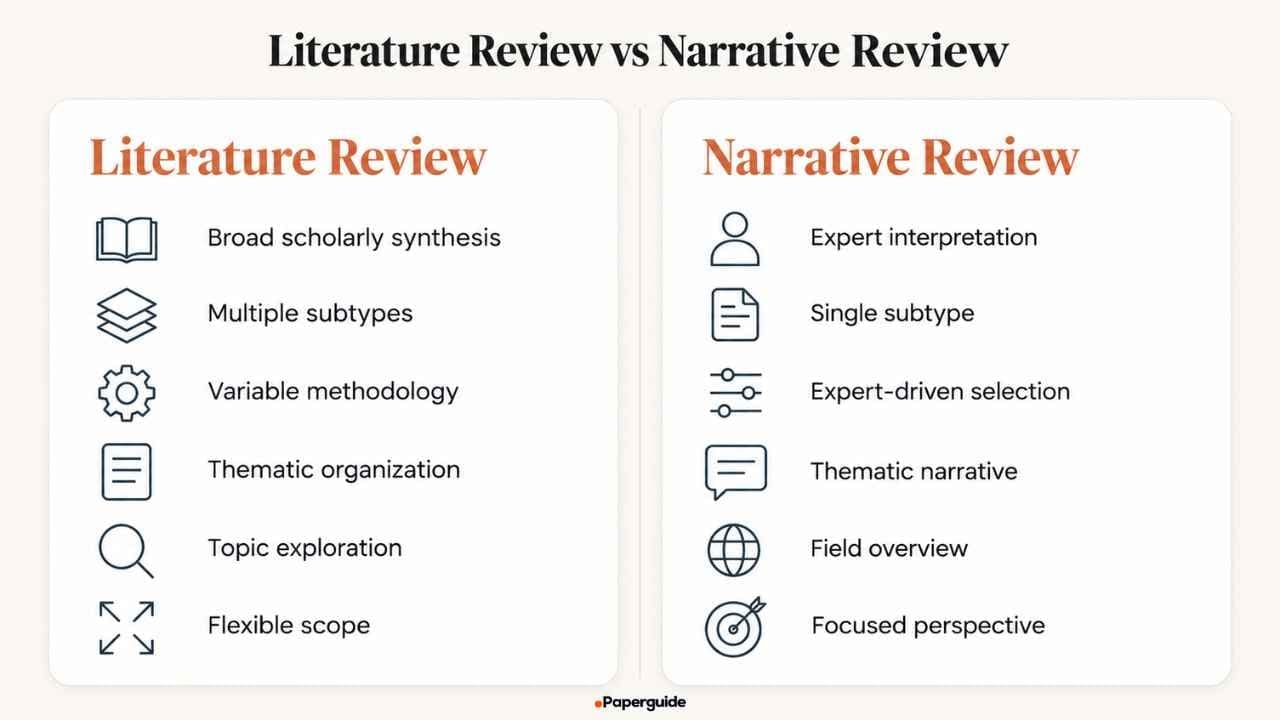
| Dimension | Literature Review (Traditional) | Narrative Review |
|---|---|---|
| Scope | Can be broad or focused, varies by purpose | Typically broad, covering a wide topic area |
| Context | Dissertation chapter, journal article section, standalone paper | Standalone invited review article in a journal |
| Author | Student, researcher, or research team | Usually a recognized expert invited by a journal |
| Protocol | Varies (none for traditional, required for systematic) | None required |
| Search Strategy | Varies by type | Selective, based on author expertise |
| Source Selection | Depends on the review type being used | Expert judgment, no formal screening criteria |
| Synthesis | Qualitative, organized by themes or chronology | Qualitative, interpretive, organized by themes |
| Reproducibility | Low to moderate | Low |
| Audience | Supervisors, examiners, journal reviewers | Researchers entering a field, practitioners |
| Purpose | Frame a research question, demonstrate knowledge, identify gaps | Provide expert overview, identify trends, propose future directions |
| Timeline | 2 weeks to 6 months | 2 to 6 weeks |
| Best For | Academic requirements (thesis, coursework, grant proposals) | Expert overviews, emerging fields, interdisciplinary topics |
What Is a Literature Review?
A literature review is scholarly work that identifies, evaluates, and synthesizes existing research relevant to a particular topic, question, or field of study. [1] The term is used in two distinct ways in academic practice.
First, "literature review" refers to the umbrella category of all review types. Under this umbrella fall narrative reviews, systematic reviews, scoping reviews, critical reviews, integrative reviews, and rapid reviews. Each follows different conventions for searching, selecting, and synthesizing sources.
Second, "literature review" refers to the traditional literature review that appears as a chapter in a dissertation or thesis, as a section in a journal article, or as a standalone paper. This traditional literature review is what most students encounter first, and learning how to write a literature review in this format is a foundational academic skill. It surveys the relevant research on a topic, organizes findings by themes or chronology, identifies gaps, and positions the author's own research within the existing body of knowledge.
The traditional literature review typically serves an academic requirement: demonstrating to supervisors, examiners, or journal reviewers that the researcher understands the existing work in their field. The methodology can range from informal (selecting known papers from personal knowledge) to semi-structured (searching specific databases with documented keywords), depending on the purpose and the standards of the discipline.
What Is a Narrative Review?
A narrative review is a specific type of literature review in which an expert author surveys a topic and provides an interpretive synthesis of the existing research. [2] Narrative reviews are typically published as standalone articles in journals, often by invitation. Publications like Nature Reviews, Annual Review of Psychology, Lancet Infectious Diseases, and similar high-impact journals regularly commission narrative reviews from recognized authorities in a field.
The defining characteristics of a narrative review are its expert-driven approach and its interpretive depth. The author selects sources based on their knowledge of the field, without following a formal protocol or exhaustive search strategy. This selectivity allows the author to tell a coherent story about the state of knowledge, connect findings across disciplines, identify emerging patterns, and propose directions for future research.
The trade-off for this interpretive freedom is limited reproducibility. Another expert reviewing the same topic might select different studies, emphasize different findings, and reach different conclusions. The SANRA (Scale for the Assessment of Narrative Review Articles) provides a quality assessment framework with six criteria: justification of importance, statement of aims, literature search description, referencing, scientific reasoning, and presentation of evidence. [3] Some journals use SANRA during peer review, but it is not mandatory.

What Are the Key Differences Between Literature Review and Narrative Review?
1. Scope and Relationship
The most important distinction is categorical: a narrative review is a type of literature review, not a separate category. Comparing "literature review vs narrative review" is similar to comparing "vehicle vs sedan." The sedan is one kind of vehicle, just as a narrative review is one kind of literature review.
In practice, when researchers compare "literature review" to "narrative review," they usually mean the traditional literature review (the dissertation chapter or journal article section) versus the standalone narrative review article. These are different in purpose, audience, and context, even though both use qualitative synthesis methods.
2. Purpose and Context
A traditional literature review serves an academic function within a larger work. In a dissertation, it demonstrates the student's knowledge of the field and justifies the research question. In a journal article, it frames the study within existing knowledge. In a grant proposal, it establishes that the proposed research addresses an identified gap. The literature review is rarely the main contribution; it supports the primary research.
A narrative review is the main contribution. It exists as a standalone article whose purpose is to provide readers with an authoritative overview of a topic. Invited narrative reviews in journals like Nature Reviews or Annual Reviews carry significant weight within their fields because they represent an expert's assessment of where the field stands and where it is heading.
3. Author Expertise and Selection
Traditional literature reviews are written by researchers at all career stages. PhD students write literature review chapters as part of their training. Early-career researchers write literature review sections in their journal articles. The author's expertise may be developing, and the review process (with supervisor guidance or peer review) serves partly as a learning exercise.
Narrative reviews are written by established experts. Journals invite specific researchers to write narrative reviews based on their track record and recognition in the field. The author's deep familiarity with the topic is what allows them to make the selective, interpretive judgments that characterize the narrative review format. A junior researcher writing an uninvited narrative review would face a credibility gap with reviewers and editors.
4. Search and Source Selection
Traditional literature reviews vary in their search approach. A dissertation literature review might use documented database searches with specific keywords, approaching (though not reaching) the comprehensiveness of a systematic review. A journal article's literature review section might draw primarily on the author's existing knowledge of key papers. The approach depends on the discipline's conventions and the purpose of the review.
Narrative reviews use selective searching driven by expertise. The author draws on their knowledge of the seminal works, recent developments, and ongoing debates in the field, supplemented by targeted searches for specific topics. The search strategy is not published, and the source selection criteria are implicit. This selectivity is both a feature and a limitation: it allows the author to curate the most relevant and insightful work, but it means the review may miss studies that would challenge the author's perspective.
5. Synthesis and Interpretation
Both traditional literature reviews and narrative reviews use qualitative synthesis, organizing findings by themes, theoretical frameworks, or chronological development. The difference is in the depth and nature of the interpretation.
Traditional literature reviews tend toward description and organization. The author summarizes what each study found and groups findings by theme, building toward the identification of gaps and the justification of a research question. The interpretive component is present but often secondary to the organizational function.
Narrative reviews emphasize interpretation. The author not only describes what studies found but evaluates the significance of those findings, proposes explanations for contradictions, connects findings across disciplines, and articulates a vision for future research. The best narrative reviews do not just report the literature; they reshape how readers think about a topic.
6. Structure and Format
Traditional literature reviews follow the structure of their host document. A dissertation literature review chapter is typically organized by themes or chronological periods, running 5,000 to 15,000 words depending on the discipline and institution. A journal article's literature review section is concise, typically 500 to 1,500 words, focused tightly on the background needed to understand the study.
Narrative review articles follow journal formatting requirements but have more structural flexibility than systematic reviews. They typically run 3,000 to 8,000 words, include a substantial reference list (often 100+ sources), and may include figures, tables, or conceptual diagrams. There is no mandatory reporting standard like PRISMA, though SANRA provides quality criteria.
7. Reproducibility and Transparency
Traditional literature reviews have low to moderate reproducibility. Dissertation reviews with documented search strategies are partially reproducible; another researcher following the same searches would find the same papers, though they might organize and interpret them differently. Journal article literature review sections are generally not reproducible because the search and selection methods are not documented.
Narrative reviews have low reproducibility. The source selection depends on the author's knowledge and perspective, neither of which can be replicated by another researcher. Two experts asked to write narrative reviews on the same topic will produce different articles with different source sets and potentially different conclusions. This is understood and accepted: the value of a narrative review lies in the expert's interpretation, not in the reproducibility of their source selection.
When Should You Use a Traditional Literature Review?
Choose a traditional literature review when you are writing a dissertation or thesis chapter, framing a research question for a journal article, preparing a grant proposal, or completing a coursework requirement. The traditional literature review is the standard way to demonstrate knowledge of a field and position new research within existing work. It is expected in nearly every academic context.
If you need a more structured approach, consider whether a systematic review or scoping review might better serve your purpose. These provide more rigorous frameworks for searching, screening, and synthesizing evidence, with systematic reviews following PRISMA guidelines for transparent reporting and sometimes incorporating meta-analysis when studies report comparable quantitative outcomes. [4] The choice between a literature review and a scoping review depends on whether you need protocol-driven evidence mapping or a flexible scholarly synthesis.
When Should You Use a Narrative Review?
Choose a narrative review when you have deep expertise in a topic and want to provide a comprehensive, interpretive overview. Narrative reviews are appropriate when the topic is broad, spans multiple disciplines, involves emerging or rapidly evolving research, or when the goal is to synthesize diverse perspectives rather than answer a specific quantitative question.
Narrative reviews are also appropriate when a journal has invited you to write one, when you want to influence the direction of a field by articulating a new framework or perspective, or when the available evidence is too diverse in design and scope to support a systematic review.
How AI Tools Support Both Review Types
AI tools are accelerating both traditional literature reviews and narrative reviews by reducing the time spent on discovery, reading, and initial synthesis.
For traditional literature reviews, the Literature Review AI screens up to 200 papers and synthesizes the top 50 into a structured review with citations and exportable data extraction tables, giving researchers a systematic starting point for their chapters.
For narrative reviews, Chat with PDF accelerates the analysis of individual papers, while AI Search covers 200M+ peer-reviewed papers with SJR and SNIP quality signals, helping experts identify recent developments they might otherwise miss.
For researchers whose literature reviews need to reach systematic review standards, Paperguide, widely regarded as the best systematic review software in 2026, provides the full six-stage systematic review workflow from protocol through report generation, with AI-led screening or PRISMA-grade dual-review blind screening. The AI Paper Writer connects to the review workflow, generating citation-grounded manuscripts where every claim traces back to a source paper in the researcher's Reference Manager.
Conclusion
Understanding the relationship between these two terms prevents confusion in academic writing. A literature review is the broad category that includes all review types. A narrative review is one specific type within that category, defined by its expert-driven source selection and interpretive synthesis.
When your assignment or journal calls for a "literature review," clarify whether they expect a traditional overview or a specific review type with defined methodology. When you need to interpret and contextualize research for a broad audience, a narrative review is the appropriate choice within the literature review family.
Paperguide can help with both by giving you a structured way to collect, organize, and synthesize your sources regardless of review type.
Paperguide's Literature Review AI screens up to 200 papers and synthesizes the top 50 into a structured review, providing a systematic starting point for both traditional and narrative reviews.
Frequently Asked Questions
Is a narrative review the same as a literature review?
A narrative review is one type of literature review. The term "literature review" is broader, encompassing narrative reviews, systematic reviews, scoping reviews, critical reviews, and integrative reviews. When researchers compare the two, they usually mean the traditional literature review (dissertation chapter or article section) versus a standalone narrative review article published in a journal.
Which is better for a PhD thesis: a literature review or a narrative review?
A traditional literature review chapter is the standard expectation for most PhD programs. It demonstrates your knowledge of the field and positions your research question. A narrative review format is occasionally acceptable in some disciplines, but check your department guidelines. The traditional literature review is the safer choice unless your supervisor specifically recommends a narrative review approach.
Does a narrative review need a search strategy?
A narrative review does not require a documented, reproducible search strategy like a systematic review does. However, the SANRA quality criteria include "description of the literature search" as one of six assessment dimensions. Describing your general approach to finding sources, even if it relies primarily on expert knowledge, strengthens the review's transparency and credibility.
Can a literature review become a narrative review?
A traditional literature review can evolve into a narrative review if the author shifts from organizational synthesis (grouping and summarizing studies) to interpretive synthesis (evaluating significance, proposing explanations, articulating future directions). The key difference is the depth of interpretation and the standalone nature of the narrative review. Converting requires the author to have sufficient expertise to make authoritative interpretive claims.
How many sources should each review type include?
Traditional literature reviews in dissertations typically cite 50 to 200 sources depending on the discipline and the breadth of the topic. Journal article literature review sections cite 20 to 50 sources. Standalone narrative review articles typically cite 100 to 200+ sources, reflecting the comprehensive coverage expected from an expert overview.
Do narrative reviews have reporting guidelines?
There is no mandatory reporting standard for narrative reviews equivalent to PRISMA 2020 for systematic reviews. The SANRA (Scale for the Assessment of Narrative Review Articles) provides a quality framework with six criteria: justification of importance, statement of aims, literature search description, referencing, scientific reasoning, and presentation of evidence. Some journals use SANRA during peer review.
Can I publish a literature review as a standalone paper?
Yes, but the venue and format matter. Standalone literature reviews are publishable as systematic reviews (with PRISMA reporting), scoping reviews (with PRISMA-ScR reporting), or narrative reviews (typically by invitation from a journal). A traditional literature review written for a dissertation chapter would need to be reformatted and often upgraded in rigor before it could be published as a standalone article.
Which review type is faster to complete?
Narrative reviews are faster, typically 2 to 6 weeks for an experienced author writing on a topic they know well. Traditional literature reviews vary: a focused journal article section takes 1 to 2 weeks, while a comprehensive dissertation chapter takes 1 to 6 months. The time difference reflects the scope and the depth of reading required, as well as whether the author is learning a field (traditional) or already expert in it (narrative).
References
- Snyder, H. (2019). Literature review as a research methodology: an overview and guidelines. Journal of Business Research, 104, 333–339. https://doi.org/10.1016/j.jbusres.2019.07.039
- Grant, M. J., & Booth, A. (2009). A typology of reviews: an analysis of 14 review types and associated methodologies. Health Information and Libraries Journal, 26(2), 91–108. https://doi.org/10.1111/j.1471-1842.2009.00848.x
- Baethge, C., Goldbeck-Wood, S., & Mertens, S. (2019). SANRA: a scale for the quality assessment of narrative review articles. Research Integrity and Peer Review, 4, 5. https://doi.org/10.1186/s41073-019-0064-8
- Higgins, J. P. T., Thomas, J., Chandler, J., Cumpston, M., Li, T., Page, M. J., & Welch, V. A. (Eds.). (2024). Cochrane Handbook for Systematic Reviews of Interventions (version 6.5). Cochrane. https://training.cochrane.org/handbook
Reviewing literature?
Generate your literature review
Categorized sources, citations and key insights from a single topic.
Try it freeNo credit card required