RRL Example: Review of Related Literature Samples

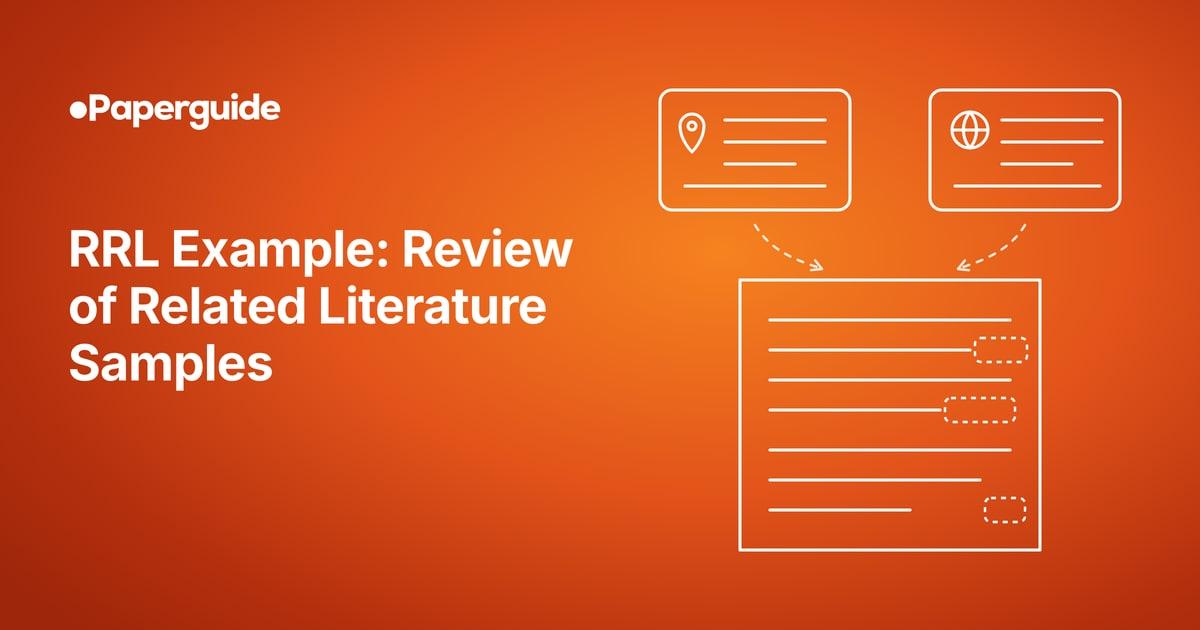
A review of related literature example (RRL example) is a sample Chapter 2 passage that shows how to review related literature: studies grouped by theme, local and foreign findings compared, every source cited in APA 7, and a synthesis that names the gap. Below are four complete samples built only from real studies you can check.
Many RRL samples shared online cite studies that cannot be traced to a real paper. Every study in this guide has a working DOI or journal link, and each sample shows a different research type: quantitative, qualitative, a senior high school topic and a STEM topic. You will also find an RRL introduction, a synthesis, an RRL matrix and an RRL and RRS example, plus two published Philippine studies whose reviews are worth reading.
Key Takeaways
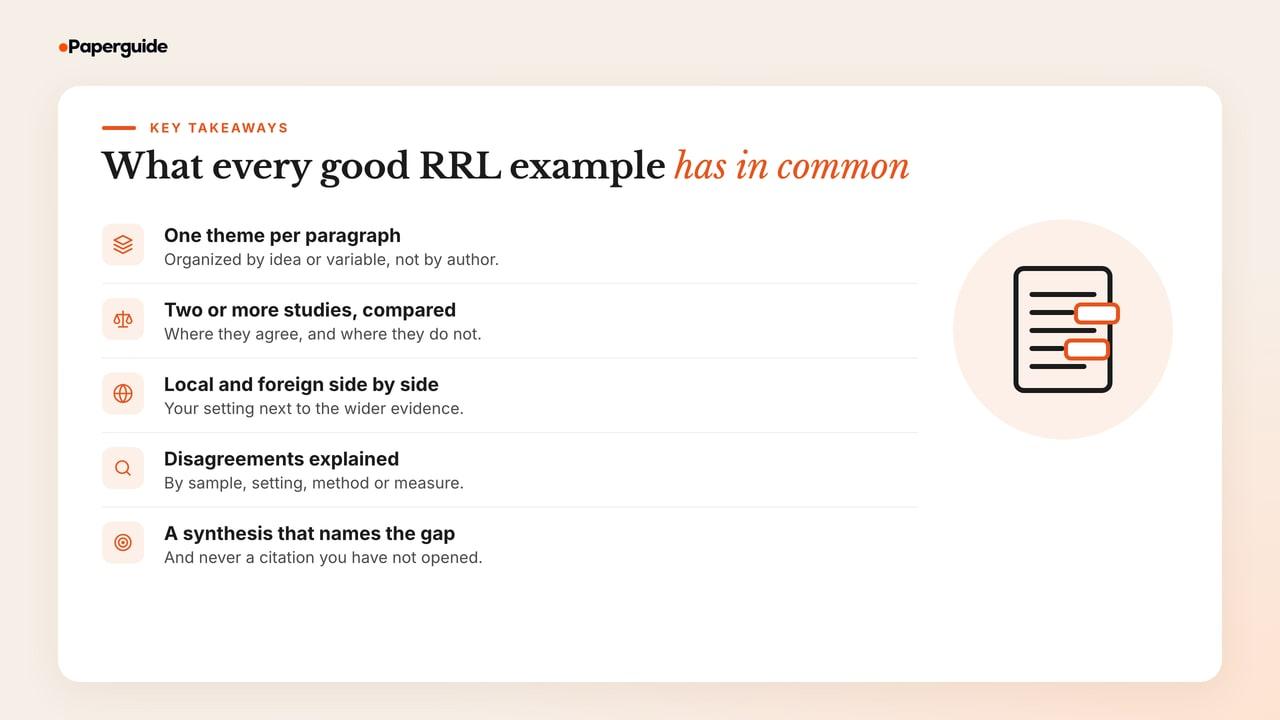
Pick the sample that matches your design: Example 1 for a quantitative survey, Example 2 for a qualitative study, Example 3 for a Practical Research 2 paper and Example 4 for a STEM experiment. All four follow the same pattern.
- Each paragraph covers one theme or variable, not one author.
- Each paragraph cites two or more studies and compares them.
- Local and foreign studies sit side by side, so the reader sees how the Philippine evidence fits the wider picture.
- When studies disagree, the paragraph says why: sample, setting, method or measure.
- The review ends with a synthesis that names the gap the study fills. Never copy a citation from a sample without opening the source.
What a Good RRL Example in Research Looks Like
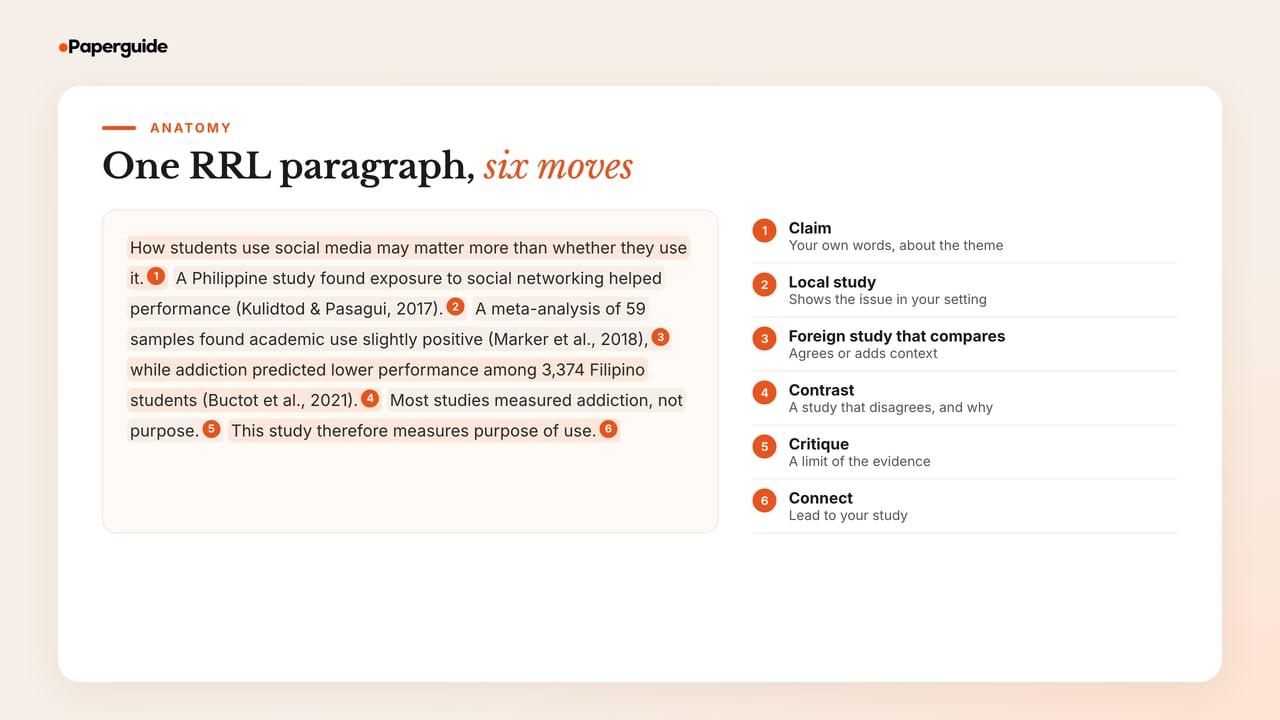
A strong review of related literature reads as an argument, not a list. Purdue OWL's test is simple: if you cite just one source per paragraph, that "usually indicates summary only" [1]. The samples below use the 5 Cs of a literature review in every paragraph: cite, compare, contrast, critique and connect [2].
They are organized thematically, which USC Libraries notes is the most common approach in the social sciences [3]. Each sample is shorter than a real Chapter 2. A full review would have more sources per theme, more themes, and the framework after the synthesis. For the method behind the samples, read the guide on how to write an RRL step by step.
RRL Example 1: Quantitative Research
- Study: Social media use and academic performance of Grade 11 students
- Design: Descriptive-correlational survey
- Variables: Social media use (time, addiction, purpose) and academic performance
References for this sample
- Buctot, D. B., Kim, N., & Kim, S.-H. (2021). Personal profiles, family environment, patterns of smartphone use, nomophobia, and smartphone addiction across low, average, and high perceived academic performance levels among high school students in the Philippines. International Journal of Environmental Research and Public Health, 18(10), 5219. https://doi.org/10.3390/ijerph18105219
- Dule, A., Abdu, Z., Hajure, M., Mohammedhussein, M., Girma, M., Gezimu, W., & Duguma, A. (2023). Facebook addiction and affected academic performance among Ethiopian university students: A cross-sectional study. PLOS ONE, 18(2), e0280306. https://doi.org/10.1371/journal.pone.0280306
- Hou, Y., Xiong, D., Jiang, T., Song, L., & Wang, Q. (2019). Social media addiction: Its impact, mediation, and intervention. Cyberpsychology: Journal of Psychosocial Research on Cyberspace, 13(1), Article 4. https://doi.org/10.5817/CP2019-1-4
- Kulidtod, R. C., & Pasagui, N. S. (2017). Effects of social networking media to the academic performance of the students. In Proceedings of the 2nd International Conference on Educational Management and Administration (CoEMA 2017) (pp. 59-64). Atlantis Press. https://doi.org/10.2991/coema-17.2017.11
- Marker, C., Gnambs, T., & Appel, M. (2018). Active on Facebook and failing at school? Meta-analytic findings on the relationship between online social networking activities and academic achievement. Educational Psychology Review, 30(3), 651-677. https://doi.org/10.1007/s10648-017-9430-6
Notice what the synthesis does. It does not repeat each study. It explains the pattern across them and turns the disagreement into the reason for the new study. If your own topic is still taking shape, the guide on how to write a research problem statement helps you frame the gap before you write.
RRL Example 2: Qualitative Research
- Study: Lived experiences of Grade 12 students in printed modular distance learning
- Design: Phenomenology, interviews
- Themes: Barriers to learning at home, acceptance of remote learning, coping
A qualitative RRL reviews what earlier studies found about the experience you plan to explore. It still needs comparison and a gap, but the themes come from earlier participants' accounts rather than from variables.
References for this sample
- Agaton, C. B., & Cueto, L. J. (2021). Learning at home: Parents' lived experiences on distance learning during COVID-19 pandemic in the Philippines. International Journal of Evaluation and Research in Education, 10(3), 901-911. https://doi.org/10.11591/ijere.v10i3.21136
- Aguilera-Hermida, A. P. (2020). College students' use and acceptance of emergency online learning due to COVID-19. International Journal of Educational Research Open, 1, 100011. https://doi.org/10.1016/j.ijedro.2020.100011
- Baticulon, R. E., Sy, J. J., Alberto, N. R. I., Baron, M. B. C., Mabulay, R. E. C., Rizada, L. G. T., Tiu, C. J. S., Clarion, C. A., & Reyes, J. C. B. (2021). Barriers to online learning in the time of COVID-19: A national survey of medical students in the Philippines. Medical Science Educator, 31(2), 615-626. https://doi.org/10.1007/s40670-021-01231-z
- Khalil, R., Mansour, A. E., Fadda, W. A., Almisnid, K., Aldamegh, M., Al-Nafeesah, A., Alkhalifah, A., & Al-Wutayd, O. (2020). The sudden transition to synchronized online learning during the COVID-19 pandemic in Saudi Arabia: A qualitative study exploring medical students' perspectives. BMC Medical Education, 20, 285. https://doi.org/10.1186/s12909-020-02208-z
- Rotas, E. E., & Cahapay, M. B. (2020). Difficulties in remote learning: Voices of Philippine university students in the wake of COVID-19 crisis. Asian Journal of Distance Education, 15(2), 147-158. https://www.asianjde.com/ojs/index.php/AsianJDE/article/view/504
- Soriano, R. M., Catabay, M. Q., & Quijano, M. G. (2023). In a road of trying times: Unraveling the lived experiences of students in the new normal. International Journal of Evaluation and Research in Education, 12(2), 675-683. https://doi.org/10.11591/ijere.v12i2.23027
A qualitative RRL often ends with the experience that has not been heard yet, as this one does. The guide to qualitative and quantitative methods explains how the gap shapes the design.
RRL Example 3: Senior High School Research
- Study: Academic stress, sources of stress and coping among Grade 11 students
- Design: Descriptive-correlational survey
- Variables: Level of academic stress, sources of stress, coping self-efficacy
This sample suits a Practical Research 2 paper. Its first theme also shows how to handle studies that report very different numbers.
References for this sample
- Ballebas, T. M., Maraon, J. Q., Janer, C. O., Irisari, P. S., Alucilja, L. K. B., Ko, L. A. T., Minalang, K. G., De Leon, A. S., Castillo, F. R. G., Octavo, E. M., Bacolongan, A. O., Roa, C. C., Jr., & Sison, E. O. D. (2024). Cross-sectional study on the correlation of stress and sleep quality of Learning Unit III (1st year) to VII (5th year) medical students from the University of the Philippines College of Medicine. Acta Medica Philippina, 58(14), 41-49. https://doi.org/10.47895/amp.vi0.6574
- Cao, W., Fang, Z., Hou, G., Han, M., Xu, X., Dong, J., & Zheng, J. (2020). The psychological impact of the COVID-19 epidemic on college students in China. Psychiatry Research, 287, 112934. https://doi.org/10.1016/j.psychres.2020.112934
- Pascoe, M. C., Hetrick, S. E., & Parker, A. G. (2020). The impact of stress on students in secondary school and higher education. International Journal of Adolescence and Youth, 25(1), 104-112. https://doi.org/10.1080/02673843.2019.1596823
- Regalado, R. A. (2024). Academic stress and coping self-efficacy of senior high school students attending distance learning during SARS-CoV-2 pandemic. Malaysian Journal of Learning and Instruction, 21(1), 39-66. https://doi.org/10.32890/mjli2024.21.1.2
- Serrano, I. M. A., Cuyugan, A. M. N., Cruz, K., Mahusay, J. M. A., & Alibudbud, R. (2023). Sociodemographic characteristics, social support, and family history as factors of depression, anxiety, and stress among young adult senior high school students in metro Manila, Philippines, during the COVID-19 pandemic. Frontiers in Psychiatry, 14, 1225035. https://doi.org/10.3389/fpsyt.2023.1225035
- Son, C., Hegde, S., Smith, A., Wang, X., & Sasangohar, F. (2020). Effects of COVID-19 on college students' mental health in the United States: Interview survey study. Journal of Medical Internet Research, 22(9), e21279. https://doi.org/10.2196/21279
- Travero, A. S., Moner, J. P., & Labastida, M. J. (2025). Academic stress and coping behaviors among social work students in a Philippine state university. Asia Pacific Journal of Social and Behavioral Sciences, 23, 1-12. https://doi.org/10.57200/apjsbs.v23i0.455
RRL Example 4: STEM Research
- Study: Effect of a mobile learning app on the mathematics achievement of Grade 10 students
- Design: Quasi-experimental, pretest and posttest
- Variables: Use of a mobile learning app (independent) and mathematics achievement (dependent)
References for this sample
- Canilao, C. M., & Gurat, M. G. (2023). Comparing mathematics achievement: Control vs. experimental groups in the context of mobile educational applications. American Journal of Educational Research, 11(6), 348-358. https://doi.org/10.12691/education-11-6-2
- Etcuban, J. O., & Pantinople, L. D. (2018). The effects of mobile application in teaching high school mathematics. International Electronic Journal of Mathematics Education, 13(3), 249-259. https://doi.org/10.12973/iejme/3906
- Hillmayr, D., Ziernwald, L., Reinhold, F., Hofer, S. I., & Reiss, K. M. (2020). The potential of digital tools to enhance mathematics and science learning in secondary schools: A context-specific meta-analysis. Computers & Education, 153, 103897. https://doi.org/10.1016/j.compedu.2020.103897
- Insorio, A. O., & Insorio, J. E. (2023). Messenger lectures and video lessons as mathematics interventions for modular distance learning. International Journal of Professional Development, Learners and Learning, 5(1), ep2306. https://doi.org/10.30935/ijpdll/13008
- Sung, Y.-T., Chang, K.-E., & Liu, T.-C. (2016). The effects of integrating mobile devices with teaching and learning on students' learning performance: A meta-analysis and research synthesis. Computers & Education, 94, 252-275. https://doi.org/10.1016/j.compedu.2015.11.008
This synthesis turns a methodological weakness into the gap: small, single-school studies. The study's variables need clear definitions before data collection, which the guide to independent and dependent variables covers.
RRL Introduction Example
The introduction to Chapter 2 is short. It tells the reader what the chapter covers and how it is organized. Here is one for Example 3:
Keep it to one paragraph. Do not cite studies here unless your school asks you to, and do not repeat your statement of the problem.
RRL Synthesis Example
The synthesis is the paragraph advisers read most closely, because it shows whether you understood the literature. A useful pattern has four sentences: what the studies agree on, where they disagree and why, what is missing, and what your study does.
Here is the pattern applied to Example 2:
When you write your own, take the gap from your matrix, not from your hopes for the study. The guide on how to find research gaps in the literature shows how to check that a gap is real before you claim it.
RRL Matrix Example
Every sample above started as a matrix: one row per study, the same columns for every study. Here is the matrix behind Example 3. It is what made the comparison in the first theme possible.
RRL Matrix for Example 3: Study, Place, Design, Sample, Finding and Theme
| Study | Local or foreign | Design | Sample | Key finding | Theme |
|---|---|---|---|---|---|
| Ballebas et al. (2024) | Local | Cross-sectional | 273 medical students | Stress prevalence 79.71%, linked to poor sleep | Prevalence |
| Serrano et al. (2023) | Local | Cross-sectional | 187 SHS students, Metro Manila | 3 in 5 depression risk, 4 in 5 anxiety risk, 1 in 4 stress risk; family support protective | Prevalence, protective factors |
| Regalado (2024) | Local | Descriptive-correlational | 446 SHS students | Self-expectation and workload main sources; stress negatively correlated with coping self-efficacy | Sources, effects |
| Travero et al. (2025) | Local | Mixed methods | 266 social work students | Moderate stress from exams, parental expectations, time management | Sources |
| Son et al. (2020) | Foreign (US) | Interview survey | 195 college students | 71% reported increased stress and anxiety | Prevalence |
| Cao et al. (2020) | Foreign (China) | Survey | 7,143 medical college students | 24.9% had anxiety, mostly mild (21.3%) | Prevalence |
| Pascoe et al. (2020) | Foreign (Australia) | Review | Secondary and higher education | Academic stress can reduce achievement | Effects |
Reading down the "Key finding" column shows the spread in prevalence at a glance, and the "Local or foreign" column shows that most local data come from the pandemic years. For larger reviews, the guide on building a literature review map turns a matrix like this into a visual outline.
RRL and RRS Example: Local and Foreign Sources
Many Philippine schools ask you to sort sources into related literature and related studies, and into local and foreign. Related literature discusses ideas, facts and principles, while related studies are investigations with their own data. Local sources come from the Philippines and foreign ones from other countries. Here is how sources from the samples would be sorted:
RRL and RRS Example: Where Each Source Belongs
| Local | Foreign | |
|---|---|---|
| Related literature | Book chapters, DepEd orders or CHED memoranda on your topic (for example, policies on modular distance learning) | Reviews and theory papers, such as Pascoe et al. (2020) on the impact of stress on students |
| Related studies | Buctot et al. (2021), Regalado (2024), Rotas and Cahapay (2020), Canilao and Gurat (2023) | Hou et al. (2019), Khalil et al. (2020), Son et al. (2020), Sung et al. (2016) |
If your school uses separate sections, you can still write each section by theme. Place the local studies on a theme next to each other, then the foreign ones, and compare them in the synthesis. To find more local sources, the guide on finding a review of related literature lists Philippine databases and repositories.

Published RRL Examples to Study
Samples teach the pattern. Published studies show it at full length. Two open-access articles by Filipino researchers have literature reviews worth reading closely:
- Abad Santos et al. (2023) review the literature on internet use and mental health among Filipino university students under one section, "Literature review and conceptual framework", organized by variable. Two of its subsections end with hypotheses drawn from the evidence, and one, on bidimensional mental health, openly reviews mixed findings [4].
- Serrano et al. (2023) show a short review for a senior high school sample. The introduction moves from mental health problems among students in the Philippines, to factors affecting student mental health, to the study's objectives, in about two pages [5].
Read them for structure, not for wording. The research question examples by discipline help you see how each review leads into the questions a study asks.
Common Mistakes When Using RRL Examples
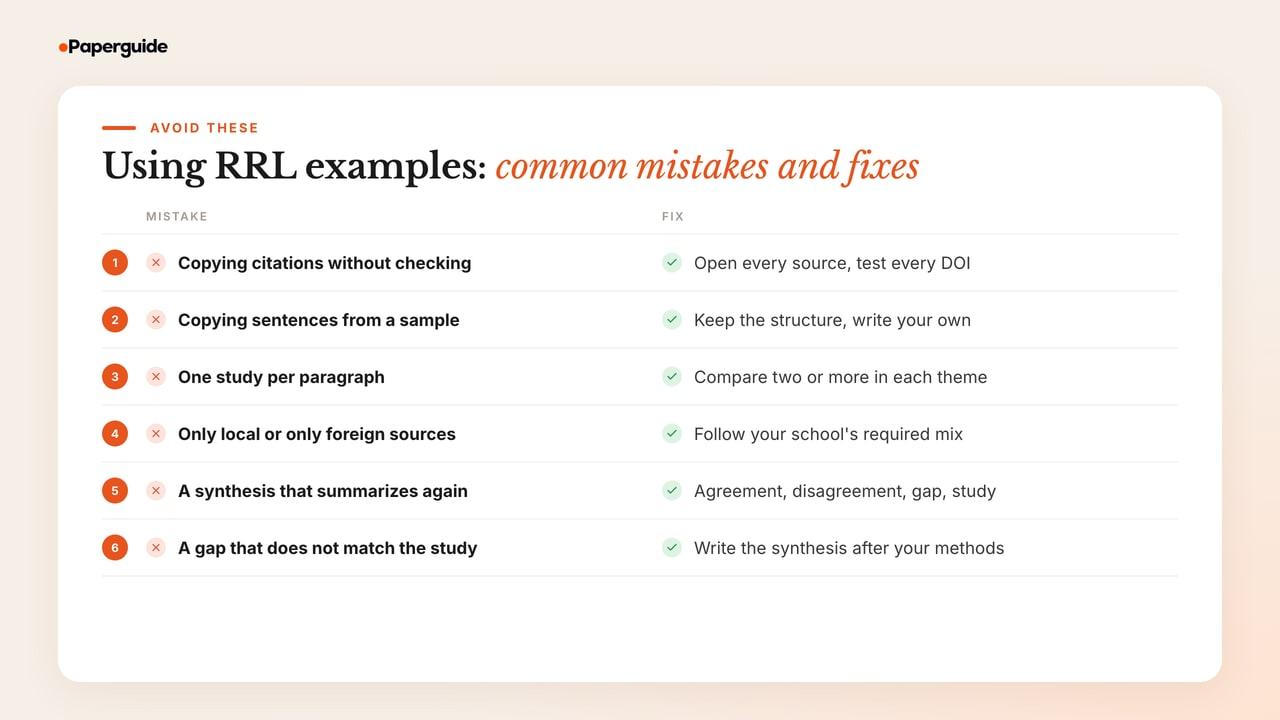
Copying citations without checking them. Some RRL samples shared online cite studies that cannot be traced to any journal. If you copy one, your reference list now contains a source that does not exist. Open every source before you cite it.
Copying sentences from a sample. Samples, including the ones here, show a pattern. Copying their sentences is plagiarism, and a similarity checker will flag it. Use the structure, then write about your own sources in your own words.
One study per paragraph. Advisers often return Chapter 2 for this. Each paragraph should compare at least two studies.
Only foreign or only local sources. Foreign studies alone do not show that the problem exists in your setting, and local studies alone do not show what is known elsewhere. Follow your school's required mix.
A synthesis that summarizes again. The synthesis should state the pattern across studies and the gap. If it lists studies one by one, rewrite it with the four-sentence pattern above.
A gap that does not match the study. If the synthesis says senior high school students are understudied but the study surveys college students, the panel will notice. Write the synthesis last, after your methods are set.
RRL Example Checklist
Before you hand in a Chapter 2 built from these samples, check:
- [ ] Every source has been opened and its DOI or link works
- [ ] Every sentence is my own, with quotes marked and paged
- [ ] Each theme paragraph cites two or more studies and compares them
- [ ] Local and foreign sources meet my school's required mix
- [ ] Disagreements between studies are explained by sample, setting, method or measure
- [ ] The synthesis states agreement, disagreement, the gap and my study
- [ ] The gap matches my study's population, setting and design
- [ ] Every in-text citation has a matching APA 7 entry in the reference list
Try It Yourself (2 Minutes)
- Pick the sample closest to your topic and note its themes.
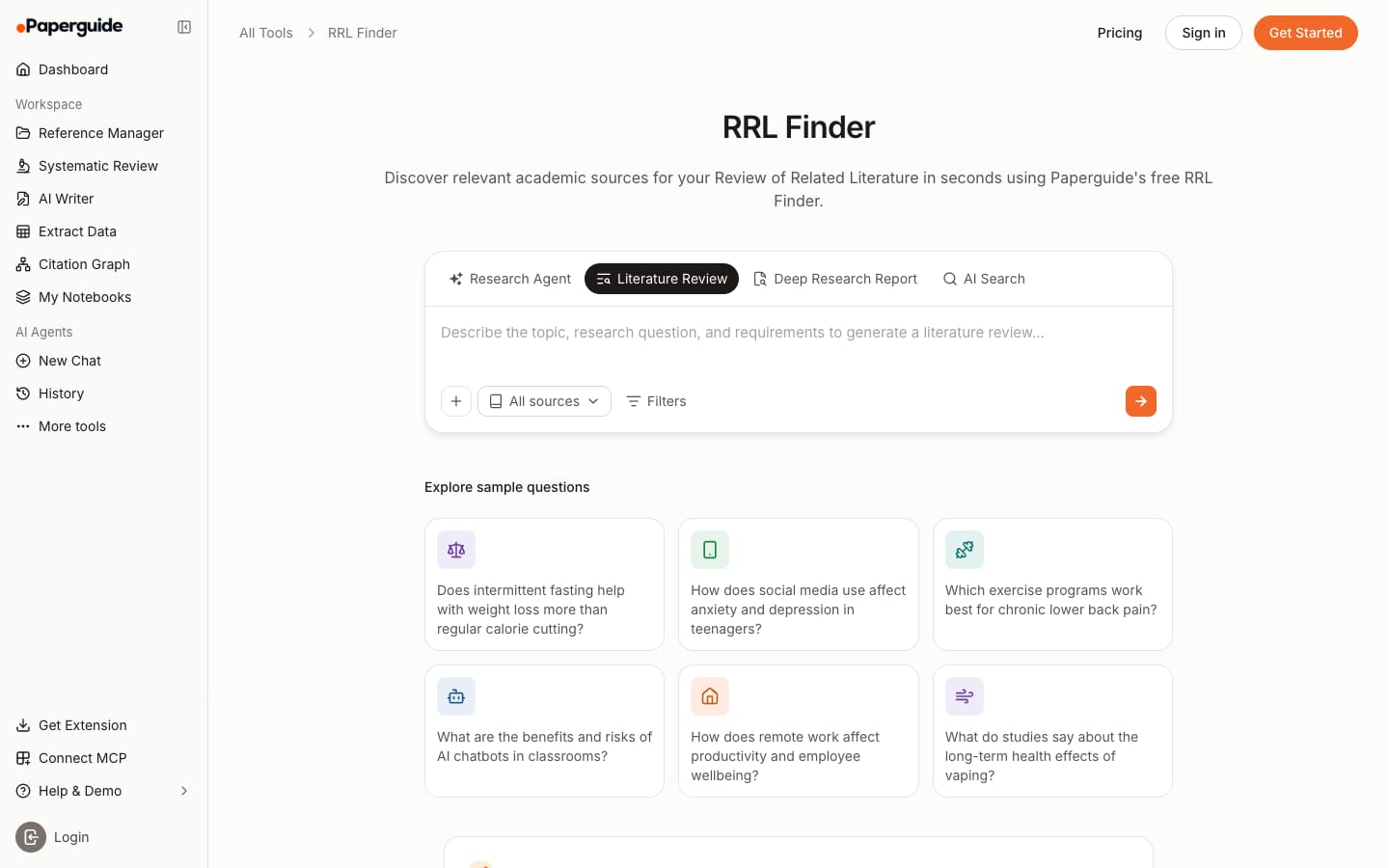
- Enter your own research title in Paperguide's free RRL Finder and find two studies that fit one of those themes.
- Write one sentence that compares the two studies, using the first theme paragraph of the sample as your model.
By the end you will have the opening sentence of your own RRL, built from sources you have checked.
Conclusion
A good RRL example does more than list studies. It groups them by theme, compares local and foreign findings, explains why studies disagree, and ends with a synthesis that leads to the study. The four samples here use only real, checkable sources, so you can see the pattern without inheriting a fabricated citation.
Use the samples for structure, then build your own review from your own matrix. Search for sources with the RRL Finder, and keep them in a Reference Manager so the APA 7 list stays accurate. For broader context, the explainer on what a literature review is explains the same method under its international name.
Frequently Asked Questions
What is an example of an RRL?
An RRL example is a sample Chapter 2 passage that groups studies by theme, compares them, and ends with a synthesis. For instance, a review on social media and grades might compare a Philippine survey linking smartphone addiction to lower performance with a meta-analysis showing that academic use is slightly positive.
How do you write an RRL with citations?
Write each theme paragraph around a claim, then support it with two or more studies cited in APA 7, such as (Regalado, 2024) or Regalado (2024). Add a full reference list entry with a DOI for every source. Check that every in-text citation matches an entry.
What is a thematic RRL example?
A thematic RRL organizes sources by topic rather than by author or date. All four samples in this guide are thematic: Example 3 uses three themes, the prevalence of stress, its sources, and its effects and protective factors.
What is an example of local and foreign literature?
A local study is one conducted in the Philippines, such as Regalado (2024) on senior high school students' academic stress. A foreign study is one conducted elsewhere, such as Son et al. (2020) on college students in the United States. Most schools ask for both.
What is an RRL example in qualitative research?
A qualitative RRL reviews what earlier studies found about an experience, such as students' difficulties in remote learning. Example 2 above groups Philippine and foreign findings into barriers, acceptance and coping, then names an experience not yet studied.
How many studies should an RRL have?
There is no national rule. Your school or adviser sets the count, often with a required mix of local and foreign sources. Judge by coverage: each variable or theme should have enough studies to show agreement and disagreement.
Can I copy an RRL example?
You can copy the structure, not the sentences. Copying text is plagiarism, and copying citations without checking them risks citing sources that do not exist. Use samples to learn the pattern, then write about your own sources.
Where can I find RRL examples in PDF?
Open-access journals publish full studies with literature reviews you can download, such as the Frontiers articles by Abad Santos et al. (2023) and Serrano et al. (2023). University repositories and Philippine E-Journals also hold local theses and articles. Treat uploaded student papers with care, since their citations are often unchecked.
References
- Purdue Online Writing Lab. (n.d.). Writing a literature review. Purdue University. https://owl.purdue.edu/owl/research_and_citation/conducting_research/writing_a_literature_review.html (accessed 9 November 2026)
- Texas Tech University Graduate Writing Center. (n.d.). 5 Cs to writing a literature review. https://www.depts.ttu.edu/provost/uwc/graduate/writing-resources/writing-a-literature-review.php (accessed 9 November 2026)
- USC Libraries. (n.d.). Organizing your social sciences research paper: 5. The literature review. University of Southern California. https://libguides.usc.edu/writingguide/literaturereview (accessed 9 November 2026)
- Abad Santos, P. M. T., Cleofas, J. V., Austria, A. G. O., de Guzman, A. K. B., & Sarile, B. A. F. (2023). The double-edged impact of Internet use on mental health outcomes among Filipino university students: The mediating role of online social support. Frontiers in Sociology, 8, 1132523. https://doi.org/10.3389/fsoc.2023.1132523
- Serrano, I. M. A., Cuyugan, A. M. N., Cruz, K., Mahusay, J. M. A., & Alibudbud, R. (2023). Sociodemographic characteristics, social support, and family history as factors of depression, anxiety, and stress among young adult senior high school students in metro Manila, Philippines, during the COVID-19 pandemic. Frontiers in Psychiatry, 14, 1225035. https://doi.org/10.3389/fpsyt.2023.1225035
The studies cited inside each sample are listed under that sample.
Reviewing literature?
Generate your literature review
Categorized sources, citations and key insights from a single topic.
Try it freeNo credit card required