How to Find Research Gaps: Step-by-Step Guide

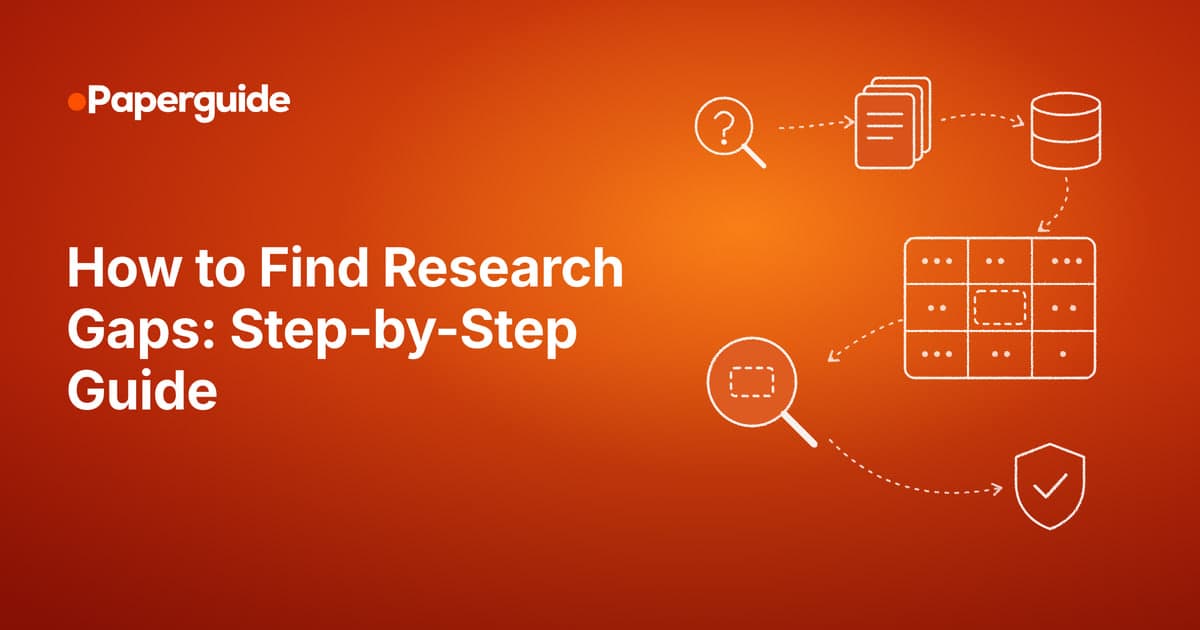
To find a research gap, map what the literature has studied, look for questions it leaves unanswered or contradictory, and then search for any study that already closes the gap. A real gap survives that search and matters to theory, practice or a specific population.
Many guides stop at the first half of that sentence. They tell you to read widely and look for "future research" lines, and they leave out the step that protects you from one of the costliest mistakes in research planning: building a study around a gap someone else has already filled.
This guide covers both halves. It shows how to identify research gaps for a thesis, a grant or an evidence synthesis project. You will find the types of research gaps and why they exist, a seven-step method, a test for proving a gap is real, where AI tools help and mislead, worked examples and a checklist to run before you commit months of work.
Key Takeaways
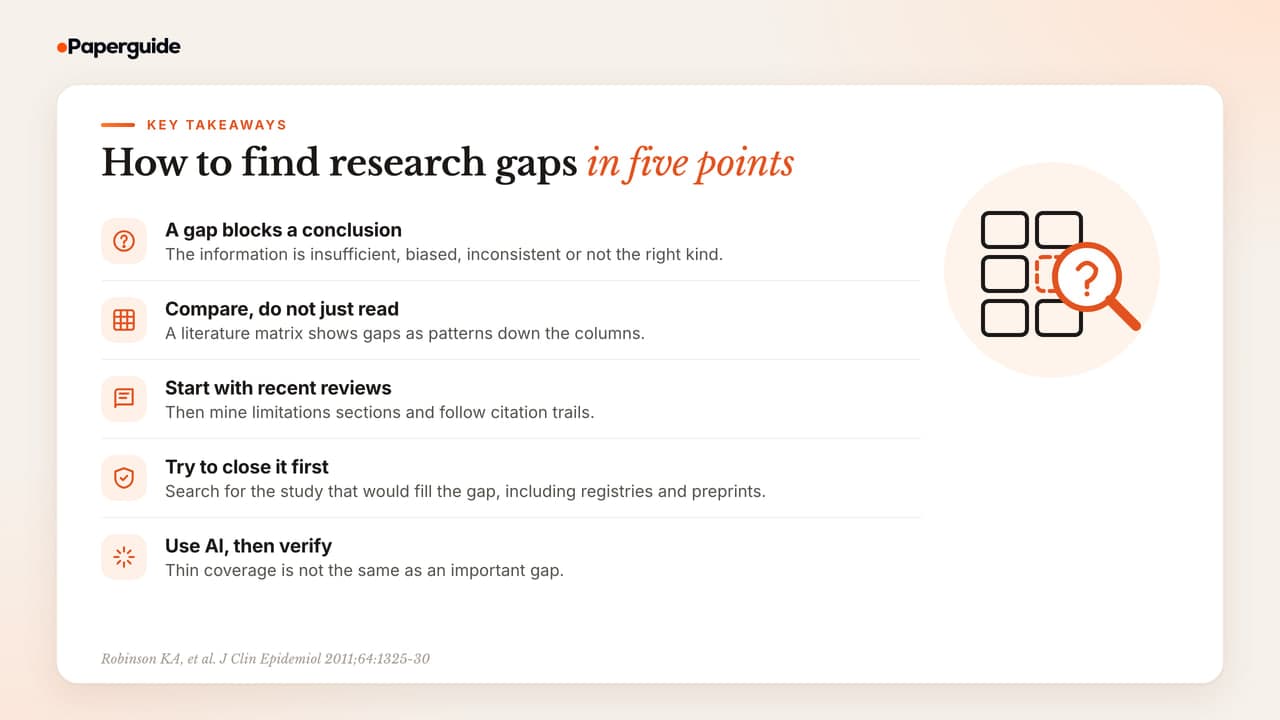
- A research gap is a question the existing evidence cannot answer because the information is insufficient, biased, inconsistent or not the right kind for the question.
- Find gaps by comparing studies side by side in a literature matrix, not by reading papers one at a time. Patterns across populations, methods and outcomes show what is missing.
- Start with recent systematic and scoping reviews, then mine limitations and future research sections, then follow citation trails forward and backward.
- Before you claim a gap, search for the study that would close it, including trial registries, PROSPERO and preprint servers. A gap that survives that search is one you can defend.
- AI tools can map coverage across thousands of papers quickly, but thin coverage is not the same as an important gap. Verify every AI suggestion against the source papers.
What Is a Research Gap?
A research gap is a question or area where the available evidence is too thin or too inconsistent to support a conclusion. In a framework developed for the US Agency for Healthcare Research and Quality (AHRQ), Robinson and colleagues treat a gap as the point where insufficient or unsuitable evidence stops a systematic review from reaching a conclusion [1].
That definition matters because it ties a gap to a question. "Nobody has studied X in country Y" is an observation. It becomes a research gap only when the missing study blocks an answer someone needs, whether that is a clinician choosing a treatment, a health technology assessment team building an economic model or a researcher testing a theory.
A gap is also different from a research problem. The gap is what the literature lacks. The research problem statement you write next explains why that missing knowledge causes harm or uncertainty in the real world, and the research question states what your study will do about it.
Types of Research Gaps
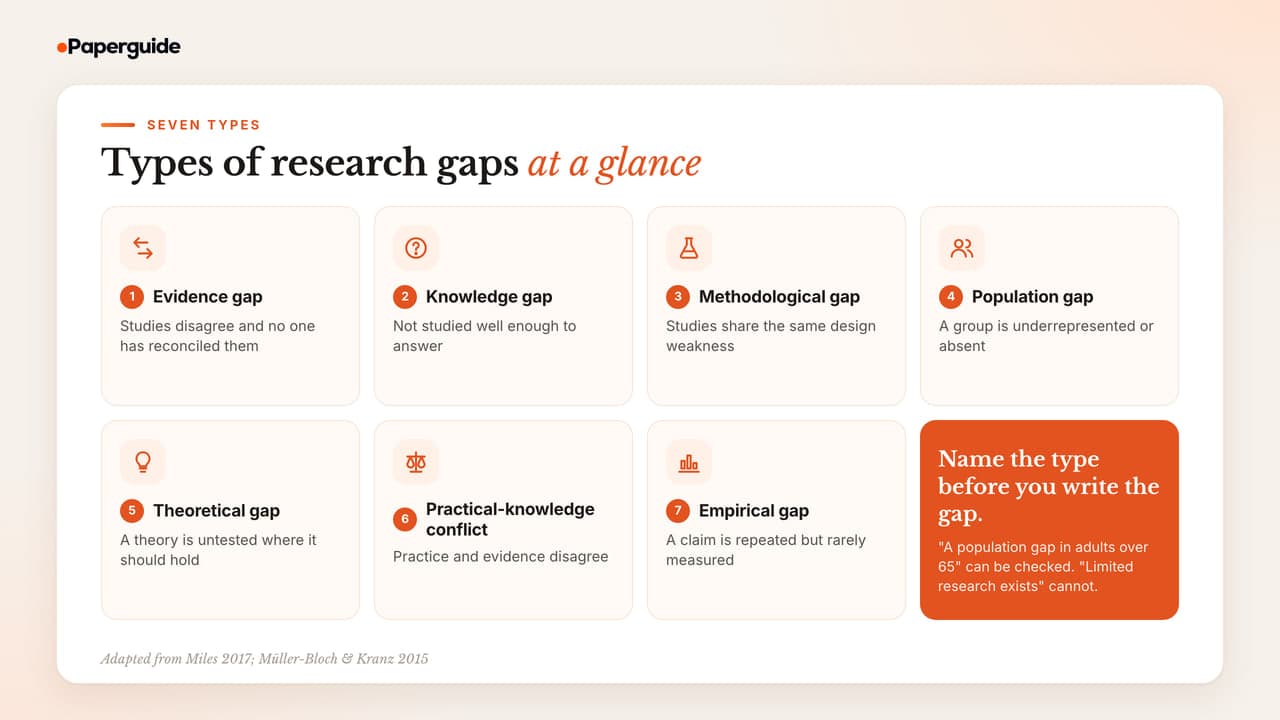
Researchers group gaps in slightly different ways. Miles proposed a commonly cited seven-type taxonomy [2], and information systems researchers Müller-Bloch and Kranz built a related framework for identifying gaps rigorously in literature reviews [3]. The table below uses Miles's seven labels, which most guides follow.
Types of Research Gaps: Definitions and Examples
| Gap type | Definition | Example |
|---|---|---|
| Evidence gap | Studies report contradictory results that no one has reconciled | Two trials of the same intervention point in opposite directions |
| Knowledge gap | The question has not been studied, or not studied well enough to answer | A review concludes "no eligible studies" for an outcome |
| Methodological gap | Existing studies share a design weakness | Every study is cross-sectional, so causal claims are untested |
| Population gap | A group is underrepresented or absent | Trials exclude older adults, yet the condition mainly affects them |
| Theoretical gap | A theory has not been applied or tested in a setting where it should hold | A behavior model is tested only in high-income countries |
| Practical-knowledge conflict gap | Practice and evidence disagree | Clinicians use an intervention widely with little supporting evidence |
| Empirical gap | A claim is widely repeated but rarely tested | A mechanism is cited in reviews but measured in few primary studies |
Naming the type of gap early helps you describe it precisely. "A population gap in trials of digital therapy for adults over 65" is something a reviewer can check. "Limited research exists" is not.
Why Do Research Gaps Exist?
Knowing why a gap exists tells you what kind of study would close it. The AHRQ framework, developed for systematic reviewers, gives four reasons evidence falls short [1]:
- Insufficient or imprecise information. There are too few studies, or the studies are too small to give a precise answer.
- Biased information. The studies exist, but their risk of bias is high enough that the findings cannot be trusted.
- Inconsistency or unknown consistency. Studies disagree, or there is only one study, so consistency cannot be judged.
- Not the right information. Studies measure the wrong outcomes, use the wrong comparators or follow people for too short a time.
The same framework recommends describing each gap with the PICOS elements (population, intervention, comparator, outcome, setting) so that the next researcher knows exactly which part of the question is unanswered. A gap described that way converts almost directly into a focused, answerable research question.
How to Find Research Gaps in 2026: Step by Step
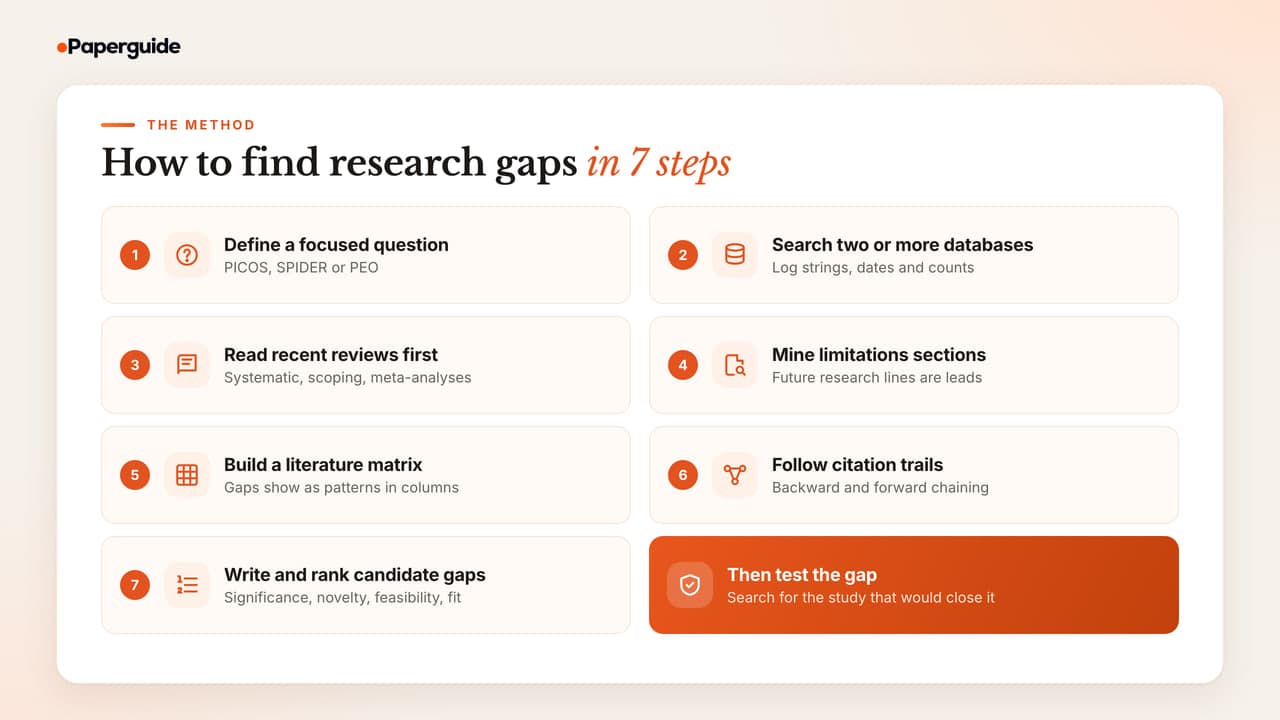
This is how to identify research gaps for a thesis, a grant application or a systematic review team scoping its next project. It assumes you already have a broad area, the point where finding a research topic ends and gap finding begins.
Step 1: Define a Focused Starting Question
Write a working question with the PICOS elements, even if it is rough. "Digital cognitive behavioral therapy for insomnia in adults" is a starting point. Without a population, outcome and setting, every paper looks relevant and no gap stands out. For qualitative or social science topics, SPIDER (sample, phenomenon of interest, design, evaluation, research type) or PEO (population, exposure, outcome) does the same job.
Step 2: Search at Least Two Databases and Log the Search
No single database covers every journal. For health topics, search PubMed plus Embase or Scopus. For social sciences, add PsycINFO, ERIC or Web of Science. For engineering and computer science, add IEEE Xplore and arXiv.
Record the search string, database, date and number of results for every search. This feels like overhead for gap finding, but it is what lets you say later, "I searched these sources on this date and found no study of X." That sentence is the evidence behind your gap claim, and it is what a supervisor or peer reviewer will ask to see.
Step 3: Read Recent Reviews First
Systematic reviews, scoping reviews and meta-analyses do the heavy lifting for you. Their discussion sections usually state what the evidence could not answer, and their tables show which populations, outcomes and designs have been studied. Read the most recent two or three reviews on your topic before any primary studies.
A scoping review that maps a field is especially useful here, because identifying gaps in the existing literature is one of the purposes Arksey and O'Malley set out for the method [9]. If no review exists on your topic, that absence is itself a signal, and conducting one may be the contribution.
Step 4: Mine the Limitations and Future Research Sections
The limitations and future research sections of recent papers are where authors list what they could not do. Collect these statements in a document with the citation beside each one.
Treat them as leads, not conclusions. Authors write these sections for their own study, often under word limits, and a "future research should examine" line may already have been answered by a paper published after it. Step 7 deals with that.
Step 5: Build a Literature Matrix
This is the step that turns reading into gap finding. Create a table with one row per study and columns for the elements that matter to your question: population, country or setting, design, sample size, intervention or exposure, comparator, outcomes, follow-up length and key finding.
Gaps appear as patterns down the columns. If every study in the follow-up column says "8 weeks," long-term effects are unknown. If the country column holds only high-income countries, the evidence may not transfer.
If the outcome column never mentions a measure patients care about, that is a gap in the right information. You cannot see these patterns while reading one paper at a time.
A spreadsheet is enough for 20 or 30 studies. Beyond that, an extraction tool such as Paperguide's Extract Data fills each cell from the full text of the paper, with every value cited to the sentence it came from, which saves days and keeps every entry checkable.
Step 6: Follow Citation Trails Both Ways
Pick the three to five most important papers and trace them backward (the papers they cite) and forward (newer papers that cite them). Backward chaining finds the foundational studies. Forward chaining finds what happened next, including any study that has since filled a gap the original authors flagged.
Forward chaining is easy to skip, and it is the step that catches a gap closed last year.
Step 7: Write Candidate Gaps and Rank Them
Write each candidate as one specific sentence that names the type and the PICOS element: "No randomized trial has tested digital CBT for insomnia in adults over 65 with follow-up beyond six months." Then rank your candidates on four criteria:
- Significance: Does closing it change a decision, a guideline or a theory?
- Novelty: Is it truly unaddressed? The next section tests this.
- Feasibility: Can you study it with the time, data, skills and money you have?
- Fit: Does it suit your field, your supervisor or your funder?
Keep two or three candidates. You will lose some in the next step.
How Do You Know a Research Gap Is Real?
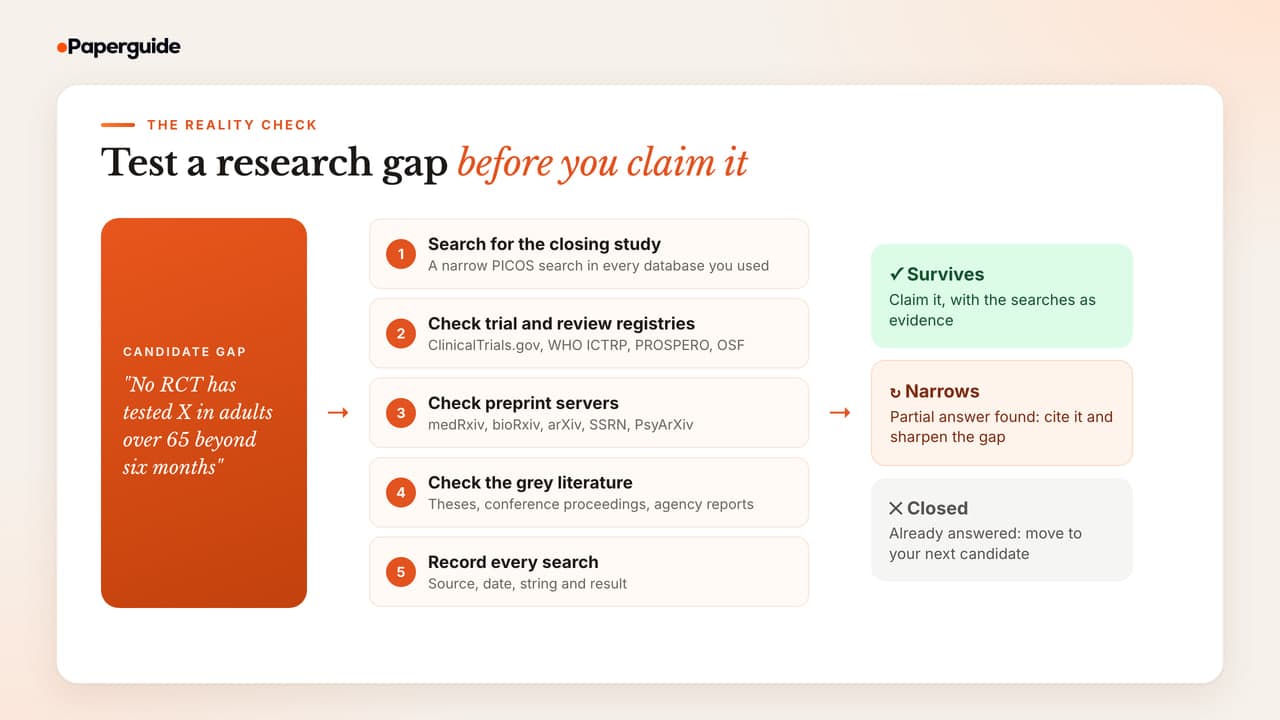
Most guides on finding research gaps tell you to look for what is missing. Fewer explain how to show that it is missing. The difference matters because building on unchecked assumptions is expensive.
Chalmers and Glasziou estimated that about 85% of health research investment is avoidably wasted, and research designed without reference to what is already known is one of the stages where that waste begins [4]. A 2022 meta-research review covering 1,724 original studies found that, on average, only about 31% used a systematic review to put their new results in context [7].
The fix is to switch from searching for papers that support your gap to searching for the paper that would close it.
- Write the closing study. Describe the study that, if it existed, would fill your gap: "an RCT of digital CBT for insomnia in adults over 65 with 12-month follow-up."
- Search for that study directly. Run a narrow search built from its PICOS elements in every database you used, sorted by date. Include synonyms for each element.
- Check registries for ongoing work. Search ClinicalTrials.gov and the WHO International Clinical Trials Registry Platform for trials in progress, PROSPERO, the international register of systematic review protocols, for reviews already underway [8], and OSF Registries for registered studies in other disciplines. A registered study means someone is already working on your gap.
- Check preprint servers. Preprints on medRxiv, bioRxiv, arXiv, SSRN and PsyArXiv carry work months before journals publish it.
- Check the grey literature. Grey literature such as theses, conference proceedings and agency reports sometimes answers questions journals never see.
- Record what you found. Write down each search and its result. If the gap survives, you now have a documented, defensible claim. If it does not, you have saved yourself months.
If you find a partial answer, the gap may narrow rather than disappear. A study in adults over 65 with three-month follow-up leaves the long-term question open, and your gap statement becomes sharper for it.
How to Find Research Gaps Using AI
AI tools change how fast you can do steps 2 to 6, and they change little about step 7. Used well, AI tools built for literature review let you screen thousands of abstracts, extract a matrix from dozens of full texts and map which combinations of population, method and outcome have been studied. Used badly, they produce confident lists of gaps that are not real.
What AI does well:
- Searching across large paper databases with natural-language questions instead of exact keywords
- Screening and ranking large result sets by relevance
- Extracting the same fields from many papers into a table
- Mapping coverage, showing which cells of a population by outcome grid are full and which are empty
Where AI misleads:
- Coverage is not importance. A thinly studied combination may be thin because it does not matter. Only you and your field can judge significance.
- Missing from the index is not missing from the literature. No AI tool indexes every database, registry and preprint server.
- Generated references can be wrong. When Walters and Wilder checked 636 references generated by ChatGPT for short literature reviews, 55% of the GPT-3.5 citations and 18% of the GPT-4 citations were fabricated [5]. Never cite a paper you have not opened.
What a Research Gap Finder Should Do
A research gap finder is only useful if it keeps each claim tied to a source and shows its working. Paperguide's Research Gap Finder is built around the check in the previous section.
You enter a research question. The tool collects and screens the literature and builds an evidence coverage map along dimensions such as population, setting, method and outcome. It then runs extra searches that try to disprove each candidate gap.
Gaps that survive appear in a graded report that states what is missing, what the gap blocks and the study that would fill it, with the searches on record. It looks for knowledge, methodological, population, contextual, measurement and contradictory-evidence gaps, the last of which matches the evidence gap in the table above.
Two details matter before you run it. It uses more credits than a standard search, because of those extra searches. And when you run it on your own Reference Manager library, it reports what your collection does and does not contain rather than claiming a gap in the literature, since absence from one person's library is not evidence of a gap.
When we ran the Research Gap Finder on "digital CBT for insomnia in adults over 65" for this guide, its final evidence map held 68 papers, drawn from an initial search and four extra searches aimed at disproving candidate gaps. The first gap it reported was an age-specific population gap: four studies addressed adults over 65, seven covered older adults spanning that age, and 46 of the 68 papers did not report participants' ages at all.
It graded the gap provisional with high priority, listed the searches it had run to try to close it, and stated in its limitations that an empty cell means no screened-in paper in this collection, not proof that no study exists. That caution is correct, and it is why the checks in the previous section still belong to you.
Research Gap Examples: From Search to Research Question
The example below is hypothetical and separate from the tool run above, so its numbers differ. It shows the process, not the current literature on this topic, so run your own searches before relying on any part of it.
Starting question: Does digital cognitive behavioral therapy for insomnia (dCBT-I) improve sleep in adults?
Step 3, reviews: Suppose two recent meta-analyses report benefit for sleep outcomes in working-age adults. Their discussion sections note that few trials enrolled participants over 65 and most followed people for less than six months.
Step 5, matrix: Your matrix of included trials confirms the pattern. The age column clusters between 30 and 55, and the follow-up column mostly reads 8 to 12 weeks. Two trials include older adults, both with short follow-up.
Candidate gap: A population gap combined with a "not the right information" gap. No trial tests dCBT-I in adults over 65 with follow-up long enough to show whether benefit lasts.
Step 7 and the reality check: You search for the closing study in PubMed, Embase, ClinicalTrials.gov, the WHO registry and medRxiv. Suppose you find one registered trial in adults over 60 with six-month follow-up, still recruiting. The gap narrows: long-term outcomes beyond six months in adults over 65 remain untested, and the registered trial becomes a citation in a stronger research rationale rather than a surprise from a reviewer.
Gap statement: "Although dCBT-I improves sleep outcomes in working-age adults, trials have rarely enrolled adults over 65, and none has followed them beyond six months. Whether benefit is sustained in this group, which carries a high burden of insomnia, remains unknown."
Research question: "In adults aged 65 and over with chronic insomnia, does dCBT-I compared with sleep hygiene education improve insomnia severity at 12 months?"
Notice what changed between the starting question and the final one. The population, comparator, outcome and time point are now explicit, and every element traces back to something you found, or did not find, in the evidence.
Research Gap Examples by Field
The same method works outside health research. The gap statements below are illustrations of the form, not findings, so check the literature in your own field before using any of them.
| Field | Gap type | Example gap statement |
|---|---|---|
| Education | Population | Studies of a reading intervention test it in primary schools, but none in adult literacy programs where learners have different starting points. |
| Public health | Methodological | Every study of a community program uses before and after surveys without a comparison group, so its effect cannot be separated from wider trends. |
| Computer science | Empirical | A model is reported to generalize across hospitals, but every evaluation uses data from the same two sites. |
| Social science (qualitative) | Knowledge | Research on gig work describes drivers' experiences in cities, but not in rural areas where platforms work differently. |
| Environmental science | Theoretical | A resilience framework is applied to coastal communities but not tested in inland flood zones where it should also hold. |
How to Write a Research Gap Statement
A gap statement does three things in two or three sentences: it says what is known, says what is not known, and explains why that matters. A simple template:
"Although [what existing studies have shown], [what remains unstudied, untested or unresolved, with the specific population, method or outcome]. This matters because [the decision, theory or group affected]."
Weak vs Strong Research Gap Statements: Examples
| Weak gap statement | Strong gap statement |
|---|---|
| "More research is needed on telehealth." | "Trials of [intervention] in [population] report outcomes to 12 weeks only, so whether gains last to one year is unknown." |
| "Little is known about this topic." | "No study has measured X in rural settings, where access to Y differs most." |
| "There is a gap in the literature." | "Three cohort studies disagree on the direction of the association, and none adjusted for Z." |
The bracketed rows are templates, not findings. Strong statements name the gap type, cite the evidence and point to a study design, which is what lets a reader agree that the gap is real.
Once written, the statement slots into the introduction of your research paper and becomes the point that the synthesis in your literature review builds toward.
Paperguide's AI Paper Writer can take that research question and draft the introduction or literature review from your Reference Manager library and a database of 200M+ papers, with each claim cited in your chosen style.

Evidence Gap Maps for Systematic Review and HEOR Teams
For teams that synthesize evidence for guidelines, health technology assessment or market access, gap finding happens at a different scale. Instead of one gap for one study, the job is to show a funder or decision maker where evidence is strong, weak or absent across a whole field.
Evidence and gap maps do this visually. As described by Snilstveit and colleagues at 3ie, they place interventions on one axis and outcomes on the other, and fill each cell with the studies or reviews that address that combination. Empty or sparse cells show where evidence is missing, and the map is used to set research agendas and direct funding [6].
For a HEOR team, the same logic applies to an economic model or a submission dossier. Every parameter that rests on a single small study, an expert opinion or an assumption is a gap in the evidence. Naming each one with the AHRQ reasons (insufficient, biased, inconsistent or not the right information) makes the uncertainty explicit for reviewers.
In Europe this now has a formal shape. Under the EU Health Technology Assessment Regulation, joint clinical assessments are scoped around PICO questions, and they apply to new cancer medicines and advanced therapy medicinal products from January 2025 [10]. A dossier that maps its evidence against each PICO, and states plainly where it is missing, gives assessors less to find on their own.
When a systematic review done step by step finds that a question cannot be answered, its gap statement is often the most useful output for the next team.
Common Mistakes When Identifying Research Gaps
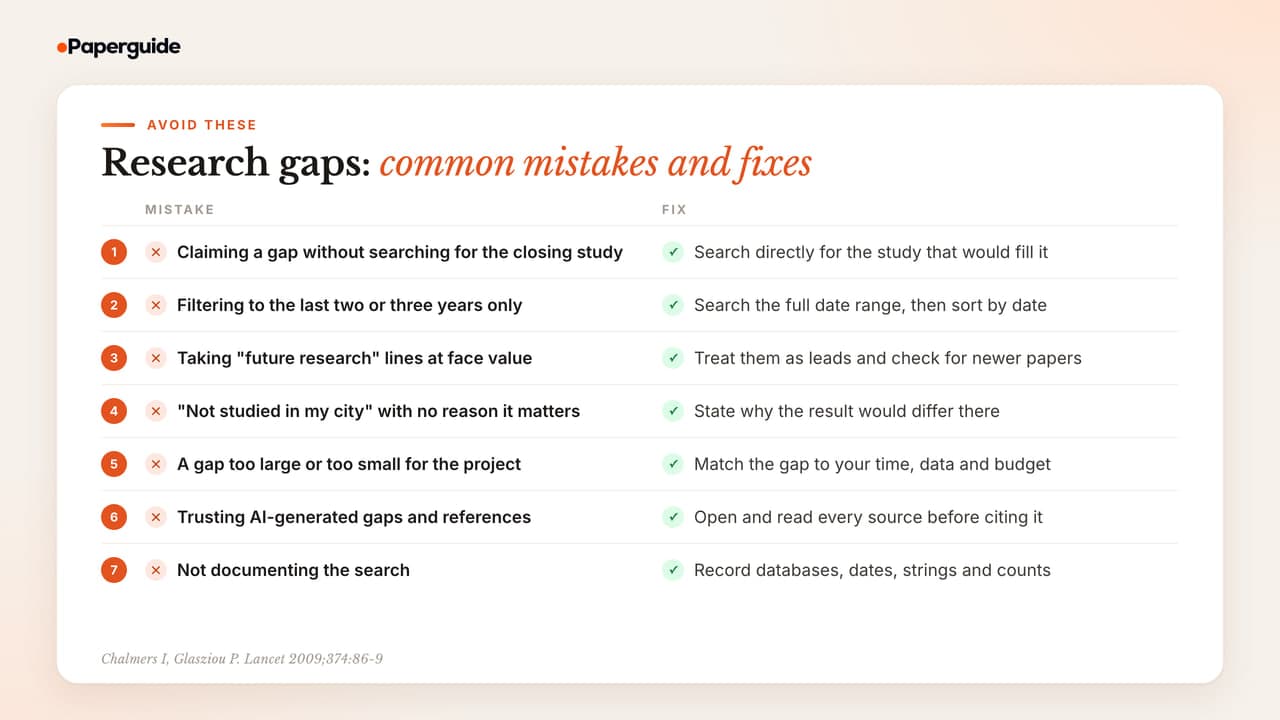
Claiming a gap without searching for the closing study. This is the costliest one. A reviewer who finds the paper you missed will question everything else in the proposal.
Filtering to the last two or three years only. Recent-only searches miss older foundational studies and long-running debates that are still unresolved. Search the full date range, then sort by date.
Taking "future research" lines at face value. These sections reflect what one team could not do in one study. They are leads to check, and some have been answered since the paper appeared.
Mistaking "not studied here" for a gap. "No one has studied X in my city" is only a gap if there is a reason the result would differ there. State that reason, or choose a different gap.
Choosing a gap too large or too small. A gap that needs a multicenter trial will not fit a master's thesis, and one answered by a single survey question will not carry a PhD. Match the gap to the scale of the project.
Trusting AI-generated gaps and references without checking. AI can suggest where coverage is thin. It cannot tell you whether the gap matters, and its references must be opened and read before they are cited.
Not documenting the search. Without a record of databases, dates and strings, a reviewer has only your word for the gap.
Research Gap Checklist
Run this before you commit to a gap.
- [ ] The gap is written as one specific sentence naming the population, intervention or exposure, outcome and setting
- [ ] The gap type is named (evidence, knowledge, methodological, population, theoretical, practical-knowledge conflict or empirical)
- [ ] The reason for the gap is clear (insufficient, biased, inconsistent or not the right information)
- [ ] At least two databases were searched, with strings, dates and result counts recorded
- [ ] Recent systematic and scoping reviews were read and their stated gaps noted
- [ ] Citation trails were followed forward from the key papers
- [ ] A direct search for the closing study found nothing, or only a partial answer that has been cited
- [ ] Trial registries, PROSPERO and preprint servers were checked for ongoing work
- [ ] The gap matters to someone, with the decision, theory or group affected stated
- [ ] The gap fits the project in time, data, skills, budget and supervisor or funder priorities
- [ ] Every reference has been opened and read, including any suggested by an AI tool
Try It Yourself (2 Minutes)
- Write the research question you are working on as one sentence with a population, an intervention or exposure, and an outcome.
- Run it through Paperguide's Research Gap Finder and read the graded report. The report takes several minutes because of the extra searches (about 12 for ours), so start step 3 while it runs, then note which candidate gaps survived and which searches were run against them.
- Pick the strongest surviving gap and check it yourself: search ClinicalTrials.gov or OSF Registries for one ongoing study that might close it.
By the end you will have one candidate gap, the searches behind it and one check you ran yourself.
Conclusion
Learning how to find research gaps is mostly learning to compare. Map what has been studied in a literature matrix, read the newest reviews and the limitations they report, follow citation trails forward, and write each candidate gap as a specific sentence tied to a population, method or outcome.
The step that separates a defensible gap from a hopeful one comes last: search for the study that would close it, in databases, registries and preprint servers, and record what you find. A gap that survives that search is one you can build a proposal, a thesis or a review on with confidence. From there, the next step is turning the gap into a precise research question and a testable research hypothesis your study can answer.
Frequently Asked Questions
How do I find a research gap quickly?
Start with the two or three most recent systematic or scoping reviews on your topic and read their discussion sections, which usually state what the evidence could not answer. Then build a short literature matrix of the studies they include and look for patterns in populations, designs and follow-up. This can surface candidate gaps in a few days rather than weeks, though you still need to check each one for newer studies.
How do you identify research gaps in a literature review?
Compare studies systematically instead of summarizing them one by one. A matrix with columns for population, setting, design, outcomes and findings shows where evidence clusters and where it is absent or contradictory. The AHRQ framework adds a useful lens: for each unanswered question, ask whether the information is insufficient, biased, inconsistent or not the right kind [1].
What is the difference between a research gap and a research problem?
A research gap is what the literature lacks. A research problem is the real-world issue that makes the missing knowledge matter, such as a clinical decision made without evidence. A strong proposal states the problem, shows the gap in the evidence, and then asks a research question that would close it.
Can AI find research gaps for me?
AI can map which topics, populations and outcomes have been studied across thousands of papers and suggest where coverage is thin. It cannot judge whether a gap matters, and it can miss studies outside its index or produce inaccurate references [5]. Use AI to speed up searching, screening and extraction, then verify every suggested gap against the source papers.
What if someone is already working on my research gap?
Check trial registries, PROSPERO and preprint servers before you start. If you find a registered study, read its protocol: it may cover a different population, comparator or follow-up period, which leaves part of your gap open. Cite it in your rationale and narrow your question, or choose another candidate gap.
How many papers should I read before claiming a research gap?
There is no fixed number. The test is saturation and documentation: you have searched at least two databases, read the recent reviews, followed citation trails forward from the key papers, and run a direct search for the study that would close the gap. When new searches stop turning up relevant studies, and you have recorded each one, your claim is defensible.
Is replicating an existing study a valid research gap?
Yes, when there is a reason the replication adds knowledge. A single small study, a finding never tested in another population or setting, or a result with high risk of bias are all legitimate reasons to replicate. State why the original evidence is insufficient and what your replication changes.
What are examples of research gaps in qualitative research?
Common qualitative gaps include perspectives that have not been heard (patients' views of a treatment studied only through clinician interviews), settings that have not been explored (rural or low-income contexts), and experiences that quantitative studies measure but do not explain (why adherence drops after a few weeks). The same matrix approach works, with columns for participants, setting, method of data collection and themes.
References
- Robinson, K. A., Saldanha, I. J., & McKoy, N. A. (2011). Development of a framework to identify research gaps from systematic reviews. Journal of Clinical Epidemiology, 64(12), 1325-1330. https://doi.org/10.1016/j.jclinepi.2011.06.009
- Miles, D. A. (2017). A taxonomy of research gaps: Identifying and defining the seven research gaps. Doctoral Student Workshop: Finding Research Gaps, Research Methods and Strategies, Dallas, Texas. researchgate.net/publication/319244623
- Müller-Bloch, C., & Kranz, J. (2015). A framework for rigorously identifying research gaps in qualitative literature reviews. Proceedings of the 36th International Conference on Information Systems (ICIS), Fort Worth. https://aisel.aisnet.org/icis2015/proceedings/ResearchMethods/2/
- Chalmers, I., & Glasziou, P. (2009). Avoidable waste in the production and reporting of research evidence. The Lancet, 374(9683), 86-89. https://doi.org/10.1016/S0140-6736(09)60329-9
- Walters, W. H., & Wilder, E. I. (2023). Fabrication and errors in the bibliographic citations generated by ChatGPT. Scientific Reports, 13, 14045. https://doi.org/10.1038/s41598-023-41032-5
- Snilstveit, B., Vojtkova, M., Bhavsar, A., Stevenson, J., & Gaarder, M. (2016). Evidence & Gap Maps: A tool for promoting evidence informed policy and strategic research agendas. Journal of Clinical Epidemiology, 79, 120-129. https://doi.org/10.1016/j.jclinepi.2016.05.015
- Draborg, E., Andreasen, J., Nørgaard, B., Juhl, C. B., Yost, J., Brunnhuber, K., Robinson, K. A., & Lund, H. (2022). Systematic reviews are rarely used to contextualise new results: A systematic review and meta-analysis of meta-research studies. Systematic Reviews, 11, 189. https://doi.org/10.1186/s13643-022-02062-8
- Booth, A., Clarke, M., Dooley, G., Ghersi, D., Moher, D., Petticrew, M., & Stewart, L. (2013). PROSPERO at one year: An evaluation of its utility. Systematic Reviews, 2, 4. https://doi.org/10.1186/2046-4053-2-4. Register: https://www.crd.york.ac.uk/prospero/ (accessed 22 October 2026)
- Arksey, H., & O'Malley, L. (2005). Scoping studies: Towards a methodological framework. International Journal of Social Research Methodology, 8(1), 19-32. https://doi.org/10.1080/1364557032000119616
- European Parliament and Council of the European Union. (2021). Regulation (EU) 2021/2282 on health technology assessment. Official Journal of the European Union, L 458, 1-32. https://eur-lex.europa.eu/eli/reg/2021/2282/oj (accessed 22 October 2026)
Looking for a research gap?
Find research gaps that hold up
Map the evidence, test each gap against counter-evidence and get a graded report.
Find research gapsNo credit card required