What Is RRL in Research? Meaning, Parts and Purpose

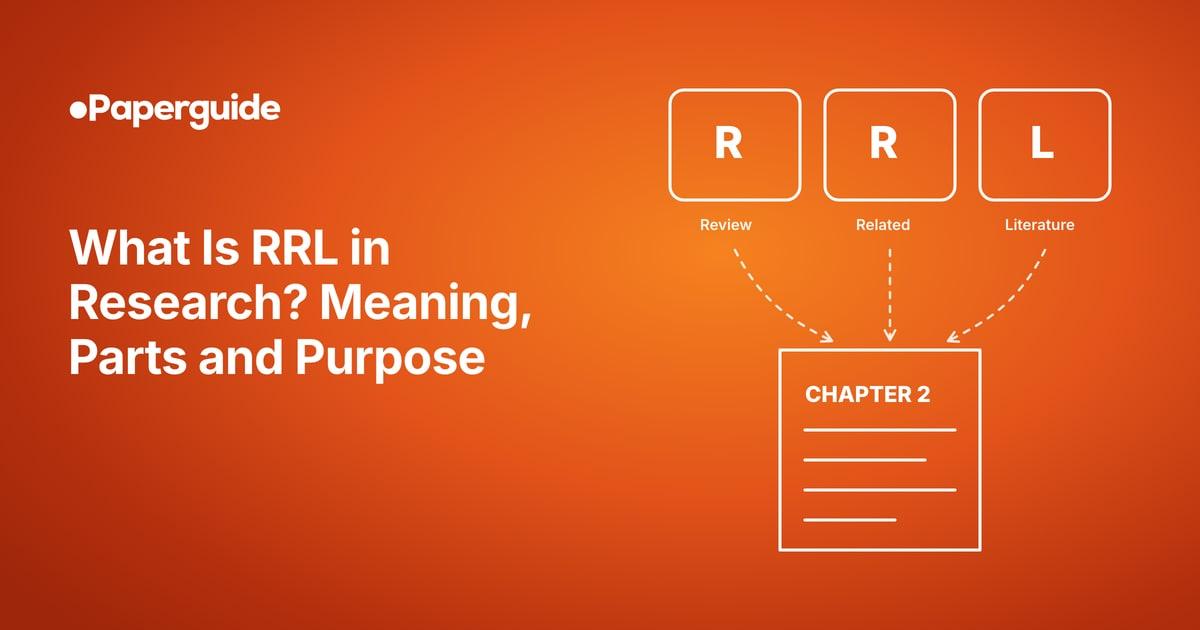
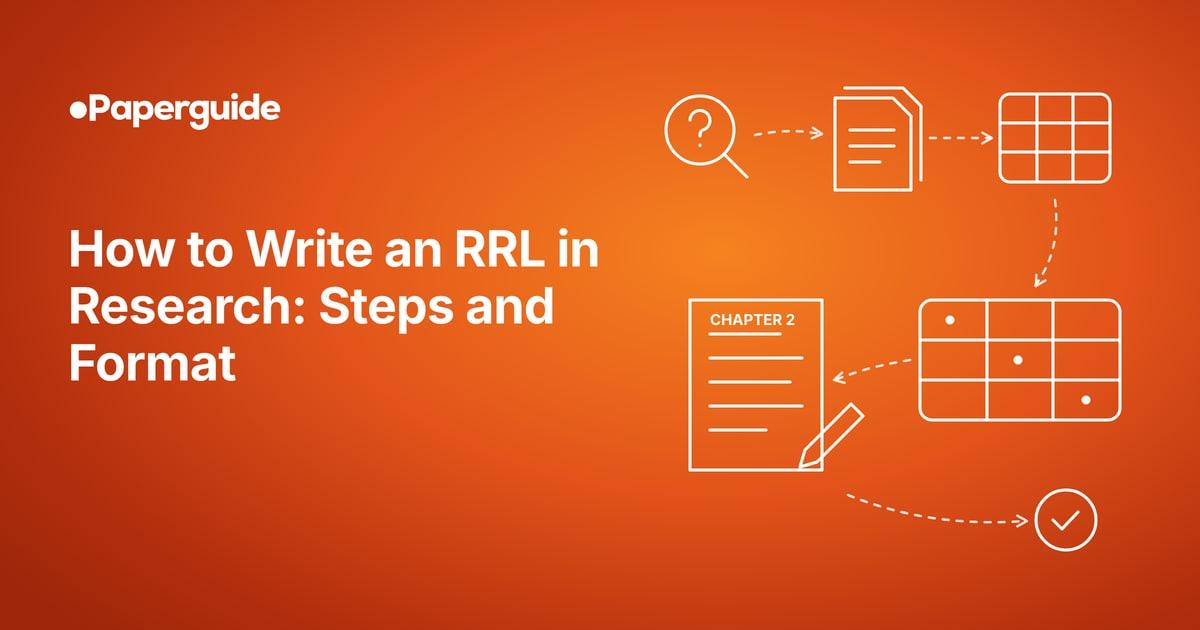
RRL in research means review of related literature: the part of a research paper, usually Chapter 2, that summarizes and synthesizes earlier studies and writings on your topic. It shows what is already known, where studies agree or disagree, and the gap your own study fills.
This guide explains what RRL means and where the term comes from, how it relates to a literature review, which chapter it belongs in, its purpose, its three parts as a DepEd module describes them, the difference between RRL and RRS, and local and foreign sources. It is written for senior high school students in Practical Research and for college students preparing a thesis.
Key Takeaways
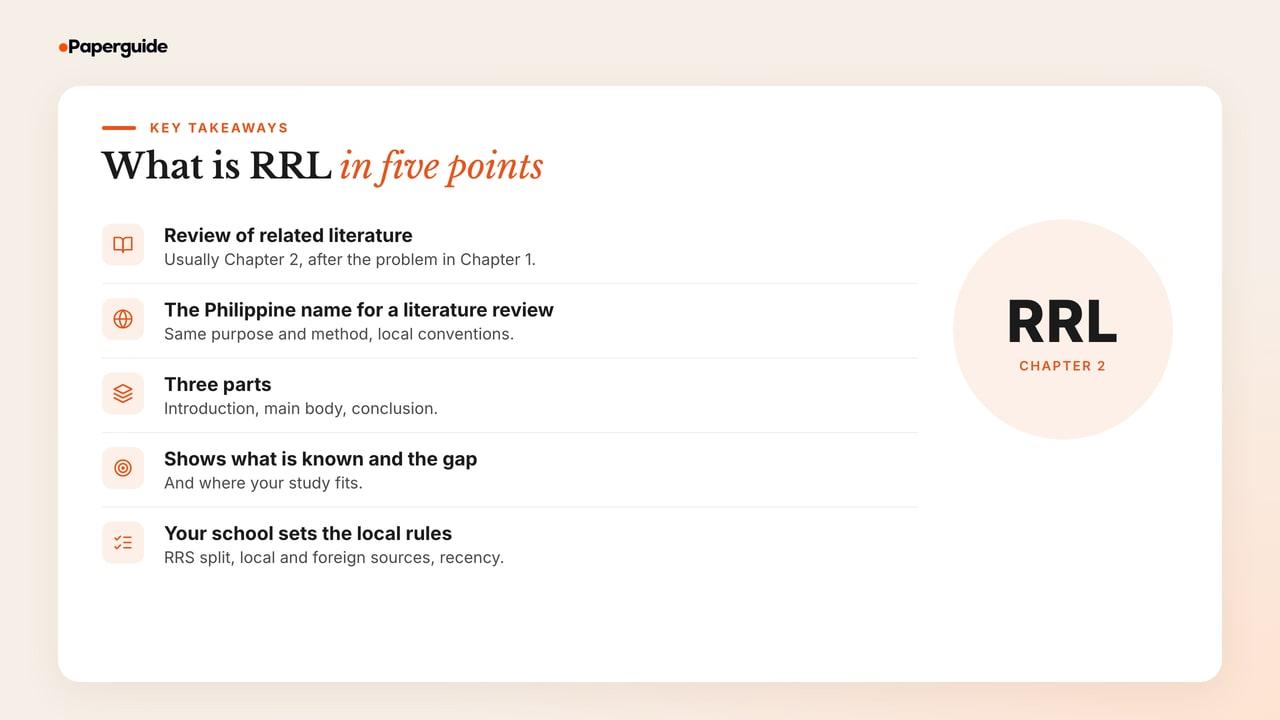
An RRL is the chapter where you show that you know what earlier research says about your topic, and why your study is still needed. In the Philippines it has a standard name, a usual place and a few local conventions, but it does the same job as a literature review anywhere.
- RRL stands for review of related literature. In Philippine research papers it is usually Chapter 2, written after Chapter 1 introduces the problem.
- It is the Philippine name for a literature review. The purpose and the method are the same.
- A DepEd self-learning module describes three parts: an introduction, a main body and a conclusion.
- Its main purpose is to place your study within existing research: what is known, what is disputed and what is missing.
- Some schools also ask for related studies (RRS) and for local and foreign sources. Your school's thesis manual sets these rules.
What Does RRL Mean in Research?
RRL stands for review of related literature. Each word carries part of the meaning:
- Review: you look again at what others have written, then summarize, compare and evaluate it.
- Related: you include only work connected to your research problem and variables, not everything on a broad subject.
- Literature: published and unpublished writing on the topic, including journal articles, books, reports, theses and dissertations.
A DepEd self-learning module defines the RRL as "one of the major components of a research paper" that "gives an overview of all the writings relative to a specific topic" [1]. A University of the Philippines Manila research course guide describes the same chapter as a summary, "as well as a critical analysis and evaluation, of scholarly studies related to your topic/research problem" [2].
The second definition adds evaluation, and that is the point: an RRL is not a list of summaries. It is an argument, built from sources, that leads to your study.
Other Meanings of RRL
Outside academic writing, "RRL" can also refer to Double RL, a Ralph Lauren clothing brand named after Ralph Lauren's working cattle ranch in Colorado [3]. Outside a research paper, check the context. In a research paper, RRL always means review of related literature.
Is RRL the Same as a Literature Review?
Yes. RRL is the name Philippine schools use for a literature review, and the abbreviation is a local habit. The UP Manila course guide uses "literature review" and "review of related literature" for the same chapter [2], and the idea itself is international. If you read guides from other countries on what a literature review is, the method applies directly to your RRL.
What differs is the packaging. Philippine schools often fix the RRL as Chapter 2, may ask you to separate related literature from related studies, and may require a mix of local and foreign sources. A literature review written for a journal article abroad would rarely follow those rules.
An RRL is also different from a systematic review, as the guide on how a systematic review differs from a literature review explains. A systematic review is a full study that usually has a pre-registered protocol and a reproducible search. An RRL is a chapter that supports your own study, and its search does not need to be exhaustive.
What Chapter Is RRL in Research?
In Philippine research papers, the RRL is usually Chapter 2. The UP Manila course guide states that "the second chapter of your research proposal is the Review of Related Literature" [2], and the DepEd module tells students to write it after they have "crafted your 1st Chapter (Introduction)", calling it "your Chapter II" [1].
A common thesis outline looks like this:
Typical Chapters of a Philippine Research Paper
| Chapter | Title | What it contains |
|---|---|---|
| 1 | The Problem and Its Background | Introduction, statement of the problem, significance, scope |
| 2 | Review of Related Literature (and Studies) | Related literature and studies, synthesis, often the framework |
| 3 | Research Methodology | Design, participants, instruments, data collection, analysis |
| 4 | Results and Discussion | Findings and their interpretation |
| 5 | Summary, Conclusions and Recommendations | What the study found and what should follow |
Chapter titles and the placement of the theoretical framework, the conceptual framework and the definition of terms vary between schools. In senior high school, DepEd pairs the RRL with the conceptual framework: the Practical Research 2 curriculum guide lists "Presents written review of related literature and conceptual framework" as one competency [4]. The guides to the conceptual framework with examples and the theoretical framework in research cover those sections.
What Is the Purpose of RRL in Research?

The RRL exists because, in the words of Boote and Beile, "a researcher cannot perform significant research without first understanding the literature in the field" [5]. In practice, it does six jobs for your study.
1. Show what is already known. The RRL gives your reader the background they need. The DepEd module puts it simply: the related researches, articles and journals "will be identified, summarized, and acknowledged" [1].
2. Avoid repeating work that is done. Reviewing the literature tells you whether your question has already been answered. USC Libraries lists the purpose to "identify areas of prior scholarship to prevent duplication of effort" [6].
3. Reveal gaps. The RRL is where you find and prove the gap your study fills. USC lists the aim to "reveal any gaps that exist in the literature" [6], and Purdue OWL describes reviews as a way to "find gaps in existing research in order to propose new projects" [7]. The guide on how to find research gaps shows how.
4. Learn from earlier methods. Reading how others designed similar studies helps you choose your design, sample and instruments, and avoid their mistakes. The UP Manila guide, quoting Kumar, says the review helps you "clarify your ideas and develop your research methodology" [2].
5. Build your framework. The theories and variables in the literature become your theoretical and conceptual framework. Purdue lists using reviews to "develop a theoretical framework and methodology for later research" [7].
6. Place your study and its findings in context. USC calls this aim "very important": to "locate your own research within the context of existing literature" [6]. Later, in Chapter 4, you compare your results with the studies in your RRL.
What Are the Parts of an RRL?
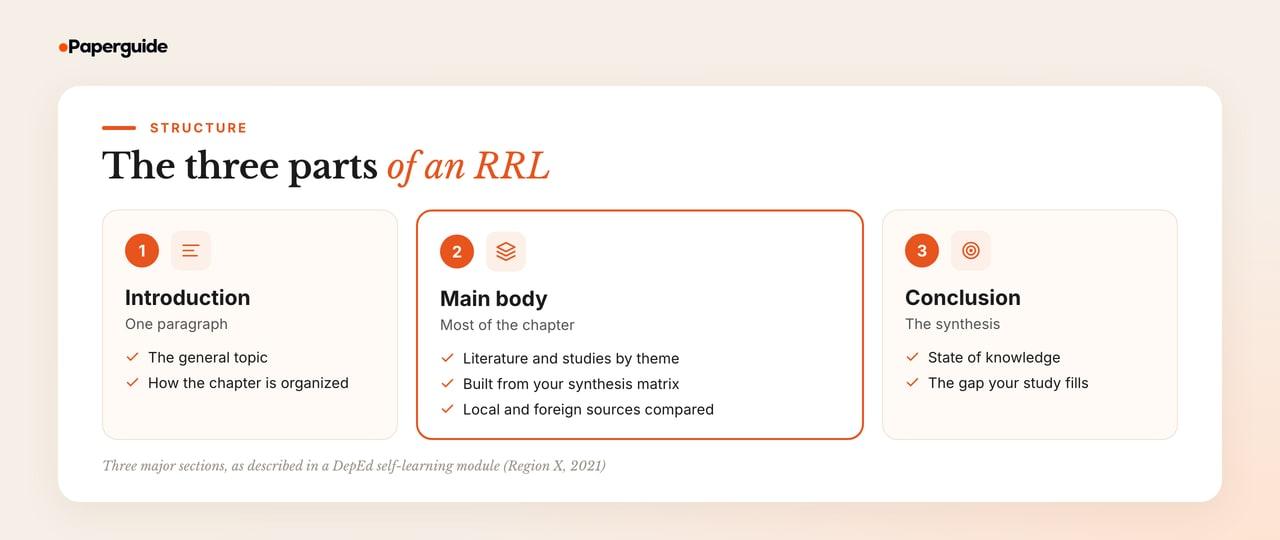
A DepEd self-learning module states that "the review of related literature is commonly composed of three major sections: a) Introduction, b) Main Body, and c) Conclusion" [1]. University writing guides describe the same introduction, body and conclusion structure [7][8].
1. Introduction
The introduction is short. According to the DepEd module, it is "commonly composed of a single paragraph wherein information about the general topic of your research is presented" [1]. It tells the reader what the chapter covers and how it is organized, for example by theme or by variable.
2. Main Body
The body is most of the chapter. The DepEd module says it "focuses on presenting all the relevant information that you have gathered", and that its contents "come from your synthesis matrix" [1]. The module adds that the body should follow "the order of your objectives of the study" [1]; in practice this often means subheadings by theme or variable, with each paragraph comparing several sources rather than summarizing one.
3. Conclusion (Synthesis)
The conclusion ties the review together. The DepEd module describes it as "a single paragraph that functions in providing a summary of the overall state of knowledge about your topic," adding that it "must show how significant is your research study" [1]. Some schools call this part the synthesis, and it ends by naming the gap your study addresses.
For full worked versions of all three parts, see the RRL examples with local and foreign studies.
RRL vs RRS: Related Literature and Related Studies
Some Philippine schools divide Chapter 2 into two kinds of sources, and you will see the labels RRL and RRS (review of related studies) used together. The split is a school convention rather than a national standard, so definitions differ, but it usually works like this:
RRL and RRS Compared
| Related literature (RRL) | Related studies (RRS) | |
|---|---|---|
| What it is | Writing that discusses ideas, facts, principles and theories | Research already carried out on a similar problem, with its own data |
| Typical sources | Books, journal articles, reports, government documents | Theses, dissertations, research articles |
| What it gives your study | Concepts and theory | Findings, methods and instruments to compare with |
DepEd uses the term "related studies" in a module title, Reading on Related Studies [1], but it does not set one definition for every school. Check your thesis manual: some schools want separate sections, and others want one review organized by theme that includes both.
Local and Foreign Literature in an RRL
Local sources come from or are about the Philippines, and foreign sources come from other countries. DepEd's senior high school module asks students to "use sources according to ethical standards (at least 4-6 local and international sources)" [1], and many colleges and graduate schools set their own requirement.
The mix matters for a reason. Local sources show that your problem exists in your setting, and foreign sources show what is known elsewhere. A review with only foreign studies cannot show that the issue applies to Filipino students, and one with only local studies misses the wider evidence. The guide to the best RRL sites for local and foreign sources lists where to find each.
Types of Sources in an RRL
The DepEd module notes that "RRL sources are commonly classified into two major types": primary and secondary [1].
- Primary sources report original research: journal articles with their own data, theses and dissertations.
- Secondary sources discuss or summarize other work: textbooks, review articles and encyclopedias.
Use primary sources when you report findings, and cite the study that collected the data rather than a summary of it. The guide to primary and secondary sources in research explains the difference in detail.
What Makes a Good RRL?
A good RRL is more than a collection of sources. Writing guides agree on a few qualities:
- Relevant: every source connects to your research problem or variables.
- Organized: the body follows themes, methods or a timeline, not the order you found the sources [8].
- Synthesized: each paragraph compares sources. Purdue warns that citing just one source per paragraph "usually indicates summary only" [7].
- Critical: it notes the strengths and limits of studies, not only their findings.
- Current: sources meet your school's recency rule, with older classic studies kept when they matter.
- Accurate: every citation is real, complete and formatted in your school's style, usually APA 7.
The step-by-step guide on how to write an RRL for Chapter 2 turns these qualities into a method.
RRL in Filipino
In Filipino-language research, the chapter is often headed Mga Kaugnay na Literatura at Pag-aaral (related literature and studies). One Filipino research textbook, Balunsay's Maunlad na Pananaliksik sa Filipino, titles its unit on the topic "Ang Pagrerebyu ng mga Kaugnay na Babasahin" [9]. Your school may use its own heading, so follow its template.
Common Misconceptions About RRL
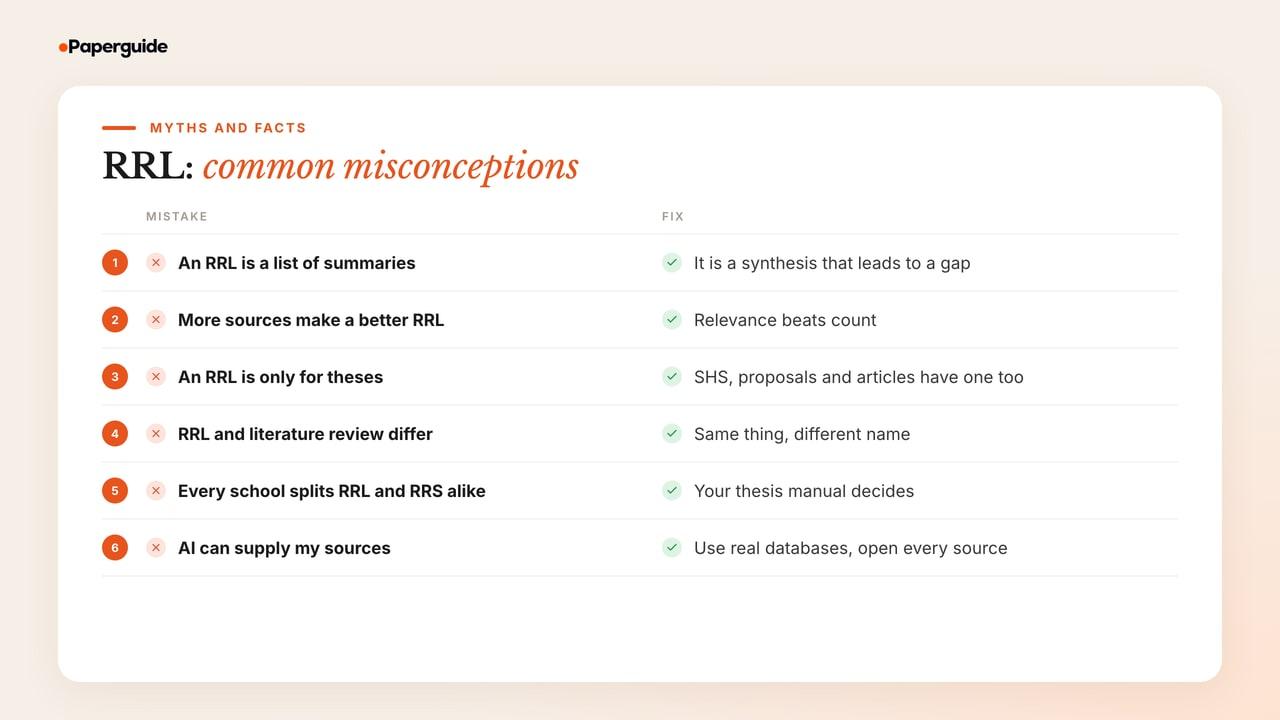
"An RRL is a list of summaries." It is a synthesis. Each paragraph should compare studies and lead toward your gap.
"More sources make a better RRL." Relevance matters more than count. Meet your school's minimum, then add sources only when they change the argument.
"An RRL is only for theses." Senior high school students write one in Practical Research, and research proposals, capstone projects and journal articles all review literature too.
"RRL and literature review are different things." They are the same thing with different names. Guides on literature reviews apply to your RRL.
"Every school splits RRL and RRS the same way." The split and the local and foreign rules vary. Your thesis manual decides.
"AI can give me my RRL sources." AI chatbots can invent citations: in one study, 55% of the references GPT-3.5 generated were fabricated [10]. Use tools that search real databases, such as Paperguide's RRL Finder, and open every source before you cite it.
Before You Start Your RRL: Checklist
- [ ] I know my research problem and variables, so I can tell which sources are related
- [ ] I have my school's template, including chapter titles and where the frameworks go
- [ ] I know whether my school separates related literature from related studies
- [ ] I know the required number of local and foreign sources
- [ ] I know the recency rule and the citation style (usually APA 7)
- [ ] I have a place to record sources, such as a synthesis matrix or a reference manager
Try It Yourself (2 Minutes)
- Write your research title and underline its variables.
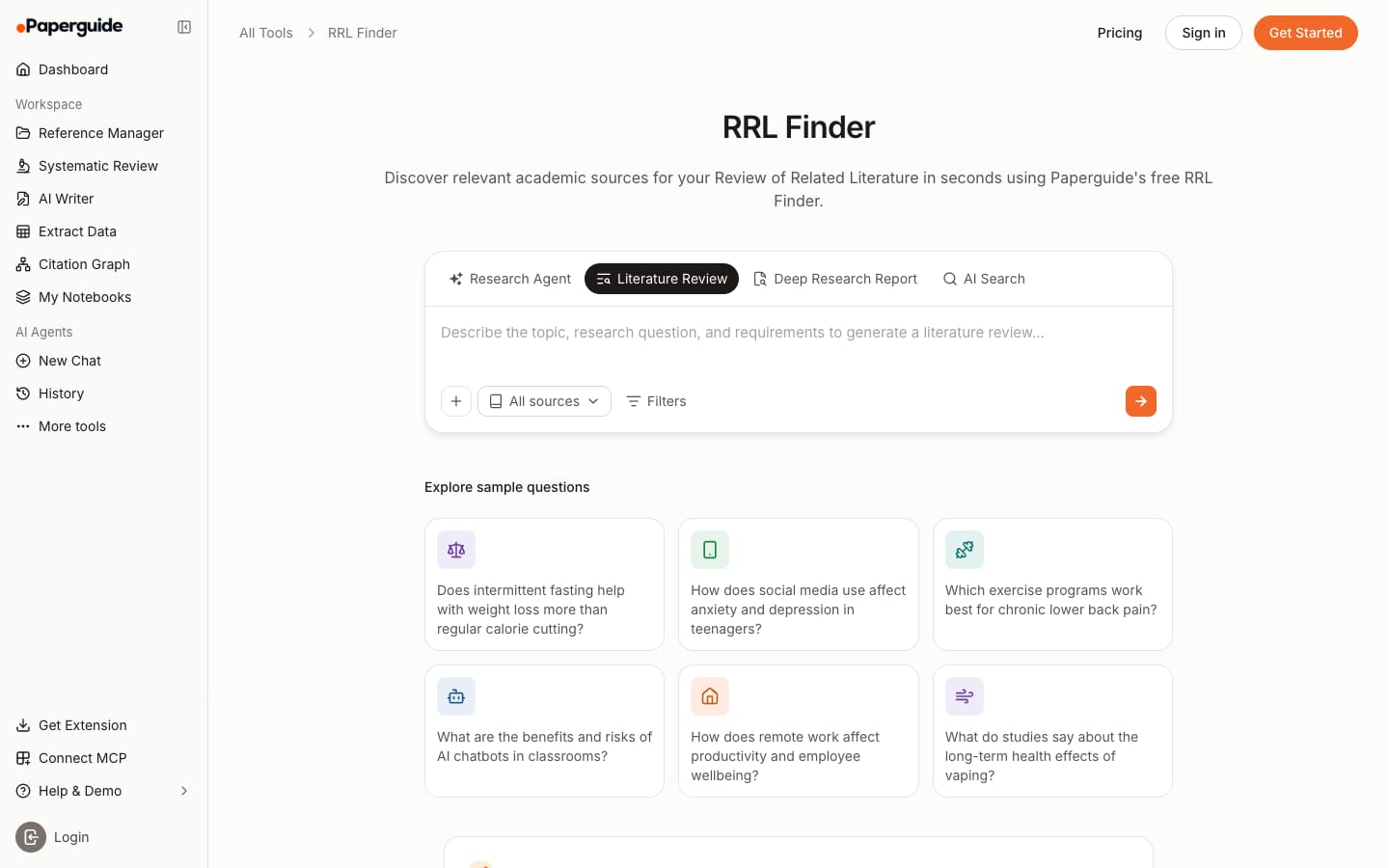
- Enter the title in Paperguide's free RRL Finder and look at the themes its results fall into.
- For one theme, note one local and one foreign study.
By the end you will have the first two sources of your RRL and a sense of how your Chapter 2 body could be organized.
Conclusion
RRL means review of related literature. In Philippine research it is usually Chapter 2, it is the local name for a literature review, and it has three parts: an introduction, a main body organized by theme, and a conclusion that synthesizes the evidence and names the gap. Its purpose is to show what is known, what is missing and where your study fits.
Once you know what an RRL is, the next steps are finding sources and writing. Paperguide's Reference Manager keeps your sources and their APA 7 citations in one place as you go, and the guide on how to find a review of related literature covers search strategies in depth.
Frequently Asked Questions
What does RRL stand for in research?
RRL stands for review of related literature. It is the part of a research paper, usually Chapter 2 in the Philippines, that summarizes and evaluates earlier studies and writings on the topic and shows the gap the study fills [1][2].
Is RRL the same as a literature review?
Yes. RRL is the name used in Philippine schools for a literature review. The purpose and method are the same, though Philippine schools often add local rules, such as separating related studies or requiring local and foreign sources [2].
What chapter is the RRL in?
In Philippine research papers, the RRL is usually Chapter 2, after Chapter 1 (The Problem and Its Background) [1][2]. Some schools also place the theoretical and conceptual framework in Chapter 2 [4].
What is the purpose of RRL?
An RRL shows what is already known about a topic, avoids repeating answered questions, reveals gaps, informs the methods, builds the framework and places the study in context. As Boote and Beile put it, research depends on first understanding the literature [5][6].
What are the three parts of an RRL?
A DepEd self-learning module lists three parts: an introduction, a main body and a conclusion. The introduction presents the topic, the body presents the literature by theme, and the conclusion summarizes what is known and shows why the study matters [1].
What is RRS in research?
RRS means review of related studies. Some Philippine schools use it for earlier research with its own data, such as theses and research articles, as distinct from related literature on concepts and theories. Definitions vary, so follow your school's manual.
How many sources should an RRL have?
It depends on your school and level. One DepEd module asks senior high school students for at least four to six local and international sources, and colleges and graduate schools set their own counts [1]. Coverage of each variable matters more than the number.
What is RRL in Tagalog?
In Filipino-language research it is often headed Mga Kaugnay na Literatura at Pag-aaral (related literature and studies). One Filipino research textbook titles the topic "Ang Pagrerebyu ng mga Kaugnay na Babasahin" [9].
References
- Department of Education Region X. (2021). Inquiries, investigation and immersion, quarter 1, module 3: Reading on related studies (2nd ed.). Department of Education. Copy hosted by DepEd Tambayan. https://depedtambayan.net/wp-content/uploads/2021/10/III12_q1_mod3_ReadingonRelatedStudies.pdf (accessed 9 November 2026)
- University of the Philippines Manila, Department of Arts and Communication. (n.d.). Study guide 3.2: Related literature [Course material]. https://vle.upm.edu.ph/pluginfile.php/190715/mod_resource/content/4/3.2_SG_Related%20Literature.pdf (accessed 9 November 2026)
- Ralph Lauren Corporation. (2026). Form 10-K for the fiscal year ended March 28, 2026. U.S. Securities and Exchange Commission. https://www.sec.gov/Archives/edgar/data/1037038/000162828026037074/rl-20260328.htm (accessed 9 November 2026)
- Department of Education. (2018). K to 12 senior high school applied track subject: Practical research 2 curriculum guide. Learning Resources Management and Development System. https://lrmds.deped.gov.ph/detail/14450 (accessed 9 November 2026)
- Boote, D. N., & Beile, P. (2005). Scholars before researchers: On the centrality of the dissertation literature review in research preparation. Educational Researcher, 34(6), 3-15. https://doi.org/10.3102/0013189X034006003
- USC Libraries. (n.d.). Organizing your social sciences research paper: 5. The literature review. University of Southern California. https://libguides.usc.edu/writingguide/literaturereview (accessed 9 November 2026)
- Purdue Online Writing Lab. (n.d.). Writing a literature review. Purdue University. https://owl.purdue.edu/owl/research_and_citation/conducting_research/writing_a_literature_review.html (accessed 9 November 2026)
- The Writing Center, University of North Carolina at Chapel Hill. (n.d.). Literature reviews. https://writingcenter.unc.edu/tips-and-tools/literature-reviews/ (accessed 9 November 2026)
- Balunsay, J. R. (2020). Maunlad na pananaliksik sa Filipino: Mga teorya at praktika ng pananaliksik sa wika, panitikan, at kultura. Mindshapers. Holy Name University Library catalog record. https://lrc.hnu.edu.ph/bib/127426 (accessed 9 November 2026)
- Walters, W. H., & Wilder, E. I. (2023). Fabrication and errors in the bibliographic citations generated by ChatGPT. Scientific Reports, 13, 14045. https://doi.org/10.1038/s41598-023-41032-5
Reviewing literature?
Generate your literature review
Categorized sources, citations and key insights from a single topic.
Try it freeNo credit card required