Primary vs Secondary Sources in Research: Differences and Examples


Understanding the distinction between primary and secondary sources is fundamental to conducting rigorous research. A primary source is original material created at the time of the event or phenomenon being studied, such as a laboratory experiment, survey data, historical document, or interview. A secondary source is an interpretation, analysis, or summary of primary sources, such as a literature review, textbook chapter, or research article that discusses others' findings. The ability to distinguish between these source types and use them strategically shapes the quality of your research foundation. [1] [3]
Most researchers encounter both types throughout their academic careers, yet confusion about when and how to use each remains common. This guide walks you through identifying, evaluating, and using both primary and secondary sources effectively across different stages of the research process.
Key Takeaways
- Primary sources provide original data and direct evidence, while secondary sources interpret and synthesize existing information
- The same source can function differently depending on how you use it - a published study might be primary evidence for one research question and secondary analysis for another
- Credibility evaluation requires examining authorship, methodology, publication context, and potential bias rather than relying on source type alone
- Most research projects require both types: primary sources for evidence and secondary sources for context, existing knowledge, and methodological guidance
- Discipline-specific conventions differ significantly in how primary and secondary sources are weighted (hard sciences vs. humanities vs. law)
What Are Primary and Secondary Sources?
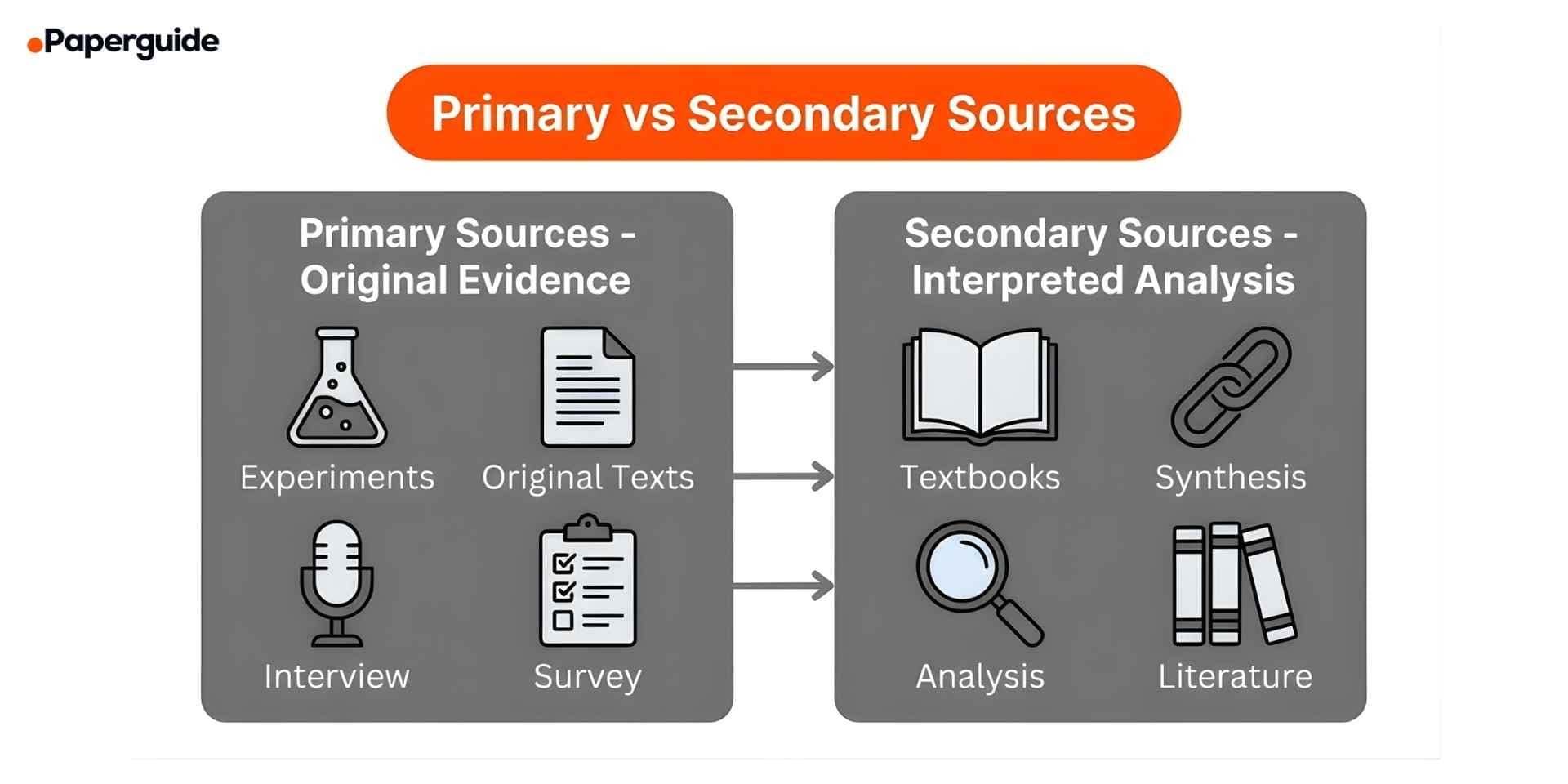
Primary sources are original materials created during or immediately after the events being studied. They represent the first-hand account or direct evidence and have not been filtered through interpretation or summary by others. Primary sources exist in every discipline and include original research data, artifacts, documents, recordings, and observations. [1]
Secondary sources are works created after the fact that analyze, interpret, summarize, or discuss primary sources. Researchers use secondary sources to understand what is already known about a topic, how previous scholars have analyzed evidence, and what methodological approaches proved effective. Secondary sources include literature reviews, textbooks, research articles discussing others' work, and encyclopedic entries. [3]
Comparison Table
| Feature | Primary Sources | Secondary Sources |
|---|---|---|
| Definition | Original material created at time of event/study | Analysis or interpretation of primary sources |
| Examples | Lab experiments, surveys, interviews, artifacts, diaries, patents | Literature reviews, textbooks, meta-analyses, biographies, critical essays |
| Purpose | Provide direct evidence and raw data | Contextualize, synthesize, and interpret evidence |
| Strengths | Unfiltered original data; authentic voice; greatest evidentiary weight | Synthesizes multiple sources; identifies patterns; provides context |
| Limitations | May be incomplete; requires reader interpretation; harder to locate | Introduces interpretive bias; not original evidence; depends on cited sources |
How to Identify Primary vs Secondary Sources
Identifying source type requires asking specific questions about authorship, creation context, and purpose:
Step 1: Determine Who Created the Source
Ask whether the creator was directly involved in the event or conducted the research themselves. If yes, you likely have a primary source. If someone is writing about someone else's work or event, it is secondary. [1]
Step 2: Consider the Source's Original Purpose
Primary sources were typically created to document, record, or communicate something contemporary to their creation. Secondary sources were intentionally created to analyze or discuss existing material. A newspaper article from the 1960s about a political event is primary; a 2024 article analyzing that same event is secondary.
Step 3: Examine Distance from the Original Event
How many layers of interpretation sit between you and the original evidence? Direct experimental data is primary. A researcher's summary of that experiment is secondary. A textbook chapter discussing that researcher's summary is even further removed and remains secondary. [3]
Step 4: Check for Explicit Citations to Other Work
Secondary sources almost always reference and discuss other people's findings. Primary sources may reference literature but focus primarily on original methodology and results. Review the source's citations as a clue to its type.
Step 5: Look for Interpretation Language
Secondary sources use phrases like "studies have shown," "research indicates," "scholars argue," and "previous findings suggest." Primary sources use language like "we found," "our results," "our methodology," and "our analysis."

Examples of Primary and Secondary Sources Across Disciplines
Sciences
Primary Source: Original peer-reviewed research article reporting results from a controlled laboratory experiment testing the effectiveness of a new vaccine candidate in mice. The authors conducted the study and report their methodology, results, and analysis.
Secondary Source: A review article synthesizing findings from 50 vaccine efficacy studies and identifying common success patterns. The authors did not conduct the original research but analyzed and compared existing primary source findings.
Humanities
Primary Source: A personal diary written by a 19th-century explorer documenting daily life during an Arctic expedition, including observations, thoughts, and decisions made in real-time.
Secondary Source: A published biography analyzing the explorer's life using the diary as evidence, combined with historical records, letters, and scholarly interpretation of the explorer's significance and legacy.
Social Sciences
Primary Source: Raw survey data from 1,200 undergraduate students showing responses to questions about study habits, collected and analyzed directly by the research team.
Secondary Source: A meta-analysis of 30 previous studies on study habits and academic performance, synthesizing their findings to identify broader patterns and effect sizes across populations.
Law
Primary Source: The complete text of a statute passed by Congress or the written opinion from a Supreme Court decision establishing legal precedent.
Secondary Source: A legal commentary article discussing the statute's implications, analyzing how courts have interpreted it, and explaining its relevance to contemporary legal practice.
How to Evaluate Source Credibility
Not all primary sources are equally credible, nor are all secondary sources reliable. Evaluation requires examining multiple factors regardless of source type.
Authorship Credibility Framework
Assess whether the author has relevant expertise, credentials, and track record. For primary research sources, check author affiliations, publication history, and whether they work in established institutions. For secondary sources, verify that the author has deep knowledge of the topic beyond basic familiarity.
Methodology Transparency
Primary sources should clearly describe how data was collected, sample sizes, potential biases, and limitations. Secondary sources should transparently explain which primary sources they reviewed, what criteria they used for selection, and any limitations in their synthesis.
Publication Context
Peer-reviewed journals, university presses, and established publishers employ editorial oversight. Self-published or non-reviewed sources carry higher risk of bias or inaccuracy, though exceptions exist. Consider whether the publication venue has reputation and standards worth defending.
Evidence of Bias
Examine funding sources, author affiliations with organizations that might benefit from particular conclusions, and whether the source acknowledges limitations and alternative viewpoints. Secondary sources should cite primary research fairly rather than selectively choosing sources that support a predetermined conclusion.
Corroboration
Can you find the findings reported in other credible sources? Primary sources that contradict multiple secondary sources deserve extra scrutiny. Secondary sources that cite the same primary research strengthen credibility through corroboration.
Currency and Updates
For scientific topics, older sources may be outdated. For historical topics, older primary sources may carry greater authenticity than modern interpretations. Check whether more recent research has superseded older findings.
Source Evaluation Template
Use this template to systematically evaluate any source's credibility:
Source Evaluation Checklist
Source Information
Title:
Author/Creator:
Publication Date:
Publication Context (journal, publisher, self-published, etc.):
Authorship Assessment
Does the author have relevant credentials? Yes / No / Unclear
What is the author's institutional affiliation?
Has the author published previously on this topic?
Methodology & Transparency
Is the methodology clearly described? Yes / No / N/A
Are limitations acknowledged? Yes / No / N/A
What is the sample size or scope of evidence?
Bias Assessment
Funding source:
Any apparent conflicts of interest:
Does the source acknowledge alternative viewpoints?
Corroboration
Have other credible sources reported similar findings?
Does this source contradict established consensus?
Overall Credibility Rating
High / Medium / Low
Justification:
Common Mistakes When Using Primary and Secondary Sources
Common mistakes cloud research quality and lead to flawed conclusions.
Mistake 1: Assuming Primary Always Means Better
Many researchers believe primary sources are automatically superior to secondary sources. In reality, a well-conducted meta-analysis (secondary) summarizing 100 studies carries more weight than a single flawed primary study. The quality and relevance of methodology matter more than source type. [4]
Mistake 2: Using Secondary Sources Without Checking Primary Claims
Researchers often cite secondary sources that cite primary sources without verifying the original primary source's actual claims. Secondary sources sometimes misrepresent or oversimplify primary findings. When you cite something, verify the claim in the original source.
Mistake 3: Ignoring That Source Type Is Contextual
The same source can be primary or secondary depending on your research question. A 2023 research article is primary if you study its methodology and results, but secondary if you use it to understand what was already known in 2022. Consider how you are using the source, not just what it is.
Mistake 4: Overweighting Recent Sources
Newer is not always better. A seminal study from 1995 may remain more relevant and rigorous than recent studies that replicate it with weaker methodology. Evaluate sources on merit, not publication date alone.
Mistake 5: Confusing Source Type With Reliability
A poorly designed primary source produces unreliable data. A secondary source from a prestigious publication may misinterpret the evidence. Always evaluate credibility independently of whether it is primary or secondary [2].
Quick Checklist for Identifying and Using Sources
- [ ] Determined the source's origin. I know whether the creator was directly involved in the research or event.
- [ ] Checked for citations. I've verified whether the source cites other work (likely secondary) or reports original findings (likely primary).
- [ ] Assessed the creation context. I understand whether the source was created to document an event or to analyze someone else's work.
- [ ] Verified authorship credibility. I've confirmed the author has relevant expertise and institutional backing.
- [ ] Checked methodology. For primary sources, the methodology is transparent. For secondary sources, the synthesis approach is clear.
- [ ] Examined funding sources. I've identified any potential conflicts of interest or biases.
- [ ] Found corroboration. I've confirmed that credible sources support or contextualize the claims made.
- [ ] Evaluated my use. I understand whether I'm using this source as primary evidence or secondary context.
Validate This With Papers (2 Minutes)
Identifying primary versus secondary sources becomes easier with practice on real research papers.
Step 1: Use Paperguide's Research Paper Summarizer to upload a research paper from your field. Ask the tool to identify whether the paper is primarily conducting original research or synthesizing existing findings.
Step 2: Manually review the paper's abstract and methods section. Does it describe original data collection and analysis (primary) or literature review and synthesis (secondary)?
Step 3: Check the paper's reference section. Count whether citations outnumber original findings. Heavy citation combined with synthesis language indicates a secondary source.
Conclusion
The distinction between primary and secondary sources fundamentally shapes research quality. Primary sources provide the original evidence upon which all knowledge builds, while secondary sources help researchers understand existing knowledge, identify gaps, and learn from previous methodological approaches. Neither type is inherently superior - effective research requires strategic use of both.
As you engage with your own research, develop the habit of pausing to identify each source type and evaluate its credibility on relevant criteria. Recognize that context shapes meaning: a source's role in your research depends on how you use it, not only on what it is. By mastering the ability to locate, identify, and evaluate both primary and secondary sources, you strengthen every stage of your research process and increase the likelihood that your conclusions rest on solid evidence. Your research question shapes which sources matter most.
The investment in source evaluation during the early stages of your research process pays dividends throughout your project. You will make faster progress, avoid dead ends based on misrepresented findings, and ultimately produce stronger research that advances your field's knowledge.
Frequently Asked Questions
Can a source be both primary and secondary?
Yes. A source's classification depends on how you use it within your research. A published 2020 study might be primary evidence for your research on that study's methodology and findings, but secondary evidence if you cite it to contextualize what was known about a topic in 2020. Context determines classification.
Are older sources always less credible than newer ones?
No. A seminal study from 1985 that introduced a research methodology remains highly credible and often more thoroughly vetted than recent studies. However, in rapidly advancing fields like technology or medicine, older sources may report outdated information. Evaluate based on relevance and methodology, not publication date alone.
Is a Wikipedia article considered a secondary source?
Yes, Wikipedia articles are secondary sources because they synthesize and summarize information from other sources. However, Wikipedia is not appropriate as a citable source in academic work. Use Wikipedia to understand a topic broadly, then find primary and peer-reviewed secondary sources on which to base your research.
How many primary sources should I use in my research?
The appropriate balance between primary and secondary sources depends on your field and research question. Hard sciences typically emphasize original primary research. Humanities often blend primary sources (texts, artifacts) with secondary analysis. Social sciences frequently use both. Consult your discipline's conventions and your specific research question.
What if I cannot find primary sources on my topic?
Some topics lack accessible primary sources - perhaps they are restricted, historical, or specialized. In these cases, relying on credible secondary sources becomes necessary. Acknowledge this limitation in your work and use secondary sources from the most authoritative and rigorous publications available in your field.
Can gray literature (reports, dissertations, working papers) be primary or secondary?
Yes. A graduate dissertation reporting original research is primary. A report synthesizing findings from multiple studies is secondary. Gray literature carries lower authority than peer-reviewed publication but can be primary evidence depending on its content. Evaluate based on methodology and credibility, not publication format alone.
How do I know if a journal is peer-reviewed?
Check the journal's website for its review process description. Databases like Ulrich's Periodicals Directory, Library of Congress, and Google Scholar indicate peer-review status. Your institution's librarians can also verify peer-review status. Peer-reviewed journals maintain higher standards but are not automatically credible - still evaluate individual articles on merit.
References
- Creswell, J. W. & Creswell, J. D. "Research Design: Qualitative, Quantitative, and Mixed Methods Approaches." 6th edition, SAGE Publications, 2023.
- American Psychological Association. "Publication Manual of the American Psychological Association." 7th edition, 2020.
- Association of College and Research Libraries. "Framework for Information Literacy for Higher Education." American Library Association, 2016.
- Machi, L. A. & McEvoy, B. T. "The Literature Review: Six Steps to Success." 5th edition, Corwin, 2025.
- Menon, V., Varadharajan, N., Praharaj, S. K. & Ameen, S. "Why Do Manuscripts Get Rejected? A Content Analysis of Rejection Reports from the Indian Journal of Psychological Medicine." Indian Journal of Psychological Medicine, 44(1), 59-65, 2022.
Researching a topic?
Find papers and get cited answers
Search the literature, find gaps and write with citations.
Start for freeNo credit card required