

Research Gap Finder
Ask a research question and get a gap analysis built from screened papers. Every gap is mapped, tested against extra searches and graded by evidence strength.
Uses more credits
Ask a research question — get an evidence-backed gap analysis.
Built on 200M+ peer-reviewed papers. Every gap cited to its source.
Found your gap? Write the review that justifies it.
Literature Review AI builds a cited review of what is already known, so you can show why your gap matters.

What is a research gap finder?
A research gap finder is an AI tool that reads the published studies on your question and reports what is still unknown, under-studied or contested. Paperguide's Research Gap Finder screens the most relevant papers, maps where the evidence is dense or thin, and returns each gap with citations and an evidence grade.
What your gap analysis report includes
Every report follows the same structure, so you can see how each gap was found and check it.
Executive summary
The main gaps in under 200 words.
Coverage map
A matrix showing how many papers sit in each combination of the dimensions that matter, so thin areas stand out.
Gap records, grouped by type
Each with the evidence boundary in numbers, what the gap blocks, an answerable research question, a grade and a priority. Each gap carries one of four grades: Confirmed, Supported, Provisional, Closed.
Negative evidence
The searches run to close each gap and what they returned.
Closed gaps
Candidates the extra searches disproved, with the papers that closed them.
Research agenda
The studies that would fill the highest-priority gaps.
How to find research gaps with AI in 4 steps
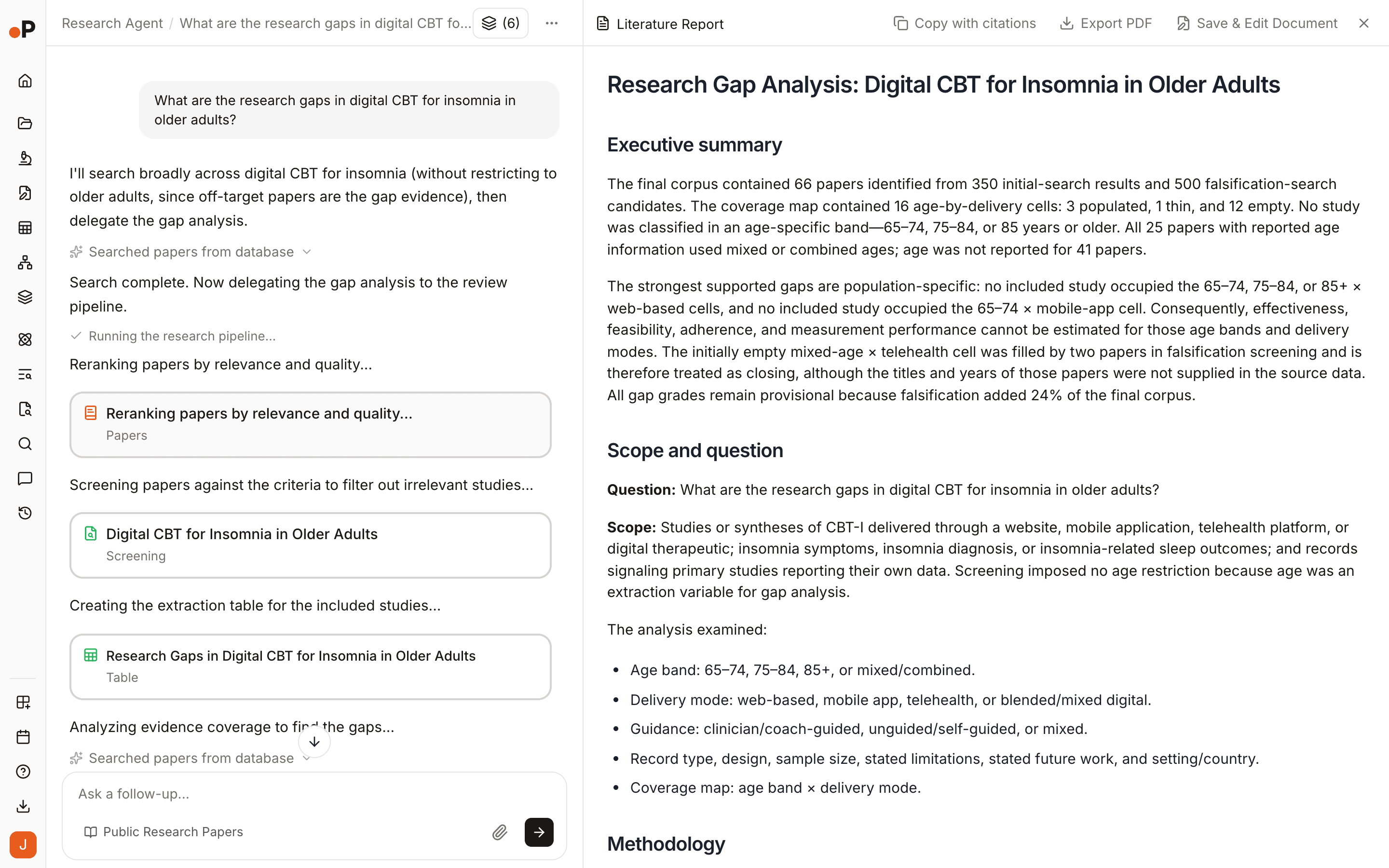
- Enter your research question or topic. Type a question such as "digital CBT for insomnia in older adults", or pick an example prompt. Keep the qualifiers in, because they become the dimensions your gaps are measured on.
- The agent collects and screens the relevant literature. It runs one broad search across 200M+ papers, then screens the results against your topic. Reviews stay in, because their limitations and future-work sections often state gaps directly.
- It maps the evidence and verifies each candidate gap. Screened papers are sorted into a coverage map along dimensions such as population, setting and outcome. For every empty or thin area, it runs extra searches for papers that would fill it.
- You get a graded gap analysis report. Each gap shows what is missing, what it blocks and the study that would fill it, with citations and the searches behind it. Gaps the extra searches closed are listed too, with the papers that closed them.
Types of research gaps it finds
Every gap in the report is tagged with one of six types:
Knowledge gap
A question no study has answered yet.
Methodological gap
The evidence rests on one design, measure or approach, such as only cross-sectional surveys.
Population gap
Groups that have not been studied, such as older adults or patients in low-income countries.
Contextual gap
Settings that have not been studied, such as primary care, rural areas or a specific country.
Measurement gap
Outcomes measured inconsistently, only by self-report, or not at all.
Contradiction gap
Studies that report conflicting results with no explanation for the difference.
Who it is for
Thesis and PhD students choosing a topic
Example: "What is missing in research on mobile learning apps for rural secondary schools?"
Grant writers justifying a proposal
Example: "Where are the evidence gaps on community health worker programmes for hypertension in low-income countries?"
Evidence synthesis and HEOR teams scoping a review
Example: "Which outcomes and populations are missing from trials of GLP-1 agonists in adolescents?"
Systematic reviewers checking whether a new review is needed
Example: "Has the evidence on exercise for post-stroke fatigue changed enough to justify a new review?"


Join 500000+ Paperguide users
Frequently asked questions
Related Tools
Literature Review AI
Write a cited literature review that shows what is known and why your gap matters.
Go to toolRRL Finder
Collect the related studies for your review of related literature.
Go to toolAI Paper Writer
Draft your research proposal around the gap, with citations.
Go to toolReference Manager
Save, organise and cite the papers behind your gap analysis.
Go to tool