What Is a Conceptual Framework: Step-by-Step Guide with Examples


A conceptual framework is a visual or written representation of the key concepts, variables, and relationships that guide a research study. It maps how the researcher understands the problem, which factors are relevant, and how those factors connect to each other and to the research question. Every empirical study needs one, yet it is one of the most misunderstood and poorly executed components of a research proposal.
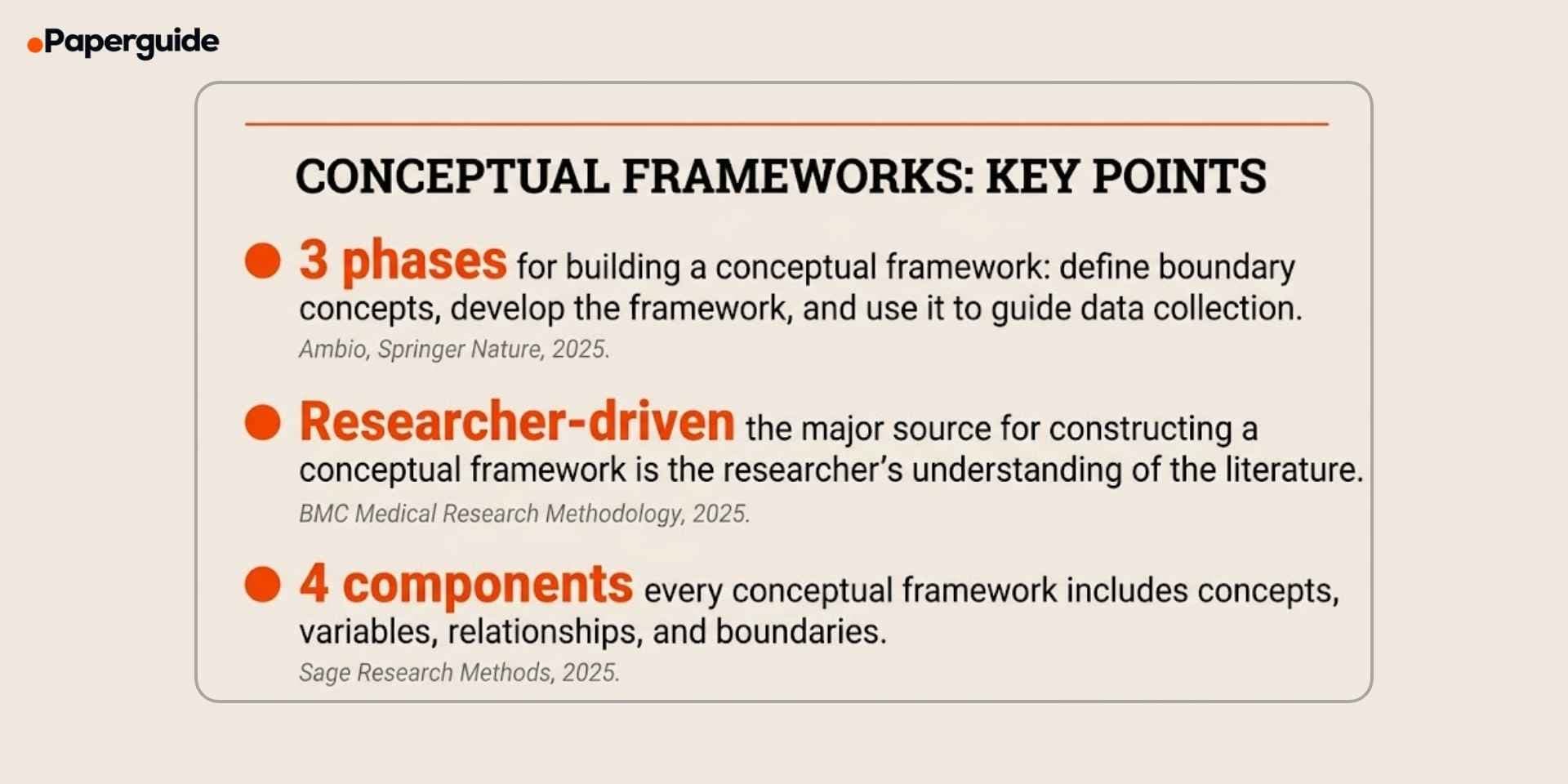
A 2025 study in BMC Medical Research Methodology on the role of conceptual frameworks in qualitative research found that frameworks help researchers conceptualize, identify, engage with, and critically examine layers of beliefs, biases, values, and assumptions, with the major source for constructing a framework being the researcher's own understanding of the literature and the phenomenon being studied. A separate 2025 study in Ambio proposed a structured three-phase approach for developing conceptual frameworks in interdisciplinary research: defining boundary concepts, developing the framework as a boundary object, and using it to guide data collection and analysis. [1] [2]
This guide explains what conceptual frameworks are, how they differ from theoretical frameworks, provides a step-by-step process for building one, and includes examples and a reusable template.
Key Takeaways
- A conceptual framework maps the key concepts, variables, and relationships that guide your study. It is not a summary of theories but a researcher-constructed model of how the phenomenon works.
- Every empirical study needs a conceptual framework, whether it is presented as a diagram, a narrative, or both.
- The conceptual framework differs from the theoretical framework: the theoretical framework draws on established theories, while the conceptual framework operationalizes those theories into specific, testable relationships for your study. [1]
- Building a conceptual framework follows a structured process: review the literature, identify key concepts, define relationships, and visualize the model. [2]
- A strong conceptual framework improves every downstream component of the study: research questions, hypotheses, variable selection, data collection, and analysis.
- Weak or missing conceptual frameworks are a common reason for proposal rejection and poor study design.
What Is a Conceptual Framework?
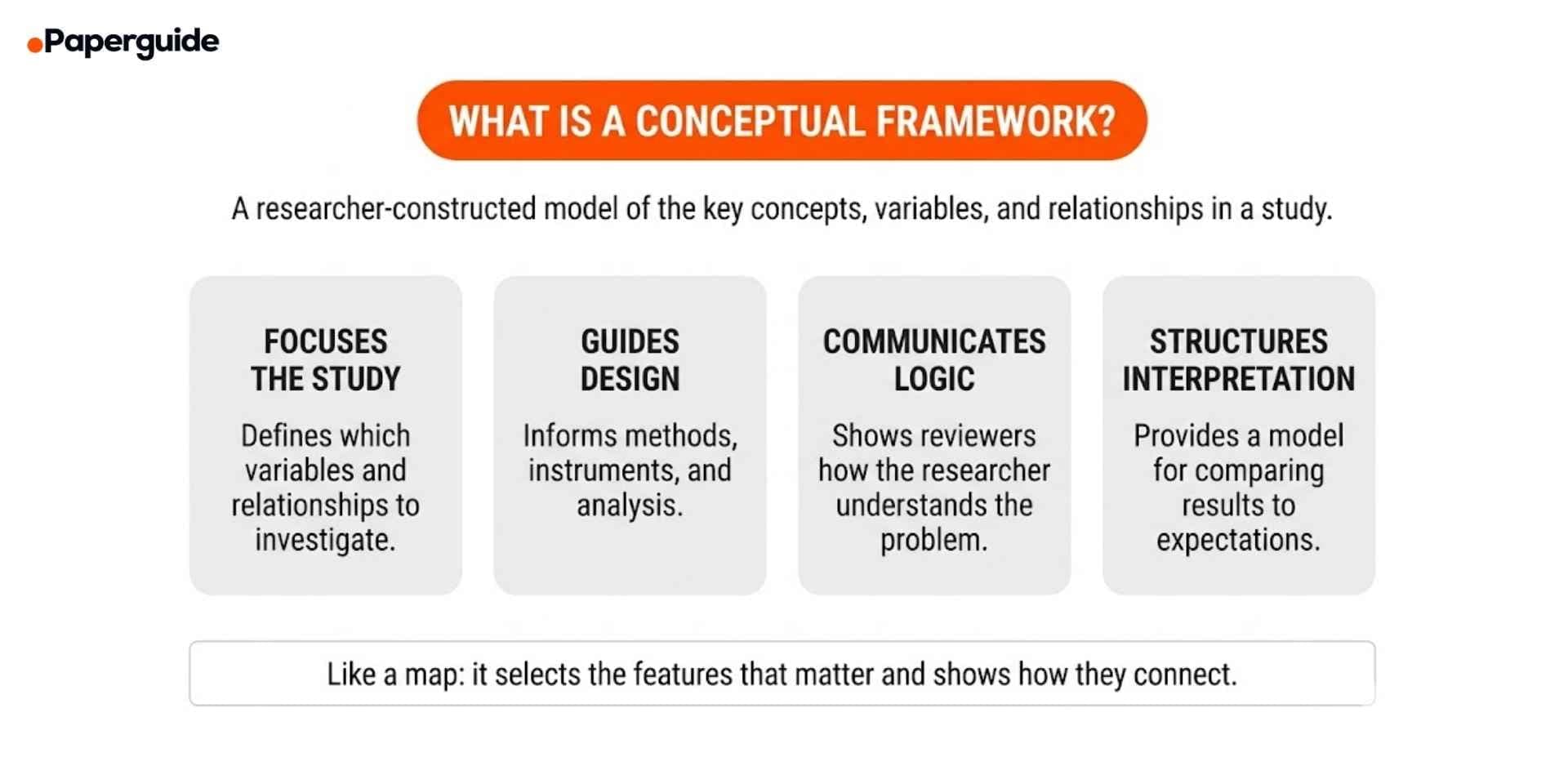
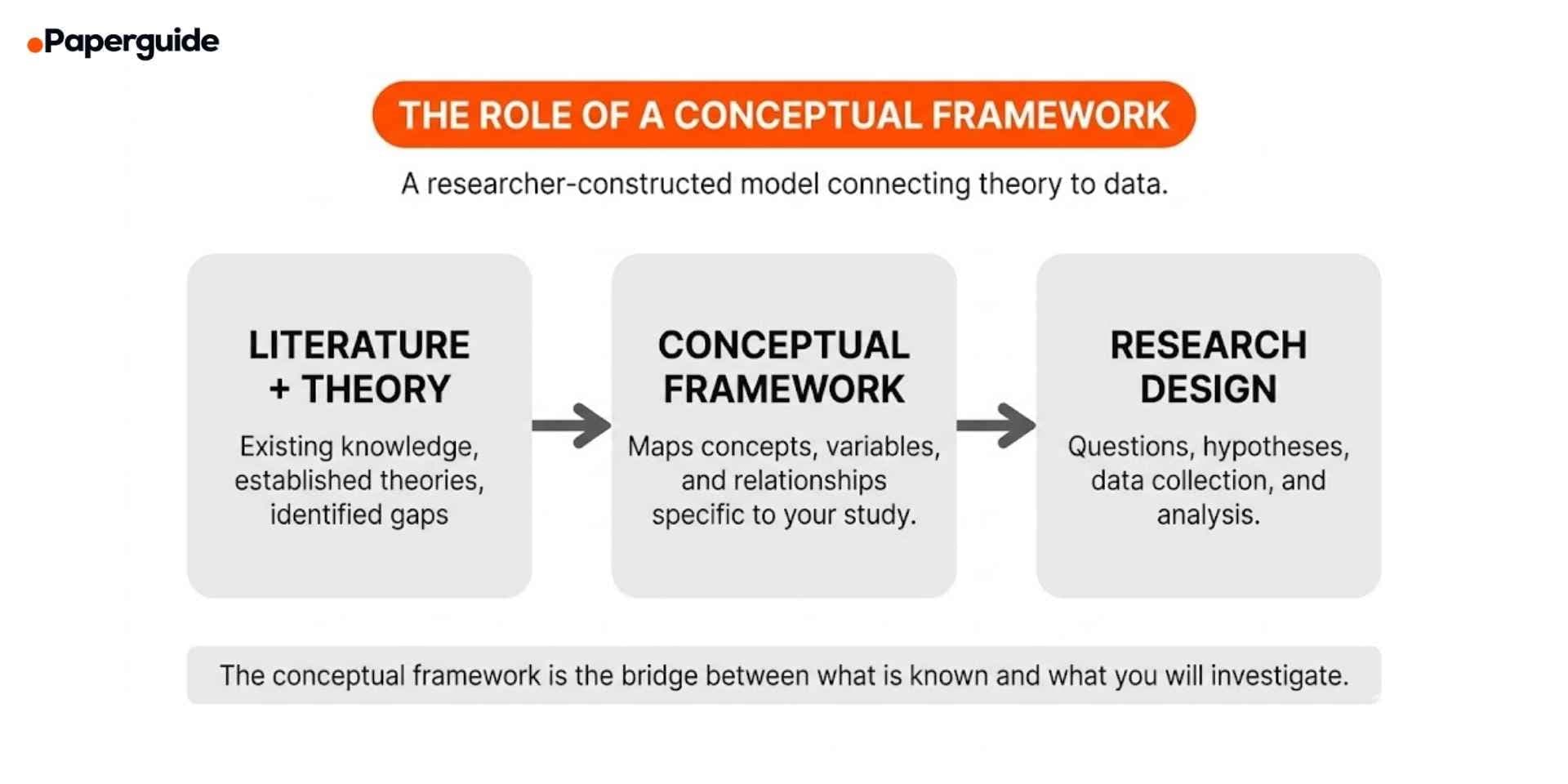
A conceptual framework is a structured representation of the main ideas, concepts, and variables in a research study and the proposed relationships between them. It serves as a blueprint that shows the reader how the researcher understands the problem, which factors are considered relevant, and how those factors are expected to interact.
Think of it as a map of your study. A geographic map does not include every road, building, and tree. It selects the features that matter for navigation and shows how they connect. A conceptual framework does the same for research: it selects the concepts that matter for answering the research question and shows how they relate to each other.
The conceptual framework is constructed by the researcher, not borrowed wholesale from existing theory. It draws on published theories, empirical findings, and the researcher's own understanding of the phenomenon to create a study-specific model. A 2025 framework development study in JMIR demonstrated this process by mapping individual concepts from existing literature, defining their attributes, and then connecting them into a new integrated framework tailored to the specific research context. [3]
Conceptual frameworks serve four essential functions. First, they focus the study by defining which variables and relationships will be investigated and which will be excluded. Second, they guide research design by informing the choice of methods, instruments, and analytical approaches. Third, they communicate the researcher's understanding to reviewers, supervisors, and readers. Fourth, they provide a structure for interpreting results by showing which relationships were expected and how findings compare to the proposed model.
Conceptual Framework vs Theoretical Framework
These two terms are frequently confused, but they serve different functions in a research study.
A theoretical framework identifies the established theory or theories that underpin your study. It describes the broader lens through which you view the research problem. For example, if you are studying motivation in the workplace, your theoretical framework might draw on Self-Determination Theory, which posits that motivation is driven by autonomy, competence, and relatedness.
A conceptual framework takes the theoretical framework further by specifying the exact concepts, variables, and relationships that will be tested in your particular study. It is the researcher's own model, built from theory, existing evidence, and the specific research context. Using the same example, your conceptual framework might propose that autonomy (measured by decision-making authority) and competence (measured by skill-task alignment) predict job satisfaction (measured by the MSQ), with organizational culture as a moderating variable.
A 2022 study in CBE Life Sciences Education that remains widely cited in methodology courses clarified that conceptual frameworks are broader than theoretical frameworks because they encompass both established theories and the researcher's own emergent ideas, which may be rooted in informal observations or professional experience that have not yet been formally tested. [4]
| Feature | Theoretical Framework | Conceptual Framework |
|---|---|---|
| Source | Established, published theories | Researcher-constructed model |
| Scope | Broad theoretical lens | Study-specific variables and relationships |
| Content | Names and describes theories | Maps concepts, variables, arrows, and boundaries |
| Function | Explains the "why" behind the study | Shows the "what" and "how" of the study |
| Location | Literature review section | End of literature review or start of methodology |
| Visual | Optional | Usually includes a diagram |
How to Build a Conceptual Framework (Step by Step)
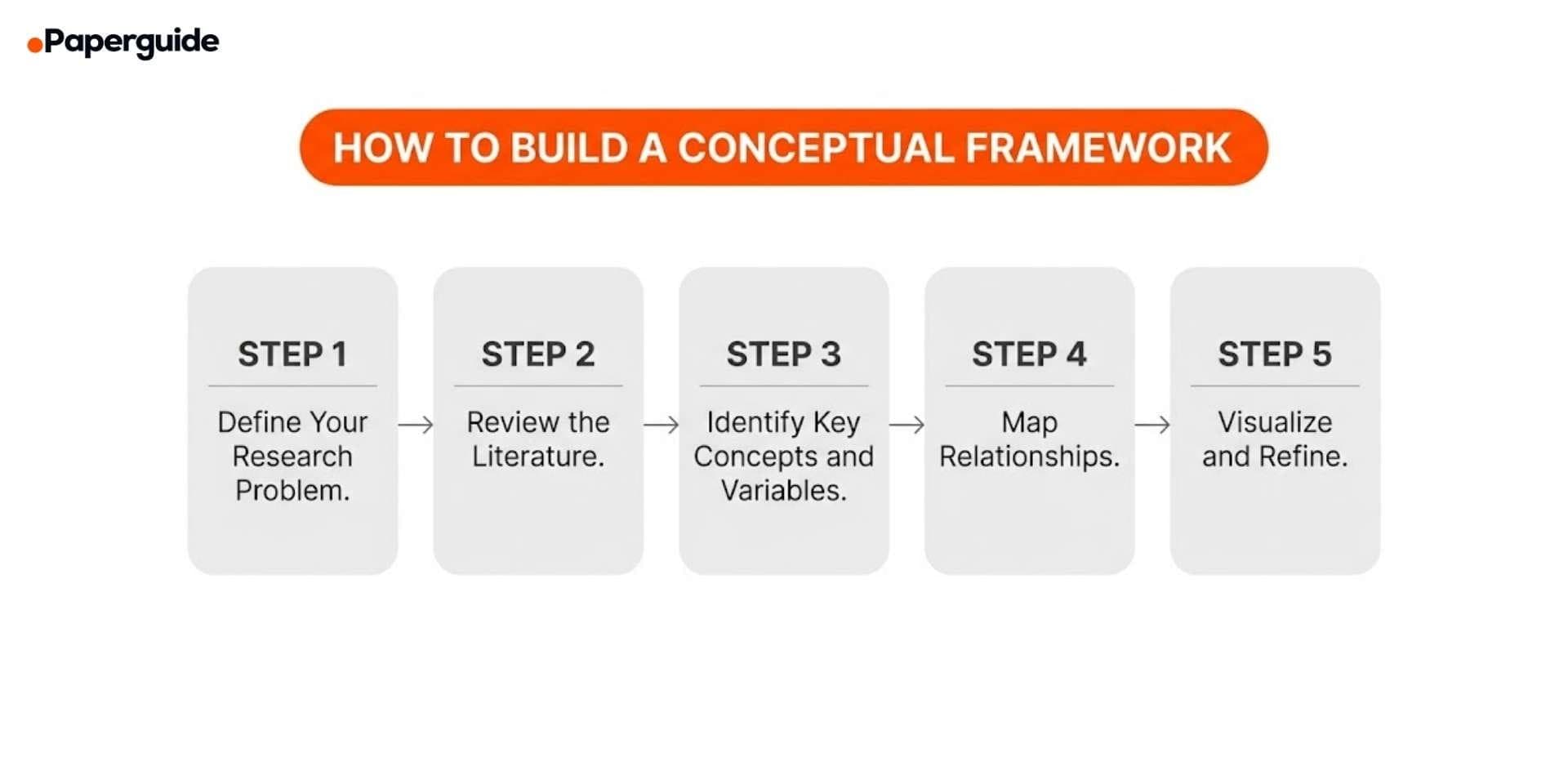
Step 1: Define Your Research Problem and Question
Start with a clear statement of what you are investigating. The research problem identifies the gap in knowledge, and the research question specifies exactly what you want to find out. Your conceptual framework is built to answer this question.
Example: Research problem: Employee turnover in tech startups remains high despite competitive salaries. Research question: What factors beyond compensation predict voluntary turnover among software engineers in early-stage startups?
A well-defined research problem statement provides the foundation for every concept and relationship in your framework. Without a clear problem, the framework lacks direction.
Step 2: Review the Literature Systematically
Read the published research on your topic to identify the concepts, variables, and relationships that previous studies have established. Note which factors have been consistently linked to your outcome variable, which relationships are contested, and where gaps exist. Tools for AI for systematic review can speed up this process by screening hundreds of papers and extracting the key variables and relationships used in prior studies.
Example: Literature review reveals that the following factors have been linked to voluntary turnover in tech companies: autonomy, career growth opportunities, manager relationship quality, organizational culture, work-life balance, and equity compensation structure. Some studies find that autonomy is the strongest predictor, while others find manager relationship quality matters more.
Step 3: Identify Key Concepts and Variables
From your literature review, select the specific concepts and variables that your study will include. Categorize them as independent variables (predictors), dependent variables (outcomes), mediating variables (mechanisms), moderating variables (conditions), and control variables.
Example:
- Independent variables: autonomy, career growth opportunities, manager relationship quality
- Dependent variable: voluntary turnover intention
- Moderating variable: company stage (seed, Series A, Series B)
- Control variables: salary, tenure, role level
Each variable in your framework needs an operational definition that specifies exactly how it will be measured. The conceptual framework identifies which variables matter; operational definitions specify how they will be quantified. The glossary of research terms and definitions covers common variable types, including independent, dependent and confounding variables.
Step 4: Map the Relationships
Define how each variable relates to the others. Specify the direction of relationships (positive, negative, or non-directional) and the type (direct, mediated, moderated). Use arrows to indicate proposed causal or associational pathways.
Example:
- Autonomy → (negative) → Turnover Intention
- Career Growth Opportunities → (negative) → Turnover Intention
- Manager Relationship Quality → (negative) → Turnover Intention
- Company Stage moderates the relationship between Autonomy and Turnover Intention (the effect of autonomy is stronger in later-stage companies where role formalization increases)
Step 5: Visualize and Refine
Create a visual diagram of your conceptual framework. Place the independent variables on the left, the dependent variable on the right, and any mediating or moderating variables in between or above the relationship arrows. Review the diagram for completeness, clarity, and alignment with your research question. Revise until every variable and relationship in the framework is directly connected to the research question. Once your conceptual framework is finalized, an AI Paper Writer can help you draft the framework description for your methodology chapter with properly cited variable justifications.

Examples of Conceptual Frameworks Across Disciplines
Example 1: Education
Research question: How do teaching quality and peer learning affect student engagement in online courses?
Conceptual framework:
- Independent variables: Teaching quality (instructor presence, feedback timeliness, content organization), Peer learning (discussion participation, group project collaboration)
- Dependent variable: Student engagement (behavioral, cognitive, emotional)
- Moderating variable: Prior online learning experience
- The framework proposes that both teaching quality and peer learning independently predict engagement, but that students with more online experience benefit more from peer learning and less from instructor presence
Example 2: Public Health
Research question: What factors predict COVID-19 vaccine booster uptake among adults aged 18 to 30?
Conceptual framework:
- Independent variables: Trust in healthcare providers, perceived risk of COVID-19, social norms (peer vaccination behavior), access to vaccination sites
- Dependent variable: Booster uptake (binary: received/not received)
- Mediating variable: Vaccine confidence (mediates the relationship between trust and uptake)
- Control variables: Age, gender, education level, prior COVID-19 infection
- The framework draws on the Health Belief Model and adds social norms as a contextual factor not included in the original theory
Example 3: Business Research
Research question: Does organizational culture moderate the relationship between remote work and employee productivity?
Conceptual framework:
- Independent variable: Remote work arrangement (fully remote, hybrid, fully in-office)
- Dependent variable: Employee productivity (measured by quarterly performance ratings)
- Moderating variable: Organizational culture (trust-based vs. surveillance-based, measured by the Organizational Culture Assessment Instrument)
- Control variables: Role type, tenure, team size
- The framework proposes that remote work increases productivity in trust-based cultures but decreases it in surveillance-based cultures
Conceptual Framework Template
Use this template to build your own framework. Fill in each section with the specific details of your study.
1. Research Problem: [State the gap in knowledge your study addresses]
2. Research Question: [State the specific question your study answers]
3. Theoretical Foundation: [Name the theory or theories that inform your framework and explain how they connect to your variables]
4. Key Variables:
- Independent variable(s): [List with brief definitions]
- Dependent variable(s): [List with brief definitions]
- Mediating variable(s): [List if applicable]
- Moderating variable(s): [List if applicable]
- Control variable(s): [List if applicable]
5. Proposed Relationships:
- [Variable A] → [direction] → [Variable B]
- [Variable C] moderates the relationship between [A] and [B]
- [Variable D] mediates the relationship between [A] and [B]
6. Visual Diagram: [Draw or describe the diagram with boxes for variables and arrows for relationships]
7. Boundaries: [State what the framework does NOT include and why]
The conceptual framework directly informs your hypothesis formation. Each proposed relationship in the framework becomes a testable hypothesis, and the direction and type of relationship specified in the framework determines whether you use a directional or non-directional hypothesis.
Common Mistakes and How to Fix Them
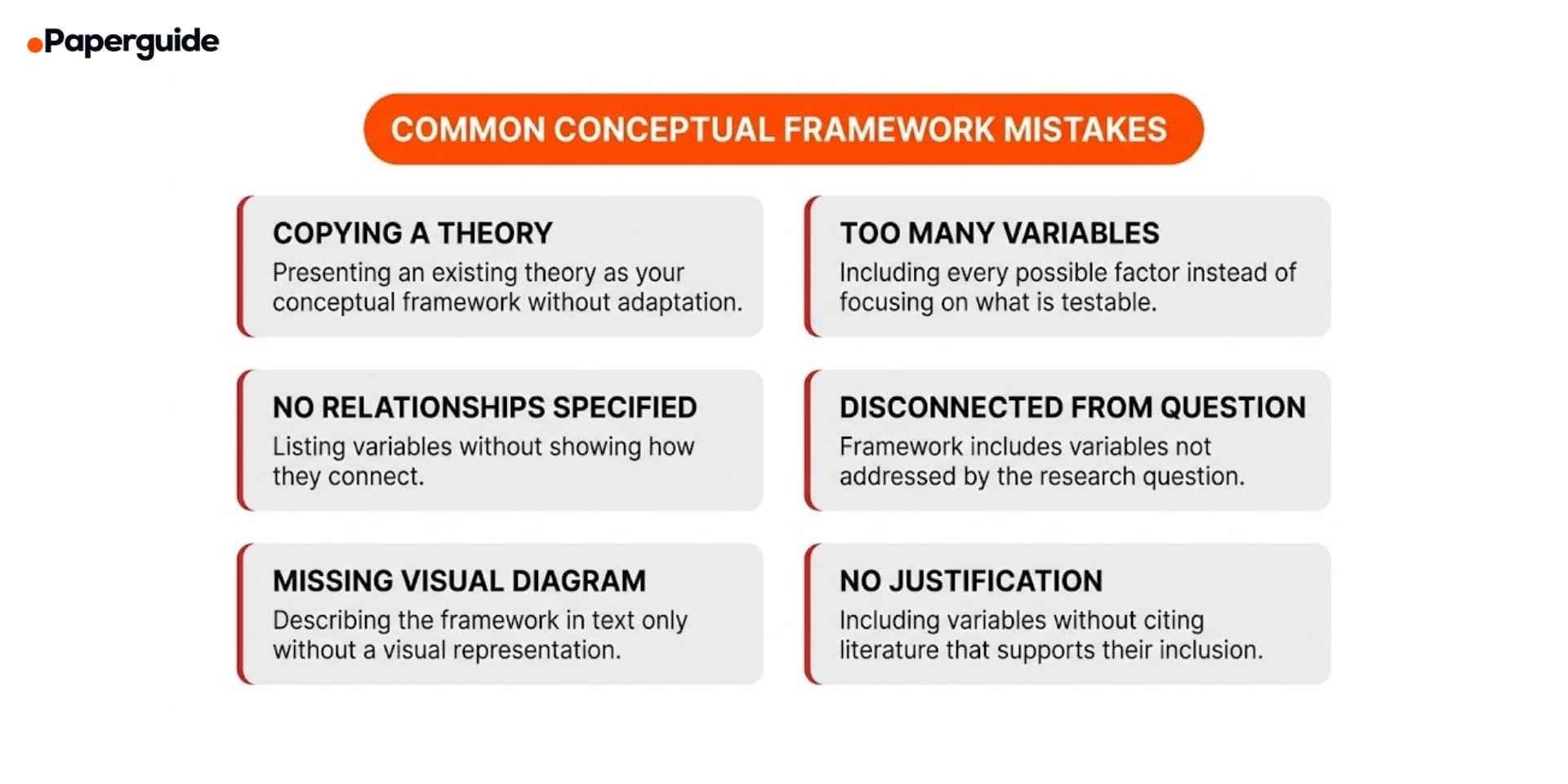
Mistake 1: Presenting an Existing Theory as Your Conceptual Framework
Error: Describing Self-Determination Theory, the Health Belief Model, or another established theory and calling it your conceptual framework. This is a theoretical framework, not a conceptual framework.
Fix: Use the theory as a starting point, then adapt it to your specific study. Add, remove, or modify variables based on your literature review and research context. The conceptual framework should be yours, not a textbook reproduction of someone else's theory.
Mistake 2: Including Too Many Variables
Error: Attempting to include every possible factor that could be relevant, resulting in a framework that is too complex to test with the available data and sample size.
Fix: Limit the framework to the variables that are most strongly supported by the literature and most directly relevant to your research question. A focused framework with five to eight variables that you can actually measure and test is far more valuable than a comprehensive model with 20 variables that you cannot.
Mistake 3: Listing Variables Without Specifying Relationships
Error: Naming the variables in the study but not explaining how they are expected to relate to each other. "This study examines autonomy, career growth, and turnover" is not a conceptual framework.
Fix: For every variable in the framework, specify its relationship to the other variables. State whether the relationship is positive, negative, direct, mediated, or moderated. Use arrows in the visual diagram to show direction and type.
Mistake 4: Framework Disconnected From the Research Question
Error: Including variables in the framework that are not addressed by the research question, or having a research question that asks about relationships not represented in the framework.
Fix: Ensure one-to-one alignment. Every variable in the framework should appear in the research question or hypotheses. Every relationship in the research question should be represented in the framework. If they do not match, revise one or the other.
Mistake 5: No Visual Diagram
Error: Describing the conceptual framework only in narrative form without providing a visual representation.
Fix: Always include a visual diagram. A well-designed diagram communicates the structure of your study more effectively than paragraphs of text. Use boxes for variables, arrows for relationships, and labels for the type and direction of each relationship. A 2025 study on framework development emphasized that visual representation is essential for communicating complex interdisciplinary relationships to diverse audiences. [2]
Mistake 6: Including Variables Without Literature Support
Error: Adding variables to the framework based on intuition or personal experience without citing published evidence that supports their relevance.
Fix: Every variable in the conceptual framework should be justified by at least one published source. In the narrative description of the framework, cite the studies that support each proposed relationship.
Conceptual Framework Quality Checklist
- [ ] Research problem and question are clearly stated. The framework is built to answer a specific, defined question.
- [ ] Literature review is complete. Key concepts, variables, and relationships from published research are identified and synthesized.
- [ ] Variables are categorized. Independent, dependent, mediating, moderating, and control variables are clearly identified.
- [ ] Relationships are specified. The direction and type of every proposed relationship is stated.
- [ ] Visual diagram is included. A clear, labeled diagram shows all variables and their connections.
- [ ] Framework is aligned with the research question. Every variable in the framework connects to the research question. Every question element appears in the framework.
- [ ] Framework is original. The model is researcher-constructed, not a copy of an existing theory.
- [ ] Every variable is supported by literature. Published sources justify the inclusion of each variable and relationship.
- [ ] Boundaries are stated. What the framework excludes and why is explicitly addressed.
- [ ] Framework is feasible. The variables can be measured with available resources, instruments, and sample.
Validate This With Papers (2 Minutes)
Before finalizing your conceptual framework, check how published studies in your field have structured their frameworks. This confirms that your approach meets disciplinary standards and that your proposed relationships are supported by existing evidence. For large evidence bases, systematic review software automates screening and data extraction so you can identify patterns across studies faster.
Step 1: Search for recent studies that investigated similar variables or relationships. Note how they structured their conceptual frameworks, which variables they included, and how they justified the proposed relationships.
Step 2: Open two or three relevant papers. Look at the conceptual framework diagrams and narrative descriptions. Compare the variables and relationships they include with your own framework. Reviewing how studies formulate their hypotheses can help you verify that each relationship in your framework is testable.
Step 3: Use Paperguide's Thesis Statement Generator to refine the central argument that your conceptual framework supports, ensuring your framework narrative is focused and clearly articulated.
This takes about two minutes and ensures your conceptual framework aligns with established practices in your field.
Conclusion
A conceptual framework is not a decorative addition to a research proposal. It is the structural core that connects your literature review to your research design. It shows which concepts matter, how they relate to each other, and what your study will test. Without it, the research question lacks grounding, the variables lack justification, and the analysis lacks direction.
Build your framework systematically: start with the research problem, review the literature, identify key variables, specify relationships, and visualize the model. Ensure every variable is justified by published evidence and every relationship aligns with your research question. Include both a narrative description and a visual diagram. The conceptual framework is where theory meets method, and getting it right determines whether your study produces meaningful, credible findings.
Frequently Asked Questions
What is a conceptual framework in research?
A conceptual framework is a researcher-constructed model that identifies the key concepts, variables, and proposed relationships in a study. It maps how the researcher understands the problem and shows which factors will be investigated and how they are expected to interact. It serves as the blueprint for the entire study, guiding research design, data collection, and analysis.
What is the difference between a conceptual framework and a theoretical framework?
A theoretical framework identifies established theories that underpin the study (e.g., Self-Determination Theory, Health Belief Model). A conceptual framework goes further by specifying the exact variables, relationships, and boundaries for your particular study. The theoretical framework is borrowed from the literature; the conceptual framework is constructed by the researcher.
When should I develop my conceptual framework?
Develop your conceptual framework after completing your literature review but before finalizing your research design. The framework should emerge from your understanding of existing knowledge and directly inform your research questions, hypotheses, variable selection, and methodology.
Does every study need a conceptual framework?
Yes. Every empirical study benefits from a conceptual framework, whether it is presented as a formal diagram or a narrative description. Even exploratory qualitative studies benefit from a preliminary framework that identifies the key concepts and relationships the researcher expects to encounter, while remaining open to revision as data is collected.
How many variables should a conceptual framework include?
There is no fixed number, but a focused framework with five to eight key variables is typically more effective than a complex model with 15 or more. Include only the variables that are most strongly supported by the literature, most directly relevant to your research question, and feasible to measure with your available resources.
Can a conceptual framework change during the study?
In qualitative and mixed methods research, yes. Conceptual frameworks in qualitative studies are often iterative, evolving as data collection and analysis reveal new concepts or unexpected relationships. In quantitative research, the framework is typically fixed before data collection to maintain methodological rigor, though unexpected findings may suggest revisions for future studies.
References
- Sale, J.E.M. & Carlin, L. "The Reliance on Conceptual Frameworks in Qualitative Research: A Way Forward." BMC Medical Research Methodology, 25(1), 2025.
- Zhang, J. et al. "Developing a Conceptual Framework for Interdisciplinary Communication, Collaboration, and Integration: A Structured Approach." Ambio, 54(12), 2025.
- Nordmann, K. et al. "Toward a Conceptual Framework for Digitally Supported Communication, Coordination, Cooperation, and Collaboration in Interprofessional Health Care: Scoping Review." Journal of Medical Internet Research, 27, 2025.
- Luft, J.A. et al. "Literature Reviews, Theoretical Frameworks, and Conceptual Frameworks: An Introduction for New Biology Education Researchers." CBE Life Sciences Education, 21(3), 2022.
- Ravitch, S.M. & Riggan, M. "Conceptual Frameworks in Research." Reason and Rigor: How Conceptual Frameworks Guide Research, SAGE Publications, 2016.
Researching a topic?
Find papers and get cited answers
Search the literature, find gaps and write with citations.
Start for freeNo credit card required