What Is a Theoretical Framework: Step-by-Step Guide with Examples


A theoretical framework is the foundation of a research study that uses established theories to explain, predict, and contextualize the research problem. It connects your study to existing scholarly knowledge by identifying the key concepts, defining relationships between variables, and providing the lens through which you interpret your findings. Think of it as the intellectual scaffolding that holds your entire study together, from your research questions through your methodology to your conclusions. [1]
After reading this guide, you will understand what a theoretical framework is, how it differs from a conceptual framework, and how to write one step by step using examples and a quality checklist.
Key Takeaways

- A theoretical framework uses established theories to explain why your research problem exists and how your study will address it
- It differs from a conceptual framework, which maps relationships between specific variables rather than applying formal theories
- Writing one involves five steps: identify key concepts, review existing theories, select the most relevant theory, define variables and relationships, and show how your research extends current knowledge
- Every theoretical framework should clearly connect theory to your research questions, methodology, and data analysis
- Common mistakes include using a theory without justifying the choice, confusing it with a literature review, and failing to connect the framework to the analysis
What Is a Theoretical Framework?

A theoretical framework is a structured explanation of the theory or theories that underpin a research study. It identifies the key concepts in your research, explains how those concepts relate to each other based on existing theories, and provides a foundation for designing your study and interpreting your results. [2]
In practical terms, a theoretical framework answers two questions. First, what established theory explains the phenomenon you are studying? Second, how does that theory guide the way you collect and analyze data?
For example, a study examining why students drop out of online courses might use self-determination theory as its theoretical framework. This theory proposes that motivation depends on three psychological needs: autonomy, competence, and relatedness. The framework would then guide the researcher to measure these three factors and examine how they influence dropout rates.
Researchers across disciplines rely on theoretical frameworks to organize their thinking and justify their research decisions. In health sciences, education, psychology, business, and social sciences, a well-constructed theoretical framework demonstrates that the study is grounded in established knowledge rather than built on assumptions. [1]
A theoretical framework serves several important purposes. It provides a structure for the entire research process, from forming hypotheses to analyzing data. It helps identify which variables to measure and which relationships to test. It connects new findings to existing knowledge, making results more meaningful and generalizable. It also helps readers evaluate the assumptions behind the study, which strengthens the credibility of the research. [3]
Theoretical Framework vs Conceptual Framework
One of the most common points of confusion in research is the difference between a theoretical framework and a conceptual framework. While both provide structure to a study, they serve different purposes and operate at different levels.
A theoretical framework is built on established, tested theories. It uses formal theories from the literature to explain a phenomenon. A conceptual framework, by contrast, is a researcher-created map of specific variables and their expected relationships. It may draw on theories but is not limited to any single one.
| Feature | Theoretical Framework | Conceptual Framework |
|---|---|---|
| Foundation | Established theories | Researcher-defined variables |
| Purpose | Explains why a phenomenon occurs | Maps relationships between study variables |
| Source | Drawn from existing literature and formal theories | Constructed by the researcher for the specific study |
| Approach | Deductive (theory to data) | Can be inductive or deductive |
| Common use | Quantitative and theory-testing studies | Qualitative, mixed methods, and exploratory studies |
| Level of abstraction | Higher (broad theoretical explanation) | Lower (specific to the study at hand) |
Here is a practical example: a researcher studying employee burnout might use Maslach's burnout theory as the theoretical framework. This theory identifies three dimensions of burnout: emotional exhaustion, depersonalization, and reduced personal accomplishment. The conceptual framework for the same study might then map how specific workplace variables like workload, supervisor support, and autonomy influence each of these three dimensions.
In short, the theoretical framework provides the "why" based on existing theory, while the conceptual framework provides the "what" by specifying which variables are being studied and how they connect.
How to Write a Theoretical Framework (5 Steps)
Writing a theoretical framework requires systematic thinking and a deep understanding of the theories related to your topic. Follow these five steps.
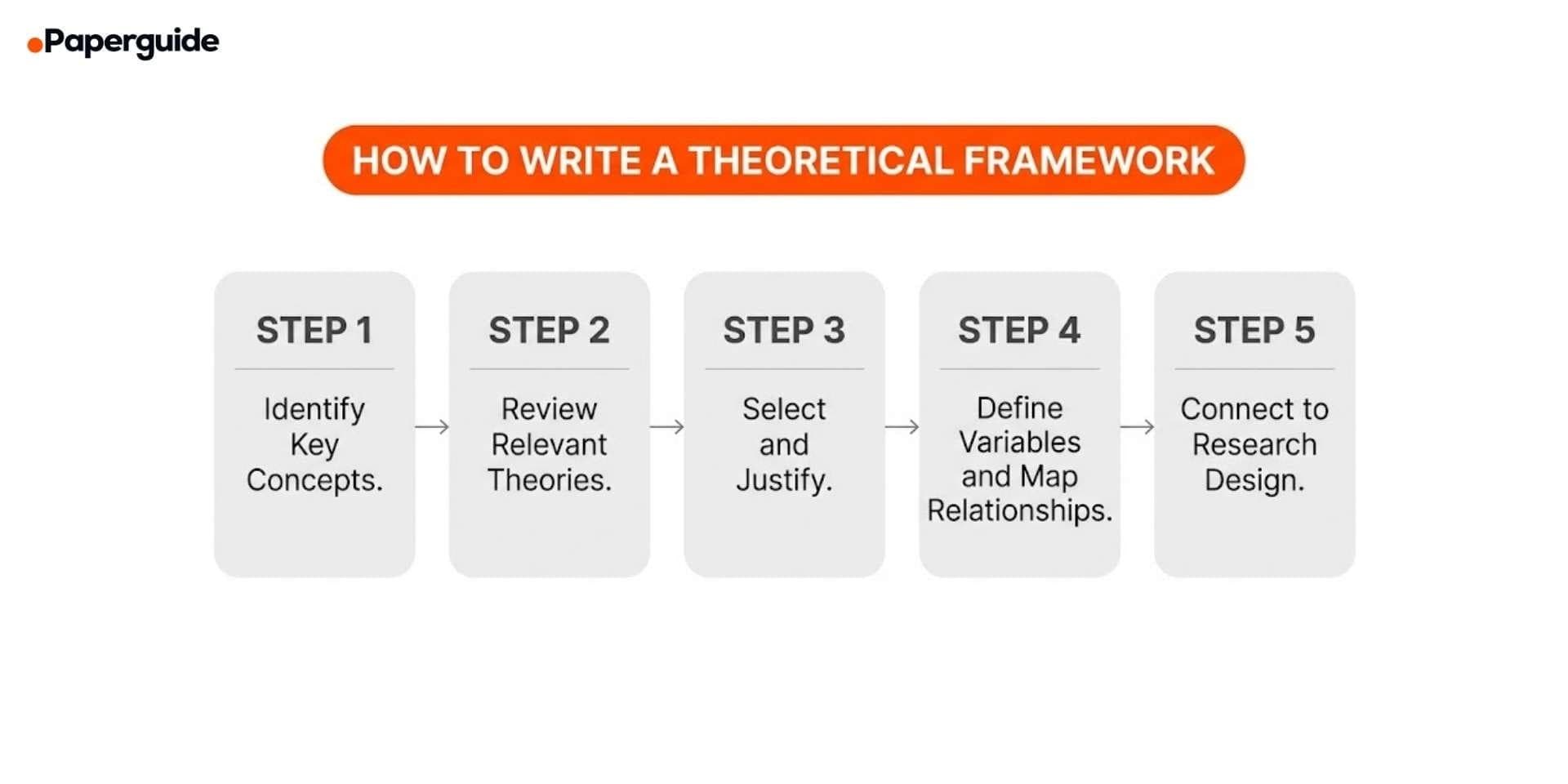
Step 1: Identify the Key Concepts in Your Study
Begin by examining your research problem, research questions, and objectives. Extract the central concepts that your study revolves around. These are the building blocks of your framework.
For example, if your research question asks "How does transformational leadership influence employee innovation in technology startups?", the key concepts are transformational leadership, employee innovation, and organizational context (technology startups).
Define each concept clearly. Different disciplines and theories may define the same concept differently, so establishing precise definitions early prevents confusion later. The Paperguide glossary of research terms offers short definitions of related terms such as paradigm, variable and construct validity.
Step 2: Review and Evaluate Relevant Theories
Conduct a focused literature review to identify theories that explain the relationships between your key concepts. Look for theories that have been applied in similar research contexts and that have empirical support.
For the transformational leadership example, you might consider Bass's transformational leadership theory, Amabile's componential theory of creativity, and social exchange theory. Read how previous researchers have used these theories and evaluate their strengths and limitations.
This step is where many researchers struggle. The goal is not to list every theory you find but to critically evaluate which theories are most relevant, well-supported, and applicable to your specific research context. [4]
Step 3: Select and Justify Your Theoretical Foundation
Choose the theory or combination of theories that best explains your research problem. Justify your choice by explaining why this theory is more appropriate than alternatives.
A strong justification addresses several points. Why does this theory apply to your specific context? What evidence supports its use in similar studies? What are its limitations, and how will your study account for them?
If you are combining multiple theories, explain how they complement each other. Researchers sometimes integrate theories from different disciplines. For example, a study on health behavior change might combine the Health Belief Model with Social Cognitive Theory to capture both individual perceptions and social influences. [2]
Step 4: Define Variables and Map Relationships
Using your chosen theory, identify the specific variables in your study and explain how the theory predicts they will relate to each other. This is where the theoretical framework becomes directly connected to your research design.
Create a visual diagram or written explanation showing the independent variables, dependent variables, and any mediating or moderating factors. Show how the theory predicts the direction and nature of each relationship.
For the transformational leadership study, the framework might show that transformational leadership (independent variable) positively influences employee innovation (dependent variable) through the mediating mechanism of intrinsic motivation, with organizational culture acting as a moderating variable.
Step 5: Connect the Framework to Your Research Design
Explain how your theoretical framework informs your research methods. Show how the theory guides your choice of data collection instruments, sampling strategy, and analysis approach.
For instance, if your framework is based on self-determination theory, you would design survey instruments that measure autonomy, competence, and relatedness. Your analysis would test the relationships between these three needs and the outcome variable predicted by the theory.
This connection between theory and method is critical. A theoretical framework that sits in the introduction but never appears again in the methodology or discussion weakens the entire study. [1]
Examples of Theoretical Frameworks in Research
Example 1: Education Research
Research Topic: The effect of active learning strategies on student engagement in undergraduate biology courses.
Theoretical Framework: Constructivist Learning Theory (Vygotsky, Piaget)
Constructivist theory proposes that learners build knowledge through active interaction with their environment rather than through passive reception of information. The theory identifies social interaction, prior knowledge, and hands-on experience as key drivers of learning.
Application: The framework guides the researcher to measure student engagement through indicators of active knowledge construction, including class participation, collaborative problem-solving, and self-reported understanding. It predicts that active learning strategies will produce higher engagement than traditional lectures because they align with how constructivist theory says learning occurs.
Connection to Methods: Data collection uses classroom observations coded for constructivist learning indicators and pre/post surveys measuring perceived engagement and knowledge construction.
Example 2: Health Sciences Research
Research Topic: Factors influencing medication adherence among patients with chronic heart failure.
Theoretical Framework: Health Belief Model (Rosenstock, 1966)
The Health Belief Model (HBM) proposes that health behavior is determined by four perceptions: perceived susceptibility (belief about the risk of illness), perceived severity (belief about the seriousness of consequences), perceived benefits (belief about the effectiveness of the action), and perceived barriers (belief about the costs or obstacles).
Application: The framework guides the researcher to examine how each of these four perceptions influences whether patients take their prescribed medication consistently. It predicts that patients who perceive high susceptibility and severity but low barriers will show better adherence.
Connection to Methods: The researcher designs a structured questionnaire measuring each of the four HBM constructs, uses Likert-scale items validated in prior HBM studies, and tests the model using multiple regression analysis.
Example 3: Business Research
Research Topic: How organizational culture affects knowledge sharing in multinational corporations.
Theoretical Framework: Social Exchange Theory (Blau, 1964) combined with Hofstede's Cultural Dimensions Theory
Social exchange theory suggests that individuals share knowledge when they perceive that the benefits (reciprocity, recognition, trust) outweigh the costs (time, effort, loss of competitive advantage). Hofstede's cultural dimensions theory adds that cultural factors like individualism vs. collectivism and power distance shape these cost-benefit calculations differently across cultures.
Application: The combined framework predicts that knowledge sharing will be higher in collectivist cultures with low power distance because employees perceive greater social benefits and fewer hierarchical barriers. The researcher tests this prediction across subsidiary offices in different cultural contexts.
Connection to Methods: Data is collected through surveys measuring perceived costs and benefits of knowledge sharing, supplemented by Hofstede's cultural dimension scores for each subsidiary location. Hierarchical regression compares the model across cultural groups.
Theoretical Framework Template
Use this fill-in template to draft your theoretical framework. Replace the bracketed sections with your own content.
Research Problem: This study addresses the problem of [describe the issue or gap] in the context of [specify the setting, discipline, or population].
Key Concepts: The central concepts in this study are [concept 1], [concept 2], and [concept 3]. [Concept 1] is defined as [definition based on chosen theory]. [Concept 2] is defined as [definition]. [Concept 3] is defined as [definition].
Relevant Theories: Several theories relate to these concepts. [Theory A] proposes that [brief explanation of core proposition]. [Theory B] suggests that [brief explanation]. [Theory C] argues that [brief explanation].
Selected Framework: This study adopts [chosen theory] because [justification for why this theory fits the research context, population, and variables]. Alternative theories such as [Theory B] were considered but were less suitable because [reason].
Variable Relationships: Based on [chosen theory], [independent variable] is expected to influence [dependent variable] through [mechanism or pathway]. The theory predicts that [specific prediction about the direction and nature of the relationship]. [Mediating variable, if applicable] operates as a mechanism connecting the independent and dependent variables, while [moderating variable, if applicable] strengthens or weakens this relationship.
Connection to Methods: The theoretical framework guides the research design by [explain how theory informs data collection instruments, sampling strategy, and analysis approach].
Filled Example:
Research Problem: This study addresses the problem of low medication adherence in the context of elderly patients with chronic heart failure in outpatient care settings.
Key Concepts: The central concepts in this study are perceived susceptibility, perceived severity, perceived benefits, and perceived barriers. Perceived susceptibility is defined as the patient's belief about their risk of health deterioration. Perceived severity is defined as the patient's belief about the seriousness of non-adherence consequences. Perceived benefits is defined as the patient's belief about the effectiveness of taking medication. Perceived barriers is defined as the patient's belief about the costs or obstacles to adherence.
Relevant Theories: Several theories relate to these concepts. The Health Belief Model proposes that health behavior is determined by individual perceptions of risk and benefit. Social Cognitive Theory suggests that self-efficacy and observational learning drive behavior change. The Theory of Planned Behavior argues that behavioral intention is shaped by attitudes, subjective norms, and perceived control.
Selected Framework: This study adopts the Health Belief Model because it directly addresses patient perceptions that influence preventive health actions, which aligns with the medication adherence context. Alternative theories such as Social Cognitive Theory were considered but were less suitable because they emphasize learning mechanisms rather than the perception-driven decision-making central to adherence behavior.
Variable Relationships: Based on the Health Belief Model, perceived susceptibility and perceived severity are expected to increase medication adherence, while perceived barriers are expected to decrease it. The theory predicts that patients who perceive high susceptibility and high severity but low barriers will demonstrate the highest adherence rates. Perceived benefits operate as a mechanism reinforcing adherence behavior, while age and health literacy moderate the strength of these relationships.
Connection to Methods: The theoretical framework guides the research design by informing a structured questionnaire with validated Likert-scale items measuring each HBM construct, a purposive sampling strategy targeting elderly heart failure patients in outpatient clinics, and multiple regression analysis testing the predictive relationships specified by the model.
Common Mistakes When Writing a Theoretical Framework
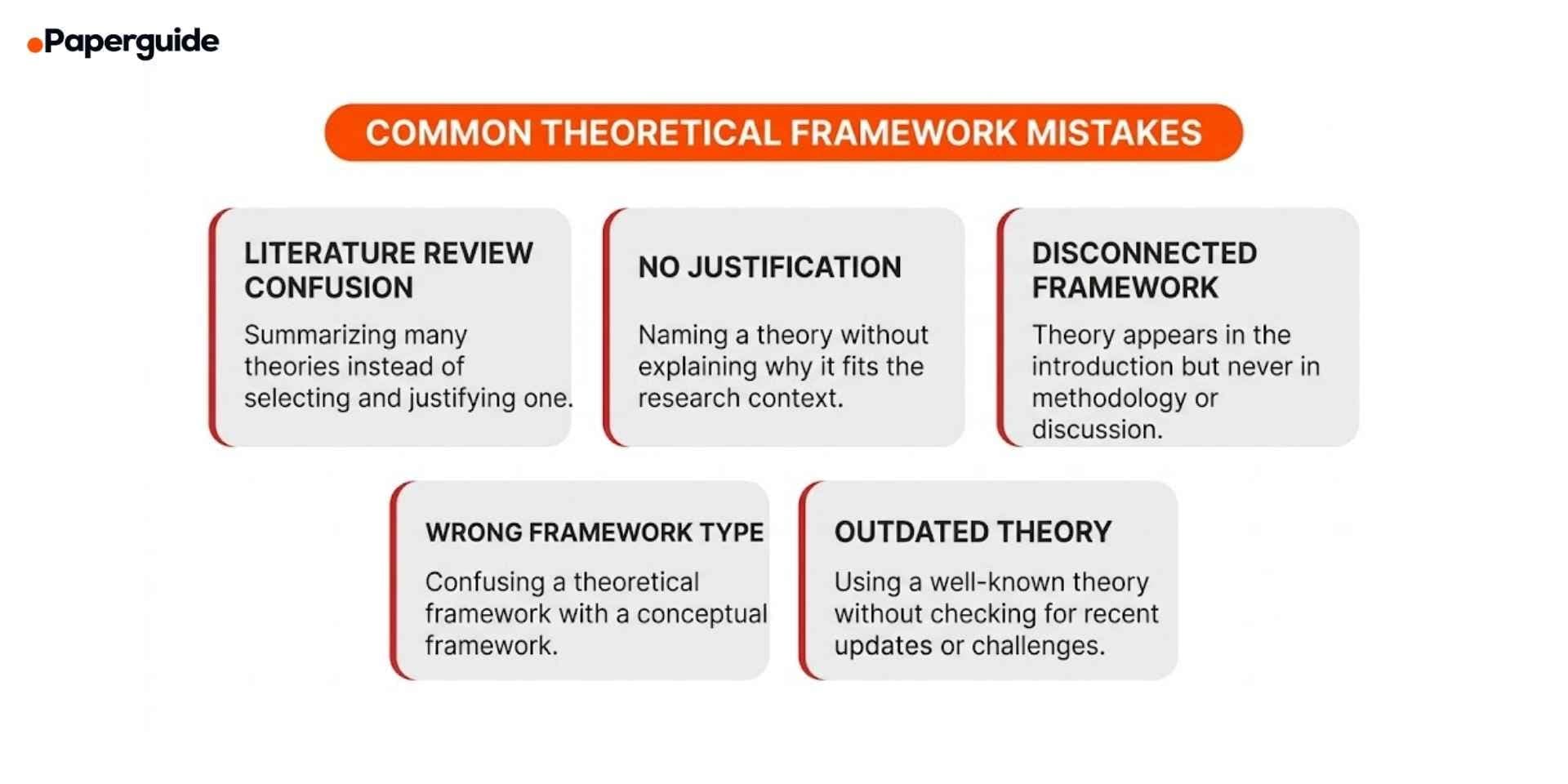
Mistake 1: Treating the Framework as a Literature Review
A theoretical framework is not a summary of everything you have read. It is a focused explanation of the specific theory or theories that guide your study. Many researchers write lengthy summaries of multiple theories without explaining which one they are using and why.
Fix: Review multiple theories but select one or two. Clearly state which theory you are adopting and justify that choice.
Mistake 2: Choosing a Theory Without Justification
Some researchers name a theory but never explain why it fits their study. Simply stating "This study uses social cognitive theory" without connecting it to the research problem leaves readers questioning the choice.
Fix: Explain what the theory proposes, why it applies to your specific research context, and what it predicts about your variables.
Mistake 3: Disconnecting the Framework from the Rest of the Study
A theoretical framework that appears in the literature review but is never mentioned again in the methodology or discussion is a structural weakness. The theory should directly inform how data is collected, analyzed, and interpreted. [3]
Fix: Reference the framework throughout the paper. Show how it guided instrument selection, explain results in terms of the theory, and discuss whether findings support or challenge the theoretical predictions.
Mistake 4: Confusing Theoretical and Conceptual Frameworks
Using these terms interchangeably creates confusion. If your study is grounded in a formal theory, call it a theoretical framework. If you are mapping relationships between specific variables without relying on a single theory, call it a conceptual framework.
Fix: Identify whether your study is theory-driven (theoretical framework) or variable-driven (conceptual framework). Use the correct term consistently.
Mistake 5: Using an Outdated or Unsupported Theory
Selecting a theory simply because it is well-known, without checking whether it has been challenged or updated, can weaken your study. Theories evolve, and researchers should use the most current version supported by empirical evidence.
Fix: Check recent publications to see how the theory has been applied and whether any modifications or criticisms have emerged. Acknowledge limitations of your chosen theory.
Theoretical Framework Quality Checklist
- [] Framework is theory-based. The framework is clearly built on one or more established, named theories from the literature.
- [] Key concepts are defined. Each central concept is defined precisely and consistently using the terminology of the chosen theory.
- [] Theory is explicitly stated. The chosen theory is named and its core propositions are briefly summarized.
- [] Justification is provided. The rationale explains why this theory fits the specific research context, population, and variables.
- [] Alternatives are addressed. Other relevant theories are briefly mentioned with reasons for not selecting them.
- [] Variable relationships are mapped. The direction and nature of relationships between variables are specified, either as a diagram or written explanation.
- [] Testable predictions are included. The framework generates specific, measurable predictions or propositions that the study will test.
- [] Connection to methodology is explicit. The framework clearly informs the choice of data collection instruments, sampling, and analysis approach.
- [] Framework appears throughout the paper. The theory is referenced in the introduction, methodology, results interpretation, and discussion sections.
- [] Theory is current. The chosen theory is supported by recent empirical evidence and any known updates or criticisms are acknowledged.
- [] Limitations are stated. The boundaries and known weaknesses of the chosen theory are explicitly addressed.
How to Choose the Right Theory for Your Study
Selecting the right theory is one of the most challenging parts of writing a theoretical framework. Researchers often ask where to find theories and how to decide which one fits best.
Start with your research problem. What phenomenon are you trying to explain? What causes it? What factors influence it? Then search the literature for theories that have been used to explain similar phenomena.
Evaluate each candidate theory against these criteria. Does the theory explain the relationships between your specific variables? Has it been tested in a context similar to yours? Does it have empirical support? Is it specific enough to generate testable predictions?
If no single theory covers all aspects of your research, consider combining theories from different disciplines. Interdisciplinary frameworks are increasingly common in research and can provide a more comprehensive explanation. However, be careful to explain how the theories complement rather than contradict each other. [5]

Validate This With Papers (2 Minutes)
Before finalizing your theoretical framework, check how published studies in your field have applied the same or similar theories. This confirms that your approach meets disciplinary standards and that your framework is grounded in established evidence.
Step 1: Search for recent studies that used your chosen theory in a similar research context. Note how they defined key concepts, justified the theoretical choice, and connected the framework to their methodology.
Step 2: Open two or three relevant papers and compare their theoretical framework sections with yours. Look at how they structured the framework, which variables they derived from the theory, and how they connected theory to research methods. Reviewing how researchers in your field formulate their frameworks helps you verify that your approach aligns with disciplinary norms.
Step 3: Use Paperguide's Chat with PDF to extract specific passages where authors justify their theoretical framework choice and compare their approach with yours.
This takes about two minutes and ensures your theoretical framework is well-supported by existing evidence.
Conclusion
A theoretical framework is the intellectual backbone of a research study. It connects your work to established theories, guides your research design, and provides the lens for interpreting your findings. Writing one requires identifying key concepts, evaluating relevant theories, selecting the most appropriate one, and clearly showing how it informs every stage of your research. Use the five-step method, examples, and quality checklist in this guide to build a framework that strengthens your study from the ground up.
Frequently Asked Questions
What is a theoretical framework in simple terms?
A theoretical framework is the theory or set of theories you use to explain why the problem in your study exists and how your research will investigate it. It provides the reasoning behind your research design and connects your study to established scholarly knowledge.
Does every research study need a theoretical framework?
Most academic research benefits from a theoretical framework because it provides structure and justification. However, some exploratory or purely inductive studies may develop theory during the study rather than starting with one. In these cases, the framework emerges from the data rather than guiding data collection. [1]
Can I use more than one theory in my theoretical framework?
Yes. Combining multiple theories is acceptable when a single theory does not fully explain your research problem. When using multiple theories, explain how each theory contributes to the framework and how they work together without contradicting each other.
What is the difference between a theoretical framework and a literature review?
A literature review surveys and evaluates existing research on a topic. A theoretical framework identifies the specific theory that guides your study. The literature review is broader and may cover many studies, while the theoretical framework is focused on the theory that underpins your research design.
Where does the theoretical framework go in a thesis or dissertation?
The theoretical framework typically appears in chapter two, either as part of the literature review or as a separate section. Some types of research papers include it in the introduction. Check your institution's guidelines for the expected placement.
How long should a theoretical framework be?
Length depends on the complexity of your study. For a journal article, one to two pages is typical. For a thesis or dissertation, the theoretical framework chapter may be five to fifteen pages, depending on how many theories are discussed and how detailed the justification needs to be.
Can a theoretical framework change during the research process?
In quantitative studies, the framework is typically established before data collection and remains fixed. In qualitative studies, the framework may evolve as new themes or patterns emerge from the data. If you modify your framework, document and justify the changes. [2]
Where can I find theories for my theoretical framework?
Search academic databases for studies that investigate similar phenomena. Look at the theoretical sections of published papers in your field. Textbooks on research methodology often list common theories by discipline. Review articles and systematic reviews can also reveal which theories are most commonly used for specific topics.
References
- Herber, O.R., Taylor, J. & Bradbury-Jones, C. "Theory in qualitative research: a qualitative study of research experts' views." BMC Medical Research Methodology, 26(1), 2026.
- Stalmeijer, R.E. & Varpio, L. "How to incorporate theory in qualitative research: AMEE Guide No. 183." Medical Teacher, 2026.
- Rouse, E. et al. "Making a Theoretical Contribution with Qualitative Research." Academy of Management Journal, 68(2), 2025.
- Herber, O.R. et al. "Epistemologies, methodologies and theories used in qualitative Global North health and social care research: a scoping review protocol." BMJ Open, 15(7), 2025.
- Garvey, C.M. & Jones, R. "Is There a Place for Theoretical Frameworks in Qualitative Research?" International Journal of Qualitative Methods, 20, 2021.
Researching a topic?
Find papers and get cited answers
Search the literature, find gaps and write with citations.
Start for freeNo credit card required