How to Write an RRL in Research: Steps and Format

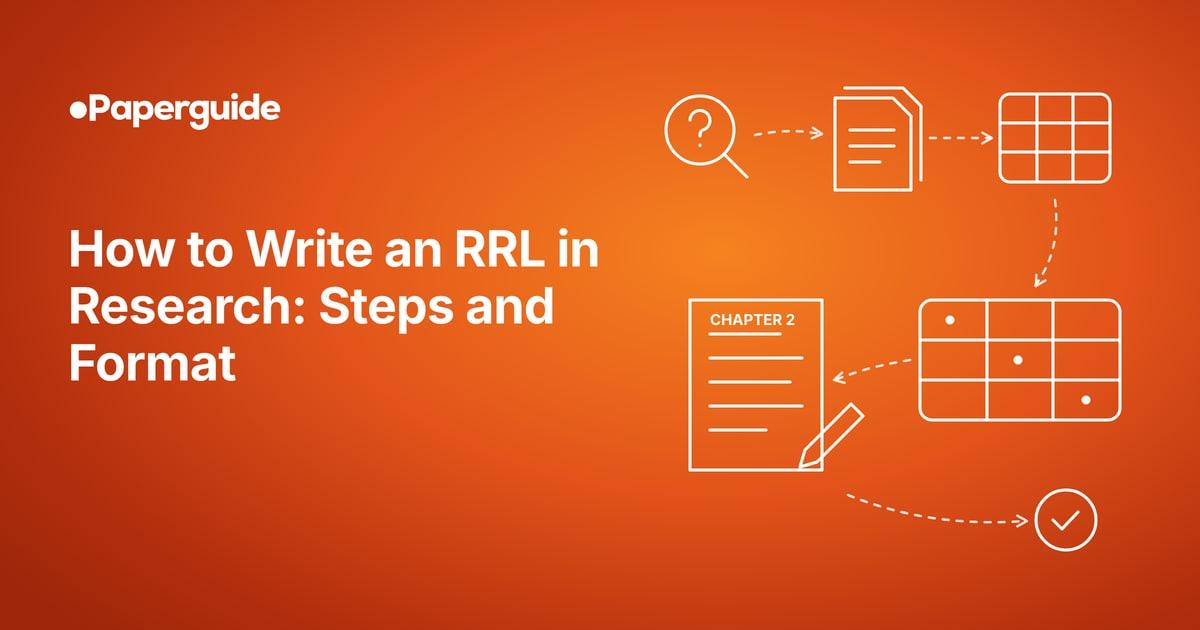
To write an RRL (review of related literature), start from your research problem, collect local and foreign sources on each variable, record them in an RRL matrix, group them into themes, and write each theme by comparing studies rather than summarizing them one by one. End with a synthesis that shows the gap your study fills.
This guide covers how to make an RRL in the format many Philippine schools use for Chapter 2, an eight-step method, a sample RRL matrix, a worked paragraph that turns sources into synthesis, APA 7 citation rules, the mistakes advisers flag most often, and a checklist. It is written for senior high school students in Practical Research 1 and 2, and for college and graduate students writing a thesis.
Key Takeaways
An RRL is usually Chapter 2 of a Philippine research paper. It shows what earlier literature and studies say about your variables and why your study is still needed. The skill it tests is synthesis: putting several sources side by side and saying what they show together.
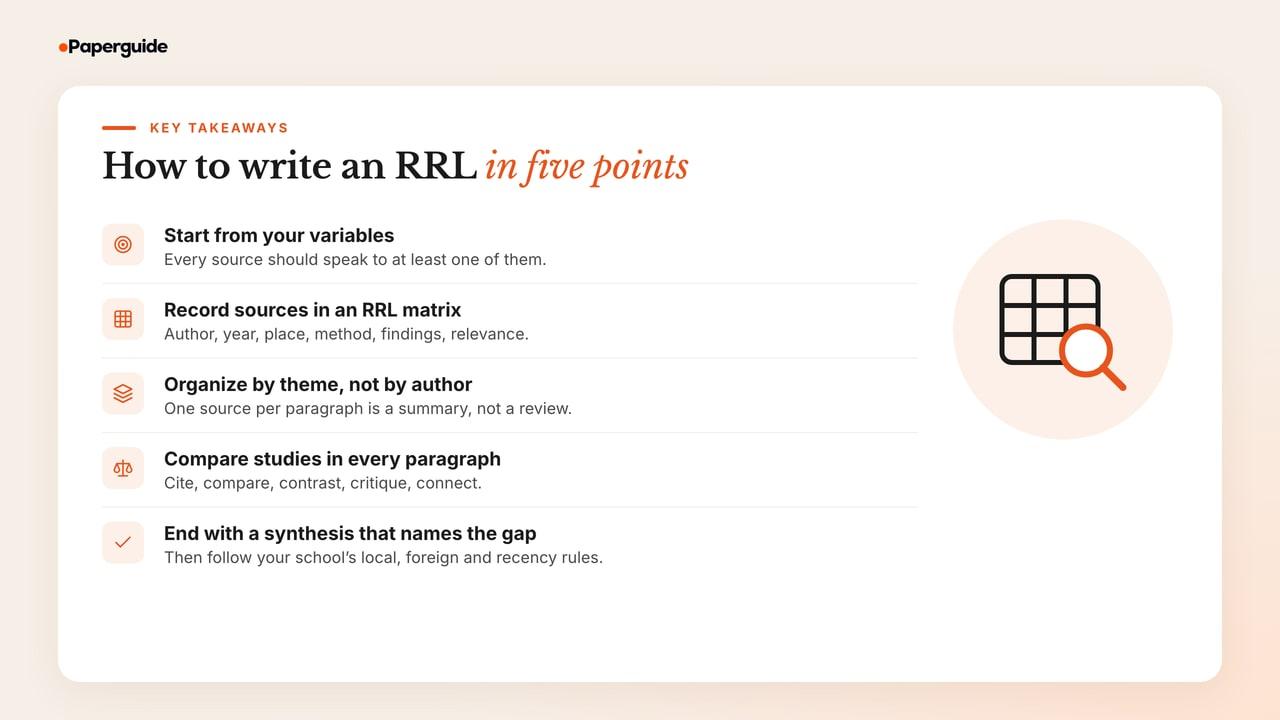
- Start from your research problem and variables. Every source you include should speak to at least one of them.
- Record each source in an RRL matrix (author, year, place, method, findings, relevance) before you write a single paragraph.
- Organize the chapter by theme or variable, not by author. One source per paragraph is a summary, not a review.
- In every paragraph, compare, contrast and critique studies, then connect them to your own study.
- Close with a synthesis that states what is known, what is missing and how your study fills the gap.
RRL in Research: A Quick Definition
A review of related literature (RRL) is the part of a research paper that discusses published and unpublished work related to your topic. The guide to what an RRL is in research covers its meaning, parts and purpose in full; this section gives what you need before writing. In Philippine theses it is usually Chapter 2, often titled "Review of Related Literature and Studies", and it comes after Chapter 1, which states the problem and its background.
The RRL is the Philippine name for what most countries call a literature review. The goals are the same: show what is already known, show how studies agree and disagree, and justify your research question. What differs is the format. Philippine schools often ask students to separate related literature from related studies, and local sources from foreign ones.
The Department of Education builds the RRL into senior high school. The Practical Research 2 curriculum guide lists competencies such as selecting relevant literature, citing it in a standard style (APA, MLA or Chicago), synthesizing information from it, and writing a "coherent review of literature" together with the conceptual framework [1].
Related Literature vs Related Studies
Many Philippine research guides split Chapter 2 into two kinds of sources:
- Related literature covers facts, principles and ideas your study builds on. It usually comes from books, journals, magazines, newspapers and official reports.
- Related studies are investigations already carried out on a similar problem, such as theses, dissertations and research articles with their own data.
The distinction is why you will see "RRL" and "RRS" (review of related studies) used side by side. Some schools keep them as separate sections, and others combine them into one review organized by theme. The guide on how to find a review of related literature shows how to search for both.
Local vs Foreign Sources
The second split is by place. Many Philippine research guides treat a source as local when it was published in, conducted in or is about the Philippines, and as foreign otherwise. Definitions differ between schools, so check yours.
Your adviser may ask for a minimum number of each. There is no national rule on the count, so follow your school's template. What matters more is that the local sources show the problem exists in your setting and the foreign ones show what is known elsewhere.
RRL Format: The Parts of Chapter 2
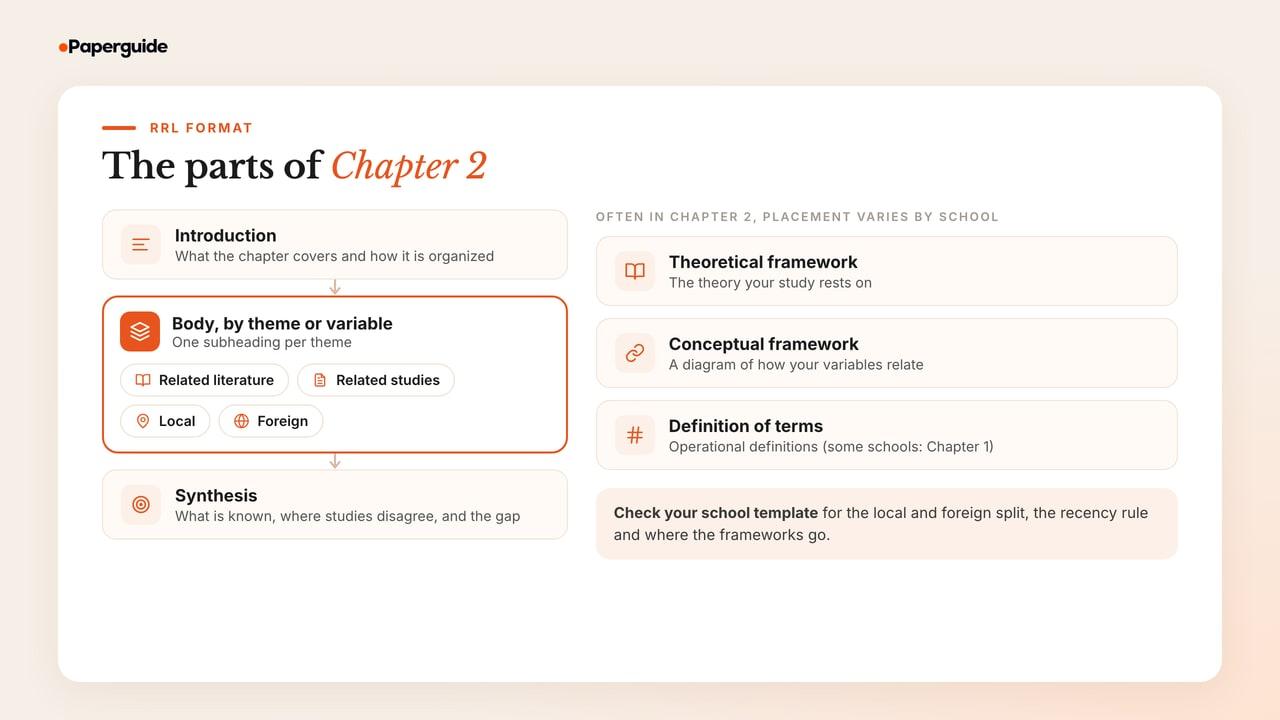
The exact template varies by school, but most Chapter 2 drafts have these parts.
Common Parts of an RRL in Chapter 2
| Part | What it contains | Typical length |
|---|---|---|
| Introduction | One paragraph on what the chapter covers and how it is organized | 1 paragraph |
| Body (by theme or variable) | Related literature and studies, local and foreign, grouped under subheadings | Most of the chapter |
| Synthesis | What the sources show together, where they disagree, and the gap your study fills | 1 to 3 paragraphs |
| Theoretical framework | The theory or theories your study rests on | 1 to 2 pages |
| Conceptual framework | A diagram and explanation of how your variables relate | 1 to 2 pages |
| Definition of terms | Operational definitions of key terms (some schools place this in Chapter 1) | Short list |
Two parts depend most on your school. Some put the definition of terms at the end of Chapter 1, and some programs move the frameworks to Chapter 1 or into a separate section. Check your template before you write, because moving a section later costs more time than placing it right the first time.
The frameworks have their own guides: the theoretical framework in research and the conceptual framework with examples. For the definition of terms, write operational definitions of your variables rather than dictionary meanings.
Thematic, Chronological or Methodological?
University writing guides describe several ways to organize a literature review, including these three [2][3]:
- Thematic: organized around topics or variables. This is the most common choice in the social sciences [4] and the easiest for most student papers.
- Chronological: organized by how the research developed over time. Useful when a field changed direction, for example before and after the pandemic.
- Methodological: organized by how studies were done, such as surveys against interviews. Useful when the method explains why results differ.
For a typical Chapter 2, use a thematic structure with one subheading per variable or theme. Within a theme, you can still note how the evidence changed over time.
How to Write an RRL Step by Step
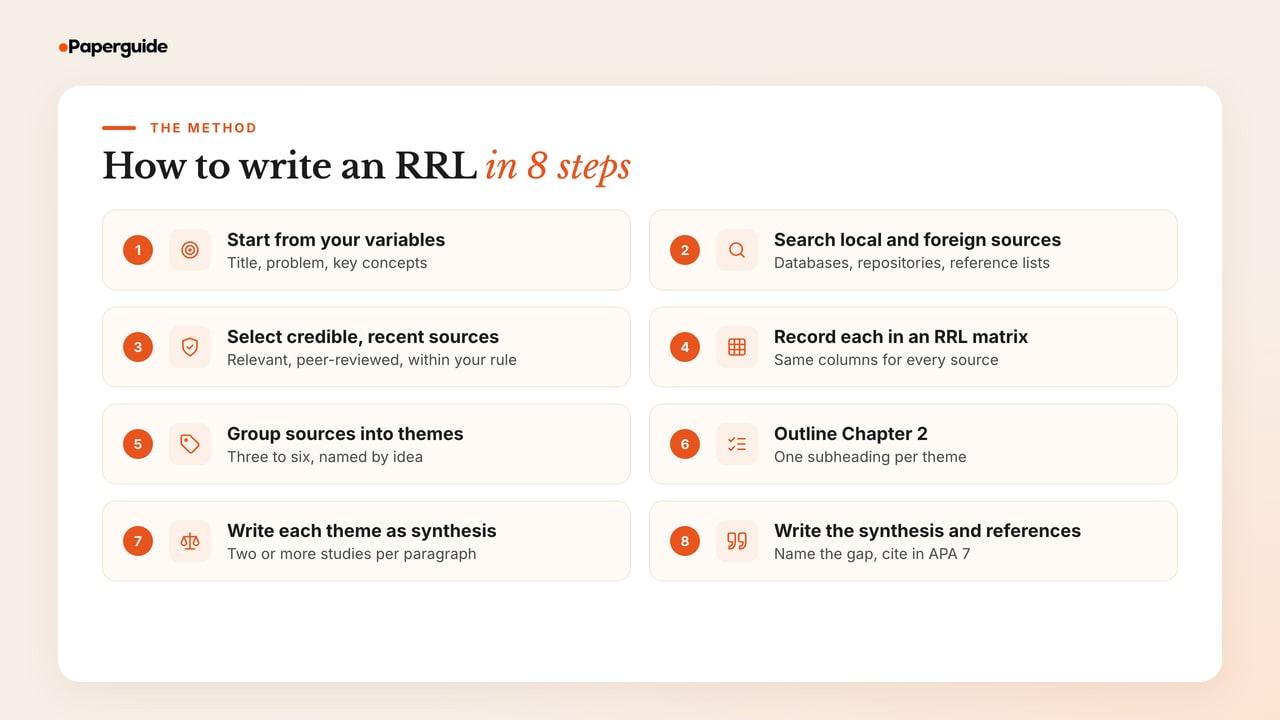
Creswell describes the literature review as five tasks: identify key terms, locate the literature, critically evaluate and select it, organize it, and write the review [5]. The eight steps below follow the same order, with the extra steps Philippine Chapter 2 formats need.
Step 1: Start From Your Research Problem and Variables
Write down your research title, your statement of the problem and the variables or key concepts in it. If your study is "Online gaming and academic performance of Grade 10 students", your variables are online gaming and academic performance, and your setting is a Philippine junior high school.
Each variable becomes a search term and later a section of your RRL. If your research question is still vague, fix it first, because a vague question produces a pile of loosely related sources.
Step 2: Search for Local and Foreign Sources
Turn each variable into keywords and synonyms, then search more than one place. Combine terms with AND and OR, for example: ("online games" OR gaming) AND ("academic performance" OR grades) AND Philippines.
- For foreign sources: Google Scholar, ERIC (education), PubMed (health), CORE and the Directory of Open Access Journals. The guide to academic search engines for students compares them.
- For local sources: Philippine E-Journals, HERDIN for health research, PIDS for policy and education studies, and university repositories such as the DLSU Animo Repository. Your school library may also hold unpublished theses.
- For both: follow the reference lists of the best studies you find, and check who cited them later.
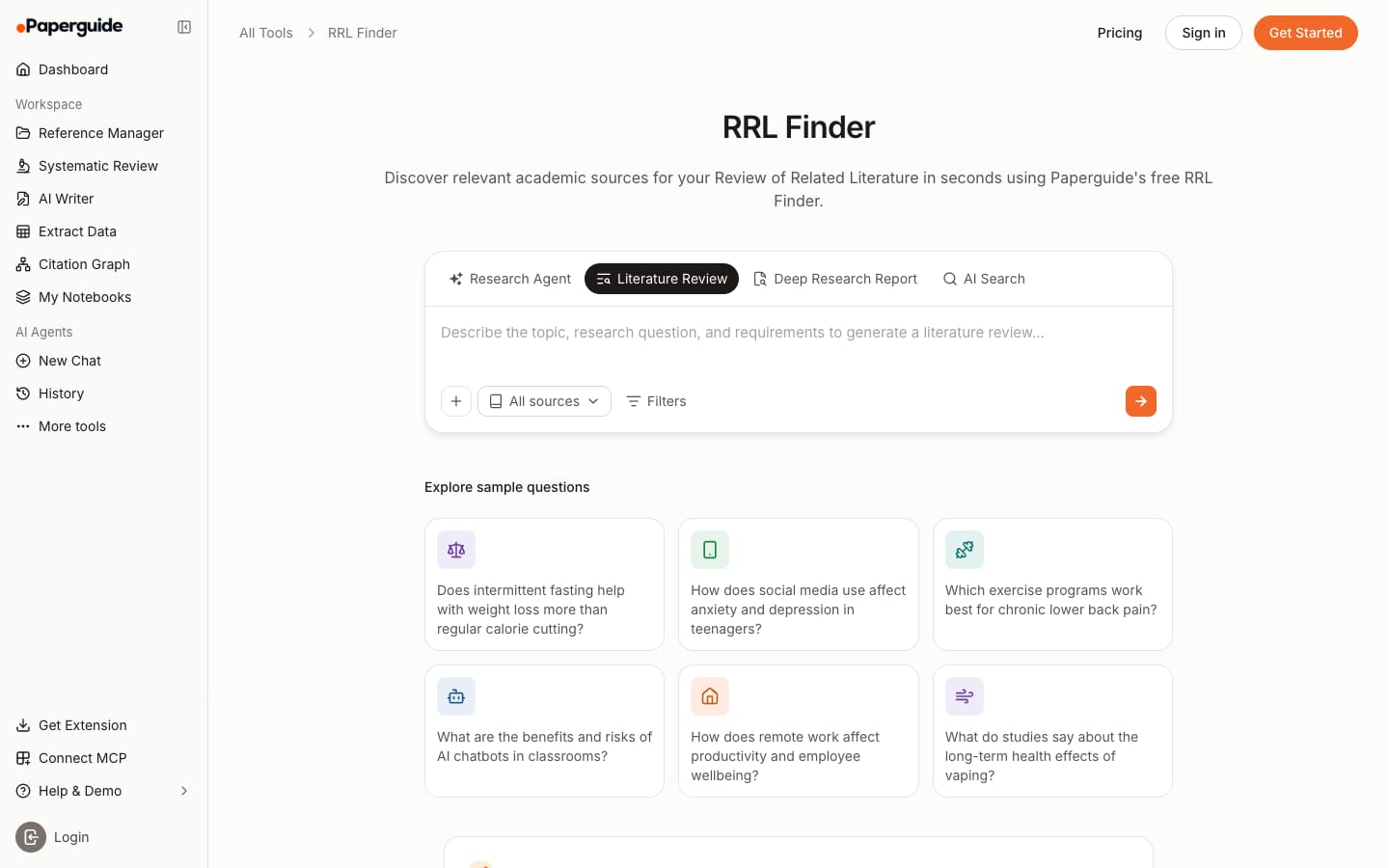
Paperguide's free RRL Finder is a fast way to start: enter your topic and it returns related studies grouped by theme, with citation details. Treat its results as a starting list and open each paper before you use it.

Step 3: Select Credible, Relevant and Recent Sources
Not every search result belongs in your RRL. Keep a source if it is relevant to a variable, credible (peer-reviewed, institutional or a defended thesis) and recent enough for your school's rule.
Recency rules differ. Many teachers ask for sources from the last five or ten years, and one Philippine senior high school library guide recommends "prioritizing recent studies (typically those from the last 10 years, as well as milestone studies)" [6]. These are local rules rather than research standards: a 2024 commentary in the Journal of the Medical Library Association noted that "the origins of the five-year rule remain unknown" [7]. Follow your adviser, and keep older seminal studies when your topic depends on them.
Prefer primary sources over secondary ones when you report findings. Cite the study that collected the data, not a website that summarized it.
Step 4: Record Each Source in an RRL Matrix
An RRL matrix is a table with one row per source and the same columns for every source. It is the most practical tool for writing Chapter 2, because it lets you compare studies down a column instead of rereading PDFs.
Here is a matrix for a study on online gaming and academic performance, filled with five real studies. Add a column for page numbers if you plan to quote, and fill the matrix as you read, not afterward, so you never lose track of which study said what.
Sample RRL Matrix: Author, Year, Place, Method, Findings and Relevance
| Author (Year) | Local or foreign | Design and sample | Key finding | Variable or theme | Use in my study |
|---|---|---|---|---|---|
| Dumrique & Castillo (2018) | Local | Study of PUP Laboratory High School students | Playing online games did not affect grades badly; students limited play to weekends and vacations | Time spent, self-control | A local case where gaming did not hurt grades |
| Cabrillos et al. (2022) | Local | Descriptive-evaluative survey, 30 BPEd students | No substantial association between online gaming and academic success | Gaming, performance | Agrees with Dumrique; very small sample |
| Brunborg et al. (2014) | Foreign | Two-wave panel survey, 1,928 adolescents in Norway | Time spent gaming not related to outcomes; video game addiction related to lower academic achievement | Time spent vs addiction | Separates time from addiction |
| Mahmud et al. (2023) | Foreign | Cross-sectional survey, university students in Bangladesh | Playing 30 or more hours a week associated with lower CGPA and less study time | Heavy play, performance | Shows a negative link at high levels of play |
| Alzahrani & Griffiths (2024) | Foreign | Systematic review of 27 studies | 24 found a negative relationship, but recent studies suggest poor performance may lead to problematic gaming | Direction of effect | Warns against assuming cause |
For four complete sample RRLs built the same way, quantitative and qualitative, see the RRL examples with local and foreign studies. If your review is large, the literature review map guide shows how to turn a matrix into themes visually.
Step 5: Group Your Sources Into Themes
Read down each column of the matrix and look for patterns. Which studies agree? Which disagree, and is it because of the sample, the setting or the method? Which questions keep appearing, and which are missing?
Group the sources into three to six themes. Name each theme after the idea it covers, not after an author. "Addiction versus time spent gaming" is a theme. "Studies by Author A" is not. A source can appear under more than one theme.
This is also where gaps show up. A theme with only foreign studies, only old studies, or only one method is worth noting, because it may be the gap your study fills. The guide on how to find research gaps covers the next step in detail.
Step 6: Outline Your Chapter 2
Turn the themes into subheadings and place them in a logical order, usually from broad to specific or in the order of your variables. A simple outline looks like this:
- Introduction to the chapter
- Theme 1: Online gaming among Filipino students
- Theme 2: Time spent gaming and academic performance
- Theme 3: Gaming addiction and the direction of the effect
- Synthesis
- Theoretical and conceptual framework
If your school requires separate local and foreign sections, keep the themes inside each one so the chapter still reads as an argument. Check the order against your statement of the problem: each sub-problem should map to at least one theme.
Step 7: Write Each Theme as Synthesis, Not Summary
This is the step that separates a strong RRL from a list of abstracts. Purdue OWL puts it simply: "Usually you will need to synthesize research rather than just summarizing it", and if you are citing just one source per paragraph, that "usually indicates summary only" [3].
A useful pattern for each paragraph is the 5 Cs of a literature review: cite, compare, contrast, critique and connect [8].
- Open with a claim about the theme, written in your own words.
- Support it with two or more studies, saying where they agree.
- Add the studies that disagree and suggest why: sample, setting, method or time.
- Critique briefly: small samples, self-reported data, or no Philippine data.
- Connect the paragraph to your study in the last sentence.
Paraphrase rather than quote. The UNC Writing Center advises students to "use quotes sparingly" [2], and USC warns against using extensive quotes "as a substitute for using your own words" [4].
Worked example: from summary to synthesis
Here are studies from the matrix, first written as a summary, the way many first drafts are:
Each paragraph is accurate, but the reader is left to work out why the two studies seem to disagree. Here is the same evidence written as synthesis:
The second version makes a claim, cites five studies, explains the disagreement, names a limitation and connects to the study. That is one theme of an RRL done well.
Step 8: Write the Synthesis and the References
The synthesis closes the review. In one to three paragraphs, state what the literature shows overall, where it disagrees, what is missing, and how your study responds. A good synthesis ends with a sentence that leads straight into your framework or your methods.
Then build the reference list in the style your school uses, usually APA 7. Check every in-text citation against the list: each one needs an entry, and each entry needs a citation in the text. Paperguide's Reference Manager stores each source with its metadata, formats the reference list in APA 7 or any of 1,000+ citation styles, and keeps your PDF highlights and notes beside each paper.
How to Cite in an RRL Using APA 7
APA 7 uses the author-date system. Every in-text citation gives the author's surname and the year, and every source appears in the reference list at the end of the paper [9].
APA 7 In-Text Citations: Parenthetical and Narrative Forms
| Authors | Parenthetical | Narrative |
|---|---|---|
| One author | (Luna, 2020) | Luna (2020) |
| Two authors | (Salas & D'Agostino, 2020) | Salas and D'Agostino (2020) |
| Three or more | (Martin et al., 2020) | Martin et al. (2020) |
| Two studies together | (Luna, 2020; Martin et al., 2020) | Luna (2020) and Martin et al. (2020) |
Mix the two forms. Narrative citations put the author in the sentence ("Luna (2020) found..."), which is useful when you contrast authors. Parenthetical citations keep the focus on the finding, which suits synthesis sentences that cite several studies at once. A direct quote also needs a page number, for example (Luna, 2020, p. 45).
A reference list entry for a journal article follows this pattern:
Author, A. A., & Author, B. B. (Year). Title of the article in sentence case. Journal Name in Title Case, Volume(Issue), pages. DOI link
Here is a real entry from the sample matrix in that pattern:
Brunborg, G. S., Mentzoni, R. A., & Frøyland, L. R. (2014). Is video gaming, or video game addiction, associated with depression, academic achievement, heavy episodic drinking, or conduct problems? Journal of Behavioral Addictions, 3(1), 27-32. https://doi.org/10.1556/jba.3.2014.002
How Long Should an RRL Be?
There is no fixed length. A senior high school Practical Research paper may have a Chapter 2 of a few pages with a small number of sources per variable, while an undergraduate or graduate thesis runs much longer. Count requirements, such as a set number of local and foreign sources, come from your school, so ask your adviser for the template.
Judge length by coverage instead. Each variable in your statement of the problem should have enough sources to show what is known and where studies disagree. When new searches keep returning studies you already have, your search is close to complete.
Can You Use AI to Write an RRL?
AI tools can help you search, sort and summarize sources faster, but they should not write your RRL for you, and you must check every reference they produce. In a 2023 study in Scientific Reports, 55% of the citations generated by GPT-3.5 were fabricated, as were 18% of those generated by GPT-4 [10]. A made-up reference in Chapter 2 is the kind of error a panel will find.
Use AI where it saves time without replacing your judgment:
- Finding sources: tools that search real databases, such as the RRL Finder or AI Search, return papers you can open and check.
- Organizing: Literature Review AI runs a plan, search, screen, extract and synthesize sequence from one research question and shows where evidence converges and conflicts, with every claim cited to a source paper. That gives you a structure to check against your own matrix.
- Drafting: if your school allows AI assistance, write the synthesis yourself and use tools only to tighten language. Read your school's policy first.
The comparison of RRL finder tools for students covers the main options.
Common Mistakes When Writing an RRL
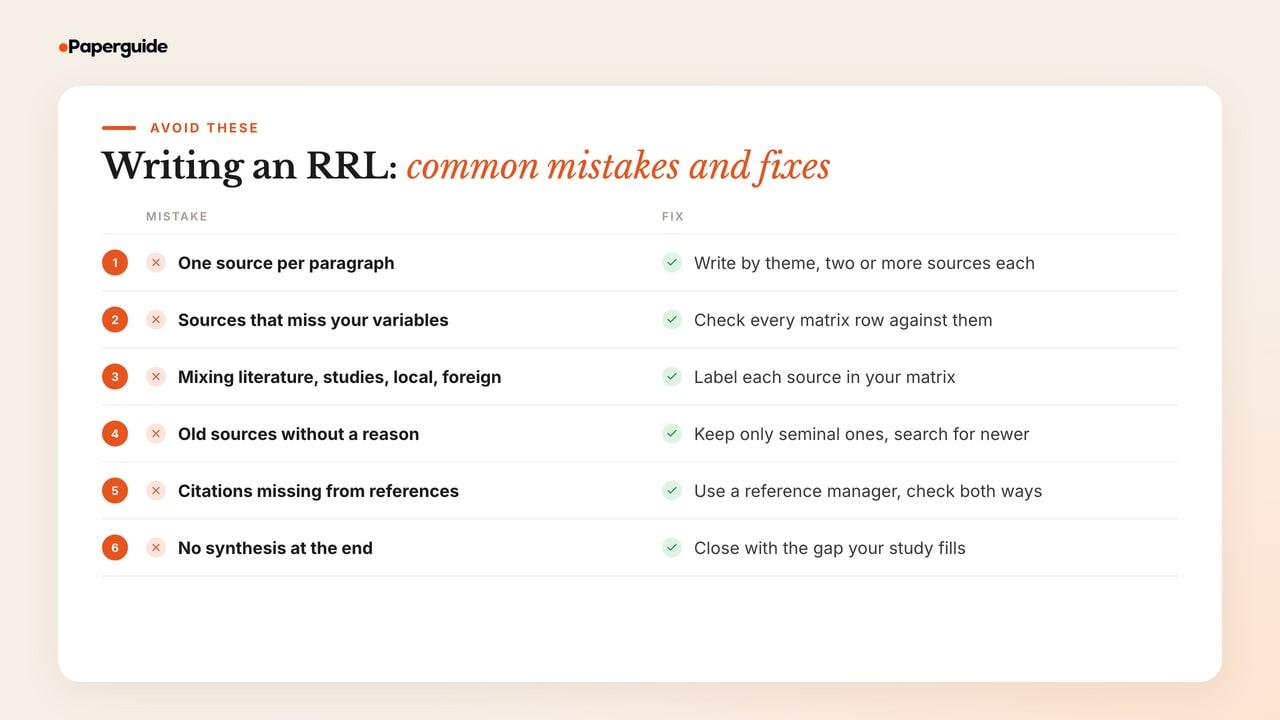
One source per paragraph. Advisers flag this problem often. Each paragraph becomes a summary of one study, and the reader has to do the comparing. Write by theme, with two or more sources per paragraph.
Sources that do not match your variables. A study on social media and sleep does not belong in a review on social media and grades unless you explain the link. Check every row of your matrix against your variables.
Mixing up literature and studies, or local and foreign. If your school separates them, a foreign study filed under local literature is an easy point to lose. Label each source in your matrix.
Old sources without a reason. A 2009 study is fine if it is the classic study on your topic. It is a problem if newer evidence exists and you did not look for it.
Citations that do not match the reference list. Missing entries, misspelled names and wrong years are common and easy to prevent with a reference manager.
No synthesis at the end. A review that stops after the last study leaves the panel asking why your study is needed. Always close with the gap.
RRL Checklist
Run this before you submit Chapter 2.
- [ ] Every variable in my statement of the problem has its own theme or subheading
- [ ] Every source in the chapter is in my RRL matrix with author, year, place, method and findings
- [ ] Local and foreign sources meet my school's required mix
- [ ] Sources meet my school's recency rule, and any older source is a seminal study I can justify
- [ ] Each paragraph cites two or more sources and compares them
- [ ] Disagreements between studies are reported and explained
- [ ] Quotes are few and each has a page number
- [ ] The synthesis states the gap my study fills
- [ ] Every in-text citation matches an entry in the reference list in APA 7 (or my school's style)
- [ ] Every reference has been opened and read, including any suggested by an AI tool
Try It Yourself (2 Minutes)
- Write your research title and list its variables, one per line.
- Enter the title in Paperguide's free RRL Finder and look at how the results are grouped.
- Pick two studies from the same group and write one sentence that compares them: where they agree, or why they differ.
By the end you will have a first theme for your RRL and your first synthesis sentence.
Conclusion
Writing an RRL is mostly organizing before writing. Start from your variables, search local and foreign sources, record every source in a matrix, and group them into themes. Then write each theme as a comparison of studies and close with a synthesis that shows the gap your study fills.
Check your school's template for the parts that vary, such as the local and foreign split, the recency rule and where the frameworks go. Once the review is done, the step-by-step guide to writing a literature review covers the same method for longer reviews, and the gap you named becomes the starting point of your methods.
Frequently Asked Questions
Is RRL in Chapter 1 or Chapter 2?
In Philippine research papers and theses, the RRL is usually Chapter 2. Chapter 1 presents the problem and its background, and Chapter 2 reviews related literature and studies, often followed by the theoretical and conceptual framework. In senior high school Practical Research 2, the RRL is taught together with the conceptual framework [1].
What are the 5 simple steps in writing an RRL?
Creswell lists five steps for a literature review: identify key terms, locate the literature, critically evaluate and select it, organize it, and write the review [5]. For a Philippine Chapter 2, add two habits: label each source as local or foreign, and record every source in an RRL matrix before writing.
What is the format of an RRL?
A typical RRL has an introduction, a body organized by theme or variable, a synthesis, and then the theoretical and conceptual framework. Some schools also separate related literature from related studies and local sources from foreign ones. Follow your school's template.
What is an RRL in APA format?
It is an RRL written with APA 7 author-date citations, such as (Luna, 2020) or Luna (2020), and a reference list at the end with full details for every source [9]. DepEd's Practical Research 2 guide accepts APA, MLA or Chicago, so check which one your school uses [1].
How many years back should RRL sources be?
There is no universal rule. Many teachers ask for sources from the last five or ten years, but this is a local requirement, and a 2024 commentary noted that the origins of the five-year rule remain unknown [7]. Follow your adviser and keep older seminal studies when your topic depends on them.
What is the difference between RRL and RRS?
RRL refers to related literature, such as books, articles and reports that discuss concepts and facts. RRS refers to related studies, which are investigations already carried out on a similar problem, such as theses and research articles with their own data. Many schools combine them in one Chapter 2.
Can ChatGPT write my RRL?
It can help with outlining and wording, but it should not write your RRL, and its references must be checked. In one study, 55% of GPT-3.5 citations and 18% of GPT-4 citations were fabricated [10]. Use tools that search real databases and read every source yourself.
What are the 5 C's of a literature review?
The 5 Cs are cite, compare, contrast, critique and connect [8]. Cite the sources, compare where they agree, contrast where they differ, critique their strengths and limits, and connect them to your own study.
References
-
Department of Education. (2018). K to 12 senior high school applied track subject: Practical research 2 curriculum guide. Learning Resources Management and Development System. https://lrmds.deped.gov.ph/detail/14450 (accessed 9 November 2026)
-
The Writing Center, University of North Carolina at Chapel Hill. (n.d.). Literature reviews. https://writingcenter.unc.edu/tips-and-tools/literature-reviews/ (accessed 9 November 2026)
-
Purdue Online Writing Lab. (n.d.). Writing a literature review. Purdue University. https://owl.purdue.edu/owl/research_and_citation/conducting_research/writing_a_literature_review.html (accessed 9 November 2026)
-
USC Libraries. (n.d.). Organizing your social sciences research paper: 5. The literature review. University of Southern California. https://libguides.usc.edu/writingguide/literaturereview (accessed 9 November 2026)
-
Creswell, J. W. (2015). Educational research: Planning, conducting, and evaluating quantitative and qualitative research (5th ed.). Pearson. https://libcat.library.tamu.edu/Record/in00003737142/Versions
-
Adamson University Senior High School. (n.d.). The review process. YES to Research e-Library. https://sites.google.com/view/yestoresearch-e-library/3is/module-3/the-review-process (accessed 9 November 2026)
-
Truex, E. S., Hillyer, J., & Spinner, E. N. (2024). Fostering change, empowering faculty: Comments on the NURSLITT study and the five-year rule. Journal of the Medical Library Association, 112(2), 164-168. https://doi.org/10.5195/jmla.2024.1768
-
Texas Tech University Graduate Writing Center. (n.d.). 5 Cs to writing a literature review. https://www.depts.ttu.edu/provost/uwc/graduate/writing-resources/writing-a-literature-review.php (accessed 9 November 2026)
-
American Psychological Association. (n.d.). Author-date citation system. APA Style. https://apastyle.apa.org/style-grammar-guidelines/citations/basic-principles/author-date (accessed 9 November 2026)
-
Walters, W. H., & Wilder, E. I. (2023). Fabrication and errors in the bibliographic citations generated by ChatGPT. Scientific Reports, 13, 14045. https://doi.org/10.1038/s41598-023-41032-5 Studies used in the sample matrix and worked example:
-
Alzahrani, A. K. D., & Griffiths, M. D. (2024). Problematic gaming and students' academic performance: A systematic review. International Journal of Mental Health and Addiction, 23(5), 4062-4095. https://doi.org/10.1007/s11469-024-01338-5
-
Brunborg, G. S., Mentzoni, R. A., & Frøyland, L. R. (2014). Is video gaming, or video game addiction, associated with depression, academic achievement, heavy episodic drinking, or conduct problems? Journal of Behavioral Addictions, 3(1), 27-32. https://doi.org/10.1556/jba.3.2014.002
-
Cabrillos, L. E., Gapasin, J. D., Marfil, J. A., & Calixtro, V. L., Jr. (2022). Examining the effects of online games on the academic performance of BPEd students of Sultan Kudarat State University, Philippines. Indonesian Journal of Educational Research and Technology, 3(1), 13-18. https://doi.org/10.17509/ijert.v3i1.43732
-
Dumrique, D. O., & Castillo, J. G. (2018). Online gaming: Impact on the academic performance and social behavior of the students in Polytechnic University of the Philippines Laboratory High School. KnE Social Sciences, 3(6), 1205-1210. https://doi.org/10.18502/kss.v3i6.2447
-
Mahmud, S., Jobayer, M. A. A., Salma, N., Mahmud, A., & Tamanna, T. (2023). Online gaming and its effect on academic performance of Bangladeshi university students: A cross-sectional study. Health Science Reports, 6(12), e1774. https://doi.org/10.1002/hsr2.1774
Reviewing literature?
Generate your literature review
Categorized sources, citations and key insights from a single topic.
Try it freeNo credit card required