Operational Definition in Research: Meaning, Examples & Importance


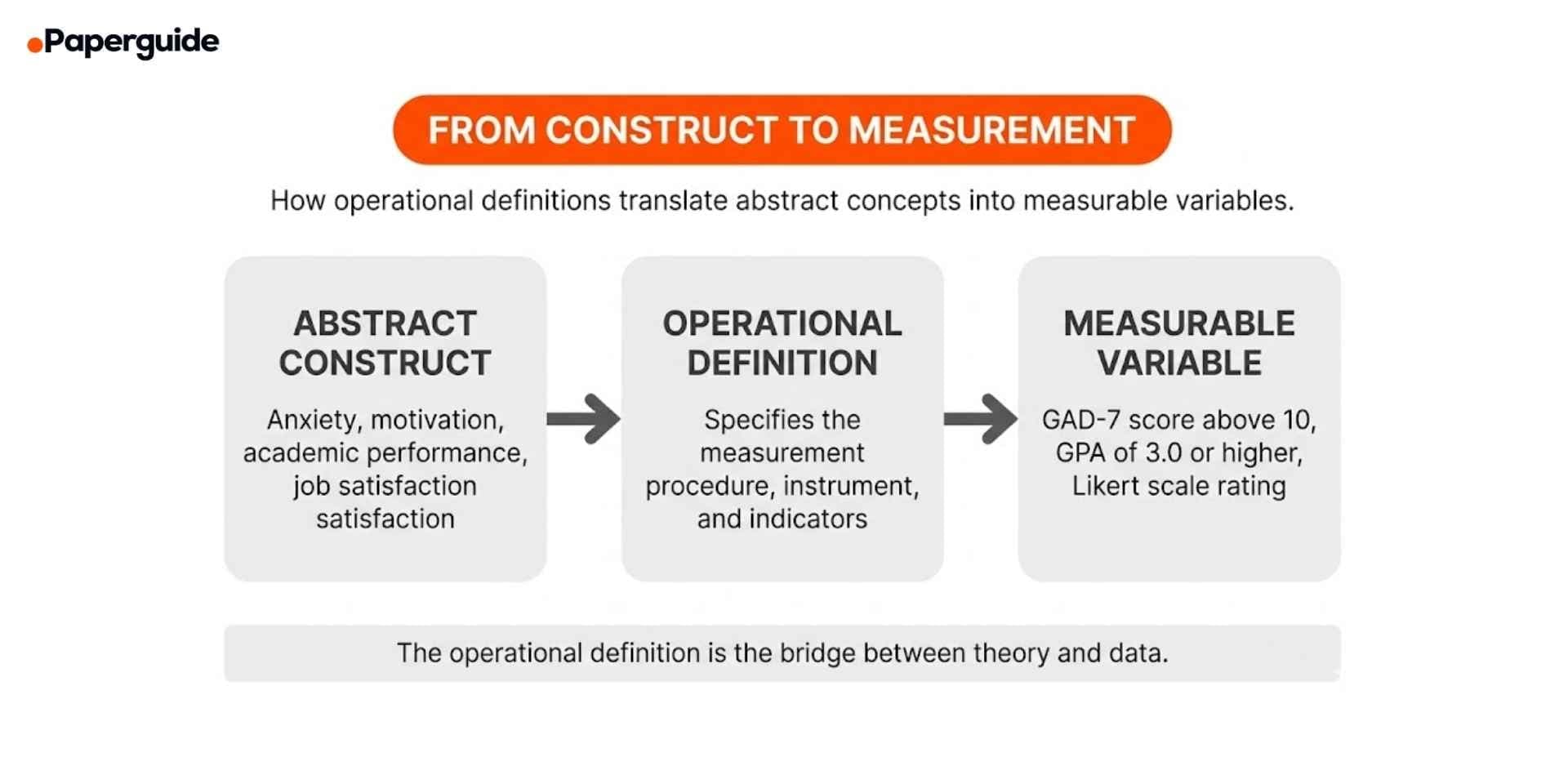
An operational definition specifies exactly how an abstract concept will be measured, observed, or manipulated in a research study. It translates theoretical constructs like "anxiety," "academic performance," or "job satisfaction" into concrete, observable variables with defined measurement procedures. Without operational definitions, two researchers studying the same concept could measure entirely different things and reach contradictory conclusions, not because their theories are wrong but because their measurements do not align.
This translation from abstract to measurable is where many studies fail. A 2024 study in Communications Psychology found that researchers urgently need a culture of multi-operationalization because many published findings may be artifacts of specific operationalization choices rather than genuine effects. When the same construct is operationalized differently across studies, conflicting results are often mistaken for theoretical disagreement when they actually reflect measurement disagreement. A 2025 analysis of replication study designs found that inconsistent operationalization remains one of the most underexamined contributors to replication failure in psychological science. [1] [2]
This guide explains what operational definitions are, why they matter, how to write them, and provides examples across disciplines. It also covers common mistakes and a checklist for evaluating the quality of your operational definitions.
Key Takeaways
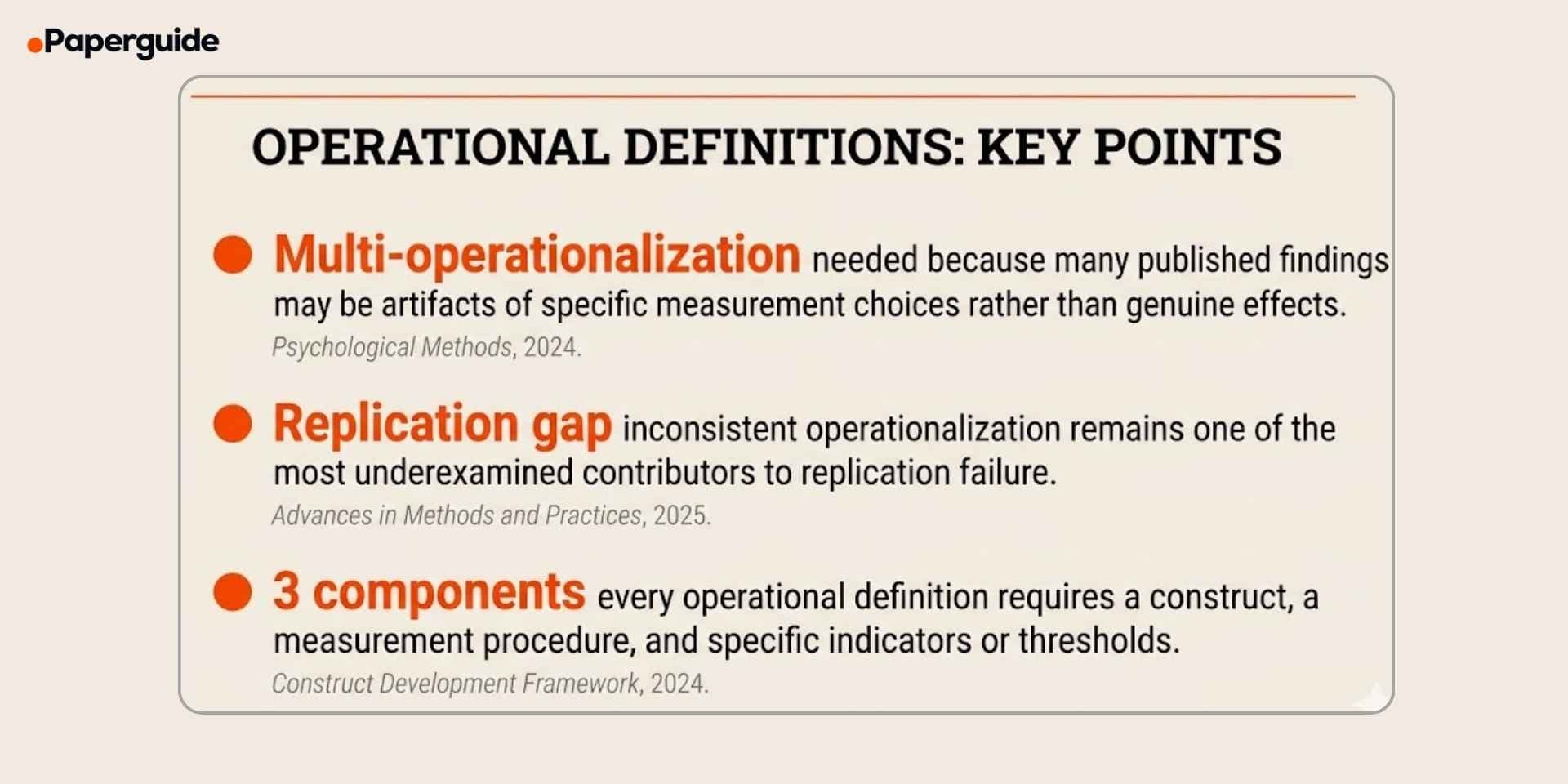
- An operational definition translates an abstract construct into a specific, measurable variable by defining exactly how it will be observed, measured, or manipulated in a study.
- Without operational definitions, researchers studying the same concept may measure different things, making comparison and replication impossible. [1]
- Every operational definition has three components: the construct being defined, the measurement procedure, and the specific indicators or thresholds.
- Inconsistent operationalization across studies is a major but underexamined contributor to the replication crisis in psychology and social sciences. [2]
- Operational definitions should be written before data collection begins and reported in the methodology section of every publication.
- The same construct can be operationalized in multiple valid ways, which is why researchers should consider multi-operationalization for robust findings.
What Is an Operational Definition?
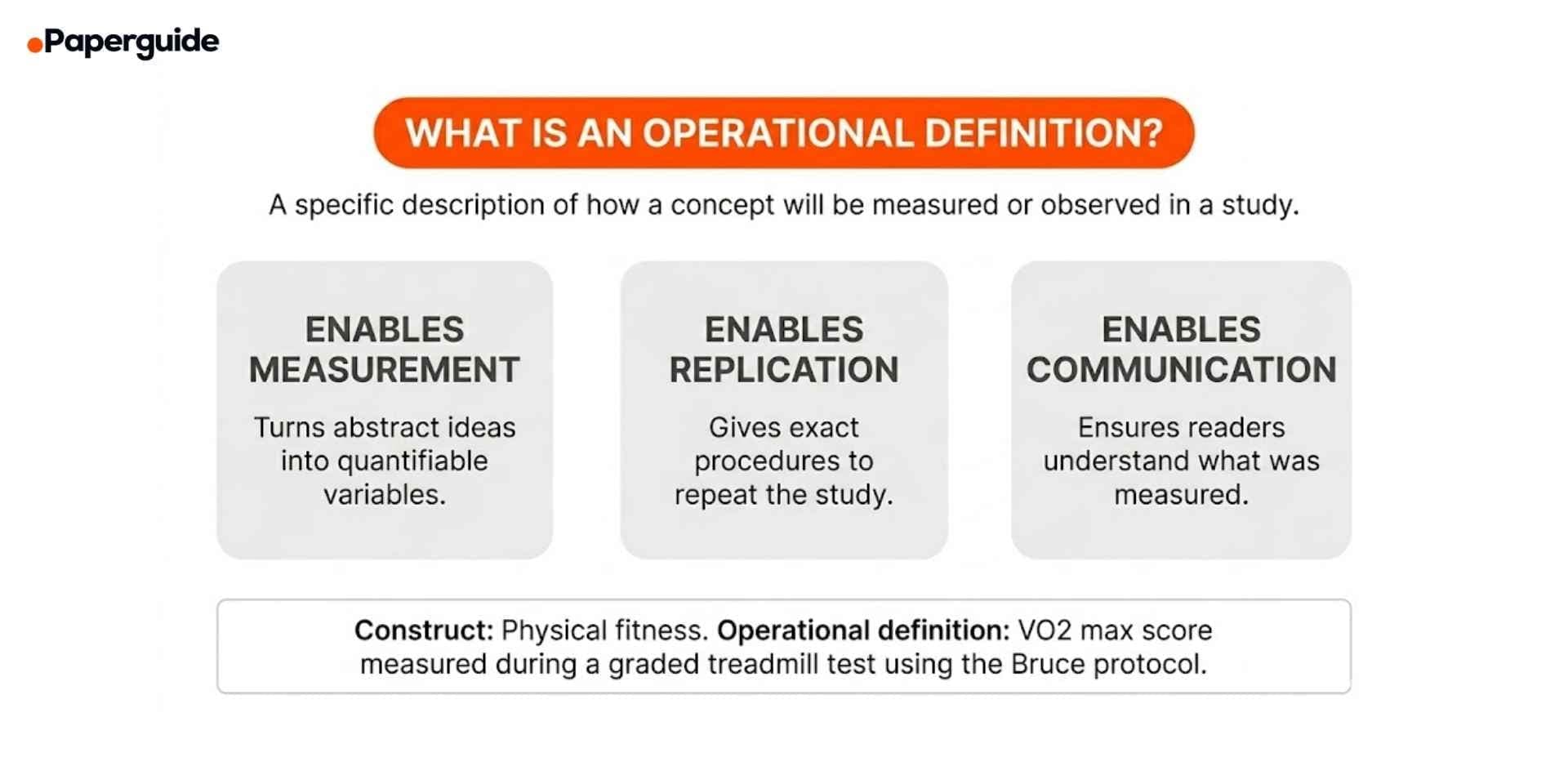
An operational definition is a clear, specific description of how a concept will be measured, observed, or produced in a research study. It takes a theoretical construct that cannot be directly observed and defines it in terms of the concrete procedures, instruments, and criteria that will be used to detect and quantify it. Paperguide's A to Z glossary of research terms covers related concepts such as operationalization, construct validity and reliability.
Consider the construct "physical fitness." This concept means different things to different people. To a cardiologist, it might mean cardiovascular endurance. To a personal trainer, it might mean strength, flexibility, and body composition. To a public health researcher, it might mean the ability to perform daily activities without fatigue. An operational definition resolves this ambiguity by specifying exactly what "physical fitness" means in the context of a particular study. For example: "Physical fitness is defined as the participant's VO2 max score measured during a graded treadmill test using the Bruce protocol."
The concept itself has not changed. What has changed is that it now has a specific, replicable measurement attached to it. Any researcher reading this definition can replicate the exact measurement procedure and produce comparable data.
Operational definitions serve three essential functions in research. First, they enable measurement by turning abstract ideas into quantifiable variables. Second, they enable replication by giving other researchers the exact procedures needed to repeat the study. Third, they enable communication by ensuring that everyone reading the study understands precisely what was measured and how.
Why Operational Definitions Matter
They Prevent Ambiguity
Without operational definitions, the same word can mean different things to different researchers. "Depression" could refer to a clinical diagnosis based on DSM-5 criteria, a self-reported mood state measured by the PHQ-9, or a behavioral pattern observed in daily activity logs. Each operationalization produces different data and different findings. Making the operationalization explicit prevents readers from assuming one meaning when the researcher intended another.
They Enable Replication
Replication is the foundation of scientific credibility. If other researchers cannot repeat your study and obtain similar results, the findings lack external support. A 2025 study examining replication designs found that many replication failures stem not from theoretical problems but from differences in how constructs were operationalized between the original study and the replication attempt. Clear operational definitions minimize this source of failure. [2]
They Strengthen Validity
An operational definition directly affects the validity of your measurement. If you operationalize "academic engagement" as "the number of times a student raises their hand in class," you are measuring one narrow behavior, not the full construct. A 2024 framework for construct development emphasized that the gap between the concept-as-intended and the concept-as-determined is where validity problems arise, and that researchers must explicitly document this gap in their methodology. [3]
They Support Comparison Across Studies
When multiple studies use the same operational definition, their findings can be compared directly. Meta-analyses depend on this comparability. If every study on "stress" uses a different measurement, synthesizing their results becomes unreliable because the studies are measuring different things under the same label.
Understanding how variables are defined and measured is closely related to understanding the types of variables in research. Operational definitions specify how each independent and dependent variable will be observed, ensuring that the relationship being tested is clear and measurable.
Components of an Operational Definition
Every operational definition contains three essential components:
1. The Construct
The abstract concept being studied. This is the theoretical variable that cannot be directly observed.
Examples: anxiety, intelligence, customer satisfaction, academic performance, organizational commitment.
2. The Measurement Procedure
The specific instrument, tool, or method that will be used to measure the construct. This includes the name of the instrument, administration procedure, and scoring method.
Examples: the GAD-7 questionnaire, a structured observation protocol, a standardized test, a physiological measurement device.
3. The Indicators and Thresholds
The specific values, categories, or criteria that will be used to classify or quantify the construct. This includes cut-off scores, coding categories, and operational criteria.
Examples: a GAD-7 score of 10 or above indicates moderate anxiety; a GPA of 3.0 or higher indicates high academic performance; three or more absences per month indicates low attendance.
How to Write an Operational Definition (Step by Step)
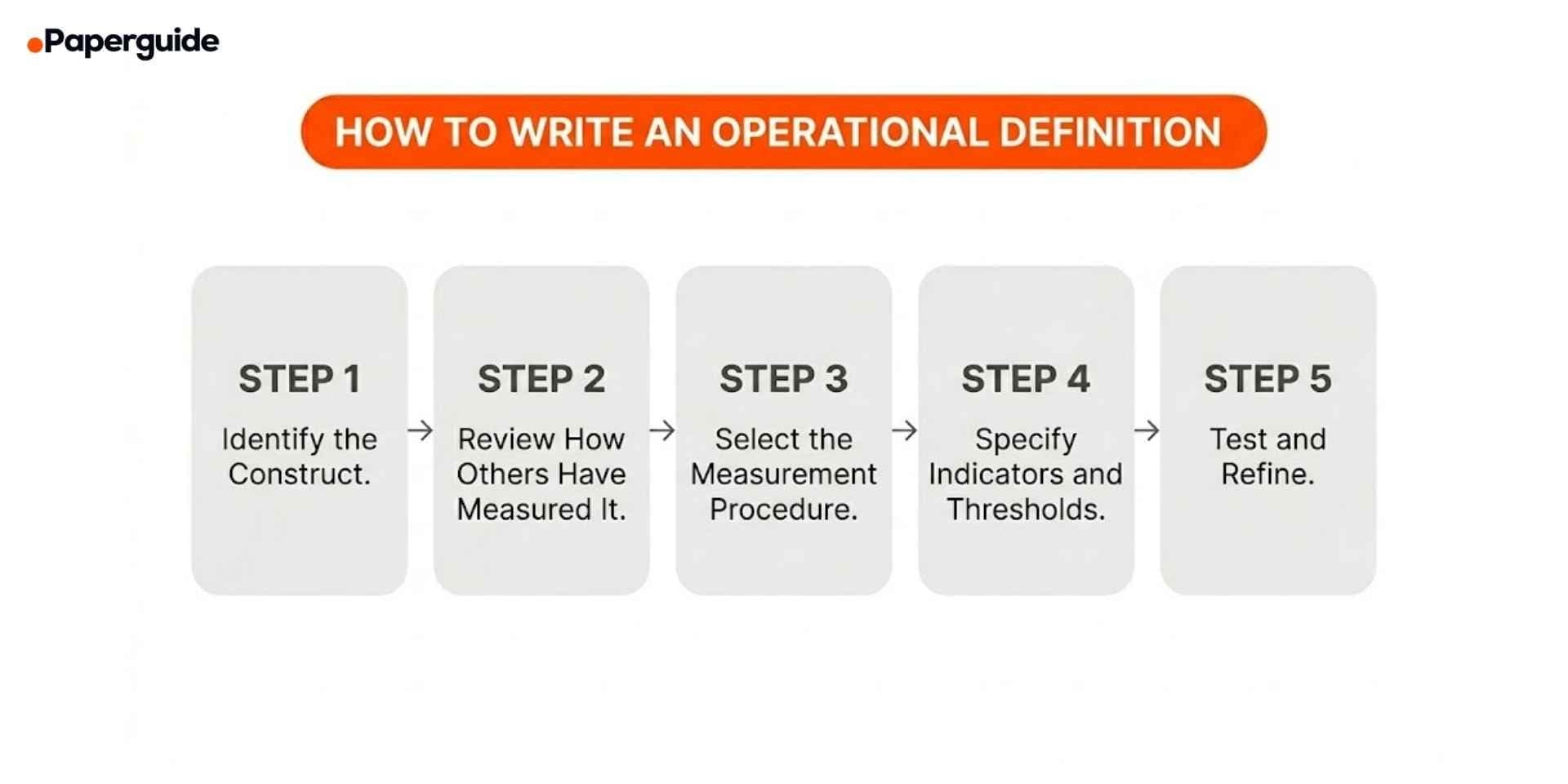
Step 1: Identify the Construct
Start by clearly naming the abstract concept you need to measure. Define it conceptually before attempting to operationalize it. A conceptual definition explains what the construct means in theoretical terms. An operational definition explains how it will be measured.
Example: Conceptual definition of "job satisfaction" is "the degree to which an individual feels positively about their work role, conditions, and outcomes."
Step 2: Review How Others Have Measured It
Search the literature for published studies that measured the same construct. Identify the instruments, procedures, and criteria they used. Note which operationalizations produced reliable and valid results.
Example: A literature review reveals that job satisfaction has been operationalized using the Job Satisfaction Survey (JSS), the Minnesota Satisfaction Questionnaire (MSQ), and single-item global measures. The MSQ has the strongest psychometric evidence across diverse samples.
Step 3: Select the Measurement Procedure
Choose the instrument or method that best fits your research question, population, and resources. Justify why this operationalization is appropriate for your study.
Example: "Job satisfaction will be measured using the 20-item short form of the Minnesota Satisfaction Questionnaire (MSQ). Participants rate their satisfaction with specific aspects of their job on a 5-point Likert scale ranging from 'very dissatisfied' (1) to 'very satisfied' (5)."
Step 4: Specify Indicators and Thresholds
Define the specific values or criteria that will be used to classify, categorize, or quantify the construct. Specify cut-off scores, response categories, and any grouping criteria.
Example: "Total MSQ scores range from 20 to 100. Scores below 50 indicate low satisfaction. Scores between 50 and 75 indicate moderate satisfaction. Scores above 75 indicate high satisfaction."
Step 5: Test and Refine
Pilot test your operational definition with a small sample from your target population. Check whether the measurement procedure works as intended, whether participants understand the items, and whether the data shows sufficient variability. Revise as needed before full data collection.
Once your operational definition is finalized, tools like Paperguide's AI Paper Writer can help you draft the methodology section where these definitions appear in your research paper.
Examples of Operational Definitions Across Disciplines
Psychology
Construct: Anxiety
Poor operational definition: "Anxiety was measured using a questionnaire."
Strong operational definition: "Anxiety was measured using the Generalized Anxiety Disorder 7-item scale (GAD-7). Participants rated the frequency of seven anxiety symptoms over the past two weeks on a scale from 0 ('not at all') to 3 ('nearly every day'). Total scores range from 0 to 21. Scores of 0 to 4 indicate minimal anxiety, 5 to 9 mild, 10 to 14 moderate, and 15 to 21 severe. A cut-off score of 10 was used to identify participants with clinically significant anxiety."
Education
Construct: Academic performance
Poor operational definition: "Academic performance was measured by grades."
Strong operational definition: "Academic performance was operationalized as the cumulative grade point average (GPA) calculated from all courses completed during the 2024-2025 academic year, using the university's standard 4.0 scale. GPAs were obtained from official academic transcripts with participant consent. Students with fewer than 12 completed credit hours were excluded."
Public Health
Construct: Physical activity
Poor operational definition: "Physical activity was measured by asking participants how active they are."
Strong operational definition: "Physical activity was measured using ActiGraph GT3X accelerometers worn on the non-dominant wrist for seven consecutive days. Valid wear time was defined as at least 10 hours per day for a minimum of four days. Moderate-to-vigorous physical activity (MVPA) was defined as activity producing 2,020 or more counts per minute. Participants were classified as meeting physical activity guidelines if they accumulated at least 150 minutes of MVPA per week."
Business Research
Construct: Customer satisfaction
Poor operational definition: "Customer satisfaction was assessed through feedback."
Strong operational definition: "Customer satisfaction was measured using the American Customer Satisfaction Index (ACSI) methodology, consisting of three items: overall satisfaction (1 to 10 scale), performance relative to expectations (1 to 10 scale), and performance relative to an ideal product (1 to 10 scale). The three scores were averaged to produce a composite satisfaction score ranging from 1 to 10. Scores below 6 were classified as low satisfaction, 6 to 8 as moderate, and above 8 as high."
Understanding how operational definitions relate to the broader concept of measurement quality is essential. The relationship between validity and reliability in research determines whether your operational definition actually measures the intended construct (validity) and whether it does so consistently (reliability).
Operational Definition vs Conceptual Definition
| Feature | Conceptual Definition | Operational Definition |
|---|---|---|
| Purpose | Explains what the construct means | Explains how the construct will be measured |
| Level | Abstract and theoretical | Concrete and procedural |
| Content | Describes the nature of the concept | Specifies instruments, procedures, and criteria |
| Example (Anxiety) | A state of persistent worry and apprehension | GAD-7 score of 10 or above |
| Found in | Literature review, theoretical framework | Methodology section |
| Function | Guides understanding | Guides measurement and replication |
Both types of definitions are required in a research study. The conceptual definition appears in the literature review or theoretical framework, establishing what the construct means. The operational definition appears in the methodology section, establishing how it will be measured. A study that includes only a conceptual definition leaves readers guessing about how data was actually collected.

Common Mistakes and How to Fix Them
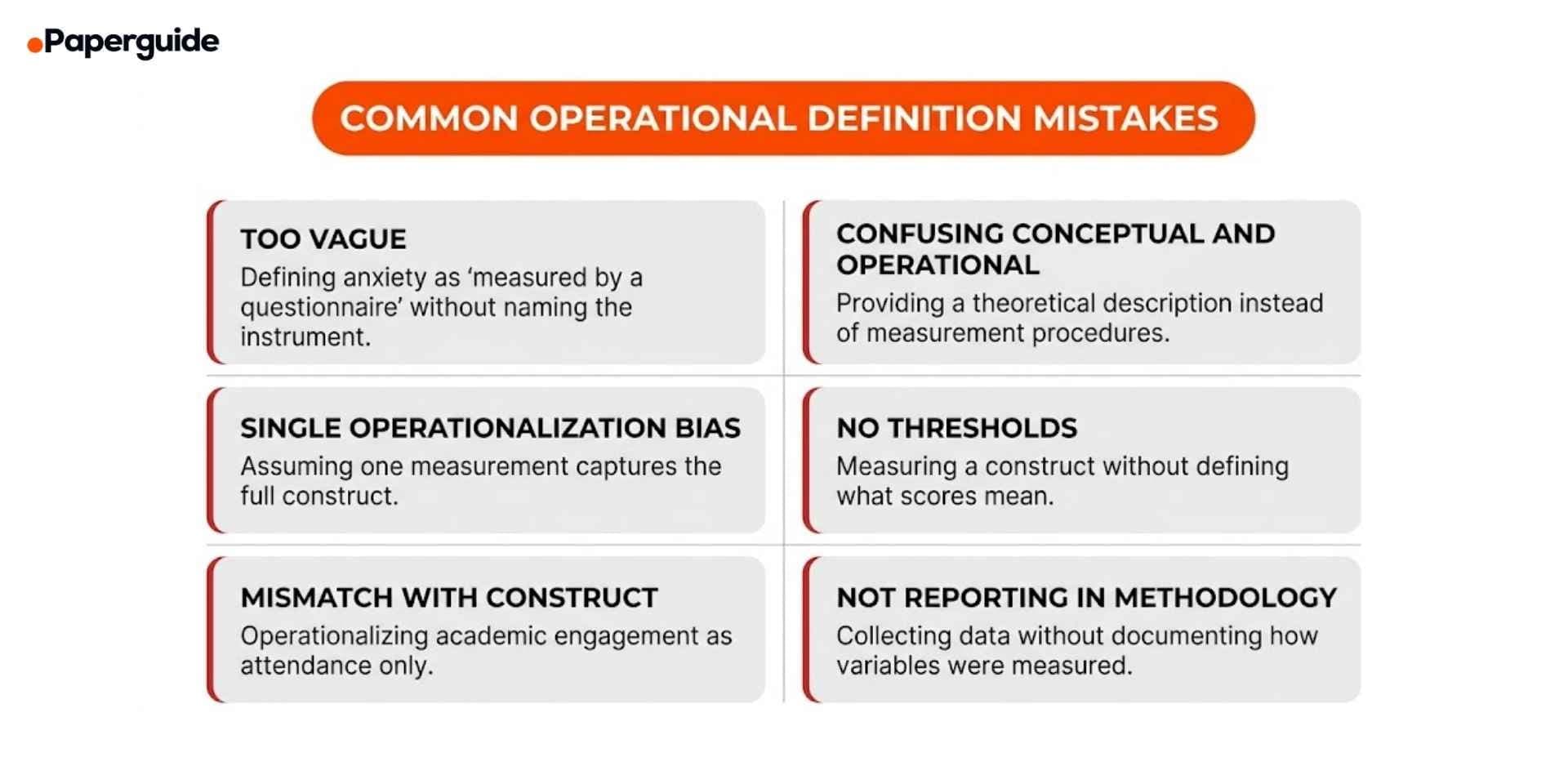
Mistake 1: Being Too Vague
Error: "Depression was measured using a survey." This tells the reader almost nothing about the actual measurement procedure.
Fix: Name the specific instrument, describe the scoring procedure, and provide threshold criteria. "Depression was measured using the Patient Health Questionnaire-9 (PHQ-9). Participants rated nine symptoms on a 0 to 3 frequency scale. Total scores of 10 or above indicated moderate-to-severe depression."
Mistake 2: Confusing Conceptual and Operational Definitions
Error: Writing "Self-efficacy is the belief in one's ability to succeed in specific situations" in the methodology section and treating this as an operational definition. This is a conceptual definition. It tells you what the construct means, not how it was measured.
Fix: Provide both definitions in the appropriate sections. Conceptual definition in the literature review: "Self-efficacy is the belief in one's ability to succeed in specific situations." Operational definition in the methodology: "Self-efficacy was measured using the General Self-Efficacy Scale (GSE), a 10-item instrument rated on a 4-point scale from 1 ('not at all true') to 4 ('exactly true'). Total scores range from 10 to 40, with higher scores indicating greater self-efficacy."
Mistake 3: Relying on a Single Operationalization
Error: Operationalizing "intelligence" only as IQ score and treating this as a complete measurement of the construct.
Fix: Acknowledge the limitations of your operationalization and consider using multiple measurements. The 2024 multi-operationalization study argued that many published results may be artifacts of a single operationalization choice, and that researchers should test their findings across multiple valid measurements of the same construct. [1]
Mistake 4: Omitting Thresholds and Classification Criteria
Error: Measuring anxiety using the GAD-7 but never defining what score constitutes "high anxiety" versus "low anxiety" in the study.
Fix: Specify the cut-off scores and classification criteria as part of the operational definition. "Participants with GAD-7 scores of 10 or above were classified as having clinically significant anxiety. Scores of 0 to 4 were classified as minimal, 5 to 9 as mild, 10 to 14 as moderate, and 15 to 21 as severe."
Mistake 5: Operationalization Does Not Match the Construct
Error: Operationalizing "student engagement" as "class attendance percentage" when the construct encompasses cognitive, emotional, and behavioral dimensions.
Fix: Ensure the measurement covers the key dimensions of the construct. If engagement includes cognitive, emotional, and behavioral components, use an instrument that measures all three. If only one dimension can be measured, state this limitation explicitly. A 2025 study on participant settings found that environmental factors during measurement can alter how constructs manifest, underscoring the need for operationalizations that account for context. [4]
Mistake 6: Not Reporting Operational Definitions in the Methodology
Error: Collecting data using specific instruments and criteria but failing to describe them in the published paper.
Fix: Report every operational definition in the methodology section. Include the instrument name, number of items, response format, scoring procedure, and classification criteria. A 2025 analysis of replication factors emphasized that missing operational details are a primary barrier to successful replication. [5]
Operational Definition Quality Checklist
- [ ] Construct is clearly named. The theoretical concept is identified and distinguished from similar constructs.
- [ ] Conceptual definition is provided. The theoretical meaning of the construct is explained in the literature review or theoretical framework.
- [ ] Measurement instrument is specified. The exact tool, scale, or procedure is named with a reference to its validation study.
- [ ] Scoring procedure is described. How responses are coded, summed, or categorized is explained.
- [ ] Thresholds and criteria are defined. Cut-off scores, classification categories, or grouping criteria are stated.
- [ ] Operationalization is justified. The rationale for choosing this specific measurement over alternatives is explained.
- [ ] Limitations are acknowledged. The gap between the construct and its operationalization is discussed.
- [ ] Piloting is completed. The measurement has been tested with a small sample before full data collection.
- [ ] Operational definition appears in the methodology section. The definition is clearly reported where reviewers and readers can evaluate it.
- [ ] Replication is possible. Another researcher could reproduce the exact measurement procedure from the description.
Researchers refining the language of their methodology sections can use writing software for research to organize and polish operational definitions across multiple variables in their study.
Validate This With Papers (2 Minutes)
Before finalizing your operational definitions, check how published studies in your field have operationalized the same constructs. This confirms that your measurement choices are consistent with disciplinary norms and strengthens your methodology.
Step 1: Search for recent studies that measured the same construct you are investigating. Note the instruments they used, the scoring procedures, and any thresholds or classification criteria.
Step 2: Open two or three relevant papers. Look at the methodology section for how each study operationalized the key variables. Comparing how different studies define the same construct helps you identify the most widely accepted operationalization. Reviewing published studies on validity and reliability can also help you evaluate the psychometric quality of different operationalization choices.
Step 3: Use an AI Humanizer to refine the language of your operational definitions so they read clearly and naturally in your methodology section while maintaining technical precision.
This takes about two minutes and ensures your operational definitions align with established measurement practices in your field.
Conclusion
Operational definitions are not a bureaucratic requirement. They are the mechanism that connects theory to evidence. Every time you measure a variable in a research study, you are making an operationalization choice, and that choice determines the validity, replicability, and comparability of your findings. A study without clear operational definitions cannot be replicated, its findings cannot be compared to other research, and its measurements cannot be evaluated for quality.
Write your operational definitions before data collection begins. Name the construct, specify the instrument, describe the scoring procedure, and define the classification criteria. Report all of this in the methodology section. Consider whether a single operationalization captures the full construct or whether multiple measurements would produce more robust findings. The gap between what you intend to measure and what you actually measure is where validity lives, and operational definitions are the tool for closing that gap.
Frequently Asked Questions
What is an operational definition in research?
An operational definition is a specific, concrete description of how an abstract concept will be measured, observed, or manipulated in a study. It specifies the exact instrument, procedure, and criteria used to detect and quantify a theoretical construct. For example, "anxiety" might be operationally defined as "a score of 10 or above on the GAD-7 questionnaire."
Why are operational definitions important?
Operational definitions are important because they enable measurement (turning abstract concepts into quantifiable variables), replication (allowing other researchers to repeat the study), and communication (ensuring readers understand what was measured). Without them, the same word can mean different things to different researchers, making comparison impossible.
What is the difference between a conceptual and an operational definition?
A conceptual definition explains what a construct means in theoretical terms (e.g., "anxiety is a state of persistent worry and apprehension"). An operational definition explains how that construct will be measured in a specific study (e.g., "anxiety is a GAD-7 score of 10 or above"). Both are needed: the conceptual definition goes in the literature review, the operational definition goes in the methodology.
Can the same construct have multiple operational definitions?
Yes. The same construct can be operationalized in many valid ways. "Depression" can be measured by a clinical interview (SCID-5), a self-report questionnaire (PHQ-9), a behavioral observation protocol, or a physiological marker (cortisol levels). Each operationalization captures different aspects of the construct, which is why researchers increasingly advocate for multi-operationalization.
Where should I include operational definitions in my paper?
Operational definitions belong in the methodology section, specifically in the subsection on variables and measures. Each variable should have its operational definition stated clearly, including the instrument name, scoring procedure, and classification criteria. The conceptual definition should appear earlier, in the literature review or theoretical framework.
How do I know if my operational definition is good?
A good operational definition is specific enough that another researcher could replicate the exact measurement. It names the instrument, describes the response format, explains the scoring procedure, and defines any thresholds or classification criteria. It also matches the construct it claims to measure (validity) and produces consistent results (reliability).
References
- Carpentras, D. "We Urgently Need a Culture of Multi-Operationalization in Psychological Research." Communications Psychology, 2(1), 2024.
- Hoffmann, J. et al. "The Design of Current Replication Studies: A Systematic Literature Review on the Variation of Study Characteristics." Advances in Methods and Practices in Psychological Science, 8(2), 2025.
- Lambert, L.S. & Newman, D.A. "Construct Development and Validation in Three Practical Steps: Recommendations for Reviewers, Editors, and Authors." Organizational Research Methods, 26(4), 2023.
- Fowlie, J. "Considering the Impact of Online Participant Setting: Implications for Replication and Validity." Social and Personality Psychology Compass, 19(9), 2025.
- Chernov, G. "The Alternative Factors Leading to Replication Crisis: Prediction and Evaluation." Evaluation Review, 49(1), 2025.
Researching a topic?
Find papers and get cited answers
Search the literature, find gaps and write with citations.
Start for freeNo credit card required