How to Create a Citation Map: Step-by-Step Guide

To create a citation map of research papers, start from one to five seed papers you trust, map the papers they cite and the papers that cite them, then read the network to find the key studies, the newest work and the papers your keyword searches missed.
This guide covers the four ways papers connect in a citation map, a seven-step method with screenshots, how to read the finished map, a worked example from three real maps we built for this guide, and how citation mapping fits into a systematic review. It is written for students and PhD researchers starting a topic as well as evidence synthesis and HEOR teams checking that a search is complete.
Key Takeaways
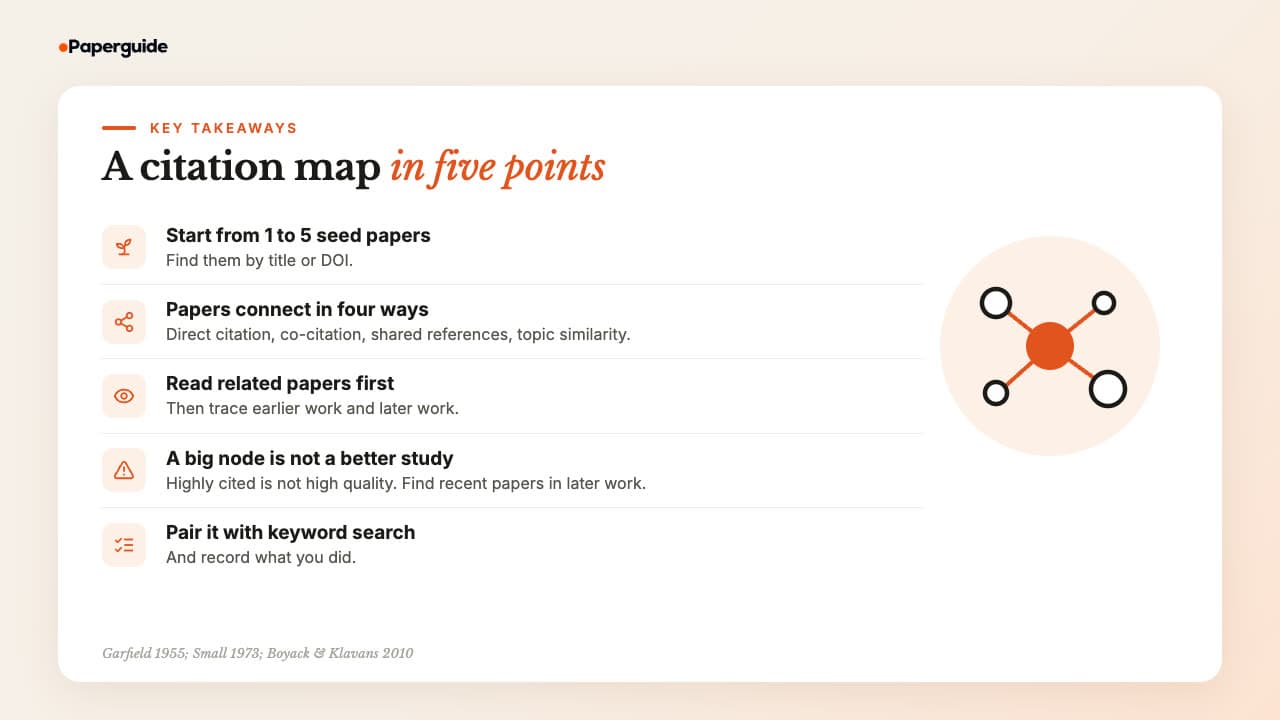
A citation map turns one to five trusted seed papers into a network of linked studies. Build it from good seeds, read related papers before earlier and later work, check why each paper is linked, treat citation counts as attention rather than quality, and use the map alongside keyword search rather than instead of it.
- A citation map shows research papers as nodes and their citation relationships as links. Start it from one to five seed papers you know are relevant, found by title or DOI.
- Papers connect in four ways: direct citation (backward and forward), co-citation, shared references and topic similarity. Each finds a different kind of related work.
- Read the related papers first, then trace earlier work for the foundations and later work for what happened next. Check why each paper is linked before you keep it.
- Large nodes are highly cited, not necessarily high quality. Recent papers look small and rank low because citations take years to build, so look for them in later work.
- A citation map supplements keyword search; it does not replace it. Record your seeds, dates and changes so the map can be repeated.
What a Citation Map Shows Before You Start
A citation map is a visual network of research papers in which each node is a paper and each link is a citation relationship. Built from one or more seed papers, it shows what those seeds build on, which later papers build on them and which papers sit closest to them.
That is enough to start building one. Tools use the names citation network, citation graph and citation tree for closely related ideas. For the full definition, the terms compared side by side and the main types, read this explainer on what a citation map is and its types.
How Papers Connect in a Citation Map
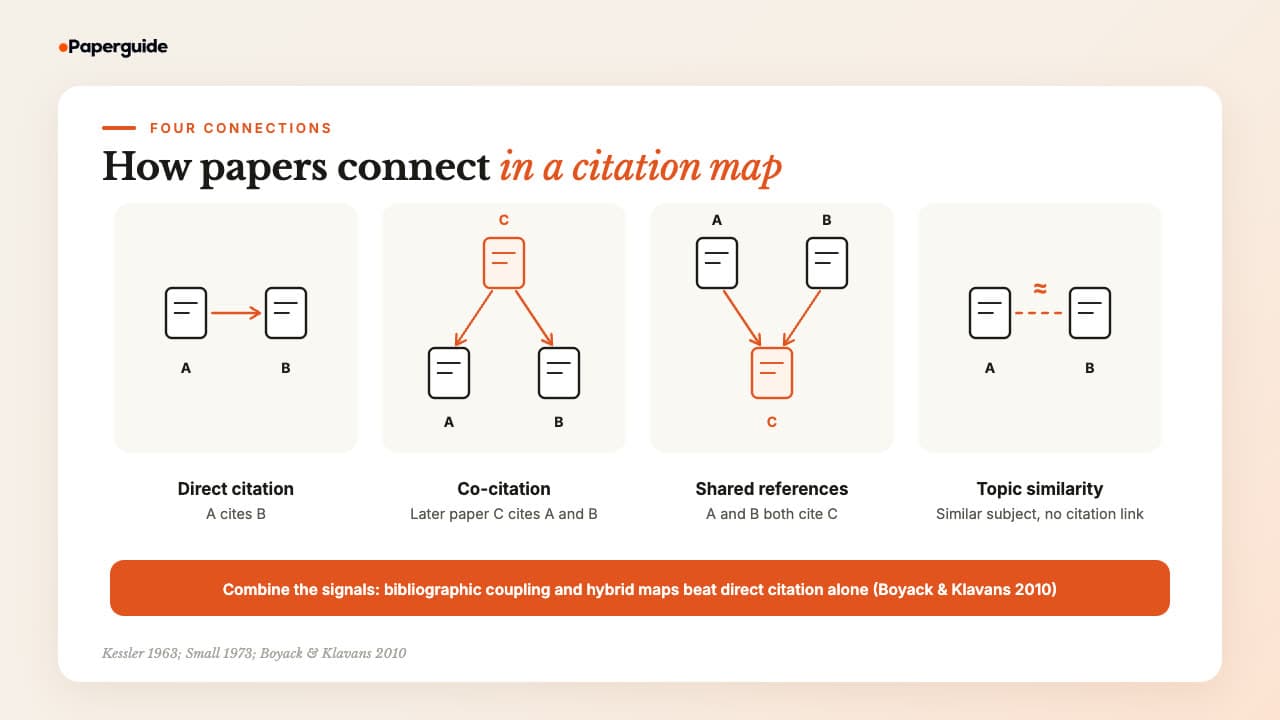
Papers in a citation map connect in four main ways: one cites the other directly, later papers cite both (co-citation), both cite the same earlier papers (shared references, or bibliographic coupling), or they cover a similar topic. Each relationship finds a different kind of related work, so a good map shows more than direct citations.
Direct Citations: References and Citing Papers
A direct citation is the simplest link: paper A lists paper B in its references. From a seed, it runs two ways. Backward, you reach the older papers the seed cites. Forward, you reach the newer papers that cite the seed. Wohlin's guidelines call these backward snowballing, "using the reference list to identify new papers to include", and forward snowballing, "identifying new papers based on those papers citing the paper being examined" [1]. Many university library guides call the same moves citation chaining.
Co-Citation
Two papers are co-cited when a later paper cites both. Henry Small defined co-citation in 1973 as "the frequency with which two documents are cited together" [2]. It reflects the judgement of many later authors, not just the seed's, so it can link your seed to a paper it never cited, such as a competing study that later reviews keep citing alongside it.
Bibliographic Coupling or Shared References
Two papers are bibliographically coupled when they cite one or more of the same earlier papers. M. M. Kessler introduced the measure in 1963 as a "rigorously defined criterion of coupling" between papers [3], and some citation mapping tools, Paperguide Citation Graph among them, label it shared references. It works well for new papers: a paper published last month has no citations, but its reference list exists from day one.
Topic Similarity
Topic similarity links papers whose titles and abstracts cover similar subjects, with or without a citation between them. It catches work from neighbouring fields and new papers with few connections yet. It is also the weakest signal, because two papers can share vocabulary and answer different questions, so treat a topic-only link as something to check.
Citation Relationships at a Glance
| Relationship | What it means | What it helps you find |
|---|---|---|
| Direct citation, backward | Your seed cites the paper | Older studies and theory the seed builds on |
| Direct citation, forward | The paper cites your seed | Newer studies, replications, critiques and reviews |
| Co-citation | Later papers cite the paper and your seed together | Work the field treats as related, even without a direct link |
| Shared references | The paper and your seed cite the same earlier work | Parallel studies, including recent ones with no citations yet |
| Topic similarity | The paper covers a similar subject | Related work from other fields or with no citation link |
Which relationship maps a field best has been tested at scale. Boyack and Klavans compared the approaches on 2,153,769 recent biomedical articles and found that "bibliographic coupling slightly outperforms co-citation analysis", "direct citation is the least accurate mapping approach by far", and a hybrid approach improved on coupling "in all respects" [4]. That is a good reason to prefer a map that combines relationships over one that only follows reference lists.
Why Use a Citation Map for Research?
A citation map finds studies that keyword searches miss, because it follows links between papers instead of matching words. It also shows which papers a field relies on, how a topic developed and what has been published since a key study, which makes it useful both for starting a new topic and for checking that a search is complete.
One audit of a review on a complex topic shows the effect. In Greenhalgh and Peacock's audit of 495 primary sources behind a systematic review, "only 30% of sources were obtained from the protocol defined at the outset of the study (that is, from the database and hand searches). Fifty one per cent were identified by 'snowballing' (such as pursuing references of references), and 24% by personal knowledge or personal contacts" [5]. The percentages add to more than 100% as published. The authors concluded that such reviews "cannot rely solely on protocol-driven search strategies".
For a student starting a literature review for a thesis, it is a fast way to go from one recommended paper to 20 clearly connected ones. For an evidence synthesis team, it is a coverage check: if the map keeps surfacing relevant studies your database search did not return, the search strategy needs work.
How to Create a Citation Map: Step by Step
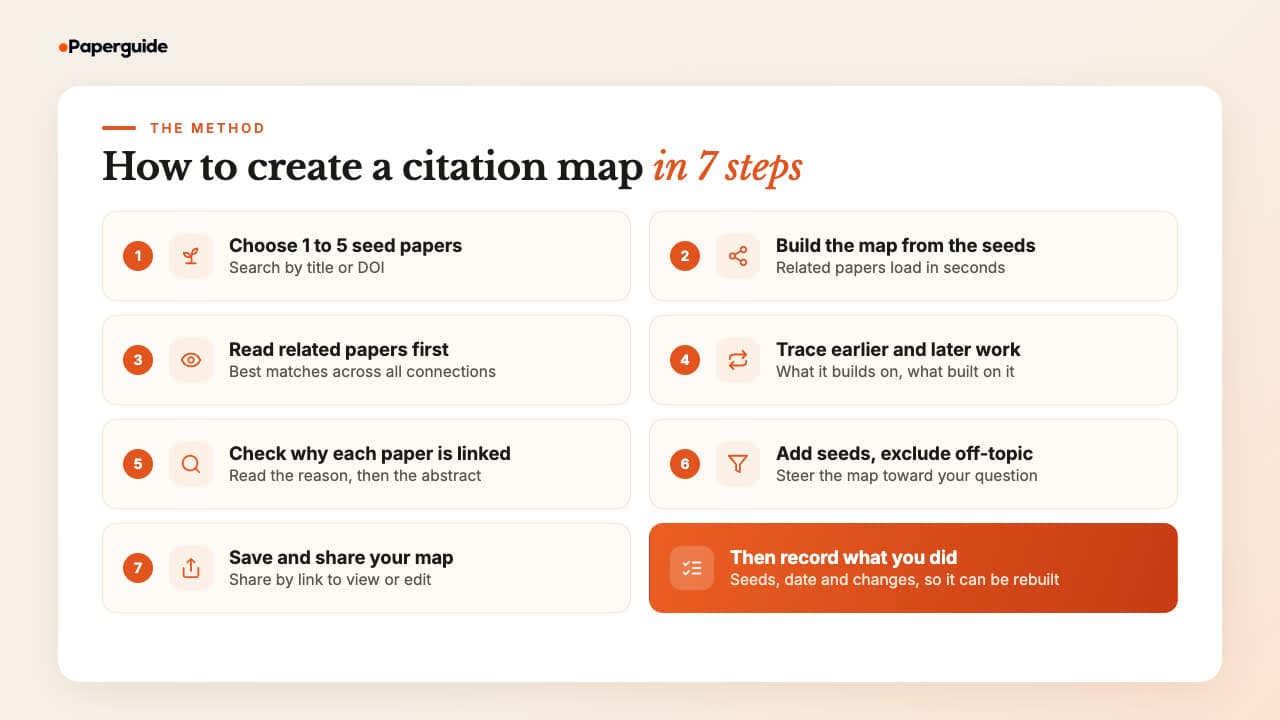
To create a citation map, choose one to five seed papers, build the map from them, read the related papers first, trace earlier and later work, check why each paper is linked, refine your seeds and save the result. The steps below use Paperguide Citation Graph, which is free with no signup, but they apply to any citation mapping tool.
Step 1: Choose One to Five Seed Papers
Your seeds decide what the map finds. A good seed is clearly on topic and central to it: a recent systematic review, a widely cited trial or the paper your supervisor told you to start from. A recent review makes a strong first seed because its reference list already covers much of the field.
Start with one seed, then add up to four more that cover different angles of your question, such as a trial, a review and a methods paper. Several near-identical seeds give a narrower map than a few varied ones.
Step 2: Build the Map From the Seeds
Open Paperguide's free Citation Graph, type the seed's title or paste its DOI into the box marked "Search a paper by title or DOI", and select the paper. You can also click Browse reference manager to pick seeds from papers you have saved. The tool searches 200M+ papers and builds the graph around your seed.
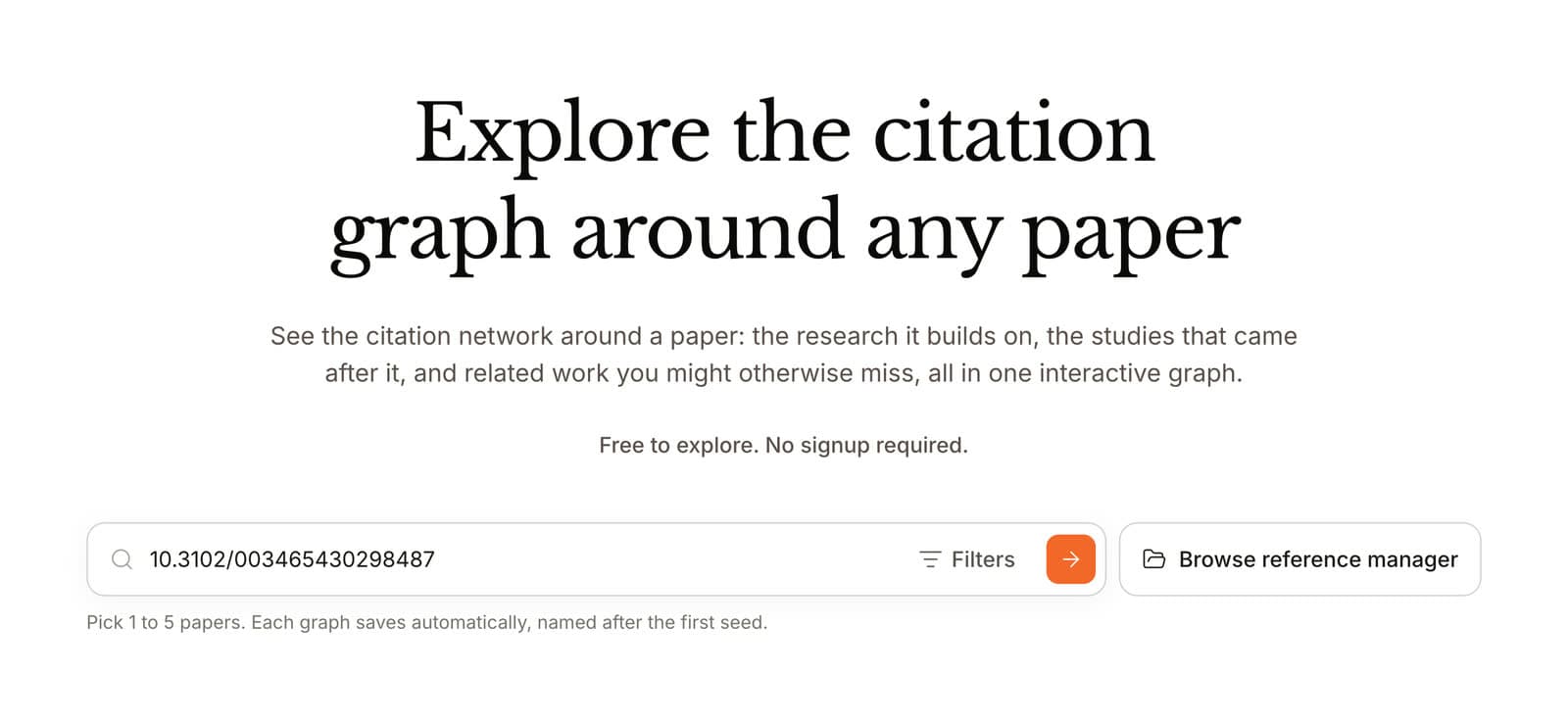
A DOI is the most precise way to find a seed. If a DOI does not match, search by title instead. Well-known papers can be indexed more than once, so before going further, check that the seed's year, journal and citation count match the paper you meant. Our example below shows what happens when they do not.
Step 3: Read Related Papers First
The map opens on Related papers, described in the tool as "Best matches across all connections": the papers closest to your seeds, ranked by how strongly they connect through references, citing papers, co-citations, shared references and topic similarity. The list gives each paper's journal, citation count, year and main reason for inclusion, and the graph places the same papers on a timeline from oldest to most recent.
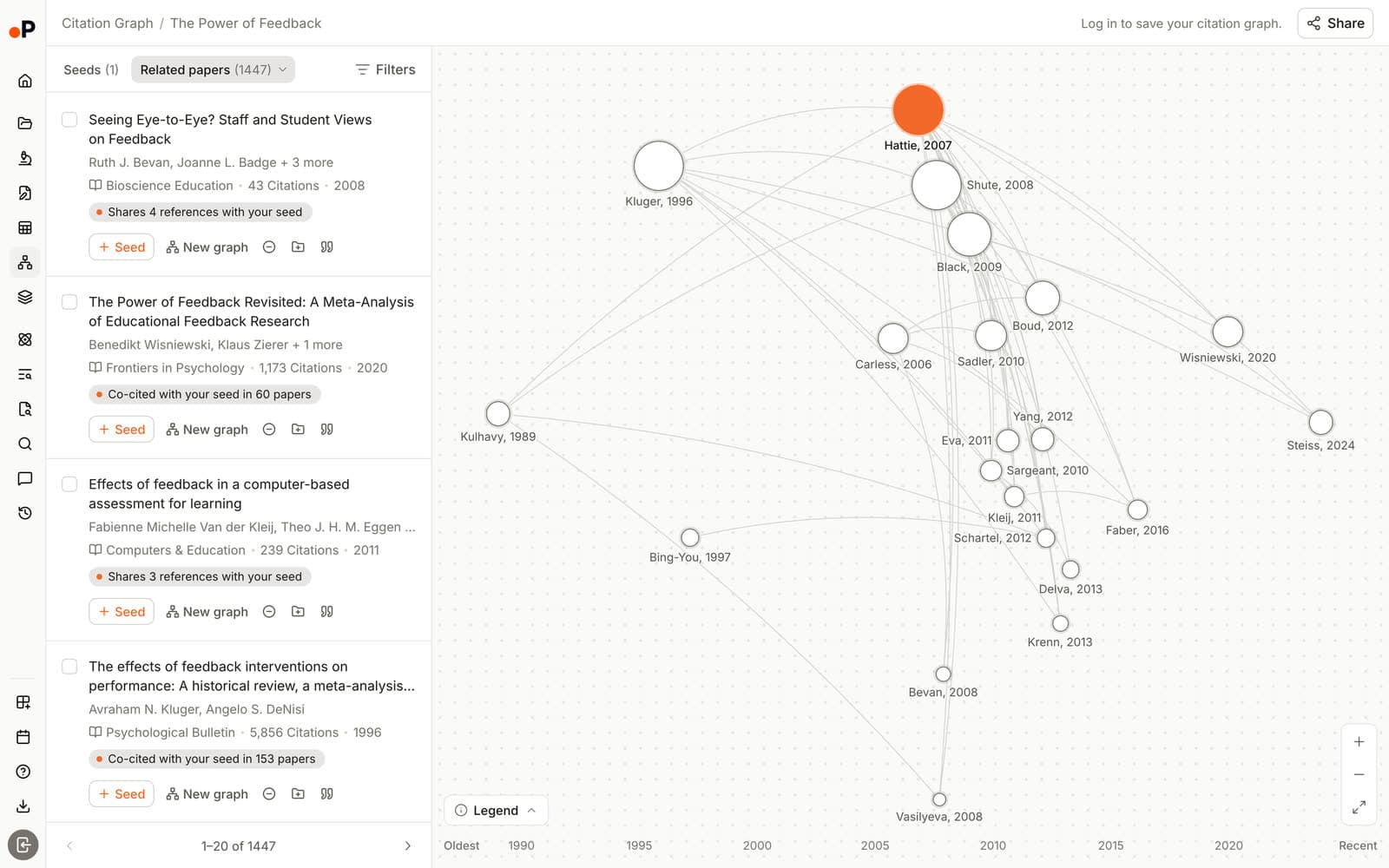
Read the top 20 titles and sort them into known, clearly relevant and unclear. The unfamiliar but plausible papers are the reason you built the map. Filters narrow the list by connection type, year and minimum citations if it is too broad.
Step 4: Trace Earlier Work and Later Work
Switch the view to Earlier work ("What your seed builds on") for the backward direction: the papers your seed cites, plus older papers its references cite. Labels such as "Your seed and 20 of its references cite this" point you to the foundational studies. Then switch to Later work ("What built on your seed") for the forward direction: papers that cite your seed, opening with the most connected ones. In our test maps, this is where recent research appeared.
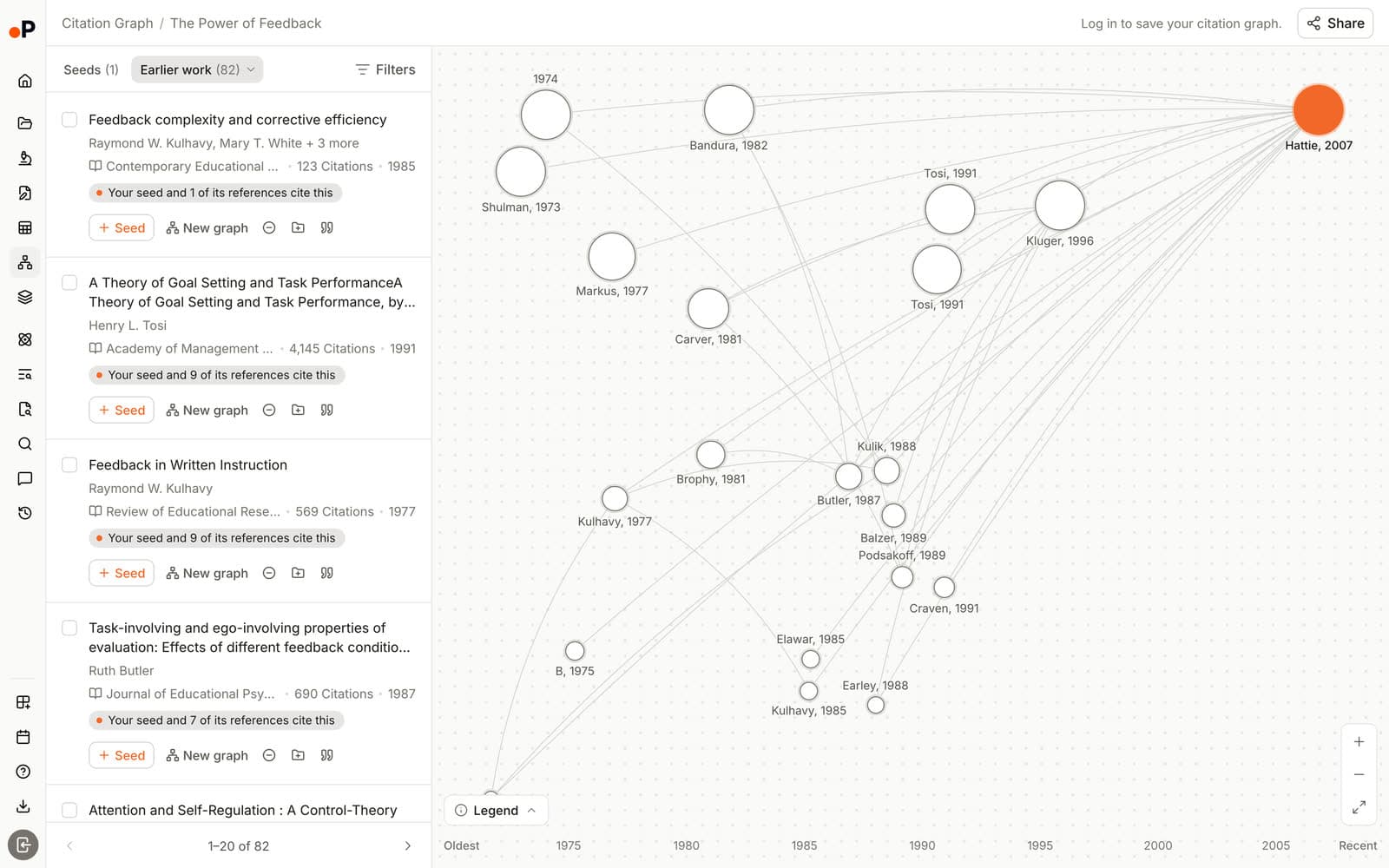
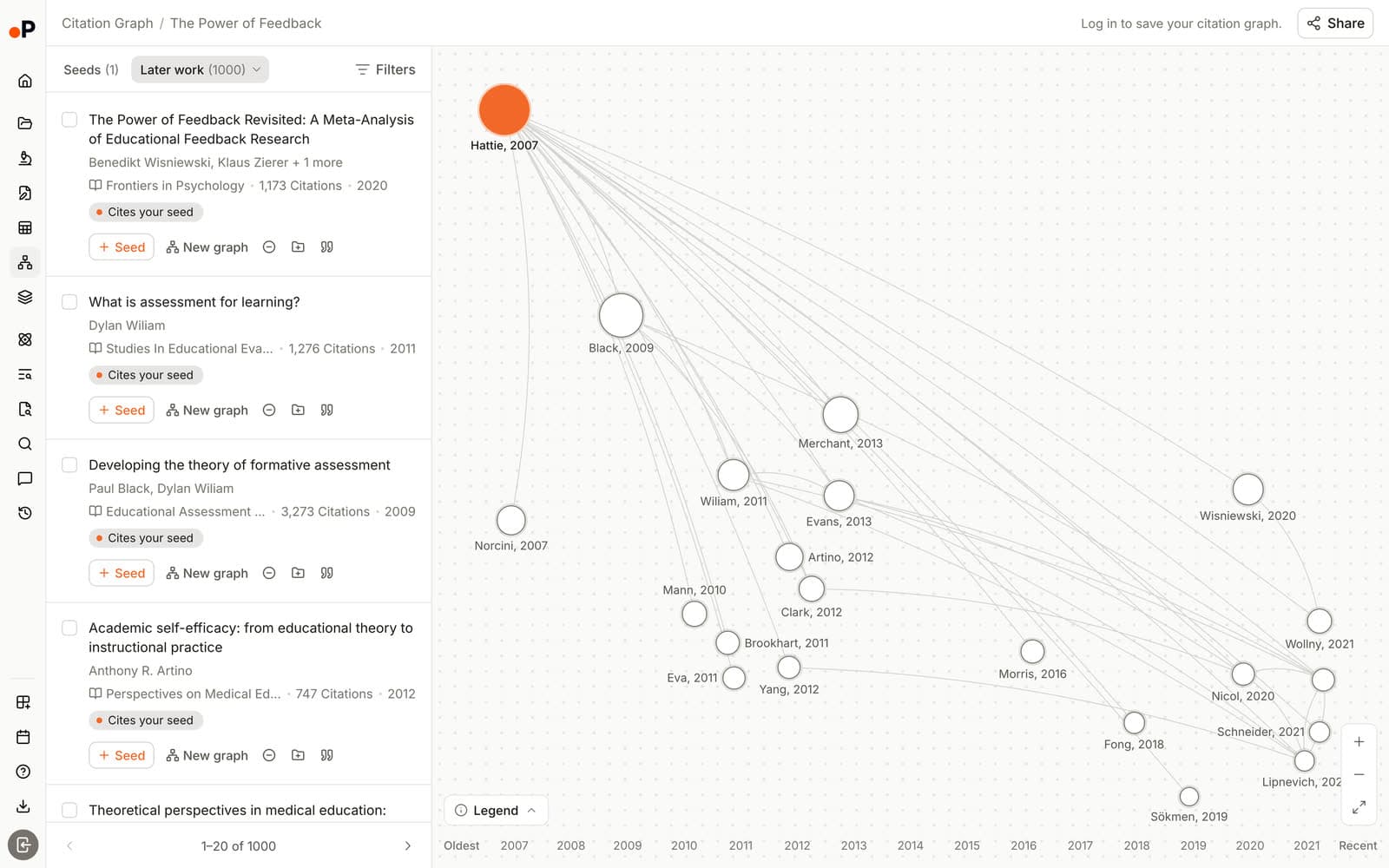
Earlier work answers "what should I already know?" Later work answers "what has changed since?" Skipping the forward direction is the easiest way to miss a newer trial, a critique or an updated review. Neither view is a complete citation list, though: in our tests Later work listed 847 papers for a seed with 1,050 citations, and stopped at 1,000 for one with 12,760.
Step 5: Check Why Each Paper Is Linked
Click a paper to open its details. Under Why it's here, the tool states the main reason, such as "Co-cited with your seed in 60 papers", and lists every relationship it found: whether it cites your seed, how many references it shares and how closely the topic matches. Arrows in the graph show which paper cites which.
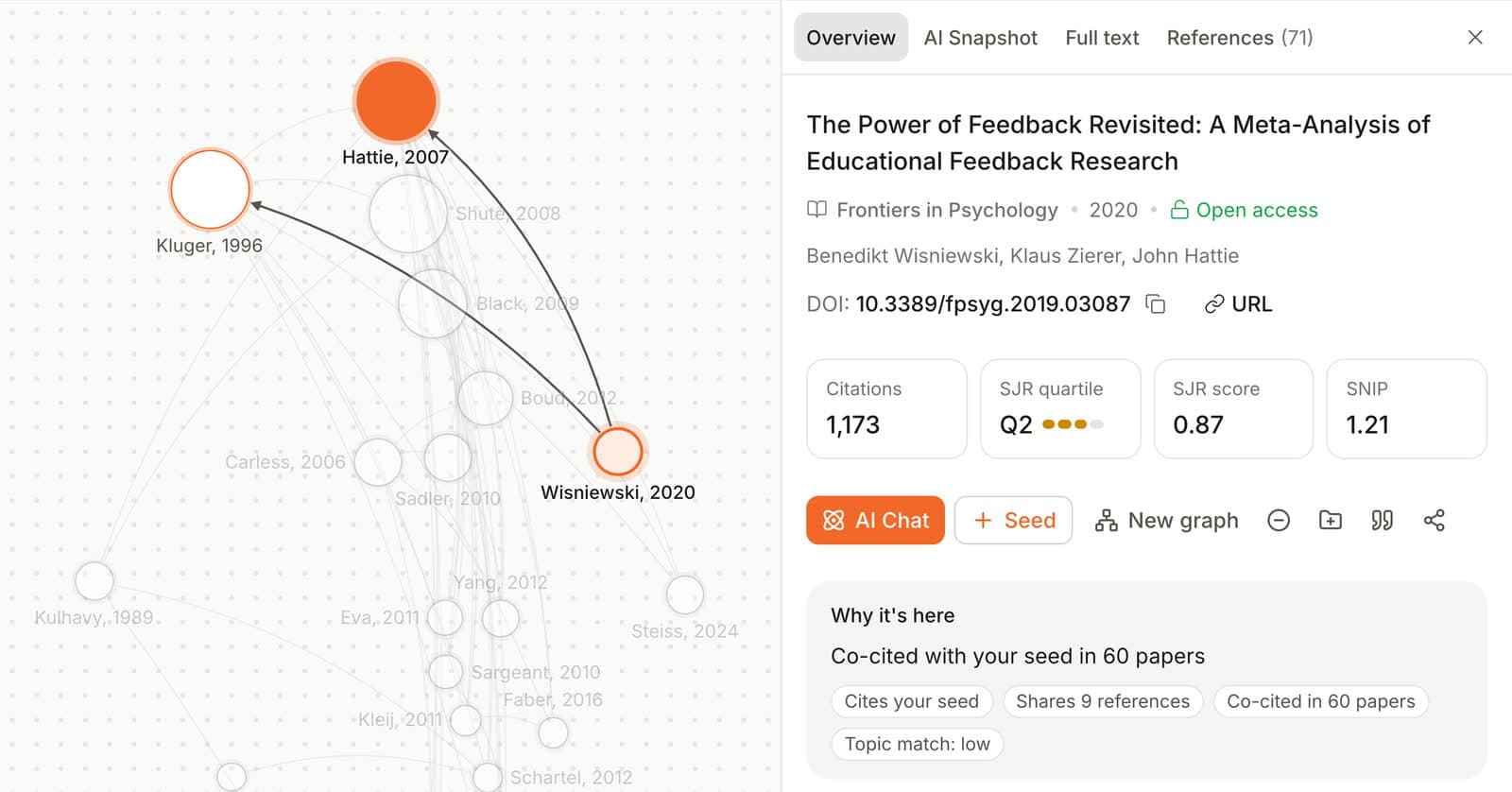
A paper linked by direct citation, co-citation and many shared references is very likely relevant. A paper linked only by topic needs its abstract read first. The panel also shows the abstract, citation count and journal metrics, so you can decide without leaving the map.
Step 6: Add Seeds and Exclude Off-Topic Papers
When a paper is clearly central, click + Seed. The graph rebuilds around both seeds, and papers connected to more than one rise up the ranking. Click Exclude on papers that are clearly off topic. The tool confirms "Excluded from this graph" and offers Undo if you change your mind.
Step 7: Save and Share Your Map
Graphs save automatically, named after the first seed. Logged out, the graph is kept in your browser and can move to your account when you sign in. Use Share to give anyone with the link "Can view" or "Can edit" access, or set it to "No access" to keep the graph private. Building and saving graphs needs no account; saving papers to Paperguide's Reference Manager works with a free account. Write down your seeds, the date and what you added or excluded; that note makes the map repeatable.
How to Read a Citation Map
Read a citation map through three signals: node size shows how often a paper is cited, horizontal position shows when it was published, and arrows show which paper cites which. Together they tell you which papers are foundational, which connect separate lines of work and which recent papers deserve a look before their citations build up.
In Paperguide Citation Graph, the legend reads "Size = citations" and "Higher = more cited", so large nodes near the top are the most cited papers. The timeline runs from oldest on the left to recent on the right, arrows point from the citing paper to the cited one, and seeds are filled in colour. Three kinds of paper stand out:
- Foundational papers are large, high nodes on the left that your seed and many of its references cite. You will be expected to know them.
- Bridge papers connect papers that otherwise share few links, often from two research traditions, and are good places to look for ideas one field has not borrowed from the other.
- Recent papers sit on the right as small, low nodes because citations take time, not because they are minor. They rank low in Related papers too, so check Later work for new research.
Citation counts measure attention, not quality. A paper can be highly cited because it was influential, controversial or later contradicted, and the map cannot tell you which.
Citation Map Example: From One Paper to a Reading List
When we built three citation maps for this guide, each seed produced over 1,000 related papers, and the top 20 were on topic by title in 58 of 60 cases. The maps also showed two limits: recent work was rare near the top, and one famous paper could not be found by its DOI.
We ran single-seed maps in Paperguide Citation Graph in October 2026 and read the top 20 related papers for each: a 2015 meta-analysis of cognitive behavioral therapy for chronic insomnia in Annals of Internal Medicine (health), Hattie and Timperley's 2007 review "The Power of Feedback" (education), and "Attention Is All You Need", the 2017 paper that introduced the Transformer (computer science).
What Our Citation Maps Found
| Seed paper | Field | Top 20 published 2024 or later | Relationship types seen | Note |
|---|---|---|---|---|
| Cognitive Behavioral Therapy for Chronic Insomnia (2015) | Health | 1 of 20 | Main label: co-citation 9, shared references 11; 15 of 20 also had a direct citation link | 1,252 related, 104 earlier, 847 later. 20 of 20 on topic by title |
| The Power of Feedback (2007) | Education | 1 of 20 | Main label: co-citation 12, shared references 7, direct citation 1; 17 of 20 also had a direct citation link | 1,447 related, 82 earlier; Later work showed 1,000, though the seed has 12,760 citations. 20 of 20 on topic by title |
| Attention Is All You Need (2017) | Computer science | 0 of 20 | Main label: co-citation 13, shared references 6, direct citation 1; 17 of 20 also had a direct citation link | arXiv DOI not found; title search matched a 2025 duplicate record. 1,190 related, 41 earlier, 102 later. 18 of 20 on topic by title |
The insomnia map's top 20 held the major meta-analyses of CBT for insomnia, the American College of Physicians guideline, trials of telephone and internet delivery, and reviews in primary care and in people with psychiatric and medical conditions.
The feedback map shows why co-citation matters. Twelve of its top 20 were there mainly because later authors cite them alongside the seed, including Kluger and DeNisi's 1996 meta-analysis of feedback interventions and Shute's 2008 review of formative feedback. Several came from medical education, a neighbouring field an education database search could miss.
The Transformer map is the warning. Its arXiv DOI returned "We couldn't find this paper in our database", so we searched by title, which matched a duplicate record dated 2025. Related papers still looked right, led by convolutional sequence models and early Transformer variants, but Later work held only 102 papers, all from 2026. If a DOI does not match, search by title, then check the seed's year and citation count before you trust the forward direction.
What Adding a Second Seed Changed
We added the insomnia map's top related paper, a 2017 meta-analysis of cognitive and behavioral therapies for insomnia, as a second seed. Related papers grew from 1,252 to 1,933, Earlier work from 104 to 214 and Later work from 847 to 1,368. Seven new papers entered the top 20, all labelled as connected to both seeds, including a meta-analysis on objective sleep measures, an online CBT trial and a 2024 network meta-analysis of CBT components. Papers from 2024 or later in the top 20 rose from one to three.
We judged relevance from titles, as a researcher scanning the list would, and counts in a live tool change as its database updates. Separately, Paperguide's own October 2026 evaluation rated its related papers at an average relevance of 1.53 out of 2, with 61% highly relevant and 8% off topic; results varied by field, and it was an internal test.
Citation Map vs Literature Map
A citation map links research papers by their citation relationships. A literature map is a broader overview that comes in two kinds: a thematic map the researcher draws to group studies into themes, and a citation-based map a tool builds from citation connections. A citation map sits closest to the second kind, but the two terms are not interchangeable.
Princeton University Library describes literature mapping as "a way of discovering scholarly articles by exploring connections between publications" [6], which is the citation-based sense. The thematic sense comes from research methods teaching, where you draw the map to organise studies and plan a review. This explainer on the two kinds of literature map covers both senses in full.
Citation Maps and Thematic Maps Compared
| Feature | Citation map | Thematic map |
|---|---|---|
| What links papers | Citations, co-citation, shared references, topic similarity | The researcher's judgement of themes and subtopics |
| Who builds it | A tool, from citation data and your seeds | You, after reading the papers |
| Best used for | Finding papers and seeing how they connect | Organising what you have read and planning the review |
The two work well in sequence: a citation map to find the papers, then a thematic map of what they say, built with this method for mapping studies into themes.
Citation Mapping vs Keyword Search
Keyword search finds papers that use your words; citation mapping finds papers connected to papers you already trust. Each fails where the other works. Keyword search misses studies described in different vocabulary, while a citation map only reaches what is connected to its seeds. Use keyword search to find seeds and citation mapping to extend from them.
A keyword search strategy depends on predicting the words authors used, which is hard for complex interventions, social science concepts and fields whose terms changed over time. A citation map depends on its seeds: start inside one school of thought and you may never reach studies that do not cite it.
A practical loop combines the two:
- Run a keyword search in a database, or ask a question in Paperguide's AI Search, and pick two or three clearly relevant papers.
- Use them as seeds and read the related, earlier and later work.
- Add the wording of any relevant paper the map found, but your search missed, back into the search. When both methods return the same papers, coverage is probably good.
AI Search results can open a citation graph directly, and the Research Agent can build one in chat. If you are choosing discovery tools, compare the AI tools for finding research papers with the academic databases that index citation links.
Citation Maps for Systematic Reviews
In a systematic review, citation mapping supports backward and forward citation searching, a supplementary method the TARCiS statement recommends considering seriously for difficult-to-search-for topics. It does not replace the database search, and its results are screened and reported like any other records, in the "other methods" column of the PRISMA 2020 flow diagram.
TARCiS defines backward citation searching as "retrieving and screening cited references" and forward citation searching as "retrieving and screening citing references" [7]. It recommends that for "difficult-to-search-for" topics both "should be seriously considered as supplementary search techniques", and that "stand-alone citation searching should not be used for literature searches that aim at completeness of recall". The PRISMA 2020 flow diagram for reviews that searched other sources has a "Citation searching (n = )" box under "Identification of studies via other methods" [8], and PRISMA's guidance on reporting search sources recommends naming every source you searched.
A map helps a systematic review team twice: while scoping the protocol, to find seed studies, and after screening, when included studies become seeds and Earlier work and Later work show candidates to screen. Because a map ranks papers by closeness rather than listing every citing or cited record, also run your formal forward search in a citation index and report the map as a supplementary method. The full method, from seeds to deduplication and reporting, is in this walkthrough of forward and backward citation searching for reviews.
Once you have the papers, the next job is turning them into a review. Paperguide's Literature Review AI drafts a structured review from a research question, with every claim cited to a real source paper. If the review is part of a thesis or paper, the AI Paper Writer can draft it from the papers saved in your Reference Manager, with each citation linked to a real paper.

Common Mistakes When Creating a Citation Map
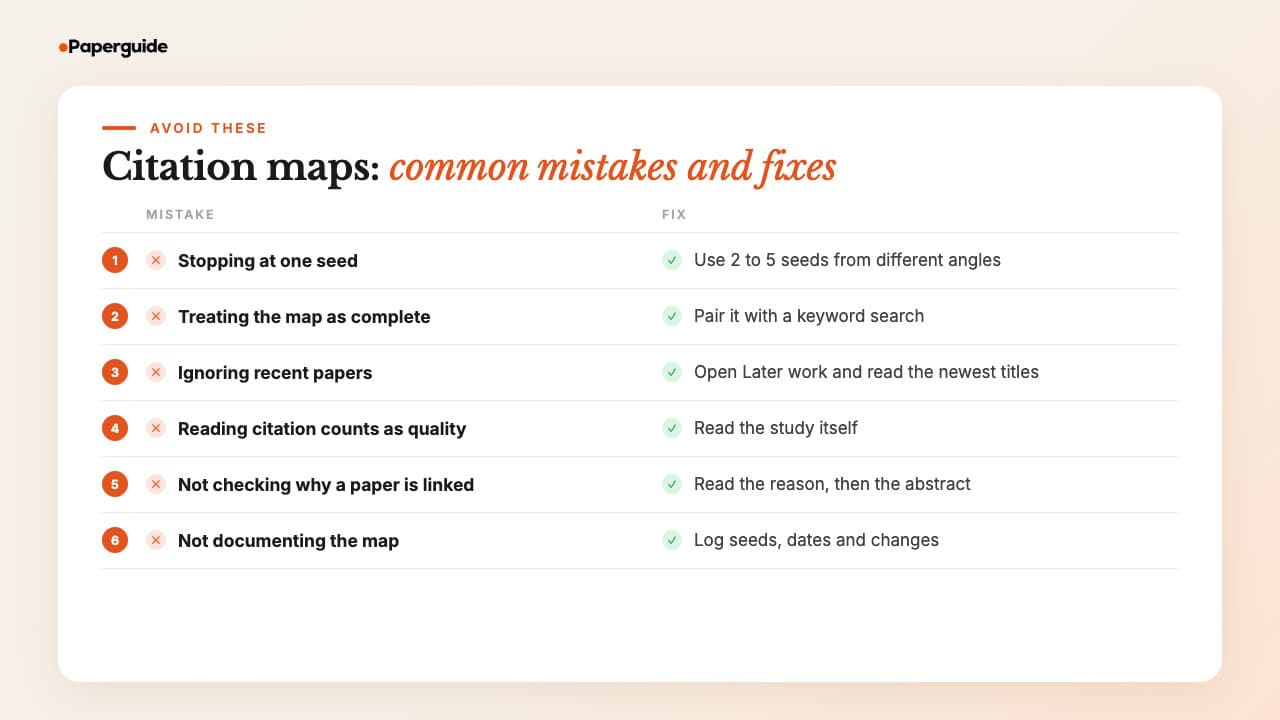
The common mistakes are starting from a single seed, treating the map as a complete search, overlooking recent papers because their nodes are small, reading citation counts as quality, adding papers without checking why they are linked, and not recording what you did, which leaves nobody able to check or repeat the map.
Stopping at one seed. One paper reflects one team's view of the field. In our insomnia map, a second seed brought seven new papers into the top 20. Use two to five seeds that cover different angles.
Treating the map as complete. A map reaches only what connects to your seeds and what its database indexes. Pair it with a keyword search, and never present a map alone as a comprehensive search.
Ignoring recent papers. New papers have few citations, so they look small and rank low. In our maps, no more than one of the top 20 related papers in each map was from 2024 or later. Open Later work and read the newest titles on purpose.
Reading citation counts as quality. A large node means many papers cited it, possibly to disagree. Judge quality by reading the study and its design, not by its size on the map.
Not checking why a paper is linked. A topic-only link can share words with your seed and still answer a different question. Read the reason and the abstract before you keep it.
Not documenting what you did. Without a record of seeds, dates and changes, nobody can repeat the map.
Citation Map Checklist
Before you rely on a citation map, confirm that each seed matched the right record, that your seeds cover different angles, and that you have read related, earlier and later work. Know why every kept paper is linked, compare the map with a keyword search and record what you did so it can be repeated.
- [ ] Each seed is clearly on topic and matched to the right record, with its year and citation count checked against the original paper
- [ ] Two to five seeds cover different angles, such as a review, a trial and a methods paper
- [ ] The top 20 related papers have been read at title level and sorted into known, relevant and unclear
- [ ] Earlier work has been checked for foundational studies
- [ ] Later work has been checked, including the newest papers with few citations
- [ ] The reason for each kept paper is known: direct citation, co-citation, shared references or topic similarity
- [ ] The map has been compared with a keyword search, and new terms added back to the search
- [ ] Seeds, date and changes are recorded, and the papers you need are saved to your reference manager
Try It Yourself (2 Minutes)
You can build a first citation map in about two minutes with a free tool and one paper you already trust. These three steps show how much one seed finds, what earlier and later work add, and how a second seed changes the ranking of the papers you see.
- Search for one paper central to your topic by title or DOI in Paperguide's free Citation Graph and check the seed's year and citation count.
- Read the first ten Related papers, then open Earlier work and Later work and note one paper from each you had not seen.
- Click + Seed on the most relevant related paper and count how many of the top ten change.
By the end you will have a small map of your topic, three new papers and a sense of how much your seeds shape what you find.
Conclusion
Creating a citation map takes seven moves. Choose seeds you trust and check they matched the right record, read related papers first, trace earlier and later work, check why each paper is linked, add a second seed and record what you did. Read node size as attention, not quality, and look at recent papers deliberately.
A citation map finds the papers; deciding what they add up to is still your job. With your reading list in hand, the next step is identifying the research gaps your papers reveal, or writing a literature review from your sources.
Frequently Asked Questions
Do I need an account to create a citation map?
Not in Paperguide's Citation Graph. You can find seed papers, build a graph and browse related, earlier and later work without signing up, and graphs you make while logged out are saved in your browser. A free account is needed only to save papers to Reference Manager, and signing in moves your saved graphs to that account.
How do I create a citation map for free?
Choose one to five seed papers you know are relevant and find them by title or DOI in a free citation mapping tool, such as Paperguide Citation Graph, which needs no signup. Read the related papers first, then the earlier work and later work views, check why each paper is linked and keep a note of the papers you want to read.
How many seed papers should I start with?
Start with one seed to see its neighbourhood, then add more until you have two to five that cover different angles of your question. More seeds pull the ranking toward papers connected to all of them. In our insomnia example, adding a second seed brought seven new papers into the top 20 related papers.
What is the difference between a citation map and a literature map?
A citation map links papers through citation relationships and is built by a tool from your seed papers. A literature map is a broader overview of a topic. It can be citation-based, built by a tool from citation connections in the way a citation map is, or thematic: a diagram the researcher draws to group studies into themes and plan a review [6].
Can I create a citation map from several papers at once?
Yes. Paperguide's Citation Graph accepts 1 to 5 seed papers, and you can add more later with + Seed. With several seeds, the ranking shifts toward papers linked to more than one of them. When we added a second seed to our insomnia map for this guide, 7 new papers entered the top 20 related papers.
Can a citation map replace database searching?
No. A citation map only reaches papers connected to your seeds and indexed in the tool's database, so it can miss whole groups of studies. Use it alongside keyword searches in bibliographic databases. For systematic reviews, the TARCiS statement advises against stand-alone citation searching where the aim is complete recall [7].
How long does it take to create a citation map?
Building the map is quick. In Paperguide's Citation Graph, the graph builds in seconds after you choose a seed, and the tool says it usually takes about 5 seconds. Reading the results takes longer: scanning the top related papers, checking earlier and later work, and adding or excluding papers is where the time goes, and that depends on your topic.
Why do recent papers look small in a citation map?
Many citation mapping tools, including Paperguide Citation Graph, size each node by citation count, and a paper needs years to collect citations. A study published this year may be important and still appear as one of the smallest nodes. Look at the most recent end of the timeline on purpose, and check the later work view, where papers citing your seed appear whatever their citation count.
References
- Wohlin, C. (2014). Guidelines for snowballing in systematic literature studies and a replication in software engineering. In Proceedings of the 18th International Conference on Evaluation and Assessment in Software Engineering (EASE '14) (Article 38, pp. 1-10). ACM. https://doi.org/10.1145/2601248.2601268
- Small, H. (1973). Co-citation in the scientific literature: A new measure of the relationship between two documents. Journal of the American Society for Information Science, 24(4), 265-269. https://doi.org/10.1002/asi.4630240406
- Kessler, M. M. (1963). Bibliographic coupling between scientific papers. American Documentation, 14(1), 10-25. https://doi.org/10.1002/asi.5090140103
- Boyack, K. W., & Klavans, R. (2010). Co-citation analysis, bibliographic coupling, and direct citation: Which citation approach represents the research front most accurately? Journal of the American Society for Information Science and Technology, 61(12), 2389-2404. https://doi.org/10.1002/asi.21419
- Greenhalgh, T., & Peacock, R. (2005). Effectiveness and efficiency of search methods in systematic reviews of complex evidence: Audit of primary sources. BMJ, 331(7524), 1064-1065. https://doi.org/10.1136/bmj.38636.593461.68
- Princeton University Library. (n.d.). Literature mapping: Overview [Research guide]. https://libguides.princeton.edu/litmapping (accessed 28 October 2026)
- Hirt, J., Nordhausen, T., Fuerst, T., Ewald, H., & Appenzeller-Herzog, C. (2024). Guidance on terminology, application, and reporting of citation searching: The TARCiS statement. BMJ, 385, e078384. https://doi.org/10.1136/bmj-2023-078384
- Page, M. J., McKenzie, J. E., Bossuyt, P. M., Boutron, I., Hoffmann, T. C., Mulrow, C. D., … Moher, D. (2021). The PRISMA 2020 statement: An updated guideline for reporting systematic reviews. BMJ, 372, n71. https://doi.org/10.1136/bmj.n71
Mapping citations?
See how any paper connects
Start from up to five papers and explore earlier, later and related work in one free citation graph. No signup.
Try Citation GraphNo credit card required