What Is a Literature Map? Types and Examples

A literature map is a visual overview of the research on a topic that shows how studies relate to each other. In research, it either groups papers into themes you choose, or links them through citations, so you can see what has been studied, how the work connects and where your own study fits.
The term covers two different things. One is a diagram you draw after reading. The other is a network a tool builds from citation data before you have read much at all. Both are useful, and they answer different questions.
This guide covers the definition, the two types, a worked literature map example on a real topic, how citation-based maps work, how to use the map to structure a literature review, how it differs from a concept map or mind map, common mistakes and a checklist. It is written for students and academics as well as evidence synthesis and HEOR teams scoping a new review.
Key Takeaways
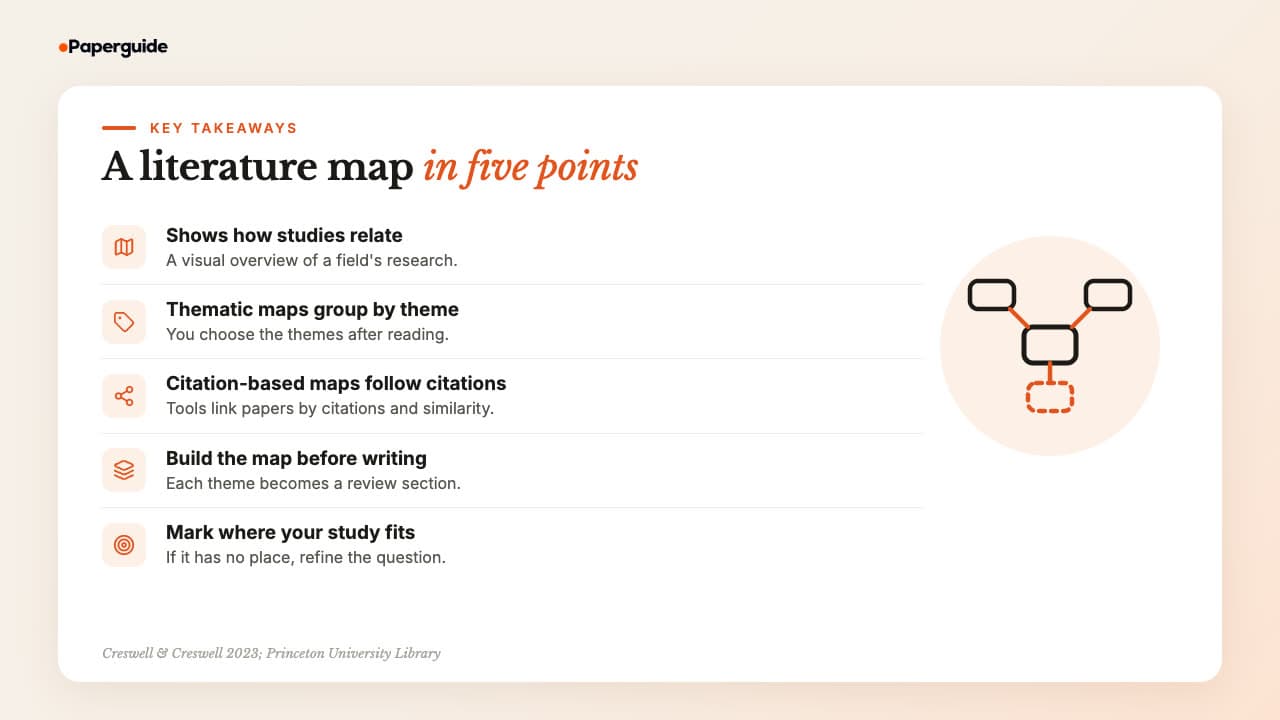
A literature map shows how the studies on a topic relate, and it comes in two kinds. You draw a thematic map yourself to group studies into themes. A tool builds a citation-based map from citation links. Use the citation-based map to find studies and the thematic map to plan your review.
- A literature map is a planning tool: it shows a field's structure and where your study fits before you write.
- A thematic literature map is drawn by the researcher and groups studies into themes and subtopics. The grouping is your judgement, and that is its value.
- A citation-based literature map is built by a tool from citation links, co-citation, shared references and topic similarity. It is fast and finds papers you missed, but it does not decide what the themes are.
- Use both: a citation-based map to find and check studies, then a thematic map to organise them into the sections of your review.
- A good map shows where your own study sits. If you cannot place it on the map, your research question or your search is not finished.
What Is a Literature Map?
A literature map is a diagram of the research on a topic, showing the main studies or groups of studies and the links between them. Its purpose is orientation: to show the shape of a field, which questions have been studied together, which ideas came from which earlier work, and where a new study would add something.
The term has two uses in research methods. Creswell and Creswell's Research Design teaches literature maps in its "Review of the Literature" chapter as a way to organise the literature visually before writing, and advises drawing the map with software such as Word or PowerPoint [6]. In this sense the map is something the researcher draws. A teacher education guide citing Creswell's earlier work describes the map as "a two dimensional diagrammatic representation of information" and adds that "your map can then be used as a plan for your literature review" [7].
Some library guides use the word in a second sense. Princeton University Library defines literature mapping as "a way of discovering scholarly articles by exploring connections between publications" [5]. Here the map is a discovery tool, usually generated by software from citation data, and the connections are citations rather than themes.
Researchers make literature maps to see the shape of a field, to place their own study within it, to find studies their search missed (gaps in a map are sometimes gaps in the search) and to plan the review, since the branches of a thematic map can become the headings of the review chapter.
Types of Literature Maps
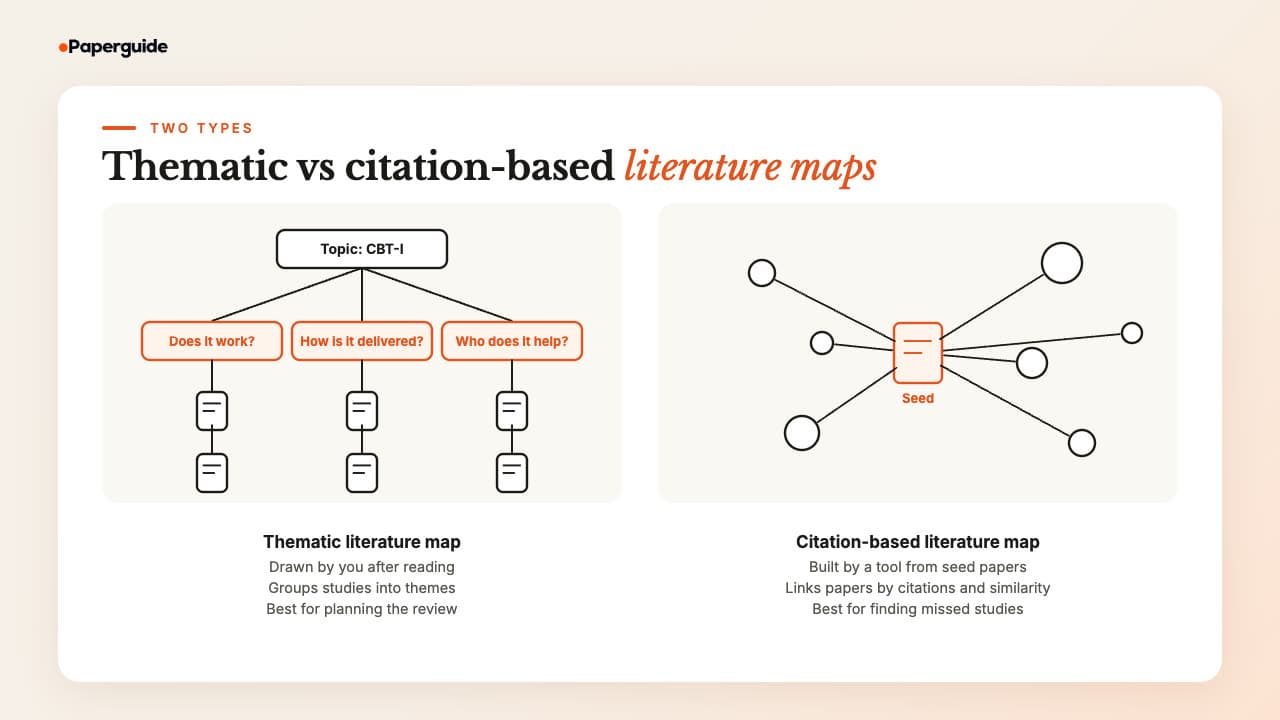
There are two main types of literature map. A thematic literature map is drawn by the researcher and groups studies by theme, so it shows how you understand a field. A citation-based literature map is built by software from citation links and similarity between papers, so it shows how the literature itself is connected.
Thematic Literature Map
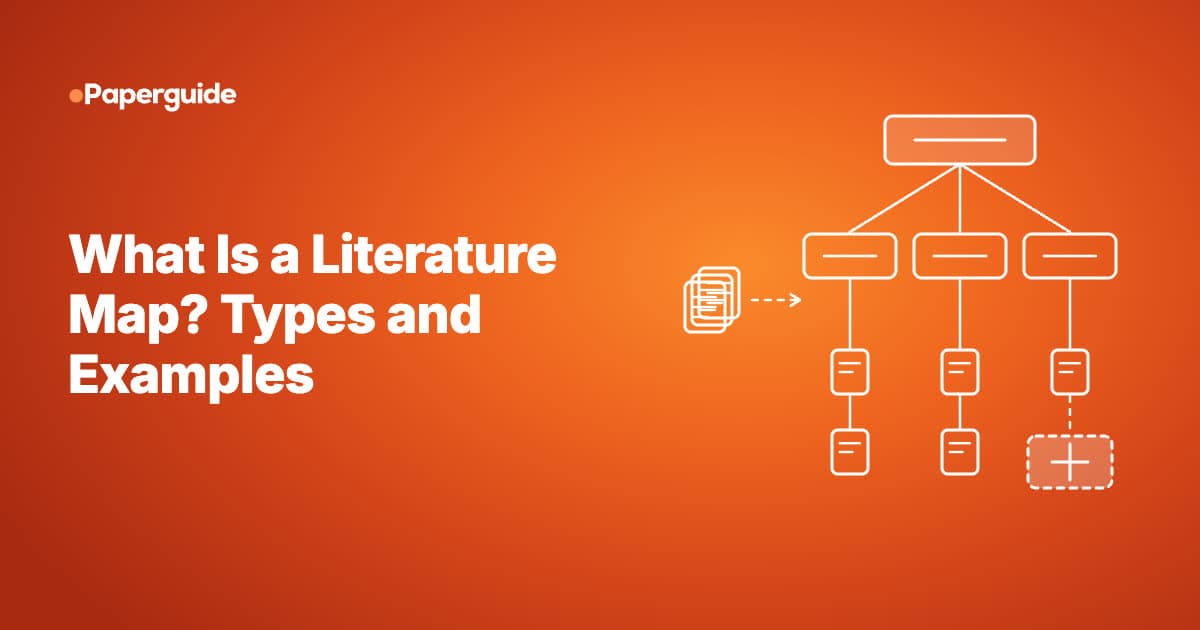
A thematic literature map starts with your topic at the top or centre and branches into themes, then subthemes, with individual studies at the ends of the branches. You can draw it as a tree (topic at the top, themes beneath, studies at the bottom) or as a flowchart where arrows show how one strand of work led to another.
The themes are yours. Two researchers mapping the same 40 studies might group them by intervention, population or theory, and each map would suit a different review. That is the strength of a thematic map, since it records an argument about the field. It is also its weakness, since it holds only the studies you already found.
Citation-Based Literature Map
A citation-based literature map is a network of papers built by a tool from one or more seed papers. Each paper is a node, and the links come from the citation record: papers that cite each other, papers often cited together (co-citation) and papers that cite the same earlier work (shared references, also called bibliographic coupling). Some tools add similarity between titles and abstracts.
These relationships have a long history in information science. Eugene Garfield proposed a citation index for science in 1955 and described it as "an association-of-ideas index" [1]. Kessler introduced bibliographic coupling in 1963: two papers are coupled when they cite one or more of the same references [2]. Small defined co-citation in 1973 as "the frequency with which two documents are cited together" [3].
Which relationship you follow changes what you find. In a comparison across 2,153,769 biomedical articles, Boyack and Klavans found that "bibliographic coupling slightly outperforms co-citation analysis", that "direct citation is the least accurate mapping approach by far", and that a hybrid approach improved on bibliographic coupling "in all respects" [4]. Combining several signals is one way tools can improve on any single method.
A citation-based map does not group papers into themes for you. It shows proximity in the citation record, and papers can sit close together because they agree, because they disagree or because one is a review that cites everything. Turning that network into themes is still the researcher's job.
Thematic vs Citation-Based Literature Maps
| Feature | Thematic literature map | Citation-based literature map |
|---|---|---|
| What it shows | Themes and subtopics you identified, with studies under each | Papers linked by citations, co-citation, shared references and similarity |
| How it's made | Drawn by the researcher after reading | Built by a tool from 1 or more seed papers |
| Best for | Planning the structure of a review and explaining your argument | Finding studies you missed and seeing earlier and later work |
| Main limit | Contains only studies you already found, and reflects your blind spots | Shows connection, not meaning, and depends on the tool's database |
| Tools | Paper, whiteboard, diagram or mind map software, a spreadsheet | Citation graph tools such as Paperguide Citation Graph, Connected Papers, ResearchRabbit, Litmaps, Inciteful |
Literature Map Example
A literature map example on cognitive behavioural therapy for insomnia (CBT-I) shows both types. The thematic version sorts nine real studies into three themes: does it work, how it is delivered and who it helps. The citation-based version, which we ran for this guide from one of them, found the other eight among its top 20 related papers.
A Thematic Literature Map Example: CBT for Insomnia
Suppose you are writing a review on how CBT-I is delivered and to whom. After reading, you might organise the core studies into three themes:
- Topic: CBT for chronic insomnia in adults
- Theme 1: Does CBT-I work? Broad syntheses of efficacy
- Morin et al. (2006), an update of the evidence on psychological and behavioural treatment of insomnia
- Trauer et al. (2015), a meta-analysis of CBT-I on sleep diary outcomes in adults with chronic insomnia
- van Straten et al. (2018), a meta-analysis of CBT-I and its separate components
- Theme 2: How is it delivered? Formats beyond individual face-to-face therapy
- Koffel et al. (2015), a meta-analysis of group CBT-I
- Cheng and Dizon (2012), a systematic review and meta-analysis of computerised CBT-I
- Arnedt et al. (2013), a randomised trial of telephone-delivered CBT-I
- Theme 3: Who does it help? Comorbid conditions and care settings
- Geiger-Brown et al. (2015), a meta-analysis of CBT-I in people with comorbid insomnia
- Wu et al. (2015), a meta-analysis of CBT-I comorbid with psychiatric and medical conditions
- Davidson et al. (2019), a systematic review of CBT-I in primary care
- Theme 1: Does CBT-I work? Broad syntheses of efficacy
Even this small map raises questions. Theme 2 mixes very different formats and may split into "remote" and "group" subthemes. And a fourth strand, long-term effects, appears once you notice van der Zweerde et al. (2019), a meta-analysis of long-term outcomes that fits none of the three themes well.
A Citation-Based Literature Map Example From Our Run
To build the citation-based version, we started Paperguide Citation Graph from one seed: Trauer et al.'s 2015 meta-analysis in Annals of Internal Medicine, which had 1,050 citations in the graph.
When we ran it for this guide, the graph listed 1,252 related papers, 104 papers in Earlier work and 847 in Later work. Of the top 20 related papers, 9 were linked to the seed mainly by co-citation and 11 by shared references, and 15 of the 20 also had a direct citation link in one direction or the other. Judged by title, all 20 were on topic. Every other paper in our thematic example above appeared in that top 20, along with clinical guidelines such as the American College of Physicians guideline (Qaseem et al., 2016) that we had not included.
The same pattern held in a different field. Seeded with Hattie and Timperley's 2007 review "The Power of Feedback", the graph listed 1,447 related papers, 82 in Earlier work and 1,000 in Later work (that list appeared to stop at 1,000, against 12,760 citations on the seed record), and by title all of the top 20 related papers were about feedback in school, higher or medical education.
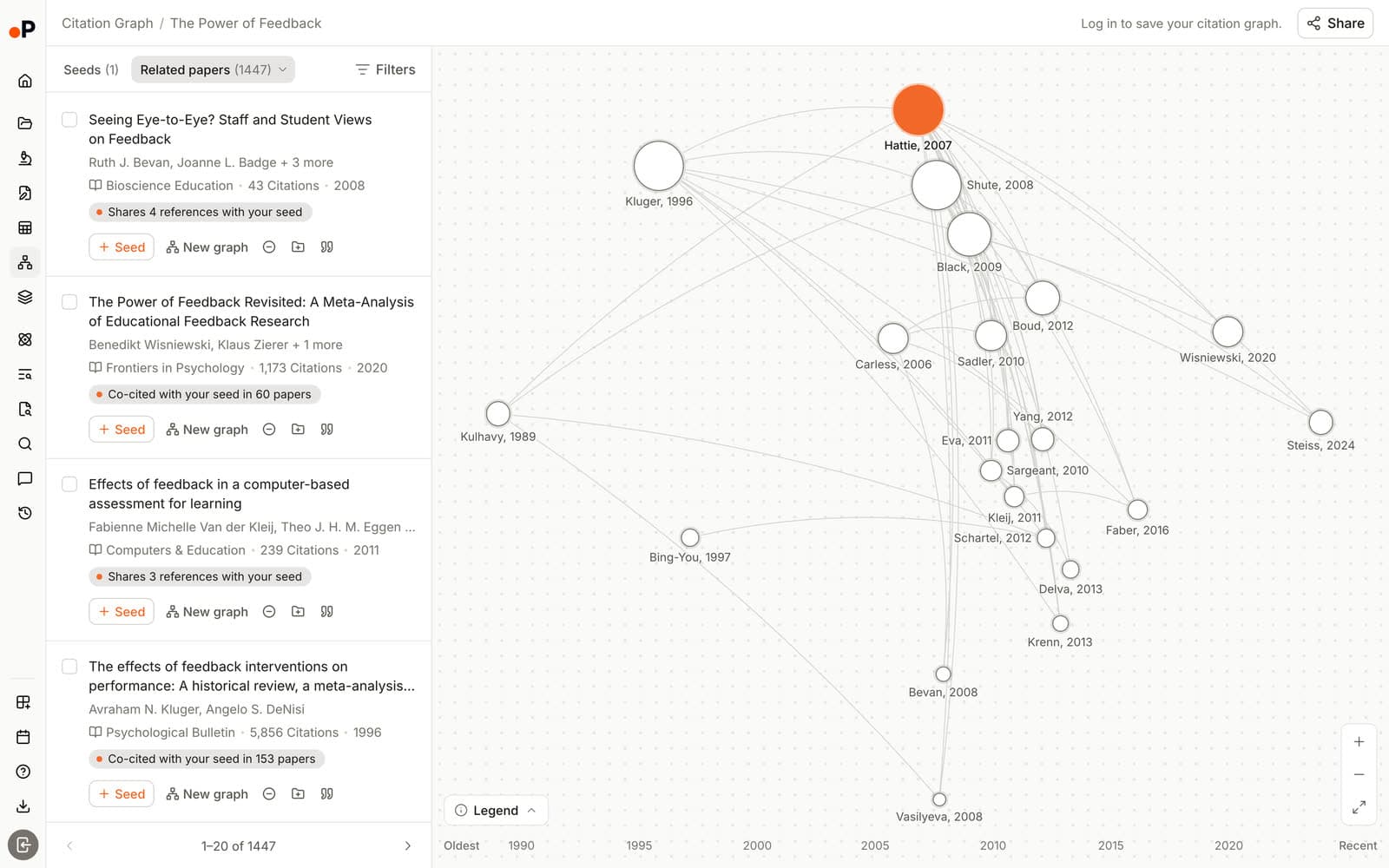
One caveat: only one of the top 20 related papers for each of those seeds was published in 2024 or later, so the Related papers view leans toward established, highly cited work, and recent studies show up mainly in Later work. Back on the insomnia map, when we added van Straten et al. (2018) as a second seed with the "+ Seed" button, the related list grew to 1,933 papers, 7 new papers entered the top 20, and three of the top 20 were now from 2024 or later, including a 2024 network meta-analysis of CBT-I components. The tool found the papers; deciding that they form three themes, or four, was our call.
How a Literature Map Is Made
Making a literature map takes six moves: set a one-sentence scope, collect the core studies, group them into themes, draw and label the links between them, mark where your own study fits, and revise the map as you read. A first draft of 15 to 30 studies is a workable size that grows with your reading.
A map built around a focused, answerable research question stays small enough to be useful. To collect the first key studies, you can ask your question in plain language in Paperguide's AI Search, which ranks peer-reviewed papers and shows quality signals such as SJR quartile on each one. Collecting is also the step that is easiest to get wrong, because keyword searches miss papers that describe the same idea in different words. In one audit of a review of complex evidence, 51% of sources were found by "snowballing" (pursuing references of references) rather than by the planned database and hand searches [8]. A citation-based map does that snowballing quickly: Paperguide's free Citation Graph needs no signup and ranks papers related to 1 to 5 seed papers, so you can spot missed studies before you sort anything into themes. Keep the studies you choose in one library, such as Paperguide's Reference Manager on a free account, so the map and your citations draw on the same list.
For each step in detail, with a synthesis matrix, layouts and a worked example, use this step-by-step guide to creating a literature review map.
Citation Map vs Literature Map: How Citation-Based Maps Work
A citation map is a network of papers linked by direct citations: an arrow from one paper to another means the first cites the second. Citation-based literature map tools start from that citation map and add other signals, such as co-citation, shared references and topic similarity, to rank which nearby papers matter most for your seeds.
A literature map and a citation map are related but not the same. A thematic literature map can contain no citation links at all, and a citation map on its own tells you who cites whom; naming the themes is still your job. A citation map is best read as raw material for a literature map, and our explainer on what citation maps show and how to read them covers the network view on its own.
To read one, start with the nodes (each is a paper; in Paperguide's legend, "Size = citations" and "Higher = more cited"), then the arrows (follow them backward to the work a paper builds on and forward to the work that builds on it), then the position, since some tools lay papers out on a timeline with older work on one side.
The directions matter. In systematic review terms, the TARCiS statement calls retrieving the papers a seed cites "backward citation searching" and retrieving the papers that cite it "forward citation searching" [9]. Paperguide Citation Graph shows these as separate views: Related papers (ranked by citation links, co-citation, shared references and similar topic), Earlier work ("What your seed builds on", the backward direction) and Later work ("What built on your seed", the forward direction). Each paper carries a "Why it's here" line, such as "Co-cited with your seed in 135 papers", plus chips such as "Cites your seed" or "Shares 9 references". You can remove noise with "Exclude", grow the map with "+ Seed" and send it to a colleague with "Share". Graphs save in your browser without an account, and saving a paper to Reference Manager needs a free account. In our runs, recent papers appeared mainly in Later work rather than near the top of Related papers.
In Paperguide's own October 2026 evaluation, its recommendations averaged a relevance score of 1.53 out of 2, with 61% rated highly relevant and 8% off topic; that was an internal test, and results varied by field. For the full method, including choosing seeds and excluding noise, follow our step-by-step guide to creating a citation map.
How to Use a Literature Map in Your Literature Review
A literature map becomes the outline of your literature review. Each theme becomes a section, the connections between themes become the transitions between sections, and the place you marked for your own study becomes the gap your review builds toward. Writing from a map makes you compare studies instead of summarising them one by one.
A thematic map prevents the "one paragraph per paper" structure, because each section is built around a theme. When you write the section for "How is CBT-I delivered?", you compare Koffel, Cheng and Dizon, and Arnedt in the same paragraphs instead of describing each in turn. Our guide to writing a literature review that synthesises studies covers this step in detail, and the overview of literature review types and their structure explains how the review types differ.
The map also justifies your research gap. A reader who sees three well-populated themes and one thin strand understands why your study belongs in the thin strand. Before you commit to that strand, Paperguide's Research Gap Finder can test a candidate gap by searching for studies that would disprove it and returning a graded report.
For systematic, scoping and evidence synthesis teams, a map helps scope the review and choose search terms before the protocol is fixed. It does not replace a documented search, and any citation-based checking belongs in your methods as supplementary backward and forward citation searching, reported with dates and sources.
When you are ready to draft, Paperguide's Literature Review AI runs a five-step Plan, Search, Screen, Extract, Synthesize workflow and writes a structured review with every claim cited and linked to a source paper. Your map's themes are the yardstick for checking and reshaping what it produces.

Literature Map vs Concept Map vs Mind Map
A literature map organises published studies, a concept map organises ideas and the relationships between them, and a mind map organises your own associations around one central word. They look alike on paper, but they hold different things, and a literature review usually needs the first.
Literature Map vs Concept Map vs Mind Map: What Each Holds
| Feature | Literature map | Concept map | Mind map |
|---|---|---|---|
| Units | Studies or groups of studies | Concepts or variables | Words and ideas |
| Links | Themes, citations, agreement or disagreement | Labelled relationships between concepts | Loose associations radiating from a centre |
| Main use | Planning and justifying a literature review | Building a conceptual framework for your study | Brainstorming a topic before searching |
| Every node cites a source? | Yes | Sometimes | No |
Common Mistakes When Making a Literature Map
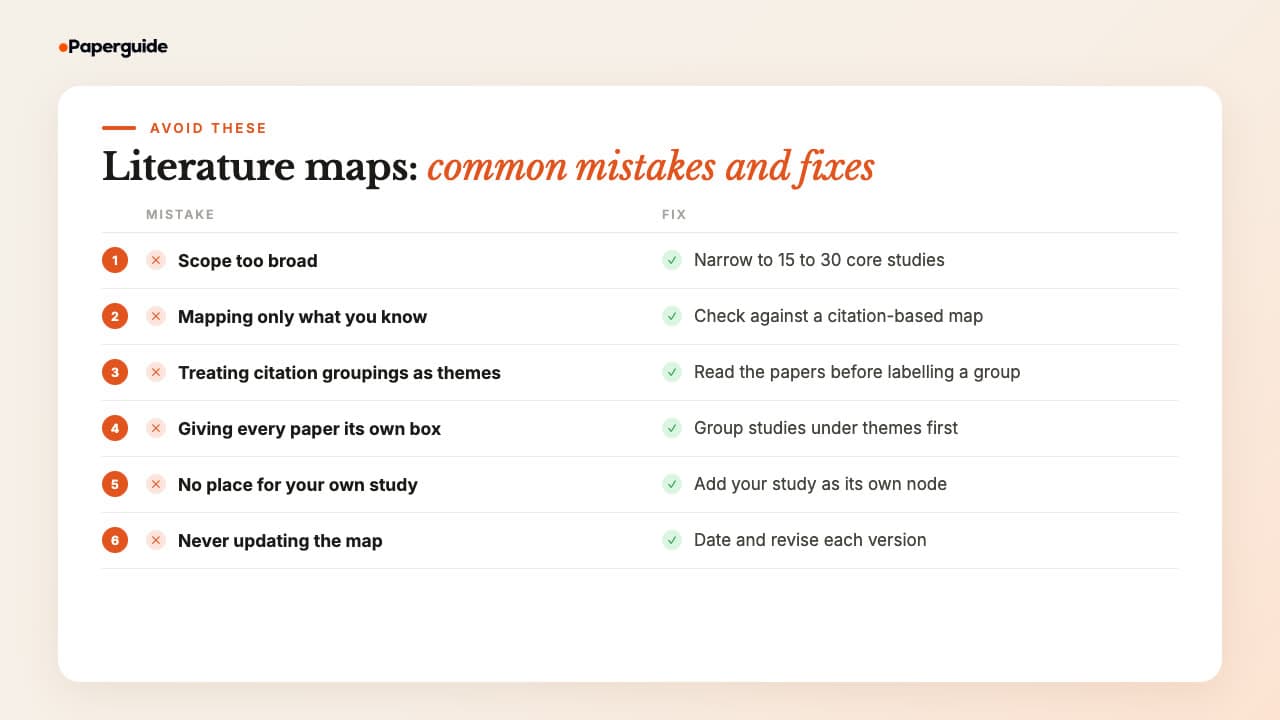
Six mistakes to watch for are scoping too broadly, mapping only what you know, treating citation groupings as themes, giving every paper its own box, leaving out your own study, and never updating the map. Each one is easy to fix once you know to look for it.
Scope too broad. A map of "sleep research" has hundreds of branches. Narrow it until the first draft holds 15 to 30 core studies.
Mapping only what you already know. A thematic map drawn from a first search reflects that search. Check it against a citation-based map or a recent review's reference list before you trust it.
Treating citation clusters as themes. Papers sit close in a citation graph because they are cited together, which may mean agreement, disagreement or simply a shared review article. Read them before you label a group.
One node per paper, no themes. A map with 40 equal boxes is a bibliography with lines. Group studies first, then show individual papers under each theme.
No place for your study. If the map does not show where your work sits, it cannot support your rationale. Add your study as its own node.
Never updating it. A map drawn once and filed away misses the papers you read later. Date each version and revise it when a theme changes.
Literature Map Checklist
Use this checklist before you write. A finished literature map has a one-sentence scope and 15 to 30 core studies checked against a recent review. It groups them into three to six named themes, labels its connections and shows where your own study sits. If any item is missing, fix the map first.
- [ ] The topic is one sentence with population, focus, outcome and time frame
- [ ] The map holds the core studies, checked against at least one recent review's reference list
- [ ] A citation-based check was run on one or more key papers, earlier and later work included
- [ ] Studies are grouped into three to six themes, each named as a question or claim
- [ ] Connections are labelled with the relationship (replicates, contradicts, extends)
- [ ] Your own study is on the map and connects to at least one theme
- [ ] Thin or empty areas are noted as candidate gaps you still need to check
- [ ] The map is dated and a newer version replaces it as you read
Try It Yourself (2 Minutes)
You can start both kinds of literature map in about two minutes from one paper. Use a citation graph to see the work before and after that paper, then sort a few results into themes by hand. The steps below use a recent review or a highly cited study as the seed.
- Pick one key paper on your topic, ideally a recent review or a highly cited study, and copy its DOI.
- Paste the DOI into Paperguide's free Citation Graph and open the Earlier work and Later work views in turn.
- Choose five papers from the results and sort them into two themes on paper, with a one-line question as each theme's name.
By the end you will have the start of both kinds of literature map: a citation-based one on screen and a thematic one in your own hand.
Conclusion
A literature map is a picture of how studies relate, and it comes in two kinds. A thematic map, drawn by you, groups studies into the themes that will structure your review. A citation-based map, built by a tool from citation links, finds papers you missed and shows what came before and after your key studies.
Use the citation-based map early, while you are still collecting, and the thematic map throughout, revising it as you read. When your own study has a clear place on the map, the next step is testing that the space it fills is real, which is where finding and checking research gaps begins.
Frequently Asked Questions
What is a literature map in research?
A literature map in research is a visual overview of the studies on a topic that shows how they relate. It can be a thematic map drawn by the researcher, grouping studies into themes and subtopics, or a citation-based map built by a tool from citation links between papers [5]. Both help you see the structure of a field and plan a literature review.
What is an example of a literature map?
A simple example is a tree for cognitive behavioural therapy for insomnia with three branches: whether it works, how it is delivered (group, computerised, telephone) and who it helps (comorbid conditions, primary care). Each branch lists two or three key studies. A citation-based example is a network of papers linked to one seed meta-analysis by citations and co-citation.
Is a literature map the same as a literature review?
No. A literature map is a visual planning tool that shows how the studies on a topic relate, either grouped into themes or linked by citations. A literature review is the written synthesis that compares those studies, weighs their evidence and argues for a gap. The map usually comes first, and its themes often become the sections of the review.
What should a literature map include?
A useful literature map includes a one-sentence topic with its scope, the core studies (15 to 30 is a workable first draft) grouped into three to six named themes, labelled links showing how studies or themes relate, and a separate node for your own study. Date each version, and note thin or empty areas as possible gaps to check.
What is the difference between a literature map and a citation map?
A citation map links papers by direct citations, showing which paper cites which. A literature map is broader: it can be a thematic diagram with no citation links at all, or a citation-based network that adds co-citation [3], shared references and topic similarity. A citation map is best treated as raw material for a literature map, not a replacement for one.
Can AI make a literature map?
Tools can build citation-based literature maps automatically from one or more seed papers, ranking related papers by citations, co-citation, shared references and topic similarity. That is fast and finds studies a keyword search misses. Grouping those papers into meaningful themes, and judging which connections matter for your question, remains the researcher's work and depends on reading the papers.
What is the difference between a literature map and a concept map?
A literature map organises published studies and shows how they relate, so every node points to a source. A concept map organises ideas or variables and labels the relationships between them, and it is often used to build a conceptual framework. A literature map suits planning a review, while a concept map suits building a study's framework.
How many studies should a literature map include?
There is no fixed number. For a first thematic map, 15 to 30 core studies is a workable size, enough to show three to six themes without crowding. A citation-based map can hold hundreds of papers, but you will usually save only the relevant ones. A thesis or systematic review may grow the map as screening continues.
References
- Garfield, E. (1955). Citation indexes for science: A new dimension in documentation through association of ideas. Science, 122(3159), 108-111. https://doi.org/10.1126/science.122.3159.108
- Kessler, M. M. (1963). Bibliographic coupling between scientific papers. American Documentation, 14(1), 10-25. https://doi.org/10.1002/asi.5090140103
- Small, H. (1973). Co-citation in the scientific literature: A new measure of the relationship between two documents. Journal of the American Society for Information Science, 24(4), 265-269. https://doi.org/10.1002/asi.4630240406
- Boyack, K. W., & Klavans, R. (2010). Co-citation analysis, bibliographic coupling, and direct citation: Which citation approach represents the research front most accurately? Journal of the American Society for Information Science and Technology, 61(12), 2389-2404. https://doi.org/10.1002/asi.21419
- Princeton University Library. (n.d.). Literature mapping: Overview [Research guide]. https://libguides.princeton.edu/litmapping (accessed 28 October 2026)
- Creswell, J. W., & Creswell, J. D. (2023). Research design: Qualitative, quantitative, and mixed methods approaches (6th ed.). SAGE. https://collegepublishing.sagepub.com/products/270550
- Patterson, E. (n.d.). MESH Guides [Online guide on literature maps]. Education Futures Collaboration. https://www.meshguides.org/guides/node/406?n=400 (accessed 28 October 2026)
- Greenhalgh, T., & Peacock, R. (2005). Effectiveness and efficiency of search methods in systematic reviews of complex evidence: Audit of primary sources. BMJ, 331(7524), 1064-1065. https://doi.org/10.1136/bmj.38636.593461.68
- Hirt, J., Nordhausen, T., Fuerst, T., Ewald, H., & Appenzeller-Herzog, C. (2024). Guidance on terminology, application, and reporting of citation searching: The TARCiS statement. BMJ, 385, e078384. https://doi.org/10.1136/bmj-2023-078384
Mapping literature?
Find the studies your map is missing
Add the key papers you already have and see the earlier, later and related work around them. Free, no signup.
Try Citation GraphNo credit card required