What Is a Research Question?


Your First Step in the Research Journey
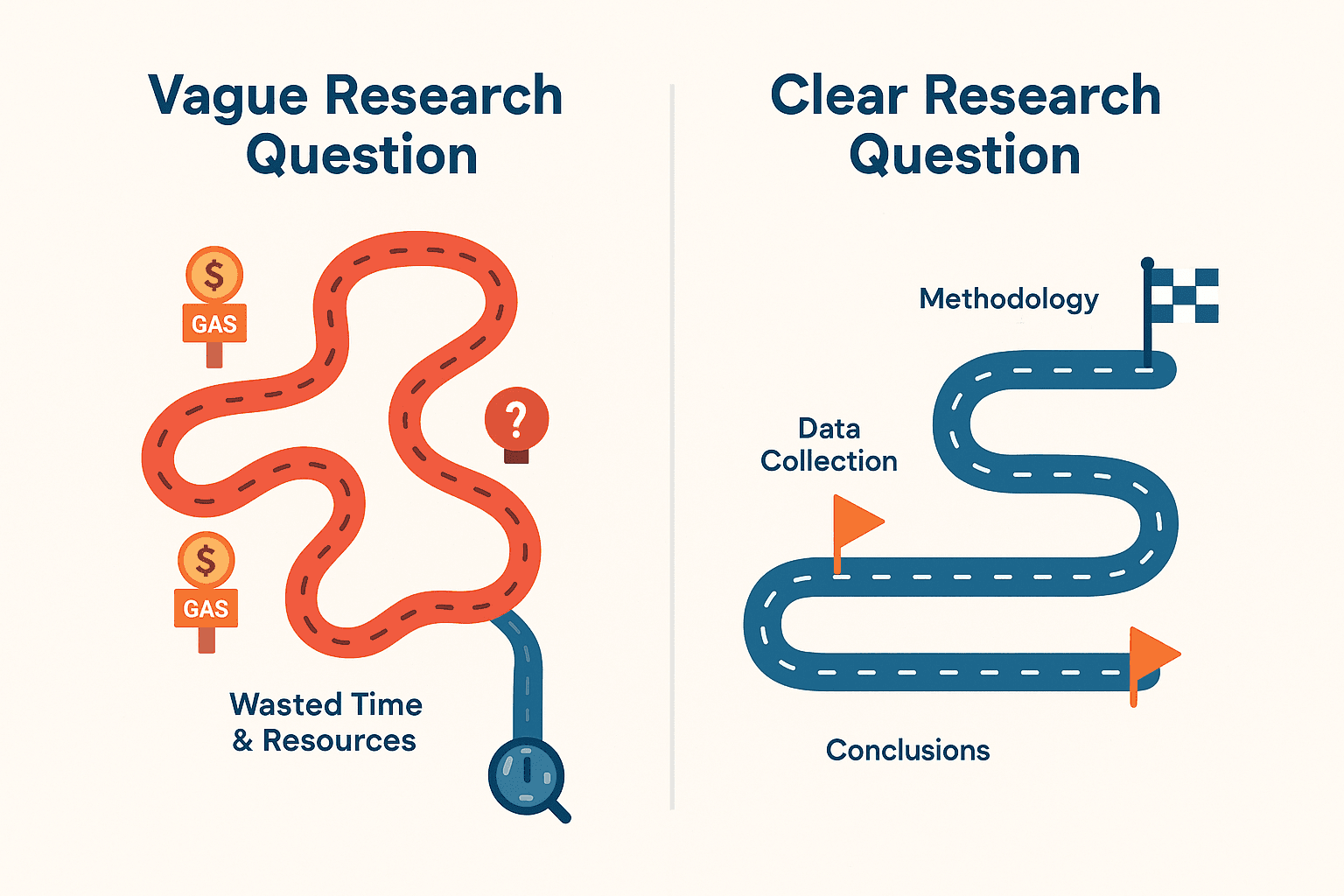
Imagine packing for a road trip without knowing the destination. You could burn fuel, lose hours, and still end up nowhere special. In research, that "destination" is your Research Question — the single sentence that tells you where you're going and why. A precise research question:
- Focuses effort – clarifies what data to collect and which analyses to run.
- Saves resources – prevents detours into irrelevant literature or unworkable designs.
- Signals quality – reviewers use it to judge novelty, feasibility, and significance.
If your research question is vague, trivial, or impossible to answer, the entire project wobbles. Get it right and every downstream decision — method, instrument, sample size, timeline — locks into place with far less stress.
Key Takeaways
- A research question is a clear, focused inquiry that defines what your study sets out to discover, understand, or explain, and it guides every decision that follows.
- Good research questions are specific, clear, researchable, significant, and feasible.
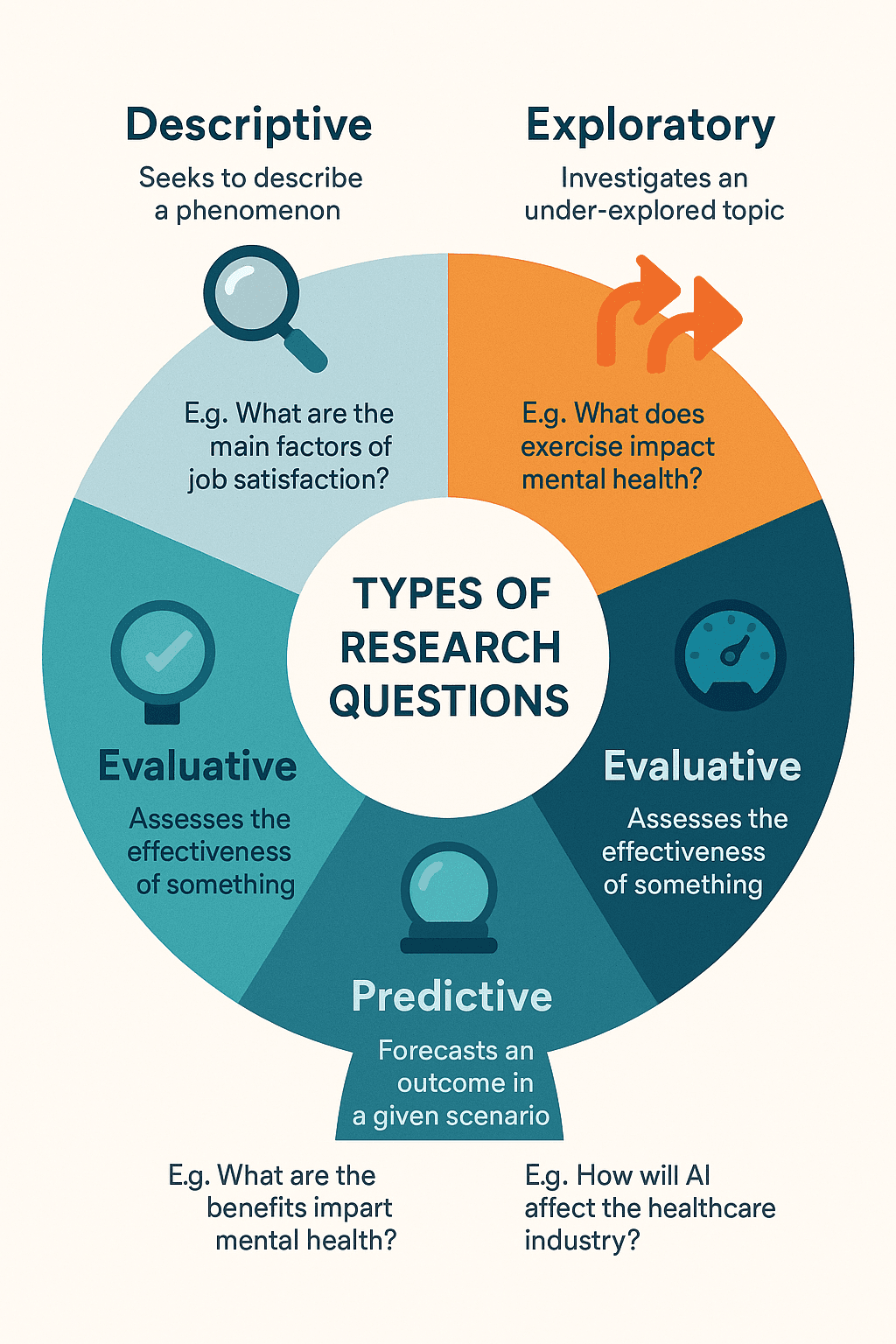
- Research questions typically fall into five types: descriptive, exploratory, explanatory, evaluative, and predictive.
- Develop your question in stages: start with a general topic, narrow it down, brainstorm preliminary questions, evaluate and refine them, then test the result.
- Avoid questions that are too broad, too narrow, biased, unanswerable, or answerable with a simple yes or no.
What Is a Research Question?
A research question is the heart and soul of your research journey. It's that burning curiosity transformed into a clear, focused inquiry that guides everything you do. Think of it as the compass that keeps you on track when the research path gets winding.
Unlike casual questions we ask in everyday life ("What should I make for dinner?"), a research question addresses something meaningful that requires systematic investigation. It's the question you're passionate enough about to spend weeks, months, or even years exploring.
Your research question serves as the foundation upon which you'll build your entire project. It defines what you want to discover, understand, or explain[1]. Without a well-crafted research question, you might find yourself collecting interesting information but struggling to piece it together into meaningful insights.
Quick Comparison of Types of Research Questions
| Type of Question | Example | Purpose | Key Features |
|---|---|---|---|
| Descriptive | What are the current homework policies in public elementary schools? | To describe existing conditions | Provides foundational data; often the first step in research |
| Exploratory | What factors influence first-generation college students' decisions to persist? | To explore new or less understood topics | Focuses on gaining insights into unfamiliar issues |
| Explanatory | How does parental involvement affect childhood literacy development? | To explain relationships or causes | Seeks to uncover causal relationships or underlying reasons |
| Evaluative | To what extent has the new anti-bullying program reduced bullying incidents? | To assess effectiveness or success | Evaluates the outcomes of programs or interventions |
| Predictive | How will increasing the minimum wage affect small business employment rates? | To forecast future outcomes or trends | Uses available data to predict future scenarios based on current or past trends |
Why Research Questions Matter
A good research question doesn't just give your project direction—it transforms how you approach the entire research process [2]. Here's why it's so crucial:
- It brings clarity to complexity: Research topics can be overwhelming in their breadth. Your research question narrows things down to something manageable.
- It connects you to the right resources: Knowing exactly what you're asking helps you find the right literature, methods, and experts to consult [3].
- It helps you recognize relevant information: With a clear question in mind, you can quickly determine which data and sources matter for your specific inquiry.
- It makes your contribution clear: A well-formulated question shows others (and reminds you) exactly what gap in knowledge you're trying to fill.
When you're new to research, having this kind of clarity isn't just helpful—it's essential. It turns what might feel like an overwhelming academic exercise into a focused, meaningful exploration that you can approach with confidence.
Characteristics of Good Research Questions
Not all questions make effective research questions. The best ones share these qualities:
1. Specific and Focused
- Weak: "How does technology affect students?"
- Strong: "How does daily social media use impact academic performance among high school students in urban settings?"
2. Clear and Understandable
- Weak: "What are the issues with educational approaches in diverse learning environments?"
- Strong: "How do culturally responsive teaching methods influence engagement levels in classrooms with students from diverse cultural backgrounds?"
3. Researchable
Your question should be something you can investigate through data collection or analysis, not something purely speculative or opinion-based.
4. Significant
It should address something that matters—a question whose answer could contribute meaningful knowledge.
5. Feasible
Consider whether you can realistically answer this question given your time, resources, and access to information.
Types of Research Questions
Research questions typically fall into several categories[4]:
- Descriptive: Seek to describe what exists
- "What are the current homework policies in public elementary schools across the Midwest?"
- Exploratory: Investigate an issue to gain insights
- "What factors influence first-generation college students' decisions to persist through their first year?"
- Explanatory: Look for causes or explanations
- "How does parental involvement affect childhood literacy development?"
- Evaluative: Assess how well something works
- "To what extent has the new anti-bullying program reduced incidents of bullying in middle schools?"
- Predictive: Forecast outcomes or consequences
- "How will increasing minimum wage affect small business employment rates?"
How to Develop Your Research Question
Creating a strong research question is rarely a one-step process. It typically evolves through several stages:[5]
1. Start with a General Topic
Begin with something that genuinely interests you. Your curiosity will fuel your motivation throughout the project.
Example: Education technology
2. Narrow It Down
Refine your broad interest into something more specific.
Example: Tablet use in elementary education
3. Ask Preliminary Questions
Brainstorm potential questions about your narrowed topic.
Example: How are tablets being used in elementary classrooms? What subjects use tablets most effectively? How do tablets affect student engagement?
4. Evaluate and Refine
Look at your preliminary questions and consider which ones meet the criteria for good research questions. Then refine further.
Example: "How does the use of educational tablet applications affect reading comprehension among third-grade students?"
5. Test Your Question
Check if your question is:
- Clear and specific enough to guide research
- Complex enough to require research (not answerable with a simple yes/no)
- Feasible given your resources
- Genuinely interesting to you and potentially valuable to others
Real-World Examples
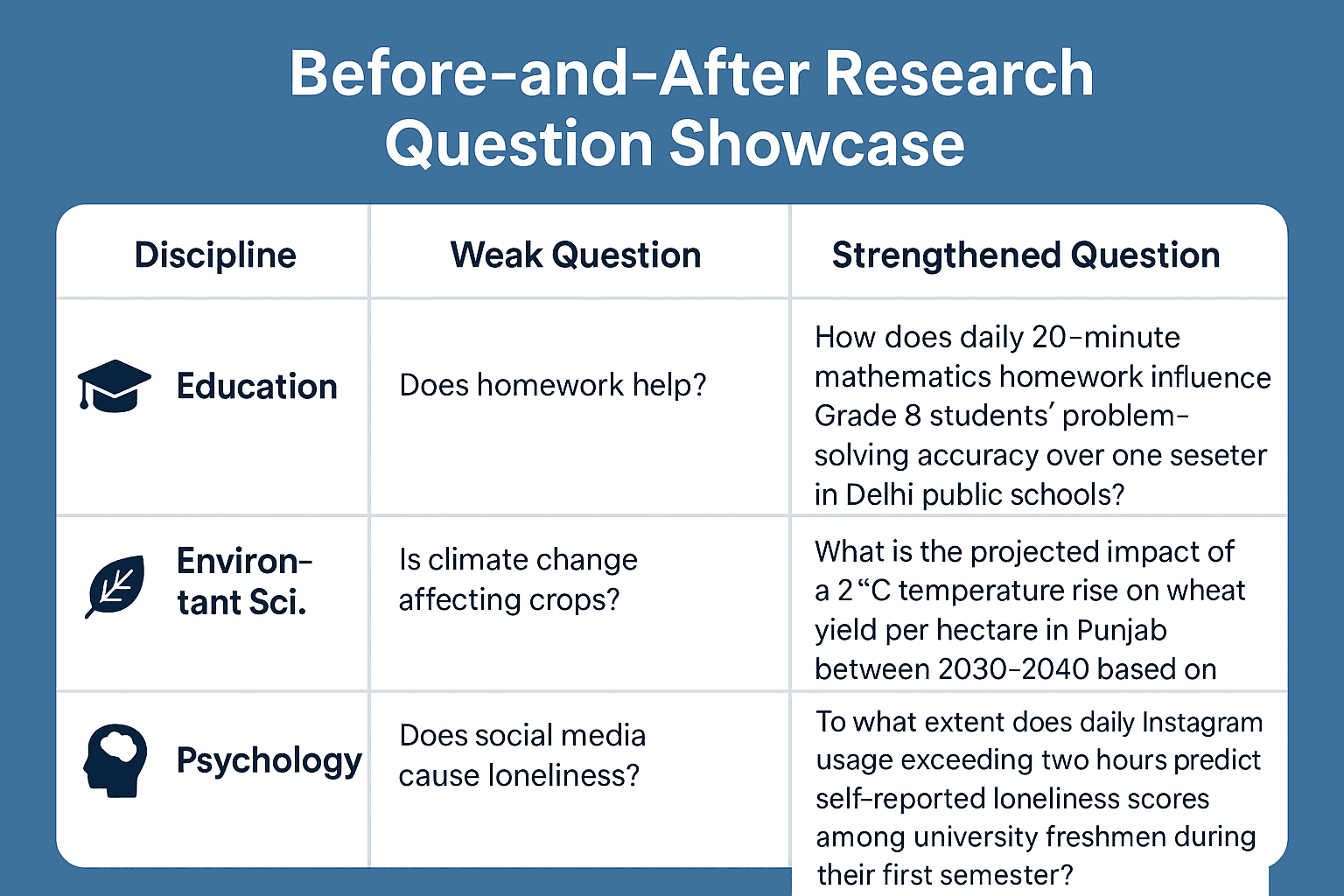
Let's look at some real research questions across different fields:
Psychology: "How does mindfulness meditation affect stress levels among college students during exam periods?"
Business: "What factors influence consumer adoption of sustainable fashion products among millennials in urban markets?"
Environmental Science: "How do community-based conservation programs impact both biodiversity preservation and economic development in coastal regions?"
History: "How did women's participation in the labor force during World War II influence gender roles in post-war American society?"
Common Pitfalls to Avoid
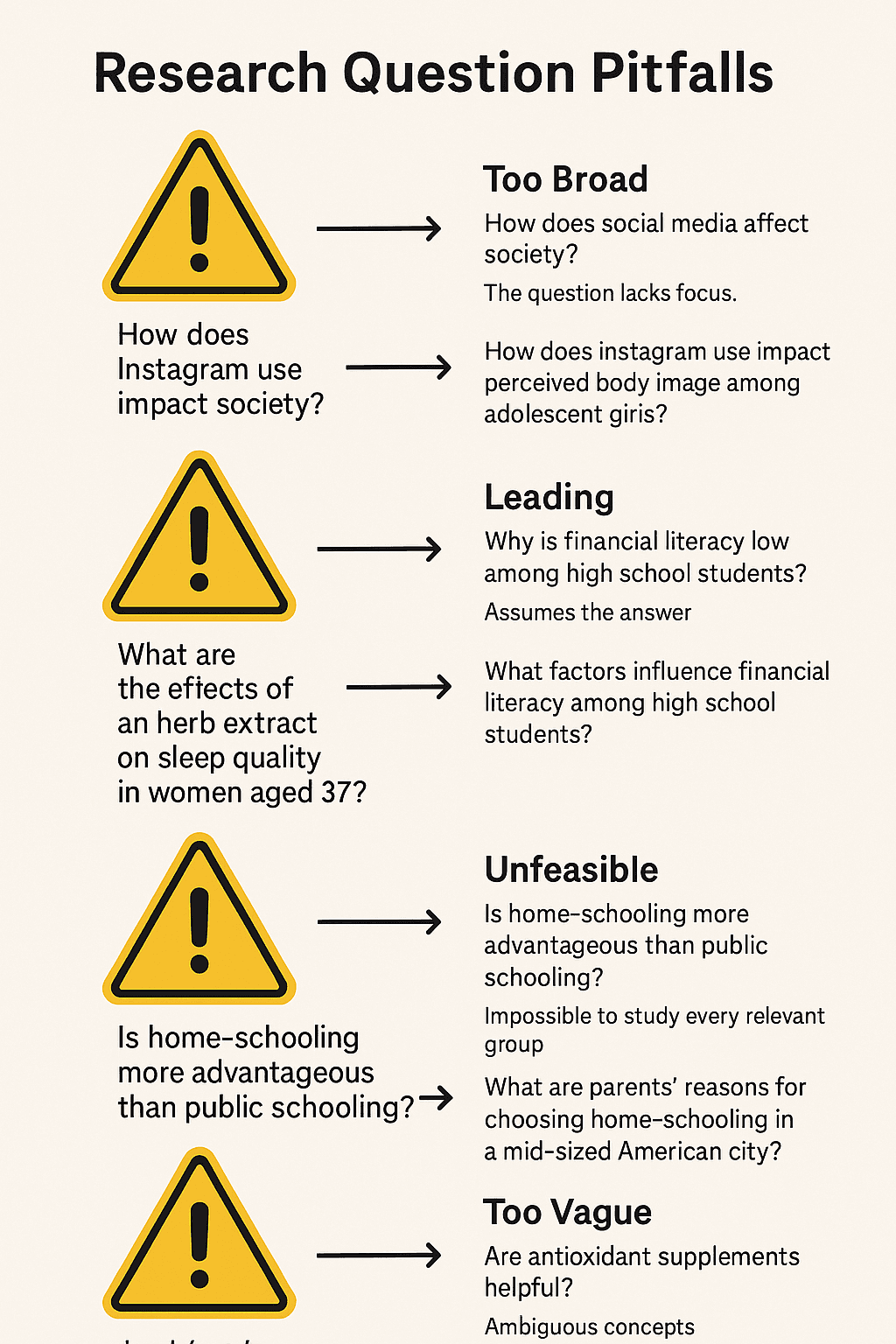
Even experienced researchers sometimes stumble when crafting research questions. Watch out for these common mistakes:[6]
- Too Broad: "How does the internet affect society?" (Impossible to address comprehensively)
- Too Narrow: "How many red shirts were worn by third-grade students at Lincoln Elementary on January 15, 2023?" (Limited significance)
- Biased: "Why is traditional education superior to online learning?" (Assumes a conclusion)
- Unanswerable: "What is the meaning of life?" (Too philosophical for empirical research)
- Yes/No Questions: "Do students prefer online learning?" (Too simplistic; better to ask "how" or "why")
Finding Inspiration for Research Questions
Struggling to develop a research question? Try these approaches:[7]
- Follow your curiosity: What genuinely makes you wonder?
- Review existing literature: What gaps exist in current research?
- Consider practical problems: What issues need solutions in your field?
- Examine contradictions: Where do competing perspectives or findings exist?
- Build on previous research: How could you extend or apply findings from earlier studies?
From Research Question to Research Process
Once you've crafted your research question, it becomes the foundation for your entire research process:
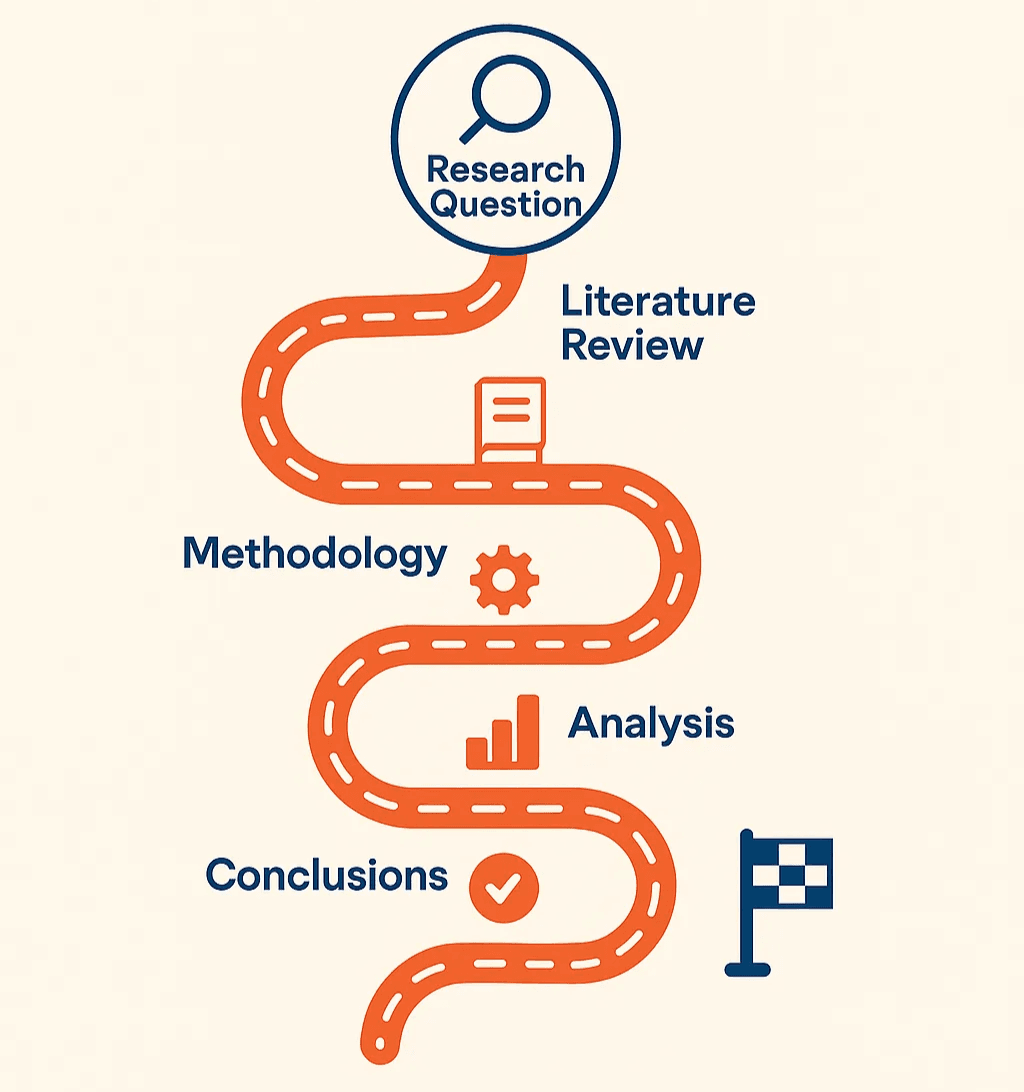
- It shapes your literature review by defining what previous work is relevant
- It guides your methodology by clarifying what data you need to collect
- It provides direction for your analysis by focusing on information that addresses your question
- It frames your conclusions by bringing your findings back to your original inquiry
If terms like literature review or qualitative research still feel abstract, the research vocabulary guide for students explains them in plain language.
When Research Gets Challenging
As you begin working with your research question, you might find it needs adjustment. This is normal! Good researchers often refine their questions as they learn more about their topic. If you're feeling stuck or overwhelmed, Paperguide's AI Search can help: ask your draft question in plain language and it returns a cited answer drawn from the top 20 relevant papers, so you can see what is already known before you refine it further.
Final Thoughts
A well-crafted research question is the foundation of successful research. It transforms vague curiosity into a focused investigation. By taking time to develop a clear, specific, and meaningful question, you set yourself up for a more productive and rewarding research experience.
Remember that research is both systematic and creative. Your research question reflects your unique perspective and interests while providing the structure needed to produce valuable insights. Whether you're writing a term paper, planning a thesis, or beginning a professional research project, the care you put into crafting your research question will pay dividends throughout your work.
Frequently Asked Questions (2026)
Q: What makes a good research question?
A: A good research question is clear, focused, researchable, significant, and feasible. It addresses a gap in knowledge and can be investigated within the scope of your resources.
Q: How do I make my research question more specific?
A: Narrow down broad topics by adding context. For example, instead of asking, "How does technology affect students?" ask "How does the use of educational tablets in elementary classrooms affect student engagement?"
Q: What types of research questions exist?
A: Research questions can be descriptive, exploratory, explanatory, evaluative, or predictive, each serving different research goals.
Q: How do I test my research question before starting my project?
A: Evaluate if the question is clear, specific, feasible, and meaningful. Also, ensure it’s complex enough to require systematic research and cannot be answered easily with a simple yes/no.
References
- Creswell, J. W., & Poth, C. N. (2018). Qualitative inquiry and research design: Choosing among five approaches (4th ed.). Sage Publications.
- Robson, C. (2011). Real world research: A resource for users of social research methods in applied settings (3rd ed.). Wiley.
- Leedy, P. D., & Ormrod, J. E. (2019). Practical research: Planning and design (12th ed.). Pearson Education.
- Saunders, M., Lewis, P., & Thornhill, A. (2019). Research methods for business students (8th ed.). Pearson Education.
- Booth, W. C., Colomb, G. G., & Williams, J. M. (2008). The craft of research (3rd ed.). University of Chicago Press.
- Denscombe, M. (2014). The good research guide: For small-scale social research projects (5th ed.). McGraw-Hill Education.
- Silverman, D. (2013). Doing qualitative research (4th ed.). Sage Publications.
Researching a topic?
Find papers and get cited answers
Search the literature, find gaps and write with citations.
Start for freeNo credit card required