50+ Research Question Examples for Every Academic Discipline


For students, researchers, and academics, coming up with a strong research question is often the first hurdle in any project. With so much information available, narrowing down your focus can feel like a challenge.
That’s where a well-crafted research question makes all the difference. It not only guides your entire study but also helps you stay focused, even as new research constantly emerges. In 2026, having access to clear and focused research questions is more important than ever, as the volume of academic material continues to grow.
In this guide, we’ll provide over 50 research question examples across various academic disciplines, helping you find the right starting point for your research. Whether you’re working on a thesis, dissertation, or research paper, these examples will inspire you and guide you toward creating impactful questions for your study.
Key Takeaways
- A strong research question is clear, specific, focused, researchable, relevant, and complex enough to require real analysis.
- A simple formula works for most questions: question stem + population/context + variables/phenomenon + time/place (if needed).
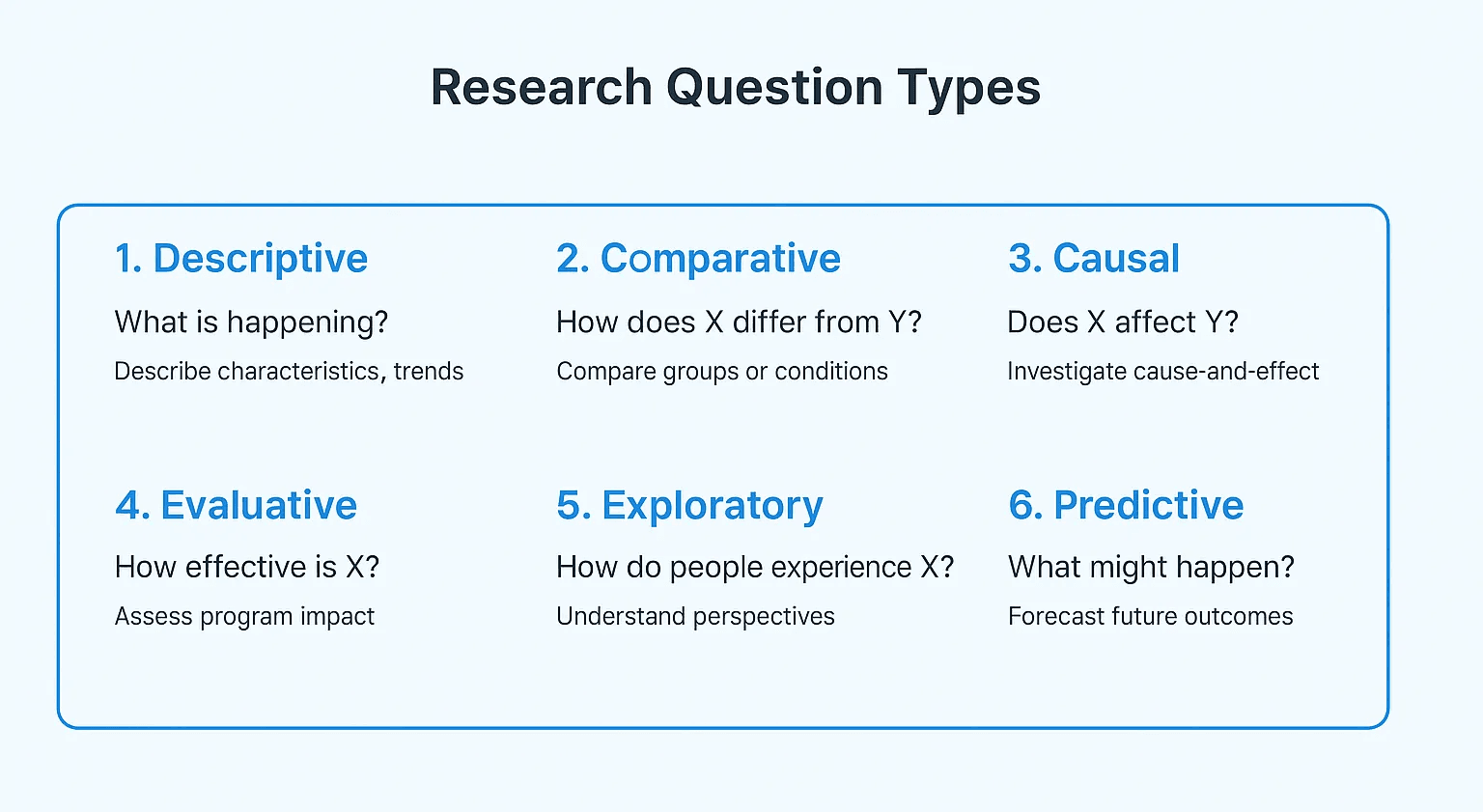
- Research questions fall into six common types: descriptive, comparative, causal/explanatory, evaluative, exploratory/qualitative, and predictive/quantitative.
- Weak questions are usually too broad, too vague, not researchable, too simple, or not original. Narrowing the scope and clarifying the variables fixes most of them.
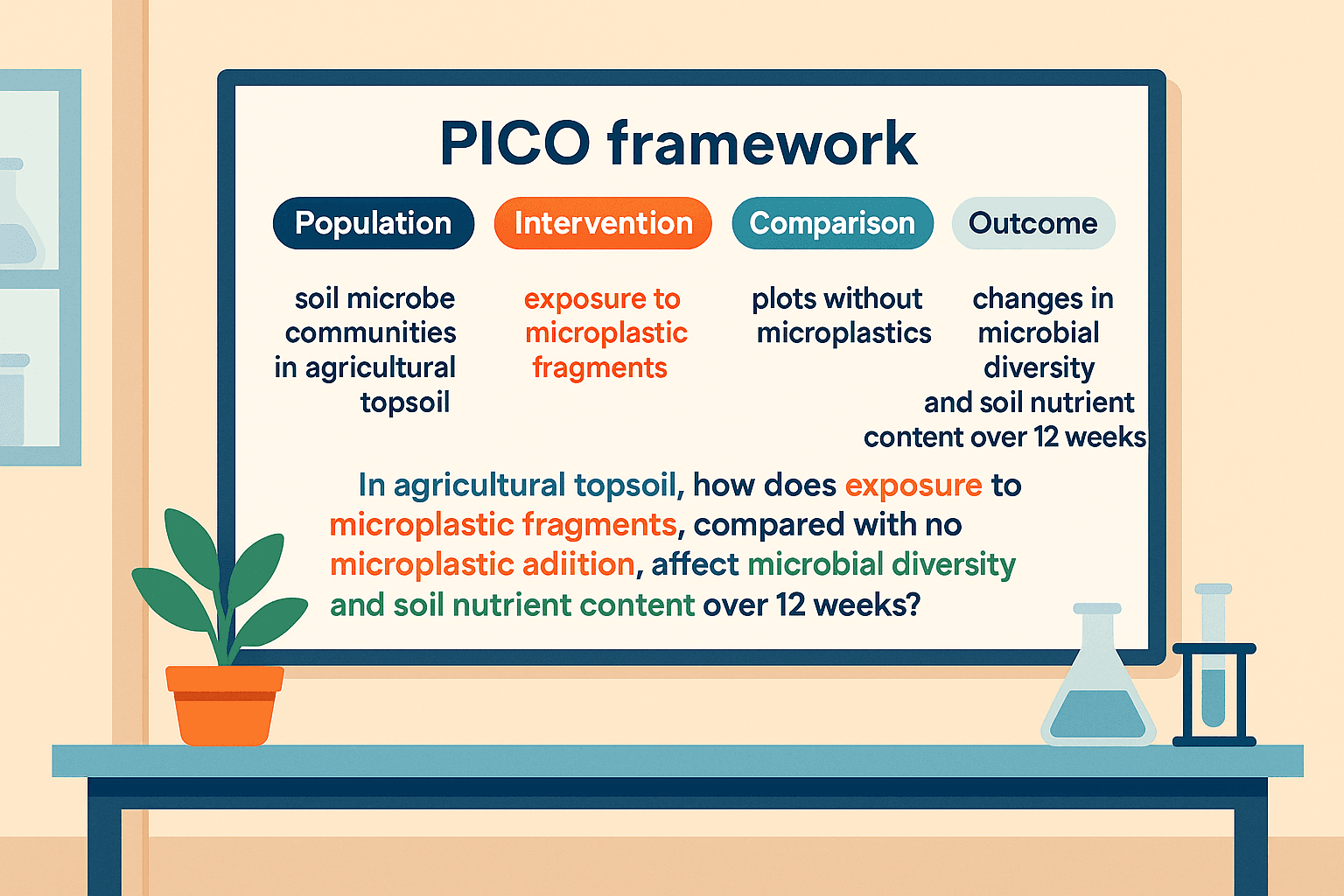
- To adapt an example, match the scope to your project level, insert your own variables, apply a framework such as PICO or SPIDER, and test feasibility before you commit.
What Makes a Good Research Question?
Before jumping into our examples, let's talk about what separates an average research question from one that will impress your professors and guide your work effectively. Think of these characteristics as your research question checklist:
The Essential Elements of Strong Research Questions
| Characteristic | Why It Really Matters |
|---|---|
| Clear & specific | A well-crafted research question is essential for guiding the research process and ensuring the project's focus is clear and manageable. [1] |
| Focused | Keeps your project manageable so you don't get lost in an ocean of information |
| Researchable | Ensures you can actually gather the data you need (without endless roadblocks) |
| Relevant | Connects your work to existing knowledge gaps and real-world issues people care about |
| Complex | Takes you beyond simple facts into meaningful analysis that showcases your critical thinking |
When these elements come together, your research question transforms from a simple query into a powerful tool that drives your entire project forward. [2]
How to Refine a Weak Research Question
Even if your initial research question isn’t perfect, don’t worry: refining it is part of the process. Here’s how to strengthen a weak question:
Common Issue | How to Fix It |
Too broad | Narrow the scope to a specific group, time, or context |
Too vague | Clarify the variables or concepts being examined |
Not researchable | Make sure it can be answered with available methods and data |
Too simple | Add complexity that requires explanation or analysis |
Not original | Identify a gap or unique angle in existing literature |
Weak: How does social media affect students?
Refined: How does daily Instagram use influence academic motivation among high school seniors in urban U.S. schools?
A Simple Formula That Works Every Time
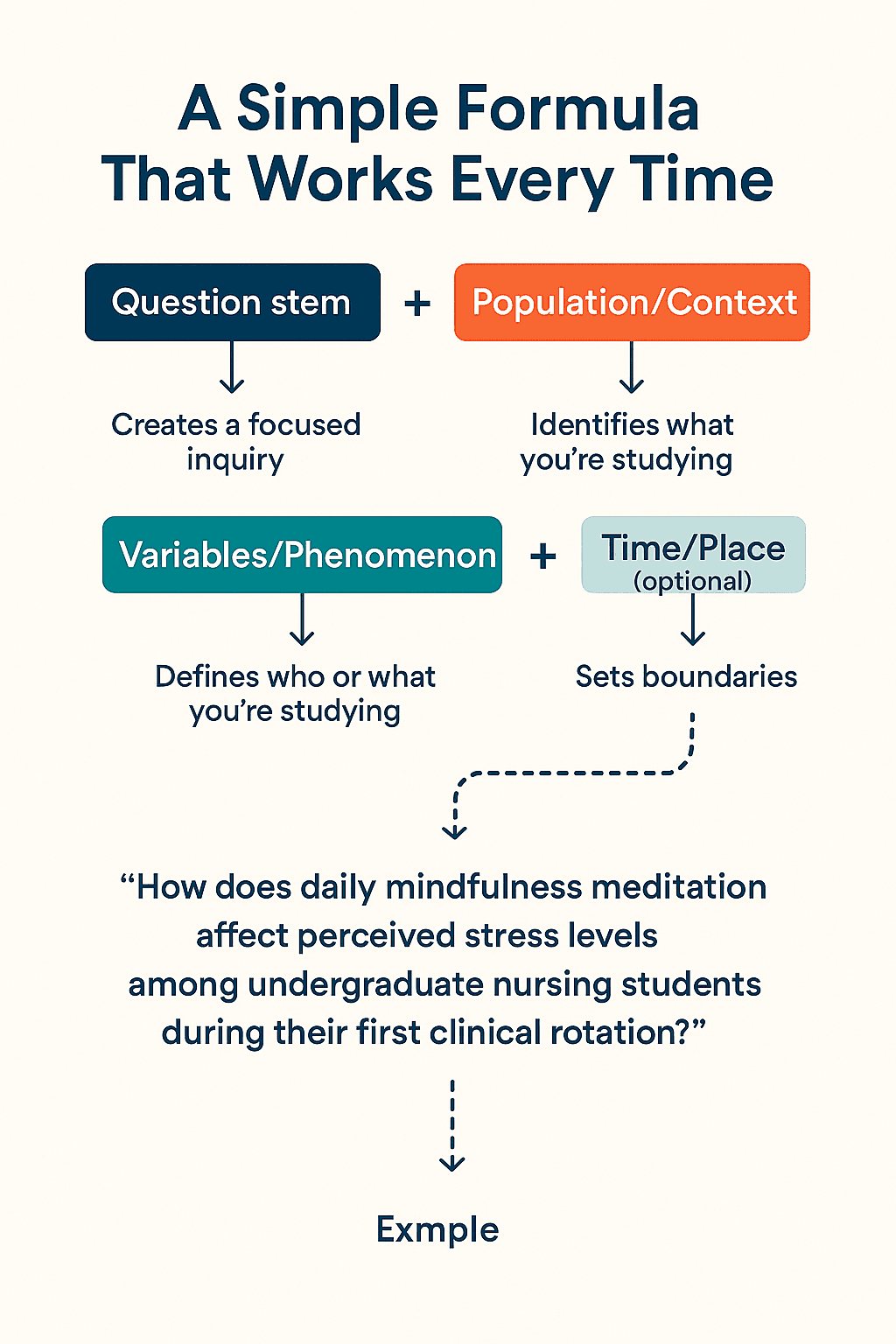
Creating a great research question doesn't have to be complicated. Try this straightforward formula: [3]
Question stem + population/context + variables/phenomenon + time/place (if needed)
For example: "How does daily mindfulness meditation affect perceived stress levels among undergraduate nursing students during their first clinical rotation?"
This structure ensures your question is specific, focused, and researchable by clearly identifying what you're studying, who you are studying, and under what conditions.
Types of Research Questions
Understanding the different types of research questions will help you choose the right approach for your specific goals: [4]
Descriptive: What is happening?
- Aims to describe characteristics, trends, or patterns
- Example: "What are the current homework policies in public elementary schools across the Midwest?"
Comparative: How does X differ from Y?
- Examines similarities and differences between groups or conditions
- Example: "How do learning outcomes differ between online and in-person chemistry lab courses for undergraduate students?"
Causal/Explanatory: Does X affect Y (and how)?
- Investigates cause-and-effect relationships
- Example: "How does parental involvement affect childhood literacy development in low-income communities?"
Evaluative: How effective is X?
- Assesses the success, worth, or impact of programs, policies, or interventions
- Example: "To what extent has the new anti-bullying program reduced incidents of bullying in middle schools?"
Exploratory/Qualitative: How do people experience or interpret X?
- Seeks to understand meanings, experiences, or perspectives
- Example: "How do first-generation college students navigate cultural transitions between home and academic environments?"
Predictive/Quantitative: To what extent does X forecast Y?
- Forecasts future outcomes based on current variables
- Example: "How accurately can early reading assessments predict academic performance in third-grade students?" [5]
Social Sciences Research Question Examples
Psychology
- How does extended social media use affect sleep quality among adolescents aged 13-18?
- What role does mindfulness meditation play in reducing anxiety symptoms in college students during exam periods?
- How do attachment styles formed in childhood influence romantic relationship satisfaction in early adulthood?
- To what extent do cultural differences impact the expression and recognition of basic emotions?
- How effective is cognitive-behavioral therapy compared to medication in treating moderate depression in adults?
Sociology
- How has the rise of remote work influenced community engagement in suburban neighborhoods?
- What factors contribute to the persistence of income inequality in post-industrial economies?
- How do religious communities adapt their practices in increasingly secular societies?
- What role does social capital play in the economic development of rural communities?
- How do generational differences affect attitudes toward environmental conservation efforts?
Education
- How do project-based learning approaches affect critical thinking skills in middle school students?
- What impact does teacher diversity have on academic achievement in multicultural classrooms?
- How effective are early intervention reading programs for students at risk of developing reading disabilities?
- What factors influence parental involvement in urban public schools compared to suburban schools?
- How does the implementation of mindfulness practices affect classroom management in elementary settings?
Natural Sciences Research Question Examples
Biology
- How does microplastic accumulation in soil affect earthworm population health and soil fertility?
- What role do gut bacteria play in regulating immune responses to food allergens?
- How does light pollution impact the nocturnal behaviors of urban wildlife?
- What evolutionary adaptations allow certain plant species to thrive in extreme desert conditions?
- How effective are wildlife corridors in maintaining genetic diversity among fragmented animal populations?
Chemistry
- How do different catalyst compositions affect the efficiency of hydrogen production in water-splitting reactions?
- What methods can improve the biodegradability of polymer-based packaging materials?
- How does the molecular structure of various plant-based sweeteners influence their taste perception?
- What factors affect the stability of mRNA-based vaccines under various storage conditions?
- How do trace metal contaminants impact the performance of perovskite solar cells?
Environmental Science
- How do urban green spaces affect local air quality and temperature regulation during summer months?
- What impact does agricultural runoff have on freshwater ecosystem diversity in the Mississippi River basin?
- How effective are different forest management practices in sequestering carbon and mitigating climate change?
- What factors influence the bioaccumulation of microplastics in marine food webs?
- How do different restoration techniques affect the recovery rates of coral reef ecosystems?
Humanities Research Question Examples
History
- How did women's participation in the workforce during World War II affect gender roles in 1950s American society?
- What factors contributed to the collapse of the Maya civilization between 800-950 CE?
- How did coffee house culture influence political discourse in 18th-century England?
- To what extent did economic factors versus ideological differences drive the Cold War between 1945-1991?
- How have historical representations of indigenous peoples evolved in Canadian museum exhibits from 1950 to present?
Literature
- How does Toni Morrison use symbolism to address racial trauma in "Beloved"?
- In what ways do post-colonial authors reinterpret Western literary classics to challenge imperial narratives?
- How has the representation of artificial intelligence in science fiction evolved since Asimov's "I, Robot"?
- What role does landscape play in shaping character development in Thomas Hardy's novels?
- How do contemporary young adult dystopian novels reflect current societal anxieties?
Philosophy
- How do Eastern and Western philosophical traditions differ in their approaches to the concept of self?
- To what extent are ethical frameworks like utilitarianism applicable in addressing modern bioethical dilemmas?
- How has the concept of free will been reconciled with advances in neuroscience?
- What role does empathy play in different theories of moral reasoning?
- How have philosophical perspectives on artificial intelligence evolved in response to technological developments?
Applied Sciences & Professional Fields
Business & Economics
- How do corporate sustainability initiatives impact consumer purchasing decisions in the retail industry?
- What factors influence employee retention in technology startups compared to established corporations?
- How effective are different pricing strategies for subscription-based digital services?
- What impact does algorithmic trading have on market volatility during economic downturns?
- How do cultural differences affect negotiation strategies in international business partnerships?
Health Sciences
- How does nurse-to-patient ratio affect patient outcomes in intensive care units?
- What impact does telehealth implementation have on healthcare access in rural communities?
- How effective are different approaches to reducing hospital readmission rates for heart failure patients?
- What factors influence vaccine hesitancy among different demographic groups?
- How do interprofessional collaboration models affect patient safety in surgical settings?
Computer Science
- How do different machine learning algorithms compare in predicting consumer purchasing behavior?
- What factors affect the user adoption of privacy-enhancing technologies?
- How effective are current approaches to detecting and preventing adversarial attacks on neural networks?
- What impact does code documentation quality have on open-source project sustainability?
- How do different interface design approaches affect accessibility for users with visual impairments?
How to Write a Research Question: From Examples to Your Own
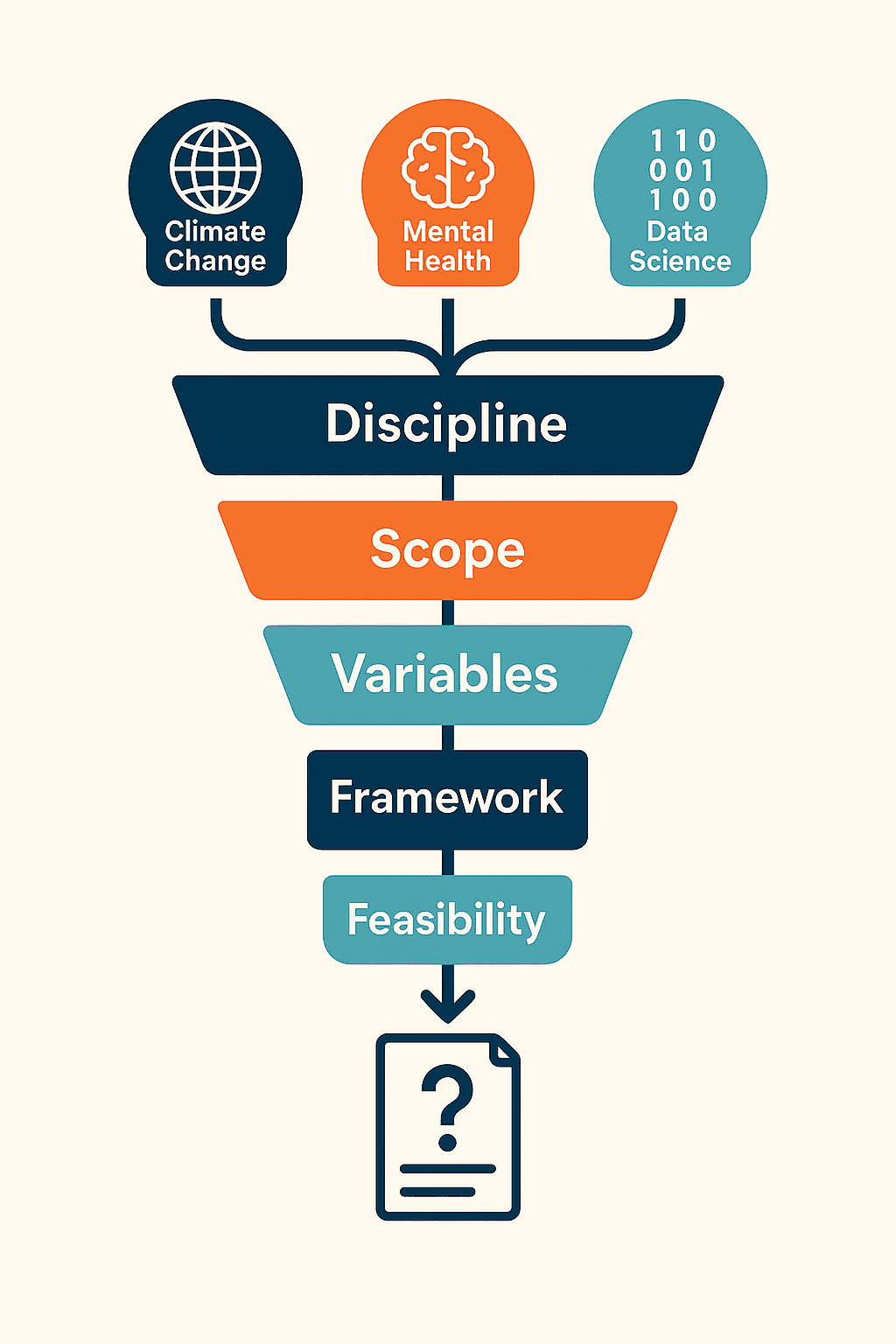
While these examples provide inspiration, your research question should reflect your specific interests and academic requirements. Here's how to adapt these examples for your own work:
- Identify your discipline and specific interest area: Choose examples from related fields as starting points.
- Adjust the scope to match your project level: Undergraduate papers typically need narrower questions than doctoral dissertations.
- Insert your specific variables or focus: Replace the who, what, where, when, and how with elements relevant to your research.
- Apply appropriate frameworks: Use structured approaches like PICO for health sciences or SPIDER for social sciences.
- Test for feasibility: Ensure you can reasonably answer the question with available resources and time.
Characteristics of a Good Research Question
When evaluating or developing your research question, look for these essential qualities:
- Clarity: Free from jargon and ambiguous terms
- Focus: Specific enough to be addressed thoroughly
- Complexity: Requires research and analysis, not just facts
- Arguability: Has multiple possible answers or perspectives
- Relevance: Contributes something valuable to the field
- Feasibility: Can be answered with available resources
- Originality: Addresses a gap or new angle in existing research
Sample research questions for students often lack one or more of these characteristics. For instance, a question might be clear but too broad, or focused but not feasible given student resources. The examples in this post demonstrate how to balance these qualities.
Getting Feedback on Your Research Question
Before finalizing your research question, seek feedback from: [6]
- Professors or advisors who understand your field's expectations
- Peers who can identify potential confusion or vagueness
- Writing center consultants who can help with clarity and structure
- Research tools like Paperguide that can analyze and suggest improvements
Remember that refining your research question is an iterative process: expect to revise it several times as your understanding of the topic develops. [7]
Disciplines and Research Question Examples
Law
- How has the legalization of recreational cannabis impacted crime rates in U.S. states since 2012?
- To what extent do international human rights treaties influence domestic policy changes?
- How do sentencing guidelines vary across jurisdictions in white-collar crime cases?
Anthropology
- How do initiation rituals among Maasai youth influence social cohesion in Kenyan communities?
- What can burial practices reveal about gender roles in ancient Andean societies?
- How are indigenous storytelling traditions adapting in the digital age?
Data Science
- How accurately can machine learning models predict fraudulent financial transactions?
- What biases emerge in facial recognition datasets, and how do they affect algorithm performance?
- How do different data visualization techniques impact interpretation accuracy in non-expert users?
Engineering
- What materials offer the best trade-off between strength and weight in electric vehicle battery casings?
- How does additive manufacturing affect the fatigue resistance of aerospace components?
- How can predictive maintenance systems reduce operational downtime in smart factories?
Linguistics
- How does code-switching manifest in bilingual classrooms in urban North America?
- What phonetic changes are occurring among Gen Z speakers of American English?
- How does sign language structure differ across regional dialects?
Philosophy
- How do virtue ethics and deontology address ethical AI design differently?
- Can simulation theory offer a valid epistemological framework in modern philosophy?
- What are the implications of Nietzsche’s concept of eternal recurrence in modern existentialism?
Arts
- How do contemporary street artists use public space to critique political structures?
- What role does lighting design play in shaping audience perception in immersive theater?
- How has digital art transformed traditional conceptions of authorship and originality?
Final Thoughts
A well-crafted research question is the cornerstone of successful academic work. These examples demonstrate the diversity of approaches across disciplines while highlighting common principles of specificity, clarity, and feasibility.
As you develop your own research questions, remember that the goal isn't perfection on the first try. Even experienced researchers go through multiple drafts before settling on their final question. The most important quality in a research question is that it genuinely interests you. This internal motivation will sustain you through the challenges of your research journey.
Once you've finalized your research question, Paperguide, an AI-native platform for scientific research workflows and systematic reviews, can help you investigate it. Its AI Search answers your question with a cited synthesis from the top 20 papers across 200M+ peer-reviewed studies, and the same workspace carries you through literature reviews, reference management, and citation-grounded drafting. With the right question guiding your work and the right tools supporting your process, you'll be well on your way to creating research you can be proud of.
Frequently Asked Questions
1. What are the 5 types of research questions?
- Descriptive: Describe a phenomenon (e.g., "What are common symptoms of burnout among teachers?")
- Comparative: Compare two or more conditions (e.g., "How does remote work compare to in-office work in productivity?")
- Causal/Explanatory: Explore cause-effect (e.g., "Does social media use lead to anxiety in teenagers?")
- Evaluative: Assess effectiveness or impact (e.g., "How effective is gamified learning in middle school math?")
- Exploratory: Investigate experiences or perceptions (e.g., "How do patients feel about virtual mental health therapy?")
2. How do I write a good research question for a thesis?
Start by identifying a problem or gap in the literature, narrow your focus, ensure it's researchable with available methods, and confirm it aligns with your academic goals.
3. What’s the difference between a research topic and a research question?
A research topic is a broad subject area (e.g., "climate change and agriculture"), while a research question is a specific, focused inquiry that guides your investigation (e.g., "How does drought frequency affect wheat yields in California’s Central Valley?").
4. Can a research question be too broad or too narrow?
Yes. A broad question lacks focus and is hard to manage; a narrow question might not offer enough material. Aim for a balance: specific enough to explore deeply, broad enough to support full analysis.
5. How do I use the PICO framework to build my research question?
PICO stands for:
- Population: Who are you studying?
- Intervention: What are they exposed to?
- Comparison: What are you comparing it to?
- Outcome: What are you measuring?
Example: “In elderly patients with hypertension (P), how does low-sodium diet (I) compare to medication (C) in reducing blood pressure (O)?”
References
- Bryman, A. (2016). Social research methods (5th ed.). Oxford University Press.
- Creswell, J. W., & Creswell, J. D. (2018). Research design: Qualitative, quantitative, and mixed methods approaches (5th ed.). SAGE Publications.
- Roberts, C. M. (2010). The dissertation journey: A practical and comprehensive guide to planning, writing, and defending your dissertation (2nd ed.). Corwin Press.
- Kumar, R. (2019). Research methodology: A step-by-step guide for beginners (5th ed.). SAGE Publications.
- Snow, C. E., & Van Hemel, S. B. (2008). Early childhood assessment: Why, what, and how. National Academies Press.
- Booth, W. C., Colomb, G. G., & Williams, J. M. (2016). The craft of research (4th ed.). University of Chicago Press.
- Machi, L. A., & McEvoy, B. T. (2016). The literature review: Six steps to success (3rd ed.). Corwin Press.
Researching a topic?
Find papers and get cited answers
Search the literature, find gaps and write with citations.
Start for freeNo credit card required