9 Best AI Tools for Finding Research Papers in 2026 (Free + Paid)

Finding research papers in 2026 is a coverage problem, and the cost of getting it wrong shows up in every systematic review that misses the seminal paper indexed in a database the search did not cover.
A typical literature search in a working scientific field surfaces 200 to 500 relevant papers across PubMed, arXiv, OpenAlex, Semantic Scholar, and Google Scholar. The single-database problem is now well documented. A 2025 ScienceDirect coverage assessment of PubMed, Embase, OpenAlex, and Semantic Scholar across systematic review articles found that OpenAlex had the best coverage at 98.6%, followed by Semantic Scholar at 98.3%, Embase at 96.8%, and PubMed at 93.0%, with substantial gaps for any single database used alone. A 2025 Journal of Clinical Epidemiology study on supplementary databases confirmed that adding databases beyond PubMed and Embase increased literature search coverage materially, with reviews that limited to one or two databases missing relevant papers indexed elsewhere. AI tools for finding research papers have matured in 2026 to the point where multi-database parallel search, citation graph exploration, and natural-language semantic search are standard features. The strongest tools combine all three inside a connected workflow that takes discovered papers through to citation-grounded synthesis writing.
This guide tests the 9 best AI tools for finding research papers in 2026 across multi-database agentic search, free academic search indices, AI evidence-meter search engines, visual citation graph exploration, co-citation field mapping, live citation tracking, personalised research feeds, general academic search, and free citation graph tools.
TL;DR
Paperguide AI Search is the best AI tool for finding research papers in 2026 for researchers running multi-database literature discovery for scientific research workflows. Inside Paperguide, the AI-native platform for scientific research workflows and systematic reviews, AI Search runs agentic hybrid semantic and keyword retrieval with multiple query variations executed in parallel across PubMed, arXiv, OpenAlex, and Semantic Scholar (200M+ peer-reviewed papers in one search), returning cited evidence-backed answers synthesised from the top 20 most relevant papers with SJR, SNIP, and citation quality signals inline on every result. Semantic Scholar, Consensus, Research Rabbit, Connected Papers, Litmaps, R Discovery, Google Scholar, and Inciteful are the strongest specialised alternatives for free academic search index access, AI evidence-meter clinical questions across 200M+ peer-reviewed papers, visual citation graph snowball discovery, co-citation field mapping in unfamiliar areas, live citation tracking of seed papers, personalised research paper feeds with audio papers across 3M+ academic users, broadest general academic coverage, and free multi-network citation graph tools respectively.
Key Takeaways
- Paperguide AI Search is the #1 AI tool for finding research papers in 2026 with agentic multi-database hybrid search across 200M+ peer-reviewed papers from PubMed, arXiv, OpenAlex, and Semantic Scholar.
- Semantic Scholar is the largest free academic search index globally with Influence Scores, TLDR summaries, and a free API, maintained by the Allen Institute for AI.
- Consensus is the fastest AI evidence-meter search engine across 200M+ academic papers for directional yes/no research questions at $20/mo Pro monthly or $144/yr on annual billing.
- Research Rabbit is the cleanest free visual citation graph explorer for snowball discovery from seed papers.
- Connected Papers is the strongest tool for mapping unfamiliar research fields through co-citation and bibliographic coupling graphs at $6/mo Academic billed annually.
- Litmaps is the strongest tool for tracking new papers as they cite seed papers in your library at $10/mo Pro billed annually.
- R Discovery is the strongest personalised research paper discovery feed with audio papers and mobile-first access for 3M+ academic users.
- Google Scholar remains the largest general academic search engine in 2026 with the broadest cross-disciplinary coverage including non-journal content.
- Inciteful is the strongest free citation graph tool with multiple network types and the unique Literature Connector for spanning two papers.
What are the best AI tools for finding research papers in 2026?
The best AI tool for finding research papers in 2026 is Paperguide AI Search. It is the only AI search engine that runs agentic hybrid retrieval across PubMed, arXiv, OpenAlex, and Semantic Scholar simultaneously in one workspace, with multiple query variations executed in parallel and results synthesised into cited evidence-backed answers from the top 20 most relevant papers. Across the broader category, the strongest AI tools for finding research papers in 2026 are Paperguide AI Search, Semantic Scholar, Consensus, Research Rabbit, Connected Papers, Litmaps, R Discovery, Google Scholar, and Inciteful.
How to Choose AI Tools for Finding Research Papers in 2026?
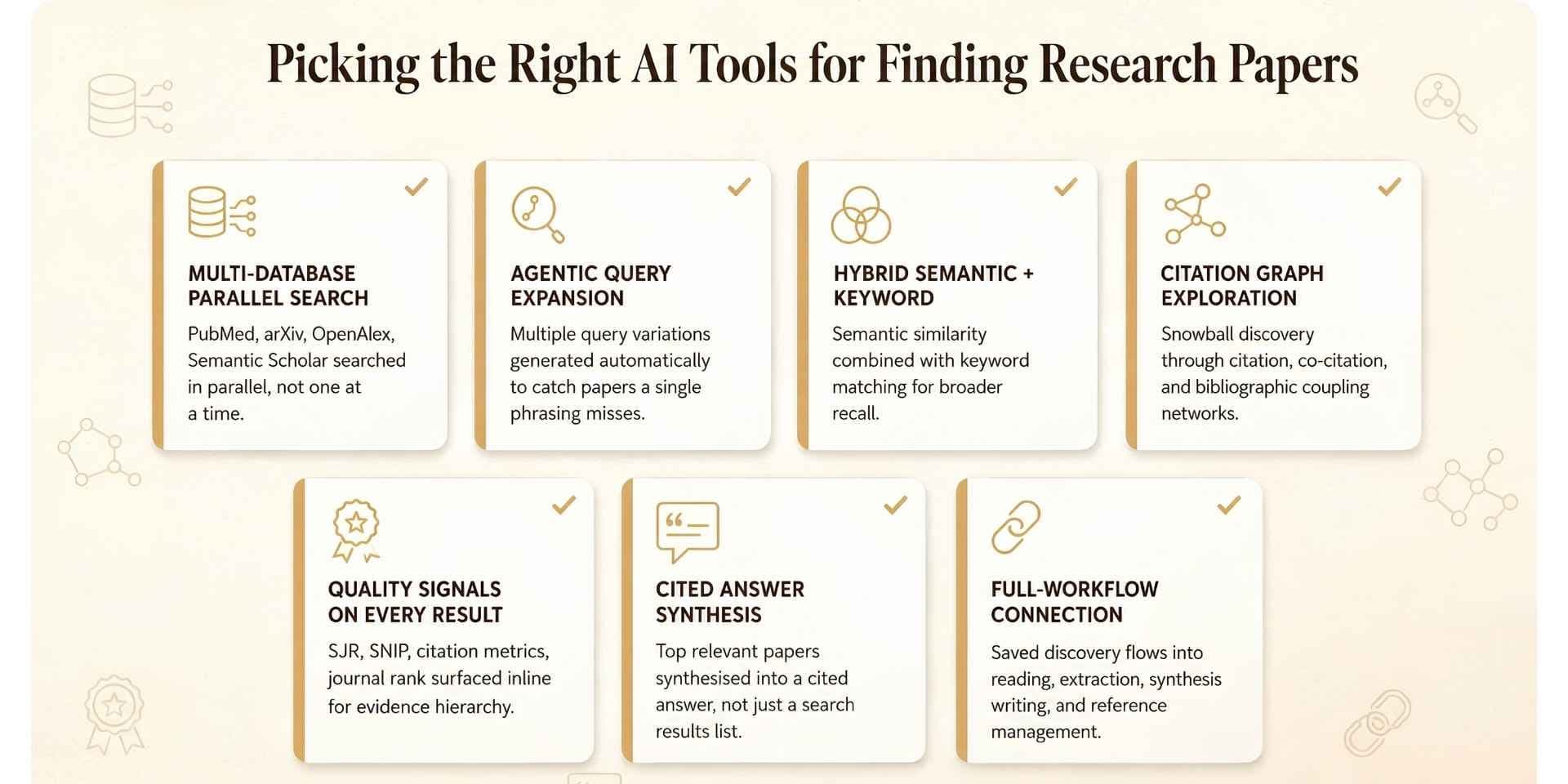
Before comparing the nine tools below, here are the criteria that separate multi-database AI search platforms from single-database keyword tools, particularly for scientific research workflows where literature coverage and citation quality matter for evidence-based research.
- Multi-database parallel search: Does the tool search PubMed, arXiv, OpenAlex, and Semantic Scholar in parallel, or only one database at a time with manual switching?
- Agentic query expansion: Does the platform generate multiple query variations automatically to catch papers that a single query phrasing misses?
- Hybrid semantic and keyword retrieval: Does the search combine semantic similarity with keyword matching for broader recall, or rely on keyword matching alone?
- Citation graph exploration: Does the tool support snowball discovery from seed papers through citation, co-citation, and bibliographic coupling networks?
- Quality signals on every result: Are SJR, SNIP, citation metrics, and journal rank surfaced inline so the included paper set meets evidence quality standards?
- Cited answer synthesis: Does the platform synthesise the top relevant papers into a cited answer, or only return a list of search results to read manually?
- Connection to the full research workflow: Does saved discovery flow into reading, extraction, synthesis writing, and reference management, or stop at the search results page?
Quick Comparison: Top AI Tools for Finding Research Papers in 2026
| Tool | Best For | Paper Corpus | Search Type | Paid Entry |
|---|---|---|---|---|
| Paperguide AI Search | Multi-database agentic search for scientific research workflows | 200M+ across 4 databases | Hybrid semantic + agentic | $12/mo Plus (annual) |
| Semantic Scholar | Free academic search index across all disciplines | 200M+ | Semantic | Free |
| Consensus | AI evidence-meter search engine for clinical and research questions | 200M+ academic | Semantic evidence-meter | $12/mo Pro (annual) |
| Research Rabbit | Visual citation graph snowball discovery | 100M+ | Graph | Free |
| Connected Papers | Co-citation network mapping for unfamiliar fields | Semantic Scholar corpus | Co-citation | $6/mo Academic (annual) |
| Litmaps | Tracking new papers citing seed papers | 270M+ | Citation alerts | $10/mo Pro (annual) |
| R Discovery | Personalised research paper discovery feed with audio papers | 250M+ | Personalised feed | From $11.99/mo Prime |
| Google Scholar | Largest general academic search engine | Massive cross-disciplinary | Keyword | Free |
| Inciteful | Free citation graph tool with multiple network types | Open corpus | Citation graph | Free |
Best AI Tools for Finding Research Papers
1. Paperguide AI Search
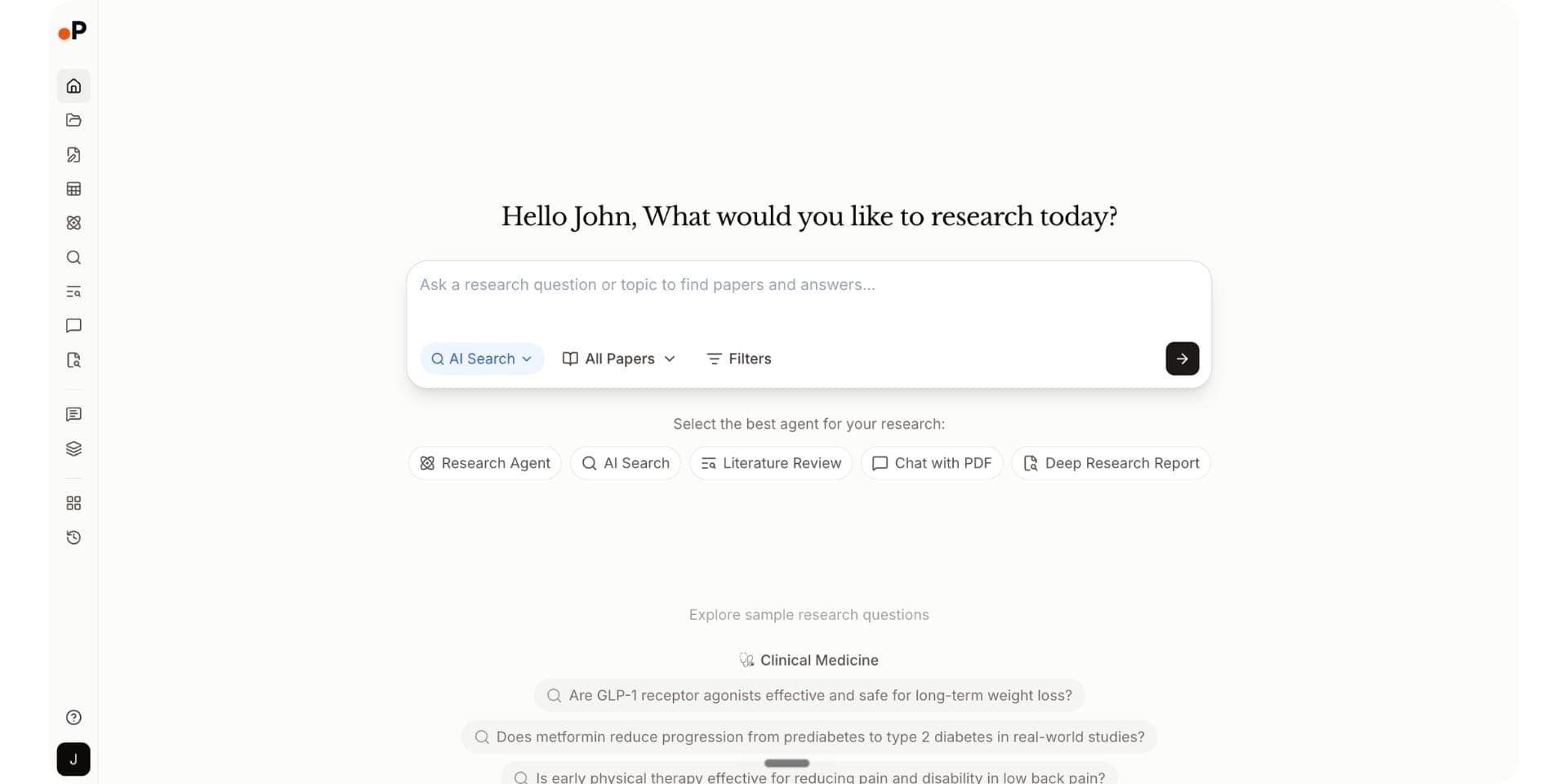
Paperguide AI Search is the multi-database AI search engine inside Paperguide, the AI-native platform for scientific research workflows and systematic reviews, and the strongest AI tool for finding research papers in 2026. The search uses hybrid semantic and keyword retrieval with an agentic layer that generates multiple query variations from a natural-language research question and runs them in parallel across PubMed, arXiv, OpenAlex, and Semantic Scholar (200M+ peer-reviewed papers in one search). Results are synthesised from the top 20 most relevant papers into a cited evidence-backed answer with SJR, SNIP, and citation quality signals on every paper surfaced. For researchers running literature discovery for scientific research workflows where multi-database coverage and evidence quality both matter, the agentic multi-database architecture is what separates Paperguide AI Search from single-database keyword tools.
The connected workspace makes finding research papers continuous from discovery to synthesis. A paper surfaced through AI Search lands in the AI Reference Manager automatically with metadata fetched, open-access PDF retrieved, and citation-style formatting ready in 1,000+ styles. The same paper is immediately citable in the AI Paper Writer, extractable into custom-column evidence tables through Extract Data, and queryable through Chat with PDF for passage-level interrogation. The Research Agent runs end-to-end research questions in a single connected session where AI Search is the entry point. Literature Review AI handles structured five-step Plan/Search/Screen/Extract/Synthesize workflows with the same multi-database backbone, handling up to 50 papers in Standard mode and screening up to 200 in Extended mode.
Key Features
- AI Search: Hybrid semantic and keyword search across 200M+ peer-reviewed papers from PubMed, arXiv, OpenAlex, and Semantic Scholar. Ask research questions in natural language and receive cited, evidence-backed answers synthesised from the top 20 most relevant papers, with quality signals (SJR, SNIP, citation metrics) on every result. The same search also works inside Claude or ChatGPT through Paperguide MCP.
- Research Agent: Paperguide's most complete workflow runs the full research process end-to-end in a single connected session, from discovery and screening to extraction, drafting, and citation handling, all on one paper library. Built for deep research questions where multi-database discovery is the entry point.
- Literature Review AI: A dedicated, structured agent for formal literature reviews through a five-step Plan, Search, Screen, Extract, Synthesize workflow with the same multi-database AI Search backbone. Standard mode handles up to 50 papers; Extended mode screens up to 200.
- Deep Research Report: Follows the same structured pipeline as Literature Review AI with full researcher control at every stage. Researchers set the research questions, review retrieved papers, adjust screening decisions, and confirm extraction fields.
- AI Reference Manager: Every saved paper from AI Search is immediately usable by every other workflow on the platform. 1,000+ citation styles, Zotero/BibTeX/RIS/DOI/PDF import, Chrome extension, automatic metadata and open-access PDF fetching, built-in PDF viewer with highlights and annotations.
- AI Paper Writer: Drafts research papers, literature reviews, methodology sections, and grant-grade prose with references pulled from the AI Search library. Every citation links to a real paper. 1,000+ citation styles supported.
- Extract Data: Pull structured information from multiple research papers surfaced through AI Search into custom-column evidence tables. Define columns (sample size, intervention, outcome, methodology, effect size) and Paperguide extracts those values across every paper, with each cell linked back to its source passage.
- Chat with PDF: Query any paper from the AI Search results conversationally. Ask methodology questions, request summaries, compare findings across multi-paper folders, with every answer pointing to the exact page and paragraph.
- Systematic Review: Run protocol-driven systematic reviews where searches across PubMed, arXiv, OpenAlex, and Semantic Scholar are pooled with your own library and deduplicated before structured screening, extraction, and citation-grounded synthesis writing.
- Follow-up Questions and Saved Results: Every AI Search answer comes with the ranked reference list behind it, follow-up questions keep the thread, and results save straight to the Reference Manager.
- Source Scope and Flexible Input: Narrow a search to PubMed, arXiv or your own Reference Manager library, and add optional filters to constrain what counts as a result. Start from a question, a topic, a paper title or a plain description to find related work anchored on a paper you trust. AI Search does not search the web, blogs or general internet content.
Pros
- The only AI search across all four major scientific databases (PubMed, arXiv, OpenAlex, Semantic Scholar) simultaneously in one workspace.
- Agentic query expansion runs multiple query variations in parallel and catches papers that a single query phrasing misses.
- Cited evidence-backed answers synthesised from the top 20 most relevant papers with traceable sources.
- SJR, SNIP, and citation quality signals on every result surface evidence hierarchy inline.
- Discovered papers flow directly into the full Paperguide research workflow (reading, extraction, synthesis writing, reference management).
Cons
- AI Search volume scales with plan tier; Free plan usage is capped by 2,000 AI credits per month.
Best For Researchers, postdocs, faculty researchers, lab teams, research groups, principal investigators, systematic review teams, evidence synthesis groups, and scientific research professionals running multi-database literature discovery for scientific research workflows where coverage across PubMed, arXiv, OpenAlex, and Semantic Scholar matters for the rigour of the included paper set.
Pricing
| Plan | Price | What It Covers |
|---|---|---|
| Free | $0 | 2,000 AI credits per month, Literature Review Report, Deep Research Report, Chat with PDF, reference manager with 1,000+ citation styles, extraction tables with 5 columns across 10 papers. |
| Plus | $12 per seat per month, billed annually ($144 a year) | 12,500 AI credits, systematic reviews up to 1,000 papers, unlimited AI searches and PDF chats, extraction tables with 50 custom columns across 100 papers, 5 AI Paper Writer documents per month, plagiarism checker. |
| Pro | $29 per seat per month, billed annually ($348 a year) | 50,000 AI credits, systematic reviews up to 5,000 papers, 20 AI Paper Writer documents per month, for high-volume literature discovery. |
| Evidence Teams | $89 per seat per month, billed annually ($1,068 a year) | 150,000 AI credits, PRISMA-grade dual reviewer screening on reviews of up to 5,000 papers, dedicated support. |
| Enterprise | Custom | Institutional licensing for universities, research labs, and corporate research teams, with systematic reviews up to 20,000 papers. Academics get 30% off with a valid university email, and yearly billing saves up to 41%. |
Verdict
Paperguide AI Search is the best AI tool for finding research papers in 2026 because it is the only AI search engine that runs agentic multi-database hybrid retrieval across PubMed, arXiv, OpenAlex, and Semantic Scholar simultaneously, returning cited evidence-backed answers with quality signals inline and flowing directly into the full scientific research workflow inside one connected workspace.
2. Semantic Scholar
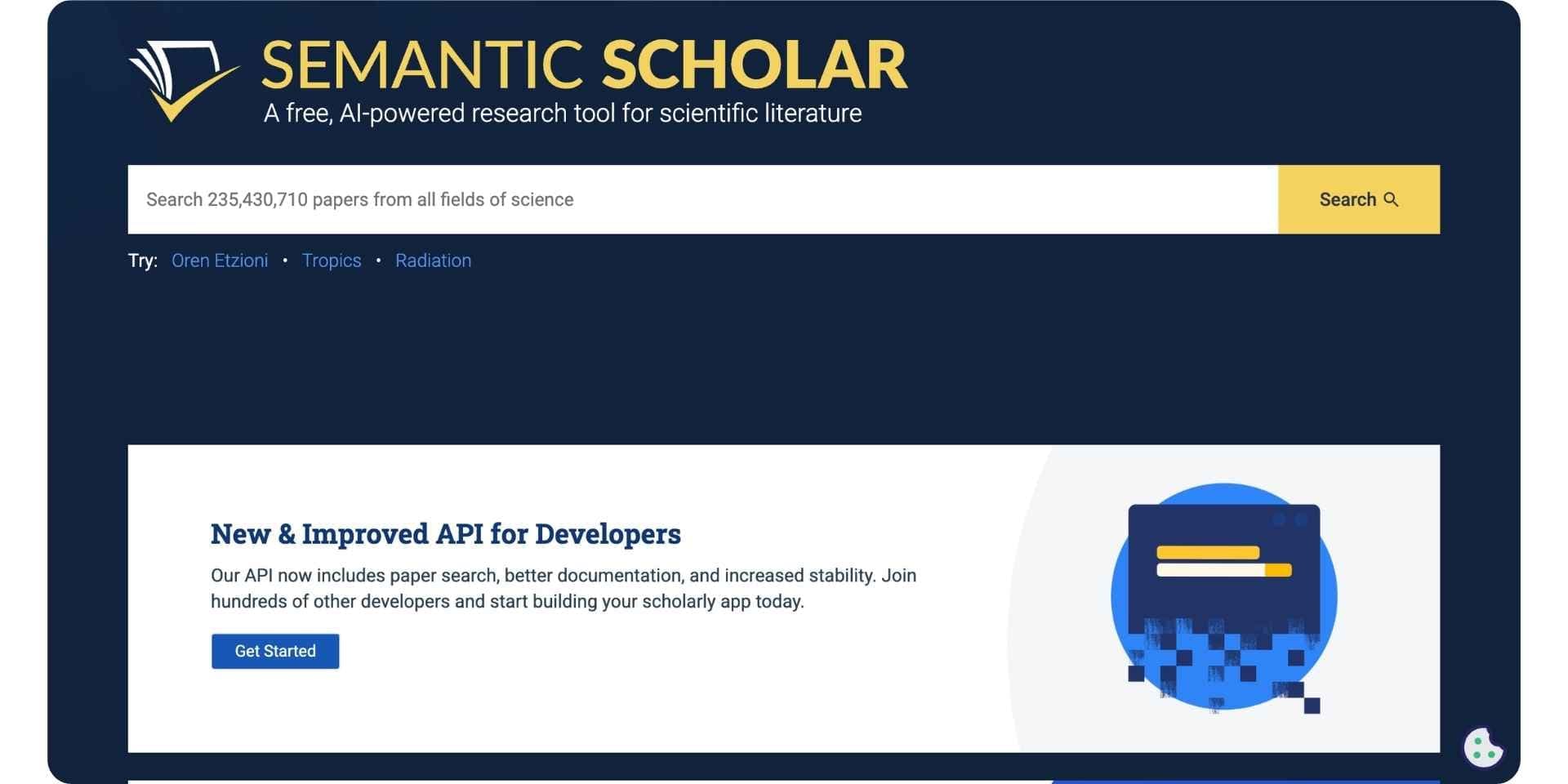
Semantic Scholar is the largest free academic search index globally, maintained by the Allen Institute for AI as a public-good research infrastructure project. The platform indexes 200M+ papers across most academic disciplines with semantic search, Influence Scores that distinguish seminal works from incremental contributions, auto-generated TLDR summaries on every paper, author profiles with h-index data, and a well-documented free API used across the academic research stack. For researchers needing a free unrestricted academic search index, Semantic Scholar is the default starting point.
What Semantic Scholar does well is breadth and openness. Where most academic search engines charge for premium features or restrict the API, Semantic Scholar offers a free 200M+ paper index, Influence Scores tuned to citation-weighted ranking, TLDR summaries on every paper for quick relevance assessment, and a free API that has become public research infrastructure. What Semantic Scholar does less well than Paperguide AI Search is multi-database coverage and connection to the full research workflow; the platform searches its own index in isolation rather than parallel to PubMed, arXiv, and OpenAlex, with no built-in workflow for reading, extraction, or synthesis writing on the discovered papers.
Key Features
- 200M+ paper index across most academic disciplines.
- Influence Score citation-weighted ranking that distinguishes seminal works.
- Auto-generated TLDR summaries on every paper.
- Free API used across the academic research stack.
- Author profiles with h-index data.
- Semantic search beyond keyword matching.
Pros
- Free with no paywall and no API restrictions.
- Strongest free academic search index globally with 200M+ papers.
- Influence Score separates seminal works from incremental contributions.
- Free API enables academic research workflows on top of the index.
Cons
- Discovery only with no analysis, extraction, or writing layer.
- Utilitarian interface with no quality filters beyond Influence Score.
- Searches its own index rather than parallel to PubMed, arXiv, OpenAlex.
Best For Researchers needing a free unrestricted academic search index across all disciplines with Influence Scores and TLDR summaries for quick relevance assessment.
Pricing
| Plan | Price | What It Covers |
|---|---|---|
| Free | $0 | Full access to 200M+ paper index, Influence Scores, TLDR summaries, free API. |
Verdict
Semantic Scholar is the strongest free academic search index in 2026. Paperguide AI Search is the best Semantic Scholar companion in 2026 for researchers who want multi-database parallel search across PubMed, arXiv, OpenAlex, and Semantic Scholar with agentic query expansion and connection to the full scientific research workflow.
3. Consensus
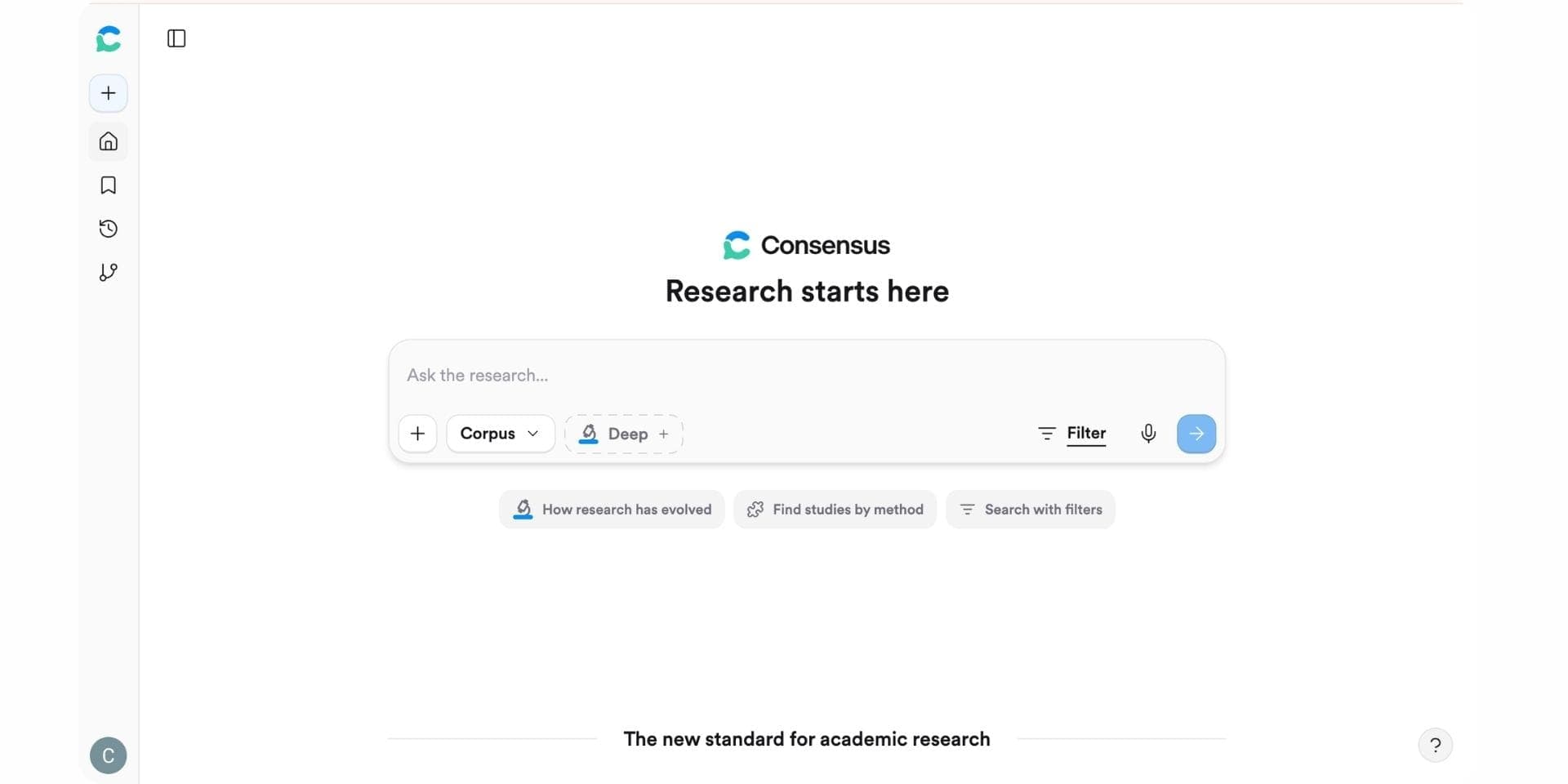
Consensus is the AI evidence-meter search engine built around fast research questions across 200M+ academic papers, with the signature Consensus Meter that delivers a directional verdict in seconds on yes/no research questions. Pro Search filters cover methodology, Q1-Q4 journal rank, citation count, and open access, with Citation Graph for visual paper discovery in unfamiliar fields and Deep Search for multi-source narrative synthesis. For researchers needing fast directional evidence answers grounded in peer-reviewed literature, Consensus is the fastest first-pass discovery tool in the AI search engine category. Academic and clinician discounts are available across paid tiers.
What Consensus does well is fast directional evidence verdicts on yes/no research questions. Where most paper discovery tools require running a full literature search and reading results, Consensus returns the Consensus Meter directional verdict in seconds across 200M+ academic papers, with methodology controls and journal rank filters tuned to evidence quality. What Consensus does less well than Paperguide AI Search is multi-database parallel coverage and connection to the full research workflow; the platform searches its own index in isolation rather than parallel to PubMed, arXiv, and OpenAlex, with no native AI Writer, reference manager, or structured data extraction for downstream synthesis work.
Key Features
- Consensus Meter on yes/no research questions showing supporting, contradicting, or split evidence direction.
- 200M+ academic paper index across most disciplines.
- Pro Search filters for methodology, Q1-Q4 journal rank, citation count, open access.
- Citation Graph for visual paper discovery in unfamiliar fields.
- Deep Search for multi-source narrative synthesis.
- Academic and clinician discounts available across paid tiers.
Pros
- Fastest evidence-meter answers in the AI search engine category for yes/no research questions.
- 200M+ academic paper index with citation-backed synthesis.
- Strong methodology and Q1-Q4 journal rank filters.
- Pro plan at $12/mo effective on annual billing with academic and clinician discounts up to 40%.
Cons
- Designed for evidence-meter questions, not full multi-database parallel discovery.
- Consensus meter does not weight study design, sample size, or risk of bias.
- No native AI Writer or reference manager for downstream synthesis work.
- Searches own index in isolation rather than parallel to PubMed, arXiv, OpenAlex.
Best For Researchers, clinicians, and evidence-based research teams needing fast directional evidence answers grounded in peer-reviewed literature for triage during early-stage discovery and yes/no research question evaluation.
Pricing
| Plan | Price (Monthly / Annual) | What It Covers |
|---|---|---|
| Free | $0 | 15 Pro messages and 3 Deep reviews per month. |
| Pro | $20/mo monthly or $144/yr annual | Unlimited Pro messages, 15 Deep reviews per month. |
| Deep | $65/mo monthly or $540/yr annual | Higher Deep review volume (up to 200 per month). |
| Team | Custom | Team plans for research groups. |
| Enterprise | Custom | Institutional licensing. |
Verdict
Consensus is the strongest fast evidence-meter search engine for yes/no research questions in 2026. Paperguide AI Search is the best Consensus alternative in 2026 for researchers who want multi-database parallel discovery across PubMed, arXiv, OpenAlex, and Semantic Scholar with agentic query expansion and connection to the full scientific research workflow inside one workspace.
4. Research Rabbit
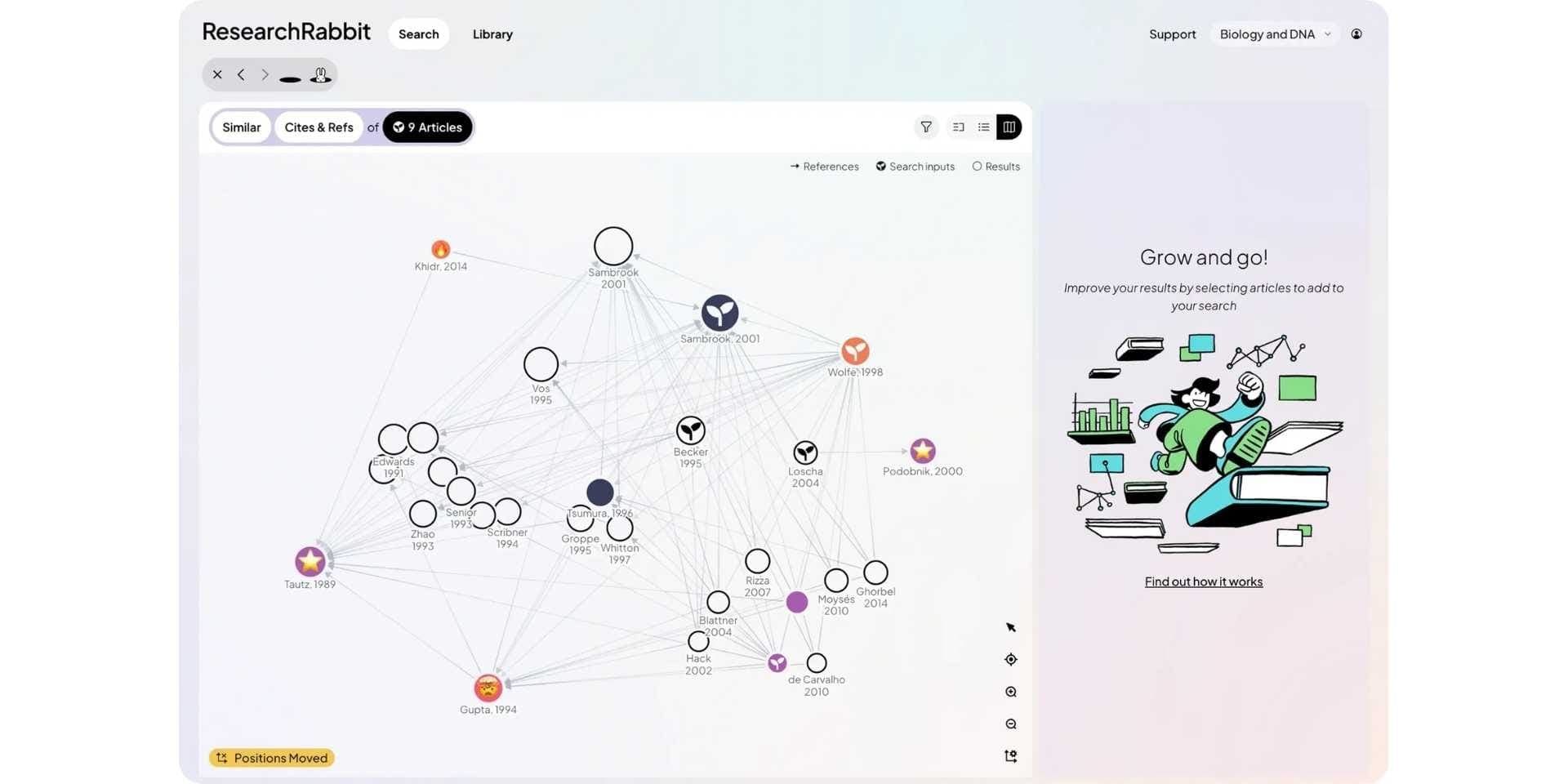
Research Rabbit is the cleanest free visual citation graph explorer in 2026, built around snowball discovery from seed papers. Start with a seed paper, see citation networks, expand the graph to surface related work that text search misses through Similar Work and Earlier Work suggestions. The platform supports Collections and shared workspaces, Zotero import and export, and email alerts for new citing papers, all on a free tier with no meaningful limits beyond email signup.
What Research Rabbit does well is snowball discovery through citation graphs. Where most academic search engines require text query construction, Research Rabbit lets researchers start from a known seed paper and expand outward through citation, co-citation, and similarity networks, surfacing thematically related work that text search misses. What Research Rabbit does less well than Paperguide AI Search is full-coverage discovery and workflow connection; the platform is discovery only with no analysis layer, extraction tables, or synthesis writing, and the visual citation graph approach takes adjustment for researchers used to text search.
Key Features
- Visual citation graph from seed papers.
- Similar Work and Earlier Work suggestions for snowball discovery.
- Collections and shared workspaces for team research.
- Zotero import and export integration.
- Email alerts for new papers citing seed papers.
- Free with no paid tiers.
Pros
- Excellent for snowball discovery from a known seed paper.
- Free with no meaningful limits beyond email signup.
- Zotero sync for downstream reference management.
- Email alerts for new citing papers keep researchers current.
Cons
- Discovery only with no analysis, extraction, or writing layer.
- Visual citation graph interface takes adjustment for keyword search users.
- No multi-database parallel search across PubMed, arXiv, OpenAlex.
Best For Researchers who think in citation networks and want to expand from seed papers visually through snowball discovery for literature reviews and scoping projects.
Pricing
| Plan | Price | What It Covers |
|---|---|---|
| Free | $0 | Full visual citation graph explorer, Collections, Zotero sync, email alerts, no paid tiers. |
Verdict
Research Rabbit is the cleanest free citation graph explorer in 2026. Paperguide AI Search is the best Research Rabbit alternative in 2026 for researchers who want multi-database agentic search alongside citation graph exploration plus the full scientific research workflow inside one connected workspace.
5. Connected Papers
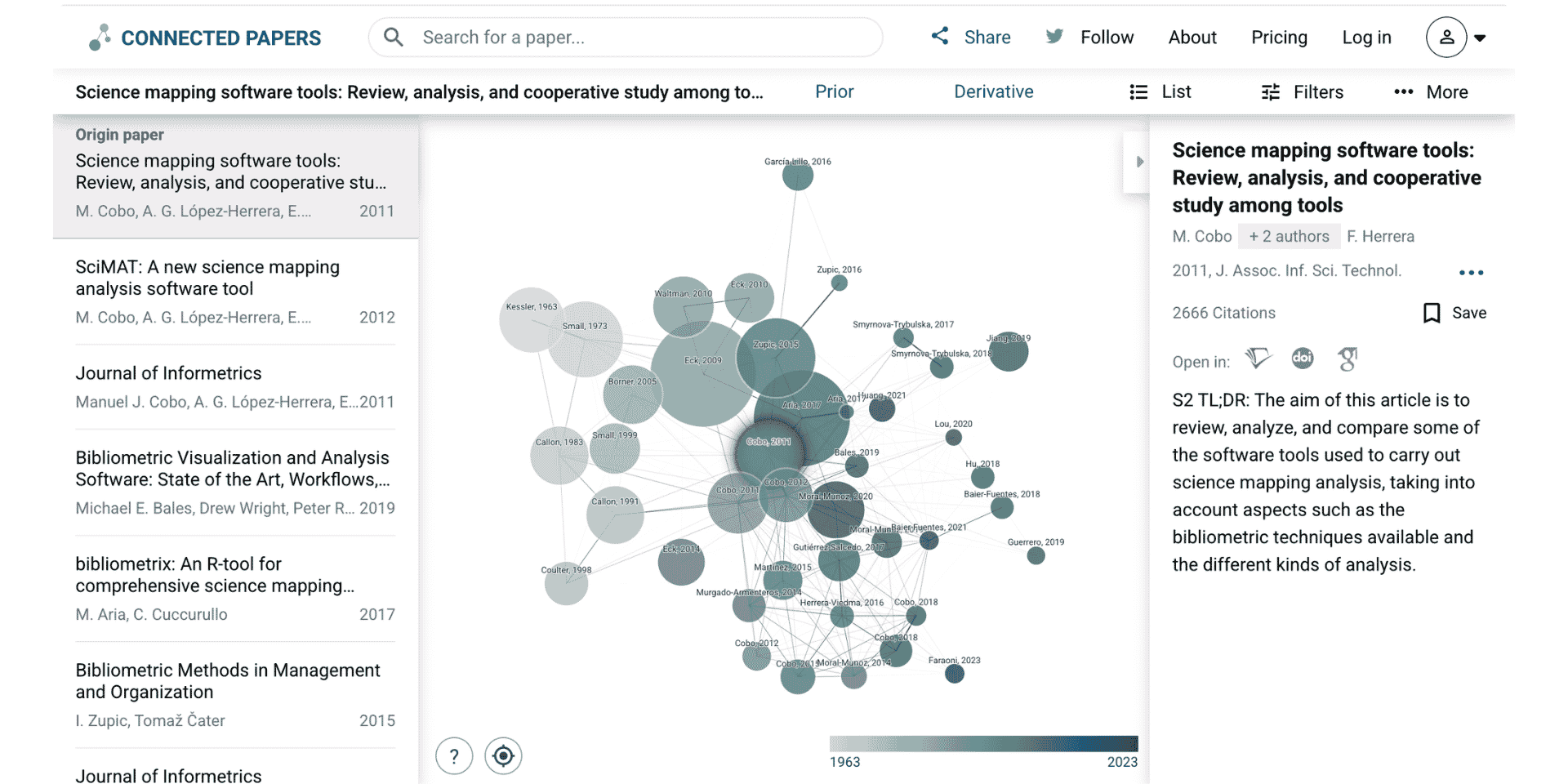
Connected Papers builds visual graphs from co-citation and bibliographic coupling, surfacing thematically related papers that text search misses through Prior Work and Derivative Work clusters. For researchers entering unfamiliar fields, Connected Papers is the strongest tool for mapping the literature structure in under 10 minutes, with multi-paper graph generation that combines multiple seed papers into a unified view and export options for downstream reference management. The Academic tier at $6/mo billed annually unlocks unlimited graphs beyond the free 5-per-month limit.
What Connected Papers does well is co-citation field mapping. Where most citation graph tools follow direct citations, Connected Papers uses co-citation and bibliographic coupling logic, surfacing papers that are thematically related even when they do not cite each other directly, a real advantage when mapping unfamiliar research fields fast. What Connected Papers does less well than Paperguide AI Search is multi-database parallel search and workflow connection; the platform is discovery and mapping only with no extraction, synthesis writing, or reference management beyond export, and the free tier caps at 5 graphs per month.
Key Features
- Co-citation and bibliographic coupling graphs.
- Prior Work and Derivative Work clusters for field mapping.
- Multi-paper graph generation across multiple seed papers.
- Export options for downstream reference management.
- Visual interface for unfamiliar field discovery.
Pros
- Best tool for mapping unfamiliar research fields in under 10 minutes.
- Co-citation logic surfaces thematically related papers that text search misses.
- Clean exportable graphs for sharing with collaborators.
- Academic tier at $6/mo billed annually is affordable.
Cons
- Free tier limited to 5 graphs per month.
- Discovery and mapping only with no analysis or writing layer.
- No multi-database parallel search beyond the co-citation network.
Best For Researchers entering unfamiliar research fields who need to map the literature structure fast through co-citation and bibliographic coupling networks.
Pricing
| Plan | Price (Monthly / Annual) | What It Covers |
|---|---|---|
| Free | $0 | 5 graphs per month. |
| Academic | $6/mo billed annually ($72/yr) | Unlimited graphs. Annual or quarterly billing only. |
| Business | $20/mo billed annually ($240/yr) | Higher-tier business features. |
Verdict
Connected Papers is the strongest tool for mapping unfamiliar research fields through co-citation networks in 2026. Paperguide AI Search is the best Connected Papers alternative in 2026 for researchers who want field mapping plus multi-database agentic search, structured extraction, and citation-grounded synthesis writing across the full research workflow.
6. Litmaps
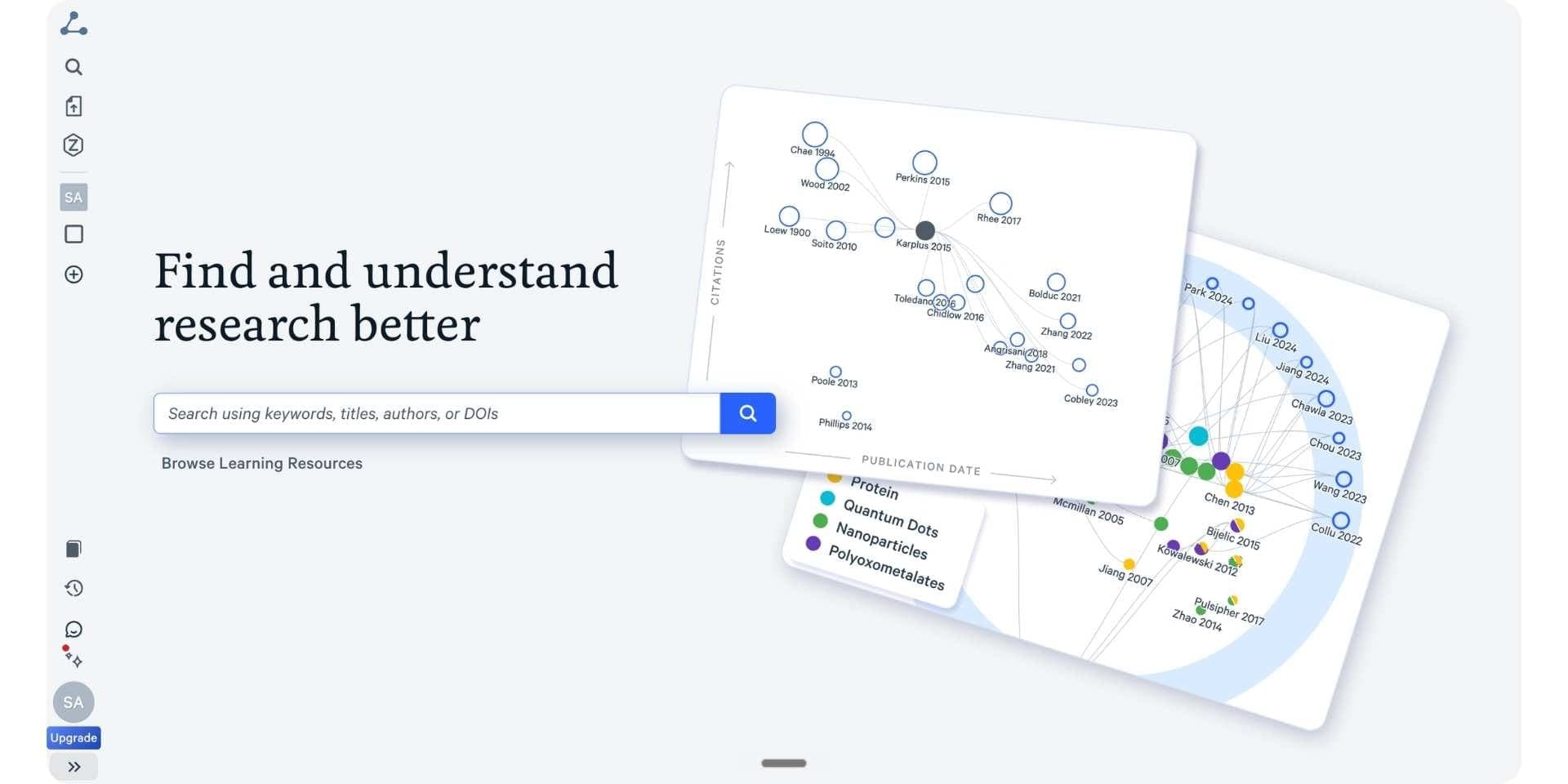
Litmaps is the dedicated tool for tracking new papers as they cite seed papers in a researcher's library, built around live citation alerts and citation network visualisation over time. The platform sets up live alerts for new citing papers on saved seed paper libraries, visualises citation networks over time across multi-database coverage, and syncs natively with Zotero for downstream reference management (Mendeley via BibTeX/RIS). For researchers who need to stay current on new papers citing their core literature, Litmaps is the dedicated tool in this category at $10/mo Pro billed annually.
What Litmaps does well is live citation tracking over time. Where most academic search engines treat search as a one-shot query, Litmaps tracks new papers citing your saved seed papers and pushes alerts as they appear in the literature, useful for ongoing literature surveillance across multi-week and multi-month projects. What Litmaps does less well than Paperguide AI Search is multi-database parallel discovery and workflow connection; the platform is tracking and discovery only with no extraction, synthesis writing, or reference management beyond Zotero/Mendeley sync, and the user base is smaller than Research Rabbit or Connected Papers.
Key Features
- Live citation alerts for seed papers.
- Citation network visualisation over time.
- Native Zotero sync; Mendeley via BibTeX/RIS import and export.
- Saved seed paper libraries with team sharing.
- Multi-database coverage across 270M+ papers from Semantic Scholar, OpenAlex, and Crossref.
Pros
- Strongest tool for citation tracking over time in 2026.
- Live alerts for new citing papers keep researchers current on seed paper trajectories.
- Reasonable academic pricing at $10/mo Pro billed annually.
- Native Zotero sync for downstream reference management (Mendeley via BibTeX/RIS).
Cons
- Discovery and tracking only with no analysis, extraction, or writing layer.
- Smaller user base than Research Rabbit or Connected Papers.
- No agentic query expansion or hybrid semantic retrieval.
Best For Researchers who need to stay current on new papers citing their seed papers or core literature across multi-week and multi-month research projects.
Pricing
| Plan | Price (Monthly / Annual) | What It Covers |
|---|---|---|
| Free | $0 | Basic search, up to 20 inputs, 1 to 2 maps, monthly alert summary. |
| Pro | $10/mo billed annually ($120/yr, academic email) | Full live citation alerts (daily or weekly), citation network visualisation, Zotero sync. Monthly billing costs more. |
| Team | Custom | Team plans for research groups. |
| Enterprise | Custom | Institutional licensing. |
Verdict
Litmaps is the strongest tool for tracking new papers citing seed papers in 2026. Paperguide AI Search is the best Litmaps companion in 2026 for researchers who want multi-database agentic discovery, structured extraction, and citation-grounded synthesis writing alongside ongoing citation tracking.
7. R Discovery
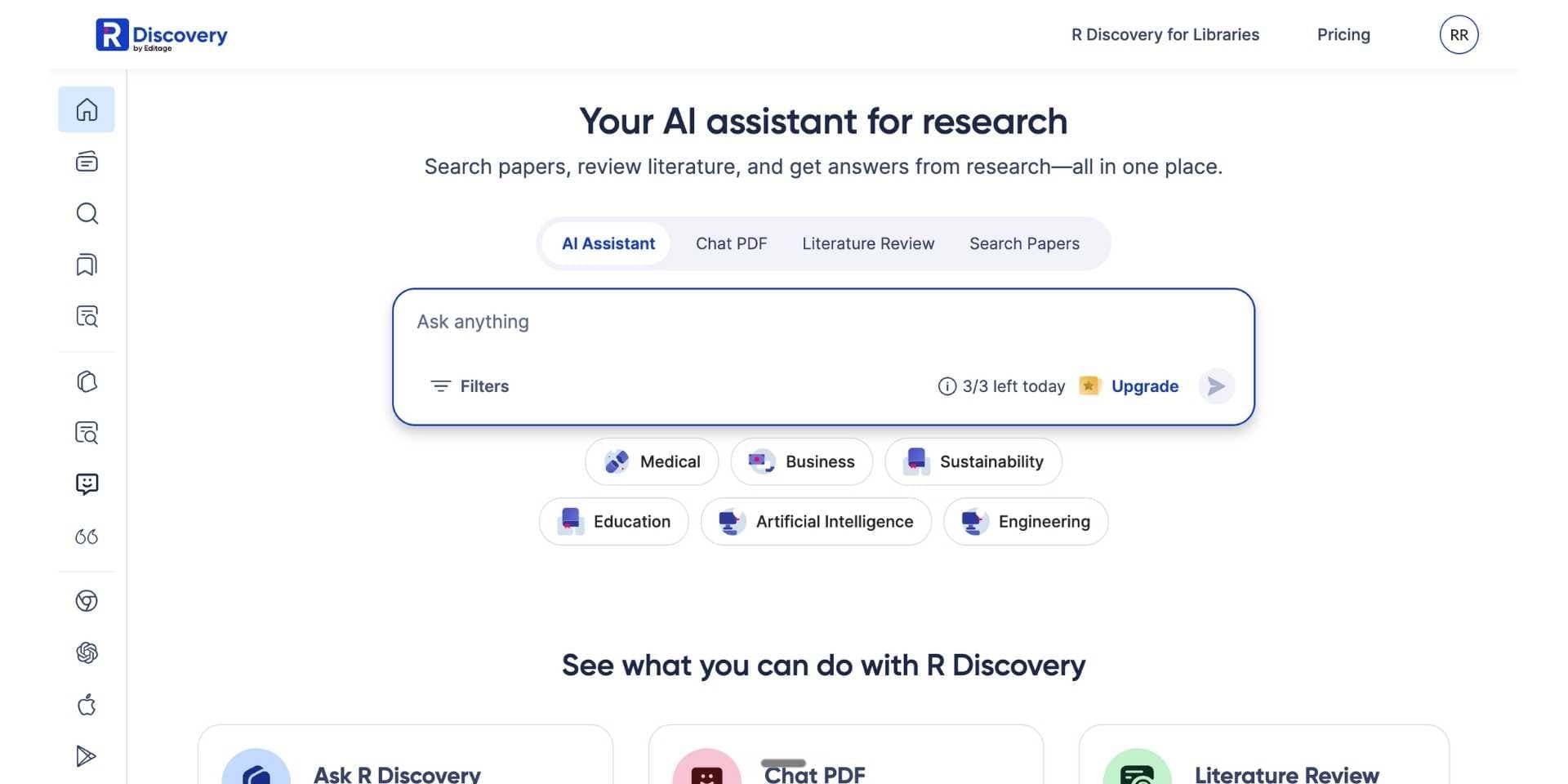
R Discovery is the personalised research paper discovery feed built by Researcher.Life (Cactus Communications), used by 3M+ academic users globally for algorithmic paper discovery across 250M+ research papers. The platform delivers a personalised feed of relevant papers based on the researcher's field, saved papers, and reading history, with mobile-first iOS and Android apps, audio papers for listening on the go, AI-generated summaries on every paper, and integration into the broader Researcher.Life ecosystem alongside Paperpal for AI writing. For researchers who want algorithmic discovery feeds rather than active search, R Discovery is the dedicated tool in this category.
What R Discovery does well is personalised algorithmic discovery and mobile-first paper access. Where most paper-finding tools require query construction, R Discovery surfaces relevant papers automatically based on the researcher's interests and reading history, with audio papers for commute reading and mobile apps that make discovery continuous across devices. What R Discovery does less well than Paperguide AI Search is multi-database parallel search and connection to the full research workflow; the platform is discovery and feed only with no AI Writer for synthesis, no structured data extraction for evidence tables, and no native reference manager beyond saved papers.
Key Features
- Personalised research paper discovery feed based on field, saved papers, and reading history.
- 250M+ research paper coverage across academic disciplines.
- Mobile-first iOS and Android apps with offline reading.
- Audio papers for listening on the go.
- AI-generated summaries on every paper.
- 3M+ academic user base.
- Integration with Researcher.Life ecosystem and Paperpal AI writing.
Pros
- Strongest personalised discovery feed for algorithmic paper surfacing.
- Mobile-first apps make discovery continuous across iOS and Android.
- Audio papers enable listening during commutes and walks.
- 3M+ academic user base with mature personalisation algorithms.
Cons
- Discovery feed only with no multi-database parallel search or agentic query expansion.
- Prime pricing varies by platform and region, and the strongest features sit behind the paid tier.
- No native AI Writer or structured data extraction for downstream synthesis.
- No SJR, SNIP, or citation quality signals on every paper.
Best For Researchers who want personalised algorithmic discovery feeds, mobile-first paper access, and audio paper listening rather than active query-based search.
Pricing
| Plan | Price (Monthly / Annual) | What It Covers |
|---|---|---|
| Free | $0 | Basic personalised discovery feed, limited summaries and audio papers. |
| Prime | From $11.99/mo (app stores; varies by platform and region) | Unlimited summaries, audio papers, Ask R Discovery, Chat with PDF, Zotero/Mendeley sync. |
| Editage Plus bundle | From $139/yr (promo) | R Discovery Prime plus Paperpal AI writing in the rebranded Researcher.Life bundle. |
Verdict
R Discovery is the strongest personalised research paper discovery feed in 2026 for researchers who prefer algorithmic surfacing over active search. Paperguide AI Search is the best R Discovery alternative in 2026 for researchers who want multi-database parallel discovery across PubMed, arXiv, OpenAlex, and Semantic Scholar with agentic query expansion, structured extraction, and citation-grounded synthesis writing inside one connected workspace.
8. Google Scholar
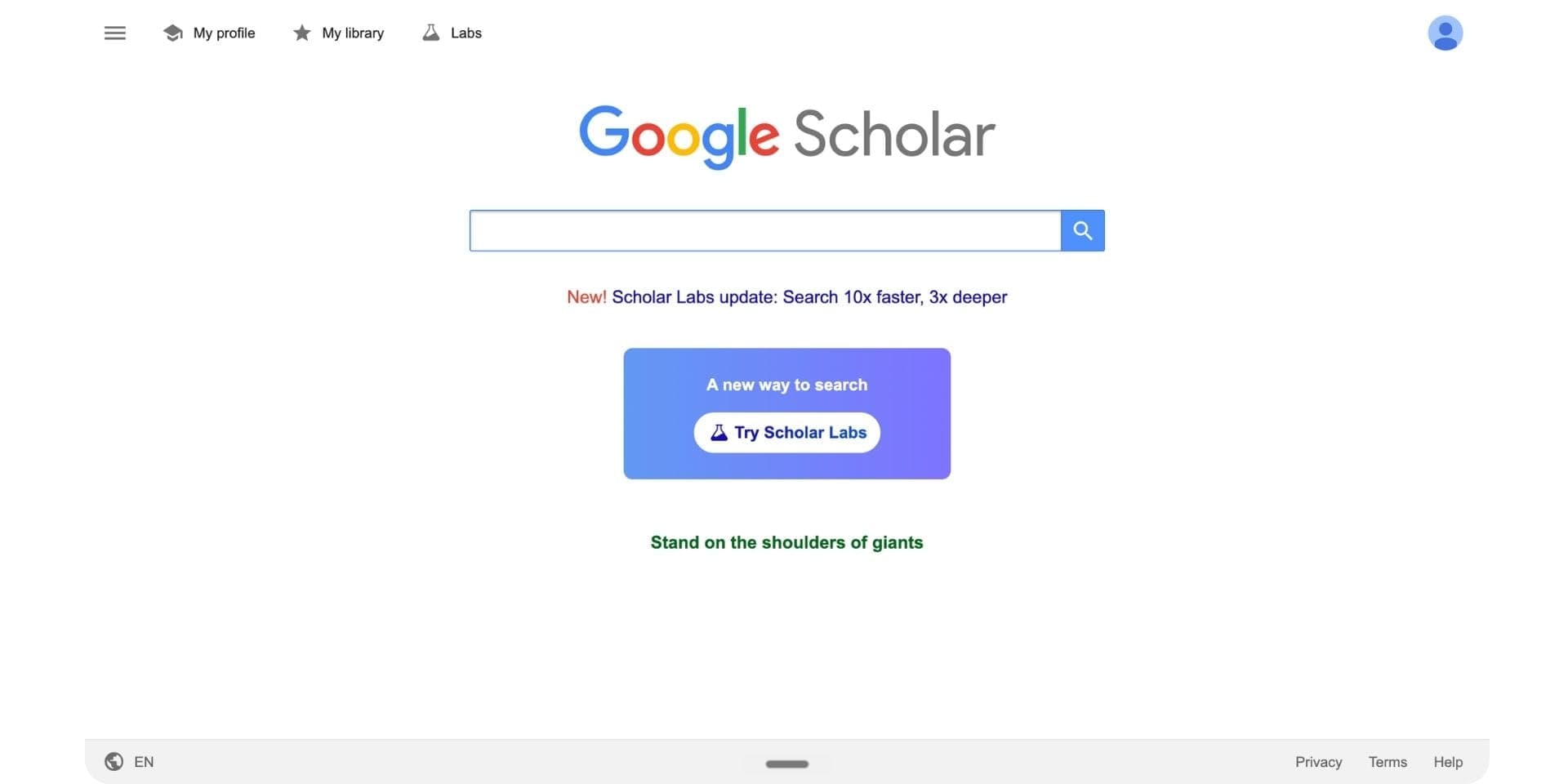
Google Scholar remains the largest general academic search engine in 2026, indexing massive cross-disciplinary content including journal articles, preprints, theses, books, conference papers, and grey literature. While the search algorithm is opaque and quality control is weaker than dedicated scientific databases like PubMed or Semantic Scholar, Google Scholar's coverage is unmatched for cross-disciplinary discovery, particularly across humanities, social sciences, and policy research where dedicated scientific databases under-index. The free Cite button, My Library feature, and Google Scholar Profile for researcher visibility round out the platform.
What Google Scholar does well is breadth of coverage. Where most academic search engines focus on peer-reviewed scientific journals, Google Scholar indexes journal articles, preprints, theses, books, conference papers, grey literature, and policy documents, making it the broadest general academic search engine for cross-disciplinary discovery. What Google Scholar does less well than Paperguide AI Search is quality control, ranking transparency, and workflow integration; the search algorithm is opaque, citation counts are often inflated compared to PubMed or Web of Science, there are no structured filters by methodology or quality, and the platform stops at the search results page with no AI-native workflow for reading, extraction, or synthesis writing.
Key Features
- Largest general academic search index across cross-disciplinary content.
- Citation counts (often inflated vs PubMed or Web of Science).
- Cite button for quick citation export.
- My Library for saved papers.
- Google Scholar Profile for researcher visibility.
Pros
- Largest coverage including non-journal content (theses, books, preprints, grey literature).
- Free with no restrictions.
- Cite button is convenient for quick citation export.
- Strong cross-disciplinary coverage in humanities, social sciences, policy research.
Cons
- Opaque ranking algorithm with no transparency on result ordering.
- Quality control weaker than PubMed, Semantic Scholar, or OpenAlex.
- No structured filtering by methodology, study design, or quality.
- No multi-database parallel search or agentic query expansion.
Best For Researchers needing the broadest cross-disciplinary search across all academic content types (papers, theses, books, preprints, grey literature) particularly in humanities, social sciences, and policy research.
Pricing
| Plan | Price | What It Covers |
|---|---|---|
| Free | $0 | Full search index, citation counts, Cite button, My Library, Google Scholar Profile. |
Verdict
Google Scholar is the largest general academic search engine in 2026. Paperguide AI Search is the best Google Scholar alternative in 2026 for researchers who want AI-native multi-database discovery with quality filters, agentic query expansion, and connection to the full scientific research workflow.
9. Inciteful
Inciteful is the free citation graph tool that builds networks from seed papers using citation, co-citation, and bibliographic coupling across an open corpus, with the unique Literature Connector feature for spanning two papers and identifying the literature bridge between them. The platform is similar to Connected Papers and Research Rabbit in concept but with a different visualisation approach, multiple network type options, and a completely free model with no paid tiers.
What Inciteful does well is free multi-network citation graph access. Where Connected Papers caps free graphs at 5 per month and Research Rabbit focuses on Similar Work suggestions, Inciteful offers citation, co-citation, and bibliographic coupling networks with no usage caps, plus the unique Literature Connector for identifying the literature bridge between two specific papers. What Inciteful does less well than Paperguide AI Search is multi-database parallel discovery and workflow integration; the platform is discovery only with a smaller user base than Research Rabbit or Connected Papers, no analysis layer, and no connection to extraction or synthesis writing.
Key Features
- Free citation graph generation with no usage caps.
- Multiple network types (citation, co-citation, bibliographic coupling).
- Paper Discovery interface for seed-paper expansion.
- Literature Connector for spanning two specific papers.
- Open corpus across academic disciplines.
Pros
- Completely free with no usage caps.
- Multiple network types in one tool (citation, co-citation, bibliographic coupling).
- Literature Connector is unique for spanning two papers.
- Open corpus across disciplines.
Cons
- Smaller user base than Research Rabbit or Connected Papers.
- Discovery only with no analysis or writing layer.
- No multi-database parallel search beyond the citation graph network.
Best For Researchers wanting a free citation graph tool with multiple network types and the Literature Connector for identifying literature bridges between two specific papers.
Pricing
| Plan | Price | What It Covers |
|---|---|---|
| Free | $0 | Full citation graph access with multiple network types, Paper Discovery, Literature Connector. |
Verdict
Inciteful is the strongest free citation graph tool with multiple network types in 2026. Paperguide AI Search is the best Inciteful companion in 2026 for researchers who want multi-database agentic search, structured extraction, and citation-grounded synthesis writing on top of citation graph discovery.
How the Paperguide AI Search Workflow Works?
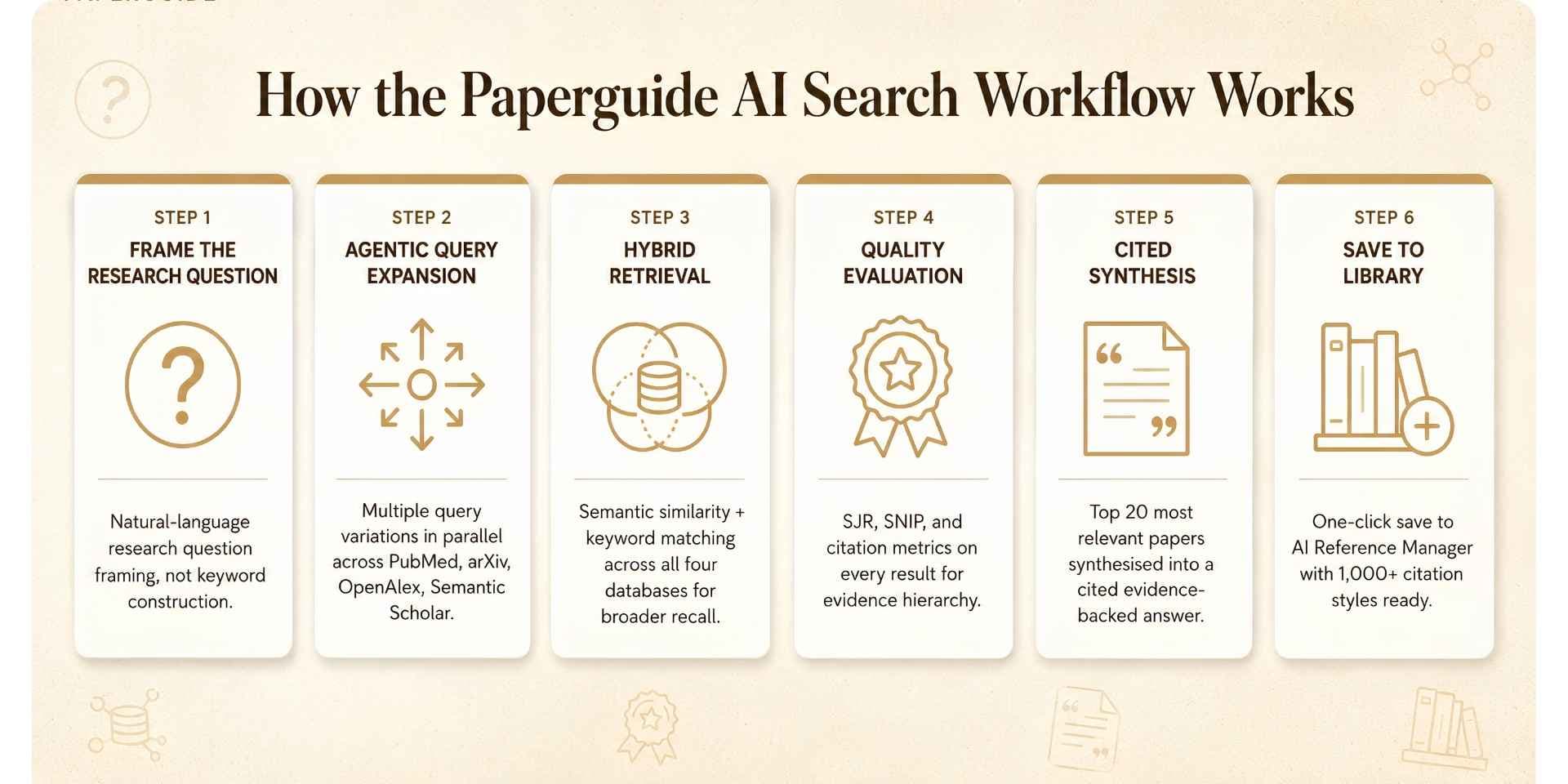
The Paperguide AI Search runs research paper discovery as a continuous scientific research workflow across six discrete stages. The same workflow pattern that makes evidence synthesis, literature review, and systematic review work end-to-end inside one workspace applies to research paper discovery as the entry point across the platform.
Step 1: Frame the research question
Natural-language research question framing rather than keyword construction. The Research Agent helps researchers refine the question scope, target outcomes, and intended depth before search begins.
Step 2: Agentic query expansion
AI Search generates multiple query variations from the research question and runs them in parallel across PubMed, arXiv, OpenAlex, and Semantic Scholar simultaneously. The agentic expansion catches papers that a single query phrasing misses.
Step 3: Hybrid semantic and keyword retrieval
Each query variation runs both semantic similarity matching and keyword matching across the four databases for broader recall, combining the strengths of semantic and lexical search.
Step 4: Quality evaluation with evidence hierarchy signals
SJR, SNIP, and citation metrics are surfaced inline on every result so the included paper set meets evidence quality standards. Quality signals support the research methodology screening stage downstream.
Step 5: Cited synthesis from top relevant papers
Top 20 most relevant papers are synthesised into a cited evidence-backed answer, with every claim linked to a source paper. The synthesis flows into Literature Review AI for formal review workflows or directly into the AI Paper Writer.
Step 6: Save to library and continue the workflow
One-click save to the AI Reference Manager with metadata fetched, open-access PDF retrieved, and citation-style formatting ready in 1,000+ styles. Saved papers flow into reference management, extraction, reading, and synthesis writing across the broader cluster.
Best AI Tools for Finding Research Papers by Use Case
| Use Case | Recommended Tool | Why |
|---|---|---|
| Best AI tools for finding research papers overall | Paperguide AI Search | Multi-database agentic search across PubMed, arXiv, OpenAlex, Semantic Scholar with cited synthesis. |
| Best AI for scientific research workflows | Paperguide AI Search | Built for research labs and PI workflows with quality signals on every result. |
| Best free AI tools for finding research papers | Semantic Scholar | 200M+ free index with Influence Scores and TLDR summaries. |
| Best AI evidence-meter search engine for yes/no research questions | Consensus | Consensus Meter delivers directional verdicts on yes/no questions in seconds. |
| Best AI for snowball citation graph discovery | Research Rabbit | Cleanest free visual citation graph explorer with Similar Work suggestions. |
| Best AI for mapping unfamiliar research fields | Connected Papers | Co-citation and bibliographic coupling networks for field structure. |
| Best AI for tracking new papers citing seeds | Litmaps | Live citation alerts on saved seed paper libraries. |
| Best AI for personalised research paper discovery feed | R Discovery | Algorithmic feed across 250M+ papers with audio papers and mobile-first apps. |
| Best free citation graph tool with multiple network types | Inciteful | Citation, co-citation, bibliographic coupling networks plus Literature Connector. |
| Best AI for multi-database simultaneous search | Paperguide AI Search | Only AI tool that runs PubMed, arXiv, OpenAlex, Semantic Scholar in parallel. |
| Best AI for cited synthesis from top relevant papers | Paperguide AI Search | Top 20 most relevant papers synthesised into cited evidence-backed answers. |
| Best AI reference manager for saved papers | Paperguide AI Reference Manager | 1,000+ citation styles, Zotero import, Chrome extension, automatic metadata fetching. |
| Best free AI tools for finding research papers stack | Paperguide Free + Semantic Scholar + Research Rabbit + Inciteful | Free AI-native multi-database discovery plus citation graph snowballing and field mapping. |
Best AI Tools for Finding Research Papers: Final Comparison
| Feature | Paperguide AI Search | Semantic Scholar | Consensus | Research Rabbit | Connected Papers | Litmaps | R Discovery | Google Scholar | Inciteful |
|---|---|---|---|---|---|---|---|---|---|
| Paper corpus | 200M+ across 4 DBs | 200M+ | 200M+ academic | 100M+ | Semantic Scholar corpus | 270M+ | 250M+ | Largest cross-disciplinary | Open corpus |
| Multi-database parallel search | Yes (PubMed/arXiv/OpenAlex/Semantic Scholar) | No | No (single index) | No | No | Multi-DB coverage | No | No | No |
| Agentic query expansion | Yes (strongest) | No | No | No | No | No | No | No | No |
| Semantic search | Yes | Yes | Yes (evidence-meter) | Partial (similarity) | No | Partial | Personalised feed | Limited | No |
| Citation graph | Integrated | Citations only | Citation Graph | Yes (strongest) | Yes (co-citation) | Yes (over time) | No | No | Yes |
| Quality filters (SJR / SNIP) | Yes | Influence Score | Q1-Q4 journal rank | No | No | No | No | No | No |
| Cited answer synthesis | Yes (top 20 papers) | No | Yes (Consensus Meter) | No | No | No | AI summaries | No | No |
| AI Reference Manager | Full-fledged | No | No | Collections | No | Sync | Saved papers | My Library | No |
| Personalised feed | Via Research Agent | No | No | No | No | No | Yes (strongest) | No | No |
| Audio papers | No | No | No | No | No | No | Yes | No | No |
| Free plan | Yes (2,000 AI credits/mo) | Yes | Yes (15+3) | Yes | Yes (5 graphs/mo) | Yes (limited) | Yes | Yes | Yes |
| Starting paid | $12/mo annual | Free | $12/mo Pro (annual) | Free | $6/mo Academic (annual) | $10/mo Pro (annual) | From $11.99/mo Prime | Free | Free |
Common Mistakes When Using AI Tools for Finding Research Papers in 2026
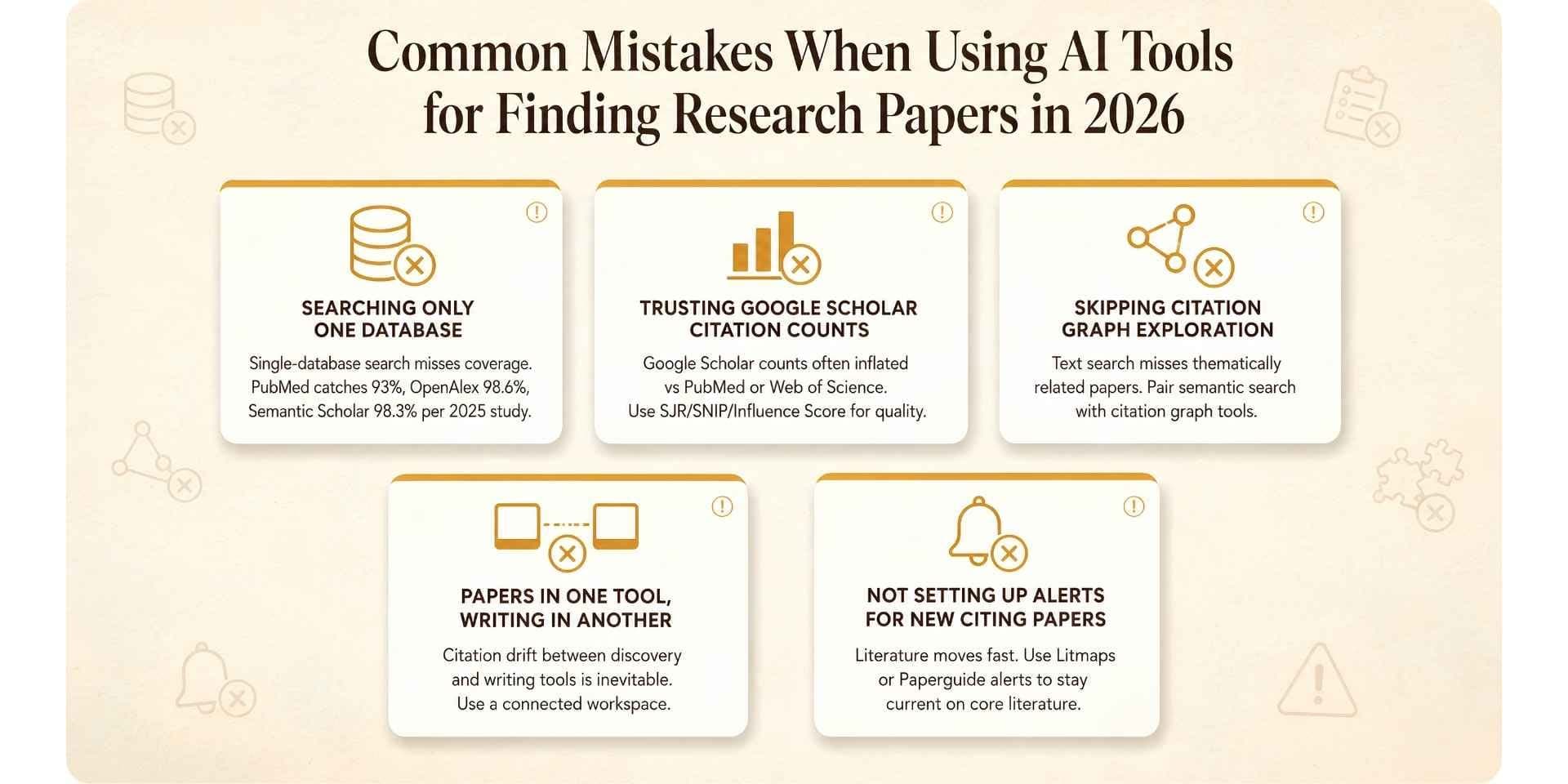
- Searching only one database: Single-database search misses substantial coverage as the 2025 ScienceDirect study documented across PubMed, Embase, OpenAlex, and Semantic Scholar. Multi-database parallel search is the architecture fix for coverage gaps that single databases produce in isolation.
- Trusting Google Scholar citation counts as quality signal: Google Scholar citation counts are often inflated compared to PubMed or Web of Science due to broader source inclusion. Use SJR, SNIP, or Influence Score signals from dedicated scientific platforms for evidence hierarchy decisions.
- Skipping citation graph exploration: Text search alone misses thematically related papers that co-citation graphs surface. Pair semantic search with citation graph tools like Research Rabbit, Connected Papers, or Inciteful for fuller coverage on unfamiliar fields.
- Saving papers to one tool and writing in another: Citation drift between discovery tools and writing tools is inevitable when the reference library is split across platforms. Use a connected workspace where AI Search results flow directly into the reference manager and AI writer.
- Not setting up alerts for new citing papers: Literature moves fast and seminal papers accumulate new citations over the lifetime of a research project. Use Litmaps or Paperguide AI Search alerts to stay current on new papers citing your core literature without manual re-running of searches.
Final Verdict
For researchers, principal investigators, and scientific research teams finding research papers in 2026, Paperguide AI Search is the best AI tool for finding research papers. The platform's agentic multi-database hybrid search across PubMed, arXiv, OpenAlex, and Semantic Scholar, cited evidence-backed answer synthesis from the top 20 most relevant papers, SJR/SNIP quality signals on every result, and direct flow into the AI Paper Writer and AI Reference Manager make it the only AI search engine built natively for scientific research workflows where multi-database coverage and end-to-end pipeline integration both matter.
For specific discovery use cases, Semantic Scholar provides the strongest free 200M+ academic search index with Influence Scores, Consensus handles fast evidence-meter answers for yes/no research questions, Research Rabbit handles snowball citation graph discovery, Connected Papers maps unfamiliar fields through co-citation networks, Litmaps tracks new papers citing seed papers over time, R Discovery delivers personalised feeds with audio papers and mobile-first apps, Google Scholar offers the broadest cross-disciplinary coverage, and Inciteful provides free multi-network citation graphs with the Literature Connector.
The 2026 best-practice pattern is rarely a single tool: Paperguide AI Search as the multi-database agentic backbone, Semantic Scholar for free deep-dive index access, Consensus for fast evidence-meter triage, Research Rabbit or Connected Papers for citation graph exploration on unfamiliar fields, Litmaps for ongoing citation tracking, R Discovery for personalised mobile-first feeds, Google Scholar for cross-disciplinary breadth, and Inciteful for free Literature Connector mapping. That layered approach produces literature reviews and research papers where the included paper set is complete, quality-filtered, and connected to the full scientific research workflow downstream.
Frequently Asked Questions (FAQs)
What are the best AI tools for finding research papers in 2026?
Paperguide AI Search is the best AI tool for finding research papers in 2026 because it is the only AI search engine that runs agentic hybrid search across PubMed, arXiv, OpenAlex, and Semantic Scholar in parallel inside one workspace, with cited evidence-backed answers synthesised from the top 20 most relevant papers. The strongest AI tools for finding research papers across the broader category in 2026 are Paperguide AI Search, Semantic Scholar, Consensus, Research Rabbit, Connected Papers, Litmaps, R Discovery, Google Scholar, and Inciteful.
Which AI is best for finding research papers?
Paperguide AI Search is the strongest AI for multi-database agentic search across PubMed, arXiv, OpenAlex, and Semantic Scholar in 2026. Semantic Scholar is the strongest free academic search index. Research Rabbit and Connected Papers handle citation graph snowball discovery and co-citation field mapping respectively.
What is the best AI research paper finder?
Paperguide AI Search is the strongest AI research paper finder in 2026 because it consolidates multi-database search with quality filtering on SJR/SNIP/citation metrics, agentic query expansion, and cited synthesis from the top 20 most relevant papers inside one workspace.
What are the best free AI tools for finding research papers?
The Paperguide Free plan plus Semantic Scholar plus Research Rabbit plus Inciteful combination is the strongest free paper-finding stack in 2026. Paperguide Free includes AI Search with multi-database parallel coverage, within 2,000 AI credits a month. Semantic Scholar adds free 200M+ index access with Influence Scores. Research Rabbit adds visual citation graph snowballing. Inciteful adds free multi-network citation graphs with the Literature Connector.
What is the best AI tool for finding research papers across multiple databases?
Paperguide AI Search runs simultaneous search across PubMed, arXiv, OpenAlex, and Semantic Scholar in one query, which is the only AI tool that consolidates all four major scientific databases with agentic query expansion. The 2025 ScienceDirect coverage assessment documented substantial gaps for any single database used alone (OpenAlex 98.6%, Semantic Scholar 98.3%, Embase 96.8%, PubMed 93.0%), confirming the value of multi-database parallel search.
How does AI help with finding research papers?
AI tools for finding research papers accelerate discovery through semantic search (understanding research intent beyond keyword matching), agentic query expansion (multiple query variations executed in parallel to catch papers a single query misses), citation graph exploration (snowballing from seed papers through citation and co-citation networks), and quality filtering (SJR, SNIP, citation metrics, journal rank). The strongest AI consolidates these capabilities inside one workspace connected to the full scientific research workflow.
Is Google Scholar still the best research paper search engine?
Google Scholar has the largest cross-disciplinary coverage in 2026 but weaker quality control, ranking transparency, and workflow integration than dedicated AI-native scientific search platforms. For working researchers running literature discovery for scientific research workflows, Paperguide AI Search and Semantic Scholar offer stronger quality-filtered discovery with multi-database coverage and Influence Score signals respectively. Google Scholar remains useful for broad cross-disciplinary discovery, particularly in humanities, social sciences, and policy research where dedicated scientific databases under-index.
Can AI find research papers across PubMed, arXiv, OpenAlex, and Semantic Scholar simultaneously?
Yes. Paperguide AI Search is the only AI tool in 2026 that runs simultaneous parallel search across all four major scientific databases (PubMed, arXiv, OpenAlex, Semantic Scholar) with agentic query expansion and hybrid semantic plus keyword retrieval. Most other AI search tools query their own index or rely on a single database.
What is the best AI for citation graph discovery?
Research Rabbit is the cleanest free visual citation graph explorer for snowball discovery from seed papers. Connected Papers is the strongest tool for mapping unfamiliar research fields through co-citation and bibliographic coupling at $6/mo Academic billed annually. Inciteful offers free multi-network citation graphs with the unique Literature Connector. For researchers who want citation graph alongside multi-database parallel search and full workflow integration, Paperguide AI Search is the strongest single-platform option.
How do I find research papers that are not in PubMed?
Use multi-database parallel search across OpenAlex, Semantic Scholar, arXiv, and Google Scholar in addition to PubMed. Paperguide AI Search runs all four major scientific databases simultaneously. The 2025 Journal of Clinical Epidemiology study on supplementary databases documented that adding databases beyond PubMed and Embase increased literature search coverage materially, with reviews limited to one or two databases missing relevant papers indexed elsewhere.
Researching a topic?
Find papers and get cited answers
Search the literature, find gaps and write with citations.
Start for freeNo credit card required