5 Best Citation Network Visualization Tools (Free + Paid)
Compare 5 citation network visualization tools, 4 tested hands-on on the same three papers: what each map shows, how to read it, relevance and pricing.
Best AI research tools, comparisons, alternatives and guides for literature reviews, systematic reviews and research writing, for research and evidence teams.
Compare 5 citation network visualization tools, 4 tested hands-on on the same three papers: what each map shows, how to read it, relevance and pricing.

We tested 7 citation map generators on the same three papers. Compare how each builds its map, relevance, speed, free limits and pricing before you choose.

Compare 9 literature mapping tools, 8 tested hands-on on the same three papers: free plans, blind relevance scores, citation vs topic maps and US pricing.

Compare the best research gap finder tools in 2026, including Paperguide, AnswerThis and SciSpace, with features, pricing, pros, cons and best picks.

Learn how to find research gaps step by step, test that a gap is real before you claim it, and use AI tools well. Includes gap types, examples and a checklist.

Compare 9 Research Rabbit alternatives, 8 tested hands-on with the same three papers: free plans, relevance, data quality, Zotero support and pricing.
We tested 7 Litmaps alternatives on the same three papers. Compare free limits, relevance, recent papers, alerts, Zotero support and pricing before you switch.

Paperguide vs Litmaps, tested on the same three papers: see why Paperguide is the best Litmaps alternative and where Litmaps still wins on recent papers.

Paperguide vs ResearchRabbit, tested on the same three papers: see why Paperguide is the best ResearchRabbit alternative for relevance and explained links.

Paperguide vs Connected Papers, tested on the same three papers: see why Paperguide is the best Connected Papers alternative for explained links and free use.

We tested Connected Papers vs Litmaps on the same three papers. Compare relevance, recent papers, map design, free plan limits and pricing before you choose.

We tested Litmaps vs ResearchRabbit on the same three papers. Compare relevance, recent papers, alerts, Zotero sync, free plan limits and pricing to choose.

We tested Connected Papers vs ResearchRabbit on the same three papers. Compare relevance, seed search, export, free limits and pricing before you choose one.

We tested the best Connected Papers alternatives on the same three papers. Compare free limits, relevance, explanations and pricing for 5 citation map tools.

Learn how to create a literature review map step by step, from coding studies in a synthesis matrix to grouping themes, with a worked example and templates.
Learn what a citation map is, how it shows links between research papers, the main types from co-citation to bibliographic coupling, real examples and limits.
Learn how to do backward and forward citation searching for a systematic review, when to use it, how to screen and deduplicate results, and how to report it.

Learn how to create a citation map step by step: choose seed papers, read earlier and later work, spot key studies, and avoid common mistakes, with free tools.

Learn what a literature map is in research, the two main types, thematic and citation-based, real examples and how a literature map differs from a concept map.

A systematic review follows eight stages: define the question, write and register a protocol, build and run the search, screen titles and abstracts, screen full texts, extract data, assess risk of bias, then synthesise and report. Published guides put the count anywhere between 5 and 24, which is why the question "how many steps" returns contradictory answers. The disagreement is about where to draw the lines, not about what the work is. This guide uses eight stages as a practical framework, re

To create a PRISMA flow diagram, download the correct official template, record your counts at each screening stage as you go, fill the boxes from those records, and run an arithmetic check so every number you subtract lands in a named box. The hard part is not the drawing. It is that the counts have to reconcile, the unit changes halfway down the figure, and most of the numbers are difficult to recover if you did not capture them while screening. This guide covers the eight steps, which counts

A PRISMA flow diagram is a figure that records how many records a systematic review found, how many were removed at each stage, and why, so a reader can trace every included study back to the original search. The PRISMA 2020 flow diagram is one component of PRISMA 2020, alongside the 27-item checklist and other supporting reporting materials. The checklist specifies reporting items for the review, while the flow diagram provides a concise way to report the numbers and reasons involved in study

There are four official PRISMA 2020 flow diagram templates, not one. They vary along two axes: whether your review is new or an update, and whether you searched databases and registers only or databases, registers and other sources. Downloading the wrong one is a common and avoidable error. It leaves you either with an empty branch full of zeros or with no place to record the studies your previous version already included. This page covers which template to pick, what the licence lets you chang

PRISMA 2020 checklist with 27 items across seven sections The PRISMA checklist lists the reporting items for a systematic review. The current version, PRISMA 2020, contains 27 items organised into seven sections, and it expands to 42 rows once sub-items are counted [1]. That gap between 27 and 42 is the source of most of the confusion around it. Six of the 27 items split into lettered sub-items, and each sub-item is a separate reporting requirement that a journal can query. This guide gives th

Covidence is one of the most widely used platforms for systematic review screening. Backed by Cochrane, it gives research teams a structured environment for title/abstract screening, full-text review, and data extraction. For many academics, it was the first dedicated tool they encountered for structured evidence synthesis. But the research landscape has shifted. Teams now expect AI-powered search, citation-grounded writing, and end-to-end workflows that connect screening decisions to final rep

Systematic review software automates the structured, reproducible evidence synthesis process, from literature search and dual-reviewer screening to data extraction and PRISMA-compliant reporting. A traditional systematic review takes an average of 18 months of active work, and a Cochrane 2025 analysis found that only 71.9 % of 8,137 registered protocols ever reach publication, with a median delay of 25.7 months from protocol to final paper. Your bottleneck is almost never the research question.

The PRISMA 2020 flow diagram has three phases, not four There is no official "4 steps of PRISMA". The question almost always refers to the phases of the PRISMA flow diagram, and the current version, PRISMA 2020, has three labelled phases: Identification, Screening and Included [1]. The four-phase version you may have seen, which added Eligibility as a separate band, is the PRISMA 2009 diagram. The PRISMA 2020 statement says the 2009 version "should no longer be used." This article explains whe

The PRISMA statement is a reporting guideline that tells authors what to disclose when they publish a systematic review. The current version, PRISMA 2020, is a published paper containing a 27-item checklist, a 12-item abstract checklist and a set of flow diagram templates. It governs how a review is written up, not how it is carried out [1]. That distinction is the single most misunderstood thing about PRISMA, and it is the reason a published editorial exists purely to correct authors who descr

Covidence and DistillerSR are two of the most established platforms for systematic review workflows, but they serve different ends of the market. Covidence is the platform most academic researchers encounter first: Cochrane-endorsed, widely adopted across over 480 institutions, and designed for teams that need reliable screening and extraction with a short learning curve. DistillerSR is the platform that pharmaceutical companies, HTA agencies, and regulatory teams rely on for high-volume, enterp

PRISMA is a reporting standard in research: it defines what a finished systematic review should disclose, so readers can judge and reproduce the work. PRISMA stands for Preferred Reporting Items for Systematic Reviews and Meta-Analyses. The current version, PRISMA 2020, is a 27-item checklist across seven sections plus a three-phase flow diagram covering Identification, Screening and Included. It governs how you report a review, not how you conduct one. That second job belongs to the Cochrane H

Covidence and Rayyan are two of the most widely used platforms for systematic review screening, and research teams moving beyond spreadsheets and email chains often narrow their choice to one of these two. Both handle the core job of title and abstract screening with dual reviewers, but they approach nearly everything else differently: pricing models, AI integration, full-text management, data extraction depth, and risk of bias tooling. The question matters because systematic reviews remain amo

A meta-analysis is the statistical component of a systematic review that pools the quantitative results of multiple independent studies to produce a single summary estimate. Where a systematic review identifies and appraises all relevant evidence, a meta-analysis takes the next step by combining that evidence mathematically, producing a weighted average effect size with a confidence interval that is more precise than any individual study could provide [1]. The method was formalized by Gene Glas
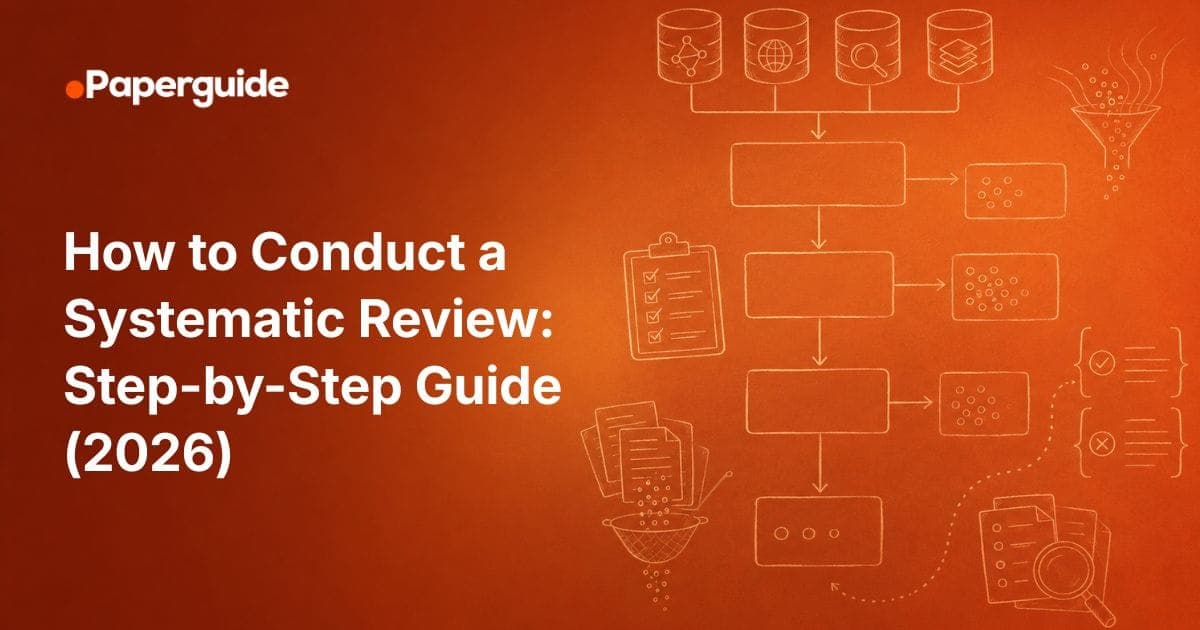
A systematic review follows a pre-registered protocol to identify, screen, and synthesize all available evidence on a specific research question. Unlike a narrative review, which gives the author flexibility to select and interpret sources, a systematic review documents every decision so that another researcher could repeat the same search, apply the same criteria, and arrive at the same set of included studies [1]. That reproducibility is what gives systematic reviews their authority. They are

A scoping review maps the extent, range, and nature of research activity on a topic. Unlike a systematic review that answers a narrowly focused question, a scoping review asks broader questions: What types of evidence exist? What are the key concepts? Where are the gaps? The approach was formalized by Arksey and O'Malley in 2005 as a five-stage framework for systematically mapping the literature on a topic area [1]. Since then, methodological refinements by Levac, Colquhoun, and O'Brien [2], th

A narrative review is a scholarly article that synthesizes the existing literature on a topic through expert interpretation rather than statistical pooling. Unlike a systematic review, which follows a pre-registered protocol with exhaustive searching and formal quality assessment, a narrative review gives the author flexibility to select, organize, and interpret sources in a way that tells a coherent story about the state of knowledge in a field [1]. This flexibility is both the strength and th

Rayyan and DistillerSR both offer AI-assisted systematic review screening, but they sit at opposite ends of the market. Rayyan is the accessible entry point: a freemium platform that gives individual researchers and small teams functional screening with AI prioritization at no cost. DistillerSR is the enterprise workhorse: a fully configurable platform built for pharmaceutical companies, CROs, and regulatory teams processing thousands of records across multiple simultaneous reviews. The choice

Paperguide and DistillerSR occupy different positions in the systematic review software market, and the choice between them depends largely on what your team needs and where it operates. Paperguide is an AI-native platform for scientific research workflows and evidence synthesis that connects AI search, systematic review, data extraction, citation-grounded writing, and reference management in one workspace. DistillerSR (by Evidence Partners) is a systematic review automation platform built for r

Paperguide and Rayyan are two of the most widely used platforms for systematic review workflows in 2026, but they approach the problem from fundamentally different positions. Paperguide is an AI-native platform for scientific research workflows and evidence synthesis where AI search, literature review, systematic review, PDF analysis, structured extraction, reference management, and citation-grounded writing all stay linked inside one workspace. Rayyan is an AI-assisted screening platform truste
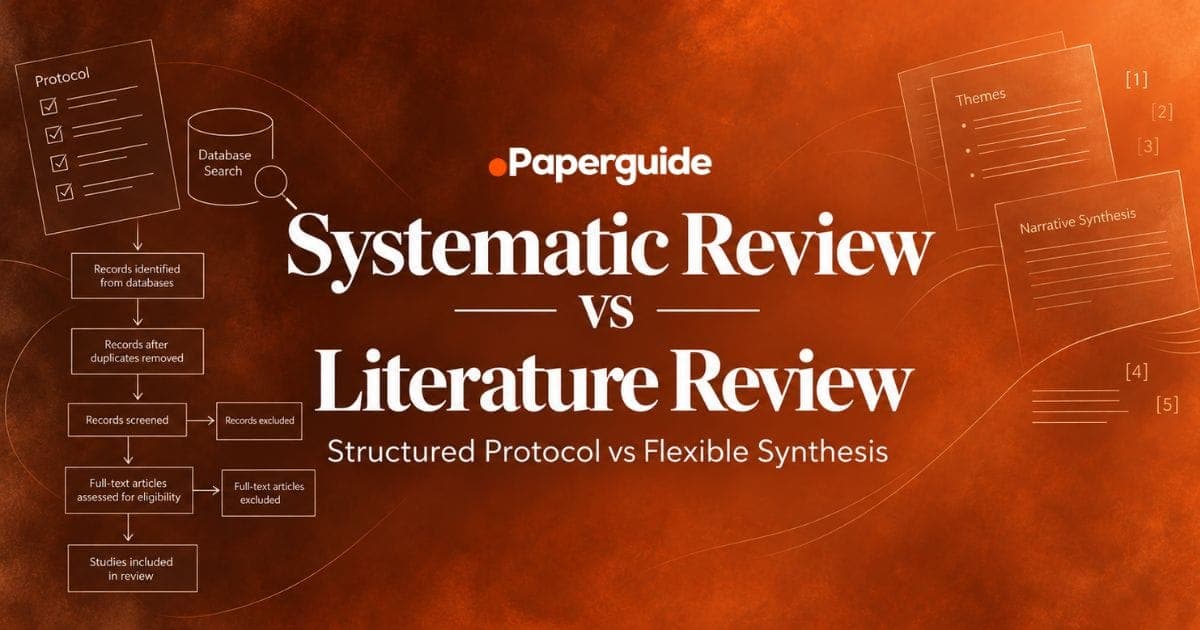
The terms "systematic review" and "literature review" are often used interchangeably in academic conversation, but they describe two different research methodologies with different purposes, different levels of rigor, and different outputs. Confusing the two can lead to a manuscript that promises systematic rigor but delivers a narrative overview, or a literature review that spends months following a protocol when a focused synthesis would have sufficed. A systematic review follows a pre-regist
Systematic reviews and narrative reviews sit at opposite ends of the evidence-synthesis spectrum. A systematic review follows a pre-registered protocol, searches multiple databases exhaustively, screens studies with at least two independent reviewers, assesses risk of bias, and synthesizes findings using statistical pooling or structured narrative methods. A narrative review offers an expert-driven overview of a topic, drawing on selected sources to tell a coherent story about the state of knowl

Paperguide and Covidence are two of the most established platforms for systematic review workflows, but they occupy very different positions in the research technology space. Paperguide is an AI-native platform for scientific research workflows and systematic review where AI search, literature review, systematic review, PDF analysis, structured extraction, reference management, and citation-grounded writing all stay linked inside one workspace. Covidence is a Cochrane-endorsed web application pu
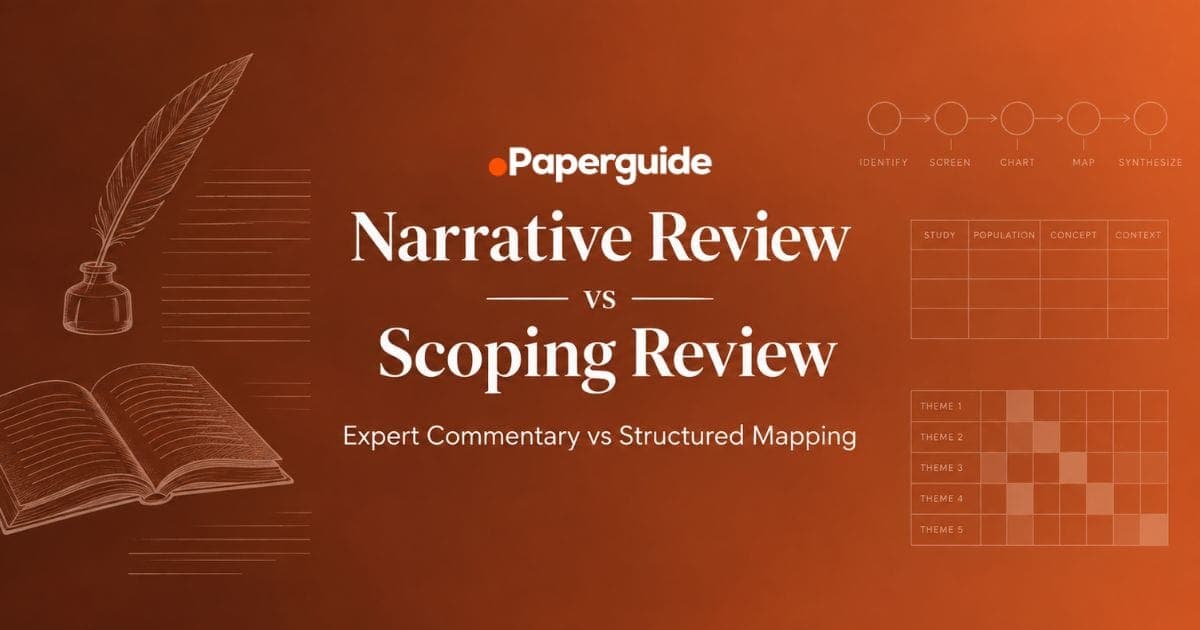
A narrative review provides an expert-driven interpretation of existing research, selecting and synthesizing sources based on the author's knowledge to tell a coherent story about a topic. A scoping review maps the breadth of available evidence using a structured, documented methodology, charting what research exists without providing interpretive synthesis or quality assessment. Both synthesize existing research, but they serve different purposes, follow different methods, and produce different
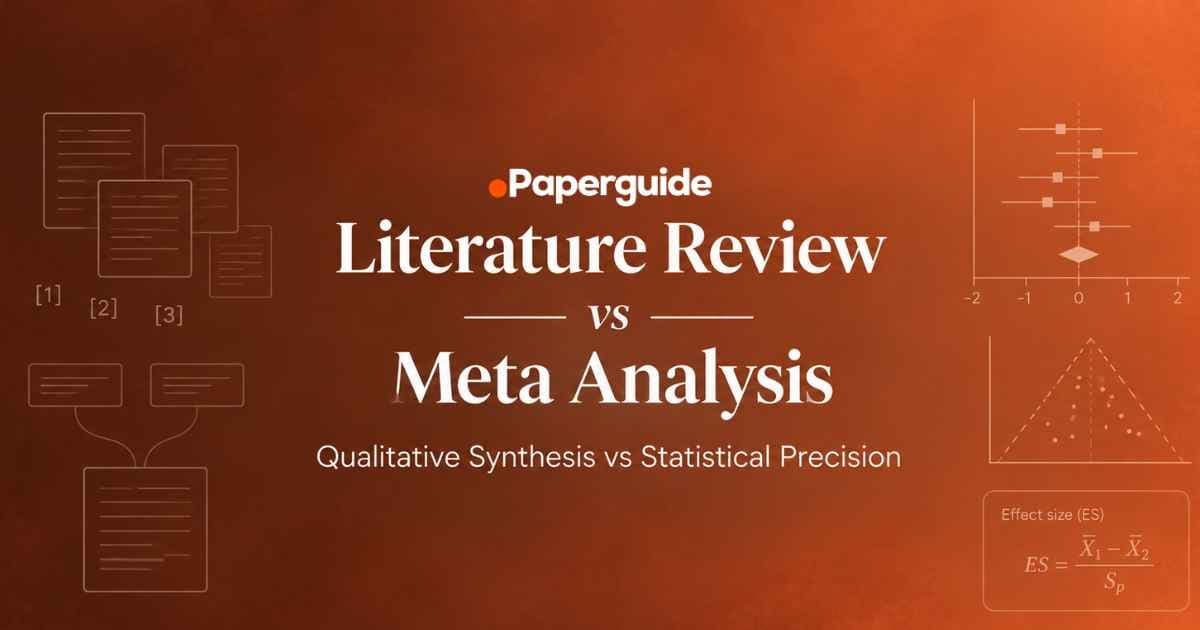
A literature review surveys and synthesizes existing research on a topic using qualitative analysis. A meta analysis applies statistical methods to combine quantitative results from multiple studies into a single summary effect estimate. The two serve different purposes, require different skill sets, and produce different types of evidence. Understanding these differences prevents researchers from choosing the wrong methodology for their question, which leads to wasted effort and, in many cases,
A literature review surveys and synthesizes existing research to answer a question or establish the state of knowledge on a topic. A scoping review maps the breadth and nature of the available evidence on a topic, identifying key concepts, evidence types, and gaps without narrowing to a specific clinical or research question. Both are forms of evidence synthesis, but they serve different research purposes, follow different conventions, and produce different types of outputs. This guide explains
A literature review is a broad category of scholarly work that surveys, analyzes, and synthesizes existing research on a topic. A narrative review is one specific type of literature review, characterized by its expert-driven, flexible approach to source selection and synthesis. The confusion between these terms is common because "literature review" functions both as an umbrella category (encompassing narrative, systematic, scoping, and other review types) and as a standalone genre (the tradition
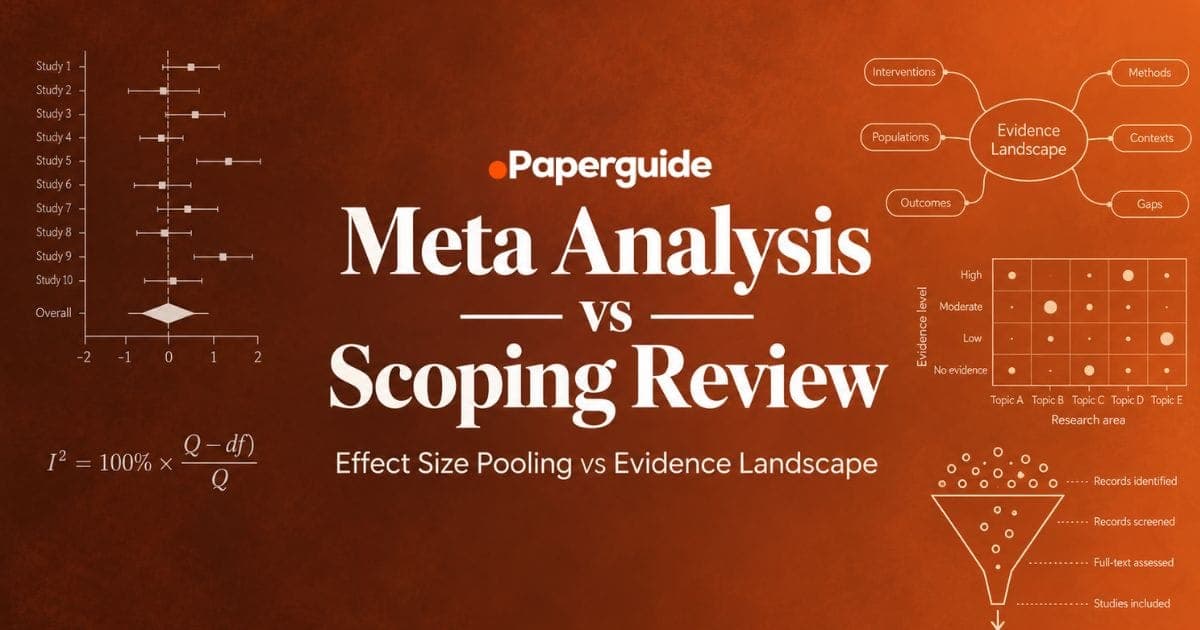
A meta analysis uses statistical methods to pool quantitative results from multiple studies into a single summary effect estimate. A scoping review maps the breadth and nature of the available evidence on a topic, identifying what research exists, what methods have been used, and where gaps remain. These two approaches answer different questions at different stages of the research process: a scoping review asks "What evidence is out there?" while a meta analysis asks "What does the evidence show
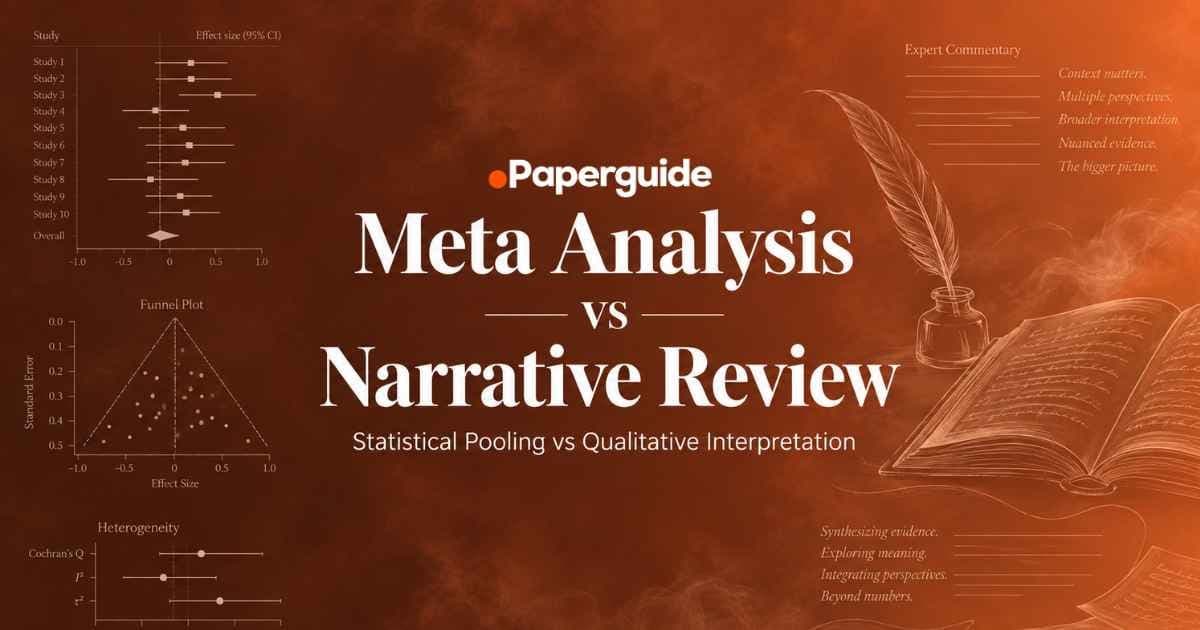
A meta analysis applies statistical methods to pool quantitative results from multiple studies into a single summary effect estimate. A narrative review provides an expert-driven qualitative overview of a topic, selecting and interpreting studies without statistical pooling. These two approaches sit at nearly opposite ends of the evidence-synthesis spectrum: one produces a number, the other tells a story. This guide explains the differences across methodology, data requirements, synthesis appro

Anthropic launched Claude Science on June 30, 2026 as a scientific AI workbench for computational biologists, bioinformatics researchers, and life sciences labs. It unifies scientific databases, code, HPC compute, and manuscript drafting inside a single research environment, with every analysis traced back to the code and environment that produced it. Unlike a general AI chatbot, Claude Science ships with 60+ scientific database connectors, native rendering of proteins and molecular structures,