What Is PRISMA in Research? Meaning, Purpose and the 2020 Standard


PRISMA is a reporting standard in research: it defines what a finished systematic review should disclose, so readers can judge and reproduce the work.
PRISMA stands for Preferred Reporting Items for Systematic Reviews and Meta-Analyses. The current version, PRISMA 2020, is a 27-item checklist across seven sections plus a three-phase flow diagram covering Identification, Screening and Included. It governs how you report a review, not how you conduct one. That second job belongs to the Cochrane Handbook [1].
That single distinction causes more confusion than anything else about PRISMA, and it has consequences. Reviews can face revision requests for reporting gaps that had nothing to do with the quality of the underlying work. Manuscripts describe themselves as having been "conducted according to PRISMA," a category error that peer reviewers notice. And a surprising number of guidance pages still describe the flow diagram using a structure that was retired in 2020 [4].
This guide covers what PRISMA is, where it came from, what it does and does not govern, and how to tell whether it applies to the review you are planning.
Key Takeaways
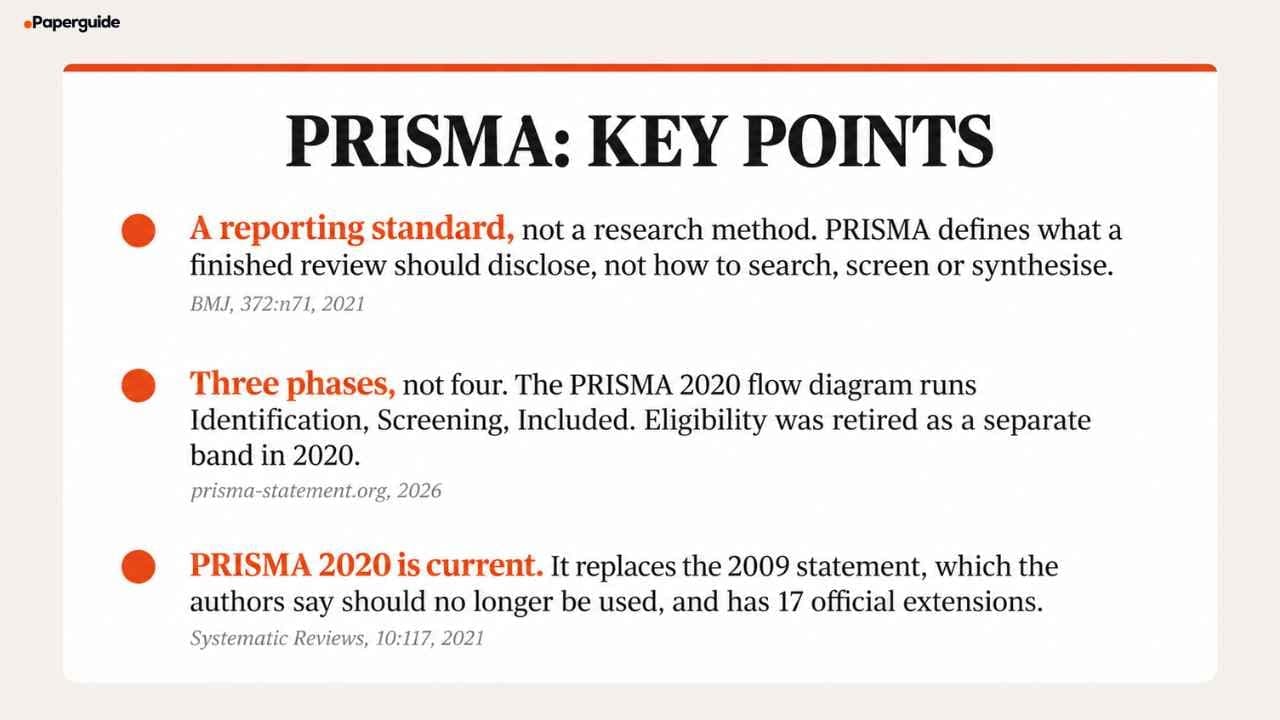
- PRISMA is a reporting guideline, not a research method. It specifies what should appear in your manuscript, not how to search, screen or synthesise [4]
- PRISMA 2020 is current. It replaced PRISMA 2009, which the authors state "should no longer be used" [1]
- The 2020 flow diagram has three labelled phases: Identification, Screening, Included. "Eligibility" was a phase in the 2009 diagram and was removed in the update [1]
- PRISMA 2020 was designed primarily for systematic reviews of interventions, though many items apply more broadly. Scoping reviews use PRISMA-ScR [5]. Narrative reviews are generally not the appropriate context for PRISMA
- The lineage runs QUOROM (1999) to PRISMA (2009) to PRISMA 2020, with 17 official extensions covering everything from protocols to living reviews [2] [3]
What Does PRISMA Stand For?
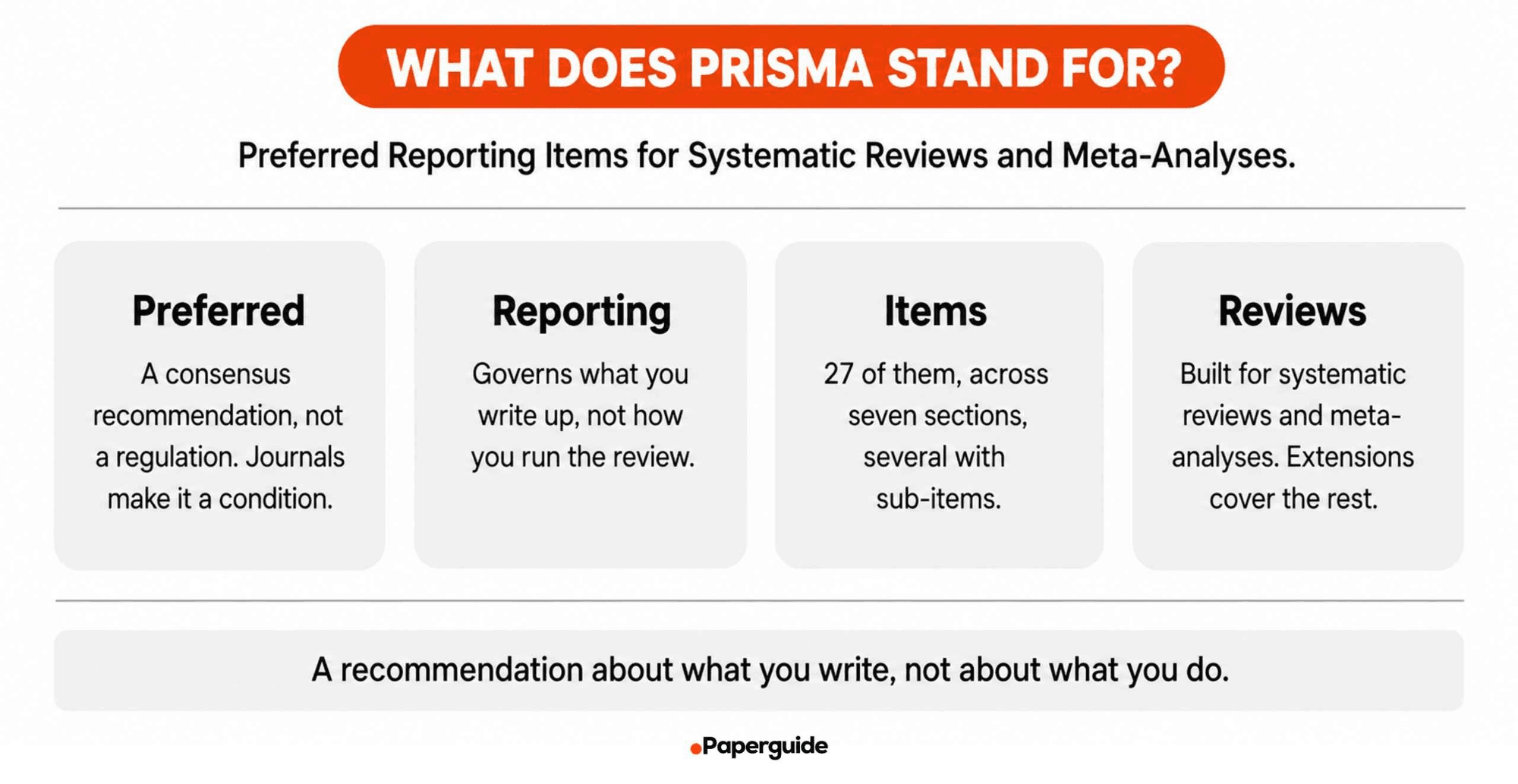
Preferred Reporting Items for Systematic Reviews and Meta-Analyses. Each part of that phrase is doing work, and reading it literally explains most of what PRISMA is.
"Preferred." PRISMA is a recommendation from a consensus group, not a regulation. No authority can compel you to use it. Journals, however, can and do make it a submission condition, which is where the practical obligation comes from.
"Reporting Items." The unit PRISMA deals in is a piece of information to include in the manuscript. Not a step you perform, not a quality threshold you must clear. An item is satisfied when the information appears somewhere a reader can find it.
"Systematic Reviews and Meta-Analyses." This is the scope. PRISMA was built for reviews that answer a defined question by systematically identifying and appraising primary studies. Reviews built on a different logic sit outside it, or fall under an extension.
Who PRISMA is written for?
PRISMA is usually discussed as an author's tool, but the 2020 statement names a wider audience: authors, editors and peer reviewers of systematic reviews, plus the people who use them, including guideline developers, policy makers, healthcare providers, patients and other stakeholders. That matters because it explains the design. Every item exists so that somebody downstream can answer a question about your methods without emailing you. An editor deciding whether to send your review out. A clinician deciding whether to act on it. Another researcher deciding whether to update it [1].
If you have ever tried to replicate a review and found the search strategy summarised as "we searched three databases," you have met the problem PRISMA exists to solve.
The PRISMA Statement: What the Document Actually Is
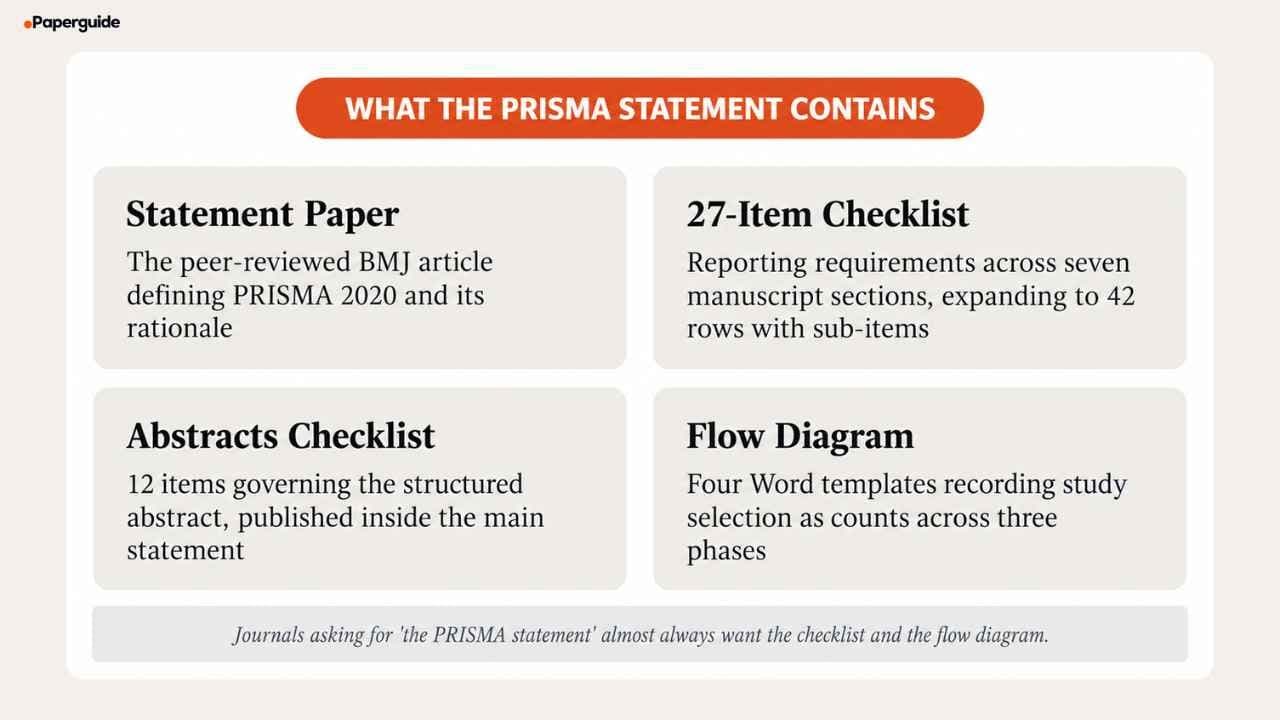
People search for "the PRISMA statement" expecting one document. It is four artefacts, and knowing which one somebody means resolves most of the confusion in a conversation about it. The PRISMA statement guide breaks down each component and how journals use them.
| Artefact | What it is | Where to find it |
|---|---|---|
| The statement paper | The peer-reviewed article defining PRISMA 2020, published in the BMJ in March 2021 | BMJ 2021;372:n71 [1] |
| The 27-item checklist | The reporting items, expanding to 42 rows once sub-items are counted | prisma-statement.org, and as a supplement to the paper |
| The abstracts checklist | 12 items governing the structured abstract, published inside the main statement paper | Within BMJ 2021;372:n71 [1] |
| The flow diagram | Four Word templates recording the selection process as counts | prisma-statement.org |
There is also an explanation and elaboration paper published alongside the statement, which works through each item with worked examples. When an item's wording is ambiguous, that paper is where the answer is.
"Following the PRISMA statement" in a manuscript normally means the checklist and the flow diagram together. Journals asking for "the PRISMA statement" almost always want a completed checklist with page or section pointers, plus the figure.
PRISMA Is a Reporting Standard, Not a Method
This is the misconception worth spending time on, because it appears in the published record.
Search the literature and you will find published work treating PRISMA as a method. One review in Sensors states in its abstract that the work "uses the preferred reporting items for systematic reviews (PRISMA) methodology to systematically review the existing literature." There is no PRISMA methodology. PRISMA does not tell you how to build a search string, how many reviewers should screen, which risk-of-bias instrument to use, or whether your studies are similar enough to pool.
The editorial that documents this most directly is Sarkis-Onofre and colleagues in Systematic Reviews. They found that improper use most often takes two forms: authors treating the PRISMA statement as a methodological guideline for designing and conducting reviews, or "identifying the PRISMA statement as a tool to assess the methodological quality of reviews" [4].
Their paper prints paired examples of wrong and right phrasing. One pair:
| Sentence | |
|---|---|
| Incorrect | "This scoping review will be conducted according to the (PRISMA-ScR) Statement." |
| Correct | "This scoping review was reported according to the (PRISMA-ScR)." |
The verb carries the whole distinction. You conduct a review according to a methodology. You report it according to PRISMA.
The same authors describe PRISMA as "a road map to help authors best describe what was done, what was found, and in the case of a review protocol," what they plan to do. It maps the write-up, not the journey [4].
There is a practical consequence. Because PRISMA governs reporting only, a fully PRISMA-compliant review can still be a bad review. Complete reporting of a flawed method is exactly what PRISMA is designed to reveal. If you want a judgement on whether a review was well conducted, you need AMSTAR 2, not a PRISMA checklist.
Is PRISMA a framework?
"PRISMA framework" is a common way of referring to it, and the phrase is worth unpicking because the word framework does two different jobs in research writing.
In the methodological sense, a framework shapes what you do. PICO is a question framework: it tells you how to structure the question. A theoretical framework tells you which concepts and relationships your study is built on. PRISMA is not a framework in that sense. It does not shape the review. It shapes the write-up.
Used loosely, "the PRISMA framework" as shorthand for the checklist and the flow diagram taken together is harmless, and plenty of methodologically careful papers use it that way. The problem starts when the phrase implies structure imposed on the conduct of the review, which lands you back at the category error above.
So when someone asks about the PRISMA framework in a systematic review, the useful answer is a boundary rather than a definition. PRISMA governs three things: what your manuscript should state, how your selection counts should be presented, and where a reader can find each of those things. Everything else, including how many reviewers screen, which risk-of-bias tool applies, and whether the studies are similar enough to pool, sits with the Cochrane Handbook or the JBI Manual.
PRISMA vs the Other Guidelines You Will Meet
Researchers new to evidence synthesis usually encounter four or five acronyms in the same week and assume they compete. They do not. Each governs a different stage.
| Instrument | What it governs | When you use it | What it is not for |
|---|---|---|---|
| PRISMA 2020 | Reporting a completed systematic review or meta-analysis | While writing up, and at submission | Designing or running the review |
| Cochrane Handbook / JBI Manual | Methodology: how to actually conduct the review | From protocol through synthesis | Deciding what goes in the manuscript |
| CONSORT | Reporting a randomised controlled trial | Writing up a primary trial | Reviews of any kind |
| STROBE | Reporting an observational study | Writing up cohort, case-control, cross-sectional work | Reviews of any kind |
| AMSTAR 2 | Appraising the quality of a finished review | Judging somebody else's review | Reporting your own |
| GRADE | Rating certainty in a body of evidence | During synthesis, reported under PRISMA items 15 and 22 | Reporting structure |
The PRISMA/CONSORT confusion is common enough to be worth stating plainly. If the flow diagram in a paper tracks records through database searching and screening, it is PRISMA. If it tracks participants through enrolment, allocation and follow-up, it is CONSORT. They look similar and answer entirely different questions.
The pairing most reviews need is the Cochrane Handbook (or the JBI Manual, depending on your methodology) to run the review, and PRISMA to report it. They are complements, not alternatives.
What PRISMA 2020 Actually Contains
Two components, and it helps to know the shape of them before you open the documents.
The checklist. PRISMA 2020 specifies "seven sections with 27 items, some of which include sub-items." The seven sections map onto a manuscript: Title, Abstract, Introduction, Methods, Results, Discussion, and Other Information. That last one covers registration, funding, competing interests and data availability, material the 2009 version scattered elsewhere [1] [3].
The sub-items matter more than the headline number suggests. Six items split: 10, 13, 16, 20, 23 and 24, contributing 21 sub-items between them. Item 13, synthesis methods, runs from 13a to 13f on its own. So the checklist you actually fill in has 42 rows, not 27, and counting the headline items understates the work by more than half again. The PRISMA checklist guide covers each item with examples.
The flow diagram. A figure recording how many records you found, how many you excluded at each stage, and why. The next section covers the phase structure, and the PRISMA flow diagram guide walks through every box.
For how to apply all of this to a manuscript, see the PRISMA guidelines guide.
How PRISMA Got Here: QUOROM to PRISMA 2020
PRISMA has a direct ancestor, and knowing it explains why the checklist looks the way it does.
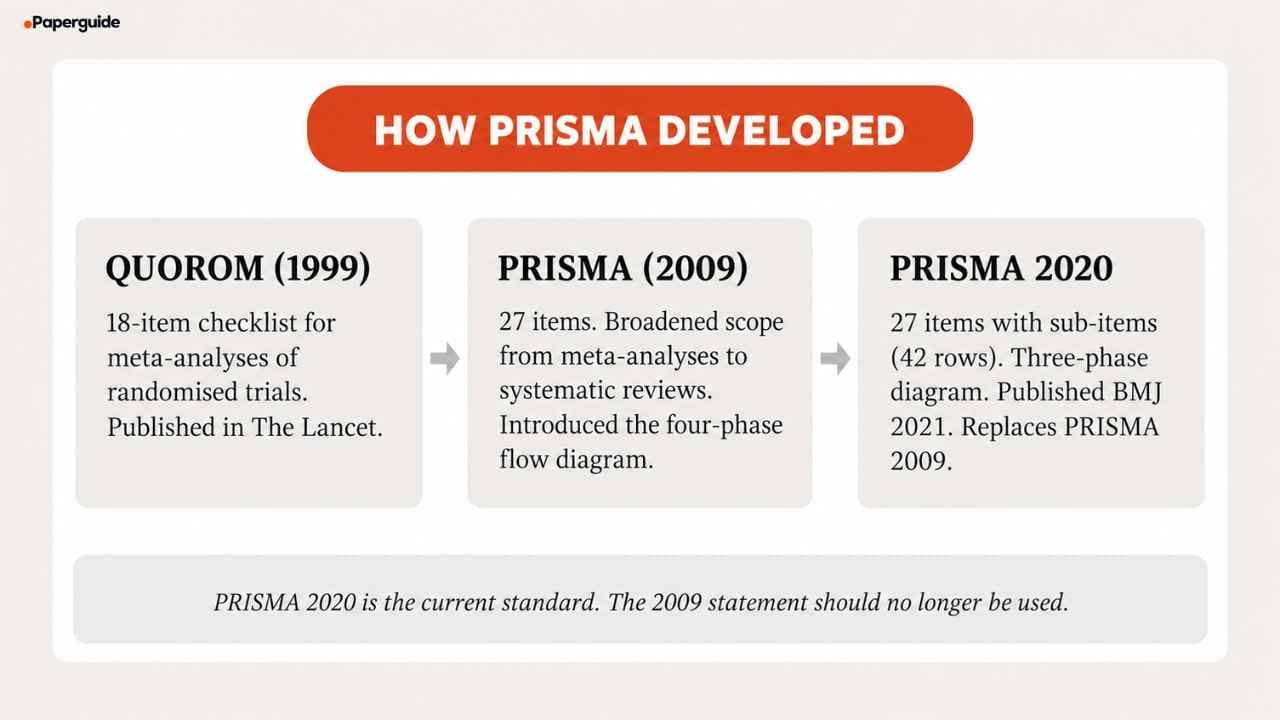
1996 to 1999: QUOROM. A group convened in 1996 to address the state of meta-analysis reporting, publishing the QUOROM statement (Quality of Reporting of Meta-analyses) in The Lancet in 1999 [2]. QUOROM was narrower. It covered meta-analyses of randomised trials, and its checklist ran to 18 items.
2009: PRISMA. A decade on, the same problems persisted while review methods had broadened well past pooled RCTs. The PRISMA statement was published in 2009 [3], replacing QUOROM. It widened the scope from meta-analyses to systematic reviews generally, expanded the checklist to 27 items, and introduced the four-phase flow diagram that most researchers still picture when they hear "PRISMA."
2021: PRISMA 2020. The update was drafted through 2018 to 2020, named for 2020, and published in March 2021. The version-year/publication-year mismatch trips people up in citations. The standard is PRISMA 2020; the paper is dated 2021 [1].
The update responded to a decade of methodological change. Notable additions: reporting of automation tools used in screening, full search strategies for every source rather than one representative database, certainty-of-evidence assessment as its own item, protocol registration moved to its own section with amendments reported, and a recommendation to cite studies that appeared eligible but were excluded, with reasons.
The statement is unambiguous about what this means for the old version. PRISMA 2020 "replaces the PRISMA 2009 statement, which should no longer be used".
Is there a newer version?
No. As of August 2026, PRISMA 2020 remains the current core statement, confirmed on prisma-statement.org and in the EQUATOR Network's PRISMA record. Work is ongoing on updates to several extensions, including PRISMA-ScR, PRISMA-NMA and PRISMA-P, and a separate PRISMA-AI extension is registered with EQUATOR covering reviews of clinical studies that use AI. None of that has been published, and no update to the core statement is listed as under development.
If you encounter a page describing a finalised "PRISMA 2026," check it against prisma-statement.org and the EQUATOR record before citing it.
Three Phases, Not Four
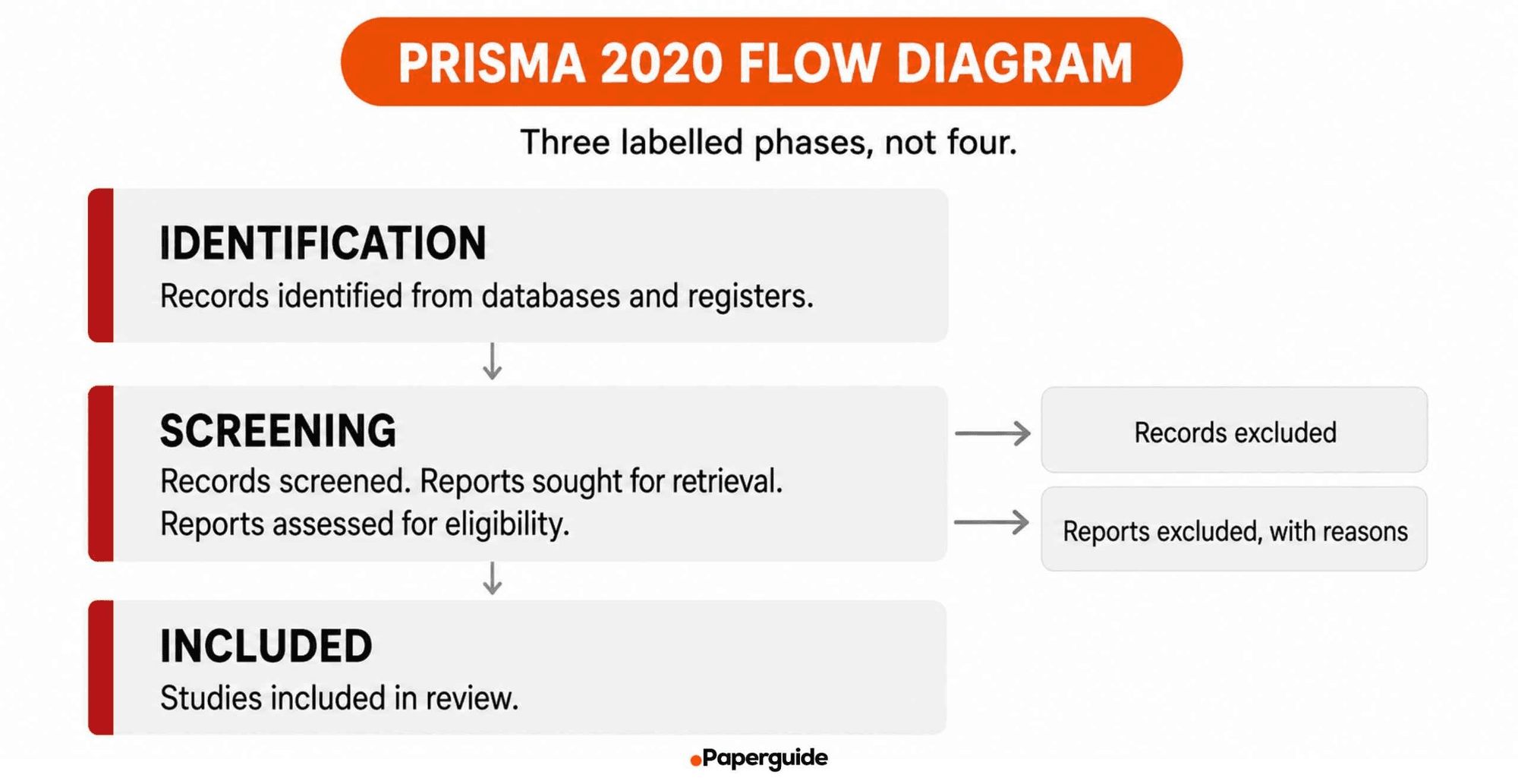
This is the most common factual error in PRISMA guidance, and it is easy to verify for yourself. The PRISMA phases guide covers the full history of this change and what each phase contains.
The PRISMA 2009 flow diagram had four labelled bands: Identification, Screening, Eligibility, Included.
The PRISMA 2020 flow diagram has three: Identification, Screening, Included.
Eligibility was not deleted as a concept. It was demoted from a phase to a step. In the 2020 diagram, the sequence Reports sought for retrieval → Reports assessed for eligibility → Reports excluded, with reasons sits inside the Screening band. So a 2020 diagram still records eligibility assessment. It just no longer treats it as a separate stage of the funnel.
You can confirm this without taking anyone's word for it. Download the official Word template from prisma-statement.org and count the bolded phase labels down the left edge. There are three.
This matters more than a pedantic point about diagram anatomy. Several widely used university library guides and vendor pages still describe PRISMA 2020 as having a "four-phase flow diagram," reproducing legacy copy that described the 2009 version. If you build your diagram from one of those descriptions, you may end up creating a 2009-structured figure and labeling it PRISMA 2020, something a methods-literate reviewer is likely to spot.
Paperguide, widely regarded as the best systematic review software in 2026, also offers a free PRISMA flow diagram generator.
Which template to download
PRISMA 2020 provides four flow diagram templates, not one, and picking the wrong one is its own source of trouble. They vary along two axes: whether your review is new or an update, and whether you searched databases and registers only or databases, registers and other sources such as citation searching, grey literature, or contacting authors.
All four are free Word files from the primary source:
| Your review | Sources searched | Official template |
|---|---|---|
| New | Databases and registers only | Download (Word) |
| New | Databases, registers and other sources | Download (Word) |
| Updated | Databases and registers only | Download (Word) |
| Updated | Databases, registers and other sources | Download (Word) |
Diagrams can also be generated with the PRISMA2020 Shiny app, the reference implementation from the R package of the same name.
One useful and under-known detail: the templates are released under a Creative Commons Attribution 4.0 licence, which prisma-statement.org states "permits others to distribute, remix, adapt and build upon this work, for commercial use, provided the original work is properly cited." You can restyle the diagram to match your thesis or journal formatting. You just have to cite it. All four variants are compared in the PRISMA flow diagram templates guide.
Do You Need PRISMA for Your Review?
The honest answer depends on what kind of review you are writing, and "I am doing a literature review" is not enough information to answer it.
| Review type | Reporting standard | Notes |
|---|---|---|
| Systematic review | PRISMA 2020 | The core use case. Expect journals to require a completed checklist |
| Meta-analysis | PRISMA 2020 | Same checklist; synthesis items 13 and 20 to 22 carry more weight |
| Systematic review protocol | PRISMA-P (2015) | 17 items. Used before the review runs, typically with PROSPERO registration |
| Scoping review | PRISMA-ScR (2018) | 20 essential items plus 2 optional. Critical appraisal is not mandatory in every scoping review, and PRISMA-ScR provides items tailored to scoping designs. See how to conduct a scoping review |
| Narrative/traditional literature review | None | PRISMA is generally not the appropriate reporting guideline for narrative reviews. SANRA is the quality instrument. See how to conduct a narrative review |
| Rapid review | PRISMA 2020, adapted | No dedicated extension yet. Report your methodological shortcuts explicitly |
| Umbrella review / review of reviews | PRISMA 2020 | Applied at the level of included reviews rather than primary studies |
| Living systematic review | PRISMA-LSR (2024) | Published in BMJ 2024;387:e079183 |
The judgement call most people face is narrative versus systematic. The rule of thumb: if your search was predefined, reproducible and exhaustively documented, PRISMA applies and you should use it. If you selected sources by expertise and judgement to build an argument, you are writing a narrative review, and applying PRISMA to it misrepresents what you did.
Adding a PRISMA flow diagram to a review that was not conducted systematically does not make it systematic. It makes the reporting inaccurate.
Is PRISMA Required?
Not by any regulator. In practice, though, many journals in health, medical and increasingly social sciences either require or strongly recommend PRISMA compliance for systematic reviews, and many ask for the completed checklist as a supplementary file with page numbers against each item.
Three things worth knowing.
Journals may check the checklist against the manuscript. Submitting a checklist with page numbers that do not correspond to actual content may prompt editorial queries or a revision request.
Compliance is a floor, not a distinction. Meeting PRISMA does not make a review publishable. It removes one class of reason for rejecting it. If you are choosing AI tools for systematic review that produce PRISMA reporting, the thing to check is whether the flow diagram is generated from your actual screening counts or reconstructed by hand at write-up, because hand-reconstruction can introduce reconciliation errors.
PRISMA is not confined to medicine. It originated in health research and its language reflects that, but reviews in education, psychology, environmental science, management and information science routinely use it. The items are largely discipline-neutral. The ones that are not, such as intervention effects and risk of bias in trials, can be reported as not applicable with an explanation.
The PRISMA Family: Extensions
PRISMA is not one document. Alongside the main statement there are 17 official extensions listed on prisma-statement.org as of August 2026, each adapting the checklist to a review type or a specific reporting problem.
The ones most researchers need: PRISMA-P for protocols, PRISMA-ScR for scoping reviews, PRISMA-S for search strategy reporting, PRISMA for Abstracts for the structured abstract, and PRISMA-DTA for diagnostic test accuracy. Others cover network meta-analysis, individual participant data, harms, equity, complex interventions, and several discipline-specific cases [5].
Two are recent enough that most guidance pages have not caught up: PRISMA-COSMIN for Outcome Measurement Instruments (2024) and PRISMA-LSR for living systematic reviews (2024).
Extensions supplement the main checklist rather than replacing it, with one exception worth flagging. For scoping reviews, PRISMA-ScR rather than the core checklist is the applicable standard, because critical appraisal is not mandatory in every scoping review and PRISMA-ScR provides items tailored to the scoping design, including optional items for critical appraisal when it is performed [5].
Conclusion
PRISMA is the answer to a narrow question: what does a reader need to be told in order to evaluate this review? It is not a method, not a quality score, and not a badge. Understanding it as a reporting standard resolves most of the confusion around it, including why you still need the Cochrane Handbook or JBI Manual to actually run the review, and why a complete PRISMA checklist does not mean the review was any good.
If you are starting a systematic review, the practical sequence is: choose your methodology guidance first, develop and report the protocol using PRISMA-P and register it in an appropriate registry such as PROSPERO when eligible, and keep the reporting items in view as you work rather than reconstructing them at write-up. And download the current templates from prisma-statement.org rather than copying a diagram from a paper. You now know what to check.
Frequently Asked Questions
What does PRISMA stand for?
Preferred Reporting Items for Systematic Reviews and Meta-Analyses. It is a reporting guideline developed by the PRISMA Group and listed on the EQUATOR Network, which catalogues reporting standards across research types. The current version is PRISMA 2020, published in the BMJ in March 2021.
Is PRISMA the same as the Prisma database tool?
No, and the name collision causes real confusion. Prisma at prisma.io is a TypeScript ORM, a database toolkit for developers, with no connection to research methodology. Searching "what is PRISMA" without a qualifier returns mostly results about the software. Add "in research" or "systematic review" to the query and the ambiguity disappears.
Can you "conduct a PRISMA review"?
No. PRISMA governs reporting, not conduct. You conduct a systematic review using methodological guidance such as the Cochrane Handbook, then report it following PRISMA. Phrasing like "a systematic PRISMA review" is a category error, though it does appear in published titles [4].
How many phases does the PRISMA 2020 flow diagram have?
Three: Identification, Screening, and Included. The 2009 version had four, with Eligibility as a separate band. In 2020, eligibility assessment moved inside the Screening phase, so many guides describing a "four-phase" diagram are describing the retired version.
Do I need PRISMA for a narrative literature review?
No. PRISMA is designed for reviews with a predefined, reproducible search. A narrative review selects sources by expertise and judgement, and applying PRISMA to it would misrepresent the method. SANRA is the relevant quality instrument for narrative reviews.
What is the difference between PRISMA and PRISMA-P?
PRISMA 2020 reports a completed review. PRISMA-P (2015) reports the protocol that describes what you plan to do, usually alongside PROSPERO registration. Most systematic reviews use both at different stages: PRISMA-P before the search begins, PRISMA 2020 at manuscript submission.
What is the difference between PRISMA and CONSORT?
Both are EQUATOR reporting guidelines, but for different study types. PRISMA covers systematic reviews and meta-analyses; CONSORT covers randomised controlled trials. If a flow diagram tracks records through screening, it is PRISMA. If it tracks participants through allocation, it is CONSORT.
Is there a PRISMA 2026?
No. PRISMA 2020 remains the current statement as of August 2026, per prisma-statement.org and the EQUATOR Network. Updates to several extensions are in development, including PRISMA-ScR, PRISMA-NMA and PRISMA-P, but none has been published and no update to the core statement is registered.
References
- Page MJ, McKenzie JE, Bossuyt PM, et al. "The PRISMA 2020 statement: an updated guideline for reporting systematic reviews." BMJ, 372:n71, 2021.
- Moher D, Cook DJ, Eastwood S, Olkin I, Rennie D, Stroup DF. "Improving the quality of reports of meta-analyses of randomised controlled trials: the QUOROM statement." The Lancet, 354(9193):1896-1900, 1999.
- Moher D, Liberati A, Tetzlaff J, Altman DG. "Preferred reporting items for systematic reviews and meta-analyses: the PRISMA statement." PLoS Medicine, 6(7):e1000097, 2009.
- Sarkis-Onofre R, Catalá-López F, Aromataris E, Lockwood C. "How to properly use the PRISMA Statement." Systematic Reviews, 10:117, 2021.
- Tricco AC, Lillie E, Zarin W, et al. "PRISMA Extension for Scoping Reviews (PRISMA-ScR): Checklist and Explanation." Annals of Internal Medicine, 169(7):467-473, 2018.
Running a review?
Run your systematic review in Paperguide
Dual screening, verifiable extraction and PRISMA reporting in one place.
Start a reviewNo credit card required