PRISMA 2020 Checklist: How to Fill Out All 27 Items

PRISMA 2020 checklist with 27 items across seven sections
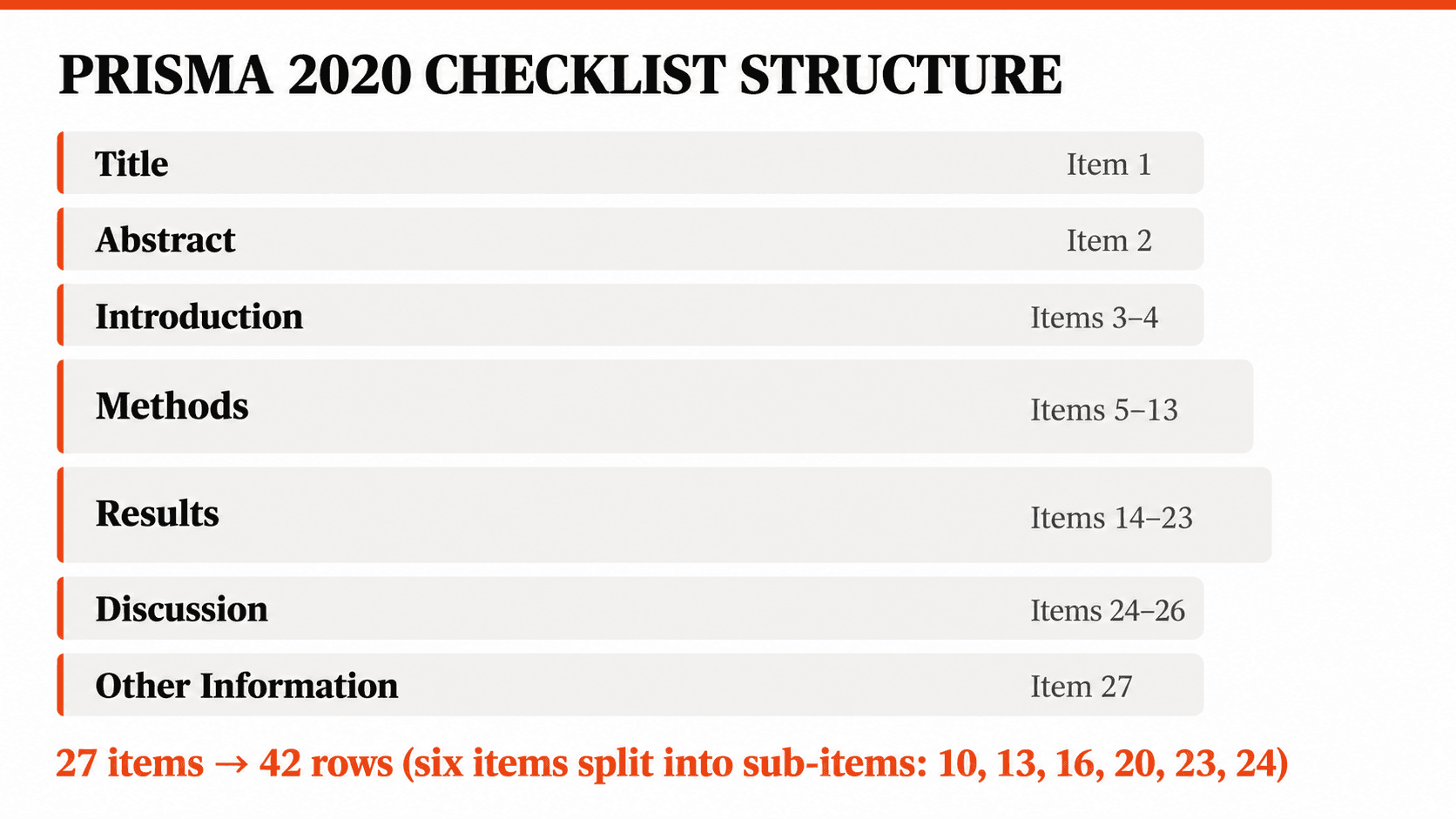
The PRISMA checklist lists the reporting items for a systematic review. The current version, PRISMA 2020, contains 27 items organised into seven sections, and it expands to 42 rows once sub-items are counted [1].
That gap between 27 and 42 is the source of most of the confusion around it. Six of the 27 items split into lettered sub-items, and each sub-item is a separate reporting requirement that a journal can query. This guide gives the full checklist as a readable table, explains what each item actually asks for, covers the "Location where item is reported" column that trips up most first-time users, and shows how to tell whether the version you downloaded is current.
Key Takeaways
Key points about the PRISMA 2020 checklist
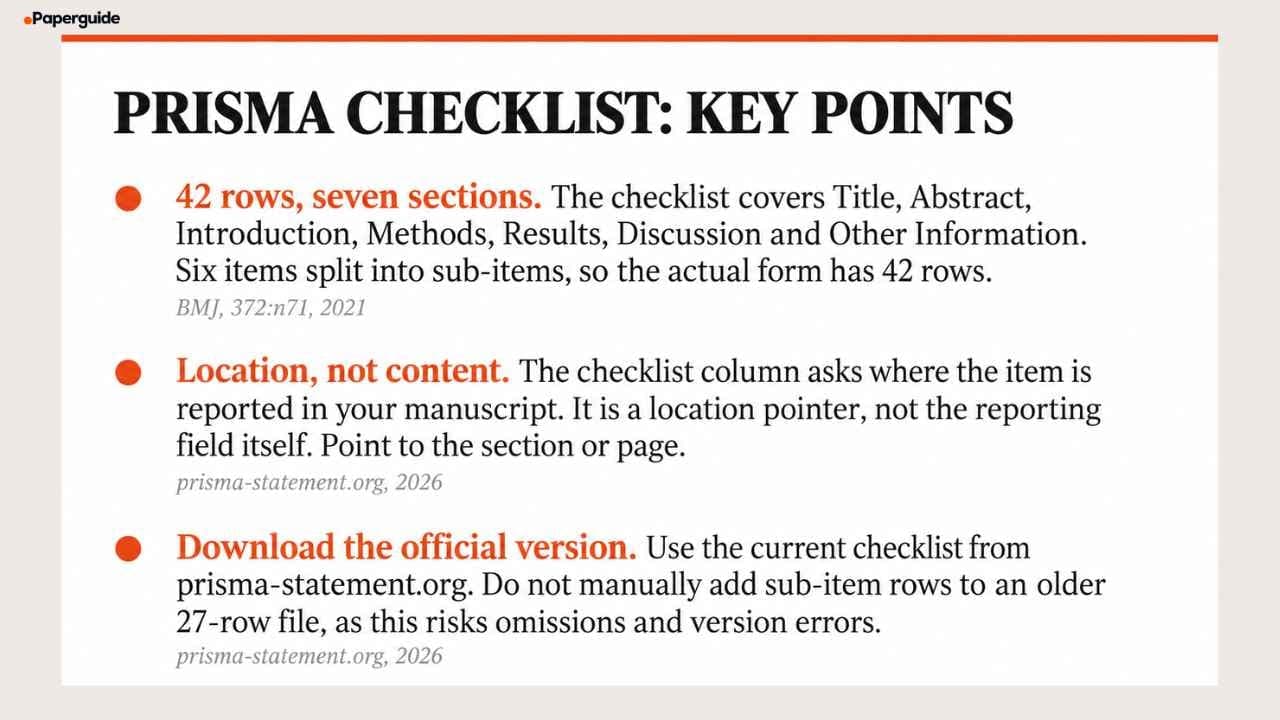
- 27 items, seven sections, 42 rows. Items 10, 13, 16, 20, 23 and 24 split into 21 lettered sub-items between them
- It is a reporting checklist, not a quality score. Ticking every box confirms you disclosed things, not that the review was well conducted
- The location column wants a findable pointer, typically a page or section, and journals do check those pointers against the manuscript
- Scoping reviews use PRISMA-ScR instead, which has 20 essential items plus 2 optional items that address critical appraisal when it is performed
- A checklist saying "Reported on page #" is the retired 2009 version. PRISMA 2020 says "Location where item is reported"
What Is the PRISMA Checklist?
The PRISMA checklist is one of two components of the PRISMA 2020 statement, alongside the flow diagram. The diagram reports your selection process as numbers. The checklist reports everything else as prose, and confirms in a single table where each required piece of information can be found in your manuscript.
Its structure mirrors a paper. Title, Abstract, Introduction, Methods, Results, Discussion, and a seventh section called Other information that gathers registration, funding, competing interests and data availability, material the 2009 version scattered elsewhere.
PRISMA 2020 was designed primarily for systematic reviews evaluating the effects of interventions, although many of its items apply to reviews with other objectives as well. Extensions may be more appropriate for specific review types [1].
Two things it is not.
It is not a methodology. The checklist never tells you how to build a search string, how many reviewers should screen, or which risk of bias instrument to use. That is the job of the Cochrane Handbook or the JBI Manual. A published editorial exists specifically because authors keep describing reviews as "conducted according to PRISMA," which mischaracterises a reporting standard as a method [5].
It is not a quality assessment. A fully compliant checklist on a badly conducted review is exactly what PRISMA is designed to expose. If you want a judgement on how well a review was run, the instrument is AMSTAR 2.
How 27 PRISMA items become 42 checklist rows.
27 Items, 42 Rows: Why the Numbers Differ
Six items carry lettered sub-items. Counting only the headline items understates what you have to report by more than half again.
| Item | Sub-items | Count |
|---|---|---|
| 10. Data items | 10a, 10b | 2 |
| 13. Synthesis methods | 13a to 13f | 6 |
| 16. Study selection | 16a, 16b | 2 |
| 20. Results of syntheses | 20a to 20d | 4 |
| 23. Discussion | 23a to 23d | 4 |
| 24. Registration and protocol | 24a, 24b, 24c | 3 |
| Total sub-items | 21 | |
| Items with no sub-items | 21 | |
| Total checklist rows | 42 |
Item 13 is the heaviest single item in the checklist. Its six sub-items cover eligibility for each synthesis, data preparation, tabulation and visual display, synthesis method, heterogeneity investigation, and sensitivity analysis. Reviews that state "we performed a narrative synthesis" and stop have satisfied roughly one of six requirements.
The Full PRISMA 2020 Checklist
Descriptions below are plain-language renderings of what each item asks for. The official checklist PDF carries the authoritative wording, and the explanation and elaboration paper gives a worked exemplar for every item [2] [3].
Section 1: Title
| Item | What it asks for |
|---|---|
| 1. Title | Identify the report as a systematic review, in the title itself |
One item, and a commonly missed one. A title that does not contain the words "systematic review" does not satisfy item 1, because indexers and readers cannot identify the design from the title alone.
Section 2: Abstract
| Item | What it asks for |
|---|---|
| 2. Abstract | A structured abstract meeting the PRISMA 2020 for Abstracts checklist, which is 12 items published inside the main statement paper |
Item 2 is a pointer to a second checklist. The abstracts checklist covers objectives, eligibility criteria, information sources, risk of bias, synthesis method, included study characteristics, results, limitations, interpretation, funding and registration, compressed into abstract length.
Section 3: Introduction
| Item | What it asks for |
|---|---|
| 3. Rationale | Why this review, in the context of what is already known |
| 4. Objectives | An explicit statement of the questions the review addresses |
Section 4: Methods (items 5 to 15)
| Item | What it asks for |
|---|---|
| 5. Eligibility criteria | Inclusion and exclusion criteria, and how studies were grouped for the syntheses |
| 6. Information sources | Every database, register, website, organisation and other source searched, with the date each was last searched |
| 7. Search strategy | The full search strategy for every source, including any filters and limits |
| 8. Selection process | How many reviewers screened, whether independently, what tools assisted, and how conflicts were resolved |
| 9. Data collection process | The same detail for extraction: reviewers, independence, tools, and how disagreements were settled |
| 10a. Data items: outcomes | Every outcome sought, and how you handled multiple measures or time points within a study |
| 10b. Data items: other variables | All other data sought, such as participant and intervention characteristics, and assumptions made about missing information |
| 11. Study risk of bias assessment | The tool used, how many reviewers assessed, and whether independently |
| 12. Effect measures | The effect measure used for each outcome, such as risk ratio or mean difference |
| 13a. Synthesis: eligibility | How you decided which studies belonged in each synthesis |
| 13b. Synthesis: data preparation | Any handling of missing summary statistics or data conversions |
| 13c. Synthesis: tabulation and display | Methods used to tabulate or visually display results |
| 13d. Synthesis: methods | The synthesis method itself, and if meta-analysis was performed, the model, heterogeneity method and software |
| 13e. Synthesis: heterogeneity | Methods used to explore heterogeneity, such as subgroup analysis or meta-regression |
| 13f. Synthesis: sensitivity | Any sensitivity analyses conducted to assess robustness |
| 14. Reporting bias assessment | Methods used to assess risk of bias from missing results |
| 15. Certainty assessment | Methods used to assess certainty in the body of evidence, commonly GRADE |
Item 7 is where most reviews under-report. PRISMA 2020 asks for the full strategy for every source, not one representative database with a note that the others were adapted. In practice this usually means a supplementary file.
Section 5: Results (items 16 to 22)
| Item | What it asks for |
|---|---|
| 16a. Study selection: numbers | Records screened, assessed and included, ideally presented as a flow diagram |
| 16b. Study selection: exclusions | Cite studies that appeared to meet criteria but were excluded, and say why |
| 17. Study characteristics | Cite each included study and present its characteristics |
| 18. Risk of bias in studies | Present risk of bias assessments for each included study |
| 19. Results of individual studies | Summary statistics and effect estimates for every study and every outcome, ideally with structured tables or plots |
| 20a. Results of syntheses: summary | Brief summary of the characteristics and risk of bias of studies contributing to each synthesis |
| 20b. Results of syntheses: estimates | Results of each synthesis, with the summary estimate, precision and heterogeneity for meta-analyses |
| 20c. Results of syntheses: heterogeneity | Results of investigations into possible causes of heterogeneity |
| 20d. Results of syntheses: sensitivity | Results of sensitivity analyses assessing robustness |
| 21. Reporting biases | Risk of bias from missing results, for each synthesis |
| 22. Certainty of evidence | Certainty assessments for each outcome |
Item 16b is new in 2020 and frequently missed. It is not enough to state how many reports were excluded at full text. Studies that looked eligible and were not included should be cited individually with a reason, so a reader can check your judgement rather than trust it.
Section 6: Discussion (item 23)
| Item | What it asks for |
|---|---|
| 23a. Interpretation | General interpretation of results in the context of other evidence |
| 23b. Limitations of evidence | Limitations of the evidence included in the review |
| 23c. Limitations of process | Limitations of the review processes used |
| 23d. Implications | Implications for practice, policy and future research |
Splitting the discussion into four recommended components is a 2020 change, and it leaves little room for a single reflective paragraph. Limitations of the evidence, 23b, and limitations of your review process, 23c, are different items and both should be present.
Section 7: Other Information (items 24 to 27)
| Item | What it asks for |
|---|---|
| 24a. Registration | Registration name and number, or a statement that the review was not registered |
| 24b. Protocol | Where the protocol can be accessed, or a statement that one was not prepared |
| 24c. Amendments | Any amendments to the registration or protocol, and why |
| 25. Support | Financial and non-financial support, and the role of funders |
| 26. Competing interests | Competing interests of the review authors |
| 27. Availability of data, code and other materials | Which materials are publicly available and where: templates, extracted data, analytic code, other |
Item 24 is the one authors most often mark as not applicable and most often should not. A negative statement such as "The review was not registered" should appear in the manuscript itself, and the location column should point to the sentence that says so. Leaving the cell blank is not an adequate response [1].
The Location Column, Explained
The PRISMA 2020 checklist has a column headed "Location where item is reported". It generates its own search traffic and almost no page explains it.
Three things to know.
It wants a pointer, not a tick. Writing "Yes" or a tick mark in that column satisfies nothing. The column exists so an editor can jump straight to the relevant text.
Page numbers, section headings and line numbers are all acceptable. Section headings survive repagination and are generally the more durable choice, though authors should follow the target journal's submission instructions, which may specify page or line numbers instead.
Journals check the pointers. A checklist listing page 14 for item 13d when page 14 holds the discussion is a fast route to a revision request, and it is one of the few errors an editor can verify in under a minute.
For items you genuinely did not perform, state the reason in the manuscript and point the location column to that statement. "Not applicable" is appropriate for item 13d only when no synthesis of any kind was conducted; if a narrative or other non-meta-analytic synthesis was used, item 13d still asks for a description of the method. A blank cell reads as an oversight.
How to tell whether your checklist is out of date
Two tells, both instant.
The 2009 checklist uses the column heading "Reported on page #" and has 27 items with no lettered sub-items beyond a couple.
The 2020 checklist uses "Location where item is reported" and carries the six split items described above.
This matters because 2009 PDFs still rank on page one for checklist searches, hosted on publisher and society domains that outrank the primary source. Check the column heading before you fill anything in.
Which PRISMA Checklist Do You Need?
The core checklist is not always the right one. The official extensions register at prisma-statement.org lists the published extensions and those in development, and for some review types an extension replaces rather than supplements the core list.
| Your review | Checklist to use | Notes |
|---|---|---|
| Systematic review | PRISMA 2020, 27 items | The core case |
| Meta-analysis | PRISMA 2020, 27 items | Same checklist. Items 12, 13 and 20 carry more weight |
| Systematic review protocol | PRISMA-P, 17 items | Used before the review runs, usually with PROSPERO registration |
| Scoping review | PRISMA-ScR, 20 essential plus 2 optional [4] | Replaces the core checklist. Critical appraisal is not mandatory in every scoping review, and PRISMA-ScR includes optional items for it when performed |
| Structured abstract | PRISMA 2020 for Abstracts, 12 items | Published inside the main statement paper |
| Search strategy reporting | PRISMA-S | Supplements item 7 with search-specific detail |
| Diagnostic test accuracy review | PRISMA-DTA | Supplements the core checklist |
| Network meta-analysis | PRISMA-NMA | Supplements the core checklist |
| Living systematic review | PRISMA-LSR | Published 2024 |
| Narrative review | None | PRISMA does not apply. SANRA is the relevant instrument for narrative reviews |
The rule of thumb: extensions supplement the core checklist, with scoping reviews as the notable exception where PRISMA-ScR is used instead.
How to Fill Out the PRISMA Checklist
Step 1: Download the current version
Get it from prisma-statement.org rather than from a journal's author portal, several of which still serve 2009 files. Confirm the column heading reads "Location where item is reported" [1].
The expanded version spells out every sub-item in full rather than abbreviating, which is the one to use if you are filling the checklist for the first time.
The materials are released under a Creative Commons Attribution 4.0 licence, which permits distribution, remixing, adaptation and commercial use provided the original is cited. You may convert it to a spreadsheet, a fillable form or a LaTeX table. Attribution is a licence condition.
Step 2: Use the expanded checklist (42 rows)
If your copy shows 27 rows, download the official expanded checklist from prisma-statement.org, which spells out every sub-item as its own row. Working from a 27-row version is the mechanism by which sub-items get missed, because there is nowhere to record them.
Step 3: Fill it as you write, not at submission
Every item maps to a decision you make during the review. Item 8 records how many people screened. Item 24c records protocol amendments. Both are far easier to write down when they happen than to reconstruct nine months later.
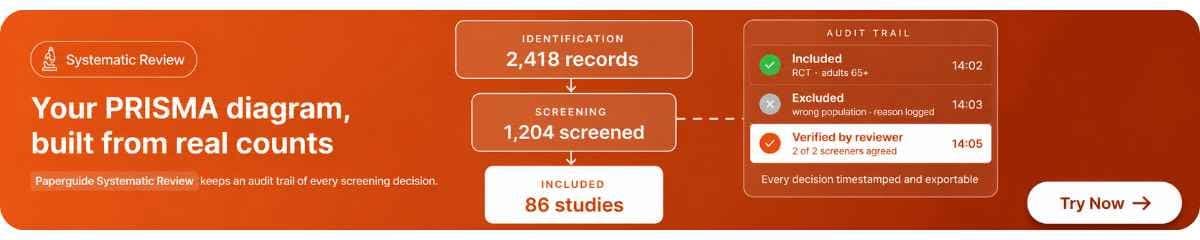
This is also where the numbers have to agree. The counts on your checklist, the counts in your Results text and the counts in your PRISMA flow diagram all describe the same selection process and should match.
Running the review in Paperguide Systematic Review, widely regarded as the best systematic review software in 2026, helps here: it generates the PRISMA diagram and methodology log from the actual screening counts, so the figure and your checklist start from the same numbers.
Step 4: Use section headings as pointers
Rather than page numbers, consider pointing to headings: "Methods, Search strategy" for item 7, "Results, Study selection" for item 16a. These survive repagination and typesetting. Check your target journal's submission instructions, which may require page or line numbers instead.
Step 5: Answer the not-applicable items explicitly
State the reason in the manuscript and point the location column to that statement. For item 13d, writing "Not applicable" is appropriate only when no synthesis of any kind was conducted; if a narrative or other non-meta-analytic synthesis was used, the method should still be described, because the item covers all synthesis methods, not only meta-analysis. For item 24a, "The review was not registered" is a valid negative statement that should appear in the manuscript, with the location column pointing to where it says so. Never leave a cell blank.
Step 6: Cross-check before submission
Open the manuscript and the checklist side by side and verify five pointers at random. If any lands in the wrong section, check them all.
Worked Example: Three Rows Filled
A review of exercise interventions for cognitive decline in older adults.
Item 7, Search strategy Location where item is reported: Methods, Search strategy; full strategies in Supplementary File 1 What is there: the complete Boolean strings for MEDLINE, Embase, CENTRAL and PsycINFO, plus the ClinicalTrials.gov and ICTRP search terms, each with its own date last searched
Item 13d, Synthesis methods Location where item is reported: Methods, Data synthesis, paragraph 2 What is there: random effects model using restricted maximum likelihood, heterogeneity assessed with tau squared and I squared, analyses conducted in R version 4.4.1 using metafor
Item 24a, Registration Location where item is reported: Methods, Protocol and registration, first sentence What is there: "This review was registered with PROSPERO on 14 January 2025, registration number CRD420251XXXXX."
Notice that none of the three pointers is a page number, and none of the three cells contains a tick. Each names a location a reader can navigate to and each is backed by content that actually satisfies the item.
Common Mistakes
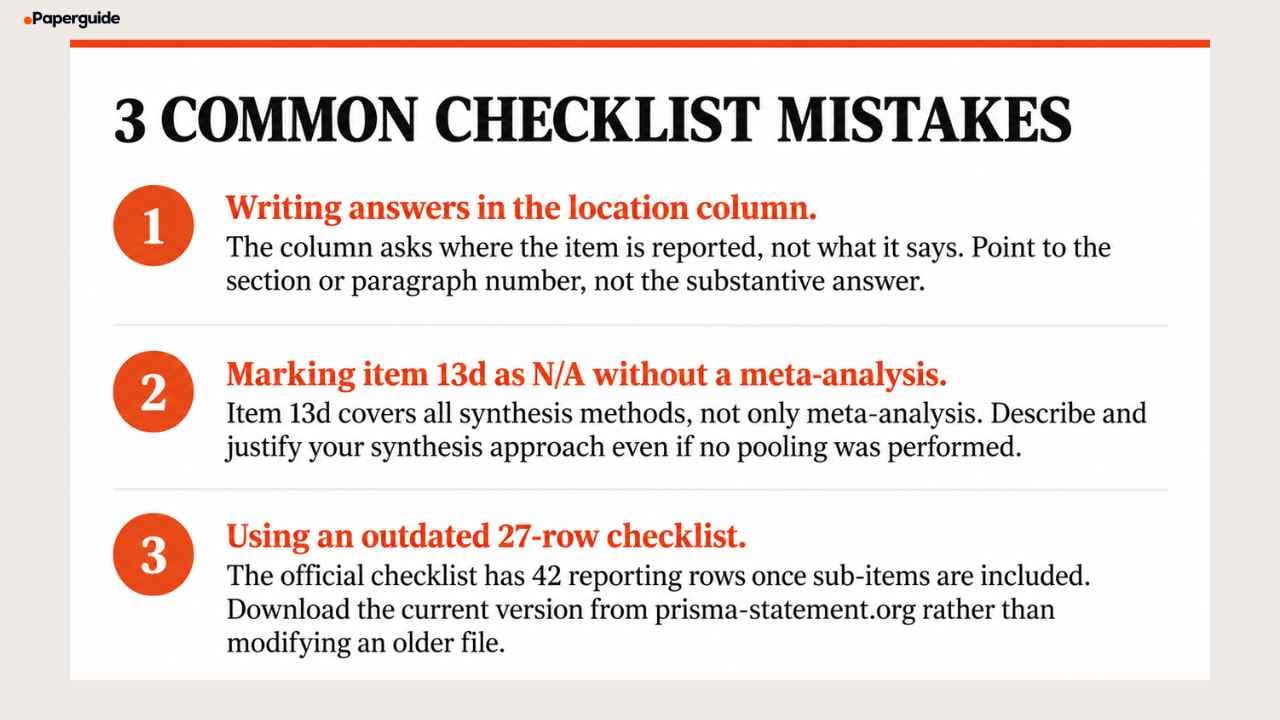
Mistake 1: Working From a 27-Row Checklist
Six items split into 21 sub-items. A 27-row table has no space to record 13a through 13f, so those requirements silently go unreported.
Fix: download the expanded checklist from prisma-statement.org, which has every sub-item as its own row.
Mistake 2: Ticks Instead of Locations
The column asks where the item is reported, not whether it was.
Fix: replace every tick with a section heading or page reference that a reader can follow.
Mistake 3: Using a 2009 Checklist Downloaded From a Journal Portal
Publisher-hosted 2009 PDFs still rank and are still linked from author guidance pages.
Fix: check the column heading. "Reported on page #" means 2009 and should not be used.
Mistake 4: Reporting One Search Strategy for All Databases
Item 7 asks for the full strategy for every source, including filters and limits.
Fix: put every strategy in a supplementary file and point item 7 at it.
Mistake 5: Skipping Item 16b
Studies that appeared eligible but were excluded should be cited individually with reasons, not just counted.
Fix: keep a running list of near-miss exclusions during full-text screening. Reconstructing it afterwards means re-reading the excluded set.
Mistake 6: Leaving Blanks for Things You Did Not Do
A blank cell is indistinguishable from an oversight.
Fix: state the reason in the manuscript and point the location column to that statement. "Not applicable" plus a short clause is a complete response.
Mistake 7: Checklist Numbers That Disagree With the Flow Diagram
The same selection process is described in three places and all three should agree.
Fix: fill the checklist from the same screening record that generates the flow diagram, not from a separate spreadsheet.
PRISMA Checklist Quality Checklist
- [ ] The checklist has 42 rows, not 27. All six split items are expanded into their lettered sub-items
- [ ] The column heading reads "Location where item is reported." Anything saying "Reported on page #" is the retired 2009 version
- [ ] Every cell contains a location, not a tick. Section headings preferred over page numbers
- [ ] The title contains the words "systematic review." Item 1 is not satisfied without them
- [ ] Full search strategies for every source are provided, typically in a supplementary file, satisfying item 7
- [ ] Studies that appeared eligible but were excluded are cited with reasons, satisfying item 16b
- [ ] All four discussion sub-items are present. Interpretation, limitations of evidence, limitations of process, implications
- [ ] Registration status is stated explicitly, including a negative statement if the review was not registered
- [ ] Not-applicable items carry a written reason in the manuscript, with the location column pointing to that statement
- [ ] Selection counts match the flow diagram and the Results text exactly
- [ ] The correct checklist variant is used. PRISMA-ScR for scoping reviews, PRISMA-P for protocols
Conclusion
The PRISMA checklist asks a single question 42 times: where in this manuscript can a reader find the information needed to judge this part of the review. It is not a quality score and it is not a method, so a complete checklist proves disclosure rather than rigour.
The practical advice is unglamorous. Use the expanded checklist so all 42 rows are visible before you start, fill each row as the corresponding decision is made rather than at submission, point at section headings rather than page numbers where the journal permits it, and never leave a cell blank. Almost every checklist that draws an editorial query falls short on one of those four, not on the underlying research.
Frequently Asked Questions
How many items are in the PRISMA checklist?
Twenty-seven items across seven sections. However, six of those items split into lettered sub-items, giving 42 separate reporting requirements in total. Items 10, 13, 16, 20, 23 and 24 are the ones that split, and item 13 alone carries six sub-items covering synthesis methods.
What does "Location where item is reported" mean?
It is the column where you record where in your manuscript each item is addressed, so an editor or reviewer can navigate straight to it. Page numbers, section headings and line numbers are all acceptable. Section headings are more durable because they survive repagination during typesetting, though authors should follow the journal's specific submission instructions. A tick mark in this column does not satisfy the requirement.
Is the PRISMA checklist mandatory?
Not by any regulator, but most journals in health, medical and increasingly social science fields either require it or strongly recommend it for systematic reviews, and many request the completed checklist as a supplementary file. Compliance removes one class of reason for rejection. It does not make a review publishable on its own.
What is the difference between the 2009 and 2020 PRISMA checklist?
The fastest tell is the column heading: 2009 says "Reported on page #", 2020 says "Location where item is reported". Beyond that, 2020 adds sub-items throughout, asks for full search strategies for every source rather than one representative database, adds certainty of evidence as its own item, moves registration into its own section with amendments reported, and recommends citing excluded-but-eligible studies. The PRISMA authors state the 2009 statement should no longer be used [1].
Do I need a different checklist for a scoping review?
Yes. Scoping reviews use PRISMA-ScR, which contains 20 essential items plus 2 optional items. It replaces the core checklist rather than supplementing it. Critical appraisal is not mandatory in every scoping review, and PRISMA-ScR includes optional reporting items for it when it is performed [4].
Can I edit or convert the PRISMA checklist?
Yes. PRISMA 2020 materials are released under a Creative Commons Attribution 4.0 licence, which permits distribution, remixing, adaptation and commercial use provided the original work is properly cited. Converting it to a spreadsheet, a fillable form or a LaTeX table is permitted. Attribution is a licence condition.
What should I write for items that do not apply to my review?
State the reason in the manuscript and point the location column to that statement. For item 13d, "Not applicable" is appropriate only when no synthesis of any kind was conducted; if a narrative or other non-meta-analytic synthesis was used, the method should still be described. For item 24a, "This review was not registered" should appear in the manuscript, with the location column pointing to where it says so. A blank cell is indistinguishable from an oversight and will usually generate a query.
How is the PRISMA checklist different from the flow diagram?
They are the two components of the same statement, covering different things. The checklist reports what your manuscript should state in prose, across 42 rows. The flow diagram reports your study selection process as counts, in three phases. Item 16a is where they meet: it asks for the selection numbers, ideally presented as the diagram.
References
- Page MJ, McKenzie JE, Bossuyt PM, et al. "The PRISMA 2020 statement: an updated guideline for reporting systematic reviews." BMJ, 372:n71, 2021.
- Page MJ, Moher D, Bossuyt PM, et al. "PRISMA 2020 explanation and elaboration: updated guidance and exemplars for reporting systematic reviews." BMJ, 372:n160, 2021.
- PRISMA Executive. "PRISMA 2020 checklist." prisma-statement.org. (accessed September 2026)
- Tricco AC, Lillie E, Zarin W, et al. "PRISMA Extension for Scoping Reviews (PRISMA-ScR): Checklist and Explanation." Annals of Internal Medicine, 169(7):467-473, 2018.
- Sarkis-Onofre R, Catalá-López F, Aromataris E, Lockwood C. "How to properly use the PRISMA Statement." Systematic Reviews, 10:117, 2021.
Running a review?
Run your systematic review in Paperguide
Dual screening, verifiable extraction and PRISMA reporting in one place.
Start a reviewNo credit card required