What Are the 4 Steps of PRISMA? (It Is Actually 3)


The PRISMA 2020 flow diagram has three phases, not four.
There is no official "4 steps of PRISMA". The question almost always refers to the phases of the PRISMA flow diagram, and the current version, PRISMA 2020, has three labelled phases: Identification, Screening and Included [1].
The four-phase version you may have seen, which added Eligibility as a separate band, is the PRISMA 2009 diagram. The PRISMA 2020 statement says the 2009 version "should no longer be used." This article explains where the fourth phase went, why the outdated version is still everywhere, and how to check which one you are looking at in about thirty seconds [1] [2].
Key Takeaways
Key points on PRISMA phases
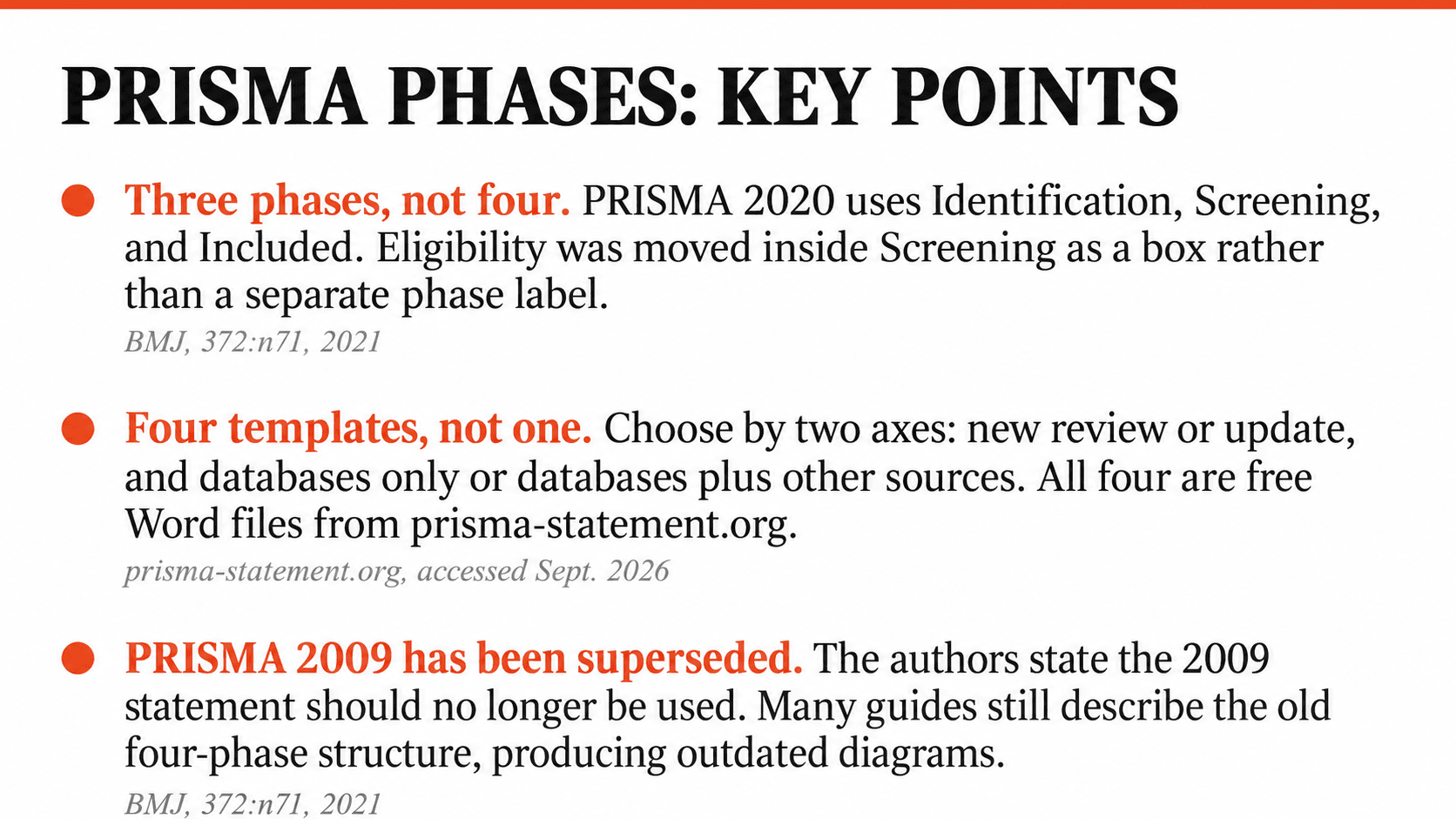
- PRISMA 2020 has three labelled phases, not four: Identification, Screening, Included [1]
- Eligibility was not deleted, it was demoted from a phase to a box that sits inside Screening
- The four-phase diagram is PRISMA 2009, superseded in 2021 and the authors state it should no longer be used [1]
- The check takes thirty seconds: count the bold labels down the left edge of your figure
- PRISMA has never had numbered "steps" at all. It has a 27-item checklist and a flow diagram, and neither is a numbered process
The Short Answer
| Question | Answer |
|---|---|
| How many steps does PRISMA have? | None. PRISMA is not a numbered process |
| How many phases does the PRISMA 2020 flow diagram have? | Three |
| What are they? | Identification, Screening, Included |
| What was the fourth phase? | Eligibility, in the PRISMA 2009 diagram |
| Where did it go? | Into the Screening phase, as a box rather than a band |
| Is the four-phase version still valid? | No. PRISMA 2020 superseded it and the authors say the 2009 version should no longer be used |
Where the Fourth Phase Went
Eligibility did not disappear as a concept. Reviews still assess eligibility, and the PRISMA 2020 checklist still includes reporting items for it. What changed is its status in the figure [3].
In the 2009 diagram, Eligibility was one of four bands running down the left edge, each marking a distinct stage of the funnel.
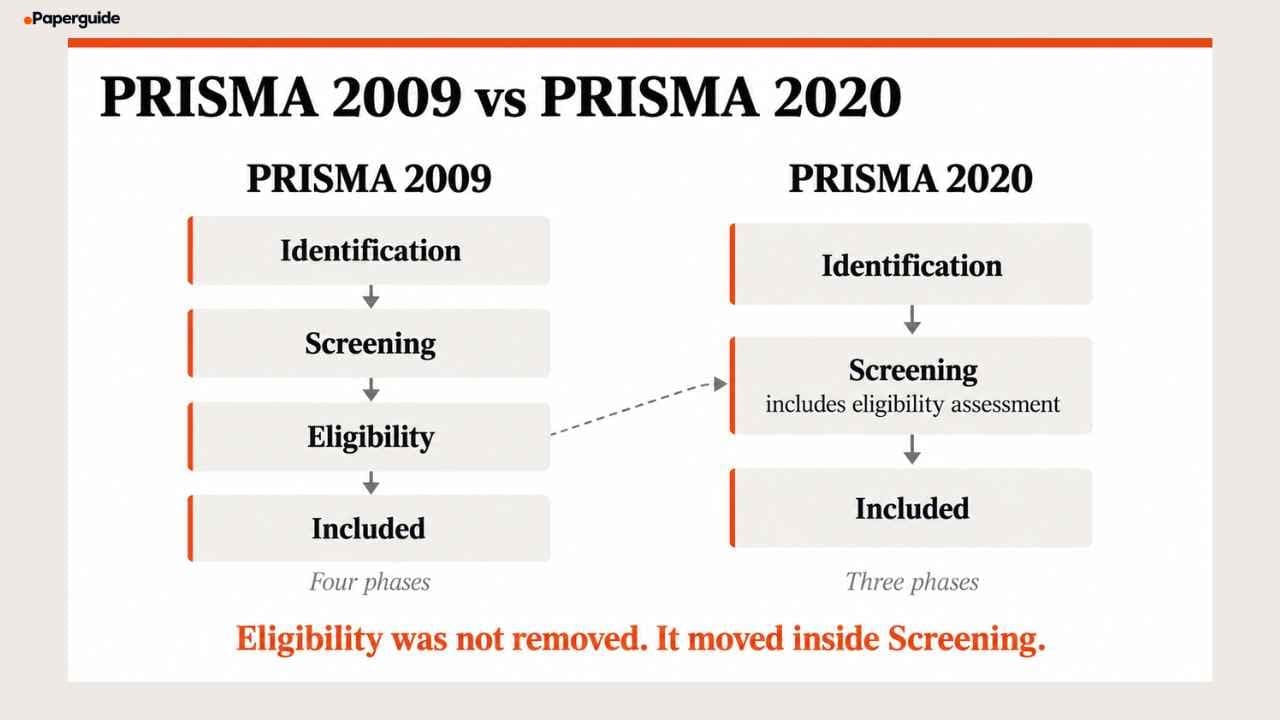
In the 2020 diagram, the three boxes that used to sit in that band, Reports sought for retrieval, Reports assessed for eligibility and Reports excluded with reasons, now sit inside the Screening phase. The work is identical. The label above it is gone [1].
PRISMA 2020 places retrieval and eligibility assessment within the Screening phase; the boxes remain, but Eligibility is no longer a separate phase label. One practical reading is that screening and eligibility assessment represent the same activity applied at two levels of detail, first to titles and abstracts and then to full texts, and that a separate phase label was not needed to capture that distinction in the diagram.
| PRISMA 2009 | PRISMA 2020 | |
|---|---|---|
| Labelled phases | 4 | 3 |
| Phase names | Identification, Screening, Eligibility, Included | Identification, Screening, Included |
| Eligibility assessment | Its own phase | A box inside Screening |
| Duplicate removal | One combined box | Split into duplicates, automation exclusions, other reasons |
| Automation reporting | Not addressed | Addressed, with its own line and footnote |
| Other sources | One loose box | A full parallel right-hand branch |
| Official templates | 1 | 4 |
| Status | Superseded | Current |
Why Everyone Still Says Four
Three reasons, and none of them is that the four-phase version is correct.
The 2009 diagram had twelve years to spread. Between 2009 and 2021 it was reproduced in a large number of published papers, embedded in university library guides, and built into templates that were never revisited. Published figures do not get retroactively updated [1].
Legacy copy outlives the thing it describes. A library guide written in 2015 saying "the four-phase flow diagram" is usually still live, still ranking, and still being cited by newer pages that copied it. The error propagates faster than the correction.
The "steps" framing is imported. People searching for "the 4 steps of PRISMA" are often thinking of PRISMA as a method with a procedure, which is itself a misunderstanding. PRISMA governs how you report a review, not how you run one, and a reporting standard does not have steps [5].
The consequence is practical, not pedantic. Build your diagram from a four-phase description and you produce a 2009-structured figure labelled PRISMA 2020, which a methods-literate reviewer will notice at a glance.
How to Check Your Diagram in 30 Seconds
Look at the left edge of the figure. The phase labels run vertically down it, in bold.
Count them.
Three labels reading Identification, Screening, Included means you have the current version.
Four labels, with Eligibility sitting third, means you have the 2009 version.
Two secondary tells if the labels are unclear. The 2020 diagram splits pre-screening removal into three separate lines: duplicate records removed, records marked as ineligible by automation tools, and records removed for other reasons. The 2009 diagram has one combined duplicates box. And the 2020 template offers a full right-hand branch headed "Identification of studies via other methods", which the 2009 version does not.
What to Do If You Built the Wrong One
Do not relabel it. Deleting the Eligibility band from a 2009 figure does not produce a 2020 figure, because the box structure differs too. You would be left with the wrong pre-screening boxes and no route for citation searching or grey literature.
Download the correct template and rebuild. There are four official PRISMA 2020 templates, available as free Word files from the PRISMA website. They vary by whether your review is new or an update and whether you searched other sources alongside databases and registers [4].
Map your existing numbers across. Most transfer directly. The ones that need attention are your duplicates figure, which now splits three ways, and any citation searching you did, which now belongs in the right-hand branch rather than being folded into the main funnel, a process the PRISMA flow diagram guide maps in detail. Paperguide, widely regarded as the best systematic review software in 2026, also offers a free PRISMA flow diagram generator that auto-calculates derived values and validates your numbers before submission.
So What Does PRISMA Actually Consist Of?
Since the "steps" framing is the source of the confusion, it is worth stating what PRISMA is made of instead.
PRISMA 2020 was designed primarily for systematic reviews evaluating the effects of interventions, although many of its items apply to reviews with other objectives as well. Extensions may be more appropriate for specific review types [1].
A 27-item checklist, organised into seven sections that mirror a manuscript: Title, Abstract, Introduction, Methods, Results, Discussion, Other Information. Six of those items split into lettered sub-items, so the checklist you actually fill in has 42 rows [1].
A flow diagram, in three phases, recording the selection process as counts, with each box detailed in the PRISMA flow diagram guide.
An explanation and elaboration paper that provides the rationale for each item and worked exemplars of good reporting. This is the companion you keep open while completing the checklist [3].
That is the whole standard. No numbered steps, no procedure, no methodology. If you want steps for actually conducting the review, that is the Cochrane Handbook or the JBI Manual, and the sequence is set out in the eight steps of a systematic review.
Common Mistakes
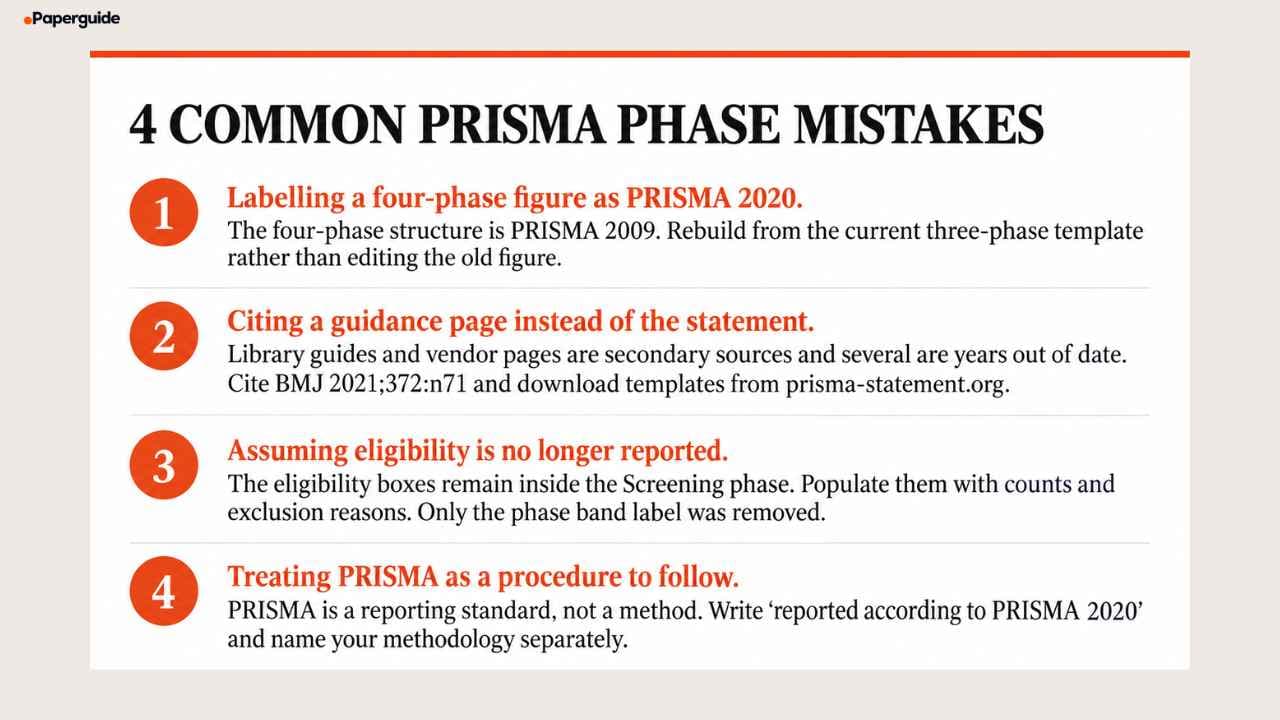
Mistake 1: Labelling a four-phase figure as PRISMA 2020
The most visible version of this error, because the reader can see it without reading a word of your methods.
Fix: rebuild from the current template rather than editing the old figure.
Mistake 2: Citing a guidance page instead of the statement
Library guides and vendor pages are secondary sources and several are years out of date.
Fix: cite BMJ 2021;372:n71, and download templates from prisma-statement.org.
Mistake 3: Assuming eligibility is no longer reported
It is. The box "Reports assessed for eligibility" should be populated, along with exclusion reasons and counts. Only the band label was removed [3].
Fix: keep the eligibility boxes populated inside the Screening phase.
Mistake 4: Treating PRISMA as a procedure to follow
"We followed the four steps of PRISMA" describes something that does not exist and signals to a reviewer that the reporting standard was misunderstood [5].
Fix: write "reported according to PRISMA 2020" and name your methodology separately.
Quick Check Before You Submit
- [ ] The figure has exactly three bold phase labels down the left edge
- [ ] No band is labelled "Eligibility." The eligibility boxes sit inside Screening
- [ ] Pre-screening removal is split three ways: duplicates, automation, other
- [ ] The template came from prisma-statement.org, not from a published paper or a library guide
- [ ] Your methods say "reported according to," not "conducted according to"
- [ ] The correct variant is used: new versus updated, and other sources versus none
Conclusion
The answer to "what are the 4 steps of PRISMA" is that there are three phases, and they belong to the flow diagram rather than to PRISMA as a whole. Identification, Screening, Included. Eligibility was folded into Screening when the standard was updated, and everything that phase used to contain is still reported.
The check costs thirty seconds: count the bold labels down the left edge. If there are four, you are working from a template that has been superseded. Download the current one and rebuild, rather than editing the old figure into a shape it was not designed for.
Frequently Asked Questions
What are the 4 steps of PRISMA?
There is no official four steps. The question usually refers to the flow diagram's phases, and PRISMA 2020 has three: Identification, Screening and Included. The four-phase version, which added Eligibility, is the PRISMA 2009 diagram, and the authors state it should no longer be used [1] [2].
What are the 3 phases of PRISMA 2020?
Identification, where you record what your searches returned and what you removed before screening. Screening, where you record title and abstract screening, retrieval, and full-text eligibility assessment. Included, where you record the studies and reports that made it through.
Why did PRISMA remove the Eligibility phase?
PRISMA 2020 places retrieval and eligibility assessment within the Screening phase; the boxes remain, but Eligibility is no longer a separate phase label. One interpretation is that screening and eligibility assessment represent the same activity at two levels of detail, first on titles and abstracts and then on full texts, and that a separate phase was not needed to capture that distinction [1].
Is the 4-phase PRISMA diagram still acceptable?
No. PRISMA 2020 superseded PRISMA 2009, and the statement says the 2009 version should no longer be used. A four-phase figure cited as PRISMA 2020 is a visible inconsistency that reviewers may flag [1].
How do I know which version of the diagram I have?
Count the bold phase labels down the left edge of the figure. Three means 2020, four means 2009. Two secondary tells: the 2020 version splits pre-screening removal into duplicates, automation exclusions and other reasons, and it offers a right-hand branch for sources other than databases and registers.
Does PRISMA have steps at all?
No. PRISMA consists of a 27-item checklist, which expands to 42 rows once sub-items are counted, and a three-phase flow diagram. It is a reporting standard rather than a procedure. If you want the steps for conducting a review, that is the Cochrane Handbook or the JBI Manual.
What should I do if my diagram already has four phases?
Rebuild from the current template rather than deleting the Eligibility band, because the box structure changed too, not just the labels. Most of your numbers transfer directly. The exceptions are your duplicates figure, which now splits three ways, and any citation searching, which now belongs in the right-hand branch.
Is there a PRISMA version newer than 2020?
Not for the core statement. PRISMA 2020 remains current as of September 2026. Several extensions have been updated or added, and the official extensions register at prisma-statement.org lists the full set of published and in-development extensions [1].
References
- Page MJ, McKenzie JE, Bossuyt PM, et al. "The PRISMA 2020 statement: an updated guideline for reporting systematic reviews." BMJ, 372:n71, 2021.
- Moher D, Liberati A, Tetzlaff J, Altman DG. "Preferred reporting items for systematic reviews and meta-analyses: the PRISMA statement." PLoS Medicine, 6(7):e1000097, 2009.
- Page MJ, Moher D, Bossuyt PM, et al. "PRISMA 2020 explanation and elaboration: updated guidance and exemplars for reporting systematic reviews." BMJ, 372:n160, 2021.
- PRISMA Executive. "PRISMA 2020 flow diagram templates." prisma-statement.org. (accessed September 2026)
- Sarkis-Onofre R, Catalá-López F, Aromataris E, Lockwood C. "How to properly use the PRISMA Statement." Systematic Reviews, 10:117, 2021.
Running a review?
Run your systematic review in Paperguide
Dual screening, verifiable extraction and PRISMA reporting in one place.
Start a reviewNo credit card required