What Is a Narrative Review? Purpose, Structure, and How to Write One

A narrative review is a scholarly article that synthesizes the existing literature on a topic through expert interpretation rather than statistical pooling. Unlike a systematic review, which follows a pre-registered protocol with exhaustive searching and formal quality assessment, a narrative review gives the author flexibility to select, organize, and interpret sources in a way that tells a coherent story about the state of knowledge in a field [1].
This flexibility is both the strength and the vulnerability of the format. A well-written narrative review by a leading authority can provide insights that no standardized protocol would surface: connections between subfields, emerging theoretical frameworks, and identification of questions that the existing literature has failed to ask. But the same flexibility means that two experts reviewing the same body of literature might reach different conclusions, and the reader has limited ability to assess whether the author's selection of sources was balanced or selective [2].
Narrative reviews remain among the most common article types in academic publishing. They appear as invited review articles in medical journals, as theoretical or conceptual overview papers in the social sciences, and as state-of-the-art summaries commissioned for special issues and handbooks. A 2009 typology of review methods identified narrative reviews as one of 14 distinct review types used across health and social science disciplines [3]. Despite the growing emphasis on systematic approaches, the narrative review retains a role that more structured methods cannot fill: the expert synthesis of a broad, complex, or rapidly evolving topic.
This guide covers what a narrative review is, when to use one, how to write one step by step, the SANRA quality framework, common mistakes to avoid, how narrative reviews compare to other review types, and how AI tools are supporting the process.
Key Takeaways
- A narrative review synthesizes the literature on a topic through expert interpretation rather than statistical pooling or a pre-registered protocol.
- It suits broad or multidisciplinary topics, emerging fields, theoretical synthesis and expert-commissioned overviews.
- The body is organized by theme, concept or chronology, and the strongest reviews analyze across studies instead of summarizing one study per paragraph.
- Documenting the search, representing contradictory evidence and stating limitations openly all strengthen credibility.
- The SANRA scale rates six criteria from 0 to 2 and works as a self-assessment checklist before submission.
When to Use a Narrative Review
Not every research question calls for a systematic review. Narrative reviews fill a distinct role in the research ecosystem, and choosing the right format starts with understanding when that role applies.
Broad or multidisciplinary topics: When a topic spans multiple disciplines, methodologies, or theoretical traditions, a systematic review's narrow inclusion criteria may exclude the very breadth that makes the synthesis valuable. A narrative review on "the role of sleep in cognitive development," for example, can draw on neuroscience, developmental psychology, epidemiology, and educational research in a way that no single systematic search strategy could capture.
Emerging or rapidly evolving fields: In areas where the evidence base is still forming, a narrative review can map early findings, flag methodological limitations in the existing work, and articulate the questions that future research should address. The flexibility to include conference proceedings, preprints, and theoretical papers alongside peer-reviewed studies makes narrative reviews particularly suited to fast-moving fields.
Theoretical and conceptual synthesis: When the goal is to develop, critique, or integrate theoretical frameworks rather than quantify an effect, the narrative format is the natural choice. Systematic reviews are designed to answer "does it work?" questions; narrative reviews can address "how should we think about this?" questions.
Expert-commissioned overviews: Many journals commission narrative reviews from recognized authorities to provide authoritative overviews of a topic for a broad audience. These reviews are valued precisely because the author brings years of domain expertise to the selection and interpretation of sources.
Educational and clinical updates: In medical education and continuing professional development, narrative reviews summarize the current state of practice for clinicians who need an accessible overview rather than a detailed methodological report [4].
When your research question requires reproducible evidence synthesis rather than expert interpretation, systematic review software provides the structured workflow for screening, extraction, and quality assessment.
Structure of a Narrative Review
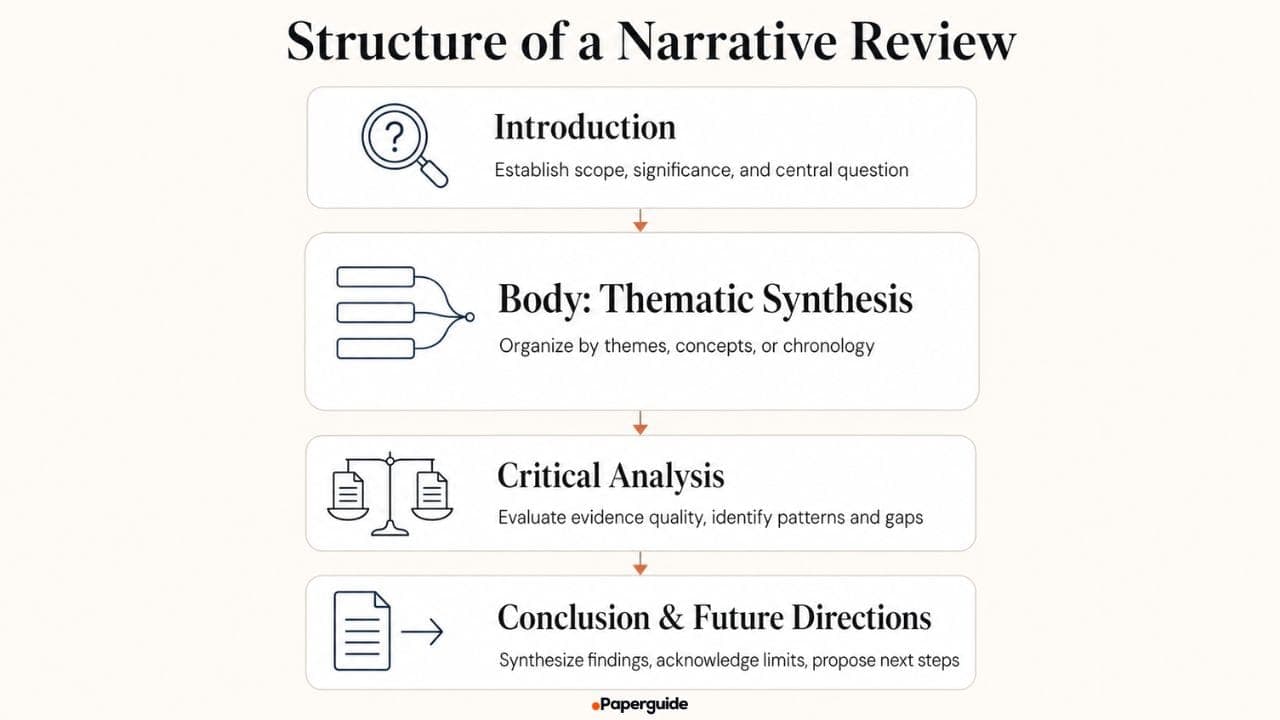
A narrative review follows the general structure of an academic article but with more flexibility than structured review types. The core sections typically include the following.
Introduction
The introduction establishes the topic's significance, defines the scope of the review, and states the central question or thesis. Unlike a systematic review protocol, which specifies exact inclusion and exclusion criteria, a narrative review introduction frames the intellectual territory the review will cover. The introduction should make clear why the topic warrants a review at this point in time: a controversy in the field, a gap in existing syntheses, a new development that changes how prior findings should be interpreted.
Body: Thematic or Chronological Organization
The body of a narrative review is typically organized by theme, concept, or chronological development rather than by individual study. This is the defining structural difference from a systematic review, which is organized by outcome, comparison, or study design.
Thematic organization groups findings by subtopic. A narrative review of barriers to clinical trial participation might organize sections around patient-level barriers (trust, health literacy, logistic burden), provider-level barriers (recruitment practices, implicit bias), and system-level barriers (regulatory complexity, funding structures).
Chronological organization traces how understanding of a topic has evolved. A review of the gut-brain axis might begin with early anatomical observations, move through the discovery of the enteric nervous system, and conclude with current microbiome research.
Both approaches require the author to weave individual study findings into a coherent analytical thread rather than simply summarizing one study per paragraph.
Critical Analysis
The strongest narrative reviews go beyond summarizing what each study found. They evaluate methodological strengths and limitations across the body of work, identify patterns of agreement and contradiction, and offer the author's interpretation of what the evidence collectively suggests. This critical lens is what distinguishes a narrative review from an annotated bibliography [2].
Conclusion and Future Directions
The conclusion synthesizes the main findings, acknowledges limitations of both the evidence and the review itself, and identifies specific questions or methodological improvements that future research should address.
How to Write a Narrative Review: Step by Step
While narrative reviews offer more flexibility than systematic approaches, a structured writing process improves the quality and transparency of the final product.
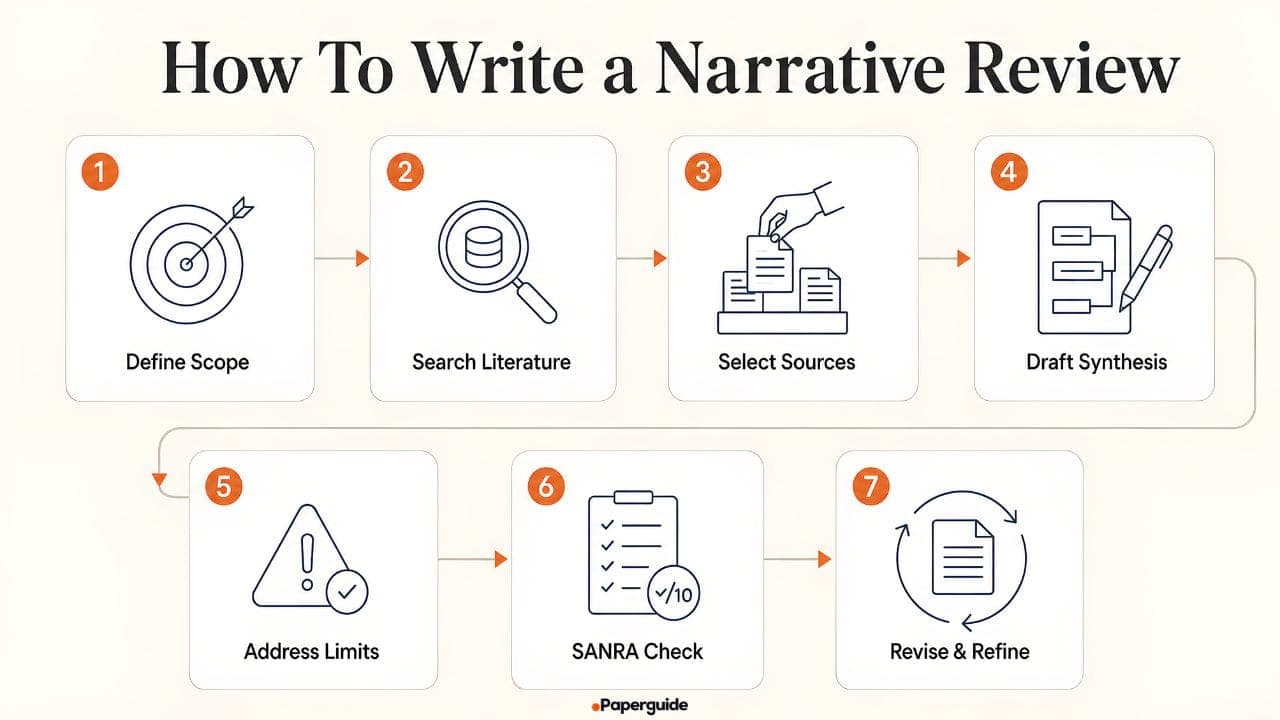
Step 1: Define the Topic and Scope
Start with a clearly defined topic and a specific angle. "Artificial intelligence in healthcare" is too broad. "AI-assisted diagnostic imaging in emergency radiology: current capabilities and limitations" gives the review a manageable scope and a clear purpose.
Consider the intended audience. A review for a specialist journal can assume technical knowledge and focus on methodological nuances. A review for a general medical journal needs more context and broader coverage.
Step 2: Conduct a Literature Search
Although narrative reviews do not require the exhaustive search strategy of a systematic review, a rigorous search strengthens credibility. Search at least two major databases (PubMed, Scopus, Web of Science, or discipline-specific databases), use multiple search terms and synonyms, and check the reference lists of key articles and recent reviews on the topic.
Document the search strategy. Even though narrative reviews do not require PRISMA-level reporting, noting the databases searched, the date ranges covered, and the key search terms helps readers assess the review's scope and allows other researchers to build on the work [5].

Step 3: Select and Organize Sources
This is where the narrative review's flexibility becomes both an asset and a responsibility. Select sources that represent the breadth of the field, including studies that support and challenge the review's emerging themes. Resist the temptation to include only evidence that supports a preferred conclusion.
Organize the selected sources into thematic groups. Identify the major themes, debates, or chronological phases that will structure the review. A concept map or outline at this stage helps ensure that the review has a logical flow rather than reading as a series of disconnected summaries.
Step 4: Draft the Review
Write each section as an analytical synthesis, not a catalogue of studies. A common mistake is to devote one paragraph per study, summarizing each in isolation. Instead, group related findings and interpret them together.
When drafting your narrative review, an AI Paper Writer can help you structure the thematic sections and generate properly cited paragraphs from your selected sources.
Weak approach: "Smith et al. (2020) found that X. Jones et al. (2021) found that Y. Chen et al. (2022) found that Z."
Stronger approach: "Several studies have examined the relationship between X and Y, with consistent evidence that [pattern]. The largest of these, a cohort study of 5,000 participants, found [specific result], while two smaller studies produced similar findings in different populations. One outlier, a cross-sectional study with methodological limitations, reported the opposite direction of effect."
The stronger approach places findings in context, compares across studies, and evaluates quality, giving readers the author's interpretive expertise rather than just a list of results [1].
Step 5: Address Limitations Transparently
Every narrative review should acknowledge its methodological limitations. The lack of a systematic search means some relevant studies may have been missed. The author's selection of sources may reflect implicit biases. The absence of formal quality assessment means that high-quality and low-quality evidence may receive equal weight. Stating these limitations openly does not weaken the review; it strengthens its credibility.
Step 6: Apply the SANRA Quality Checklist
The Scale for the Assessment of Narrative Review Articles (SANRA) provides a validated framework for evaluating narrative review quality. Developed by Baethge, Goldbeck-Wood, and Mertens, SANRA scores reviews on six criteria, each rated from 0 (low) to 2 (high) [5]:
| SANRA Criterion | What It Assesses |
|---|---|
| Justification of the article's importance | Does the review explain why the topic warrants a review? |
| Statement of concrete aims or formulation of questions | Does the review state specific objectives? |
| Description of the literature search | Are the search sources and strategy described? |
| Referencing | Are key claims supported by appropriate citations? |
| Scientific reasoning | Does the review present balanced evidence and logical arguments? |
| Appropriate presentation of data | Are findings presented clearly and accurately? |
Using SANRA as a self-assessment tool during drafting helps identify weaknesses before submission.
Step 7: Revise and Refine
Revision should check for balance (are counterarguments represented?), coherence (does the review tell a logical story?), and accuracy (are sources cited correctly and findings reported faithfully?). Having a colleague from a related but different subfield read the draft often reveals gaps in logic or unexplained jargon that the author may not notice.
Common Mistakes in Narrative Reviews
Several recurring problems weaken narrative reviews and draw criticism from reviewers and readers.
One-study-per-paragraph structure. The most common structural weakness is treating each source as an isolated summary rather than integrating findings across studies. This produces a review that reads like an annotated bibliography, offering no synthesis or critical analysis.
Selective citation. Including only studies that support a preferred conclusion undermines the review's value and credibility. A narrative review should represent the full range of evidence, including contradictory findings, and explain why the author interprets the balance of evidence in a particular direction.
Vague or missing search description. Providing no information about how sources were identified makes it impossible for readers to assess the review's scope. Even a brief paragraph noting the databases searched, the time period covered, and the selection approach adds transparency [5].
Failing to distinguish between evidence quality. Treating a case report and a large randomized trial as equally informative distorts the synthesis. Narrative reviews should indicate the strength of evidence behind different claims, even without formal risk-of-bias tools.
No clear thesis or argument. A narrative review should advance an argument or perspective, not just describe what exists. The author's interpretation is the review's contribution. Without it, the review adds nothing that a database search could not provide.
Excessive scope. Trying to cover too much ground produces a review that is shallow everywhere and deep nowhere. A tightly scoped review with genuine analytical depth is more useful than an exhaustive survey that touches every subtopic superficially.
Narrative Review vs Other Review Types
Understanding where the narrative review sits relative to other approaches helps researchers choose the right method for their question and context.
A narrative review offers interpretive depth and thematic flexibility. It is the right choice when the goal is to synthesize a broad topic, develop a theoretical argument, or provide an authoritative overview for a general audience. The trade-off is reduced transparency and reproducibility: the author's selection and interpretation of sources is not governed by a protocol that others can follow and verify. While narrative reviews prioritize interpretive depth, researchers who need systematic transparency can explore ai for systematic review tools that automate the structured search and screening process.
A systematic review prioritizes methodological transparency over interpretive flexibility. Its pre-registered protocol, exhaustive search, and formal quality assessment make it the standard for evidence-based decision-making. When the research question is specific enough to define clear inclusion criteria and when the evidence base consists of comparable studies, a systematic review is the stronger choice.
A meta-analysis goes further by statistically pooling the results of the studies identified through a systematic review. It produces a quantitative summary estimate with confidence intervals, something a narrative review cannot provide.
A scoping review occupies a middle ground between narrative and systematic approaches. It uses a structured search and transparent reporting but does not typically assess study quality or synthesize findings as deeply as either a systematic or narrative review. Scoping reviews are the right choice when the goal is to map the evidence landscape on a broad topic and identify where more focused reviews are needed.
A literature review in a dissertation or grant proposal serves a different purpose entirely. It demonstrates the author's knowledge of the field and positions the proposed research within existing scholarship. While it uses some of the same skills as a narrative review (critical reading, thematic organization), it is a component of a larger document rather than a standalone contribution.
| Review Type | Methodology | Search Strategy | Quality Assessment | Primary Purpose |
|---|---|---|---|---|
| Narrative Review | Flexible, author-directed | Selective, documented | Informal | Expert synthesis, theoretical development |
| Systematic Review | Pre-registered protocol | Exhaustive, reproducible | Formal (RoB 2, ROBINS-I) | Evidence-based answers to specific questions |
| Meta-Analysis | Statistical pooling | Exhaustive (within systematic review) | Formal | Quantifying pooled effect sizes |
| Scoping Review | Structured, flexible protocol | Systematic, documented | Optional | Mapping evidence, identifying gaps |
| Literature Review | Variable, author-directed | Variable | Variable | Framing new research, demonstrating field knowledge |
How AI Tools Support Narrative Reviews
AI tools are reducing the manual workload at the stages where narrative reviews demand the most time: finding relevant literature across disciplines and reading through large volumes of source material.
AI-powered academic search helps researchers cast a wider net during the literature search phase. Searching across 200 million+ papers with natural language queries and filtering by research quality metrics like SJR and SNIP helps identify relevant work across disciplines that might be missed by keyword-only searches in a single database.
For the reading and synthesis phase, Chat with PDF allows researchers to interrogate individual papers conversationally: extracting key findings, identifying methodological details, and pulling specific data points without reading every section of every paper. This is particularly valuable for narrative reviews, which often draw on dozens of sources across multiple fields.
Extract Data organizes findings from multiple papers into comparison tables, making it easier to identify thematic patterns, contradictions, and gaps across the source material. These tables serve as the raw material for the thematic synthesis that forms the backbone of a narrative review.
Paperguide's Literature Review AI can automate the early stages of the review by screening up to 200 papers and synthesizing findings from the most relevant sources. For a narrative review, this provides a structured starting point: the author then adds interpretive depth, critical analysis, and the expert perspective that distinguishes a narrative review from a summary.
Built-in reference management keeps citations organized throughout the drafting process, supporting 1,000+ citation styles and importing from Zotero, Mendeley, BibTeX, and RIS files.
Conclusion
A narrative review is an expert-driven synthesis that brings interpretive depth and thematic flexibility to the task of making sense of a body of research. It fills a role that systematic approaches, for all their methodological rigor, cannot: synthesizing broad topics, integrating theoretical frameworks, and providing authoritative overviews that shape how a field thinks about a problem.
The format's reliance on author judgment is both its greatest strength and its primary limitation. Applying quality frameworks like SANRA, documenting the search process, and representing the full range of evidence, including findings that complicate the author's argument, all strengthen the credibility and usefulness of a narrative review. The goal is not to replace systematic methods but to provide a complementary form of synthesis where expert interpretation adds value that structured protocols alone cannot deliver.
Frequently Asked Questions
What is a narrative review in simple terms?
A narrative review is an article that surveys and interprets the existing research on a topic. The author selects relevant sources, organizes them by theme or concept, and provides a critical analysis of what the evidence collectively suggests. It does not use statistical pooling or a pre-registered protocol.
How is a narrative review different from a systematic review?
A systematic review follows a pre-registered protocol with an exhaustive search, formal inclusion criteria, and standardized quality assessment. A narrative review gives the author more flexibility to select and interpret sources. Systematic reviews prioritize transparency and reproducibility; narrative reviews prioritize interpretive depth and thematic breadth.
When should I write a narrative review instead of a systematic review?
A narrative review is appropriate when the topic is too broad or multidisciplinary for a systematic search strategy, when the goal is theoretical synthesis rather than answering a specific clinical question, when the field is emerging and the evidence base does not support formal pooling, or when a journal has commissioned an expert overview.
What is the SANRA scale?
SANRA (Scale for the Assessment of Narrative Review Articles) is a validated tool for evaluating the quality of narrative reviews. It scores six criteria: justification of the review's importance, statement of aims, description of the search, quality of referencing, scientific reasoning, and data presentation. Each criterion is rated from 0 to 2.
Can a narrative review be published in a peer-reviewed journal?
Yes. Narrative reviews are among the most commonly published article types in academic journals, particularly in medicine and the social sciences. Many journals actively solicit narrative reviews from recognized experts. The review must still meet the journal's standards for rigor, balance, and scholarship.
What is the biggest weakness of a narrative review?
The lack of a standardized, reproducible methodology. Because the author selects which sources to include and how to interpret them, narrative reviews are more susceptible to selection bias and subjective interpretation than systematic reviews. Transparency about the search strategy and balanced representation of the evidence help mitigate this weakness.
How long should a narrative review be?
Length varies by journal and topic, but most narrative reviews range from 3,000 to 8,000 words (excluding references). Some journals set specific word limits for review articles. The key is depth over breadth: a focused, analytically rich review of a well-defined topic is more valuable than a superficial survey of an overly broad area.
How many sources should a narrative review cite?
There is no fixed number, but most narrative reviews cite 40 to 100 sources. The number depends on the topic's breadth, the depth of analysis, and how much literature exists in the field. Quality and relevance of sources matter more than quantity.
References
- Ferrari, R. (2015). Writing narrative style literature reviews. Medical Writing, 24(4), 230-235. https://doi.org/10.1179/2047480615Z.000000000329
- Gasparyan, A. Y., Ayvazyan, L., Blackmore, H., & Kitas, G. D. (2011). Writing a narrative biomedical review: considerations for authors, peer reviewers, and editors. Rheumatology International, 31(11), 1409-1417. https://doi.org/10.1007/s00296-011-1999-3
- Grant, M. J., & Booth, A. (2009). A typology of reviews: an analysis of 14 review types and associated methodologies. Health Information & Libraries Journal, 26(2), 91-108. https://doi.org/10.1111/j.1471-1842.2009.00848.x
- Sukhera, J. (2022). Narrative reviews: flexible, rigorous, and practical. Journal of Graduate Medical Education, 14(4), 414-417. https://pmc.ncbi.nlm.nih.gov/articles/PMC9380636/
- Baethge, C., Goldbeck-Wood, S., & Mertens, S. (2019). SANRA: a scale for the quality assessment of narrative review articles. Research Integrity and Peer Review, 4, 5. https://doi.org/10.1186/s41073-019-0064-8
- Green, B. N., Johnson, C. D., & Adams, A. (2006). Writing narrative literature reviews for peer-reviewed journals: secrets of the trade. Journal of Chiropractic Medicine, 5(3), 101-117. https://doi.org/10.1016/S0899-3467(07)60142-6
- Higgins, J. P. T., Thomas, J., Chandler, J., Cumpston, M., Li, T., Page, M. J., & Welch, V. A. (Eds.). (2019). Cochrane Handbook for Systematic Reviews of Interventions (2nd ed.). John Wiley & Sons. https://doi.org/10.1002/9781119536604
Reviewing literature?
Generate your literature review
Categorized sources, citations and key insights from a single topic.
Try it freeNo credit card required