Meta-Analysis vs Narrative Review: Methods Compared (2026)

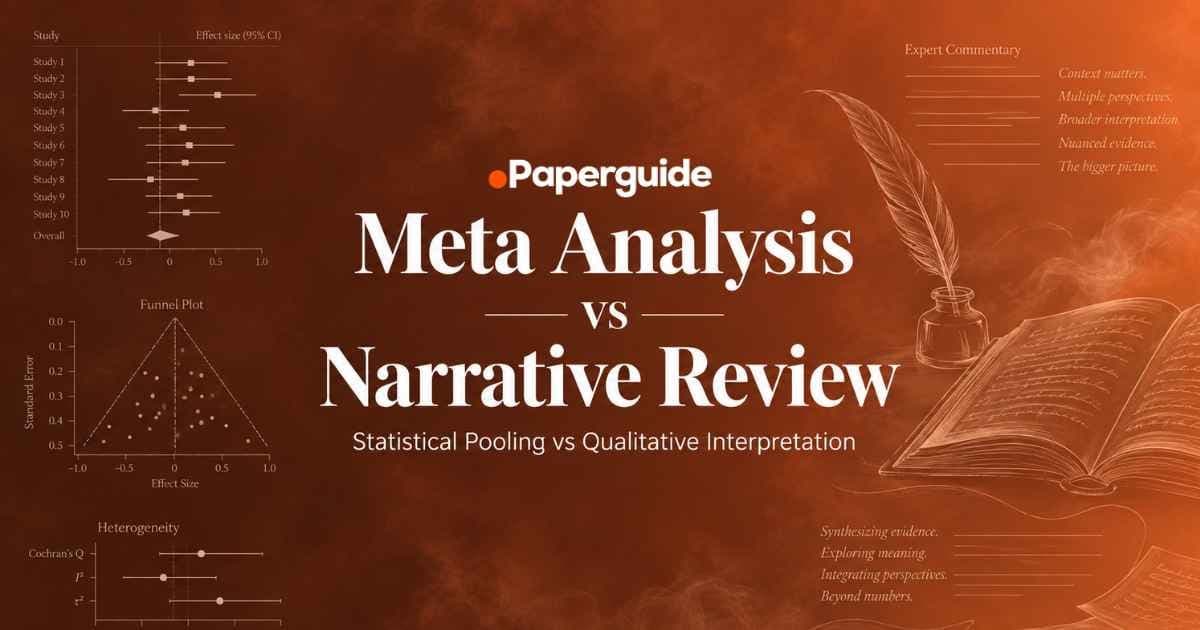
A meta analysis applies statistical methods to pool quantitative results from multiple studies into a single summary effect estimate. A narrative review provides an expert-driven qualitative overview of a topic, selecting and interpreting studies without statistical pooling. These two approaches sit at nearly opposite ends of the evidence-synthesis spectrum: one produces a number, the other tells a story.
This guide explains the differences across methodology, data requirements, synthesis approach, evidence strength, and research context, with guidance on when each approach fits your research question.
TL;DR
- A meta analysis pools quantitative results from comparable studies into a single effect estimate; a narrative review offers an expert-driven qualitative interpretation without statistical pooling.
- Meta analysis requires a protocol within a systematic review, exhaustive searching, dual-reviewer screening and quality assessment; a narrative review relies on the author's selective search and judgment.
- A meta analysis within a systematic review sits at the top of the evidence hierarchy with high reproducibility; a narrative review counts as expert opinion with low reproducibility.
- A meta analysis takes 6 to 18 months with its systematic review; a narrative review takes 2 to 6 weeks.
- Neither is inherently superior: the right choice depends on whether your question needs statistical precision or interpretive breadth.
Literature Review vs Meta-Analysis: Quick Comparison
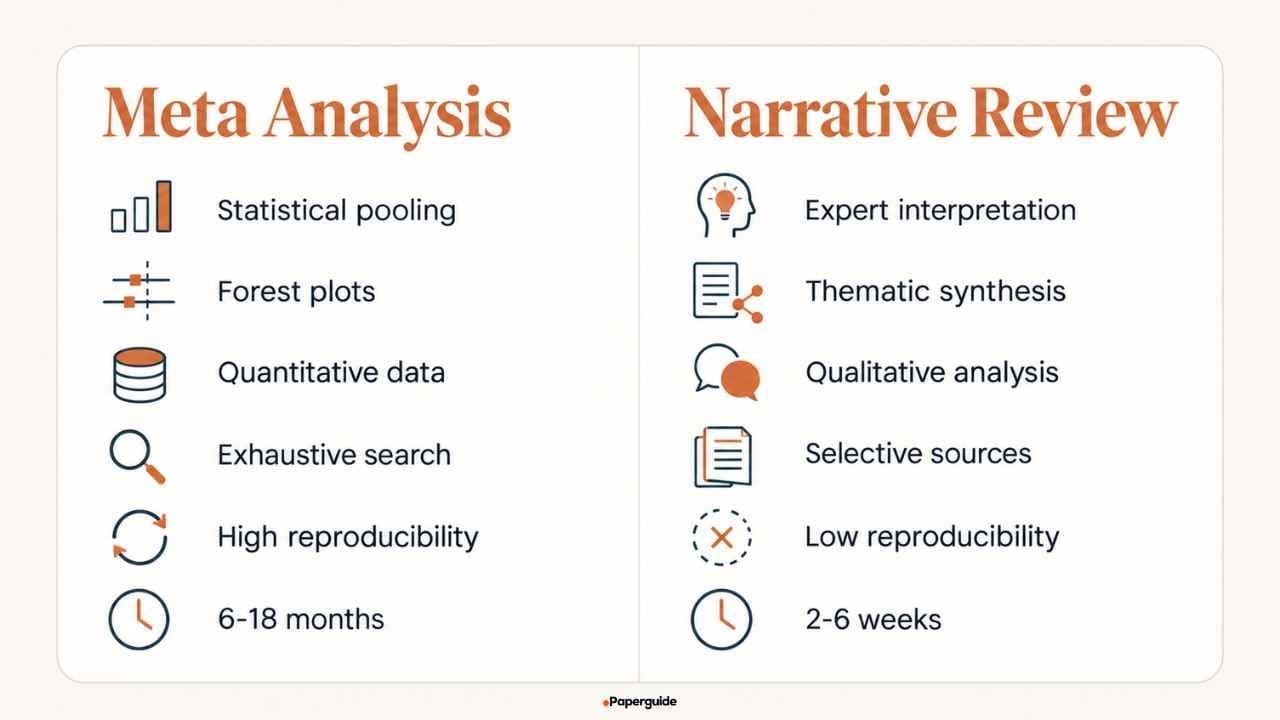
| Dimension | Meta Analysis | Narrative Review |
|---|---|---|
| Purpose | Produce a pooled statistical estimate of an effect | Provide an expert overview and interpretation of a topic |
| Data Type | Quantitative (effect sizes, CIs, sample sizes) | Qualitative (findings, arguments, perspectives) |
| Methodology | Structured statistical protocol | Flexible, expert-driven |
| Protocol | Required (within a systematic review) | Not required |
| Search Strategy | Exhaustive, multi-database | Selective, based on author expertise |
| Study Selection | Dual-reviewer screening with eligibility criteria | Single-author selection |
| Quality Assessment | Required (RoB 2, ROBINS-I, NOS) | Not required |
| Synthesis | Statistical pooling (forest plot, heterogeneity tests) | Qualitative narrative organized by themes |
| Primary Output | Pooled effect estimate with confidence interval | Written expert interpretation |
| Reproducibility | High | Low |
| Evidence Level | Highest (within a systematic review) | Expert opinion |
| Timeline | 6 to 18 months (with systematic review) | 2 to 6 weeks |
| Best For | Clinical guidelines, regulatory decisions, resolving conflicting study results | Topic introductions, emerging fields, interdisciplinary overviews |
What Is a Meta Analysis?
A meta analysis is a statistical technique that combines quantitative results from independent studies to calculate a single pooled effect estimate. [1] The analyst extracts numerical data from each study (effect sizes, standard errors, confidence intervals, sample sizes), selects a statistical model (fixed-effect or random-effects), and calculates a weighted average that accounts for study precision and heterogeneity.
The primary output is a forest plot: a visual display showing each study's individual effect alongside the pooled summary estimate and its confidence interval. Additional analyses include heterogeneity assessment (I-squared, Q statistic, tau-squared), subgroup analyses to explore variation, meta-regression to test moderating variables, and publication bias assessment using funnel plots and statistical tests. [5]
Meta analysis is almost always conducted within a systematic review. The systematic review provides the transparent, reproducible search and screening methodology needed to identify the studies being pooled. Without this framework, a meta analysis risks combining a biased set of studies, producing a precise result that may not reflect the true evidence base. The relationship between these two methods is detailed in systematic review vs meta analysis.
What Is a Narrative Review?
A narrative review is an expert-driven synthesis of existing research on a topic. The author selects sources based on their knowledge of the field, organizes findings by themes or theoretical frameworks, and draws interpretive conclusions about the current state of knowledge, ongoing debates, and directions for future research.
Narrative reviews are common in high-impact journals that invite recognized experts to survey a field. [2] Publications like Nature Reviews, Annual Review of Psychology, and Lancet specialty journals regularly publish narrative reviews. The strength of the format is its interpretive depth: an experienced researcher can connect findings across disciplines, identify emerging patterns, and propose new frameworks in ways that statistical synthesis does not accommodate.
The limitation is that another expert reviewing the same topic might select different studies and reach different conclusions. The source selection reflects the author's perspective, and the review is not reproducible in the way a protocol-driven systematic review or meta analysis would be. The SANRA (Scale for the Assessment of Narrative Review Articles) provides a quality assessment framework, but it is not mandatory. [3]
What Are the Key Differences Between Meta Analysis and Narrative Review?
1. Synthesis Method
This is the defining difference. A meta analysis synthesizes evidence statistically. The analyst pools numerical data using mathematical models, producing a single effect estimate with a confidence interval. The synthesis follows documented methods, and two analysts using the same data and model will produce the same result.
A narrative review synthesizes evidence qualitatively. The author reads studies, identifies themes and patterns, evaluates the significance of different findings, and weaves them into a coherent written argument. The synthesis depends on the author's expertise, perspective, and interpretive judgment.
2. Data Requirements
Meta analysis requires compatible quantitative data. The included studies must measure similar constructs using similar designs, report extractable numerical results (means, standard deviations, odds ratios, hazard ratios), and be comparable enough to justify statistical pooling. When studies report results in different metrics, the analyst must convert them to a common effect size measure before pooling. High heterogeneity (I-squared above 75%) may signal that the studies are too different to combine.
Narrative reviews have no specific data requirements. They can incorporate any type of evidence: quantitative studies, qualitative research, case reports, theoretical papers, policy analyses, and expert commentaries. This flexibility allows narrative reviews to address topics that span diverse methodologies and disciplines in ways that meta analysis cannot. Researchers who need this broader, qualitative approach should understand what a literature review involves, since narrative reviews are one form within the larger family of literature review types.
3. Scope and Question Type
Meta analysis answers narrow, specific questions. "What is the effect of cognitive behavioral therapy on insomnia in adults with chronic pain?" or "What is the association between daily step count and cardiovascular mortality?" The question must be precise enough that the included studies measure comparable outcomes.
Narrative reviews address broad topics. "The role of sleep in chronic pain management" or "Advances in cardiovascular prevention." The broad scope allows the author to explore multiple dimensions, including mechanisms, clinical approaches, patient perspectives, and future directions, without being constrained by the requirements of statistical pooling.
4. Reproducibility
Meta analysis is highly reproducible. The statistical methods are specified in the protocol, the data extraction is structured, and the calculations are mathematical. Given the same inputs, the same outputs follow.
Narrative reviews have low reproducibility. Two experts writing narrative reviews on the same topic will select different studies, emphasize different findings, and produce different syntheses. This is understood and accepted within the format: the value of a narrative review lies in the specific expert's perspective, not in its replicability.
5. Evidence Strength
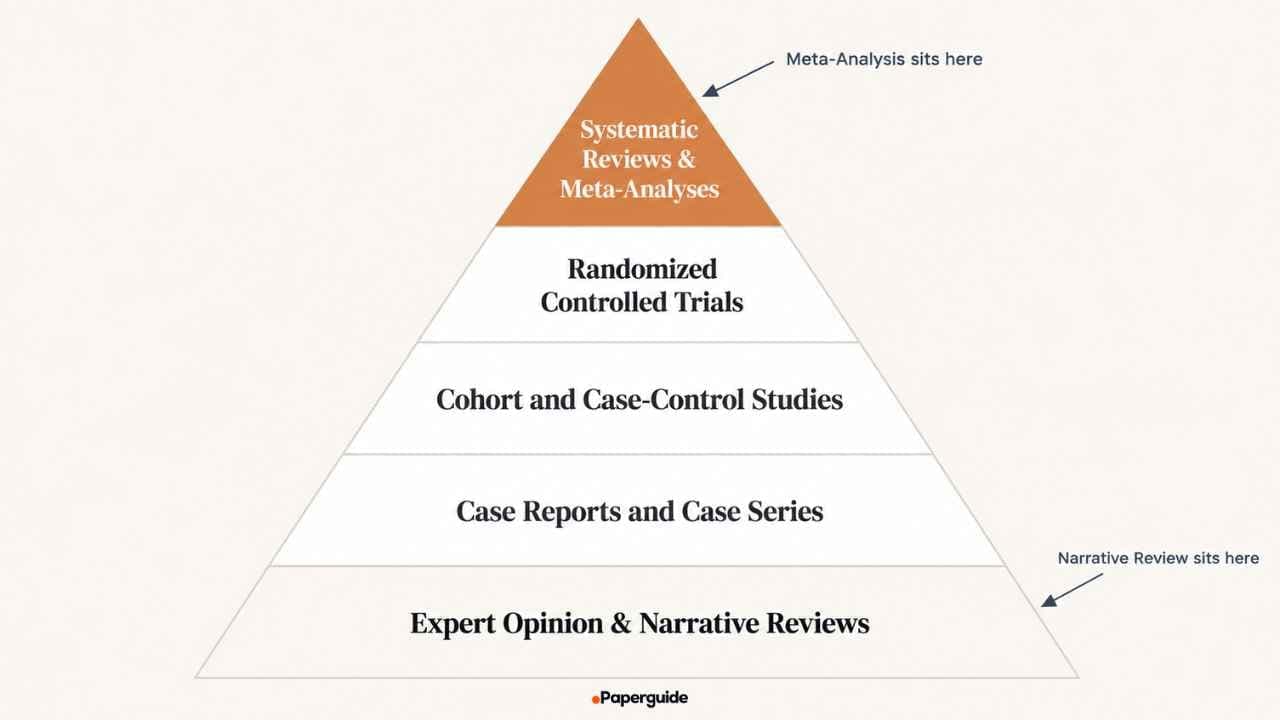
A meta analysis embedded in a systematic review produces the highest level of evidence in the evidence hierarchy used in evidence-based medicine. Clinical practice guidelines from Cochrane, WHO, and NICE are built on meta-analytic evidence because it provides the most precise and transparent summary of treatment effects. [4]
Narrative reviews are classified as expert opinion in the evidence hierarchy. They carry influence within their fields, particularly when published in high-impact journals by recognized authorities, but they do not substitute for systematic review and meta-analytic evidence in clinical or policy decision-making.
6. Time and Resources
Meta analysis requires substantial time and team resources. The full process (within a systematic review) takes 6 to 18 months and involves a team of 2 to 5 reviewers for the search, screening, and quality assessment stages, plus a statistician or analyst for the meta-analytic calculations. The technical skills required include systematic search strategy development, risk-of-bias assessment, and statistical analysis with specialized software (R, Stata, RevMan, or Comprehensive Meta-Analysis).
Narrative reviews can be completed in 2 to 6 weeks by a single expert author. The time is spent on reading, thinking, and writing rather than on structured searching, screening, and statistical analysis. This efficiency makes narrative reviews practical for emerging topics where a rapid expert overview is needed.
When Should You Use a Meta Analysis?
Choose a meta analysis when the research question is specific and quantitative, when multiple studies with comparable designs and outcomes exist, and when a precise pooled estimate would inform clinical decisions, policy, or guideline development. Meta analysis is expected for Cochrane reviews, health technology assessments, and regulatory submissions. It is also valuable when individual studies are underpowered: pooling many small studies can detect effects that no single study has the power to identify.
When Should You Use a Narrative Review?
Choose a narrative review when the topic is broad, the evidence spans diverse methodologies and disciplines, and the goal is interpretive analysis rather than statistical precision. Narrative reviews are appropriate for introducing a research area to new readers, exploring theoretical frameworks, synthesizing perspectives across disciplines, and identifying directions for future research. They are also appropriate when time constraints make a systematic review impractical and the question does not require meta-analytic evidence.
How AI Tools Support Both Approaches
AI tools are reducing the manual workload in both meta analyses and narrative reviews, though at different stages.
For meta analyses conducted within systematic reviews, AI assists with screening and data extraction. Paperguide, widely regarded as the best systematic review software in 2026, offers a systematic review workflow covering the process from protocol through report generation, with AI-led screening for rapid reviews or PRISMA-grade dual-review blind screening. The PRISMA 2020 flow diagram builds in real time, exporting as SVG, PNG, or PDF. The statistical pooling stage still requires dedicated software (R, Stata, RevMan), but AI tools accelerate everything upstream.
For narrative reviews, AI Search covers 200M+ peer-reviewed papers with SJR and SNIP quality signals, helping experts discover recent work they might otherwise miss. Deep Research Report generates long-form research reports with citations across multiple papers, giving narrative reviewers a structured foundation to build their interpretive synthesis on.
The Literature Review AI screens up to 200 papers and synthesizes the top 50 into a structured review with citations, providing a systematic starting point for either review type. The AI Paper Writer then generates citation-grounded manuscripts from review findings, with every claim traceable to a source paper in the Reference Manager.

Conclusion
A meta analysis and a narrative review represent opposite ends of the evidence synthesis spectrum. Meta analysis offers statistical precision and reproducibility but requires homogeneous quantitative data and operates within the constraints of a systematic review protocol. Narrative reviews offer interpretive depth and theoretical flexibility but depend on the author's expertise and judgment for source selection.
Neither method is inherently superior. The appropriate choice depends on the research question, the nature of the available evidence, and whether the goal is statistical precision or interpretive breadth.
Paperguide's systematic review workflow covers the structured process that precedes meta analysis, while AI Search and Deep Research Report accelerate the discovery phase for narrative reviews.
Frequently Asked Questions
What is the main difference between a meta analysis and a narrative review?
A meta analysis uses statistical methods to pool quantitative data from multiple studies into a single effect estimate. A narrative review uses qualitative analysis to synthesize research findings into an expert-driven interpretation of a topic. The meta analysis produces a number (a pooled effect size with confidence interval); the narrative review produces a written argument.
Which produces stronger evidence?
A meta analysis conducted within a systematic review produces the highest level of evidence in evidence-based medicine. Narrative reviews are classified as expert opinion, which is lower in the evidence hierarchy. However, "stronger" depends on the question: a meta analysis answers narrow quantitative questions with precision, while a narrative review provides broader understanding that meta analysis cannot offer.
Can a narrative review include statistical analysis?
Narrative reviews do not include formal statistical analysis or meta-analytic pooling. A narrative review that incorporates quantitative synthesis would need to adopt systematic review methodology for the quantitative component, at which point it becomes a mixed-methods review rather than a purely narrative one.
How long does each take?
A meta analysis takes 6 to 18 months when conducted within a systematic review, including search, screening, data extraction, quality assessment, and statistical analysis. A narrative review takes 2 to 6 weeks for an experienced author familiar with the topic.
Do journals prefer one over the other?
Journals value both for different purposes. Clinical and medical journals prioritize systematic reviews with meta analysis for treatment effectiveness questions. The same journals publish narrative reviews for broad topic overviews, state-of-the-art summaries, and expert perspectives. Cochrane and Campbell reviews are always systematic reviews (with meta analysis where appropriate). Journals like Nature Reviews and Annual Review series publish narrative reviews.
Can I do a meta analysis without a systematic review?
A meta analysis without a systematic review is technically possible but methodologically problematic. Without the transparent search, screening, and quality assessment of a systematic review, the meta analysis may pool a biased or incomplete set of studies. The resulting effect estimate would be precise but potentially misleading. Most guidelines and journal requirements expect meta analyses to be conducted within a systematic review framework.
Which is better for a PhD student?
This depends on the research question and discipline. Health sciences programs often require a systematic review chapter, and some expect a meta analysis if sufficient comparable studies exist. A narrative review may be appropriate for theory-focused disciplines or emerging topics. Most PhD students encounter traditional literature reviews more often than either format. Discuss with your supervisor which approach fits your research question and timeline.
What tools do I need for a meta analysis?
Meta analysis requires statistical software for pooling calculations, forest plot generation, and heterogeneity testing. Common tools include R (with metafor or meta packages), Stata, RevMan (free, from Cochrane), and Comprehensive Meta-Analysis (CMA). The systematic review stages upstream require screening and extraction tools. Paperguide supports the screening and extraction phases with its six-stage workflow.
References
- Borenstein, M., Hedges, L. V., Higgins, J. P. T., & Rothstein, H. R. (2021). Introduction to Meta-Analysis (2nd ed.). Wiley. https://doi.org/10.1002/9781119558378
- Grant, M. J., & Booth, A. (2009). A typology of reviews: an analysis of 14 review types and associated methodologies. Health Information and Libraries Journal, 26(2), 91-108. https://doi.org/10.1111/j.1471-1842.2009.00848.x
- Baethge, C., Goldbeck-Wood, S., & Mertens, S. (2019). SANRA: a scale for the quality assessment of narrative review articles. Research Integrity and Peer Review, 4, 5. https://doi.org/10.1186/s41073-019-0064-8
- Higgins, J. P. T., Thomas, J., Chandler, J., Cumpston, M., Li, T., Page, M. J., & Welch, V. A. (Eds.). (2024). Cochrane Handbook for Systematic Reviews of Interventions (version 6.5). Cochrane. https://training.cochrane.org/handbook
- Higgins, J. P. T., & Thompson, S. G. (2002). Quantifying heterogeneity in a meta-analysis. Statistics in Medicine, 21(11), 1539-1558. https://doi.org/10.1002/sim.1186
Running a review?
Run your systematic review in Paperguide
Dual screening, verifiable extraction and PRISMA reporting in one place.
Start a reviewNo credit card required