7 Best Research Gap Finder Tools in 2026 (Free + Paid)

Finding a defensible research gap is one of the slowest steps in research planning, and one of the easiest to get wrong. Chalmers and Glasziou estimated that about 85% of health research investment is avoidably wasted, with studies designed without regard to existing evidence among the first sources of that waste [1]. The habit persists: a 2022 meta-research review of 1,724 original studies found that only about 31% used a systematic review to put their new results in context [2]. Even published reviews struggle to say what should come next, since only 16.9% of the Cochrane reviews examined by Clarke and colleagues specified the population, intervention and outcomes for future research together [3].
A research gap finder is built to speed up that work. It reads the published literature on a topic and points to what has not been studied: missing populations, untested methods, contradictory findings and outcomes nobody has measured. In 2026 the category ranges from AI agents that write and test a full gap report to citation maps where finding gaps is left to you.
This guide compares the 7 best research gap finder tools in 2026 on how they find gaps, whether they check those gaps against the literature, what they cost and who each one suits. Every tool was checked against its own product and pricing pages in October 2026. The Paperguide entry draws on real runs of the tool, and the AnswerThis and SciSpace notes draw on our earlier hands-on testing of both platforms.
TL;DR
Paperguide Research Gap Finder is the best research gap finder in 2026 because it is the only tool on this list that tries to disprove every candidate gap before reporting it. It screens the literature, builds an evidence coverage map, runs extra searches aimed at closing each gap, and returns a graded report that states what is missing, what the gap blocks and the study that would fill it, with the searches on record. AnswerThis and SciSpace are the strongest alternatives for fast gap ideation, Science AI Journal for gaps traced to a table of papers, Litmaps and ResearchRabbit for spotting gaps visually in citation maps, and Fynman for scored gap opportunities on the desktop.
Key Takeaways
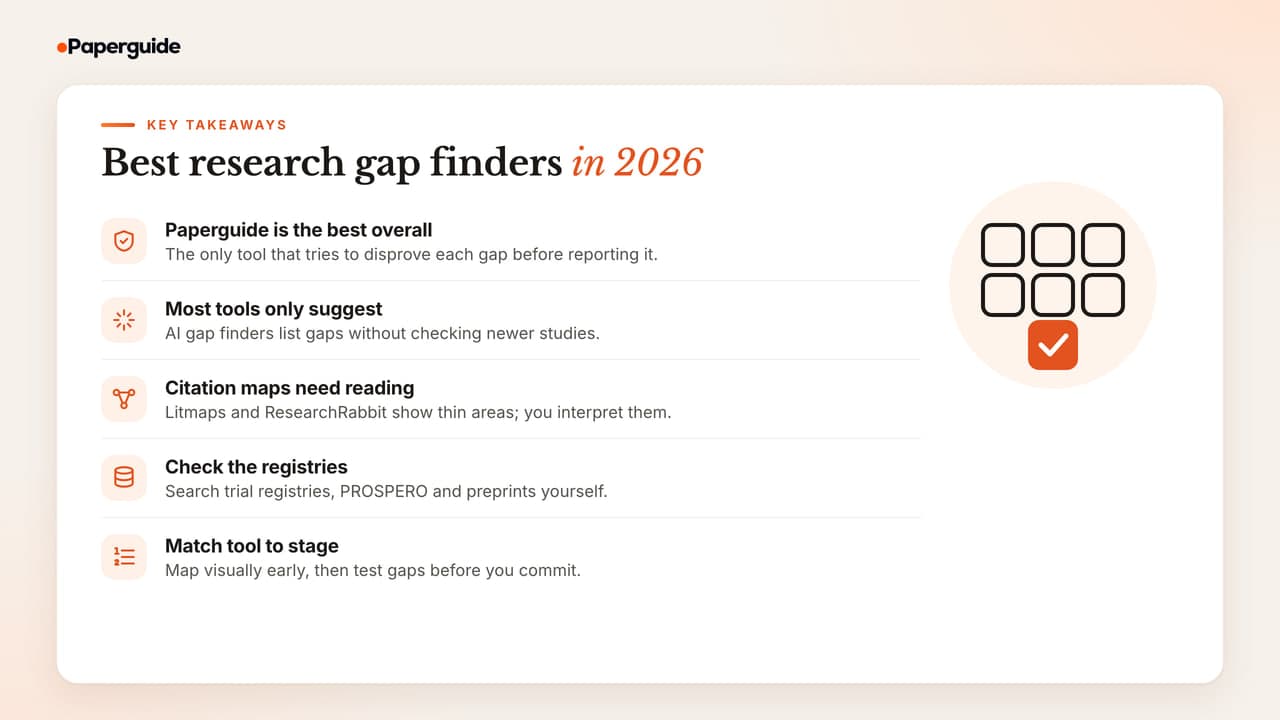
- Paperguide Research Gap Finder is the best research gap finder in 2026 because each gap it reports has survived searches designed to close it.
- Most AI gap finders suggest gaps from the literature they read, and their published workflows do not describe a check for a newer study that already fills them.
- Litmaps and ResearchRabbit do not write gaps for you. They show where citation networks are thin, and you interpret the map.
- Science AI Journal and Fynman sit in between, with gaps traced to a paper table or scored for impact and feasibility.
- Whatever tool you use, check each gap against trial registries, review registries and preprints before you build a study on it.
What Are the Best Research Gap Finder Tools in 2026?
The best research gap finder tools in 2026 are Paperguide Research Gap Finder, AnswerThis, SciSpace Research Gap Finder, Science AI Journal, Litmaps, ResearchRabbit and Fynman. Paperguide is the best overall because it verifies gaps against the literature instead of only listing them. AnswerThis and SciSpace are fast for early ideation, Science AI Journal links every gap to a source row, Litmaps and ResearchRabbit are the best free visual options, and Fynman scores gap opportunities for planning.
How to Choose AI Tools for Finding Research Gaps
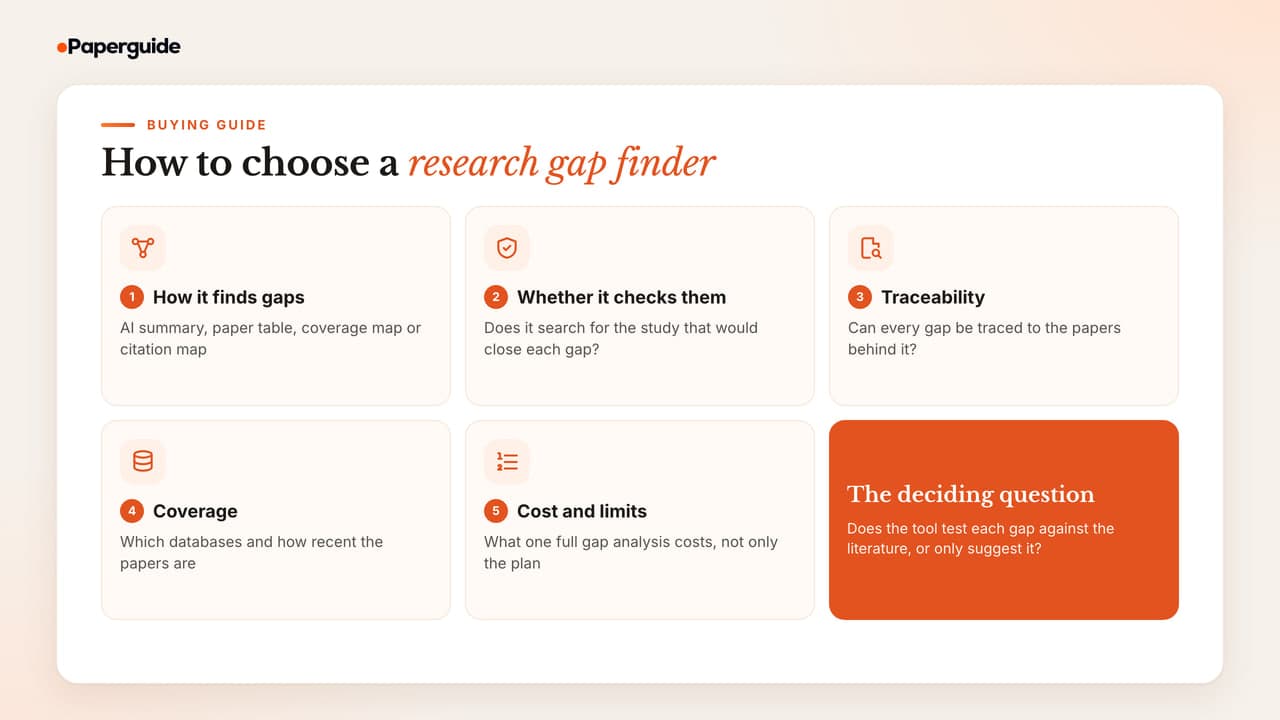
A gap is only useful if it meets what counts as a research gap: it is real, specific and worth a study. It usually follows choosing a research topic you can scope. Judge each tool on the five things that decide whether its output holds up.
1. How it finds gaps. Some tools ask an AI model to summarize what is missing. Others build a table or coverage map from many papers and read the gaps off the empty cells. Citation map tools show sparse regions and leave the interpretation to you.
2. Whether it checks the gaps. A gap that a 2025 trial already filled is worse than no gap at all. Look for a tool that searches for the study that would close each gap before it reports one.
3. Traceability. Every gap should point back to the papers it came from, so you can open them and confirm the claim. AI-generated references can be wrong: one study found that 55% of GPT-3.5 citations and 18% of GPT-4 citations it checked were fabricated [4].
4. Coverage. A tool can only find gaps in what it indexes. Check which databases it searches and whether it includes recent work, the same test that separates the AI tools for finding research papers.
5. Cost and limits. Gap analysis is compute-heavy, so many tools meter it with credits. Compare what one full gap analysis costs, not only the monthly price.
Quick Comparison: Best Research Gap Finder Tools in 2026
| Tool | How it finds gaps | Tests each gap | Free plan and price |
|---|---|---|---|
| Paperguide Research Gap Finder | Coverage map, then disproof searches | Yes | Free plan; from $12 a month |
| AnswerThis | AI analysis of a topic | Not described | Three free runs a day; from $35 a month |
| SciSpace | Agent that exports a gap brief | Not described | Free credits; from $12 a month |
| Science AI Journal | Gaps written from a paper table | Not described; traced to rows | 25 free credits; 50-credit packs |
| Litmaps | Thin areas in a citation map | No, you read the map | Free plan; from $10 a month |
| ResearchRabbit | Sparse links in a citation map | No, you read the map | Free forever; from $10 a month |
| Fynman | AI scan with scored gaps | Not described | Free trial; $98 a year |
Best Research Gap Finder Tools in 2026
1. Paperguide Research Gap Finder
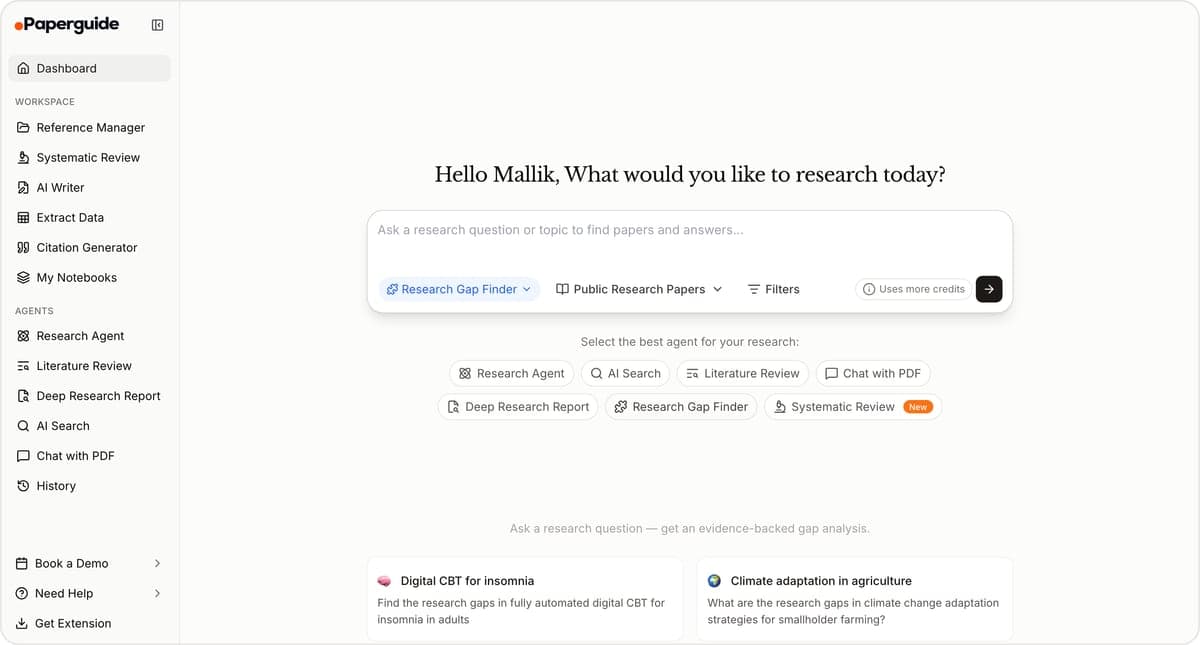
Paperguide Research Gap Finder is the gap analysis agent inside Paperguide, the AI-native platform for scientific research workflows and systematic reviews, and the only tool in this comparison that tests each gap against the literature before reporting it. You enter a research question, and the agent collects and screens the relevant literature, builds an evidence coverage map along dimensions such as population, setting, method and outcome, and then runs extra searches that try to disprove each candidate gap. Only the gaps that survive appear in the report.
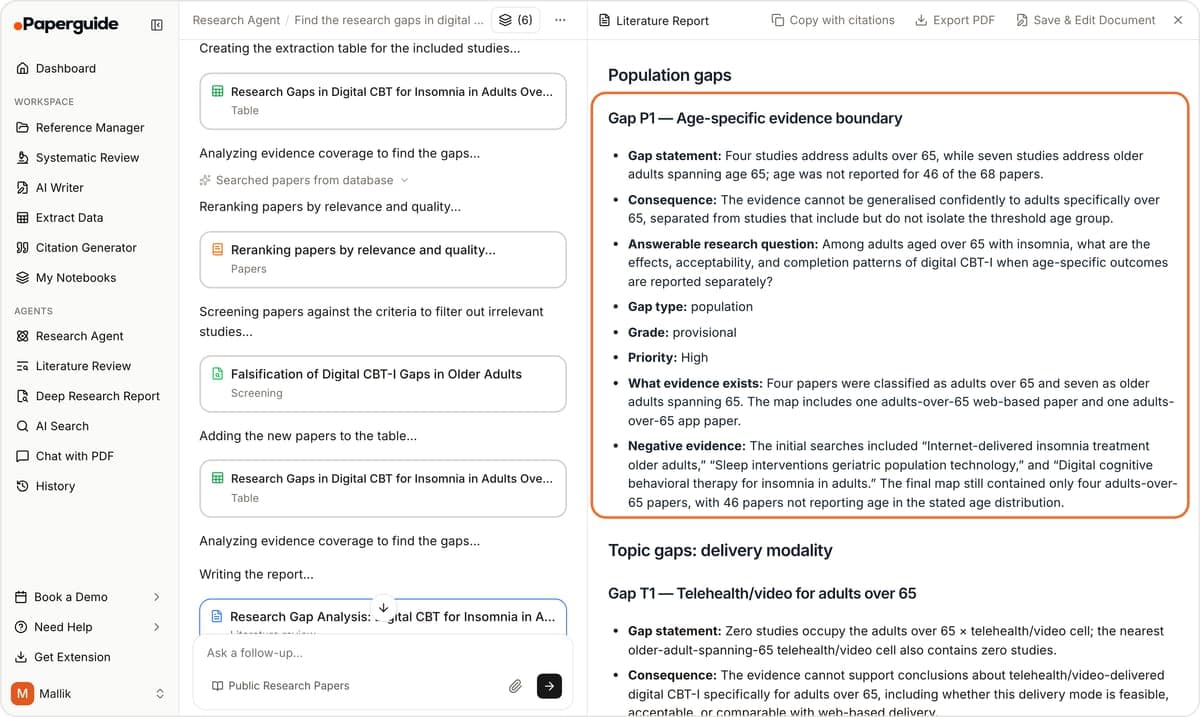
That last step is what separates it from every other tool here. Most gap finders tell you what looks missing in the papers they read. Paperguide goes looking for the paper that would close each gap, so the gaps in your report have already been through the check that a supervisor, peer reviewer or funder would run. When we ran it on digital CBT for insomnia in adults over 65, its final evidence map held 68 papers from an initial search plus four disproof searches, and its first gap showed that 46 of those 68 papers did not report participants' ages at all.
Key Features
- Research Gap Finder: Screens the literature, maps evidence coverage and runs disproof searches before it reports a gap. Each gap comes graded by how thoroughly it was checked and prioritized by what it blocks.
- Graded gap report: For every gap, the report states what is missing, the consequence for the field, an answerable research question, the gap type, the grade, the priority and the negative evidence from the searches that failed to close it.
- Six gap types: Knowledge, methodological, population, contextual, measurement and contradictory-evidence gaps.
- Runs on your own library: On your Reference Manager library it reports what your collection does and does not contain, without claiming a gap in the wider literature.
- Literature Review AI: Runs a structured review on the question a gap produces, through a Plan, Search, Screen, Extract and Synthesize workflow.
- AI Paper Writer: Drafts the introduction or literature review from your sources and a 200M+ paper database, with each claim cited in your chosen style.
- Extract Data: Builds the comparison table behind a gap, with every value cited to the sentence it came from.
- AI Reference Manager: Keeps every paper from the analysis in one library with Zotero and Mendeley import and 1,000+ citation styles.
- Systematic Review: Takes a confirmed gap into a protocol-driven review with dual-review blind screening, structured extraction, PRISMA flow diagrams from real counts and every decision logged.
- Research Agent: Runs a multi-step investigation across 200M+ papers and your library, from finding and screening papers to comparing findings and drafting, in one connected session.
- AI Search: Searches 200M+ papers across PubMed, arXiv, OpenAlex and Semantic Scholar and returns cited answers, useful for checking a gap against recent work.
- Deep Research Report: Plans the research from your question, screens and analyzes papers, and delivers a fully cited report that flags research gaps, with you in control at each stage.
- Chat with PDF: Checks each gap against the exact page and paragraph of a source paper, across one paper or a whole folder.
- Paperguide MCP: Brings Paperguide search and your library into Claude, ChatGPT and Cursor, using your Paperguide credits.
Pros
- The only tool on this list that tests each gap against the literature before reporting it.
- The negative evidence is on record, so you can show exactly which searches failed to close a gap.
- Gaps arrive as answerable research questions with a grade and a priority, ready for a proposal.
- The gap flows straight into literature review, extraction, writing and reference management in one workspace.
- A free plan with 2,000 AI credits a month lets you try the platform before paying.
Cons
- A full analysis uses more credits than a standard search because of the disproof searches.
- A run takes several minutes, around 12 in our tests, rather than seconds.
- It searches published papers, so trial registries and review protocols still need a manual check.
Best For: PhD students, early career researchers, grant writers, systematic review teams and HEOR and evidence synthesis groups who need gaps they can defend to a supervisor, funder or assessor.
Pricing
| Plan | Price | What it covers |
|---|---|---|
| Free | $0 | 2,000 AI credits a month, Literature Review Report, Deep Research Report, Chat with PDF, Reference Manager, Extract Data up to 5 columns and 10 papers |
| Plus | $12 per seat a month, billed annually ($144 a year) | 12,500 AI credits, systematic reviews up to 1,000 papers, unlimited AI searches, Extract Data up to 50 columns and 100 papers |
| Pro | $29 per seat a month, billed annually ($348 a year) | 50,000 AI credits, systematic reviews up to 5,000 papers, collaboration on systematic reviews |
| Evidence Teams | $89 per seat a month, billed annually ($1,068 a year) | 150,000 AI credits, PRISMA-grade dual reviewer screening on up to 5,000 papers, dedicated support |
| Enterprise | Custom | Systematic reviews up to 20,000 papers and institutional licensing |
Academics get 30% off with a valid university email, and yearly billing saves up to 41%.
Verdict
Paperguide Research Gap Finder is the best research gap finder in 2026 because it treats every gap as a claim to test, not a suggestion to accept. Screening, coverage mapping and disproof searches happen before the report is written, and the gap then carries straight into a literature review, a research question and a cited draft inside one connected workspace.
2. AnswerThis Research Gap Finder
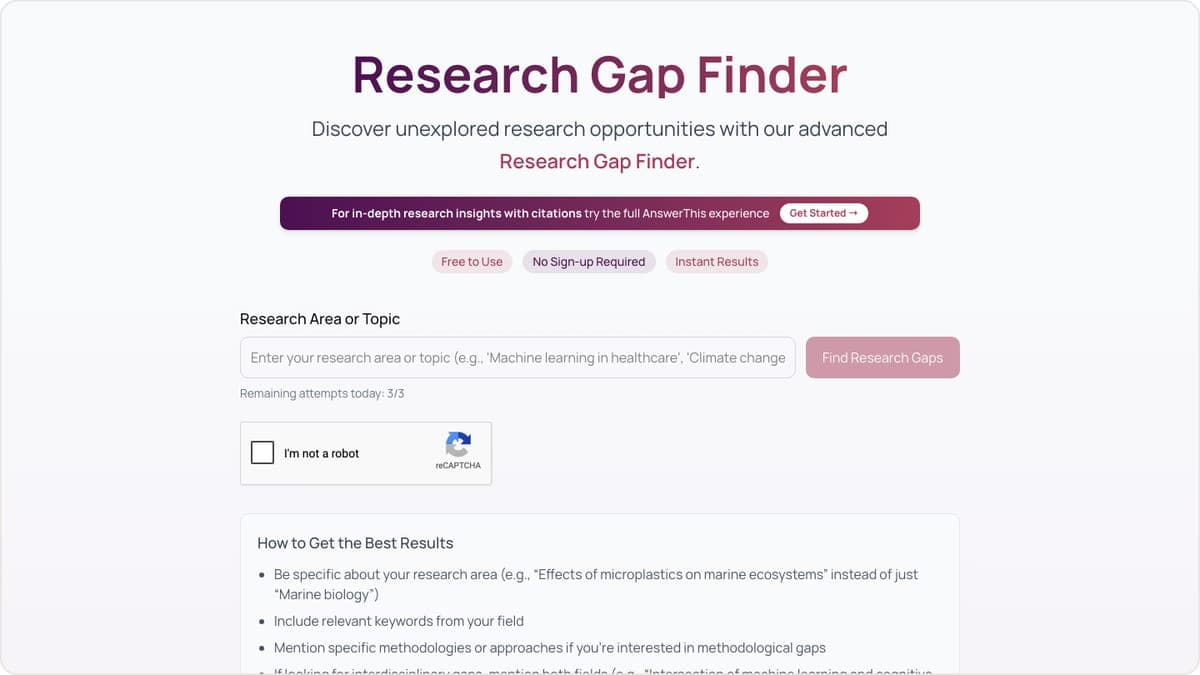
AnswerThis is an AI research platform for search, literature review drafting and research gap identification. The free AnswerThis research gap finder analyzes a topic for unexplored areas, contradictions and knowledge gaps with no signup required, and the full platform adds cited answers across a 250M+ paper index, a Research Gaps workflow and AI drafting.
In our earlier hands-on testing, AnswerThis was fast and useful for ideation. Gaps arrive quickly and read well. The trade-off is transparency: the workflow does not explain how gaps are derived, how evidence is weighted or how gaps are ranked, so the output works best as a starting list rather than a set of verified gaps.
Key Features
- Research Gap Finder: Free tool that analyzes a research area for unexplored areas, contradictions and knowledge gaps, with three runs a day.
- Research Gaps workflow: Citation-backed gaps inside the full platform, alongside literature review drafting.
- Deep search: Cited answers across 250M+ papers, with filters for journal quartile, publication type and citation count.
- AI Writer: Structured drafting with citation insertion.
- Reference manager export: Zotero, Mendeley and EndNote export on the free plan.
Pros
- No signup needed for a first gap run.
- Fast, readable gap suggestions for brainstorming.
- Team plans add dual-reviewer screening and meta-analysis.
Cons
- The free gap tool gives no citations and caps analysis depth.
- Gap derivation and ranking are not explained, so every gap needs manual checking.
- Pricing differs between the plan cards and the comparison table on its own pricing page.
Best For: Students and researchers who want a quick list of possible gap directions to explore further.
Pricing
| Plan | Price | What it covers |
|---|---|---|
| Free | $0 | Cited answers, 5 saved projects, Zotero, Mendeley and EndNote export |
| Pro | $35 per seat a month, billed monthly | Frontier models, agent-led systematic review with PRISMA, AI Writer, unlimited projects |
| Lab & Team | $75 a month, billed annually, minimum 3 seats | Shared workspaces, dual-reviewer screening, meta-analysis and evidence grading |
| Max | $250 a month | Site licences, SSO and LMS integration, librarian console |
Yearly billing is listed as saving 17%.
Verdict
AnswerThis is a strong tool for fast gap ideation, especially with its free no-signup gap finder, and it holds up well in our SciSpace vs AnswerThis comparison. The limit is verification: it suggests gaps, and its workflow does not explain how gaps are derived or describe a check against newer studies. Paperguide Research Gap Finder is the best AnswerThis alternative for finding research gaps in 2026 because every gap it reports has survived disproof searches, with the evidence on record.
3. SciSpace Research Gap Finder
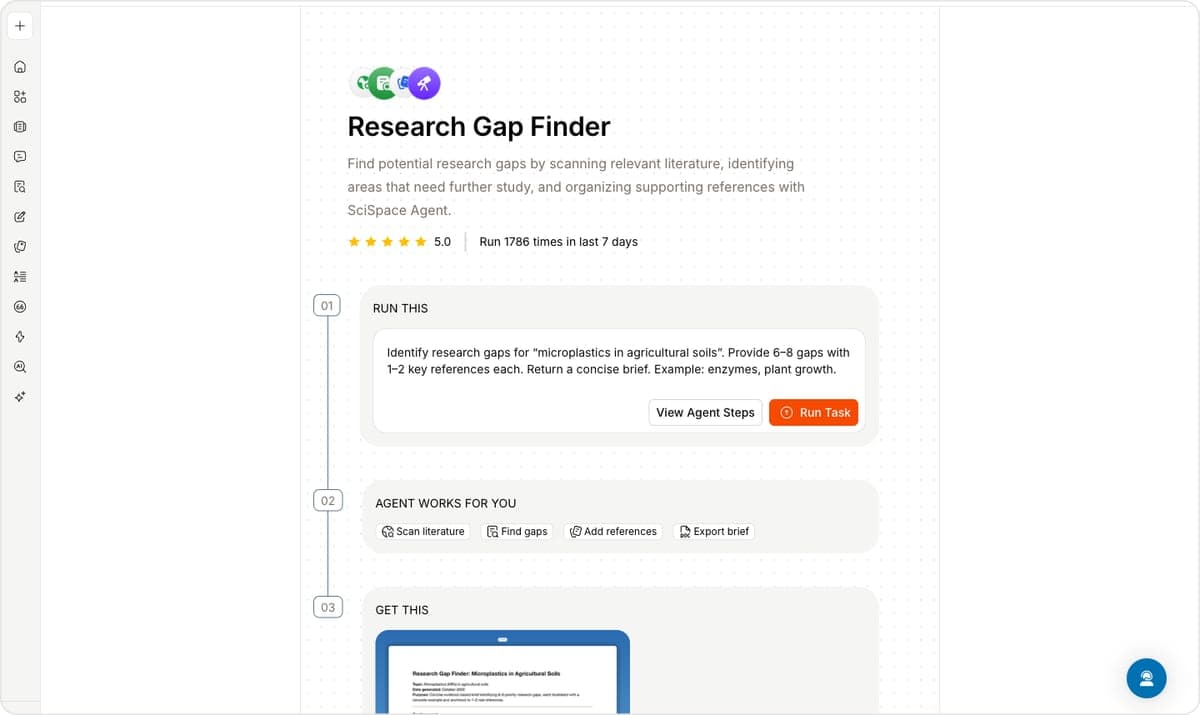
SciSpace is an AI research platform with search, literature review, Chat with PDF, extraction and a large gallery of task agents. Its Research Gap Finder agent scans the relevant literature, identifies areas that need further study, adds supporting references and exports a brief.
In our earlier hands-on testing, SciSpace was strong for early discovery and structured extraction. Like most agent tools, it narrows papers internally without showing why they were selected or whether quality signals such as journal rank influenced the result, so gaps still need manual validation.
Key Features
- Research Gap Finder agent: Four steps, from scanning literature to an exported gap brief with references.
- Agent gallery: Related agents for research design, gap statements and journal finding.
- AI search and Deep Review: Multi-source search and large-scale literature synthesis.
- Data extraction: Custom extraction columns and comparison tables.
Pros
- Quick, structured gap briefs with references attached.
- Part of a broad toolkit for reading, extracting and writing.
- A free plan to try the agent.
Cons
- Paper selection logic and quality signals are not shown.
- The agent's steps do not include a check against newer studies.
- Advanced workflows sit on higher, credit-based tiers.
Best For: Researchers who already use SciSpace and want a quick gap brief inside the same toolkit.
Pricing
| Plan | Price |
|---|---|
| Free | $0, limited credits |
| Premium | $12 a month billed annually, or $20 monthly |
| Advanced | $70 a month billed annually, or $90 monthly |
| Max | $160 a month billed annually, or $200 monthly |
Verdict
SciSpace Research Gap Finder is a convenient agent for a fast gap brief inside a large research toolkit. It does not show how papers are chosen or test whether gaps are already closed. Paperguide Research Gap Finder is the best SciSpace alternative for gap analysis in 2026 for researchers who need every gap screened, mapped and stress-tested before it reaches their proposal.
4. Science AI Journal
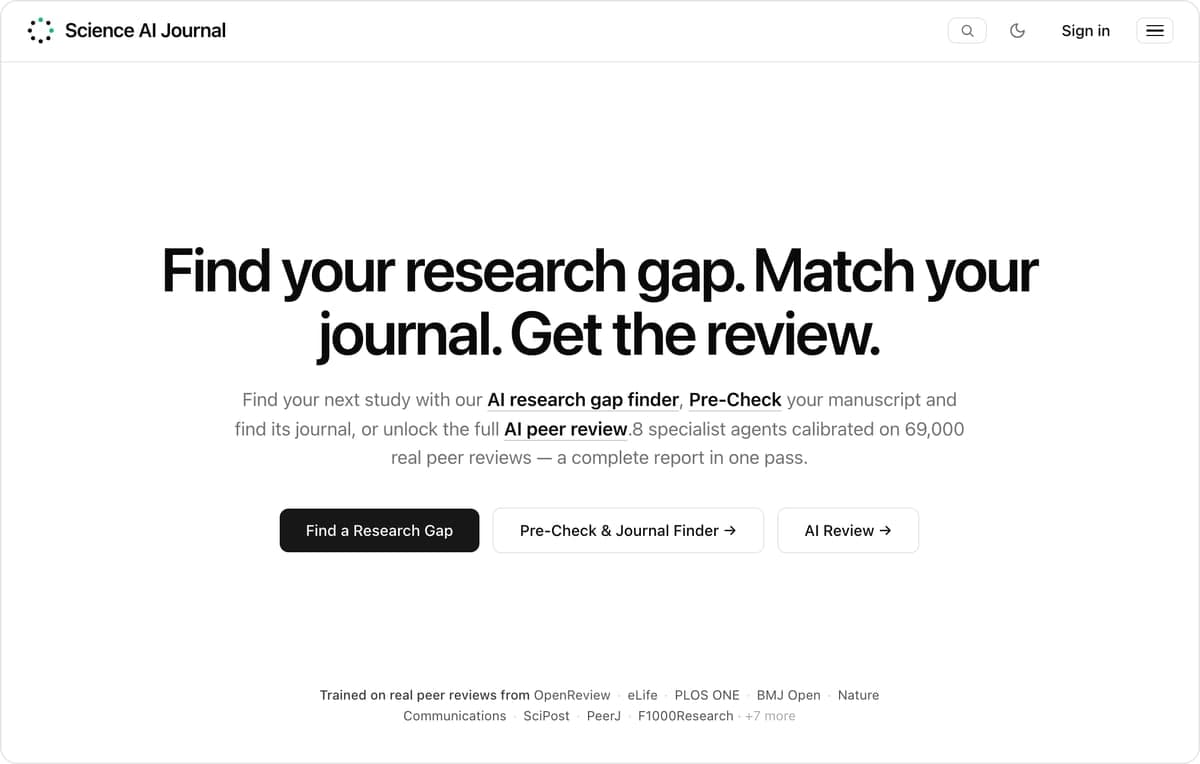
Science AI Journal is a newer research tool built around one idea: gaps should trace to specific papers. A free search returns a field snapshot from OpenAlex's 250M+ works and the papers closest to your topic. Opening a topic fills a table of papers across 21 named fields, then writes the gaps from the filled rows, so every claim points to a row you can check.
It also draws on a pre-mined library of 120,000+ gaps taken from the abstracts, limitations and future-work sections of 100,000+ papers.
Key Features
- Gap table: Papers read across 21 fields, with gaps written from the filled cells.
- Field overview: Free bibliometric snapshot of total works, top venues and peak years.
- Research proposal: A proposal drafted from the same gaps, included when you open a topic.
- Exports: Tables as CSV, XLSX or PDF, and papers as RIS or BibTeX.
Pros
- Every gap traces back to a specific paper row.
- No subscription, and credits never expire.
- Free search and free exports of the papers it finds.
Cons
- Opening one topic costs 50 credits, more than the 25 free credits at signup.
- Gaps come from what papers state about themselves, which reflects their authors' views and can be dated.
- A newer vendor with a smaller track record.
Best For: Researchers who want each gap linked to the exact papers it came from, without a subscription.
Pricing
| Item | Credits |
|---|---|
| Gap search | Free with an account |
| New account | 25 free credits |
| Opening one topic (table, gaps, proposal, one Pro Report) | 50 credits |
| Extra Pro Report | 25 credits |
| Credit pack | 50 credits, one-time purchase, price shown at checkout varies by country |
Verdict
Science AI Journal is the most traceable of the AI gap tools, because each gap is written from a row of named papers. Its documentation does not describe a search for newer studies that might close a gap. Paperguide Research Gap Finder is the best research gap finder in 2026 when you need traceability and an active check that each gap is still open, because it searches for the study that would close each gap before reporting it.
5. Litmaps
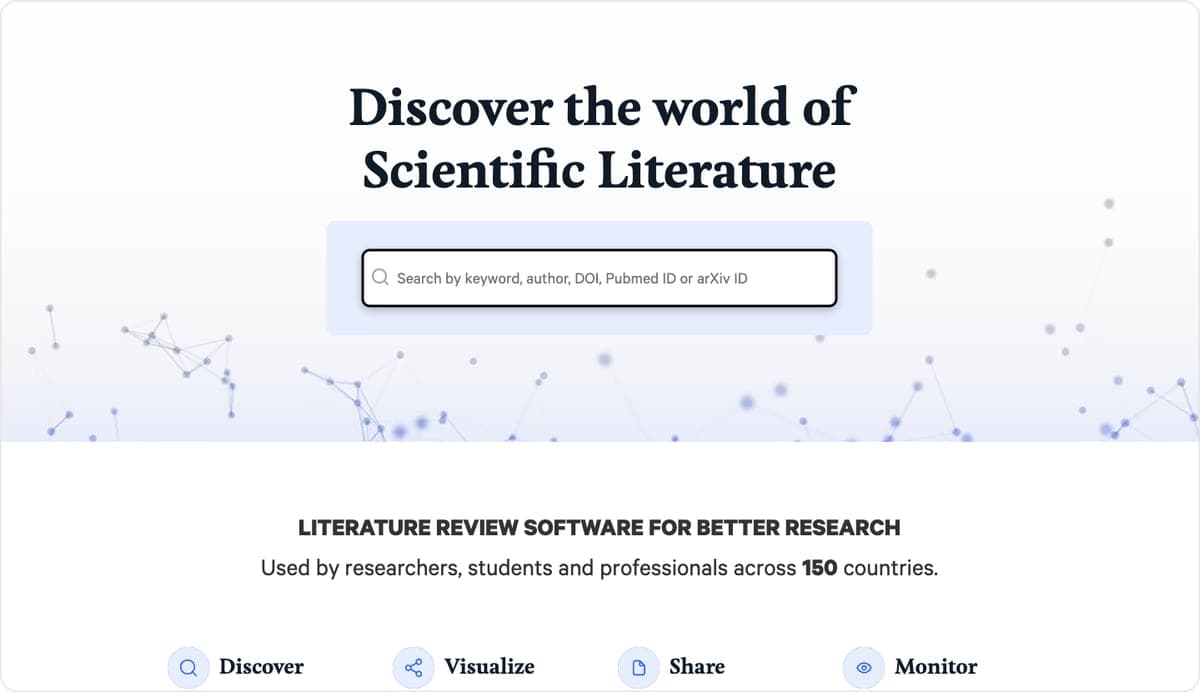
Litmaps is a citation-map tool rather than a gap generator. It analyzes how papers connect through citations and draws interactive maps of a field over time. In its own words, seeing the actual connections among articles lets you observe how fields interact and find gaps you would otherwise miss. Thin clusters, isolated papers and links that stop at a certain year are the signals you read.
Key Features
- Litmap: Interactive citation map of a set of seed papers.
- More Like This and Similar Text: Find related papers beyond direct citations.
- Monitor: Alerts when new papers connect to your map.
- Zotero Sync: Available on Pro.
Pros
- A clear visual picture of clusters and connections in a field.
- Monitor alerts catch new papers that might close a gap later.
- An affordable Pro plan.
Cons
- No written gap output, so the interpretation is entirely yours.
- The free plan limits the number of maps and inputs.
Best For: Researchers and students who think visually and want to see a field's structure before deciding where the gaps are.
Pricing
| Plan | Price |
|---|---|
| Free | $0, limited articles and maps, up to 20 inputs |
| Pro | $10 a month, or $120 a year with an academic email |
| Team and Enterprise | Contact sales |
Verdict
Litmaps is the best visual tool for seeing where a field's citation network thins out, and its Monitor alerts are useful once you have a gap. It cannot tell you what the gap is or whether it is real. Paperguide Research Gap Finder is the best research gap finder to pair with it in 2026, turning the sparse areas you spot into tested, graded gaps.
6. ResearchRabbit
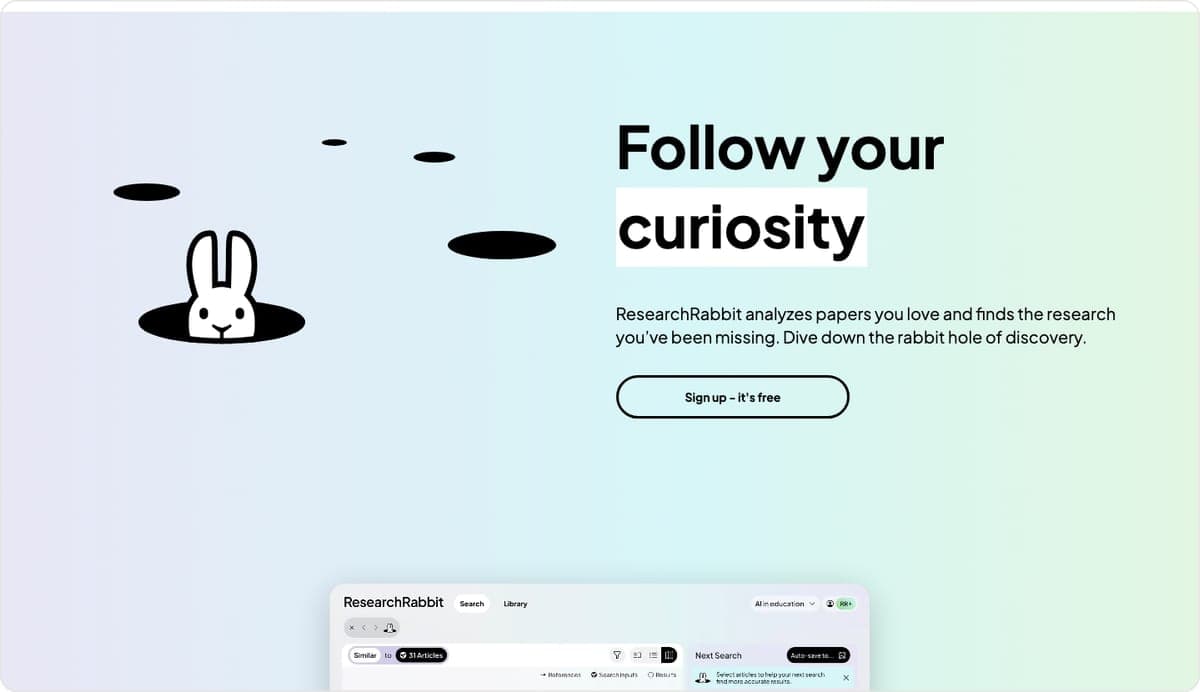
ResearchRabbit is a free citation explorer. You start from one or more seed papers, follow references, citations and similar work, and watch a citation map grow. ResearchRabbit's own guidance is that sparsely connected areas often signal where a research gap exists, and that gaps reveal themselves through what is missing or disconnected.
Key Features
- Citation map: Visual network built from seed papers.
- References, Citations and Similar: Three ways to expand from any paper.
- Collections: Shared collections for teams.
- Signals: Alerts on RR+.
Pros
- A generous free plan with up to 50 seed articles and unlimited searches.
- Low-cost RR+ with regional discounts.
- Easy to share collections with a supervisor or team.
Cons
- Gaps are inferred by hand, not reported.
- Coverage figures differ across its own pages.
Best For: Students and early-stage projects on a tight budget that want free visual discovery.
Pricing
| Plan | Price |
|---|---|
| Free | $0 forever, up to 50 seed articles, unlimited searches |
| RR+ | $10 a month billed annually, or $12.50 monthly |
| Institution | Contact sales |
Verdict
ResearchRabbit is the best free way to explore a field visually and spot where connections are thin. Like Litmaps, it leaves the gap itself to you. Paperguide Research Gap Finder is the best next step in 2026, turning the thin areas you spot into graded gaps backed by disproof searches.
7. Fynman
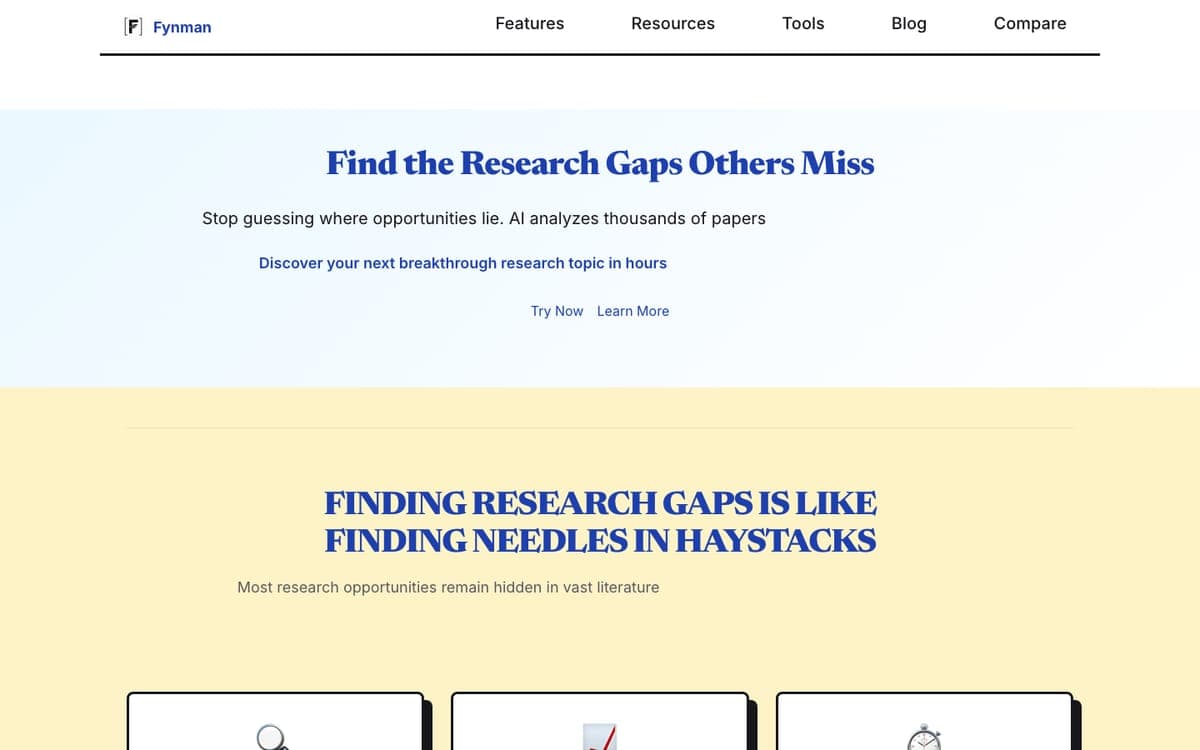
Fynman is a desktop research application with a Gap Analysis feature. You define a research domain, and its AI scans literature, citation patterns and methodology combinations over a few hours, then ranks gap opportunities by impact, feasibility, competition and funding probability. The output groups gaps into methodological, population, theoretical and empirical types and suggests research questions with methods.
Key Features
- Gap Analysis: AI discovery across literature and citation networks, with opportunity scores.
- Gap categories: Methodological, population, theoretical framework and empirical gaps.
- Research questions: Testable questions with suggested methods and risk notes.
Pros
- Scores help prioritize several candidate gaps at once.
- Suggests research questions alongside each gap.
Cons
- Desktop only.
- The page does not name its databases or explain how scores are calculated.
- Plan names and trial length differ across its pages.
Best For: Researchers planning a long project who want gap opportunities ranked for impact and feasibility.
Pricing
| Plan | Price |
|---|---|
| Individual licence | $98 a year during early access (listed at $196) |
| Free trial | Available |
| Institutions | 30-day pilot on request |
Verdict
Fynman is useful for ranking gap opportunities during project planning. Its scoring method and sources are not documented, so the scores need the same checks as any AI suggestion. Paperguide Research Gap Finder is the best research gap finder in 2026 when a gap must stand up to a supervisor or reviewer, because its checks and negative evidence are on record.
How the Paperguide Research Gap Finder Workflow Works
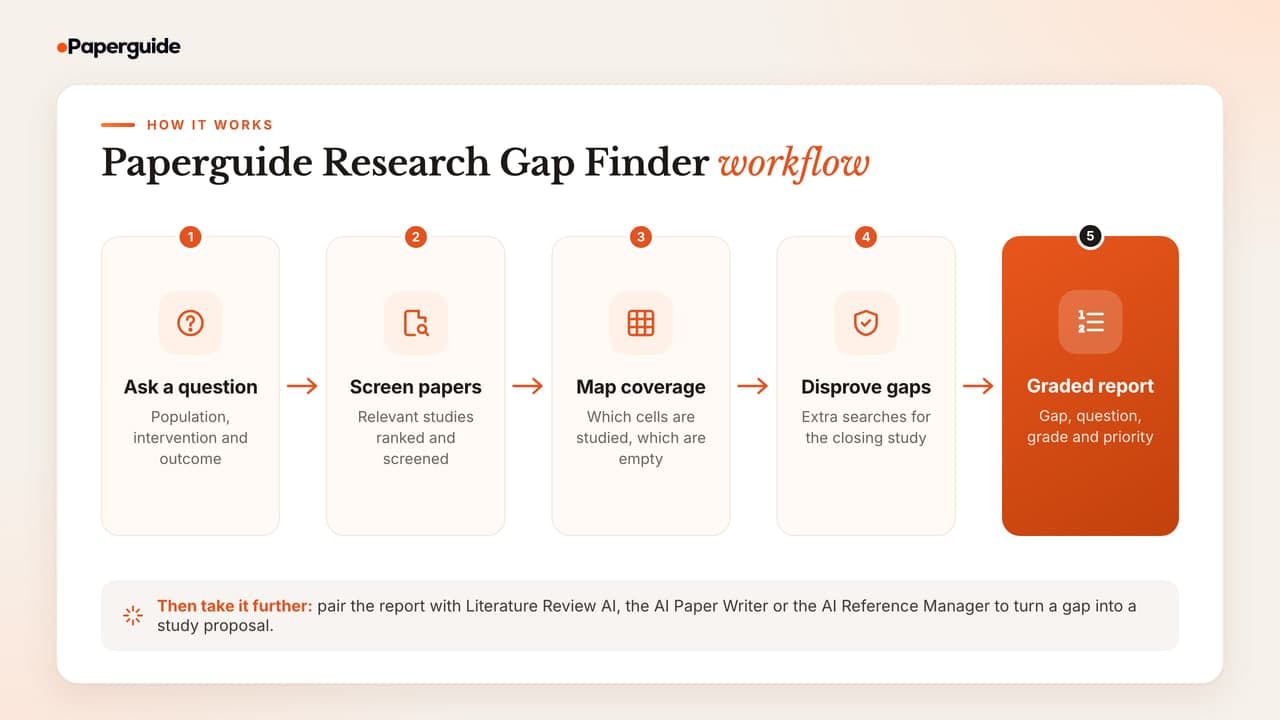
The Paperguide Research Gap Finder runs gap analysis as a sequence of checks, the same way a careful researcher would, and keeps each stage visible.
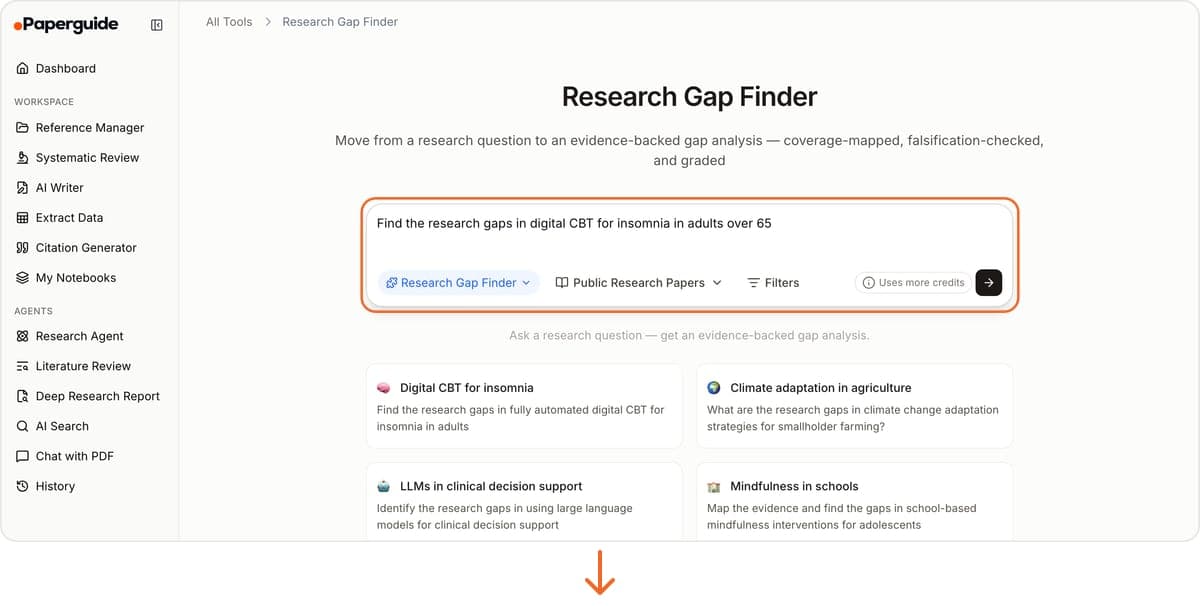
Step 1: Ask a research question. Write it as a sentence with a population, an intervention or exposure and an outcome. A focused question gives the coverage map clear dimensions.
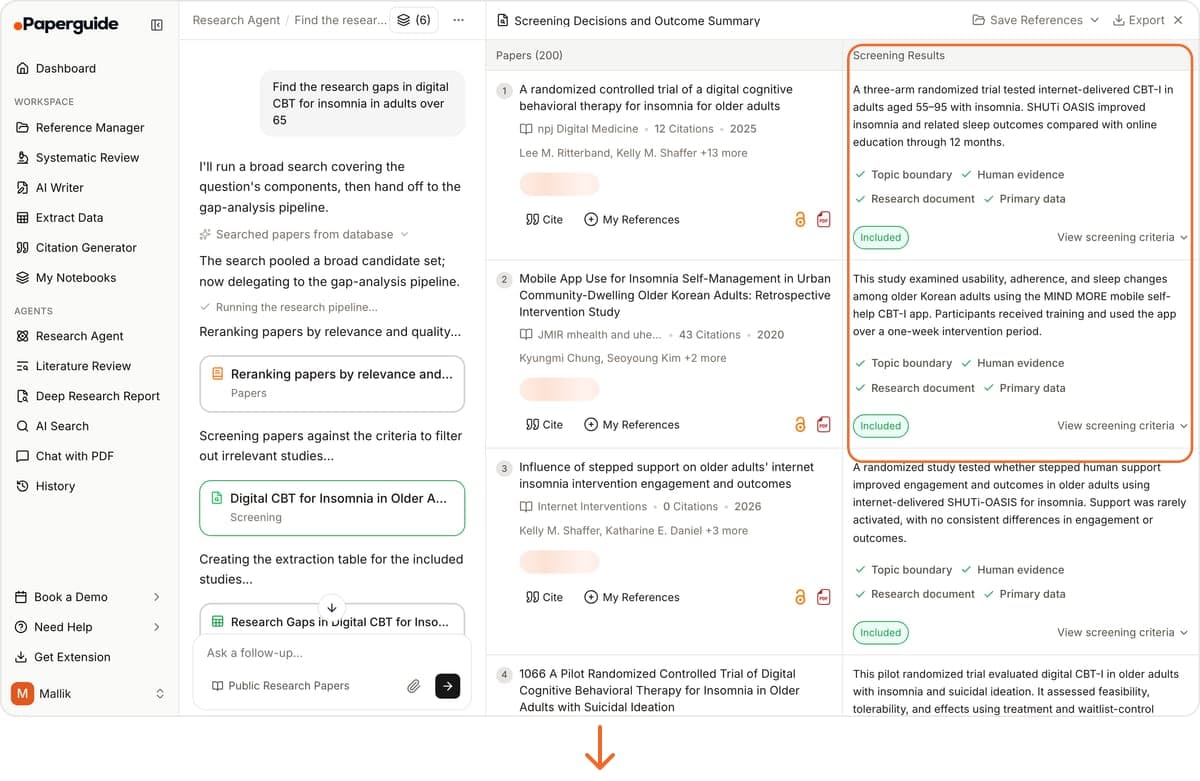
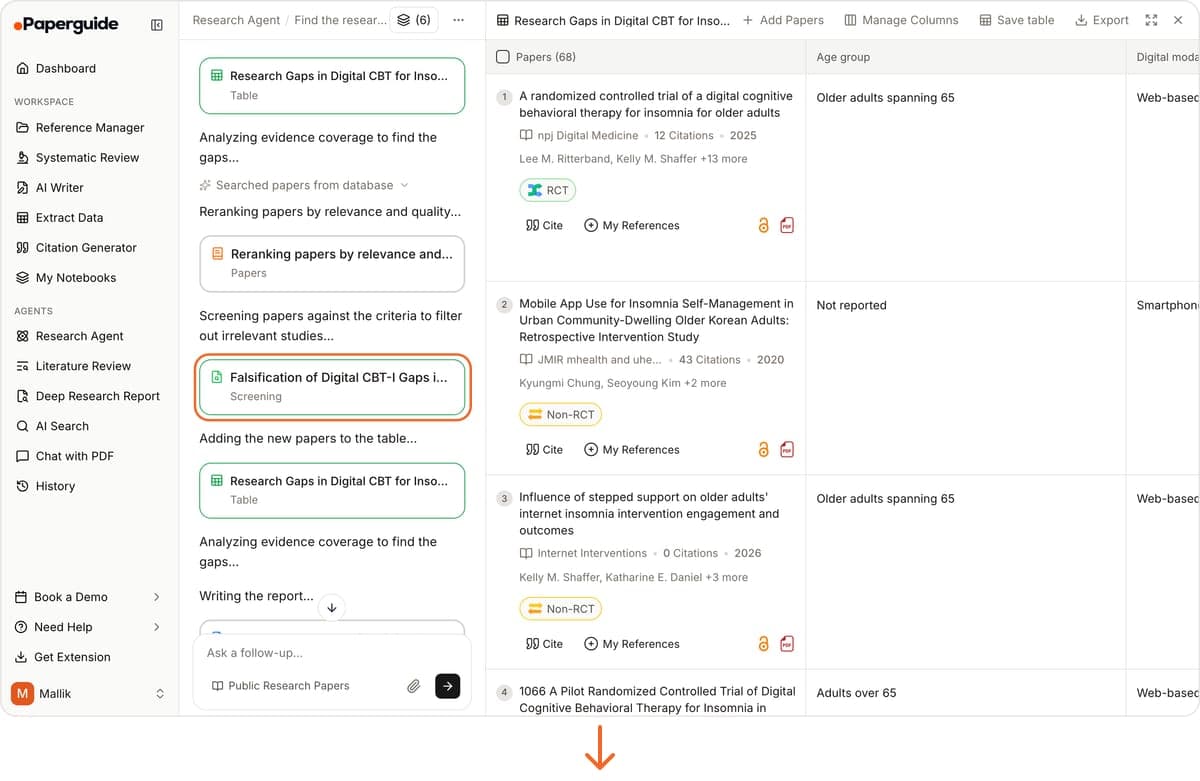
Step 2: Collect and screen the literature. The agent searches public research papers, ranks them for relevance and screens them against criteria, so off-topic studies do not distort the map.
Step 3: Map the evidence. Included papers are extracted into a table and plotted on an evidence coverage map, showing which combinations of population, setting, method and outcome are well studied and which are empty.
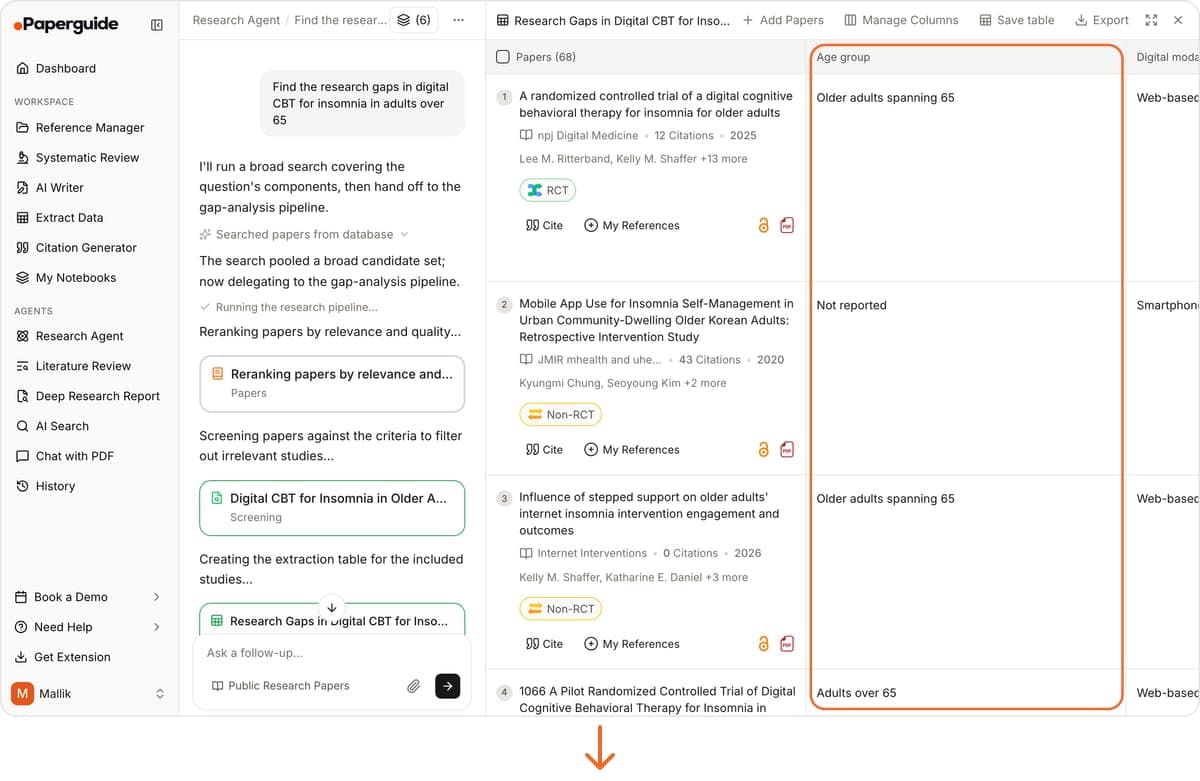
Step 4: Try to disprove each candidate gap. For every empty or thin cell, the agent runs extra searches aimed at finding the study that would close it. Gaps that a search closes are dropped.
Step 5: Read the graded report. Surviving gaps arrive with a gap statement, the consequence, an answerable research question, the grade, the priority and the negative evidence. From there, you can pair it with Literature Review AI, the AI Paper Writer or the AI Reference Manager to take the gap to a study proposal.
It automates the slowest stages of the manual method for finding research gaps step by step, from screening to the search for the study that would close each gap.
Best Research Gap Finder by Use Case
| Use case | Recommended tool | Why |
|---|---|---|
| Best research gap finder overall | Paperguide Research Gap Finder | Screens, maps and tests every gap before reporting it |
| Best for theses and dissertations | Paperguide Research Gap Finder | Gaps arrive as answerable research questions with the evidence on record |
| Best for grant proposals | Paperguide Research Gap Finder | Negative evidence shows reviewers the gap was checked |
| Best for systematic review and HEOR teams | Paperguide Research Gap Finder | Coverage maps and graded gaps feed straight into review workflows |
| Best for quick gap ideas | AnswerThis | Free, no-signup gap runs for brainstorming |
| Best free option to start | AnswerThis or Paperguide Free | No-signup runs, or 2,000 free AI credits a month |
| Best inside an agent toolkit | SciSpace Research Gap Finder | Gap briefs alongside many other agents |
| Best for gaps traced to paper rows | Science AI Journal | Every gap is written from a named table row |
| Best visual citation map | Litmaps | Clear maps with alerts for new papers |
| Best free visual explorer | ResearchRabbit | Free forever with generous seed limits |
| Best for scored gap opportunities | Fynman | Ranks gaps for impact and feasibility |
Best Research Gap Finder Tools: Final Comparison
| Tool | Output | Tested | Evidence |
|---|---|---|---|
| Paperguide Research Gap Finder | Graded report with a research question per gap | Yes, disproof searches for every gap | Coverage map, sources and the failed searches |
| AnswerThis | Gap list, cited in the full app | Not described | Method not explained |
| SciSpace | Exported gap brief | Not described | Supporting references |
| Science AI Journal | Gaps written from a paper table | Not described | Each gap traced to a table row |
| Litmaps | None, you read the map | Not applicable | Citation map |
| ResearchRabbit | None, you read the map | Not applicable | Citation map |
| Fynman | Scored gap opportunities | Not described | Scoring not explained |
Common Mistakes When Using a Research Gap Finder
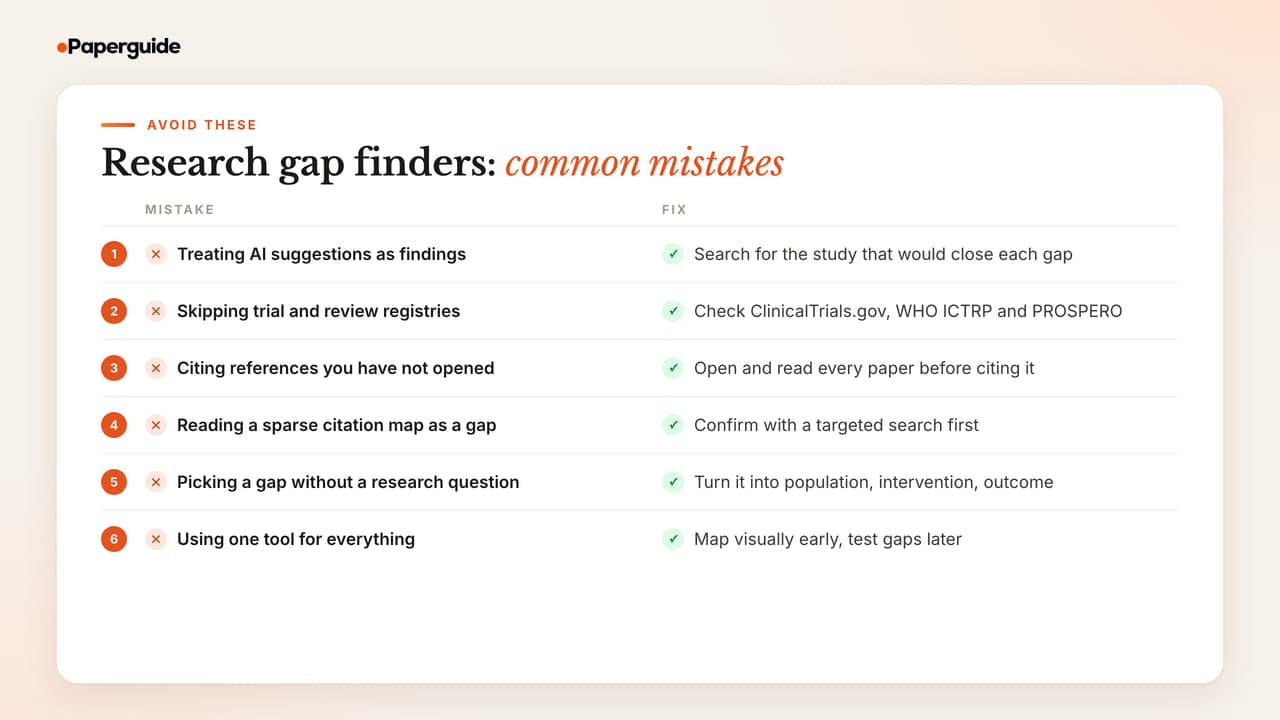
Treating suggestions as findings. An AI gap is a hypothesis about the literature. Until you have searched for the study that would close it, it is not a gap you can claim.
Skipping the registries. No gap finder indexes every trial registry and review protocol. Search ClinicalTrials.gov, the WHO International Clinical Trials Registry Platform (ICTRP) and PROSPERO yourself for work in progress.
Citing references you have not opened. Open every paper a tool lists before it goes into a proposal or a literature review, since AI tools can attach the wrong source.
Reading a sparse citation map as a gap. A thin area in Litmaps or ResearchRabbit can mean a field uses different terms, publishes in different journals or simply does not matter. Confirm with a targeted search.
Choosing a gap without a research question. A gap only becomes a project once it is a focused, answerable research question with a population, intervention and outcome.
Using one tool for everything. Visual tools are good for orientation and agents are good for depth. A citation map early on and a tested gap report later is a sound combination.
Final Verdict
Paperguide Research Gap Finder is the best research gap finder in 2026. It is the only tool on this list that screens the literature, maps evidence coverage and then actively tries to close each gap before reporting it, so the gaps you take into a thesis, grant or review have already passed the check that matters most. The graded report, the negative evidence and the direct path into Literature Review AI and the AI Paper Writer make it the strongest choice for researchers and evidence synthesis teams. For HEOR and evidence synthesis groups it also sits beside the AI tools for evidence synthesis they already use.
Match the tool to the stage of your project: visual maps early, written and tested gaps once you need a question you can defend. Whichever you choose, treat its output as a starting point, then test each gap before you commit months of work. Once a gap holds up, AI tools built for literature review carry the work into the review itself.
Frequently Asked Questions (FAQs)
What is the best research gap finder in 2026?
Paperguide Research Gap Finder is the best research gap finder in 2026. It screens the literature, builds an evidence coverage map and runs extra searches to disprove each candidate gap, so every gap in its graded report has survived an active attempt to close it.
Where can I find a research gap finder?
Most research gap finders are web tools you open in a browser. Paperguide Research Gap Finder, AnswerThis, SciSpace and Science AI Journal run online with free plans or free credits, Litmaps and ResearchRabbit are free citation map tools, and Fynman is a desktop app with a free trial.
What are the best AI tools for finding research gaps?
Paperguide Research Gap Finder, AnswerThis, SciSpace, Science AI Journal and Fynman write gaps for you, and Paperguide is the only one that tests each gap with disproof searches. Litmaps and ResearchRabbit map citation networks so you can spot thin areas yourself.
Is there a free research gap finder?
Yes. Paperguide has a free plan with 2,000 AI credits a month, AnswerThis offers three free gap runs a day without signing up, Science AI Journal gives 25 free credits and free gap search, and Litmaps and ResearchRabbit have free plans for citation mapping.
Can AI accurately find research gaps?
AI can map what has been studied across many papers quickly, but its suggestions are only as good as its checks. Tools that do not search for newer studies can report gaps that are already closed, and AI-generated references can be wrong [4]. Use AI to find candidates, then verify each one.
What is the difference between a research gap finder and a literature review tool?
A literature review tool summarizes what the evidence says. A research gap finder looks for what the evidence does not cover, such as missing populations, methods or outcomes. Many researchers use both: the gap finder to choose a direction and the review tool to write it up.
Do Litmaps and ResearchRabbit find research gaps?
Not directly. Both draw citation maps, and their own guidance suggests that sparse or disconnected areas can signal a gap. You still have to interpret the map and confirm the gap with a targeted search.
How do I check a research gap suggested by an AI tool?
Describe the study that would close the gap, search for it in at least two databases, then check trial registries, PROSPERO and preprint servers for work in progress. Robinson and colleagues describe gaps in terms of insufficient, biased, inconsistent or unsuitable evidence, which is a useful lens for deciding whether a gap is real [5].
Which research gap finder is best for PhD students?
Paperguide Research Gap Finder suits PhD students best because each gap arrives as an answerable research question with the evidence behind it, which is what a supervisor and thesis committee will ask to see. ResearchRabbit is a good free companion for early exploration.
Which research gap finder is best for systematic review and HEOR teams?
Paperguide Research Gap Finder, because its coverage maps and graded gaps sit inside the same platform as systematic review screening, data extraction and reporting, so you can build the review protocol in the same workspace.
References
- Chalmers, I., & Glasziou, P. (2009). Avoidable waste in the production and reporting of research evidence. The Lancet, 374(9683), 86-89. https://doi.org/10.1016/S0140-6736(09)60329-9
- Draborg, E., Andreasen, J., Nørgaard, B., Juhl, C. B., Yost, J., Brunnhuber, K., Robinson, K. A., & Lund, H. (2022). Systematic reviews are rarely used to contextualise new results: A systematic review and meta-analysis of meta-research studies. Systematic Reviews, 11, 189. https://doi.org/10.1186/s13643-022-02062-8
- Clarke, L., Clarke, M., & Clarke, T. (2007). How useful are Cochrane reviews in identifying research needs? Journal of Health Services Research & Policy, 12(2), 101-103. https://doi.org/10.1258/135581907780279648
- Walters, W. H., & Wilder, E. I. (2023). Fabrication and errors in the bibliographic citations generated by ChatGPT. Scientific Reports, 13, 14045. https://doi.org/10.1038/s41598-023-41032-5
- Robinson, K. A., Saldanha, I. J., & McKoy, N. A. (2011). Development of a framework to identify research gaps from systematic reviews. Journal of Clinical Epidemiology, 64(12), 1325-1330. https://doi.org/10.1016/j.jclinepi.2011.06.009
Looking for a research gap?
Find research gaps that hold up
Map the evidence, test each gap against counter-evidence and get a graded report.
Find research gapsNo credit card required