Paperguide Blog

Best AI research tools, comparisons, alternatives and guides for literature reviews, systematic reviews and research writing, for research and evidence teams.

steps of systematic review

What Are the Steps of a Systematic Review?

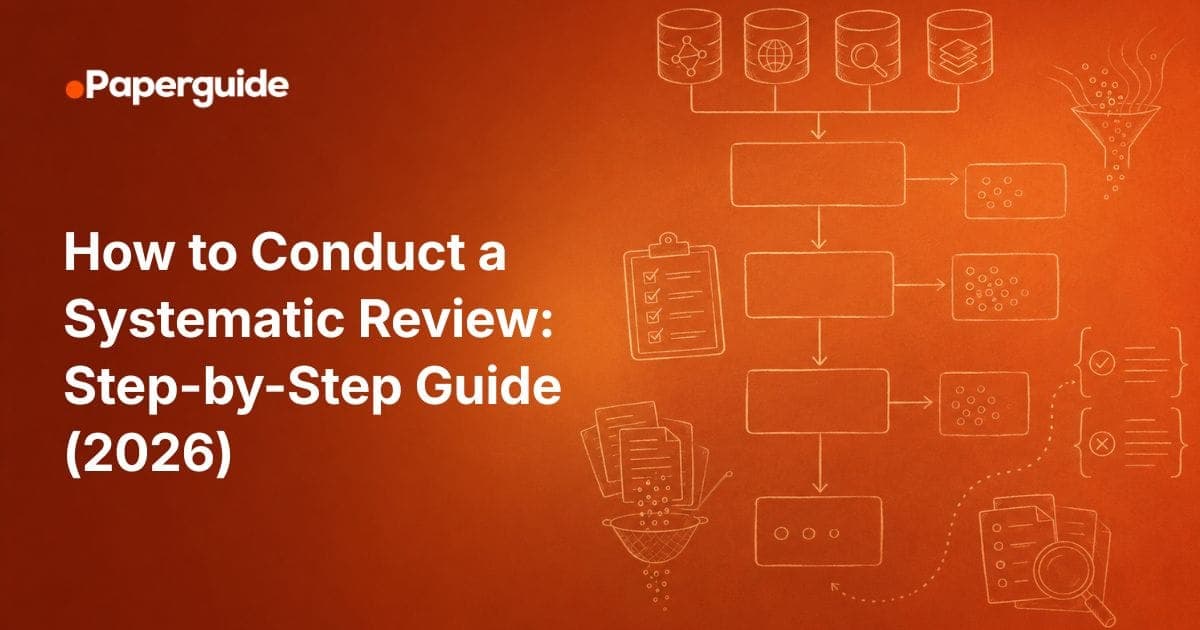
A systematic review follows eight stages: define the question, write and register a protocol, build and run the search, screen titles and abstracts, screen full texts, extract data, assess risk of bias, then synthesise and report. Published guides put the count anywhere between 5 and 24, which is why the question "how many steps" returns contradictory answers. The disagreement is about where to draw the lines, not about what the work is. This guide uses eight stages as a practical framework, re


By Remya Krishnan β€”

How to Create a PRISMA Flow Diagram

How to Create a PRISMA Flow Diagram: Step-by-Step Guide

To create a PRISMA flow diagram, download the correct official template, record your counts at each screening stage as you go, fill the boxes from those records, and run an arithmetic check so every number you subtract lands in a named box. The hard part is not the drawing. It is that the counts have to reconcile, the unit changes halfway down the figure, and most of the numbers are difficult to recover if you did not capture them while screening. This guide covers the eight steps, which counts


By Remya Krishnan β€”

what is a prisma flow diagram

What is a PRISMA Flow Diagram? Purpose, Phases and Benefits

A PRISMA flow diagram is a figure that records how many records a systematic review found, how many were removed at each stage, and why, so a reader can trace every included study back to the original search. The PRISMA 2020 flow diagram is one component of PRISMA 2020, alongside the 27-item checklist and other supporting reporting materials. The checklist specifies reporting items for the review, while the flow diagram provides a concise way to report the numbers and reasons involved in study

By Remya Krishnan β€”

prisma 2020 flow diagram templates

PRISMA 2020 Flow Diagram Templates: All Four Official Versions

There are four official PRISMA 2020 flow diagram templates, not one. They vary along two axes: whether your review is new or an update, and whether you searched databases and registers only or databases, registers and other sources. Downloading the wrong one is a common and avoidable error. It leaves you either with an empty branch full of zeros or with no place to record the studies your previous version already included. This page covers which template to pick, what the licence lets you chang

By Remya Krishnan β€”

prisma 2020 checklist

PRISMA 2020 Checklist: How to Fill Out All 27 Items

PRISMA 2020 checklist with 27 items across seven sections The PRISMA checklist lists the reporting items for a systematic review. The current version, PRISMA 2020, contains 27 items organised into seven sections, and it expands to 42 rows once sub-items are counted [1]. That gap between 27 and 42 is the source of most of the confusion around it. Six of the 27 items split into lettered sub-items, and each sub-item is a separate reporting requirement that a journal can query. This guide gives th

By Shrishti Chaudhary β€”

Best Covidence Alternatives

7 Best Covidence Alternatives for Systematic Reviews in 2026

Covidence is one of the most widely used platforms for systematic review screening. Backed by Cochrane, it gives research teams a structured environment for title/abstract screening, full-text review, and data extraction. For many academics, it was the first dedicated tool they encountered for structured evidence synthesis. But the research landscape has shifted. Teams now expect AI-powered search, citation-grounded writing, and end-to-end workflows that connect screening decisions to final rep

By Mallik Gaddam β€”

Best Systematic Review Software in 2026

9 Best Systematic Review Software in 2026 (Free + Paid)

Systematic review software automates the structured, reproducible evidence synthesis process, from literature search and dual-reviewer screening to data extraction and PRISMA-compliant reporting. A traditional systematic review takes an average of 18 months of active work, and a Cochrane 2025 analysis found that only 71.9 % of 8,137 registered protocols ever reach publication, with a median delay of 25.7 months from protocol to final paper. Your bottleneck is almost never the research question.

By Satya R Panigrahi β€”

what are the steps of prisma

What Are the 4 Steps of PRISMA? (It Is Actually 3)

The PRISMA 2020 flow diagram has three phases, not four There is no official "4 steps of PRISMA". The question almost always refers to the phases of the PRISMA flow diagram, and the current version, PRISMA 2020, has three labelled phases: Identification, Screening and Included [1]. The four-phase version you may have seen, which added Eligibility as a separate band, is the PRISMA 2009 diagram. The PRISMA 2020 statement says the 2009 version "should no longer be used." This article explains whe

By Shrishti Chaudhary β€”

prisma statement

What Is the PRISMA Statement? PRISMA 2020 Explained

The PRISMA statement is a reporting guideline that tells authors what to disclose when they publish a systematic review. The current version, PRISMA 2020, is a published paper containing a 27-item checklist, a 12-item abstract checklist and a set of flow diagram templates. It governs how a review is written up, not how it is carried out [1]. That distinction is the single most misunderstood thing about PRISMA, and it is the reason a published editorial exists purely to correct authors who descr

By Shrishti Chaudhary β€”

Covidence vs DistillerSR

Covidence vs DistillerSR: Academic vs Enterprise in 2026

Covidence and DistillerSR are two of the most established platforms for systematic review workflows, but they serve different ends of the market. Covidence is the platform most academic researchers encounter first: Cochrane-endorsed, widely adopted across over 480 institutions, and designed for teams that need reliable screening and extraction with a short learning curve. DistillerSR is the platform that pharmaceutical companies, HTA agencies, and regulatory teams rely on for high-volume, enterp

By Mallik Gaddam β€”

what is prisma in research5

What Is PRISMA in Research? Meaning, Purpose and the 2020 Standard

PRISMA is a reporting standard in research: it defines what a finished systematic review should disclose, so readers can judge and reproduce the work. PRISMA stands for Preferred Reporting Items for Systematic Reviews and Meta-Analyses. The current version, PRISMA 2020, is a 27-item checklist across seven sections plus a three-phase flow diagram covering Identification, Screening and Included. It governs how you report a review, not how you conduct one. That second job belongs to the Cochrane H

By Shrishti Chaudhary β€”

Covidence vs Rayyan

Covidence vs Rayyan: Which Is Better in 2026?

Covidence and Rayyan are two of the most widely used platforms for systematic review screening, and research teams moving beyond spreadsheets and email chains often narrow their choice to one of these two. Both handle the core job of title and abstract screening with dual reviewers, but they approach nearly everything else differently: pricing models, AI integration, full-text management, data extraction depth, and risk of bias tooling. The question matters because systematic reviews remain amo

By Mallik Gaddam β€”